Dead of Night (1945)

DEAD OF NIGHT (1945) ****
Back in 2005, I needed three credits to complete a master’s degree in history (lifetime underachievement) and I finished a three-week 120-hour internship that summer at the National Archives in Kansas City, Missouri.

Anyway, they let me loose on their free account on some genealogical site as reward for good behavior and a day-and-a-half later I came back with Sisney family history dating back to 1776.

On February 27, 1776, a few months before the Declaration of Independence, Steven Sisney fought at and was captured and imprisoned during the Battle of Moores Creek Bridge near Wilmington, North Carolina. Sisney was one of about 1600 loyalist-siding Highland Scots who marched from Cross Creek, North Carolina, toward the coast behind British Colonel Donald McLeod. The loyalists lost, the patriots received a morale boost, and North Carolina became the first colony to vote for independence, beating the official declaration by a couple months easy.

Every once in a while, I think about Steven Sisney and his loyalty to the British since I favor the Beatles and the Stones and the Who and the Kinks and Black Sabbath and Led Zeppelin and the Clash and the Sex Pistols and the Buzzcocks and Radiohead and Pink Floyd and Peter Cushing and Christopher Lee and Sherlock Holmes and James Bond and Alec Guinness and Cary Grant and Ben Kingsley and Ian McKellen and Glenda Jackson and Hammer and Hitchcock and Monty Python and Lord of the Rings and Harry Potter and on and so on and on some more again.

If nothing else, the 1945 horror anthology film Dead of Night made me think about Steven Sisney, the epic 1989 David Hackett Fischer history book Albion’s Seed: Four British Folkways in America (never forget the saga of the poor one-eyed servant George Spencer in New Haven, who was hanged for bestiality after a sow birthed a deformed pig with one eye and the two witnesses required for conviction were the deformed piglet and Spencer’s recanted confession), the late Pittsburg State history professor Judith Shaw (1931-2013) who taught many British History courses over the decades, and how much of an impact Dead of Night had on Richard Attenborough’s Magic.

Horror anthologies generally offer a mixed bag of success and failure.

Of course, Ray Davies outlined it in Celluloid Heroes, Success walks hand-in-hand with failure along Hollywood Boulevard. I always think about Twilight Zone: The Movie from 1983 to illustrate the mixed bag qualities of just about every anthology we’ve ever been expected to consume. The segments directed by John Landis and Steven Spielberg suck, the ones from Joe Dante and George Miller are dynamite, and the prologue and epilogue push the overall package into positive review terrain.

In Dead of Night, Alberto Cavalcanti directed Christmas Party and The Ventriloquist’s Dummy, Charles Crichton directed Golfing Story, Robert Hamer directed The Haunted Mirror, and Basil Dearden directed Hearse Driver and Linking Narrative.

It all starts when architect Walter Craig (Mervyn Johns) tells host and potential client Eliot Foley (Roland Culver) and his guests at country estate Pilgrim’s Farm that he’s seen them all in a recurring dream. Craig feels like he’s been at Pilgrim’s Farm before and every guest rings a bell to him despite never having met any of them before. Each person (host and guests alike) rattles off a supernatural tale, inspired by Craig’s revelations. Craig wants to leave because he doesn’t want his dream to come true and the guests do their best to make him stay.

The Haunted Mirror and The Ventriloquist’s Dummy are especially brilliant and Golfing Story reminds one that Ealing Studios later brought us Kind Hearts and Coronets, The Lavender Hill Mob, and The Ladykillers, all of which feature a dark comedy that seems to have started with Hitchcock. Hamer directed Kind Hearts and Coronets and Crichton directed The Lavender Hill Mob (and later on in his career A Fish Called Wanda).

Basil Radford (1897-1952) and Naunton Wayne (1901-70) appear together in Dead of Night, but not as their characters Charters and Caldicott. Charters and Caldicott began in Hitchcock’s 1938 classic The Lady Vanishes and then the acting duo appeared together in a series of films from 1940 through 1949, including three more times playing Charters and Caldicott. They are very funny, both individually and collectively, in Dead of Night. They don’t seem particularly gay in Dead of Night.

During The Haunted Mirror, guest Joan Cortland (Googie Withers) relays to us what happened after she gifted an antique mirror to her future husband Peter (Ralph Michael). Peter sees another room in the mirror’s reflection, does not see Joan in the mirror when she confronts him, and for a spell he sees the room as normal. Joan finds out the history of the mirror and the wealthy man who owned it after she visits the antique shop from which she purchased the mirror. This wealthy man was crippled in a riding accident, then he grew so insanely jealous of his wife that he strangled her and he finally slit his own throat in front of the mirror. When Joan returns home, Peter accuses her of having an affair and then he attempts to strangle her. Joan smashes the mirror in sheer desperation and breaks the spell.

In The Ventriloquist’s Dummy, the absolute most effective segment, resident rational explanation seeker Dr. Van Straaten (Frederick Valk) tells us about the case of ventriloquist Maxwell Frere (Michael Redgrave) and his dummy Hugo Fitch. Maxwell develops a dual personality with Hugo becoming the dominant part. Poor, poor, poor Sylvester Kee (Hartley Power), who happens to catch and be impressed by the act.

In the long run, I was much impressed by Dead of Night and I recommend it to anyone.
Dracula (1931)

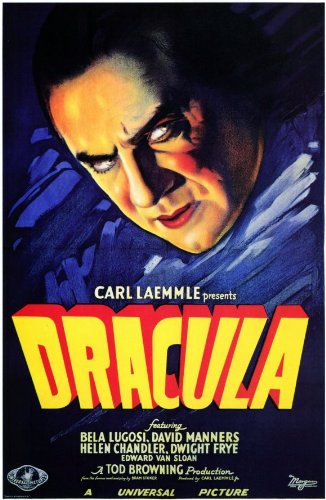
DRACULA (1931) ****
I remember being first disappointed by the 1931 Dracula and that disappointment carried over for more than two decades.

Around the turn of the 21st Century, I bought the 1999 VHS release and that’s what I first watched, the one with Classic Monster Collection across the top and then New Music by Philip Glass and Performed by Kronos Quartet immediately below. Of course, I thought Bela Lugosi as Dracula and Dwight Frye as Renfield were absolutely incredible, David Manners as Jonathan Harker and Edward Van Sloan as Professor Van Helsing and Helen Chandler as Mina Harker less so, and I loved director Tod Browning’s 1932 Freaks at first sight contemporaneous with Dracula. Freaks remains one of my absolute favorite movies, so obviously some movies hit people right from the start and others just simply take more time or sometimes they never make that deep, personal connection others do.

For the longest time, at least a decade if not longer, I thought Dracula was overrated and paled in comparison against Freaks, Frankenstein, The Bride of Frankenstein, and The Wolf Man, all of which I first saw around the same time as Dracula and I loved, absolutely loved, and still do love all of them. At the time, I also loved Abbott and Costello Meet Frankenstein more than Dracula.

It was that darn Philip Glass / Kronos Quartet score that stank up Dracula and I still get a big kick out of the Triumph the Insult Comic Dog couplet, Philip Glass, atonal ass, you’re not immune / Write a song with a fucking tune. I remember my wife complained about Glass’ score for the experimental non-narrative film Koyaanisqatsi and I bristled at his score for Candyman upon revisiting that 1992 film for the first time in several years.

Revisiting the 1931 Dracula in recent years, without the Glass / Kronos score and back closer to how it first appeared in theaters on Feb. 14, 1931, it’s risen in stock from three to three-and-a-half and finally four stars. I cannot deny that it still has a fair share of faults, like those performances I mentioned earlier and the stage-bound production quality since it’s based off the 1924 stage play adapted from Bram Stoker’s 1897 novel, but I’ve grown appreciation for everything that works from the opening scenes in Transylvania to Lugosi (1882-1956) and Frye (1899-1943), who inspired later songs from Bauhaus (Bela Lugosi’s Dead) and Alice Cooper (The Ballad of Dwight Fry).

It also helps one to catch up with the Spanish language Dracula from the same year and the same sets but a different cast, a different language, and a different director. This Spanish version, rediscovered first in 1978 and then later on video in 1992, lasts 30 minutes longer and it’s better in almost every respect than its famous counterpart. Better shot and better looking, vastly superior cleavage and far sexier women (Lupita Tovar over Helen Chandler any day of the millennium), and less wimpy men in the Spanish version, but Lugosi still prevails against Carlos Villarias.

Several lines had already entered the lexicon decades before I first watched Dracula: I never drink … wine. For one who has not lived even a single lifetime, you’re a wise man, Van Helsing. Listen to them. Children of the night. What music they make. Even I am Dracula belongs somewhere in the pantheon near Bond, James Bond. Lugosi’s ability or lack thereof speaking the English language actually benefits the otherworldly nature of his Dracula and I hold his performance in high regard alongside Max Schreck in Nosferatu, Christopher Lee in Dracula, and Gary Oldman in Dracula.

I have a long relationship with vampires.

I remember the 1985 Fright Night being the highlight of a boy slumber party circa 1988 and third or fourth grade.

I must have been 11 or 12 years old and in the fifth or sixth grade when reading the Stoker novel. Right around that point in time, I also read Sir Arthur Conan Doyle’s The Hound of the Baskervilles and Roald Dahl’s Charlie and the Chocolate Factory. I loved all three of them and they each fired up my imagination and creative spirit.

A few years later, I caught up with the Francis Ford Coppola version and talk about a movie that wowed a 14-year-old boy. I remember staying up late and sneaking around (somewhat) to watch this Dracula on my bedroom TV, captivated by all the nudity and sexuality and violence and Winona Ryder and Sadie Frost and it recalled some of what I liked about the novel all while becoming a cinematic extravaganza. I know critics of the 1992 Dracula blasted the film for being all style, no substance and for being overblown, but I think it’s overflowing with creativity and sheer cinematic beauty. I rate it right up there with F.W. Murnau’s Nosferatu as one of the best vampire films ever.

Some things simply transcend Keanu Reeves’ horrible accent and Dracula’s at one point beehive hairdo.

The vampire genre itself transcends such duds as Dracula 2000 and New Moon.

Auto Pilot Cinema: The Airport Movies

AUTO PILOT CINEMA: THE AIRPORT MOVIES
When thinking of the worst series in movie history, I am tempted to start with Saw and Fast and the Furious then move back through time with The Omen and Amityville Horror and finally go way way way back to the Dead End Kids, er, Bowery Boys.

In piecing through all this cinematic carnage, I should not leave behind the four Airport movies that were churned out by Universal Pictures from 1970 to 1979. Maybe I should leave them behind.

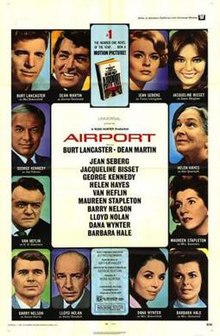
Airport, based on Arthur Hailey’s 1968 novel of the same name, made a killing at the box office upon its late May release in 1970 and it even received 10, yes, believe it or not, 10 Academy Award nominations, including Best Picture, and 70-year-old Helen Hayes won Best Supporting Actress.

The three subsequent films — helpfully labeled 1975, ’77, and ’79 — got worse and worse, naturally, and the last film in the series, The Concorde … Airport ’79, is so bad (and so aggressively stupid) in fact that it could kill off any series. That’s despite the fact that it reportedly made $65 million, a much better take than, for example, Irwin Allen productions The Swarm ($7.7 million), Beyond the Poseidon Adventure ($2.1 million), and When Time Ran Out ($3.8 million). Regardless, Universal stopped making Airport movies after The Concorde and I’m almost dumbfounded why there’s not been a remake or a reboot loaded with today’s stars.

Hey, wait, did somebody mention stars? Yes, stars, that’s what these Airport movies were about — speculating which ones would emerge at the end of the picture relatively intact and which ones would die spectacularly. Grand Hotel in the sky, not exactly, since none of the careers in the Airport movies were at their peak like the ones in Grand Hotel, but the idea of stuffing the screen with stars in every scene applies just the same.

Airport: Burt Lancaster, Dean Martin, Jean Seberg, Jacqueline Bisset, George Kennedy, Hayes, Van Heflin, Maureen Stapleton, Barry Nelson, Dana Wynter, Lloyd Nolan.

Airport 1975: Charlton Heston, Karen Black, Kennedy, Efrem Zimbalist Jr., Susan Clark, Helen Reddy, Linda Blair, Dana Andrews, Roy Thinnes, Sid Caesar, Myrna Loy, Gloria Swanson.

Airport ’77: Jack Lemmon, Lee Grant, Branda Vaccaro, Joseph Cotten, Olivia de Havilland, Darren McGavin, Christopher Lee, Robert Foxworth, Kathleen Quinlan, James Stewart.

Airport ’79: Alain Delon, Susan Blakely, Robert Wagner, Sylvia Kristel, Kennedy, Eddie Albert, Bibi Andersson, Charo, John Davidson, Andrea Marcovicci, Martha Raye, Cicely Tyson, Jimmie Walker, David Warner, Mercedes McCambridge.

More like Hollywood Squares in the Sky? Yeah, believe so, especially since Davidson hosted a Hollywood Squares revival in the late ’80s.

Beside Airport in the titles, Kennedy (1925-2016) proved to be the connective tissue between all four pictures, meaning he’s the inverse of the Brody boys (Jaws) and the Griswold children (Vacation). Kennedy played Joe Patroni — first as mechanic, then as vice president of operations (1975), a consultant (’77), and finally an experienced pilot (’79). Regardless of position or rank, the character got worse and worse over the course of the films, not that he or the films started out all that hot. I found even his cigar was guilty of overacting in the original film and Patroni was so odiously obnoxious in the fourth film, especially after he utters the line that articulates the sexism of the entire series, They don’t call it the cockpit for nothing, honey. George Kennedy as sex symbol? Sure, I’ll believe anything, nearly anything except for, oh, the entire plot of The Concorde.

I’ll talk more about The Concorde and the original because they’re fresher in my memory. To be honest, though, I probably won’t even feel like discussing the original because …

Movies rarely come any dumber than The Concorde: Let’s see, this is going to be fun, not really, anyway TV reporter Susan Blakely comes across some highly incriminating evidence against defense contractor (and covert arms dealer) Robert Wagner. Wagner decides that he’s going to attempt to blow up real good the plane she’s on en route from Washington to Paris. Okay, okay, his plot to blow up the Concorde real good fails and they have dinner together in Paris during the middle section of the movie, because, you know, they have a history together and they still love each other. She still has this incriminating evidence, naturally, she’s going to eventually go public with it, of course, and what does he do? Kill her? He lets her walk away safe and unharmed, so he’ll have to go after the plane again. That’s right, she gets back on the Concorde for the final leg of the flight from Paris to Moscow. Guilt stricken, Wagner commits suicide very late in the picture and I believe it’s not because his secret’s been discovered and will be exposed regardless of whether he’s alive or not, but more that he’s one of the worst villains in cinematic history.

The Concorde is so laughable in so many ways, as if that whole plot discussed in the last paragraph wasn’t enough. The Concorde stops over in Paris for a night, and every single passenger gets back on the plane the next morning. They all seem way too calm and collected after the events of the first half of the movie. I would love to have just heard one character say ‘Hell no, I’m not getting back on that damn plane!’ They all deserved to die, but we know that’s not happening.

At one critical point during the first attack on the Concorde, the Übermensch George Kennedy proves that he’s truly The Übermensch by sticking his hand out the window of the Concorde and throwing a flare. Unbelievable, utterly unbelievable even in this preposterous movie. If only the first Airport had been the in-flight movie on The Concorde, especially that scene where Patroni discusses the effects of a bomb on a 707 and concludes, When I was a mechanic in the Air Force, I was being transferred on a MATS plane. At 20,000 feet, one of the windows shattered. The guy sitting next to it was about 170 pounds. He went through that little space like a hunk of hamburger going down a disposal, and right after him coats, pillows, blankets, cups, saucers. That was just a MATS plane, not the fastest plane in the universe.

I’m done, I can’t take it anymore, and I’m bailing out on the Airport movies.

Airport (1970) **; Airport 1975 (1974) **1/2; Airport ’77 (1977) *; The Concorde: Airport ’79 (1979) 1/2*

An Eye for an Eye (1981)

AN EYE FOR AN EYE (1981) ***
An Eye for an Eye is one of the better Chuck Norris movies and that’s because it fits the bill for what helps define a better Chuck Norris movie — the quality of the supporting cast, something it has in common with Lone Wolf McQuade, Code of Silence, The Delta Force, and Silent Rage.

Let’s see, we have Christopher Lee, Richard Roundtree, Matt Clark, Mako, Maggie Cooper, Rosalind Chao, Professor Toru Tanaka, Stuart Pankin, Terry Kiser and Mel Novak, and they’re basically all good in their standard hero and villain roles.

Lee (1922-2015) enjoyed a truly marvelous career that intersected with Sherlock Holmes, Dracula, James Bond, Star Wars, Ichabod Crane, Kharis, Victor Frankenstein, Gandalf, and Hercules. Never mind acting alongside Slim Pickens and Toshiro Mifune in Steven Spielberg’s 1941. Often playing the villain, Lee had the ability to maximize his minimal screen time and An Eye for an Eye benefits from his presence.

Roundtree made his fame as the title character in Shaft and sequels Shaft’s Big Score and Shaft in Africa, and so I must admit to being somewhat amused that he’s played a cop so often throughout his career. It was both amusing and frustrating to watch his police superior character bust Norris’ chops. I told my wife during An Eye for an Eye, ‘At least he’s not killed by a winged serpent in this movie.’

Cooper plays Norris’ obligatory romantic interest and she gets a rare female nude scene in a Norris movie. Writing on Silent Rage, I noted that it was refreshing to see somebody’s chest other than Norris and I second that emotion after An Eye for an Eye.

Tanaka’s dossier begins, ‘Was an American professional wrestler, professional boxer, college football player, soldier, actor, and martial artist.’ What did the Professor earn his degree in? Judging by An Eye for an Eye and the vast majority of his filmography and his professions, it’s safe to say Tanaka earned a doctorate in pain. Like others in the An Eye for an Eye cast, he’s good at maximizing minimal screen time and in his case, minimal dialogue. Norris vs. Tanaka proved to be one of the film’s greatest highlights.

Before she went to sleep, I told my wife that Norris’ partner will be dead very shortly and it did not help the character’s survival odds being played by Terry Kiser, an actor best known for playing a corpse. Bernie from Weekend at Bernie’s and Weekend at Bernie’s II ring any bells? Yeah, I still argue that dead Bernie still shows more life than nominal leads Andrew McCarthy and Jonathan Silverman. For a man later hacked and whacked by Jason Voorhees, Kiser’s character died spectacularly in An Eye for an Eye — shot in the chest, crushed between not one but two cars, and caught on fire. His death haunts Norris’ Sean Kane during two flashback scenes.

An Eye for an Eye director Steve Carver died in January 2021 of complications from COVID-19 and he was 75. Carver also directed arguably Norris’ best picture, Lone Wolf McQuade, and the infamous 1974 Roger Corman / New World Productions films The Arena and Big Bad Mama. No doubt that Pam Grier and Angie Dickinson, as well as William Shatner, prepared Carver for Chuck Norris.

Kill and Kill Again, Firecracker, Circle of Iron

KILL AND KILL AGAIN, FIRECRACKER, CIRCLE OF IRON

In his 1981 TV review of the South African martial arts spectacular KILL AND KILL AGAIN, Roger Ebert predicted action movie stardom for James Ryan and invoked the names Eastwood, Bronson, and Bruce Lee.

Well, in this business and life in general for that matter, you win some, you lose some.

James Ryan, who? Yeah, not exactly a household name.

Describing the plot, I would like to just string together a bunch of random words: martial arts champion for hire undercover government agent top secret rescue mission kidnapped scientist recruit colleagues alternative energy source megalomaniac uniformed cult mind control world domination bar fight mushy romance mushy talk middle-of-nowhere fight storming fortress explosions fisticuffs flips plot revelations not particularly revelatory.

There you go. KILL AND KILL AGAIN, the sequel to KILL OR BE KILLED, in a nutshell.

KILL AND KILL AGAIN works predominantly because it has a good sense of humor and it finds just the right tone to pull off being a successful action comedy.

There’s one especially fun supporting character and supporting performance, the diabolical genius’ assistant and (significant other) Minerva played by Marloe Scott-Wilson. She looks like she drifted over from ROCK ‘N’ ROLL HIGH SCHOOL or THE DECLINE OF WESTERN CIVILIZATION, especially with that ridiculous Day-Glo hairdo. She’s a lot of fun in every scene, especially when she calls residential madman Marduk (Michael Mayer) by these absolutely ridiculous pet names. She comes up with a fresh one every single time. And it rankles Marduk, because good old Minerva says her little terms of endearment right in front of everybody. At one point, Marduk tells her, “I said don’t call me Popsicle.” This running gag even has an explosive payoff in the end.

Guess we should mention that South African beauty queen Anneline Kriel — Miss World 1974 — does her own stunts in the movie. She has to overcome playing a character named “Kandy Kane.” I almost wish they would have named her character “Susan Alexander Kane” or “Emily Kane,” for all us CITIZEN KANE fans in the audience. Now, that would have been an impressive stunt.

Impressive stunts are at the heart of FIRECRACKER, especially during the film’s last 30 minutes.

We’re talking about topless kickboxing and what must surely be one of the weirdest love scenes ever committed to celluloid.

Two sicko creeps pursue our heroine Susanne Carter, played by the luscious Jillian Kesner, and they eventually shed her of her top and bra. She then proceeds to kick their asses viciously. Meanwhile, in the background, we have “Rack Master” boxes. Perfect!

“Rack Master” should have been Carter’s martial arts name and it also should have been a title for FIRECRACKER.

That’s not too much of a stretch, especially since FIRECRACKER traveled as NAKED FIST in Australia.

FIRECRACKER director Cirio H. Santiago plagiarized this topless kickboxing scene from his earlier New World Pictures extravaganza TNT JACKSON.

Now, let us consider that weird love scene. Oh Susanna and her love interest Chuck Donner (Darby Hinton) consummate their relationship, but not before they remove each other’s clothes stitch-by-stitch with a knife. Kinky. Chuck Donner and his incredible mustache, especially his incredible mustache, just scream “Creepy seducer of the ladies who killed Susanna’s sister.” Of course, Susanna does not learn of this fact until after their lovemaking.

Susanna exacts her revenge against Chuck in the ring and we all can be sure that he will never look at another woman ever again.

Kesner passed away in 2007 and she and her late husband Gary Graver (1938-2006) became known for their efforts to preserve the work and legacy of legendary director Orson Welles. I do believe it is time for another reference to CITIZEN KANE.

CIRCLE OF IRON attempts to be something bigger, greater than KILL AND KILL AGAIN and FIRECRACKER. It wants to be a transcendent exploitation film.

We are given the only clue we need as soon as the following title card appears on screen: “Prior to the death of the legendary Bruce Lee he helped to create a movie story that might capture not only the spirit of martial arts but a part of the Zen philosophy he lived by. He was aware that a film with these dynamics would cause controversy, particularly among those unfamiliar with Zen beliefs. But it was this very uniqueness that he believed wound enthrall the moviegoer. Bruce set the story in a land that never was and always is. It is to Bruce Lee that this film is posthumously dedicated.”

I was definitely not enthralled by CIRCLE OF IRON. Not very often.

It certainly did not help that Captain Hairdo, er, Jeff Cooper plays the lead character Cord and this character and performance never quite resonated with me because I kept seeing Roger Daltrey instead and I pretended it was TOMMY.

I kept waiting for Cooper’s cord to break out into song, “Listening to you, I get the music / Gazing at you I get the heat / Following you I climb the mountain / I get excitement at your feet!” and “See me, feel me, touch me, heal me.”

It never happened and I felt extremely disappointed.

David Carradine plays about four roles too many in CIRCLE OF IRON. Okay, I’ll say three roles too many, because we get one of the film’s most entertaining scenes when Carradine assumes the guise of “Monkeyman.” At one point, Carradine’s wig came off and I thought shit like that only happened in SAMURAI COP.

Christopher Lee passed on THE LEGEND OF THE 7 GOLDEN VAMPIRES, a joint venture between Hammer Studios and the Shaw Brothers, because he did not want to play Dracula for the millionth time … but he plays what turns out to be a role that sucks even more in CIRCLE OF IRON, Zoltar, er, Zetan. This is one of those quest movies where you’ll become irritated after hearing a certain name — Zetan, maybe — many, many, many, many, many, many times.

Orson Welles asked me not to reference a certain movie during this review of CIRCLE OF IRON. I must respect his wishes.


KILL AND KILL AGAIN ***; FIRECRACKER ***; CIRCLE OF IRON **

The Legend of the 7 Golden Vampires (1974)

THE LEGEND OF THE 7 GOLDEN VAMPIRES

THE LEGEND OF THE 7 GOLDEN VAMPIRES (1974) ***

It was really only a matter of time before Hammer, the British masters of the macabre, and the Shaw Brothers, the Hong Kong masters of martial arts, would combine forces and make the world’s first martial arts vampire movie spectacular. An exploitation movie fan’s wet dream come true, in other words.

They created THE LEGEND OF THE 7 GOLDEN VAMPIRES in 1974, not the greatest vampire or martial arts movie ever made, of course, but still an enjoyable romp for those who have a hankering for (in no particular order, except for the last item) vampire hunting, neck biting, blood letting, boiling blood, severed hands, throat slitting, stabbings through the heart, vampires turning to dust, fake bats, fake castles, sword fights, martial arts combat between warriors and vampires & their minions, archery, breasts, romance, and one ridiculous, anticlimactic ending. Three stars, check it out.

Christopher Lee first played Dracula for Hammer in 1958 and he returned for PRINCE OF DARKNESS (1966), DRACULA HAS RISEN FROM THE GRAVE (1968), TASTE THE BLOOD OF DRACULA (1970), SCARS OF DRACULA (1970), DRACULA 1972 (1972), and THE SATANIC RITES OF DRACULA (1973). Lee’s animosity toward the series increased over time and he finally refused to participate in THE LEGEND OF THE 7 GOLDEN VAMPIRES after seven times as the Count. Lee read the script and said “No deal.”

That’s a bummer, especially since John Forbes-Robinson makes for a horrible Dracula. How horrible? They dubbed him with David de Keyser and Dracula only appears in a few minutes at the beginning and end of the picture. In the opening scene, Dracula kills a Chinese monk and takes on his form. (Reportedly, Forbes-Robinson was furious about being dubbed. Hey, it’s not the first time in history. A few years after GOLDEN VAMPIRES, SATURN 3 director Stanley Donen felt dissatisfied with Harvey Keitel’s Brooklyn accent and since Mr. Keitel refused participation in post-production, Donen dubbed over Keitel with a British actor using a Mid-Atlantic accent.)

Granted, we do have Peter Cushing for the fifth time as Professor Van Helsing. Who else would handle the plot exposition through dialogue scenes? How about that plot? Van Helsing, on a lecture stop in China, agrees to help seven siblings (six men, one woman) take back their ancestral mountain village that’s been taken over by seven “golden” vampires (including Dracula trapped in another body) and their living dead minions. Then again, I already described the plot in 44 words in the second paragraph.

THE LEGEND OF THE 7 GOLDEN VAMPIRES can stand with any of the goofiest Shaw Brothers spectaculars and it ranks among the best of the Hammer Dracula films.

Nosferatu (1979)

NOSFERATU

NOSFERATU (1979) ***1/2

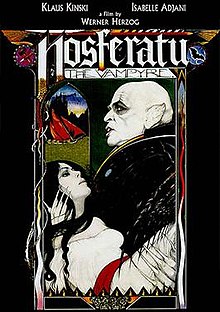
German director Werner Herzog’s NOSFERATU THE VAMPYRE has often been described as a “slow burn” horror film and every critic seems to want to sound a fire alarm that it’s not the average “creature feature” with cheap thrills every few minutes and that it will disappoint most horror movie fans.

The former is certainly true and I cannot speak for the latter except to say this horror movie fan liked it. I’ll be honest, I did not much enjoy it the first time watching it a good 20 years before my return viewing. I remember having a more neutral reaction that first time. Not sure why.

Looking up “slow burn,” I find that it means “a filmmaking style, usually in narrative productions, wherein plot, action, and scenes develop slowly, methodically toward a (usually) explosive boiling point.”

NOSFERATU definitely fits methodical and perhaps only slow to viewers raised on Attention Deficit Cinema. I’d rather say that Herzog’s remake and F.W. Murnau’s original 1922 masterpiece subtitled A SYMPHONY OF HORROR both move at their own leisurely pace. They play more like fever dreams than the average horror movie.

NOSFERATU does not fit the back end of that slow burn definition, because there’s not an explosive boiling point. Certainly not anything resembling the stereotypical big bang grand finale to a standard Hammer Dracula picture.

Herzog marches to the beat of his own drum. That’s for sure and thank God for that, just as we should be thankful for every great director. I consider his AGUIRRE, THE WRATH OF GOD to be the best film I have seen from 1972 and I would put it on a list of the greatest films ever made. LITTLE DIETER NEEDS TO FLY and GRIZZLY MAN are on my top 10 lists for 1997 and 2005, respectively. Les Blank’s documentary BURDEN OF DREAMS, which chronicles Herzog’s great adventure making FITZCARRALDO, also makes my top 10 list for 1982. Ramin Bahrani’s 18-minute PLASTIC BAG, a top 10 entry for 2010, utilizes Herzog as its narrator.

I know that NOSFERATU was my first time watching a Herzog movie and I believe I had not yet seen the Murnau original. To be sure, I was more equipped watching NOSFERATU for a second time.

More than anything else, images stand out. Brilliant images are the heart of both the 1922 and 1979 films and both Murnau’s and Herzog’s filmography.

Musophobes should not watch NOSFERATU, because rats take over the screen at crucial points late in the picture. The rats are the source of some legendary stories: Herzog said the rats were better behaved during the shoot than star Klaus Kinski and since real grey rats proved to be unavailable, white rats were given a grey makeover, for example.

The rats call to mind the monkeys from AGUIRRE.

Of course, there’s every time Dracula (Kinski) is on the screen. Since copyright was not a concern for Herzog like it had been in 1922 for the first NOSFERATU, Herzog returned names like Dracula, Jonathan Harker, and Lucy to his version. Dracula’s look echoes Max Schreck’s iconic Count Orlok and both vampires are radically different from the classic bloodsuckers played by Bela Lugosi and Christopher Lee, as well as just about every other vampire in cinematic history. Herzog and Murnau both show how it is more of a curse to be a vampire and make it far less of a power trip. Herzog’s Dracula and Count Orlok are not suave and debonair, and their striking physical appearances echo vampire folklore. We also have far more complex reactions to the vampires played by Schreck and Kinski, since we feel more empathy for them.

Around her mid-20s at the time she made NOSFERATU, French actress Isabelle Adjani already had a strong claim on the title of most beautiful woman in the world. NOSFERATU did nothing to refute that.

Thinking about the various Jonathan Harkers over time, Bruno Ganz’s performance ranks better than David Manners in the 1931 DRACULA and Keanu Reeves in the 1992 DRACULA. He certainly goes through a wider emotional range than either Manners or Reeves, who are both “mannered” in their performances.

Ultimately, NOSFERATU leaves one with feelings different from how we normally react to a vampire picture. There’s not the standard euphoria that we experience, for example, when Lee’s Dracula spectacularly bites the dust. Instead, we are more pensive and melancholic than excited and thrilled.

Fright Night (1985)

FRIGHT NIGHT

FRIGHT NIGHT (1985) Three-and-a-half stars

In a not-at-all shocking revelation, Crispin Glover admitted that he did FRIDAY THE 13TH: THE FINAL CHAPTER (1984) because he needed the money and that he does not think much of the slasher film genre overall.

“I’ve only seen two of those films, I saw the original film [FRIDAY THE 13TH] and the one that I’m in,” Glover told Yahoo! Movies. “I remember when I saw the original one, not too long before it I’d seen the original TEXAS CHAINSAW MASSACRE, and when I saw the first FRIDAY THE 13TH, I thought, ‘Well, this is extremely derivative.'”

Not sure what Glover thinks of FRIGHT NIGHT, but surely he can relate to the dialogue from horror movie host Peter Vincent (Roddy McDowall) after he’s fired by that darn TV station wrapped up in demographics and ratings.

“I have just been fired because nobody wants to see vampire killers anymore, or vampires either. Apparently, all they want to see are demented madmen running around in ski-masks, hacking up young virgins.”

FRIGHT NIGHT gives us vampires and vampire killers, and it’s one of the best examples from a decade of horror movies that successfully mixed horror and comedy. That’s part of a grand tradition that started with all them Universal classics in the 1930s.

FRIGHT NIGHT both pays tribute to classic horror movies of the variety that we’d see on late night TV and updates them for contemporary audiences and mores, taking in the rising expectations for special effects and our increased demand for gore and nudity. Richard Edlund, whose previous credits include RAIDERS OF THE LOST ARK and GHOSTBUSTERS, delivers the gore effect goods late on in FRIGHT NIGHT and Chris Sarandon’s head vampire Jerry Dandridge is both a charming ladies killer and a nasty piece of work. He’s not one of them pretty boy puss vampires that we have seen in such bastardizations of the genre as TWILIGHT and DRACULA 2000.

The name Peter Vincent itself descends from actors Peter Cushing and Vincent Price, who are symbolic of the horror movies obviously loved by director and screenwriter Tom Holland. Cushing slayed Dracula several times in Hammer films, as he played Van Helsing in HORROR OF DRACULA, DRACULA A.D. 1972, THE SATANIC RITES OF DRACULA, THE BRIDES OF DRACULA, and THE LEGEND OF THE 7 GOLDEN VAMPIRES. He should not be mistaken for Christopher Lee, who played Dracula so many times that a Hollywood traffic cop once pulled over the actor and asked him if he should be out in the daylight.

I wonder if Cushing (1913-94) and Price (1911-93) saw FRIGHT NIGHT and what they made of both the film and the Peter Vincent character. (McDowall said that he used “The Cowardly Lion” from THE WIZARD OF OZ as his inspiration for Peter Vincent. As a guest at one of McDowall’s parties, Price said FRIGHT NIGHT was wonderful and McDowall gave a wonderful performance.)

McDowall’s Vincent is one of those characters that elevate a film. Fortunately, there’s a few more memorable characters in FRIGHT NIGHT.

William Ragsdale plays our bright-eyed high school protagonist Charley Brewster who just might be Peter Vincent’s biggest fan. He never misses a “Fright Night” episode. Mr. Brewster encounters great difficulty getting anybody to believe him that his next-door neighbor, the charming and good-looking Jerry, is a vampire. Everybody thinks it’s just a byproduct of Charley’s overactive imagination only made worse by horror movies.

Peter ultimately believes Charley and the old washed-up actor becomes a real-life vampire hunter, paired up with the horror movie fanatic. They believe in each other.

Amanda Bearse is Charley’s girlfriend and Jerry’s target for his vampire bride, since she resembles the lady in that painting on his wall or Bearse’s Amy is the reincarnation of Jerry’s long-lost love. Stephen Geoffreys, who looked like he was Jack Nicholson’s son, almost steals every scene that he’s in as Evil Ed, Charley’s friend.

FRIGHT NIGHT has made a lasting impression on me. I first watched it as part of a horror movie marathon during a friend’s slumber party. It was the film that I remembered most fondly and it stuck with me for several years before watching it again.

Gremlins 2: The New Batch (1990)

GREMLINS 2

GREMLINS 2: THE NEW BATCH (1990) Four stars

I watched GREMLINS 2: THE NEW BATCH for the first time sometime that summer after it first attacked multiplexes on June 15, 1990.

I wanted to see it badly, since I absolutely loved the original GREMLINS and felt hyped up additionally by the TV ads. I saw it at the Pittsburg 8 during a calendar year (1989-90) that brought multiplex trips to BATMAN, BACK TO THE FUTURE PART II, PARENTHOOD, and TEENAGE MUTANT NINJA TURTLES.

GREMLINS 2 did not let me down, I loved it then and I love it now after having seen it several times, and it has remained one of the most pleasurable multiplex experiences of my life. It’s lingered in my head all these years.

For example, every time since watching GREMLINS 2, when I hear Frank Sinatra’s “New York, New York,” I cannot help but replace it with the Gremlins’ grand production number inside my head. Watching the horribly overrated SHAME (2011) quite a few years back, I wished that GREMLINS 2 and SHAME were spliced together and the little beasties would ruin Carey Mulligan’s showcase rendition.

I’ve heard that GREMLINS 2 is an acquired taste and that you have to be in a certain mood to watch it. Well, I can say that I have acquired that taste and I don’t know, I’m always in the mood to watch a good movie.

“Silly rather than scary like the first GREMLINS” is the verdict on GREMLINS 2 and what people really mean when they spew the party line about being in that certain mood.

— GREMLINS 2 is a running commentary on sequels — everything from merchandising to an endless supply of new characters to sharp but affectionate jabs at the rules of the GREMLINS world and movie sequels in general.

It attempts to be an anti-sequel.

“When I was asked to do the sequel, which I originally turned down because it was so hard to make the first one,” director Joe Dante said in a 2015 interview. “The only reason I decided to make the sequel was because years later they had tried to make a sequel and couldn’t figure out how to do it, and they really wanted another one. So they said to me, ‘If you give us a couple of cans of film with gremlins in them next summer, you can do whatever you want.’ And they gave me three times the money we had to make the first one. So I made GREMLINS 2, which was essentially about how there didn’t need to be a sequel to GREMLINS.”

— We all know the three rules from GREMLINS: Don’t get them wet; Don’t expose them to bright light (especially sunlight, it will kill them); Don’t feed them after midnight.

Naturally, in GREMLINS 2, supporting characters in a control room challenge the hero Billy after he shares the rules.

“What if one of them eats something at 11:00, but then he gets something stuck in his teeth?”

“Like a caraway seed or a sesame seed?”

“And after 12:00, it comes out. Now, he didn’t eat that after midnight.”

It goes on.

“Wait, what if they’re eating in an airplane and they cross a time zone? I mean, it’s always midnight somewhere.”

I am sure many of us asked the burning question, “Isn’t it always after midnight?”

— Mr. and Mrs. Murray Futterman, whom we all thought met their demise in GREMLINS, return for the sequel. That guy Dick Miller (1928-2019) and Jackie Joseph (born 1933) reprise their roles, partly because it’s a Joe Dante movie and what’s a Joe Dante movie without Dick Miller.

— GREMLINS sparked much controversy over its ‘PG’ rating and parents complained about the film, a fact incorporated into GREMLINS 2.

From a 1984 article in The Christian Science Monitor, “Recent releases such as INDIANA JONES AND THE TEMPLE OF DOOM and GREMLINS have spurred controversy about their PG ratings. Many parents felt the violent content and some of the special effects warranted a stiffer rating. A significant number of directors, producers, and theater owners agreed and pushed for a change.”

Hence, the PG-13 rating was born and it debuted with the release of RED DAWN on Aug. 10, 1984.

— Film critic Leonard Maltin, a fan of Dante and his work, gave a negative review to GREMLINS.

“A teenager’s unusual new pet spawns a legion of vicious, violent monsters who turn picture-postcard town into living hell. Comic nightmare is a cross between Capra’s IT’S A WONDERFUL LIFE and THE BLOB; full of film-buff in-jokes but negated by too-vivid violence and mayhem.”

Maltin then makes a gratuitous cameo appearance in GREMLINS 2, where he’s mauled by the new batch for his negative review of the original film. Maltin’s famous last words, “Ow. I was just kidding. Ah. It’s a 10. It’s a 10.”

— At one point in GREMLINS 2, the title monsters disrupt their own film and it takes a threat from Hulk Hogan to get the picture back on track. …

“Okay you guys, listen up! People pay good money to see this movie! When they go out to a theater they want cold sodas, hot popcorn, and no monsters in the projection booth! Do I have to come up there myself? Do you think the Gremsters can stand up to the Hulkster? Well, if I were you, I’d run the rest of GREMLINS 2! Right now! Sorry folks, it won’t happen again.”

— Phoebe Cates became famous predominantly for two scenes: doffing her bikini top to the tune of the Cars’ “Moving in Stereo” in FAST TIMES AT RIDGEMONT HIGH and her ‘Why I hate Christmas’ speech in GREMLINS. In GREMLINS 2, Cates’ Kate starts on a speech why she also hates Lincoln’s birthday.

— GREMLINS and GREMLINS 2 main protagonist Billy Peltzer’s inept inventor father Rand (Hoyt Axton) played a pivotal role in the first movie. Rand Peltzer gets an upgrade in GREMLINS 2. We get eccentric billionaire Daniel Clamp (John Glover), a combination of Donald Trump and Ted Turner, whose technological innovations inside his wonderful Clamp Tower never seem to work properly. I get a kick from the building announcements, for example “Tonight, on the Clamp Cable Classic Movie Channel, don’t miss CASABLANCA, now in full color with a happier ending.”

The title characters take over Clamp Tower, creating all sorts of memorable scenes.

— I should perhaps mention the diabolical Dr. Catheter (Christopher Lee), identical twins Martin and Lewis played by identical twin actors Don and Dan Stanton, Grandpa Fred (Robert Prosky) clearly inspired by Grandpa (Al Lewis) from “The Munsters,” the appearance of the Batman logo, and a talking Gremlin named Brain (voiced by Tony Randall) who gets an opportunity to sum up the ethos of the beasts.

“The fine points: diplomacy, compassion, standards, manners, tradition … that’s what we’re reaching toward. Oh, we may stumble along the way, but civilization, yes. The Geneva Convention, chamber music, Susan Sontag. Everything your society has worked so hard to accomplish over the centuries, that’s what we aspire to; we want to be civilized.”

Of course, in the very next moment, Brain takes out his gun and shoots dead a goofy acting Gremlin.

Civilization is very hard to come by.

1941 (1979)

day 68, 1941

1941 (1979) Three-and-a-half stars
I have a general rule: Any movie featuring Slim Pickens, Christopher Lee, and Toshiro Mifune in the same scene will automatically be given a positive review, so Steven Spielberg’s 1941 has that going for it right off the bat.

I am sure you remember Pickens, Lee, and Mifune.

Pickens (1919-83) played many, many supporting roles in Westerns, but he also had a great role in Stanley Kubrick’s DR. STRANGELOVE as Major T.J. “King” Kong that incorporated his cowboy flair.

Lee (1922-2015) played Count Dracula seven times, I do believe, in Hammer productions like TASTE THE BLOOD OF COUNT DRACULA and later appeared in one James Bond, five Tim Burton, two STAR WARS, and three LORD OF THE RINGS films. There’s a story that Lee was once pulled over by a Hollywood traffic cop, who asked Lee if he should be driving in daylight.

Mifune (1920-97) appeared in over 150 movies during his career and none are more famous than his 16 collaborations with director Akira Kurosawa (ordered from last to first): RED BEARD, HIGH AND LOW, SANJURO, YOJIMBO, THE BAD SLEEP WELL, THE HIDDEN FORTRESS, THE LOWER DEPTHS, THRONE OF BLOOD, I LIVE IN FEAR, SEVEN SAMURAI, THE IDIOT, RASHOMON, SCANDAL, STRAY DOG, THE QUIET DUEL, and DRUNKEN ANGEL.

All three actors are each speaking different languages.

Awesome.

Pickens, Lee, and Mifune appear together early on in 1941 and we get the first shark victim in JAWS (actress and stuntwoman Susan Backlinie) as bonus opening scene treat.

1941 is the bastard child on Spielberg’s filmography, seemingly the film that even he doesn’t like all that much.

Just how much of a bastard child?

John Wayne and Charlton Heston were both offered the role of General Stilwell and turned it down because they believed 1941 to be unpatriotic.

I believe Wayne even told Spielberg that he should be ashamed … and called the script the most anti-American piece of drivel he ever read.

Robert Stack took on Stilwell and looking at photos of the real Joseph Stilwell, the actor looks just like the real person.

1941 came between CLOSE ENCOUNTERS OF THE THIRD KIND (1977) and RAIDERS OF THE LOST ARK in Spielberg’s filmography, so of course the $94 million worldwide gross of 1941 would be considered a huge bust compared to $300 million for CLOSE ENCOUNTERS and $390 million for RAIDERS.

It’s an oversized, loud comedy that mostly fails on that intended level, but succeeds in other ways. That’s very strange and yes, 1941 is very strange indeed.

Spielberg himself said, “Some people think (1941) was an out-of-control production, but it wasn’t. What happened on the screen was pretty out of control, but the production was pretty much in control. I don’t dislike the movie at all. I’m not embarrassed by it. I just think that it wasn’t funny enough.”

Spielberg has said that Robert Zemeckis, who co-wrote the picture with Bob Gale, should have directed the picture.

Though I don’t laugh at the vast majority of 1941, I am never bored and I end up smiling through a lot of the picture.

I’ve already mentioned Pickens, Lee, Mifune, and Stack, and that just scratches the surface of the star power on board.

We also have Dan Aykroyd, Ned Beatty, John Belushi, Lorraine Gary, Murray Hamilton, Tim Matheson, Warren Oates, and Nancy Allen, and several more familiar faces in Treat Williams, Bobby DiCicco, Eddie Deezen, Wendie Jo Sperber, Perry Lang, Penny Marshall, Michael McKean, Joe Flaherty, Mickey Rourke, and John Candy.

In addition to Pickens, we have a couple more of the great old-time character actors in Dub Taylor and Elisha Cook Jr.

Williams, DiCicco, Dianne Kay, and especially Sperber are particularly delightful and basically steal the movie away from the bigger names. They are fun, fun, fun, that’s for sure, and their work peaks at the USO club sequence, by far the best part of the movie that incorporates a dance contest and a brawl. This sequence found inspiration from both a film and real life: Universal Pictures’ HELLZAPOPPIN’ (1941) and the Zoot Suit Riots of 1943. I rate this sequence with any Spielberg’s ever done throughout his nearly five-decade career; Spielberg thought about making 1941 an old-fashioned musical, but he said he didn’t have the guts to go through with it at the time.

There’s just a lot of enjoyable moments during 1941, plain and simple.

For example, Stilwell watched DUMBO twice in real life during the month of December 1941 when he was a commander in the Los Angeles area. Stilwell, I believe, even cries watching DUMBO in 1941. Sure difficult being a cinephile.