The Man Who Knew Too Much (1956)

THE MAN WHO KNEW TOO MUCH (1956) ***
I would have liked to been a fly on the wall (but not Mike Pence’s head) for several conversations throughout motion picture history.

For example, when Chevy Chase was offered Oh Heavenly Dog. We all remember that one, right, where Chase plays a private detective who’s murdered real early in the picture and then, almost just like Warren Beatty in Heaven Can Wait, he’s reincarnated as, wait for it, Benji. We see Benji solve the murder and hear Chase on the soundtrack. Yes, it’s a real movie.

Another example would be how Alfred Hitchcock reacted when he was told his Man Who Knew Too Much star Doris Day would sing Que Sera, Sera (Whatever Will Be, Will Be) not once but twice during the movie — the first time about 12 minutes in and the second with about 12 minutes left.

Isn’t it obvious, though, that Hitchcock wasn’t into Que Sera, Sera, even before Day sings that line about 500 times.

I search it up (as the kids today say) and find this juicy bit of IMDb trivia: Throughout the filming, Doris Day became increasingly concerned that Alfred Hitchcock paid more attention to camera set-ups, lighting, and technical matters than he did to her performance. Convinced that he was displeased with her work, she finally confronted him. His reply was, ‘My dear Miss Day, if you weren’t giving me what I wanted, then I would have to direct you!’

Apparently, Day (1922-2019) herself was initially turned off by the notion of singing what became her signature song, even in death. She thought it was a forgettable children’s song.

I call this 1956 version The Woman Who Sang Too Much.

The Man Who Knew Too Much ’56 (a remake of Hitchcock’s own 1934 film) predominantly works because of the performance of James Stewart and a couple spectacular set pieces.

Despite this being the least of the four features Stewart made with Hitchcock, way behind Vertigo, Rope, and Rear Window (in that order), we follow the events from beginning to end mostly because of the inherent pull of Stewart … and we also know that even during a lesser Hitchcock film, that sly old master, that dirty old dog, would still come up with something to wow us.

Here, it’s the murder of the mysterious Frenchman in Morocco and the attempted assassination of the prime minister at Royal Albert Hall. Personally, I still prefer Jimi Hendrix’s two nights at the Royal Albert in February 1969. Que sera, sera, right?

Bernard Herrmann, the man responsible for the scores to seven Hitchcock films as well as Citizen Kane and Taxi Driver, makes a cameo as the conductor.

Hitchcock apparently made his trademark cameo around 25 minutes in, but I missed it. Que sera, sera, right?

Especially now that I’m blaring Hendrix’s Hear My Train A Comin’.

Calling All Cars, We Have a 412! Calling All Cars!

CALLING ALL CARS, WE HAVE A 412! CALLING ALL CARS!
I watched Chu Chu and the Philly Flash on March 7 and 18 days later, I can still hear it, that’s for sure, especially co-stars Alan Arkin and Carol Burnett and supporting player Danny Aiello.

Burnett plays Chu Chu, or Emily as only her dearest friends know her, who performs this Carmen Miranda routine out in the streets. Her performance gives one all the maracas needed for at least one year, perhaps even one lifetime. Emily used to be a successful entertainer, before the booze got to her. We all know the story by now.

Arkin, meanwhile, plays the Philly Flash, given that name not because of his ability to shed his raincoat but his former ability turning double plays at second base for the Philadelphia Phillies. Was he named the Philly Flash just because the real-life Phillies won the World Series in 1980? Anyway, just like Emily, booze got to Flash, not Grandmaster Flash (think I’d rather watch The Adventures of Grandmaster Flash on the Wheels of Steel than Chu Chu and the Philly Flash) or Flash Gordon (who just had a movie, a much better one believe it or not, come out in 1980) or The Flash. No, the Philly Flash’s power, like Chu Chu’s, seems to be that he can scream and carry on a whole lot. In fact, that’s about both all they ever do in Chu Chu and the Philly Flash.

Not sure that it even matters or not if Burnett played the Philly Flash and Arkin drew Chu Chu. They could have made him a former professional golfer and her a former burlesque entertainer or something. Yeah, like Bill Murray said in Meatballs, it doesn’t even matter.

Government secrets fall, yes, literally fall into the hands of Philly Flash and Chu Chu. Well, technically, not right into their hands, I mean they did have to walk over and pick up the briefcase. By the way, the briefcase gives the best performance in Chu Chu and the Philly Flash, since even the maracas overact.

Rating: One-half star.

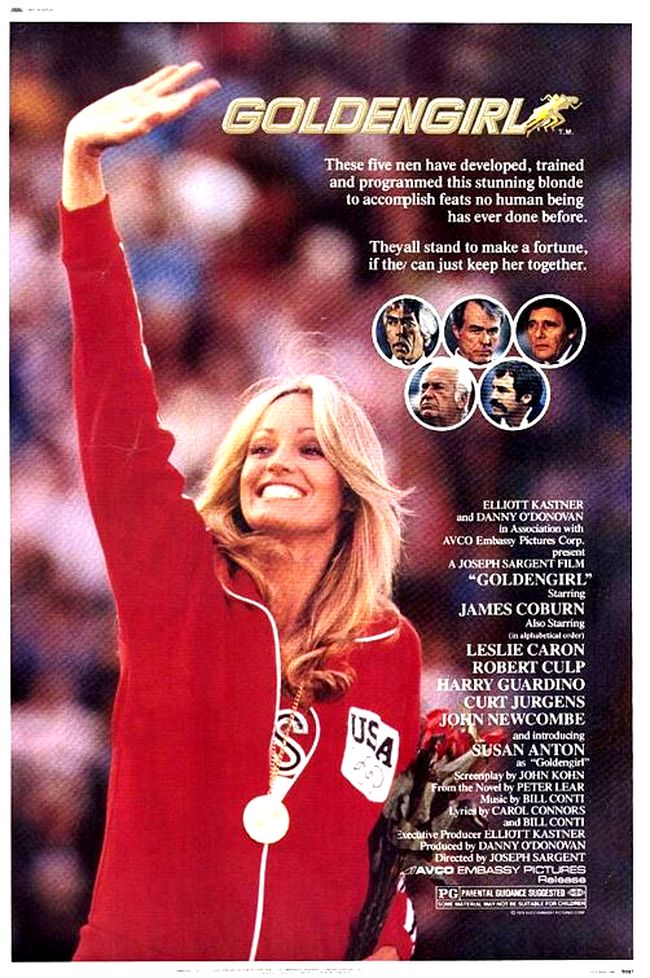
— Earlier in the same day I watched Chu Chu and the Philly Flash, I endured Goldengirl about basically a genetically engineered super female runner and it co-stars James Coburn, Robert Culp, Curt Jurgens, Leslie Caron, Jessica Walter, Michael Lerner, and Harry Guardino.

They’re all fine and dandy, more or less, but it’s star Susan Anton who ruins Goldengirl every single time she expresses any emotion. Guess they can’t genetically engineer the ability to act and the ability to not wreck an entire movie, because Anton can’t act and she absolutely obliterates Goldengirl every single time I wanted to give it another chance.

Give her one thing, though, because just like Donny and Marie Osmond in their motion picture debut and finale Goin’ Coconuts, Anton does have a great set of teeth. Outside her canines, incisors, premolars, and molars, though, Anton sucks in Goldengirl and despite the speeded up and slowed down footage, she’s not the least bit convincing as this incredible champion runner.

Anton and Coburn do have one of the great dialogue exchanges in motion picture history, one that could be played right alongside Fini can water you from Yes, Giorgio. She just set a new Olympic record and doesn’t she even deserve a kiss? Coburn works his way toward her magical lips and Anton moves the goalposts. She insists that he kisses her feet, then laughs maniacally, while Coburn, well, maybe he’s wishing that he could get hit upside the head by his old friend Bruce Lee’s one-hit punch again. Lee died in 1973 and Coburn was one of the pallbearers at Lee’s funeral.

The IMDb trivia entry starts out promisingly for Goldengirl, “Produced and theatrically released in 1979 prior to the 1980 Olympics boycott, this film depicts American athletes competing at the Moscow games. In reality, the boycott meant that the USA did not perform there, making the picture post-release anachronistic and historically inaccurate.”

Blame the boycott on Goldengirl.

Rating: One star.

— I watched Under the Rainbow between opener Goldengirl and closer Chu Chu and the Philly Flash.

That’s right, one of the worst movie-watching nights of a lifetime.

Under the Rainbow, like Goldengirl, has at least a far more interesting plot summary than anything else associated with the finished product.

Okay, to be honest, only the part about the 150 little people descending upon Hollywood for a part in The Wizard of Oz (and a wild and crazy party) sounds interesting, then it gets all mucked up when federal agents, fat cats, and Nazi and Japanese spies enter the picture. Anyway, doesn’t 1938 seem too early for Nazi and Japanese spies? I mean, the Nazis didn’t invade Poland until Sept. 1939 and the United States officially remained neutral until late 1941.

Regardless of social class and nationality and historical accuracy, though, all the characters get run through the cinematic claptrap blender at maximum speed with broad, inane slapstick and would-be wacky hijinks the settings. Despite the maximum speed, Under the Rainbow still feels like it takes forever to be done and over. That’s because it’s all played as loudly as possible, of course, with so much mugging on display that it’s another one of those movies where you feel the back of your head for lumps and bruises and then check for your wallet after watching it.

Chevy Chase and Carrie Fisher are the nominal stars, but they’re lost in the crowd because they play it too cool for school. Meanwhile, Billy Barty acts like he’s in three movies simultaneously and Japanese-American actor Mako settles for only two, and their terminal mugging calls to mind the 1942 propaganda comedy short The Devil with Hitler. The Devil with Hitler is better than Under the Rainbow, and I should just leave it at that statement, though I want to end this review with one last cheap shot at three lousy pictures that I wish I would have left buried inside their time capsules.

Stan Freberg would have charged the casts of Chu Chu and the Philly Flash, Goldengirl, and Under the Rainbow with one heinous crime against humanity: a 412. What’s a 412? Over-acting.

Rating: One star.

A Boy and His Dog (1975)

A BOY AND HIS DOG

A BOY AND HIS DOG (1975) ***

Forgive me for giving away the ending of A BOY AND HIS DOG: The Boy chooses The Dog over The Girl.

Then again, I am not sure I gave away the ending any one bit more than a title like A BOY AND HIS DOG. Yeah, right, it’s not called A BOY AND HIS GIRL.

Character actor L.Q. Jones, a favorite of the director Sam Peckinpah (1925-84), wrote, directed, and produced A BOY AND HIS DOG, adapted from Harlan Ellison’s 1969 short story “A Boy and His Dog.” Just take a look at the film’s poster: “The year is 2024 … a future you’ll probably live to see” and “a boy and his dog: an R rated, rather kinky tale of survival.” That part about A BOY AND HIS DOG being kinky, it’s no lie. Jones, in fact, makes a cameo in the porno movie within the movie.

In post-apocalyptic times, it quickly becomes apparent that a boy and his dog need each other more than ever before.

Especially this boy. He’s named Vic (Don Johnson). He’s 18 years old. He’s obsessed with sex and food, in just that order. Both his parents are gone. He lacks formal education and his ethics and morality are naturally twisted by the world he lives in. He’s a survivor, by any means necessary.

Meanwhile, his telepathic dog named Blood (voiced by Tim McIntire) is one helluva smart and savagely witty canine. He’s better than Benji! Benji, when he was voiced by Chevy Chase in OH! HEAVENLY DOG, never uttered anything like “I hope the next time you play with yourself, you go blind” or “Pull up your pants, Romeo.”

Vic and Blood have worked themselves out a nice little survival pact, at least until the lovely and sassy lass Quilla June Holmes (Susanne Benton). She knows how to appeal to Vic, but good old hound Blood knows a no-count hooch when he sees (and smells) one.

She’s been sent above ground by her powerful father from another world (Jason Robards) to scout talent for a sperm donor to perpetuate the species of underground survivors. Of course, Vic has got the super sperm necessary for the job, a fact Miss Holmes finds out firsthand. She ditches the boy and his dog and returns below ground, proving that Blood definitely sniffed out her wily ways.

Blood advises Vic not to chase the girl and go below ground, but the perpetually horny Vic lets his libido be his guide. Vic asks Blood to wait above ground for his return.

After boy and girl escape the underworld in harrowing fashion, they find Blood and he’s barely alive. That’s when The Boy faces his choice between The Dog and The Girl. Feed her to the dogs, indeed.

A BOY AND HIS DOG makes a strong case that dames are a dime a dozen even in a post-apocalyptic world, but dogs like Blood are truly a rare breed.

Big (1988)

BIG (1988) Three-and-a-half stars

Twelve-year-old Joshua Baskin (David Moscow) cannot gain admittance on a roller coaster ride because he’s not tall enough, so the embarrassed young man finds a Zoltar Speaks machine and it grants his wish that he were big. Overnight, Joshua Baskin becomes 30 years old and he’s played by Tom Hanks for basically the rest of the movie.

BIG is by far the best of the body switch movies that were all the rave during the Reagan administration. Anybody sentient during that era can surely remember a body switch pic or two. Let’s see, we had OH! HEAVENLY DOG from 1980, whose July 11 release date predates Reagan and which gives us Chevy Chase trapped inside Benji … Chase provides voice-over for Benji in a rather dull murder mystery. Then, there’s LIKE FATHER LIKE SON from 1987 pairing Dudley Moore and Kirk Cameron, who just scream father and son, in one of the worst movies of all-time had it not come out during the same year as such cinematic landmarks as THE GARBAGE PAIL KIDS MOVIE, LEONARD PART 6, JAWS THE REVENGE, MANNEQUIN, and TEEN WOLF TOO. Never mind, it’s still one of the worst movies of all-time.

BIG streamlined and more or less perfected the body switch, because we stick with one character (Joshua Baskin) the whole time and there’s less of a suspension of disbelief required for the movie to work. For example, in LIKE FATHER LIKE SON, we have to picture Dudley Moore inside Kirk Cameron and vice-versa (pun and reference to another body switch movie intended), but it’s almost impossible since their speaking voices remain the same. Movies like LIKE FATHER LIKE SON are why the late Roger Ebert coined the phrase “The Idiot Plot.”

Hanks gives a strong performance, especially in conveying the whole child trapped inside a grown man’s body through body language, facial gestures, boyish enthusiasm, wide-eyed reactions. He works his predicament for laughs, for pathos, for drama, and there’s a compelling sequence during his first “big” day when he’s staying at this seedy New York City hotel and he’s scared by the real world. Hanks broke away from his poor man’s Bill Murray for the first time in his career and established his own niche that would culminate in playing Forrest Gump.

Elizabeth Perkins is just terrific in BIG and I don’t think she’s ever been either better or more beautiful than as Susan. Perkins matches Hanks every step of the way during their complicated romance and please go back and watch her during the farewell scene with Baskin. She kisses him on the forehead and strokes behind his ear, in a tender and more motherly fashion. She makes the scene work, as Hanks reverts back to Moscow as Baskin.

Robert Loggia (1930-2015) and John Heard (1946-2017) were two of the best character actors during their respective careers.

Loggia plays against type here as MacMillan, the owner of a toy company who takes a major liking to the way Baskin looks at toys; phooey to marketing reports, Baskin and MacMillan test toys the old-fashioned way by going straight to the biggest toy store. They pair together for a toy piano duet and create one of the most iconic movie scenes of the late 80s. It’s known quite simply as the “Big Piano Scene.”

There was often an edge to Heard during his performances and he taps into that edge a great deal in BIG. Heard creates a real jerk.

Penny Marshall became a name director after BIG and she and Hanks reunited for A LEAGUE OF THEIR OWN. Anne Spielberg and Gary Ross wrote the script and Barry Sonnenfeld worked as cinematographer; Ross later directed PLEASANTVILLE and Sonnenfeld’s directorial credits include GET SHORTY and MEN IN BLACK.

There seems to be a certain nostalgia for BIG, just like at times it seems like that’s all true for anything (the good and the bad, and the ugly) from the 80s.

How far can that nostalgia go? Well, there’s the Nostalgic Zoltar Speaks machine for sale on the Zoltar site. One machine comes equipped with a $10,500 price tag and that’s not counting any customization like a wireless microphone to talk through Zoltar ($425 without remote control, $520 with), breathing movement for Zoltar ($625), motion activated attract ($75), custom fortune cards, custom audio messages, and traveling case ($1,500 plastic, $650 wood).

If you do buy that Nostalgic Zoltar Speaks machine for a major chunk of change, do you dare make a wish, “I wish I were big.” I say you better for that level of investment.


Foul Play (1978)

FOUL PLAY

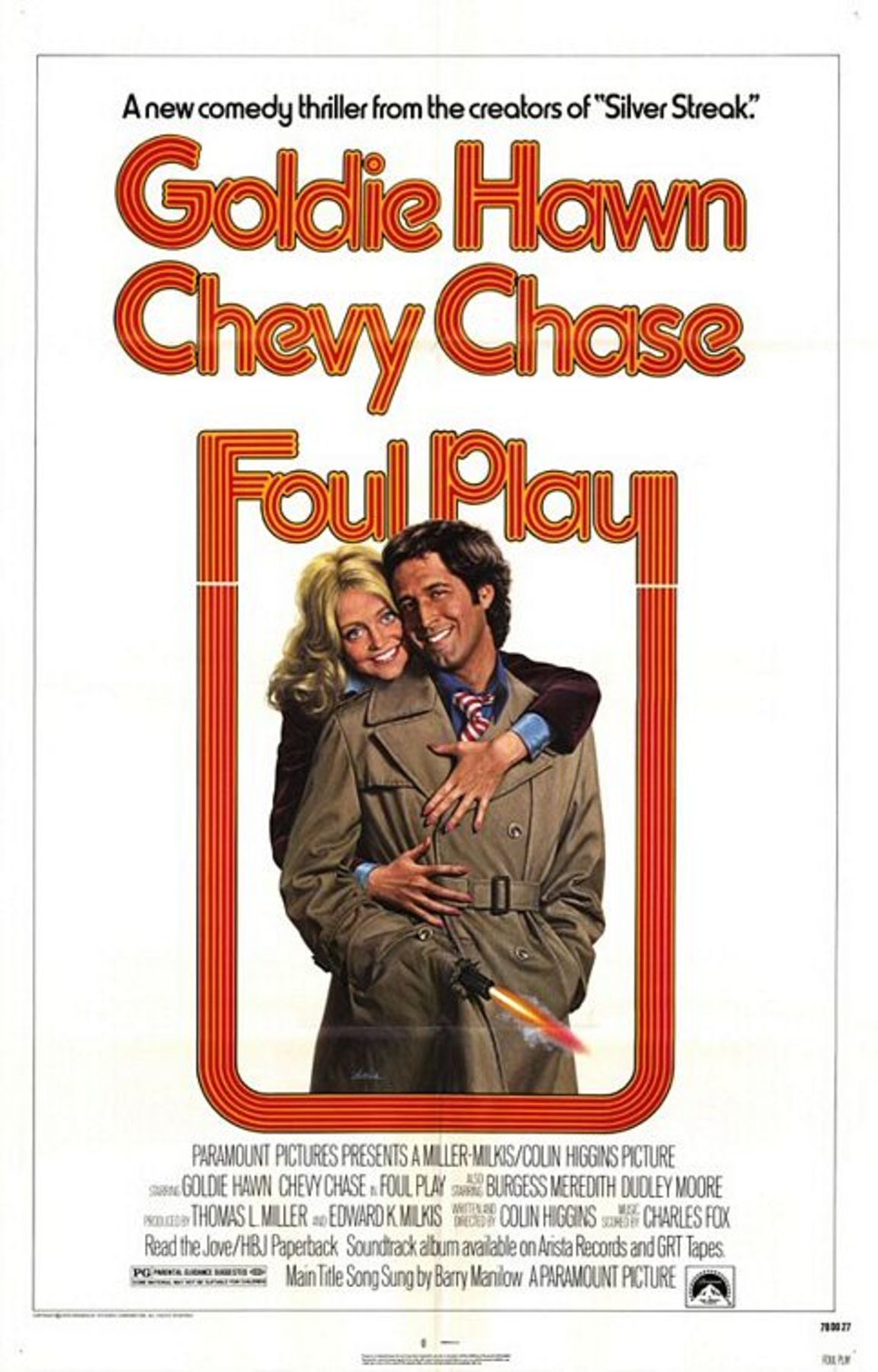
FOUL PLAY (1978) Three stars

Universal Studios demanded that Chevy Chase, the first breakout star from “Saturday Night Live,” be cast in NATIONAL LAMPOON’S ANIMAL HOUSE. However, in a lunch between ANIMAL HOUSE director John Landis, producers Matty Simmons and Ivan Reitman, and Chase, Landis played a Jedi mind trick on Chase, telling him that ANIMAL HOUSE would be an ensemble piece whereas FOUL PLAY would let Chase be a star. Chase stayed with FOUL PLAY and ANIMAL HOUSE cast Tim Matheson in the Otter role.

FOUL PLAY debuted July 14, 1978, and ANIMAL HOUSE came out two weeks later.

ANIMAL HOUSE made $141.6 million on a $3 million budget and changed the face of comedy forever. Yes, every year we get at least one comedy that would not have been possible without the example set by ANIMAL HOUSE. Meanwhile, FOUL PLAY generated $45 million and has been consigned to the margins of history.

It’s certainly not a bad movie by any stretch of the imagination, but it does pale in comparison when stacked up against ANIMAL HOUSE. Granted, FOUL PLAY chased different goals than the undeniably anarchic, anti-establishment ANIMAL HOUSE.

FOUL PLAY is the byproduct of writer and director Colin Higgins (1941-88). He’s one of those cases where you just might not know the name but you definitely know his movies. He made his name in Hollywood by penning the screenplay for the legendary cult favorite HAROLD AND MAUDE (1971). Five years later, he wrote the screenplay to SILVER STREAK, a comedic thriller hit pairing Gene Wilder and Richard Pryor. Higgins made his directorial debut with FOUL PLAY and would end with three directorial credits, 9 TO 5 and THE BEST LITTLE WHOREHOUSE IN TEXAS his second and third efforts. Additionally, Higgins wrote the screenplay for all three comedies he directed. All five comedies enjoyed some level of success.

Nominally Chase and Goldie Hawn are the stars of FOUL PLAY, but the writing and directing style of Higgins should not go unappreciated.

Both SILVER STREAK and FOUL PLAY stand out from HAROLD AND MAUDE, 9 TO 5, and THE BEST LITTLE WHOREHOUSE, in the fact they are heavily influenced by Alfred Hitchcock. SILVER STREAK screams Hitchcock’s 1938 thriller THE LADY VANISHES and FOUL PLAY references THE 39 STEPS, SABOTEUR, NORTH BY NORTHWEST, THE MAN WHO KNEW TOO MUCH, NOTORIOUS, VERTIGO, and PSYCHO. Fans of the Master of Suspense will also be delighted by Higgins’ inclusion of what the maestro called “The MacGuffin,” which is a roll of film hidden in a pack of cigarettes in FOUL PLAY.

I know that Hitchcock himself loved Mel Brooks’ HIGH ANXIETY, a 1977 affectionate spoof of suspense films mostly focused on Hitchcock’s SPELLBOUND, VERTIGO, PSYCHO, and THE BIRDS, so it is quite possible that he enjoyed FOUL PLAY.

In FOUL PLAY, librarian Gloria Mundy (Hawn) finds herself in the midst of a bizarre plot that ultimately involves an assassination attempt on the pope. We have a dwarf, an albino, a wild and crazy guy who attempts to seduce Miss Mundy, a karate fight between two highly unlikely combatants, an endless chase scene, and a pair of Japanese tourists who are big fans of Kojak and bang, bang! This is a pleasantly silly concoction and Hawn takes us through what turns out to be an overlong motion picture at 115 minutes. Or maybe it just felt that way every single damn time I heard the song “Ready to Take a Chance Again,” which predated the similar use of the song “That’s What Friends Are For” a few years later in NIGHT SHIFT. In both cases, I was ready to hear another song again instantly.

What about Chase? He’s part of an ensemble and he almost gets lost in the shuffle at times in his first movie leading role, but this is one of his better performances and his best films. Chase plays a capable leading man paired with Hawn.

Dudley Moore (1935-2002) basically steals every scene that he’s in and his work here led to his being cast in Blake Edwards’ 10, Burgess Meredith (1907-97) made four movies in 1978 and this is the one where his character knows martial arts, and Rachel Roberts’ last screen credit before FOUL PLAY was the eccentric Australian thriller PICNIC AT HANGING ROCK. Moore and Brian Dennehy, Chase’s partner, appeared together in 10.

FOUL PLAY is a minor film with minor charms, but sometimes that’s more than enough or just enough to hit the spot.

Caddyshack (1980)

CADDYSHACK

CADDYSHACK (1980) Three-and-a-half stars
Harold Ramis’ CADDYSHACK gives the consumer four movies for the price of one.

1) Rodney Dangerfield vs. Ted Knight.

2) Chevy Chase and his meandering philosophical musings and lady man ways.

3) Bill Murray and his bizarre shenanigans.

4) The caddies and their little melodramas.

Most films don’t even give us one.

We have four distinct comedic styles at work in CADDYSHACK: Dangerfield (1921-2004) comes on and thankfully never stops doing variations on his night club act; Knight (1923-86) plays the ultimate snob and perfect counterpoint to Dangerfield; Chase gives us Zen wisdom filtered through deadpan absurdity; and Murray creates a world of his own that combines Dalai Lama and Cinderella stories, gross out snooty old ladies Baby Ruth taste testing, hunting and blowing up animatronic gophers real good, and Bob Marley joints.

Murray’s like a gopher within CADDYSHACK itself, burrowing underneath Dangerfield vs. Knight and the caddies.

CADDYSHACK plays like a 98-minute throwback to the Marx Brothers, the Three Stooges, and W.C. Fields.

First-time director Ramis (1944-2014), in fact, envisioned Murray as Harpo Marx, Dangerfield as Groucho, and Chevy as Chico. Guess that made Ted Knight the villainous Sig Ruman (A NIGHT AT THE OPERA, A DAY AT THE RACES) and Cindy Morgan a more risqué Thelma Todd (MONKEY BUSINESS, HORSE FEATHERS).

Improvisation and cocaine fueled CADDYSHACK.

It seems like Ramis and gang threw away the script written by Brian Doyle-Murray, Ramis, and Douglas Kenney (Ramis and Kenney worked together on NATIONAL LAMPOON’S ANIMAL HOUSE) just to make it all up as they went along, especially Chase, Dangerfield, and Murray.

This is one example of how the makers of a film went in expecting to make a certain film and came out with something completely different. The original plan had been to make the movie focused on the caddies, of course with a title like that, but the comedians took over and stole the show.

To be fair, however, the caddies have their fair share of funny moments and Doyle-Murray steals every scene that he’s in as caddy master Lou.

Chris Nashawaty’s book “Caddyshack: The Making of a Hollywood Cinderella Story” details just how much of a miracle it was even that the movie got finished.

“I had never seen cocaine before I got to the set of CADDYSHACK,” actor Peter Berkrot said. “This was really good cocaine. Pure, like they had just beaten it out of a leaf in Columbia and somebody had carried the leaf to us and turned it into powder in front of us just so we knew how pure it was,” said actor Hamilton Mitchell.

Ramis and Kenney (1946-80) turned in an original cut that ran four hours. A consultant recommended a through line with Danny Noonan (Michael O’Keefe) and his quest for a caddy scholarship and his relationship with a waitress (Sarah Holcomb, who played the mayor’s daughter in ANIMAL HOUSE).

Like classics by the Marx Brothers, the Three Stooges, and Fields, though, we don’t require much of a plot when there’s so much funny going on.

Over the years, I’ve come to appreciate Knight’s asshole Judge Elihu Smails just as much as Dangerfield’s Al Czervik and Murray’s Carl Spackler.

Smails is every bit as quotable as Czervik, Spackler, and Chase’s Ty Webb.

My favorite Smails line comes right after Noonan says that he would like to go to law school after he graduates but his parents do not have enough money to put him through college.

Smails says, “Well, the world needs ditch diggers, too.”

July 1980 undoubtedly ranks among the great months for comedies: AIRPLANE! debuted July 2, USED CARS on July 11, and CADDYSHACK on July 25.