
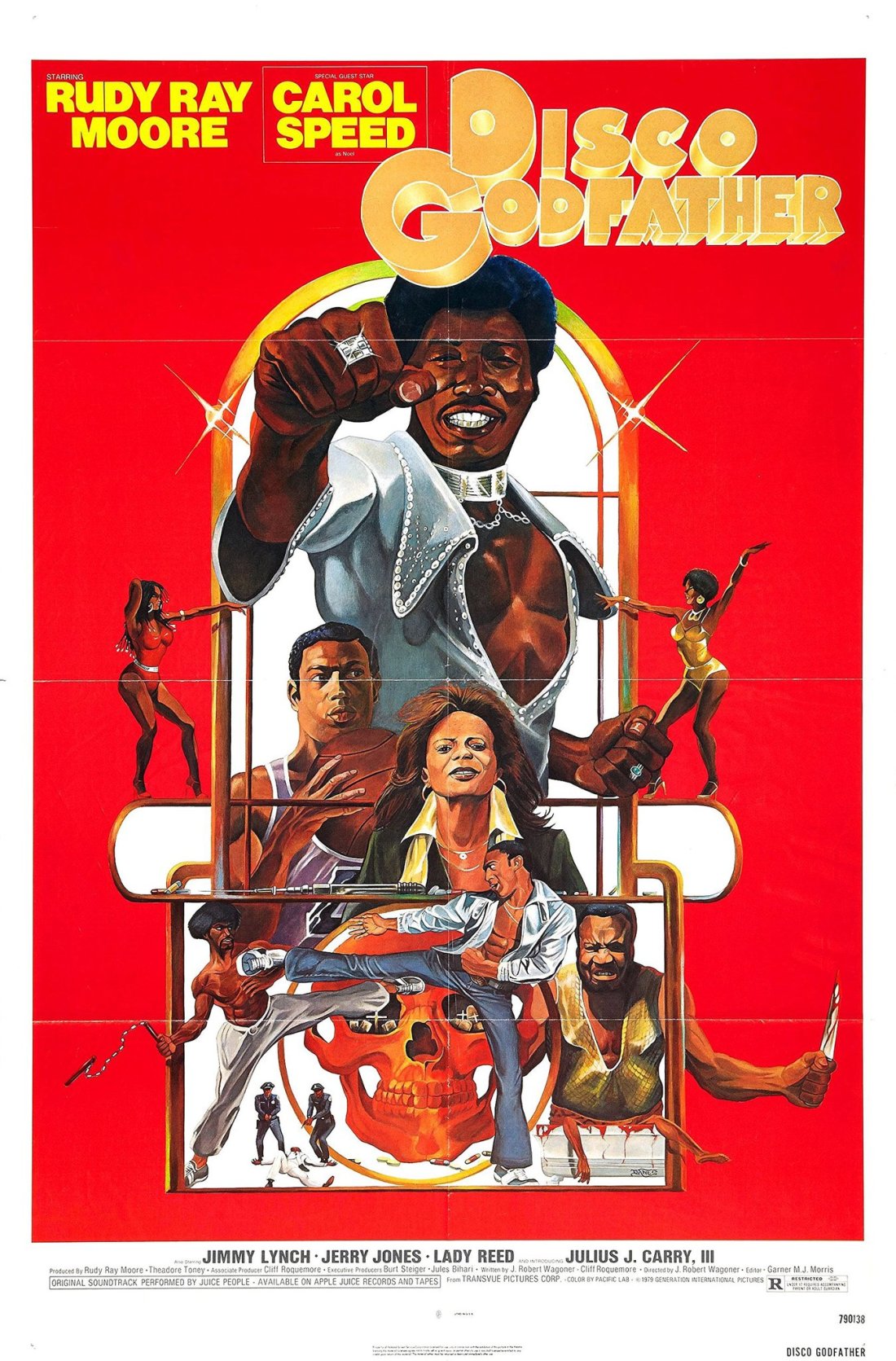
Disco Godfather (1979)

DISCO GODFATHER

DISCO GODFATHER (1979) *1/2

I kept having flashbacks throughout DISCO GODFATHER.

I asked myself several times, “Am I tripping balls or have I not seen this film a few hundred times?” Then, I said, “I know, I know, this is my first time watching it, but it still feels like I have seen DISCO GODFATHER before.” Later, “It’s only a movie. It’s only a movie. It’s only a movie.” Finally, “I’ll have my revenge. I’ll write a review.”

The plot: Rudy Ray Moore plays retired cop Tucker Williams turned nightclub owner and famed DJ “Disco Godfather.” His nephew Bucky (Julius J. Carry III) gets hooked on angel dust and it warps him something fierce. Tucker decides to return to his roots and wipe out this angel dust plague. See what I mean about having seen DISCO GODFATHER before?

After the dust has settled so to speak on this movie, I mostly remember the Disco Godfather saying “Put your weight on it!” It feels like Mr. Disco Godfather says “Put your weight on it” a million times. Apparently, it’s actually only 24 times that he uttered that infamous line. I am shocked and thoroughly disappointed.

“Put your weight on it” still, though, ranks among the greats in the cinematic annals of lines / incantations / mantras.

Cheech & Chong said “Man” 285 times in UP IN SMOKE, far out, man. Characters say the name “Carol Anne” 121 times in POLTERGEIST III. With their lesser weight, both UP IN SMOKE and POLTERGEIST III had to make up for it through sheer volume of repetition.

We also cannot forget “With great power comes great responsibility” from the Sam Raimi SPIDER-MAN films (originally from the comic books written by Stan Lee). From what I understand, this phrase has become known as the Peter Parker Principle. To be honest, I have not ever written much on the SPIDER-MAN films because “Weird Al” Yankovic already criticized the first Raimi SPIDER-MAN magnificently with “Ode to a Superhero,” which is set to the tune of Billy Joel’s “Piano Man.” Here’s the part about “With great power comes great responsibility”:

“With great power comes great responsibility / That’s the catch phrase of old Uncle Ben / If you missed it, don’t worry, they’ll say the line / Again and again and again.” Yeah, that’s exactly what I thought, “Weird Al,” and you wrote “Ode to a Superhero” after just the first SPIDER-MAN film.

Anyway, through the virtual magic of searching the Internet, I found a link to Rudy Ray Moore’s “Put Your Weight on It” in song form. Rudy Ray Moore and the Fillmore Street Soul Rebellion released a single in 1971 with “Put Your Weight on It” the B-side to a monologue and “Easy Easy Baby.” Hold on for about 2 minutes, 43 seconds, I must cast aside this “Weird Al” playlist that started by listening to “Ode to a Superhero” and instead listen to “Put Your Weight on It.” I’ll report back very soon with my findings.

Holy bat shit, Robin, I found a version that’s 4 minutes, 55 seconds. It’s from the Rudy Ray Moore Singing Album “The Turning Point,” from 1972. I’ve got Mr. Rudy Ray down for saying “Put your weight on it” 21 times. I did not count the “Keep your weight on it,” which he seems to say about as many times as the name of the song. I’m not going back for another listen any time soon.

Moore (1927-2008) was a multimedia “ghetto expressionist” (his preferred nomenclature for his act) who recorded his first comedy album “Below the Belt” in 1959. Moore debuted the Dolemite character in the early 1970s and he released albums with titles like “Eat Out More Often” and “This Pussy Belongs to Me.” He then successfully financed the motion picture DOLEMITE in 1975, followed by THE HUMAN TORNADO and THE MONKEY HUSTLE in 1976, PETEY WHEATSTRAW in 1977, and DISCO GODFATHER in 1979. He’s been called “The Godfather of Rap.” Dolemite unleashed lines like “You no-business, born-insecure, jock-jawed motherfucker” and “I’m gonna let ‘em know that Dolemite is my name, and fuckin’ up motherfuckers is my game.” This influence on subsequent generations of black entertainment is undoubtedly why DISCO GODFATHER seemed so old hat and overly familiar watching it for the first time in 2020.
Poltergeist III (1988)

DAY 8, POLTERGEIST III

POLTERGEIST III (1988) One star
Cheech & Chong said “man” 295 times in UP IN SMOKE (1978).

By comparison, characters said “Carol Anne” 121 times in POLTERGEIST III.

Still, I have this nice dream where the movies are spliced together via the miracle of modern technology and somehow Cheech & Chong say “Carol Anne” rather than “man” 295 times. Yes, rather than the characters played by Tom Skerritt and Nancy Allen, Cheech & Chong are tracking down Carol Anne and fighting the evil spirits. Skerritt makes a cameo in this alternate POLTERGEIST III, since he played Strawberry in UP IN SMOKE and that will be his character this second time around.

I do have this strange habit of imagining alternate scenes or alternate entire movies pieced together from two different movies.

For example, I remember Carey Mulligan’s character singing “New York, New York” in SHAME (the Steve McQueen and not the Ingmar Bergman version) and then all of a sudden, I had this vision of the Gremlins’ grand musical production number of the same song in GREMLINS 2: THE NEW BATCH. Here was the big tender moment in SHAME and I wanted the Gremlins’ version instead to show up on the screen. It played out inside my head that Mulligan started before she was oh so rudely interrupted by the mass Gremlin chaos choir. I also sing the Gremlins’ version every time I come across Frank Sinatra’s standard, which must be one of the most overplayed songs in popular culture.

Fantasies like that help to pass time, especially during a bad movie like POLTERGEIST III where I often can’t stand the sight of what’s on screen.

In economics, the law of diminishing returns refers to a point at which the profit becomes less than the amount of money or energy invested.

In movies, diminishing returns refers mainly to sequels that are vastly inferior to previous films in the series. Just look at any number of movie series for examples.

This third POLTERGEIST tries our patience right from the start with its central premise and it only gets worse through its execution.

It’s rather sick.

I mean, that poor child Carol Anne (played by Heather O’Rourke).

Why couldn’t they just let her be after POLTERGEIST II: THE OTHER SIDE?

What she endured in the first two movies would be enough for several lifetimes, but she’s back for a third installment and without her parents (Craig T. Nelson and Jo Beth Williams) and brother (Oliver Robins). Carol Anne’s been sent to live with her aunt (Allen) and uncle (Skerritt) at their high rise apartment in Chicago.

We know that she’s going to be put through the wringer for the third time as soon as we see her, no matter that she’s 2,000 miles and 30 hours by car away from Southern California, location of the infinitely superior first POLTERGEIST.

(By the way, Nelson was approached to return for POLTERGEIST III but he reportedly said “Two was enough.” That’s nowhere as brilliant as what Roy Scheider thought about JAWS 3-D, “Mephistopheles couldn’t talk me into doing (it). They knew better than to even ask.”)

POLTERGEIST III saddles poor Carol Anne with a psychiatrist named Dr. Seaton (Richard Fire). Of course, in the movies, psychiatrists normally do more harm than good and well, this Dr. Seaton character follows that character pattern to a T. Dr. Seaton encourages Carol Anne to chat with him about her experiences, though he believes her to be delusional, and, of course, this discussion enables the evil spirit of Rev. Henry Kane to find Carol Anne and wreak havoc on her once again.

This Dr. Seaton is a real piece of work. He belongs in the annals of bad screen doctors alongside such notables as the paranormal investigator played by Robert Joy in AMITYVILLE 3-D and the psychiatrist played by Bruce Willis in COLOR OF NIGHT.

A demon first burns Joy’s Dr. Elliot West’s face and then drags him to Hell. One of just a couple highlights in AMITYVILLE 3-D.

Dr. Seaton gets pushed to his death down the empty elevator shaft of the 100-story John Hancock Center.

Willis’ psychiatrist lives through COLOR OF NIGHT.

Well, you know, two out of three ain’t bad.

The POLTERGEIST movies, especially this third installment, have long been tinged with sadness and talk of the “Poltergeist Curse” almost overshadows the movies.

Dominique Dunne, who played Carol Anne’s older sister, died at the age of 22 five months to the day after the release of POLTERGEIST. Dunne’s ex-boyfriend, John Thomas Sweeney, strangled Dunne in the driveway of her West Hollywood home. Dunne went into a coma and died five days later on November 4, 1982.

O’Rourke died at the age of 12 on February 1, 1988 under extremely unusual circumstances. She died of cardiopulmonary arrest caused by septic shock due to intestinal stenosis, and her manager said at the time, “It’s weird. She was completely healthy Saturday, they thought she had the flu on Sunday and she was dead on Monday.” She had been diagnosed with Crohn’s Disease (chronic inflammation of the intestines) in 1987.

Dunne and O’Rourke are buried at the Westwood Memorial Park in Los Angeles.

POLTERGEIST III (released June 10, 1988) was O’Rourke’s last film and it was dedicated to her memory.