
Fat City (1972)

FAT CITY

FAT CITY (1972) ****

I would not be surprised if writer and director John Huston (1906-87) had the nickname “The Great Adapter.”

Huston directed 37 feature films from 1941 through 1987 and his films adapted from works by Dashiell Hammett, Ellen Glasgow, Robert Carson, B. Traven, Maxwell Anderson, Robert Sylvester, W.R. Burnett, Stephen Crane, C.S. Forester, Pierre LaMure, Claud Cockburn, Herman Melville, Charles Shaw, Romain Gary, Alan LeMay, Philip McDonald, Tennessee Williams, the Book of Genesis, Carson McCullers, Ian Fleming, David Haggart, Hans Koningsberger, Noel Behn, Leonard Gardner, Desmond Bagley, Rudyard Kipling, Flannery O’Conner, Zoltan Fabri, Harold Gray, Malcolm Lowry, Richard Condon, and James Joyce.

Huston co-wrote some of those adaptations, but it was Gardner himself who adapted his own novel, “Fat City,” for the big screen.

In a 2019 interview with the Paris Review, celebrating the 50th anniversary of his novel, Gardner spoke about Huston and the film adaptation.

“Before I started to write it (the screenplay), he invited me to come over to his place in Ireland for a couple of weeks for a discussion about how it was going to go,” Gardner said. “He was a funny guy. He trusted me, I think, because we didn’t talk all day about the script. We talked maybe a half an hour. Then he wanted to paint. He was always painting.

“He’d been an amateur boxer. It was lucky because my objection to boxing movies back then was that they were all the same. It’s a fixed fight and the hero won’t take a dive and maybe they break his hands afterward. I thought there needed to be a boxing film done another way. He was all for it.”

FAT CITY set itself within the city of Stockton, California, population over 100,000 at the time of the making of the film. The scenes are played out in skid row bars, restaurants and living spaces, work on a migrant labor farm, bowling alleys, a boxing gym, and boxing venues in a gritty, street-level fashion. Huston and Gardner definitely created a boxing film that’s done another way.

Stockton, now with a population above 300,000, received a dubious recognition from Forbes Magazine in 2012: “The Most Miserable City in the U.S.”

“I think that this is such a rough place that people who are highly educated use it as a springboard to get jobs in other places, and what it leaves behind is not the cream of the crop. The really smart people don’t want to stay here. They don’t want to be here with the violence and the crime and everything,” said substitute teacher Ronald Schwartz in a story for PBS News Hour.

So things only seemed to get worse in Stockton since 1972.

Creedence Clearwater Revival released the song “Lodi” as the B-side to “Bad Moon Rising,” the lead single from their third album “Green River,” in April 1969. Farrar, Straus & Giroux published “Fat City” in 1969.

Lodi is approximately 15-20 miles north of Stockton.

Creedence songwriter John Fogerty has said that he picked Lodi because it had the coolest-sounding name. The song’s refrain “Oh Lord, stuck in Lodi again” has truly stuck with Lodi for more than 50 years, unfairly or not.

FAT CITY utilizes Kris Kristofferson’s “Help Me Make It Through the Night” and the lyrics and the way Kristofferson sings them suit FAT CITY perfectly. Kristofferson said that he got his inspiration for the song from an interview with Frank Sinatra, who said “Booze, broads, or a bible … whatever helps me make it through the night.”

Any of the characters in FAT CITY could have said that.

We follow two boxers in FAT CITY: 29-year-old Billy Tully (Stacy Keach) and 18-year-old Ernie Munger (Jeff Bridges). Tully meets Ernie in a Stockton gym, sees potential in the young man after they spar, and encourages him to get into the fight game. Tully recommends manager and trainer Ruben (the great character actor Nicholas Colasanto).

Keach and Bridges play off or against each other perfectly. Bridges, in his early 20s and on his fifth feature overall, fits the part of a promising up-and-coming talent like a glove; Bridges had already received an Academy Award nomination for Best Supporting Actor for his performance in THE LAST PICTURE SHOW. Keach’s own struggles to get a part like Billy Tully infuses his characterization of a washed-up boxer clawing and scratching (and drinking) his way through life; for example, Mike Nichols fired Keach from CATCH-22 a week into rehearsals. Keach’s propensity for overacting and Bridges’ for underacting factored in.

“FAT CITY is a good film,” Keach said in Dennis Brown’s “Actors Talk: Profiles and Stories from the Acting Trade,” “but 20 minutes were cut. Twenty minutes longer, FAT CITY is a great film, a classic. Unfortunately, 20 minutes longer made it 20 minutes more depressing.”

A theory: All good films are not depressing and all bad films are.

Boxing takes Ernie away from the pressures of a young wife (Candy Clark) and the start of a nuclear family. Tully, a shell of himself since his wife left him and since his defeat in the ring in Panama City, takes up with Oma (Susan Tyrrell), a character described as a “woozy boozy floozy” in the New York Times. Booze initially lubricates their relationship, of course, but it fizzles out spectacularly down the home stretch.

Tully tells Oma “You can count on me!” so many times that you wonder if he’s attempting to get himself to believe that more than even this woman.
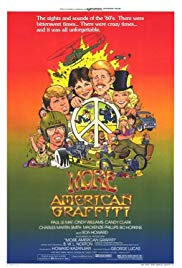
More American Graffiti (1979)

MORE AMERICAN GRAFFITI

MORE AMERICAN GRAFFITI (1979) *

I missed the point of MORE AMERICAN GRAFFITI, the 1979 sequel to George Lucas’ highly influential smash hit from 1973, AMERICAN GRAFFITI.

Sure, I realize we are intended to catch up with John Milner (Paul LeMat), Steve and Laurie Bolander (Ron Howard and Cindy Williams), Debbie Dunham (Candy Clark), Carol “Rainbow” Morrison (Mackenzie Phillips), and Terry “The Toad” Fields (Charles Martin Smith) at different points in the 1960s, but I don’t know if the film had any other greater purpose than attempting to cash in on the AMERICAN GRAFFITI name for another box office bonanza.

You’re right: Richard Dreyfuss and Curt Henderson did not return for the sequel. He’s only the main character in AMERICAN GRAFFITI, for crying out loud. Just like there’s no Dreyfuss and Matt Hooper in JAWS 2. Like his friend Steven Spielberg did not direct JAWS 2, Lucas does not direct MORE AMERICAN GRAFFITI. Unlike Spielberg, though, Lucas had far more involvement with the AMERICAN GRAFFITI sequel, including editing duties.

We have Milner on New Year’s Eve 1964, The Toad in Vietnam on New Year’s Eve 1965, Debbie in San Francisco on New Year’s Eve 1966, and Steve and Laurie on New Year’s Eve 1967.

We shuffle between the four different New Year’s Eve days and director and screenwriter Bill L. Norton gussies up the 1965 and 1966 scenes with grainy newsreel style footage (1965) and split screen (1966). That helps us identify which year we’re seeing, for sure, but otherwise, both gimmicks do not work. Especially the split screen, a technique already overplayed after WOODSTOCK and Brian DePalma films like CARRIE. In MORE AMERICAN GRAFFITI, split screen takes away from every scene it’s used.

The original AMERICAN GRAFFITI focused on a single long day in 1962 and that made the parallel adventures of Curt, Milner, The Toad, and Steve much easier to follow and less distracting. Automobiles cruising the main drag and car radios playing Wolfman Jack’s radio show unified just about every scene.

AMERICAN GRAFFITI also proved to have a theme: It showed Curt, Milner, and The Toad all outside their comfort zones and getting to know somebody beyond their accustomed social circle: intellectual and future college boy Curt and the tough guy car club the Pharaohs, the James Dean “Rebel Without a Cause” Milner and a young teenage girl dumped off on him by her older sister and older friends, and the geeky and socially awkward Toad and the blonde bombshell Debbie. They all form a greater understanding of each other.

Lucas did not get across the theme in a pretentious, heavy-handed, preachy way. Just about every scene in AMERICAN GRAFFITI worked on some level, and it especially seemed incredibly accurate about what life was like in 1962.

Meanwhile, in MORE AMERICAN GRAFFITI, hardly any scenes work and the film never builds up any momentum. It seems to mark off the list of every cliche of the era and maybe it just feels that way even more after one million ‘60s nostalgia trips. MORE AMERICAN GRAFFITI plays like a Time Life movie.

MORE AMERICAN GRAFFITI loses steam early on when Debbie and her loser man friend Lance Harris (John Lansing) are pulled over and he’s busted for just a little joint by Officer Bob Falfa (gratuitous Harrison Ford cameo appearance) after a chase that feels like it takes forever … and that’s immediately followed by Steve and Laurie playing the Bickersons.

Considering how little works in MORE AMERICAN GRAFFITI, it’s even greater insult to injury when the final shot teases us with the death of a main character.

Q: The Winged Serpent (1982)

Q

Q: THE WINGED SERPENT (1982) Three-and-a-half stars
I admit loud and proud a weakness for time travel, robots, monsters, and mad scientists.

Maybe weakness is the wrong choice of word. How about predilection?

Q: THE WINGED SERPENT definitely fits the bill for monsters, a grand homage to the great monster movies of the 1950s.

It’s directed, written, and produced by Larry Cohen (1941-2019) and it’s financed by Samuel Z. Arkoff (1918-2001) as the first release from Arkoff International Pictures.

Of course, Arkoff was involved with Q.

Arkoff’s producer credits include THE PHANTOM FROM 10,000 LEAGUES, IT CONQUERED THE WORLD, THE SHE-CREATURE, INVASION OF THE SAUCER MAN, THE AMAZING COLOSSAL MAN, HOW TO MAKE A MONSTER, and REPTILICUS.

Arkoff even provided a great quote in a conversation between the producer and critic Rex Reed (relayed by Roger Ebert).

Reed: “Sam! I just saw THE WINGED SERPENT! What a surprise! All that dreck — and right in the middle of it, a great Method performance by Michael Moriarty!”

Arkoff: “The dreck was my idea.”

That brings us to Michael Moriarty, whose performance elevates Q to another level.

He plays Jimmy Quinn (though he’s not the “Q” of the film’s title), a cheap dime store hood with aspirations of being a jazz pianist.

Quinn’s like Jeffrey Combs’ Herbert West in RE-ANIMATOR and Thomas Wilson’s Biff Tannen (and various historical offshoots) in the BACK TO THE FUTURE series.

In other words, he’s a lovable asshole or we love hating Jimmy Quinn.

Personally, I love what he does after his discovery of the Quetzalcoatl (the real source for the film’s title) responsible for several deaths.

A pair of hoods lean on Quinn after his part in a botched diamond heist and he leads them to the Chrysler Building, nesting ground of the Quetzalcoatl. The hoods don’t know that.

Quinn’s priceless reaction to the fate of the hoods: “Eat ‘em, eat ‘em! Crunch! Crunch!”

Then Quinn comes up with a plan, a ransom deal for New York City authorities: $1 million in cold, hard cash in exchange for divulging the nest location. “All my life I’ve been a nobody and right now I’ve got the chance of being somebody important,” Quinn said.

Seems like Quinn served as New York City’s preparation for the Ghostbusters, especially dealing with one Peter Venkman.

Guess we’ve covered a little bit of the plot.

If you’re not satisfied, though, I found this plot summary on Amazon: “Its name is Quetzalcoatl, a dragon-like Aztec god that is summoned to modern-day Manhattan by a mysterious cult. But just call it Q … because that is all you’ll be able to say before it tears you apart!”

Okay, that’s enough plot.

Moriarty headlines a very capable cast also including David Carradine, Richard Roundtree, and Candy Clark.

Carradine and Roundtree play NYPD detectives, who almost matter-of-factly react to a winged serpent and ritualistic Aztec murder.

Just another day on the beat.

That’s the beauty of a Larry Cohen film.

In the opening paragraph, I mentioned a taste for time travel, robots, monsters, and mad scientists. I should go back and put “stop-motion” in front of monsters, loving everything from Willis O’Brien’s pioneering work in KING KONG (1933) to Ray Harryhausen’s grand finale CLASH OF THE TITANS (1981).

Randall William Cook and David Allen worked on Q, a deliberate throwback to O’Brien and Harryhausen.

Between Moriarty’s performance and a stop-motion winged serpent, as well as Cohen’s work both writing and directing, Q rates as one of the great not-so-guilty pleasures.