Bomb, Bomb, Bomb: Partners, Charlie Chan and the Curse of the Dragon Queen, When Time Ran Out

BOMB, BOMB, BOMB: PARTNERS, CHARLIE CHAN AND THE CURSE OF THE DRAGON QUEEN, WHEN TIME RAN OUT

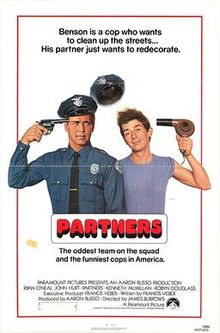
I could only make it through about 30 minutes of Partners and that’s more than enough for at least about 10 lifetimes, I’d say. I gave up on the picture for good around the fourth time star Ryan O’Neal uttered the epithet faggot. Yeah, Partners basically plays Cruising for laughs. Ha-ha, funny … about as funny as punching somebody’s mother in the face.

I consider Partners the absolute worst film from 1982, at least among the 70 or so films that I have seen thus far in my 42 years on this planet. It supplanted Amityville II: The Possession, a lovely little number incorporating blood, vomit, incest, matricide and patricide, fratricide and sororicide, and demonic possession. Never mind Inchon, a $46 million Korean War epic that bombed mightily at the box office with only a $5.2 million return. Never mind Halloween III: Season of the Witch, which features one of the least likable lead characters (Dr. Dan Challis) and lead performances (Tom Atkins) in recent memory. Believe it or not, Partners beats those other films in sheer unpleasantness.

Did longtime TV director James Burrows use Partners for his audition for Will and Grace? I seriously doubt it, because Partners is one of the nastiest pieces of work I have ever seen. Burrows has directed more than 1,000 TV episodes, including 237 Cheers and 75 Taxi and 32 Frasier. Thankfully, Burrows stuck with television after Partners.

Early in the picture, O’Neal asks his boss how he got stuck partnering up (literally) with gay records clerk Kerwin (John Hurt) to infiltrate and investigate a series of murders in the Los Angeles gay community. Anyway, Chief Wilkins (Kenneth McMillan) tells our matinee idol, “Because you’re a good cop, a real good cop. And because of your cute ass.” Maybe that’s how O’Neal himself got the gig. O’Neal certainly dressed up for the part, wearing a ridiculous tank top and then a leather garb in just the portion I watched before saying Roberto Duran on Partners.

— As I sit here before this keyboard and ponder my next direction, I consider how I endured all 95 minutes or so of Charlie Chan and the Curse of the Dragon Queen, another great big smelly turd from the early ’80s like the ones mentioned about three paragraphs up.

When folks express this incredible nostalgia for the ’80s, undoubtedly it’s not Charlie Chan or Partners or Inchon, for that matter, they’re nostalgic about, because they SUCK in the immortal words of Al from Caddyshack. Then again, if I have learned anything over the years writing about movies or music online, it’s that somewhere in this great big world there’s a cult following Howard the Duck or Halloween III, for example, and they just might flame you for not cherishing their cult object in the same way they do.

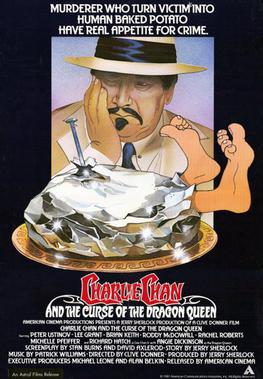
Charlie Chan asks us to believe Peter Ustinov (1921-2004), Richard Hatch (1945-2017), and Angie Dickerson as characters of Asian descent. Sure, I believe the Englishman Ustinov as fictional Belgian detective Hercule Poirot (a character he played six times, including features Death on the Nile, Evil Under the Sun, and Appointment with Death) and Roman emperor Nero in Quo Vadis, but I call it more of a stretch to consider him as Chan in 2020, nearly 40 years after the film was made. It’s even worse for both Hatch and Dickerson.

Charlie Chan features plenty of the broadest comedy and frenzied overacting by a rather distinguished cast that also includes Lee Grant, Brian Keith, Roddy McDowall, Rachel Roberts, and Michelle Pfeiffer early in her career. Hatch plays Chan’s fumbling bumbling stumbling grandson Lee Chan Jr. and I’ve watched so many films lately with fumbling stumbling bumbling would-be detectives that I now grumble and rumble when I see them on the screen. I’m thankful my Grandma never behaved like the one played by Grant in Charlie Chan. Keith’s police chief says ‘Goddamn’ about 50 times. McDowall and Roberts play Grant’s domestic helpers, Gillespie and Mrs. Dangers respectively, but they both provide little help to Charlie Chan since they are both in the grand tradition of melodramatic domestic help in the movies; Mrs. Dangers calls to mind Patsy Kelly’s frantic maid in The Gorilla. Pfeiffer could have dialed the perkiness down a notch or few and still have saved enough for the rest of her career. Nearly all of these characters are cringeworthy.

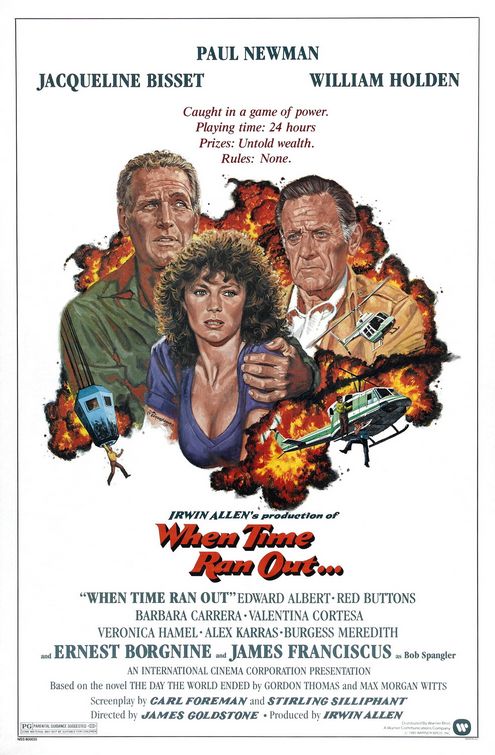
When Time Ran Out came out Mar. 28, 1980 and it eventually fell about $16 million short of making its $20 million production budget back at the American box office.

Later that year, on July 2, Airplane parodied Airport specifically and disaster movies in general, and became one of the biggest hits of the summer and the entire calendar year.

The failure of When Time Ran Out and the success of Airplane signaled the end of the disaster movie, at least in the form that dominated the first half of the seventies with The Poseidon Adventure, Earthquake, and Towering Inferno and then dribbled out pure unadulterated dreck the final half of that decade like The Swarm, Beyond the Poseidon Adventure, and Meteor. Since I mentioned Meteor, I also have to mention Avalanche, which provided disaster footage recycled in Meteor as if being in one disaster of a disaster movie just simply was not enough.

Master of disaster Irwin Allen (1916-91) produced at least half the films mentioned in the paragraph right above this one and he even stepped in the director’s chair for the turkey bombs The Swarm and Beyond the Poseidon Adventure. Allen called on Rollercoaster director James Goldstone for When Time Ran Out, which features the required number of old time movie stars, hot commodities, and fledgling character actors. When Time Ran Out should have been called Take the Money and Run, though Woody Allen and Steve Miller already used it for a comedy (1969) and a hit song (1976).

We have William Holden (1918-81), Paul Newman (1925-2008), Jacqueline Bisset, Ernest Borgnine (1917-2012), James Franciscus (1934-91), Burgess Meredith (1907-97), Red Buttons (1919-2006), Barbara Carrera, Pat Morita (1932-2005), Veronica Hamel, Edward Albert (1951-2006), and Alex Karras (1935-2012), as well as a volcano, a tidal wave, etc.

Seemingly half of the cast takes part in a glorified soap opera before the molten lava really begins to flow and they have to repeat business from Beyond the Poseidon and seemingly every other disaster movie of the era. Here’s that glorified soap opera: Holden proposes to Bisset very early in the movie and she turns him down because she’s in love with Newman, who’s not the marrying kind and anyway he does not seem to much care for Bisset but maybe he’s just masking his true feelings toward her with standard male bluster. Franciscus is married to Hamel but he’s fooling around with half-brother Albert’s significant other Carrera. Just wait, it gets better, Albert does not know that he’s Franciscus’ half-brother … and Holden and Hamel are sleeping together. I think I just about nailed it down and you’re right if you’re thinking all that seems like too much plot for such a dimwitted movie.

You’re also right that I hated these characters and their miserable lives, and rooted for the volcano to wipe them all out.

Especially Franciscus, who takes chronic disbelief in the face of impending disaster to new lows in When Time Ran Out. Unfortunately, an incredibly shoddy special effect leads to an incredibly unsatisfying death for Franciscus’ character. We crave to see him bite the dust or eat molten lava in spectacular fashion, and what we get is just plain laughable.

Of course, just plain laughable describes about 99 percent of When Time Ran Out.

Believe it or not, costume designer Paul Zastupnevich earned an Academy Award nomination for Best Costume Design and went against winner Tess, The Elephant Man, My Brilliant Career, and Somewhere in Time, all of them period films where the look of the film itself becomes another important character.

Yeah, I hope the 1981 Oscar broadcast used a shot of Newman in his utterly ridiculous Urban Cowboy garb.

Zastupnevich received a nomination for the same award two years before for his edgy, state-of-the-art costume work on The Swarm, beekeeper outfits. The Agatha Christie Hercule Poirot period murder mystery Death on the Nile won the prize.

I hate to say it, but time ran out on this review because I don’t want to consider When Time Ran Out any longer than I already have.

Partners No stars; Charlie Chan and the Curse of the Dragon Queen 1/2*; When Time Ran Out *

Clash of the Titans (1981)


CLASH OF THE TITANS (1981) Three-and-a-half stars

Harryhausen vs. Harry Hamlin.

That’s what CLASH OF THE TITANS amounts to in the long run for this viewer.

Artist, designer, visual effects man, writer, and producer Ray Harryhausen (1920-2013) mastered the dying art of stop-motion animation. His credits include MIGHTY JOE YOUNG, THE 7TH VOYAGE OF SINBAD, JASON AND THE ARGONAUTS, ONE MILLION YEARS B.C., and CLASH OF THE TITANS, Harryhausen’s final production in which he goes out with a big bang.

Harryhausen is the real star of CLASH OF THE TITANS, and not Harry Hamlin or even big-name actors Laurence Olivier, Ursula Andress, Maggie Smith, Burgess Meredith, and Claire Bloom.

I like CLASH OF THE TITANS a lot because of all them stop-motion creations.

Let’s see, we have scorpions, the Stygian witches, Calibos and his vulture, a two-headed hound of Hell, the Kraken, the mechanical owl Bubo, and, of course, Medusa.

The Medusa sequence is the pièce de résistance of CLASH OF THE TITANS and responsible for at least three stars alone.

Harryhausen himself favored Medusa among his many creations.

The snake-haired Medusa, we all know that she’s deadly with arrows and she can turn a person to stone if you make contact with her eyes. Personally, I pretend that every salesperson in a shopping mall is Medusa and eye contact must be strictly avoided. Perseus (Hamlin) tricks Medusa with his reflection and he lops off her head. Then, our hero uses Medusa’s head to turn the formidable Kraken to stone.

A wide range of filmmakers have been inspired by Harryhausen’s work, including Steven Spielberg, Joe Dante, James Cameron, Tim Burton, Peter Jackson, and Sam Raimi.

In 2010, Academy Award winning animator Nick Park talked with the BBC about his three favorite Harryhausen moments. He finished up with Medusa from CLASH OF THE TITANS after picking two from JASON AND THE ARGONAUTS.

“It was so well done and frightening,” Park said. “It’s all the same technique but going to different heights of intricacy.

“I thought it was a combination of really good lighting and shadow. I do admire a lot of CGI, but there’s something not real about it.

“In the Medusa that Ray did it’s there and it’s grounded, there’s real light hitting real surfaces. Somehow your brain knows it’s not real with CGI.”

I’ll be honest, I am far more interested in Harryhausen’s creatures than the rather convoluted plot involving Perseus, Andromeda (Judi Bowker), Calibos, Cassiopeia, and the gods pulling all the strings.

That’s what I meant by starting this review “Harryhausen vs. Harry Hamlin.”

Most of CLASH OF THE TITANS plays like a soap opera, not helped out by pretty boy Hamlin and Bowker, who seem like they should be on “Days of Our Lives.”

Google is a wondrous invention: With just two magic words and one little click, I found the 1987 People article on Hamlin, “The Sexiest Man Alive” double issue no less, and the opening paragraph of “Last of the Great Romantics” just hooks me in against my better instincts.

“The name seems wrong for The Sexiest Man Alive, Harry is a name for an uncle, or a guy who asks you to the prom because his mother made him. Of course, Harold would be worse. So Harry it is. Harry Robinson Hamlin, to be precise … the Harry everyone’s just wild about.” (Personally, I prefer Harry Truman or Harry Potter, quite possibly since neither will ever be proclaimed “The Sexiest Man Alive.”)

The article comes back around for a swipe at CLASH OF THE TITANS.

“And there’s always the possibility of doing a remake of CLASH OF THE TITANS. ‘I brought my toga home,’ says Harry, raising hopes of another glimpse of those knees. He’s kidding, of course. Frivolous flicks are a thing of the past for The Sexiest Man Alive. Besides, says Harry, laughing, ‘I used the toga to wash my car.’”

Frivolous flicks a thing of the past for Hamlin? Hamlin’s career has included 105 episodes of “L.A. Law,” 21 of “Movie Stars,” 12 of “Veronica Mars,” eight apiece of “Army Wives” and “Shameless,” and 15 of “Mad Men,” as well as a plethora of TV movies and other shows.

Hamlin should count himself lucky to be associated with CLASH OF THE TITANS.

Because Harryhausen trumps Harry Hamlin every single time.

Foul Play (1978)

FOUL PLAY

FOUL PLAY (1978) Three stars

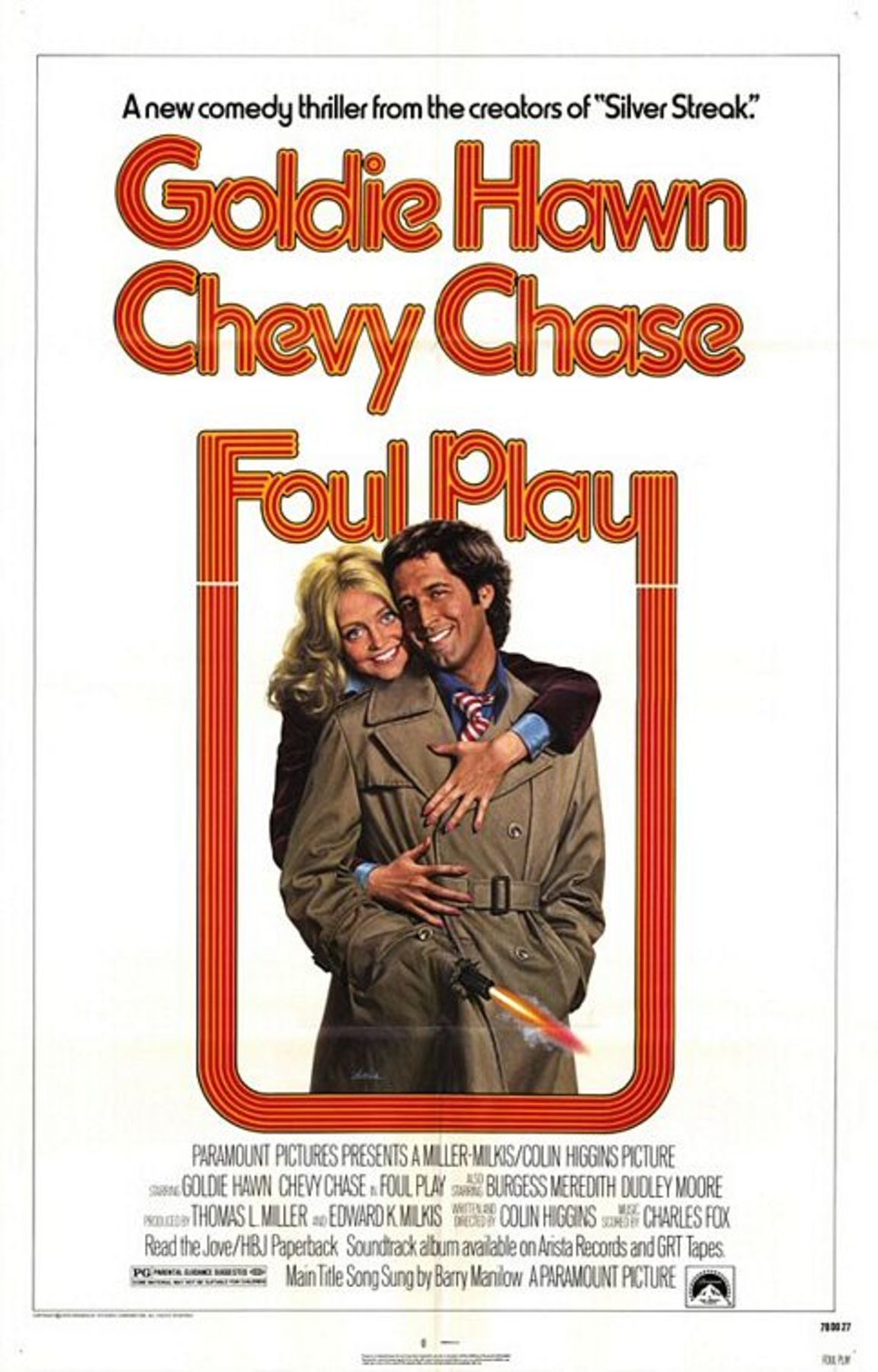
Universal Studios demanded that Chevy Chase, the first breakout star from “Saturday Night Live,” be cast in NATIONAL LAMPOON’S ANIMAL HOUSE. However, in a lunch between ANIMAL HOUSE director John Landis, producers Matty Simmons and Ivan Reitman, and Chase, Landis played a Jedi mind trick on Chase, telling him that ANIMAL HOUSE would be an ensemble piece whereas FOUL PLAY would let Chase be a star. Chase stayed with FOUL PLAY and ANIMAL HOUSE cast Tim Matheson in the Otter role.

FOUL PLAY debuted July 14, 1978, and ANIMAL HOUSE came out two weeks later.

ANIMAL HOUSE made $141.6 million on a $3 million budget and changed the face of comedy forever. Yes, every year we get at least one comedy that would not have been possible without the example set by ANIMAL HOUSE. Meanwhile, FOUL PLAY generated $45 million and has been consigned to the margins of history.

It’s certainly not a bad movie by any stretch of the imagination, but it does pale in comparison when stacked up against ANIMAL HOUSE. Granted, FOUL PLAY chased different goals than the undeniably anarchic, anti-establishment ANIMAL HOUSE.

FOUL PLAY is the byproduct of writer and director Colin Higgins (1941-88). He’s one of those cases where you just might not know the name but you definitely know his movies. He made his name in Hollywood by penning the screenplay for the legendary cult favorite HAROLD AND MAUDE (1971). Five years later, he wrote the screenplay to SILVER STREAK, a comedic thriller hit pairing Gene Wilder and Richard Pryor. Higgins made his directorial debut with FOUL PLAY and would end with three directorial credits, 9 TO 5 and THE BEST LITTLE WHOREHOUSE IN TEXAS his second and third efforts. Additionally, Higgins wrote the screenplay for all three comedies he directed. All five comedies enjoyed some level of success.

Nominally Chase and Goldie Hawn are the stars of FOUL PLAY, but the writing and directing style of Higgins should not go unappreciated.

Both SILVER STREAK and FOUL PLAY stand out from HAROLD AND MAUDE, 9 TO 5, and THE BEST LITTLE WHOREHOUSE, in the fact they are heavily influenced by Alfred Hitchcock. SILVER STREAK screams Hitchcock’s 1938 thriller THE LADY VANISHES and FOUL PLAY references THE 39 STEPS, SABOTEUR, NORTH BY NORTHWEST, THE MAN WHO KNEW TOO MUCH, NOTORIOUS, VERTIGO, and PSYCHO. Fans of the Master of Suspense will also be delighted by Higgins’ inclusion of what the maestro called “The MacGuffin,” which is a roll of film hidden in a pack of cigarettes in FOUL PLAY.

I know that Hitchcock himself loved Mel Brooks’ HIGH ANXIETY, a 1977 affectionate spoof of suspense films mostly focused on Hitchcock’s SPELLBOUND, VERTIGO, PSYCHO, and THE BIRDS, so it is quite possible that he enjoyed FOUL PLAY.

In FOUL PLAY, librarian Gloria Mundy (Hawn) finds herself in the midst of a bizarre plot that ultimately involves an assassination attempt on the pope. We have a dwarf, an albino, a wild and crazy guy who attempts to seduce Miss Mundy, a karate fight between two highly unlikely combatants, an endless chase scene, and a pair of Japanese tourists who are big fans of Kojak and bang, bang! This is a pleasantly silly concoction and Hawn takes us through what turns out to be an overlong motion picture at 115 minutes. Or maybe it just felt that way every single damn time I heard the song “Ready to Take a Chance Again,” which predated the similar use of the song “That’s What Friends Are For” a few years later in NIGHT SHIFT. In both cases, I was ready to hear another song again instantly.

What about Chase? He’s part of an ensemble and he almost gets lost in the shuffle at times in his first movie leading role, but this is one of his better performances and his best films. Chase plays a capable leading man paired with Hawn.

Dudley Moore (1935-2002) basically steals every scene that he’s in and his work here led to his being cast in Blake Edwards’ 10, Burgess Meredith (1907-97) made four movies in 1978 and this is the one where his character knows martial arts, and Rachel Roberts’ last screen credit before FOUL PLAY was the eccentric Australian thriller PICNIC AT HANGING ROCK. Moore and Brian Dennehy, Chase’s partner, appeared together in 10.

FOUL PLAY is a minor film with minor charms, but sometimes that’s more than enough or just enough to hit the spot.