Calling All Cars, We Have a 412! Calling All Cars!

CALLING ALL CARS, WE HAVE A 412! CALLING ALL CARS!
I watched Chu Chu and the Philly Flash on March 7 and 18 days later, I can still hear it, that’s for sure, especially co-stars Alan Arkin and Carol Burnett and supporting player Danny Aiello.

Burnett plays Chu Chu, or Emily as only her dearest friends know her, who performs this Carmen Miranda routine out in the streets. Her performance gives one all the maracas needed for at least one year, perhaps even one lifetime. Emily used to be a successful entertainer, before the booze got to her. We all know the story by now.

Arkin, meanwhile, plays the Philly Flash, given that name not because of his ability to shed his raincoat but his former ability turning double plays at second base for the Philadelphia Phillies. Was he named the Philly Flash just because the real-life Phillies won the World Series in 1980? Anyway, just like Emily, booze got to Flash, not Grandmaster Flash (think I’d rather watch The Adventures of Grandmaster Flash on the Wheels of Steel than Chu Chu and the Philly Flash) or Flash Gordon (who just had a movie, a much better one believe it or not, come out in 1980) or The Flash. No, the Philly Flash’s power, like Chu Chu’s, seems to be that he can scream and carry on a whole lot. In fact, that’s about both all they ever do in Chu Chu and the Philly Flash.

Not sure that it even matters or not if Burnett played the Philly Flash and Arkin drew Chu Chu. They could have made him a former professional golfer and her a former burlesque entertainer or something. Yeah, like Bill Murray said in Meatballs, it doesn’t even matter.

Government secrets fall, yes, literally fall into the hands of Philly Flash and Chu Chu. Well, technically, not right into their hands, I mean they did have to walk over and pick up the briefcase. By the way, the briefcase gives the best performance in Chu Chu and the Philly Flash, since even the maracas overact.

Rating: One-half star.

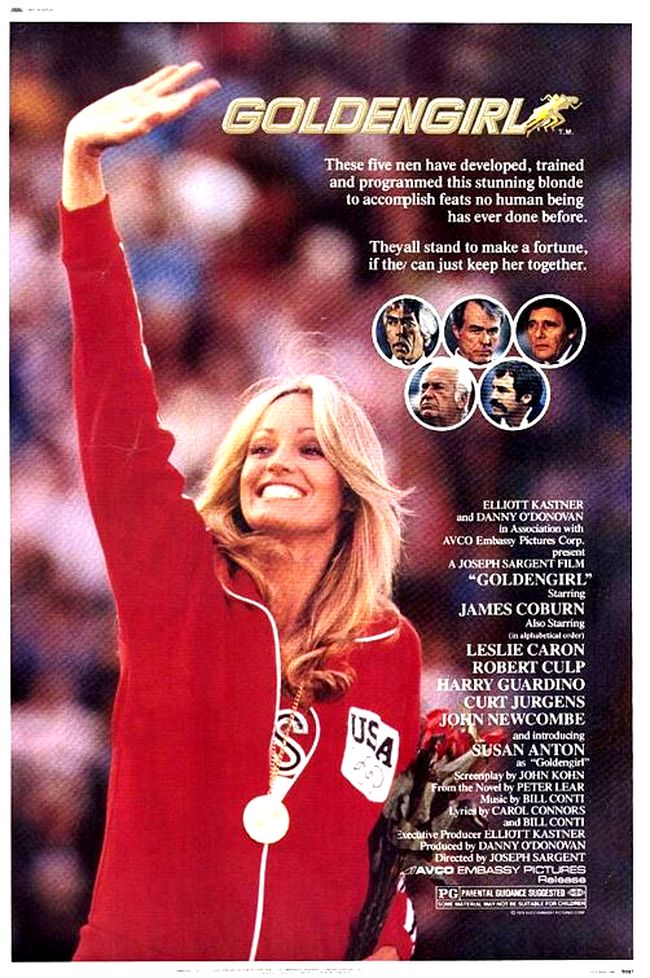
— Earlier in the same day I watched Chu Chu and the Philly Flash, I endured Goldengirl about basically a genetically engineered super female runner and it co-stars James Coburn, Robert Culp, Curt Jurgens, Leslie Caron, Jessica Walter, Michael Lerner, and Harry Guardino.

They’re all fine and dandy, more or less, but it’s star Susan Anton who ruins Goldengirl every single time she expresses any emotion. Guess they can’t genetically engineer the ability to act and the ability to not wreck an entire movie, because Anton can’t act and she absolutely obliterates Goldengirl every single time I wanted to give it another chance.

Give her one thing, though, because just like Donny and Marie Osmond in their motion picture debut and finale Goin’ Coconuts, Anton does have a great set of teeth. Outside her canines, incisors, premolars, and molars, though, Anton sucks in Goldengirl and despite the speeded up and slowed down footage, she’s not the least bit convincing as this incredible champion runner.

Anton and Coburn do have one of the great dialogue exchanges in motion picture history, one that could be played right alongside Fini can water you from Yes, Giorgio. She just set a new Olympic record and doesn’t she even deserve a kiss? Coburn works his way toward her magical lips and Anton moves the goalposts. She insists that he kisses her feet, then laughs maniacally, while Coburn, well, maybe he’s wishing that he could get hit upside the head by his old friend Bruce Lee’s one-hit punch again. Lee died in 1973 and Coburn was one of the pallbearers at Lee’s funeral.

The IMDb trivia entry starts out promisingly for Goldengirl, “Produced and theatrically released in 1979 prior to the 1980 Olympics boycott, this film depicts American athletes competing at the Moscow games. In reality, the boycott meant that the USA did not perform there, making the picture post-release anachronistic and historically inaccurate.”

Blame the boycott on Goldengirl.

Rating: One star.

— I watched Under the Rainbow between opener Goldengirl and closer Chu Chu and the Philly Flash.

That’s right, one of the worst movie-watching nights of a lifetime.

Under the Rainbow, like Goldengirl, has at least a far more interesting plot summary than anything else associated with the finished product.

Okay, to be honest, only the part about the 150 little people descending upon Hollywood for a part in The Wizard of Oz (and a wild and crazy party) sounds interesting, then it gets all mucked up when federal agents, fat cats, and Nazi and Japanese spies enter the picture. Anyway, doesn’t 1938 seem too early for Nazi and Japanese spies? I mean, the Nazis didn’t invade Poland until Sept. 1939 and the United States officially remained neutral until late 1941.

Regardless of social class and nationality and historical accuracy, though, all the characters get run through the cinematic claptrap blender at maximum speed with broad, inane slapstick and would-be wacky hijinks the settings. Despite the maximum speed, Under the Rainbow still feels like it takes forever to be done and over. That’s because it’s all played as loudly as possible, of course, with so much mugging on display that it’s another one of those movies where you feel the back of your head for lumps and bruises and then check for your wallet after watching it.

Chevy Chase and Carrie Fisher are the nominal stars, but they’re lost in the crowd because they play it too cool for school. Meanwhile, Billy Barty acts like he’s in three movies simultaneously and Japanese-American actor Mako settles for only two, and their terminal mugging calls to mind the 1942 propaganda comedy short The Devil with Hitler. The Devil with Hitler is better than Under the Rainbow, and I should just leave it at that statement, though I want to end this review with one last cheap shot at three lousy pictures that I wish I would have left buried inside their time capsules.

Stan Freberg would have charged the casts of Chu Chu and the Philly Flash, Goldengirl, and Under the Rainbow with one heinous crime against humanity: a 412. What’s a 412? Over-acting.

Rating: One star.

Kill and Kill Again, Firecracker, Circle of Iron

KILL AND KILL AGAIN, FIRECRACKER, CIRCLE OF IRON

In his 1981 TV review of the South African martial arts spectacular KILL AND KILL AGAIN, Roger Ebert predicted action movie stardom for James Ryan and invoked the names Eastwood, Bronson, and Bruce Lee.

Well, in this business and life in general for that matter, you win some, you lose some.

James Ryan, who? Yeah, not exactly a household name.

Describing the plot, I would like to just string together a bunch of random words: martial arts champion for hire undercover government agent top secret rescue mission kidnapped scientist recruit colleagues alternative energy source megalomaniac uniformed cult mind control world domination bar fight mushy romance mushy talk middle-of-nowhere fight storming fortress explosions fisticuffs flips plot revelations not particularly revelatory.

There you go. KILL AND KILL AGAIN, the sequel to KILL OR BE KILLED, in a nutshell.

KILL AND KILL AGAIN works predominantly because it has a good sense of humor and it finds just the right tone to pull off being a successful action comedy.

There’s one especially fun supporting character and supporting performance, the diabolical genius’ assistant and (significant other) Minerva played by Marloe Scott-Wilson. She looks like she drifted over from ROCK ‘N’ ROLL HIGH SCHOOL or THE DECLINE OF WESTERN CIVILIZATION, especially with that ridiculous Day-Glo hairdo. She’s a lot of fun in every scene, especially when she calls residential madman Marduk (Michael Mayer) by these absolutely ridiculous pet names. She comes up with a fresh one every single time. And it rankles Marduk, because good old Minerva says her little terms of endearment right in front of everybody. At one point, Marduk tells her, “I said don’t call me Popsicle.” This running gag even has an explosive payoff in the end.

Guess we should mention that South African beauty queen Anneline Kriel — Miss World 1974 — does her own stunts in the movie. She has to overcome playing a character named “Kandy Kane.” I almost wish they would have named her character “Susan Alexander Kane” or “Emily Kane,” for all us CITIZEN KANE fans in the audience. Now, that would have been an impressive stunt.

Impressive stunts are at the heart of FIRECRACKER, especially during the film’s last 30 minutes.

We’re talking about topless kickboxing and what must surely be one of the weirdest love scenes ever committed to celluloid.

Two sicko creeps pursue our heroine Susanne Carter, played by the luscious Jillian Kesner, and they eventually shed her of her top and bra. She then proceeds to kick their asses viciously. Meanwhile, in the background, we have “Rack Master” boxes. Perfect!

“Rack Master” should have been Carter’s martial arts name and it also should have been a title for FIRECRACKER.

That’s not too much of a stretch, especially since FIRECRACKER traveled as NAKED FIST in Australia.

FIRECRACKER director Cirio H. Santiago plagiarized this topless kickboxing scene from his earlier New World Pictures extravaganza TNT JACKSON.

Now, let us consider that weird love scene. Oh Susanna and her love interest Chuck Donner (Darby Hinton) consummate their relationship, but not before they remove each other’s clothes stitch-by-stitch with a knife. Kinky. Chuck Donner and his incredible mustache, especially his incredible mustache, just scream “Creepy seducer of the ladies who killed Susanna’s sister.” Of course, Susanna does not learn of this fact until after their lovemaking.

Susanna exacts her revenge against Chuck in the ring and we all can be sure that he will never look at another woman ever again.

Kesner passed away in 2007 and she and her late husband Gary Graver (1938-2006) became known for their efforts to preserve the work and legacy of legendary director Orson Welles. I do believe it is time for another reference to CITIZEN KANE.

CIRCLE OF IRON attempts to be something bigger, greater than KILL AND KILL AGAIN and FIRECRACKER. It wants to be a transcendent exploitation film.

We are given the only clue we need as soon as the following title card appears on screen: “Prior to the death of the legendary Bruce Lee he helped to create a movie story that might capture not only the spirit of martial arts but a part of the Zen philosophy he lived by. He was aware that a film with these dynamics would cause controversy, particularly among those unfamiliar with Zen beliefs. But it was this very uniqueness that he believed wound enthrall the moviegoer. Bruce set the story in a land that never was and always is. It is to Bruce Lee that this film is posthumously dedicated.”

I was definitely not enthralled by CIRCLE OF IRON. Not very often.

It certainly did not help that Captain Hairdo, er, Jeff Cooper plays the lead character Cord and this character and performance never quite resonated with me because I kept seeing Roger Daltrey instead and I pretended it was TOMMY.

I kept waiting for Cooper’s cord to break out into song, “Listening to you, I get the music / Gazing at you I get the heat / Following you I climb the mountain / I get excitement at your feet!” and “See me, feel me, touch me, heal me.”

It never happened and I felt extremely disappointed.

David Carradine plays about four roles too many in CIRCLE OF IRON. Okay, I’ll say three roles too many, because we get one of the film’s most entertaining scenes when Carradine assumes the guise of “Monkeyman.” At one point, Carradine’s wig came off and I thought shit like that only happened in SAMURAI COP.

Christopher Lee passed on THE LEGEND OF THE 7 GOLDEN VAMPIRES, a joint venture between Hammer Studios and the Shaw Brothers, because he did not want to play Dracula for the millionth time … but he plays what turns out to be a role that sucks even more in CIRCLE OF IRON, Zoltar, er, Zetan. This is one of those quest movies where you’ll become irritated after hearing a certain name — Zetan, maybe — many, many, many, many, many, many times.

Orson Welles asked me not to reference a certain movie during this review of CIRCLE OF IRON. I must respect his wishes.


KILL AND KILL AGAIN ***; FIRECRACKER ***; CIRCLE OF IRON **

The Last Dragon (1985)

THE LAST DRAGON

THE LAST DRAGON (1985) Three stars

Gene Siskel included THE LAST DRAGON among his “Guilty Pleasures” in a 1987 “Siskel & Ebert” show and he gave it one of his funniest reviews, highlighted by “I’m a sucker for glowing fingers. Roger, I see glowing fingers in a movie, I tend to like the movie. … Just one finger (in E.T.), that’s how much I like it. In this one, you get 20. Two men, Roger, 20. Can you imagine the ads? ‘20 times the entertainment value of E.T.’” Siskel gave it three-and-a-half stars in his 1985 print review.

Roger Ebert gave it a mixed negative review and two-and-a-half stars, “THE LAST DRAGON turns into a funny, high-energy combination of karate, romance, rock music and sensational special effects. It’s so entertaining that I could almost recommend it … if it weren’t for an idiotic subplot about a gangster and his girlfriend, a diversion that brings the movie to a dead halt every eight or nine minutes. … They’ve been borrowed from a hundred other movies, they say things that have been said a hundred other times, and they walk around draining the movie of its vitality. They’re tired old cliches getting in the way of the natural energy of Taimak, Vanity and the Shogun character.”

I find myself occupying the middle ground between Siskel and Ebert. They both agreed on the strengths and the weaknesses of THE LAST DRAGON, but Siskel found the strengths to be stronger and Ebert the weaknesses to be weaker. LAST DRAGON co-stars Taimak, Vanity, and Julius J. Carry III are the strengths and Chris Murney as comic gangster Eddie Arkadian and Faith Prince as his aspiring singer girlfriend Angela Viracco are the weaknesses.

Taimak (full name Taimak Guarriello) stars as Leroy Green, who’s inspired by the works of Bruce Lee to such a degree that he’s called “Bruce Leroy.” He’s in pursuit of “The Glow,” referenced memorably by Siskel — see, only a true martial arts master can exhibit “The Glow” over his entire body and that’s Leroy’s No. 1 goal. Scenes like “Don’t think, feel! It’s like a finger pointing away to the moon. Do not concentrate on the finger or you will miss all of the heavenly glory” from ENTER THE DRAGON undoubtedly warmed the heart of Mr. Leroy … and possibly Motown mogul Berry Gordy, whose Motown Productions sponsored THE LAST DRAGON.

He’s opposed by Sho’nuff (Carry III), a.k.a. “The Shogun of Harlem,” who sees Leroy in his way for ultimate martial arts mastery. Sho’nuff interrupts a showing of the sacred text ENTER THE DRAGON in an urban theater and he throws down the gauntlet, “Well well, well. If it ain’t the serious, elusive Leroy Green. I’ve been waiting a long time for this, Leroy. I am sick of hearing these bullshit Superman stories about the — Wassah! — legendary Bruce Leroy catching bullets with his teeth. Catches bullets with his teeth? Nigga please.” Leroy counters with two platitudes that he might have gleaned from the “Kung Fu” TV show, then Sho’nuff throws it down again, “See, now it is mumbo jumbo like that, and skinny little lizards like you thinkin’ they the last dragon that gives kung fu a bad name. Get up, Leroy, I got somethin’ real fo’ yo’ ass in these hands.” Carry III (1952-2008) undoubtedly prepared for his role as Sho’nuff by playing in both DISCO GODFATHER, his debut feature, and THE FISH THAT SAVED PITTSBURGH.

All roads lead to a final showdown between Leroy and Sho’nuff when, sure enough, they both have “The Glow.” Leroy, though, finally exhibits true martial arts mastery.

Bruce Leroy also becomes the protector of television personality Laura Charles (Vanity) against them comic gangsters. She tells Leroy, “I thought that maybe it would be a great idea if I got myself a bodyguard. You know, like someone to guard my body? What girl could do worse than to have her own real life kung fu master?”

THE LAST DRAGON is a lot of fun, especially for viewers who are fans of martial arts spectaculars, particularly Bruce Lee. During the 1985 episode they reviewed THE LAST DRAGON, Siskel and Ebert lamented the lack of quality martial arts entertainment in a special “X-ray segment.” They singled out three “better” martial arts films that predated THE LAST DRAGON: ENTER THE DRAGON, THE OCTAGON starring Chuck Norris, and THE KARATE KID, the surprise blockbuster from 1984. I felt bad for Siskel and Ebert, because it seemed like they missed a great many great martial arts films like DRUNKEN MASTER and THE 36TH CHAMBER OF SHAOLIN, for example, and instead they made several “Dogs of the Week” (their picks for worst movie each episode until September ‘82) from seeing obviously inferior martial arts imports with lousy prints and horrific dubbing. It would be difficult for anybody not to form a negative opinion about martial arts films from seeing only the mass-produced bargain-basement rip-offs that almost immediately came in the wake of Bruce Lee’s death in 1973.

Thankfully, through ventures like the Dragon Dynasty, we can see classics like THE 36TH CHAMBER, KING BOXER (a.k.a. FIVE FINGERS OF DEATH), THE ONE-ARMED SWORDSMAN, FIST OF LEGEND, MAD MONKEY KUNG FU, FIVE DEADLY VENOMS, and EIGHT DIAGRAM POLE FIGHTER in quality prints and not dubbed in dodgy English. Films like these have provided me a ridiculous amount of enjoyment over the years.

Code of Silence (1985)

CODE OF SILENCE

CODE OF SILENCE (1985) Three-and-a-half stars

CODE OF SILENCE and LONE WOLF McQUADE are the best Chuck Norris movies.

They are the ones for people who otherwise grunt and groan at the possibility of watching a Chuck Norris movie. You know, individuals who go, “Ugh, I don’t like Chuck Norris, his movies are so dumb and stupid. They’re ridiculous and redneck.” Then, there’s other people who only want to watch Norris on “Walker, Texas Ranger” re-runs 24 hours a day 365 days a year because they have little tolerance for movie violence and vulgarity.

Let’s get a few things straight: I don’t especially care for Norris’ ultra-conservative politics (he predicted 1,000 years of darkness if Obama won a second term). I hate those darn infomercials that he did with Christie Brinkley plugging exercise machines. I cannot stand “Walker, Texas Ranger,” except for when clips were used for the “Walker, Texas Ranger Lever” on Conan O’Brien. I hate that he sued “Chuck Norris Facts” author Ian Specter because “Mr. Norris is known as an upright citizen to whom God, country, and values are of paramount importance” and “Mr. Norris also is concerned that the book may conflict with his personal values and thereby tarnish his image and cause him significant personal embarrassment.” I often dislike the use of slow motion in many Norris pictures, like, for example, at the end of A FORCE OF ONE and I cannot decide if that ridiculous echoed voice-over in THE OCTAGON is the worst or the funniest thing I have ever heard. Finding all his voice-overs compiled into a 4-minute, 20-second YouTube video, I vote for the latter. I will one day write a review of THE OCTAGON in the style of that voice-over; I remember Richard Meltzer’s review of the Creedence album PENDULUM with a built-in echo. For whatever reason, Norris’ inner monologues in THE OCTAGON call to mind Ted Striker’s cockpit moment when he hears echo and Manny Mota pinch-hitting for Pedro Borbon. THE OCTAGON voice-over is even funnier than the one in AIRPLANE! I understand that I like watching old Norris movies for their camp and nostalgic value. I’d rather watch one than listen to a Ted Nugent album (or song). I apologize for (possibly) coming on so defensive about Carlos.

In the pantheon of action stars, Norris rates below Clint Eastwood, Steve McQueen, Jackie Chan, Bruce Lee, Arnold Schwarzenegger, and Sylvester Stallone. He’s never made a movie quite at the level of THE GOOD, THE BAD AND THE UGLY, THE GREAT ESCAPE, DRUNKEN MASTER, ENTER THE DRAGON, the first two TERMINATOR movies, and ROCKY. Norris belongs in the second tier of action stars.

Back to CODE OF SILENCE (and LONE WOLF McQUADE).

Both movies have good supporting casts — for example, CODE OF SILENCE surrounds Norris with quality character actors like Henry Silva, Bert Remsen, Dennis Farina (before he became a full-time actor), Ralph Foody, Ron Dean, and Joseph F. Kosala.

Andrew Davis directed CODE OF SILENCE, his first action picture, and his later credits include ABOVE THE LAW, THE PACKAGE, UNDER SIEGE, THE FUGITIVE, CHAIN REACTION, and COLLATERAL DAMAGE. THE FUGITIVE, one of the best films of 1993, was nominated for seven Academy Awards, including Best Picture, and good old grizzled Tommy Lee Jones won an Oscar for Best Supporting Actor. He’s a good director, certainly the best of any Norris movie.

At this point in his career, Norris wanted to distance himself somewhat from his karate and become a more polished, all-purpose action star. If all his subsequent movies were more like CODE OF SILENCE, he would have been onto something, but, alas, Norris returned to third- and fourth-rate product like FIREWALKER and MISSING IN ACTION III before finding his greatest commercial success on TV.

In CODE OF SILENCE, Norris plays Chicago policeman Eddie Cusack, who finds himself in the middle of a gang war all while he’s alienated himself from his fellow officers (barring one, his former partner) for breaking the “code of silence” by standing and testifying lone wolf like against a veteran officer (Foody) accused of killing an unarmed teenager.

Norris enlists Prowler on his side for the final confrontation, Prowler a police robot with a tremendous arsenal that kills bad guys good.

We do see one particularly rare scene in any Norris movie: He gets knocked around real good by a group of thugs. That’s not happened often to Norris since he took on Bruce Lee late in WAY OF THE DRAGON.

Between his work in CODE OF SILENCE, ABOVE THE LAW, and THE FUGITIVE, Davis showed himself to be a master of scenes involving the ‘L,’ Chicago’s elevated train rapid transit system that we have seen on many films and shows. There’s a chase and fight scene on top of the ‘L’ in CODE OF SILENCE that belongs with Norris’ flying kick through a windshield in GOOD GUYS WEAR BLACK and driving his super-charged Dodge Ramcharger out of the grave in LONE WOLF McQUADE as the best Norris moments.

Fist of Fury (1972)

day522cfistoffury

FIST OF FURY (1972) Three-and-a-half stars
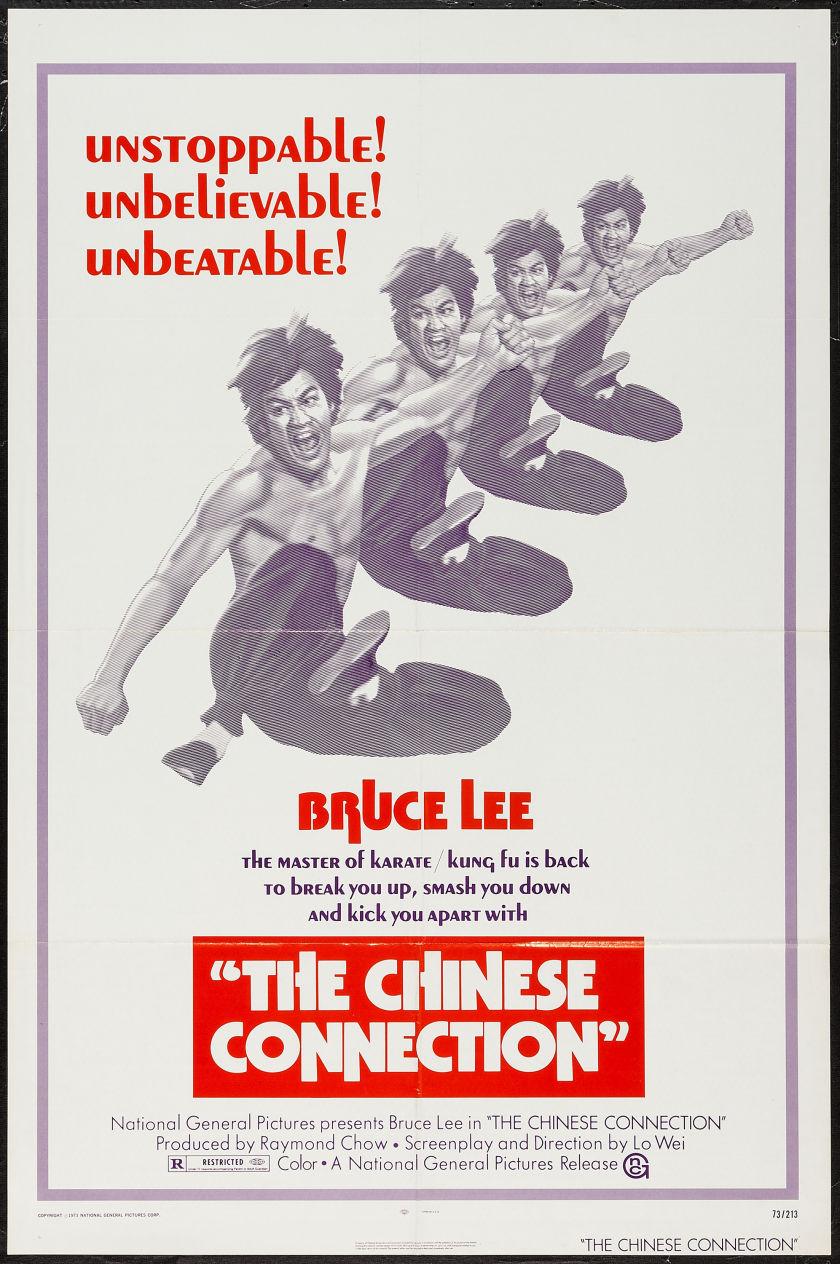
I started the month with Bruce Lee’s ENTER THE DRAGON and now I review a fifth Bruce Lee action spectacular, FIST OF FURY, originally called THE CHINESE CONNECTION for many, many years after its 1972 release in America.

FIST OF FURY ranks second in the Lee pantheon and for me it’s the most emotionally resonant of his pictures. ENTER THE DRAGON succeeds more as spectacle, a slambang entertainment, than anything else.

I’ve always responded to the story of Lee’s Chan Zhen in FIST OF FURY, a young man who stands against the Japanese antagonists who belittle their Chinese neighbors in Shanghai at every turn and Chan Zhen also seeks justice for those responsible for his master Huo Yuanja’s death. The other Lee films’ stories do not grip me quite like this one.

This was Lee’s second film, coming hot on the heels of THE BIG BOSS. It’s a far more successful film than its precursor, and it does away with any silly notion or pretense of nonviolence, when we all know that it would never last. I don’t think that withholding strategy worked whatsoever in THE BIG BOSS. I mean, come on, we just want to see Lee fight and waiting half the damn film made no damn sense. That would be like a Gene Kelly musical where he did not dance until the final scene.

FIST OF FURY gives us a couple nifty villains, although not quite as nifty as WAY OF THE DRAGON and ENTER THE DRAGON.

Former professional baseball player Riki Hashimoto portrays Suzuki, the master of the Hongkou dojo that presents so many problems for Chan Zhen and Huo Yuanja.

Hashimoto played for the Mainichi Orions (now the Chiba Lotte Marines) in the 1950s before an injury forced his early retirement. Hashimoto turned to acting and he had 25 credits from 1960 to 1985; FIST OF FURY was his third-to-last acting credit. Hashimoto died in 2017 at the age of 83, of lung cancer.

FIST OF FURY introduces a secondary villain, Suzuki’s translator played by Paul Wei. Yes, another movie where a translator’s rendered redundant by the fact all the characters are dubbed into English. Anyway, Wei returned in WAY OF THE DRAGON for a similar role. He’s an oily bastard in both movies, a weasel of the highest order basically. He’s called “Interpreter Wu” in FIST OF FURY and “Ho” in WAY OF THE DRAGON. Wei died in 1989.

So we have a story that grips us, a martial arts dynamo and all-around charismatic movie star in the lead role, and villains that we love to hate.

Sounds like a good movie.

Okay, now back to the titles. Until 2005, FIST OF FURY was mistakenly called THE CHINESE CONNECTION in America. See, they originally meant to title THE BIG BOSS as THE CHINESE CONNECTION and FIST OF FURY as, well, FIST OF FURY. They wanted to exploit William Friedkin’s THE FRENCH CONNECTION, a big critical and commercial success (and the first R-rated movie to win the Academy Award for Best Picture) that featured drug smuggling, just like THE BIG BOSS. For many years, however, we had the wrong titles.

Guess you could say though, in the case of FIST OF FURY, a good action movie under another name is a good action movie all the same.

On the eve of Thanksgiving, I’d like to say thanks for Lee (1940-73) and the work that he left behind. It’s still inspiring after all these years.

NOTE: This review was part of a series of reviews in November 2018.

Way of the Dragon (1972)

day 51, way of the dragon

WAY OF THE DRAGON (1972) Three stars
Foreign movies have always faced challenges in America. Always have, most likely always will.

I can remember selecting PAN’S LABYRINTH at the video store and the concerned clerk attempted warning me that it had subtitles.

I was at first amused and then quickly frustrated by this warning, and mumbled back “OK” in a way that communicates far more than just two letters.

Next time I hear something like that, I’ll pipe back, “I can read” and “Well, I hope so, I’m not that fluent in … ”

Some people just have an irrational fear of subtitles, apparently they are the chopsticks of cinema. Come on, suck it up buttercup and don’t be a candy ass, reading won’t kill you.

Another memorable foreign movie experience was CROUCHING TIGER, HIDDEN DRAGON at the Pittsburg 8 Cinema, where two airheads kept snickering throughout the picture and they accounted for more laughter than I heard that year during so-called comedies THE LADIES MAN and NEXT FRIDAY. I laughed most that year at DRACULA 2000, followed by THE SKULLS and ROMEO MUST DIE, although I have been informed that I should not have been laughing.

The challenges faced by foreign movies always come to mind every time I watch Bruce Lee’s WAY OF THE DRAGON, titled RETURN OF THE DRAGON in America because it was released after ENTER OF THE DRAGON. Lee’s movies, by the way, often had title issues.

I always hate it when characters are supposed to be speaking different languages (in WAY OF THE DRAGON, I am betting on Chinese, Italian, and English) and there’s obviously a translator in a scene. Instead, they’re all dubbed awkwardly into English and the translator merely repeats what’s already been said just moments ago. Scenes are (needlessly) rendered redundant.

This situation happened years ago during a version of Jean-Luc Godard’s CONTEMPT that played on Turner Classic Movies, where I was only left with contempt for the English dub. Apparently, only the French received a multilingual (French, English, Italian, and German) release while the American and Italian releases were dubbed entirely into their respective languages. Still a great movie, but the French version would have been superior because I’d rather have multiple languages all subtitled rather than everybody reduced to one dubbed language.

Thankfully, for WAY OF THE DRAGON, it’s a martial arts picture and Bruce Lee’s dynamism cannot be lost in translation.

Howard Hawks once called a good movie “three good scenes and no bad scenes,” and the director of SCARFACE, BRINGING UP BABY, and THE BIG SLEEP would know.

WAY OF THE DRAGON has the three good scenes down pat. Unfortunately, it’s got a few bad scenes, largely because of the dodgy dubbing, but we’ll cover two great scenes in this space.

WAY OF THE DRAGON features arguably the best cinematic display of Lee’s nunchakus, as he takes on a whole gang of buffoonish henchmen.

Lee was introduced to the weapon by Dan Inosanto, who battled against Lee with nunchakus in one of the best scenes in GAME OF DEATH.

Legend has it Lee played ping pong and lit cigarettes with nunchakus. Apparently, the part about ping pong, that’s false. The video was just a promotional spot with digital trickery and a Lee look-alike highlighting the shenanigans, a promo by the way for the Nokia N96 Limited Edition Bruce Lee cell phone that was produced in 2008. Doesn’t sound any more nefarious than any of the other Lee exploitation after his 1973 death.

The crime boss in WAY OF THE DRAGON hires American karate champion Colt and the legendary Chuck Norris makes his motion picture debut.

Lee’s Tang Lung and Colt have one of the great movie fights at the Colosseum and it’s quite possibly the best fight the Colosseum’s seen for at least a few hundred years, a 10-minute spectacle that never gets old to watch.

Indelible images like Norris’ chest hair (enough for a bear skin rug), that damn cute little cat (it gets more close-ups than Norma Desmond and Daffy Duck combined), and Lee’s touching gesture of final respect toward his worthy opponent after an epic battle make it more than just another fight.

Norris makes for a great villain, but it’s unfortunately a vein that he never tapped again, preferring to play square heroes.

Norris fans and fact hunters might deny the existence of WAY OF THE DRAGON. I found some alternative “facts” on the Internets.

Q: Why are there more Chuck Norris Jokes than Bruce Lee?

A: Because Bruce Lee is no joke.

FACT: Monsters look under the bed for Chuck Norris. Chuck Norris checks his closet and looks under the bed in fear of Bruce Lee.

FACT (using John Goodman’s piece-pulling Walter from THE BIG LEBOWSKI in the meme): “Am I the only one around here that thinks Bruce Lee is way more badass than Chuck Norris?”

Q: Want to know Chuck Norris fact?!

A: I (Bruce Lee smiling in the meme) kicked his ass.

The Big Boss (1971)

day 50, the big boss

THE BIG BOSS (1971) Two stars
Glad that I didn’t watch THE BIG BOSS (a.k.a. FISTS OF FURY) first among Bruce Lee films; ENTER THE DRAGON, RETURN OF THE DRAGON, and FIST OF FURY (a.k.a. THE CHINESE CONNECTION) each came before and that’s a groovy thing because I could definitely understand what the furor over Lee is about.

First time I watched THE BIG BOSS, I did not know what quite to make of it, other than I didn’t like it very much. I thought, let me get this straight, this is Lee’s first martial arts feature and his character has sworn an oath of nonviolence. Ridiculous. Absolutely ridiculous. I know, I know, they wanted a dramatic build-up to the inevitable moment when that nonviolence goes straight out the damn window and Hell (in the form of Lee) breaks loose. That’s just not how it works, though, for me and I have always found the moments leading up to the later fight scenes a genuine snoozer. Cue to the good parts, please. I’ve watched it several times and I’ve never been able to connect with it like many others have.

Lee’s character taking a pledge to nonviolence, why that’s about the equivalent of strapping a piano on Fred Astaire’s back during one of his musicals or it’s like making a great singer play a mute character for half the movie. This is not quite as frustrating as the script for JAWS 2 that delayed the inevitable for Sheriff Brody to go and kill the damn shark with some truly idiotic plot gyrations … but it’s close, real close. How many characters have to die before it’s set right?

No offense to Lee, but he was no Gandhi or Martin Luther King.

I don’t care what anybody says, but we go to a Lee movie for the fight scenes and there’s just not enough of them in THE BIG BOSS (nearly 120 minutes in length) for it to qualify as one of Lee’s better efforts. It’s a grade above GAME OF DEATH or at least the bastardized posthumous version conjured up by Robert Clouse of what could have been Lee’s masterpiece had the man been able to complete it.

There’s still moments, though, in THE BIG BOSS when you realize what’s so special about Lee. He’s truly one of a kind, even in dreck. This flick made Lee famous throughout Asia, and it became the highest-grossing film of all-time in Hong Kong in 1971, beating out THE SOUND OF MUSIC and TORA! TORA! TORA! That’s all because of Lee, who commands the screen like only a select few have in motion picture history.

Like GAME OF DEATH and its fight scenes late in that movie, viewers have to wade through a lot of crap just to get to the high points; we’re knee deep. There’s a 4-5 minute fight sequence in the ice factory in THE BIG BOSS that gets at the heart of Lee’s appeal, though Lee memorably made his own criticism of his own movies in ENTER THE DRAGON, “Why doesn’t somebody pull out a .45 and, bang, settle it?”

Of course, that would not be within the basic spirit of a martial arts picture. The genre exists as an alternative to the Western and it’s based on a lot of the same themes, such as integrity and honor, as what was once the quintessential American movie genre. Martial artists, though, use their fists and feet rather than guns.

The graphic violence, though, in THE BIG BOSS belongs more to a Spaghetti Western than anything directed by John Ford or Anthony Mann.

THE BIG BOSS is a poorly made exploitation film that features one great aspect (two if you count that poster; all Lee’s films have incredible posters) and reportedly director Lo Wei (1918-96) was more interested in the racetracks than the film. Wei’s known for launching both Lee and Jackie Chan, directing Lee in THE BIG BOSS and FIST OF FURY and Chan in NEW FIST OF FURY. Wei can be seen in FIST OF FURY as the police inspector Lo.

Game of Death (1978)

day 44, game of death

GAME OF DEATH (1978) One-and-a-half stars
After Bruce Lee’s death in 1973, a new genre of exploitation films came into existence, “Bruceploitation.”

Actors in this genre included Bruce Li, Bronson Lee (combining two action stars), Bruce Lai, Bruce Le, Bruce Lei, Bruce Lie, Bruce Liang, Saro Lee, Bruce Ly, Bruce Thai, Bruce K.L. Lea, Brute Lee, Myron Bruce Lee, Lee Bruce, and Dragon Lee, while Jackie Chan was touted as the next Bruce Lee until he found his own groove with SNAKE IN THE EAGLE’S SHADOW and DRUNKEN MASTER (both 1978).

“Bruceploitation” films often included some variant of “Enter,” “Fist,” “Fury,” “Dragon,” and “New” in their titles. BRUCE LEE FIGHTS BACK FROM THE GRAVE, that’s my favorite title and VHS cover art.

The films were nearly all garbage.

That leads us to GAME OF DEATH.

Lee started filming GAME OF DEATH after WAY OF THE DRAGON and he finished a few dazzling fight sequences, including the most famous one against NBA superstar Kareem Abdul-Jabbar, a matchup pitting the 5-foot-7 Lee and 7-2 Abdul-Jabbar. GAME OF DEATH had all the makings of Lee’s masterwork.

Alas, it never came to be.

Lee stopped filming GAME OF DEATH to go make ENTER THE DRAGON, the film that helped break martial arts films in the international market.

Unfortunately, Lee died on July 20, shortly before the release of ENTER THE DRAGON, and he never completed GAME OF DEATH.

A few years later, director Robert Clouse built a theatrical version of GAME OF DEATH around Lee’s three fight scenes (totaling 11 minutes), with all sorts of subterfuge used to “cover” for the fact Lee died and left a major hole in the production. Clouse, under the pseudonym Jan Spears with Raymond Chow, concocted an entirely different plot leading up to the fights and changed Lee’s character from “Hai Tien” to “Billy Lo.” Amazingly enough, two former Academy Award winners found their way into the cast, Dean Jagger (in his penultimate theatrical film) and Gig Young (in his final film).

This insulting subterfuge includes multiple Lee stand-ins who hide behind shades for the majority of the movie, stock footage beginning with Lee’s fight scene from WAY OF THE DRAGON against Chuck Norris, a superimposed towel over stock footage, a cardboard cutout, cuts to “fake” Bruce from “real” Bruce, and finally footage from Lee’s actual funeral.

You can differentiate stock footage from the body of the movie, because of its grainy quality.

Abdul-Jabbar even refused to participate in the reshoot and so they filled the “Hakim” part with somebody who does not even closely resemble the basketball star.

In other words, none of it’s well done.

Not that it should have been done at all.

Heart of the Matter: The 11 minutes of the real Lee are the only reason GAME OF DEATH gets more than one star for a rating and these scenes are the only reasons for watching. Lee deserved better, a lot better, than a cynical slapdash exploitation film like the first 80 minutes directed by Clouse.

In those 11 minutes, however, we remember what a dynamo Lee truly was, a marvel of modern man. Just dazzling.

Thankfully, after technological advances, viewers can skip all the bullshit and cue up the good parts, as Phil Hartman’s Telly Savalas said (about different movies, lol, but yeah, we don’t have time to fast-forward).

Still, it’s tempting to speculate what could have been.

They could have taken all of Lee’s completed footage and built around it with interviews from Lee himself, Norris, Abdul-Jabbar, Robert Wall, Steve McQueen, James Coburn, et cetera. Or just used only the completed footage.

Nearly anything would have been superior to what they did for the first 80 minutes in GAME OF DEATH.

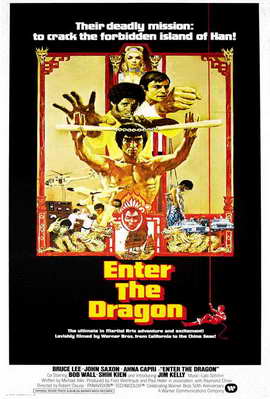
Enter the Dragon (1973)

DAY 34, ENTER THE DRAGON

ENTER THE DRAGON (1973) Four stars
There’s a line in BLADE RUNNER that makes me think about Bruce Lee (1940-73), “The light that burns twice as bright burns half as long, and you have burned so very very brightly.”

Lee made his screen debut as an infant in GOLDEN GATE GIRL, a.k.a. TEARS IN SAN FRANCISCO.

He appeared in several films throughout the ’50s and ’60s, and played the role of Kato on “The Green Hornet” during that show’s 1966-67 run.

Lee made his legend, though, on five martial arts films that were filmed over a period of two years in the early ’70s, where his light burned twice as bright half as long: THE BIG BOSS, FIST OF FURY, THE WAY OF THE DRAGON, ENTER THE DRAGON, and THE GAME OF DEATH (a new, different plot filmed after his death around Lee’s completed fight scenes; Lee postponed finishing THE GAME OF DEATH to make ETD).

ENTER THE DRAGON was the groundbreaker, known as the first martial arts film produced by a major American studio and for a whopping $850,000. The film made $21,483,063 in North America and coupled with the success of the English dub of FIVE FINGERS OF DEATH earlier in 1973, martial arts exploded. (Lee’s earlier films FIST OF FURY and THE WAY OF THE DRAGON fared much better financially in Hong Kong.)

Unfortunately, Lee died of a cerebral edema on July 20, 1973, just six days before ENTER THE DRAGON premiered in Hong Kong. One month later, it premiered in the United States at Grauman’s Chinese Theatre on the Hollywood Walk of Fame.

It’s been said that Lee was very nervous before making ENTER THE DRAGON. Lee’s wife, Linda Lee Cadwell, countered that in the Q&A session for the film’s 40th anniversary Blu-ray.

“I think it’s been portrayed that (Bruce) was very nervous before filming began,” she said. “I think it’s been misrepresented to the point that some people say he was having a nervous breakdown he was so paralyzed by fear. That is false. He was a professional actor. He’d been acting his whole life. And he was a professional martial artist as well. So he had no butterflies about that kind of thing. But what he wanted was to make this film very special. And he had ideas he would like to see added to the script. He was very adamant about it.

“He really put a lot of work into studying how to improve this film. To make it the best product that it could be because this was an important film for Bruce. It was going to be his first introduction to the American market. There was some reticence on the side of the people making the film. They wanted Bruce to get on the set and get going but he didn’t want to show up and get going on the film until the things he wanted — namely all the philosophy ­— in the film were done.”

ENTER THE DRAGON has been described as James Bond meets Fu Manchu, a fact some reviewers have lamented.

For example this one from Time Out, “A sorry mixture of James Bond and Fu Manchu, it tacks together the exploits of a multi-national crew of martial artists converging on Hong Kong for a tournament, infiltrated by Lee — fresh from his Shaolin temple — on an assignment to bust an opium racket. Worth seeing for Lee, but still unforgivably wasteful of his talents.”

Paul Bramhall wrote “Enter the Dragon: The Most Overrated Kung Fu Movie Ever?” in July 2018 and here’s his take on the Bond element: “The influence of Bond drifts in and out of ENTER THE DRAGON like spliced footage in a Godfrey Ho movie, making it come across as shoehorned in rather than a natural part of the narrative. … Released the same year as Roger Moore’s debut as Ian Fleming’s most famous creation, the secret agent styled shenanigans on display in ENTER THE DRAGON were dated even before it hit cinema screens. Casting Geoffrey Weeks a poor man’s M, and a head scratching plot of a rogue Shaolin student using a martial arts tournament as a front to his opium smuggling operation, (director) Robert Clouse and co. should have taken a page out of the ‘less is more’ manual of filmmaking.”

Nigel Tufnel had the answer for all that, “That’s just nitpicking, isn’t it?”

ENTER THE DRAGON downplays the sex angle, the double entendres, and the gadgets, and this low-budget “Bond movie” can stand head-to-head with any of the best Bond films like FROM RUSSIA WHITH LOVE, GOLDFINGER, ON HER MAJESTY’S SECRET SERVICE, and SKYFALL, for example.

Like how those early Bond films gather a lot of their appeal from the star power of Sean Connery, ENTER THE DRAGON draws heavily on Lee.

He’s a movie star, yes, tried and true with charisma and electricity that can transcend a low budget, a dodgy or dopey plot, awkward and awful voice dubbing, and other production lapses.

Lee ranks with Humphrey Bogart, Marilyn Monroe, James Dean, et cetera, all the great stars of the screen.

Not only that, watching Lee in action is like watching great athletes Barry Sanders, Jerry Rice, Michael Jordan, and Mike Tyson, for example.

You know you’re watching the very best, a grand master at his or her craft and somebody in the greatest physical (and mental) shape.

George C. Scott said that he looked for a “joy of performing” quality in judging actors, that the great ones separated themselves from the good with their joy. Scott named James Cagney.

You can say all these actors and athletes named in the last few paragraphs all have this “joy of performing.”

Lee definitely had that joy, and it’s apparent throughout even his worst movies.

Unlike the other Lee martial arts movies released in America, though, we hear Lee’s actual speaking voice in ENTER THE DRAGON.

He’s very, very quotable and my friends and I loved to do our best Lee impression with lines such as “Don’t think. FEEEEEEEEL! It’s like a finger pointing away to the moon. Do not concentrate on the finger or you miss all of the heavenly glory,” “You can call it the art of fighting without fighting,” and “Why doesn’t somebody pull out a .45 and, bang, settle it?”

In addition to Lee at the center, we have John Saxon and Jim Kelly as Roper and Williams, respectively, who also end up on Han’s Island (not to be confused with the small, uninhabited island that Canada and Denmark are in dispute over) because they were designed to give the film a wider appeal to maximize profits. Unlike Lee, who transcends fads and fashions, Saxon and Kelly and their characters are a bit more prisoner of the times. Fortunately, the two Americans both have enough personality and martial arts skill to justify their presences, and they’re fun.

Then we have the arch villain Han, just like a Bond picture, but please try and picture Gert Frobe or Telly Savalas do martial arts battle with Lee and the other protagonists and their fists and feet of fury.

Shin Kein (his speaking voice dubbed by Keye Luke, since he did not speak English) received acting credits in 272 films from 1940-95 and he’s most identified with Han. Like the best of the Bond films, Han contributes to the success of ENTER THE DRAGON with his villainy, a great foil to the good guys.

I love this blurb from his profile on the Villains Wiki, “Han is a heroin drug lord who runs his heroin cooking business from a secluded island. He also lost a hand, though how he lost it is never explained. He keeps the bones of the severed hand on display in a museum of torture and weapons. In place of the missing hand he has a variety of weapon hands to use like a iron hand, claw hand and a bladed hand. He is also an expert in martial arts.”

ENTER THE DRAGON ends in slambang fashion with the final fight between Lee and Han — a scene that could be played right alongside THE LADY FROM SHANGHAI and DUCK SOUP, three of the best usages of mirrors in motion picture history.

I would love to have seen ENTER THE DRAGON at its American premiere, just for the response to Lee alone.

NOTE: Raymond Chow, the producer behind Lee and Jackie Chan, died Friday, November 2, 2018 at the age of 91.