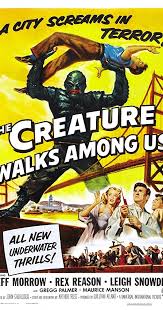
The Creature Walks Among Us (1956)

THE CREATURE WALKS AMONG US (1956) **1/2
I should have already learned my lesson.

I bitch about the yucky suck face between scientists John Agar and the lovely Lori Nelson through most of the second half of Revenge of the Creature, so it only serves me right that I got immediately served with the miserably married couple played by Jeff Morrow and Leigh Snowden in The Creature Walks Among Us, the third and final entry in the Creature series released by Universal Studios. Morrow and Snowden are truly a downer and their scenes drag The Creature Walks Among Us down a notch or two from being a perfectly enjoyable creature feature.

All three Creature features benefit heavily from their underwater photography and Walks Among Us works best when the action takes place underwater. Above water, especially when Morrow and Snowden provide us another unpleasant scene together, it’s not so hot. Watching Revenge and Walks Among Us in close proximity, it’s obvious just how much influence these earlier films had upon the later Jaws series also produced by Universal. Jaws 3 borrowed major plot developments from Revenge, for crying out loud.

In a fundamental way, though, Walks Among Us cheats us. It doesn’t really live up to any part of that title until the very end of the picture, when the title character escapes from captivity. I certainly don’t remember a city screaming in terror and the poster incorporates the Golden Gate Bridge into its promotional campaign. Good job, marketing department. Sure, we see the Golden Gate, kinda sorta obligatory for any film shot for any length in San Francisco, but I don’t recall any character being held up above the Golden Gate by our title character, sure to be thrown to his death. Now, that would be an impressive scene.

I feel like I must make amends in this review for cheating Ricou Browning (born 1930) in the Revenge review. He’s the man in the creature suit in the underwater scenes. In Walks Among Us, Don Megowan plays the Gill Man on land. In Revenge, it was Tom Hennesy. In Creature, it was Ben Chapman. I believe it’s a testament to the quality of Browning’s work in the underwater scenes that he filled the creature suit in all three movies.

Strangely enough, I felt a certain sadness during Walks Among Us, alternating with a sense of overall wonderment toward the Universal Classic Monsters series. Walks Among Us ended a stretch where I watched 16 classic horror films, from 1935’s Werewolf of London to 1956’s The Creature Walks Among Us, for the first time, having already watched Universal’s true classics like The Bride of Frankenstein and The Wolf Man several times before. Because I even sometimes enjoy watching a bad movie, like The Invisible Woman, this stretch greatly satisfied both the historian and the horror movie fan living inside me.

Top 12 Universal Classic Monster Movies
1. The Bride of Frankenstein (1935)
2. Frankenstein (1931)
3. The Wolf Man (1941)
4. Son of Frankenstein (1939)
5. Creature from the Black Lagoon (1954)
6. The Invisible Man (1933)
7. The Phantom of the Opera (1925)
8. The Mummy (1932)
9. Dracula’s Daughter (1936)
10. Dracula (Spanish version) (1931)
11. Dracula (English version) (1931)
12. Abbott and Costello Meet Frankenstein (1948)
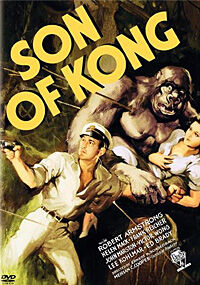
Son of Kong (1933)

SON OF KONG

Son of Kong (1933) Two stars

Released on Mar. 7, 1933, in New York City and a month later nationally, King Kong quickly took the nation by storm and became a cinematic landmark.

Nine months later, incredibly, RKO released the sequel Son of Kong and Hollywood did not make another Kong picture for more than 40 years.

Son of Kong just might be Hollywood’s first rush job and one of its first sequels*. It is a pleasant enough movie to watch, but obviously it’s not a patch on an all-time classic. I’ve watched the original numerous times, but I doubt I’ll want to return to Son of Kong a second time.

That’s because it’s virtually dull as dishwater. It takes approximately 45 minutes to get to our title character. That’s way too long for a movie that lasts only 69 minutes. Despite the return of Carl Denham, the most interesting human character in King Kong, played by the reliably entertaining Robert Armstrong, Son of Kong does not maintain the interest level high enough for a Kong movie. Of course, the original set the bar incredibly high.

They give Denham a potential romantic interest, because lovebirds Ann Darrow (Fay Wray) and John Driscoll (Bruce Cabot) quite naturally did not return for the sequel after their harrowing experiences, and Helen Mack’s Helene Peterson epitomizes the movie as a whole, since she’s pleasant but dull. She’s a singer, not an actress like the lovely Miss Darrow, and gets a production number. Again, pleasant but dull.

Kong co-directors Ernest B. Schoedsack and Merian C.Cooper returned as director and producer. Special effects guru Willis O’Brien and composer Max Steiner also returned, as did some of the supporting cast.

They were on a tight budget, an even tighter schedule, and they obviously knew there was no way they could topple King Kong. Armstrong himself preferred Son of Kong, but that’s because Denham received greater character arc. He’s probably the only person to ever prefer Son over its father. Both the son and the sequel are kinder, gentler — not good for a creature feature.

Sequels very rarely even approach their predecessors, and that was true in 1933 every bit as it is this very day.

For every Bride of Frankenstein and The Empire Strikes Back, we have a million failures and footnotes, like Son of Kong.

*United Artists released Don Q, Son of Zorro in 1925, a sequel to the 1920 classic Mark of Zorro. Swashbuckler supreme Douglas Fairbanks starred in both films. Son of Zorro also predates Son of Kong, Son of Frankenstein, Son of Godzilla, and Son of the Mask. To be fair, though, the sound of a toilet flushing predates Son of the Mask.

Young Frankenstein (1974)

YOUNG FRANKENSTEIN

YOUNG FRANKENSTEIN (1974) Four stars

Over a 20-year period from the late ‘60s to the late ’80s, Mel Brooks directed a series of inspired comedies: THE PRODUCERS, THE TWELVE CHAIRS, BLAZING SADDLES, YOUNG FRANKENSTEIN, SILENT MOVIE, HIGH ANXIETY, HISTORY OF THE WORLD PART I, and SPACEBALLS.

I’ll choose YOUNG FRANKENSTEIN as his best (i.e. my favorite) work.

It’s not his funniest work, per se, but you could put it on a DVD following FRANKENSTEIN, BRIDE OF FRANKENSTEIN, SON OF FRANKENSTEIN, and THE GHOST OF FRANKENSTEIN and it would be perfect. In fact, YOUNG FRANKENSTEIN nearly gives you the feeling that it’s a lost classic from Universal Studios during their reign of terror.

Brooks and co-writer and star Gene Wilder obviously loved Universal classics like FRANKENSTEIN. Brooks’ last feature film, DRACULA: DEAD AND LOVING IT, came in 1995, so Brooks took on Universal’s two most legendary monsters.

We can be sure the big boys at 20th Century Fox did not want YOUNG FRANKENSTEIN made in black & white. Some folks are guaranteed to say, “Black & white will never work again,” but what about every time it has worked over the years.

Wilder and Brooks based their characters on Mary Wollstonecraft Shelley’s original classic novel. They might as well have credited the screenwriters for the old Universal FRANKENSTEIN pictures.

All the technical people deserve their fair share of the credit for YOUNG FRANKENSTEIN: John Morris’ musical score, Gerald Hirschfeld’s cinematography, John C. Howard’s editing, Dale Hennesy’s production design, Robert De Vestel’s set decoration, Dorothy Jeakins’ costume design, and Edwin Butterworth’s, Mary Keats’, and William Tuttle’s work in the makeup department.

YOUNG FRANKENSTEIN benefits from using some of the same sets the original FRANKENSTEIN used.

Beyond the overall look and style of the picture, though, both the performances and the jokes are their usual grab bag that’s found in a Mel Brooks film.

Wilder’s obits called him “A Master of Hysteria” and he gave some of his defining performances in Mel Brooks comedies, namely THE PRODUCERS, BLAZING SADDLES, and YOUNG FRANKENSTEIN. There’s even the legendary “I’m hysterical and I’m wet” scene in THE PRODUCERS. Honestly, though, I prefer Wilder when he’s more calmer, more restrained and that patented hysteria did not work as well in his later pictures.

Wilder’s hysteria fits Dr. Frederick Frankenstein, the grandson of Victor Frankenstein, because British actor Colin Clive (1900-37) specialized in a bit of hysteria in FRANKENSTEIN and BRIDE OF FRANKENSTEIN.

Brooks himself does not appear as a main character in YOUNG FRANKENSTEIN, which differentiates it from later Brooks productions like SILENT MOVIE, HIGH ANXIETY, and HISTORY OF THE WORLD PART I.

Marty Feldman (1934-82) was perfect for the role of Igor (pronounced “EYE-gore”), Frankenstein’s hunchback compadre. Madeline Kahn (1942-99), Cloris Leachman, and Teri Garr insure that it’s not all about the boys — Kahn eventually makes a perfect bride for The Monster after being engaged to Frankenstein, Leachman plays a character and a name (Frau Blucher) loved by horses, and Garr’s cleavage deserves its own screen credit. Kenneth Mars’ police inspector Hans Wilhelm Friedrich Kemp calls to mind Dr. Strangelove in addition to his FRANKENSTEIN precursors. Gene Hackman makes a cameo as the blind hermit who befriends The Monster.

That brings us to The Monster, played by the great character actor Peter Boyle (1935-2006). I’ll make a case for Boyle being the second best actor to play The Monster, behind only the immortal Boris Karloff (1887-1969) who initiated the role. Boyle definitely gives a better performance than his TAXI DRIVER co-star Robert DeNiro did as “The Creation” in Kenneth Branagh’s MARY SHELLEY’S FRANKENSTEIN (1994). Of course, Boyle is the only Monster required to perform a soft-shoe number and he enjoys a domestic life.

Brooks practiced “saturation comedy,” a style where the jokes fly past fast and furious. It’s been said to not worry if you missed one joke because another one will be coming any moment. Brooks’ comedies are not quite as saturated as the works of the Zucker Brothers and Jim Abrahams during AIRPLANE!, TOP SECRET!, and THE NAKED GUN, which have jokes in virtually every inch of the frame. Saturation comedies are special because they believe in the intelligence of the audience, that we’re smart enough to get the jokes.

I’ll say that my favorite moment in YOUNG FRANKENSTEIN involves a revolving bookcase.

Bride of Frankenstein (1935)

day 14, bride of frankenstein

BRIDE OF FRANKENSTEIN (1935) Four stars
Boris Karloff movies could fill an entire year of daily movie reviews.

Karloff (1887-1969) undoubtedly is one of the most prolific actors who ever lived, working steadily from 1918 through 1968.

Karloff established an incredible work pace, especially in the 1930s.

Take, for example, the years 1931 and 1932 alone when Karloff appeared in 24 films, including such classics as FRANKENSTEIN, SCARFACE, THE OLD DARK HOUSE, THE MASK OF FU MANCHU, and THE MUMMY.

He was billed only as “Karloff” in several pictures after FRANKENSTEIN (1931) made him a phenomenon.

For example, a producer’s note before the start of THE OLD DARK HOUSE: “Karloff, the mad butler in this production, is the same Karloff who created the part of the mechanical monster in ‘Frankenstein.’ We explain this to settle all disputes in advance, even though such disputes are a tribute to his great versatility.”

Every time I watch both FRANKENSTEIN and BRIDE OF FRANKENSTEIN (1935), I am just amazed once again by what Karloff was able to do with The Monster.

He’s absolutely phenomenal.

It took make-up artist Jack Pierce four hours every day to make Karloff into Frankenstein’s Monster, with a concoction of cotton, collodion, gum, and green greasepaint. Pierce and Karloff worked together on a multitude of films during the Golden Age of Horror (1930s and 1940s).

The IMDb identified eight Karloff trademarks and I especially like the eighth one: “Making audiences feel sorry for his evil characters by displaying extreme frailty and vulnerability, even when the material didn’t call for this.”

We feel a multitude of things for the Frankenstein Monster, and that’s at the center of the character’s greatness.

We especially feel for The Monster during BRIDE OF FRANKENSTEIN, a rare sequel that builds upon and honestly betters the previous film.

Karloff did not want The Monster to speak, feeling that it would eventually destroy the character. He looks a little differently here than in the first film, because in order to speak more clearly Karloff did not remove the dental plate in his face like he did in the first film. His cheeks appear less hollow as a result.

While giving The Monster the ability to speak could have miserably backfired, it works (like just about everything else) in BRIDE OF FRANKENSTEIN.

The Monster is a quick learner and the writers give him some great lines.

“I love dead … hate living” and “Alone: bad. Friend: good!” might not seem like much on the page, but the way Karloff handles them, they affect viewers on a deep emotional level.

There’s much poignancy to be found in the plight of The Monster.

He’s more like an innocent child than pure evil in both FRANKENSTEIN and BRIDE OF FRANKENSTEIN.

He can’t help what God or Dr. Henry (Victor in the novel) Frankenstein in this case made him.

Like Karloff, Colin Clive returns for the sequel as Dr. Frankenstein and he’s reluctant to the extreme (after the events of the first movie) to participate in Dr. Pretorius’ scheme to make The Monster a bride. Finally, he does though, of course, and it’s back to the laboratory; production designer Charles D. Hall’s lab sets in the first two FRANKENSTEIN films have been endlessly influential.

Clive and Dwight Frye (killed as two different characters in FRANKENSTEIN and BRIDE OF FRANKENSTEIN) are two of the great scenery chewers of all-time, but this is largely Karloff’s and Ernest Thesiger’s show.

Thesiger plays Dr. Pretorius, Dr. Frankenstein’s former teacher and, of course, a rebellious mad scientist. He’s as explicitly homosexual as one could present in a 1935 film and, according to the book “The Monster Show: A Cultural History of Horror” by David J. Skal, openly gay director James Whale told Thesinger to play Dr. Pretorius as an “over-the-top caricature of a bitchy and aging homosexual.”

Frankenstein and Pretorius rank among the best screen mad scientists.

BRIDE OF FRANKENSTEIN can be enjoyed at face value or can be seen as a daring gay parable that sneaked just enough content past the censors.

In the 1997 Gary Morris article “Sexual Subversion: The Bride of Frankenstein” printed in the Bright Lights Film Journal, the author postulates that the movie “assaults the notion of the sanctity of standard sex roles and ‘family values.'” Whale thus made the only sequel that interested him.

“THE BRIDE can be read from a modern perspective as a homosexual joke on the heterosexual communities Whale — a gay man — served and benefited from: his ‘masters’ at Universal and the mass audience to whom he could present unconventional images and ideas and see them unknowingly endorsed and approved in the most direct way possible: from the moviegoer’s pocketbook,” Morris wrote.

Under this theory, Whale’s attacks on hetero institutions can be seen most vividly when The Bride (Elsa Lanchester) rejects The Monster near the end, including a famous hiss that speaks louder than a thousand words. (Reportedly, Lanchester based her spitting and hissing on the swans in Regent’s Park, London.)

Not everything passed the censors enforcing the Motion Picture Production Code: Any references to the sexual arrangements of Mary Shelley (Lanchester in her first of two roles), Percy Bysshe Shelley, and Lord Byron (especially this line of dialogue: “We are all three infidels, scoffers at all marriage ties, believing only in living freely and full”) and “too revealing” shots of Lanchester’s cleavage were cut.

It’s still amazing what Whale put into the film.

Others have dismissed the gay parable angle in BRIDE OF FRANKENSTEIN.

That’s fine because any way you read it, though, BRIDE OF FRANKENSTEIN is a classic.