
Karloff Meets Lugosi Meets Poe: The Black Cat, The Raven

KARLOFF MEETS LUGOSI MEETS POE: THE BLACK CAT, THE RAVEN
Boris Karloff (1887-1969) and Bela Lugosi (1882-1956) endure as two icons of horror and their best movies remain essential to a greater understanding of the horror genre long after their death.

Karloff and Lugosi starred in many classic films. Dracula. Frankenstein. Island of Lost Souls. The Mummy. White Zombie. Old Dark House. Murders in the Rue Morgue. The Mask of Fu Manchu. Chandu the Magician. The Bride of Frankenstein. Mark of the Vampire. The Black Room. The Man They Could Not Hang. The Wolf Man. Frankenstein Meets the Wolf Man. The Return of the Vampire. House of Frankenstein. Isle of the Dead. Bedlam. Abbott and Costello Meet Frankenstein. Targets.

That list grows once the several films they made together are considered: The Black Cat, The Raven, The Invisible Ray, Son of Frankenstein, Black Friday (not a classic), You’ll Find Out (not seen this one), and The Body Snatcher.

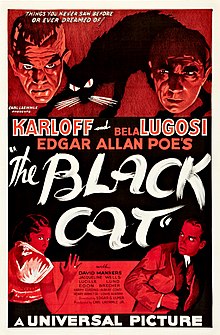
The Black Cat and The Raven, generally paired together in greatest hits packages, are the films where Karloff and Lugosi are most evenly matched on screen. They’re both immortal movie classics based on that mere fact alone; Lugosi nearly walks away with Son of Frankenstein as Ygor, while it’s sad to see how much of a nonentity part Lugosi received in The Body Snatcher, especially when compared against Karloff’s meaty role as John Gray and perhaps his best performance.

Young American lovers on their honeymoon in Hungary, a train ride beginning and ending the picture, a dark and rainy night, a road accident, an old dark house, an enigmatic doctor, a Satan worshipping priest, a story suggested by the work of Edgar Allan Poe with story and direction from Edgar G. Ulmer, and The Black Cat flies past in about 65 minutes, like a lot of the early horror classics.

Of course, there’s Karloff credited merely as Karloff, David Manners as one of the young American lovers, and Karloff and Lugosi find themselves at each other’s throat by the end of the picture.

Like the Frankenstein pictures and the Mary Shelley source material, The Black Cat departs almost entirely from Poe’s short story originally published in The Saturday Evening Post on August 19, 1843. I am okay with that, because Ulmer has a style all his own like James Whale in Frankenstein and The Bride of Frankenstein and The Black Cat pairs two movie legends for the first time.

The Raven gets done faster than even The Black Cat at 61 minutes, credits both Karloff and Lugosi with their surnames alone, and it has a lot of the same elements as The Black Cat.

Lugosi plays arguably his most diabolical and evil character in Dr. Richard Vollin, the archetype for the brilliant but troubled surgeon who has this, let’s say, morbid obsession with instruments of torture. He’s not your average doctor, obviously. Lugosi chews through the scenery, especially in the final reel, and relishes lines like Death is my talisman, I like torture, I tear torture out of myself by torturing you, and Poe, you are avenged!

Yes, he’s also obsessed with Edgar Allan Poe. The Pit and the Pendulum even makes a cameo appearance!

The Raven tilts more toward being Lugosi’s show because Karloff doesn’t even show up for his first scene until 17 minutes into the picture.

Karloff is great though, of course, and brings a certain poignancy to the tortured murderer on the run Edmond Bateman, who just wants the doctor to fix his ugly face.

EB: I’m saying, Doc, maybe because I look ugly … maybe if a man looks ugly, he does ugly things.

DRV: You are saying something profound.

Naturally, Vollin makes Bateman’s face even uglier and enlists him in a diabolical scheme.

The rest of the cast doesn’t measure up against Lugosi and Karloff, especially Irene Ware as the screaming socialite Jean Thatcher, but it doesn’t really matter because Lugosi and Karloff are so damn great.

I heartily recommend The Black Cat and The Raven, both Poe and Universal.

The Black Cat (1934) ****; The Raven (1935) ****


Frankenstein Meets the Wolf Man (1943)

FRANKENSTEIN MEETS THE WOLF MAN (1943) ***1/2
Frankenstein Meets the Wolf Man starts with an absolute big bang and we have possibly the greatest five minutes in any classic Universal monster movie.

That includes such immortal movies as Frankenstein, The Bride of Frankenstein, Son of Frankenstein, Dracula, The Mummy, The Invisible Man, and The Creature from the Black Lagoon, all stone cold classics essential to every horror movie lover.

The opening gets everything absolutely right: two grave robbers, a cemetery in the middle of the night, Larry The Wolf Man Talbot’s crypt, a full moon, a whole bunch of wolfbane, the revived Wolf Man’s hand, and enough overall spooky atmosphere for approximately 50 scary movie scenes. Yeah, it’s such a phenomenal sequence that director Tom McLoughlin revived it for his opening in Jason Lives, the one film during that long-running series most influenced by classic monster movies.

The rest of Frankenstein Meets the Wolf Man does not quite measure up, especially once Frankenstein’s Monster enters the picture, but it’s still a great deal of fun.

Of course, it doesn’t hurt any that Lon Chaney Jr. (1906-73) returns as Larry Talbot, one of the greatest horror movie characters. Chaney Jr. played Talbot five times from 1941 through 1948 — the original Wolf Man, Frankenstein Meets the Wolf Man, House of Frankenstein, House of Dracula, and Abbott and Costello Meet Frankenstein.

Talbot’s a tortured soul — in fact, mondoshop.com hypes its Wolf Man poster, The most tortured soul in the Universal Monsters universe is unquestionably that suffering bastard Larry Talbot, a.k.a. The Wolf Man — and we feel great empathy for this character because he essentially doesn’t want any damn part of being the Wolf Man. Your own son Bela was a werewolf. He attacked me. He changed me into a werewolf. He’s the one that put this curse on me. You watched over him until he was permitted to die. Well, now I want to die to. Won’t you show me the way?

In that way, he’s different from Dracula, Frankenstein’s Monster, the Mummy, and the Invisible Man. Lon Chaney’s Phantom in the 1925 classic The Phantom of the Opera inspires similar feelings as Talbot and the Wolf Man. To his enduring credit, Boris Karloff (1887-1969) worked some pathos into Frankenstein’s Monster, especially in Frankenstein and The Bride of Frankenstein. Still, Talbot stands apart from most cinematic monsters and maybe it’s because he’s the most explicitly human.

Bela Lugosi (1882-1956) passed on Frankenstein’s Monster in Frankenstein, much to his eternal regret, and so he signed on for the Monster in Frankenstein Meets the Wolf Man after playing Ygor in Son of Frankenstein and The Ghost of Frankenstein. During the latter film, one might remember that Dr. Ludwig Frankenstein accidentally put Ygor’s brain into the Monster’s head — he speaks poetically at one point in the film, I am Ygor. In a series that paid minuscule attention to continuity from one film to the next, the Monster originally spoke and explained his plight in Frankenstein Meets the Wolf Man, but Universal studio heads apparently laughed their heads off at Lugosi’s dialogue and demanded it be excised from the final cut, rendering the monster absolutely ridiculous and his scenes basically a washout. I am not sure why Lugosi’s voice suddenly became laughable. Lugosi’s stunt double stands in for the 61-year-old man in many scenes. Ironically, though, whenever people imitate Frankenstein’s Monster, it’s the Lugosi version from Frankenstein Meets the Wolf Man. (Lugosi played Bela in The Wolf Man and Chaney Jr. was Frankenstein’s Monster in The Ghost of Frankenstein after Karloff bowed out.)

We’re not sure exactly why the Monster’s encased in ice or why there’s a production number that must have moseyed on over from MGM. The second half of Frankenstein Meets the Wolf Man often leaves us feeling awful perplexed.

Frankenstein Meets the Wolf Man finishes strong, thankfully, and we do see our titular monsters slug it out, though it presents an internal struggle because while we’d love more battle royale between the monsters we do love the 90 seconds they give us. This movie paved the highway for King Kong vs. Godzilla and Freddy vs. Jason.

In most every way possible, Frankenstein Meets the Wolf Man proves to be a red hot mess, but a lovable and thoroughly entertaining one nonetheless.

Boris, Boris, Boris: The Man They Could Not Hang, The Man with Nine Lives, The Boogie Man Will Get You

BORIS, BORIS, BORIS: THE MAN THEY COULD NOT HANG, THE MAN WITH NINE LIVES, THE BOOGIE MAN WILL GET YOU

I am a big fan of the horror movies of the 1930s and 1940s and I am a big Boris Karloff (1887-1969) fan.

Older horror movies often stand out for two main reasons: atmosphere and wit. Just think DR. JEKYLL AND MR. HYDE and THE BRIDE OF FRANKENSTEIN.

Karloff’s film career began in the silent era and he was already 80 movies deep into his career when he portrayed Frankenstein’s Monster in James Whale’s 1931 FRANKENSTEIN. Karloff’s career exploded and he (along with such figures as Bela Lugosi, Peter Lorre, Basil Rathbone, Lionel Atwill, and Lon Chaney Jr.) became synonymous with a certain vintage of horror thrillers.

Watching his early Universal films like FRANKENSTEIN and THE OLD DARK HOUSE and then his work for Columbia like THE MAN THEY COULD NOT HANG, THE MAN WITH NINE LIVES, and THE BOOGIE MAN WILL GET YOU, it is fascinating to observe Karloff’s evolution from menacing mutes to mad scientists with mad elocution. In fact, during THE BOOGIE MAN WILL GET YOU, I wanted Karloff’s Professor Nathaniel Billings to just the heck shut up for a darn minute. He’s a blabbermouth, and it’s amazing to even think of Karloff playing that way after FRANKENSTEIN and THE OLD DARK HOUSE made the actor famous for playing silent but deadly.

THE MAN THEY COULD NOT HANG contains one of Karloff’s best performances. He plays Dr. Henryk Savaard, a genius who can bring the dead back to life, a feat that might come in handy for a film titled THE MAN THEY COULD NOT HANG. You guessed it, that man would be Dr. Savaard. Anyway, a medical student volunteers for Dr. Savaard and before he can be returned to life, them darn proper authorities interrupt Dr. Savaard. Call it “cadaver reanimatus interruptus.” They bring Dr. Savaard up for murder, convict him, and sentence him to death by hanging. They do in fact hang the good doctor, but his incredibly trustworthy assistant claims the body and brings the doctor back to life to enact his revenge against the judge and the jury responsible for convicting him and sentencing him to his death.

THE MAN THEY COULD NOT HANG basically splits into three movies: mad scientist, courtroom drama, and revenge thriller. It all works extremely well predominantly because of Karloff, whose performance dominates the movie. His courtroom defense scene is a thing of absolute beauty and it just might be his best single scene.

By the way, I absolutely love it when horror movies are not afraid to venture into other genres and become more than a horror movie while simultaneously maintaining the bulk of their body within the genre.

THE MAN WITH NINE LIVES tells a similar tale and Karloff plays a similar character to his role in THE MAN THEY COULD NOT HANG. Both pictures also have the same director (Nick Grinde) and the same writer (Karl Brown), as well as the same cinematographer (Benjamin Kline).

NINE LIVES picks up once we find Karloff’s Dr. Leon Kravaal frozen in an ice chamber deep in a secret passage within his home. Also found are Dr. Kravaal’s accusers … and might I add the plot of THE MAN WITH NINE LIVES gets very loopy even for its genre, despite its ties to real life.

Both THE MAN THEY COULD NOT HANG and THE MAN WITH NINE LIVES are rooted in Dr. Robert E. Cornish and his famous resuscitation experiments. Cornish successfully revived two dogs (Lazarus IV and V) and he wanted to expand his testing on humans. San Quentin inmate Thomas McMonigle, on Death Row, contacted Cornish and offered his body for experimentation, but California denied Cornish and McMonigle their petition because law enforcement officials feared a reanimated McMonigle would have to be freed due to “double jeopardy.” McMonigle was executed in early 1948. Cornish (1903-63) himself appeared in the 1935 film LIFE RETURNS, playing himself.

THE BOOGIE MAN WILL GET YOU plays around with similar material as the other Karloff films he made for Columbia, only more for laughs this fifth time. Yes, Karloff plays yet another mad scientist.

The presence of Karloff and Peter Lorre (1904-64) guarantees at minimum a certain quality and THE BOOGIE MAN WILL GET YOU definitely finds that minimum and nothing less or nothing more. The less said about it the better, and I wish the movie would have followed that policy.


THE MAN THEY COULD NOT HANG ***1/2; THE MAN WITH NINE LIVES ***; THE BOOGIE MAN WILL GET YOU **

The Old Dark House (1932)

day 15, the old dark house

THE OLD DARK HOUSE (1932) Four stars
Stop me if you think you’ve heard this plot before: On a dark and stormy night, five travelers are caught up in one helluva storm and flooded out roads make it virtually impossible for travel by motorcar. Our travelers seek out overnight shelter from the storm and take refuge at the nearest house.

Next time, of course, our travelers might just take their chances with the rain and the mud rather than people like the ones they find inside that house or, if nothing else, keep walking and eventually find another house with different people inside.

THE OLD DARK HOUSE takes this old-fashioned plot (probably old-fashioned in 1932) and classes it up because of atmosphere, the cast, and the sharp screenplay by J.B. Priestley, Benn Levy, and R.C. Sherriff.

It’s directed by that master of 1930s cinema, James Whale, whose credits include WATERLOO BRIDGE, FRANKENSTEIN, THE INVISIBLE MAN, BRIDE OF FRANKENSTEIN, and THE GREAT GARRICK, some of the best from that era.

Whale’s movies generally have style for miles and miles, and intelligence and wit at their core to go along with their atmosphere.

THE OLD DARK HOUSE is no different, and cinematographer Arthur Edeson and production designer Charles D. Hall do wonders to create a sustained mood for 72 minutes. You’re in the hands of master craftsmen, as well as master performers.
Worlds collide in THE OLD DARK HOUSE.

The Femm house contains dread people who have dread secrets: brother and sister Horace (Ernest Thesiger) and Rebecca (Eva Moore), butler Morgan (Boris Karloff, still not speaking after FRANKENSTEIN), 102-year-old patriarch Sir Roderick Femm (played by a woman named Elspeth Dudgeon when the credits give John Dudgeon), and the pyromaniac named Saul (Brember Willis) who’s kept hidden in a locked room. Horace and Rebecca behave like they’re hiding something (namely their brother Saul) and Morgan, why he’s a mean drunk.

Our travelers are Philip Waverton (Raymond Massey) and his wife Margaret (Gloria Stuart) and Roger Penderel (Melvyn Douglas) and then Sir William Porterhouse (Charles Laughton) and his girlfriend Gladys DuCane (Lilian Bond), who come calling at dinner time.

You can basically guess what happens in THE OLD DARK HOUSE and while that normally sinks lesser pictures, you want the travelers to encounter the dread people and discover the dread secrets inside the Femm house, because you know that you will enjoy watching this plot unfold. We want to see who gets out of there alive in the morning.

There’s really not anything complicated about THE OLD DARK HOUSE, but it’s one of the best examples of the haunted house film, a branch of the horror genre that includes such films as THE SHINING, POLTERGEIST, AMITYVILLE HORROR, and the first two EVIL DEAD movies.

The late film critic Roger Ebert loved to say “It’s not what a movie is about, it’s how it is about it.”

THE OLD DARK HOUSE could be used as one of the exhibits for that argument.

Bride of Frankenstein (1935)

day 14, bride of frankenstein

BRIDE OF FRANKENSTEIN (1935) Four stars
Boris Karloff movies could fill an entire year of daily movie reviews.

Karloff (1887-1969) undoubtedly is one of the most prolific actors who ever lived, working steadily from 1918 through 1968.

Karloff established an incredible work pace, especially in the 1930s.

Take, for example, the years 1931 and 1932 alone when Karloff appeared in 24 films, including such classics as FRANKENSTEIN, SCARFACE, THE OLD DARK HOUSE, THE MASK OF FU MANCHU, and THE MUMMY.

He was billed only as “Karloff” in several pictures after FRANKENSTEIN (1931) made him a phenomenon.

For example, a producer’s note before the start of THE OLD DARK HOUSE: “Karloff, the mad butler in this production, is the same Karloff who created the part of the mechanical monster in ‘Frankenstein.’ We explain this to settle all disputes in advance, even though such disputes are a tribute to his great versatility.”

Every time I watch both FRANKENSTEIN and BRIDE OF FRANKENSTEIN (1935), I am just amazed once again by what Karloff was able to do with The Monster.

He’s absolutely phenomenal.

It took make-up artist Jack Pierce four hours every day to make Karloff into Frankenstein’s Monster, with a concoction of cotton, collodion, gum, and green greasepaint. Pierce and Karloff worked together on a multitude of films during the Golden Age of Horror (1930s and 1940s).

The IMDb identified eight Karloff trademarks and I especially like the eighth one: “Making audiences feel sorry for his evil characters by displaying extreme frailty and vulnerability, even when the material didn’t call for this.”

We feel a multitude of things for the Frankenstein Monster, and that’s at the center of the character’s greatness.

We especially feel for The Monster during BRIDE OF FRANKENSTEIN, a rare sequel that builds upon and honestly betters the previous film.

Karloff did not want The Monster to speak, feeling that it would eventually destroy the character. He looks a little differently here than in the first film, because in order to speak more clearly Karloff did not remove the dental plate in his face like he did in the first film. His cheeks appear less hollow as a result.

While giving The Monster the ability to speak could have miserably backfired, it works (like just about everything else) in BRIDE OF FRANKENSTEIN.

The Monster is a quick learner and the writers give him some great lines.

“I love dead … hate living” and “Alone: bad. Friend: good!” might not seem like much on the page, but the way Karloff handles them, they affect viewers on a deep emotional level.

There’s much poignancy to be found in the plight of The Monster.

He’s more like an innocent child than pure evil in both FRANKENSTEIN and BRIDE OF FRANKENSTEIN.

He can’t help what God or Dr. Henry (Victor in the novel) Frankenstein in this case made him.

Like Karloff, Colin Clive returns for the sequel as Dr. Frankenstein and he’s reluctant to the extreme (after the events of the first movie) to participate in Dr. Pretorius’ scheme to make The Monster a bride. Finally, he does though, of course, and it’s back to the laboratory; production designer Charles D. Hall’s lab sets in the first two FRANKENSTEIN films have been endlessly influential.

Clive and Dwight Frye (killed as two different characters in FRANKENSTEIN and BRIDE OF FRANKENSTEIN) are two of the great scenery chewers of all-time, but this is largely Karloff’s and Ernest Thesiger’s show.

Thesiger plays Dr. Pretorius, Dr. Frankenstein’s former teacher and, of course, a rebellious mad scientist. He’s as explicitly homosexual as one could present in a 1935 film and, according to the book “The Monster Show: A Cultural History of Horror” by David J. Skal, openly gay director James Whale told Thesinger to play Dr. Pretorius as an “over-the-top caricature of a bitchy and aging homosexual.”

Frankenstein and Pretorius rank among the best screen mad scientists.

BRIDE OF FRANKENSTEIN can be enjoyed at face value or can be seen as a daring gay parable that sneaked just enough content past the censors.

In the 1997 Gary Morris article “Sexual Subversion: The Bride of Frankenstein” printed in the Bright Lights Film Journal, the author postulates that the movie “assaults the notion of the sanctity of standard sex roles and ‘family values.'” Whale thus made the only sequel that interested him.

“THE BRIDE can be read from a modern perspective as a homosexual joke on the heterosexual communities Whale — a gay man — served and benefited from: his ‘masters’ at Universal and the mass audience to whom he could present unconventional images and ideas and see them unknowingly endorsed and approved in the most direct way possible: from the moviegoer’s pocketbook,” Morris wrote.

Under this theory, Whale’s attacks on hetero institutions can be seen most vividly when The Bride (Elsa Lanchester) rejects The Monster near the end, including a famous hiss that speaks louder than a thousand words. (Reportedly, Lanchester based her spitting and hissing on the swans in Regent’s Park, London.)

Not everything passed the censors enforcing the Motion Picture Production Code: Any references to the sexual arrangements of Mary Shelley (Lanchester in her first of two roles), Percy Bysshe Shelley, and Lord Byron (especially this line of dialogue: “We are all three infidels, scoffers at all marriage ties, believing only in living freely and full”) and “too revealing” shots of Lanchester’s cleavage were cut.

It’s still amazing what Whale put into the film.

Others have dismissed the gay parable angle in BRIDE OF FRANKENSTEIN.

That’s fine because any way you read it, though, BRIDE OF FRANKENSTEIN is a classic.