When a Stranger Calls (1979)

WHEN A STRANGER CALLS (1979) **
The 1979 psychological horror film When a Stranger Calls has developed a certain reputation in horror movie circles.

Or we should say the first 20 or so minutes of the movie have become legendary.

When a Stranger Calls starts with the babysitter and the man upstairs urban legend, or a teenage girl babysitter keeps receiving phone calls from a stalking stranger who repeatedly asks her to check the children.

The film revisits the babysitter and the man upstairs seven years later for the final 20 or so minutes.

In between, we have many, many, many scenes that left me wondering how exactly I am supposed to be reacting to this bilge. What a waste!

I found When a Stranger Calls predominantly a dull experience, and it kept me thinking about superior and much superior films like Black Christmas, Halloween, and Dog Day Afternoon during even the film’s best moments.

First of all, Carol Kane plays the babysitter and seven years later the married young adult Jill Johnson. When a Stranger Calls tries to make her out to be high school in the first 20 minutes. Of course, that’s a fine showbiz tradition, like the thirtysomething Norma Shearer and fortysomething Leslie Howard playing tempestuous teenage lovers Romeo and Juliet in the 1936 MGM version, but it’s simply not convincing in the slightest bit and jars considerably.

I mean, for crying out loud, Kane received a nomination for Best Actress at the 1976 Academy Awards for her performance in Hester Street. We have the feeling that she shouldn’t be playing meek, timid, and cowering, even if she lost to Louise Fletcher for her performance as Nurse Ratched in One Flew Over the Cuckoo’s Nest.

Black Christmas did this phone caller and psycho killer number and big THE CALLS ARE COMING FROM INSIDE THE HOUSE reveal not only before but also better than When a Stranger Calls. Fred Walton (director and co-writer) and Steve Feke (co-writer) basically remade their 1977 short film The Sitter for the first 20 minutes of When a Stranger Calls, only with a much-larger budget and big-name cast members, and it’s possible they weren’t inspired by Black Christmas.

Seven years after murdering both children Jill was babysitting for Dr. and Mrs Mandrakis, Curt Duncan (Tony Beckley) escapes from the psychiatric facility and Dr. Mendrakis (Carmen Argenziano) hires former police officer and current private detective John Clifford (Charles Durning) to find Duncan. We first see Clifford in an early shock moment.

Are we supposed to feel sympathy for Duncan in the film’s long middle passages?

I only ask because I’m not buying it one bit, especially after Clifford goes into explicit detail about Duncan’s child killings, After the coroner’s investigation the bodies were taken to the mortuary where the undertaker took one look at them and said their bodies couldn’t be reconstructed for the burial without six days of steady work. Then he asked what had been the murder weapon, because looking at the mess in front of him he couldn’t imagine what had been used. The coroner told him there had been no murder weapon. The killer had used only his hands.

Before that monologue, we get to watch two awkward scenes between Duncan and the 54-year-old Colleen Dewhurst’s Tracy. Their first scene together culminates in one of their fellow bar patrons beating Duncan to a pulp. Tracy feels sympathy for Duncan after that.

Clifford’s dogged pursuit and obsession with Duncan calls to mind Dr. Loomis in Halloween and the opening 20 and closing 20 minutes place When a Stranger Calls near both Halloween and Black Christmas.

It’s the roughly 50-55 minutes in between that mostly lose and frustrate me. Imagine Halloween if it ditched Laurie Strode after 20 minutes in only to rejoin her later in the movie and instead, we spent 50 minutes following mostly babysitter killer Michael Myers in mostly awkward and (seemingly) pointless scenes.

That’s right, it would be painful to watch and that describes When a Stranger Calls, an otherwise well-made movie, for most of its duration.
Sleepaway Camp (1983)

SLEEPAWAY CAMP

SLEEPAWAY CAMP (1983) Two stars

This is one of those instances where I can remember seeing the poster long before the attached movie.

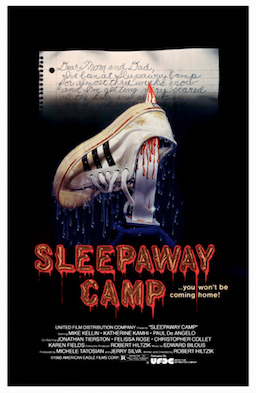
Undoubtedly like most of the jaded youth of my generation, I first saw the poster for SLEEPAWAY CAMP back in the late 1980s. It’s the one that stayed with me the most over the decades.

It has the dominant image of a dripping wet shoe being stabbed all the way through by a bloodied knife. Above, there’s a letter from a camper, “Dear Mom and Dad, I’ve been at Sleepaway Camp for almost three weeks now and I’m getting very scared. …” Right below the hand holding the knife are the title dripping blood from its bold type and the tag “You won’t be coming home!”

Now, hours after watching SLEEPAWAY CAMP for the first time, it’s just as unforgettable as the poster.

To a great degree, SLEEPAWAY CAMP chucks our traditional notions of what constitutes a “good” or a “bad” movie right out the fucking window. It’s more of an experience, an event, a rite of passage, something where you can ask friends and family if they have ever seen it. If they have or haven’t, dynamite conversation will follow either way. For sure, though, it would make a great watch party — of course, following proper social distancing protocol at this point in history.

Here’s a few notes on the experience:

— Melodrama is defined as such, “A sensational dramatic piece with exaggerated characters and exciting events intended to appeal to the emotions.” Addendum: See SLEEPAWAY CAMP. Early on, after the obligatory flashback to traumatic events of the past, Desiree Gould’s Aunt Martha establishes the basic tone for the rest of the movie: Campy with overacting possible. Yes, SLEEPAWAY CAMP goes over-the-top, gleefully, merrily, in every scene, including the end credits.

— Being bat shit crazy for 84 minutes has been SLEEPAWAY CAMP’s meal ticket to cult movie immortality. Because, let’s face it, it’s not as well-made technically as similar low-budget precursors BLACK CHRISTMAS, ALICE SWEET ALICE, and HALLOWEEN. Not even remotely close.

— SLEEPAWAY CAMP uses a musical score that also functions as bludgeoning device and melodrama amplifier. I just checked for any injuries after being whacked upside the head at regular intervals by Edward Bilous’ sledgehammer score. I survived without a single bump — amazing, I know. Anyway, I looked up this Bilous fellow. IMDb linked me to edwardbilous.com and a Bilous quote from the Wall Street Journal, “Artists today need a new set of skills to be able to tell the unique story of their generation.” He’s the founding director for the Center for Innovation in the Arts and the artistic director for Beyond the Machine, A Festival of Electro-Acoustic and Interdisciplinary Art at Juilliard. He joined the Juilliard faculty in 1984.

— “Weird Al” Yankovic’s “Nature Trail to Hell” sounds like a spin on FRIDAY THE 13TH PART III and SLEEPAWAY CAMP. “Coming this Christmas to a theater near you / The most horrifying film to hit the screen / There’s a homicidal maniac who finds a cub scout troop / And he hacks up two or three in every scene / Please don’t reveal the secret ending to your friends / Don’t spoil the big surprise / You won’t believe your eyes when you see. …” and “See severed heads that almost fall right in your lap / See that bloody hatchet coming right at you / No, you’ll never see hideous effects like these again / ‘Till we bring you ‘Nature Trail to Hell Part 2.’” File “Nature Trail to Hell” alongside such “Weird Al” epics as “The Biggest Ball of Twine in Minnesota,” “Albuquerque,” “Trapped in the Drive-Thru,” and “Jackson Park Express.”

— In his final performance, veteran actor Mike Kellin (1922-83) surpasses Gould in scenery chewing. He chews scenery to such a degree that he could chew through every picture’s scenery within an entire multiplex. Kellin plays Camp Arawak owner Mel Kostic, who keeps downplaying everything until about the 50th dead body. At least it feels that way anyway. He’s one of those characters who becomes creepier and more detestable over the course of the movie, especially when he lines up dinner with a camp counselor in her late teens and assaults one of the main characters who he mistakenly believes to be the killer. Mel loses his shit late in the picture, and it’s not pretty.

— By this point in the review, I should have already discussed the plot. Eight years after a tragic boating accident near Camp Arawak, Aunt Martha sends her niece Angela (Felissa Rose) to camp with Ricky (Jonathan Tiersten), Angela’s cousin and Martha’s son who’s a veteran camper. Mean girls Judy (Karen Fields) and Meg (Katherine Kamhi), as well as a group of their male counterparts both teenage and prepubescent, are relentlessly cruel and nasty toward Angela and Ricky, especially the initially painfully shy and quiet Angela. Ricky’s friend Paul (Christopher Collet) takes a shining to Angela and he’s able to break her silence. Over time, however, the picture develops a dread pattern: Every character who’s cruel and nasty to Angela or Ricky bites the dust in spectacular fashion. Yes, just like everything else in the picture, including the crop-tops and short-shorts, the murder set pieces are over-the-top.

— At this relative late point in the slasher film craze, a mere five years since HALLOWEEN, films in the genre needed a major selling point and SLEEPAWAY CAMP includes one of those (awesome but infuriating) endings that redefines the reality of every scene that came before, just like FRIDAY THE 13TH and HAPPY BIRTHDAY TO ME. This beyond bizarre ending is the first and foremost reason we still talk about SLEEPAWAY CAMP all these years later.

Black Christmas (1974)

BLACK CHRISTMAS

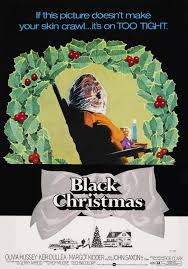
BLACK CHRISTMAS (1974) Three stars

Watching BLACK CHRISTMAS for the first time, one might be surprised just how many standards of the slasher film can be seen during this 1974 Canadian chestnut from director Bob Clark.

Let’s see, we have an opening shot later repeated by John Carpenter’s HALLOWEEN, a killer who racks up a rather impressive body count, POV shots from the killer’s perspective, obscene phone calls from the killer following every killing, plot twists (including the location of the caller), “The Final Girl,” and a shock ending, as well a holiday theme. BLACK CHRISTMAS basically synthesized elements that were already present during previous films like PSYCHO, PEEPING TOM, and Mario Bava movies BLOOD AND BLACK LACE and TWITCH OF THE DEATH NERVE into a single horror film narrative.

The plot also echoes “The Babysitter & The Man Upstairs” urban legend, so we already know the location of the caller. Still, the characters do not, so it’s a jolt hearing “The call is coming from inside the house.” Several movies, notably BLACK CHRISTMAS and WHEN A STRANGER CALLS, have relied on this angle for their chills and thrills.

A real-life case has been credited for inspiring the urban legend.

On Mar. 18, 1950, 13-year-old babysitter Janett Christman was raped and strangled to death in Columbia, Missouri, three days before her 14th birthday. Mr. and Mrs. Ed Romack found the body when they returned home, but, fortunately, their 3-year-old son Gregory was still alive, sleeping in his room. From the AP story, “Prosecuting Attorney Carl Sapp said blood was smeared through the house, indicating the girl put up a terrific struggle. … Footprints were found in a sleet-covered area near a broken window in the house. Police believe the intruder crawled through the window. The state highway patrol also is processing fingerprints found at the scene.”

More from the report, “An electric iron cord was twisted around the girl’s throat. Her scalp had been pierced several times by an instrument, apparently similar to a small lead pipe.”

Christman may have attempted to call the police around 11 p.m. the night of her death. Columbia policeman Roy McCowan took a call from a frightened girl who told him to “come quick.” “I urged her to calm down and just tell me where she was,” he said. “Then there was silence — not the sound of a receiver being hung up — just silence.” The Romacks’ phone was discovered “improperly placed on the instrument.”

Christman’s murder remains unsolved.

Just a few years earlier in Columbia, Stephens College student Marylou Jenkins, a white woman, was raped and murdered with an electric cord (reportedly from a lamp) twisted around her throat. An all-white jury convicted black man Floyd Cochran of the crime and he was executed Sept. 26, 1947 in the Missouri State Penitentiary Gas Chamber in Jefferson City. Cochran was originally arrested for murdering his wife with a shotgun and then he confessed to raping and murdering Jenkins.

For his last meal, Cochran ordered but did not partake in consuming a T-bone steak, french fries, scalloped corn, cream gravy, bread, butter, cake, and coffee. He died at the age of 36.

From 1938 through 1989, Missouri put to death 40 inmates in the gas chamber at Jefferson City, with John Brown the first on Mar. 3, 1938 and George “Tiny” Mercer the last on Jan. 6, 1989. Mercer was the first person from Missouri executed since 1965.

Just about seemingly every horror movie in existence shoots for a slambang ending, so we leave it discussing just what happened inside our heads or with all our friends and loved ones who have also seen this movie. BLACK CHRISTMAS gives us a rather unconventional ending, in that we are left unsure of the fate of protagonist Jess (Olivia Hussey) as she’s alone in the sorority house with the killer. Also, we never find out the real identity of the killer other than he’s named “Billy” and very rare indeed is the horror movie (especially a slasher) without a great big reveal in the grand finale. You just might have to be a fan or at least more forgiving of an ambiguous ending to appreciate BLACK CHRISTMAS. Either way, though, it will be discussed.

Like the later HALLOWEEN, BLACK CHRISTMAS thrives on atmosphere. That’s what they both do best and why fans appreciate them all these decades later.

Both films have rather distinguished casts for low-budget horror movies. Hussey came to fame during her teenage years for her performance as Juliet in Franco Zeffirelli’s 1968 ROMEO AND JULIET. Keir Dullea played astronaut Dave Bowman in both 2001: A SPACE ODYSSEY (1968) and later 2010 (1984); Dave uttered the famous words, “Open the pod bay doors please, HAL.” Margot Kidder (1948-2018) appeared previously in Brian De Palma’s 1973 shocker SISTERS and subsequently made her fame as Lois Lane in four Superman movies. Character actor John Saxon’s six-decade career includes ENTER THE DRAGON, TENEBRAE, A NIGHTMARE ON ELM STREET, and FROM DUSK TILL DAWN.

Director, screenwriter, and producer Clark (1939-2007) is best known for his two radically different nostalgia pieces, PORKY’S and A CHRISTMAS STORY. Yes, please wrap that magnificently designed brain around the fact that Clark directed both BLACK CHRISTMAS and A CHRISTMAS STORY. Louisiana born Clark found his greatest success up north in Canada. PORKY’S supporting actors Doug McGrath and Art Hindle both appear in BLACK CHRISTMAS.

Kidder almost steals the show in BLACK CHRISTMAS as the drunken, profane sorority girl Barb. She rips into her dialogue with extra relish. Hussey makes for a good entry point and rooting interest. Saxon knows how to maximize his screen time.

For horror movie fans who have not yet seen BLACK CHRISTMAS, I fully recommend amending it immediately.

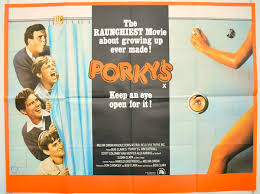
Porky’s (1981)

PORKY'S

PORKY’S (1981) Three stars

“Nobody ever went broke underestimating the intelligence of the American public,” H.L. Mencken famously said.

Mencken said that long before the success of PORKY’S, PORKY’S II: THE NEXT DAY, and PORKY’S REVENGE!, comedies which combined for over $200 million in box office and rental returns. Mencken died in 1956.

PORKY’S earned the vast majority of that $200 million and it came from out of seemingly nowhere to place fifth at the American box office in 1982, behind only breakaway winner E.T., ROCKY III, ON GOLDEN POND, and AN OFFICER AND A GENTLEMAN. PORKY’S sat on top of the American box office from late March through early May and it was dethroned by Arnold Schwarzenegger and CONAN THE BARBARIAN.

Unlike those other films, however, critics absolutely detested PORKY’S and aligned it with FRIDAY THE 13TH and THE CANNONBALL RUN in an unholy trinity of films that would no doubt lead to the downfall of Western Civilization. PORKY’S exhibits more than most how a film can be hated by critics and loved by the masses.

The success of the first PORKY’S spawned a whole slew of teenage sex comedies, often nostalgic and especially set in either the 1950s or 1960s.

I claimed a copy of PORKY’S as one of my first VHS purchases in my late teenage years and it quickly became a favorite movie of my rowdy group of friends. We loved it, as well as NATIONAL LAMPOON’S ANIMAL HOUSE, CADDYSHACK, KINGPIN, and THE BIG LEBOWSKI.

Every time I watch PORKY’S, I find a few big laughs and that’s why I am giving the film a passing grade. As far as the sequels are concerned, they are dreadful and deserve their horrible reputation. I remember seeing all of them in heavily edited form on “USA Up All Night,” before catching up with them all on video or pay TV.

Of course, our seven high school horn balls in PORKY’S are all played by older actors: Dan Monahan turned 26 in 1981, Mark Herrier 27, Wyatt Knight 26, Roger Wilson 25, Cyril O’Reilly 23, Tony Ganios 22, and Scott Colomby 29. That’s not anything new for a Hollywood film. For example, in GREASE, another highly successful nostalgia piece, John Travolta was 23 when he made it and Olivia Newton-John was 28 almost 29, Stockard Channing 33, Jeff Conaway 27, Barry Pearl 27, and Michael Tucci 31 when they were playing high school students.

Speaking of GREASE, one could describe PORKY’S as GREASE with T&A and rednecks instead of PG and greasers and without musical numbers.

PORKY’S includes sex jokes, condom jokes, sex jokes, size jokes, sex jokes, nude jokes, sex jokes, penis jokes, sex jokes, virgin jokes, sex jokes, and fat jokes, especially at the expense of villains Porky (Chuck Mitchell, a 6-foot-3, nearly 400-pound man) and Ms. Beulah Balbricker (Nancy Parsons).

Porky is a real vile piece of work, a saloon and brothel owner who is the most powerful man in his county. Every public official seems to be related to Mr. Wallace, namely his brother Sheriff Wallace (former NFL great Alex Karras). Mitchell wraps his best redneck goon around such dialogue as “I was givin’ the old place an enema and this pile of shit come floatin’ up to the surface” and “Where are these five little virgins who think they reached manhood? You wanna tangle ass with me? Come up here, you sawed-off punk! I’ll educate ya! I’ll wrap this right around your damn neck!” It is to Mitchell’s credit that he creates such a nasty character that we do root for his comeuppance in the final reel.

Balbricker embodies the worst killjoy or she’s basically portrayed as the Carrie Nation of the teenage sex comedy. Less successful, though, much less successful. After all, Carrie Nation (1846-1911) said things like “I felt invincible. My strength was that of a giant. God was certainly standing by me. I smashed five saloons with rocks before I ever took a hatchet” and “I want all hellions to quit puffing that hell fume in God’s clean air.” Balbricker (also called “Ball-breaker” and “King Kong” by other characters) develops an obsession with one character’s penis. Please can we call it a tallywhacker? Penis is so personal. Parsons, like Mitchell, gives a very good performance, one that rates with John Vernon in ANIMAL HOUSE.

Kim Cattrall must have used her work here as Miss Honeywell (“Lassie”) during her audition for “Sex and the City.” It definitely beats MANNEQUIN.

Writer and director Bob Clark (1939-2007) has a very interesting story and filmography, since his credits include the 1974 proto-slasher BLACK CHRISTMAS, the beloved A CHRISTMAS STORY, and the first two PORKY’S films, as well as even more diverse entries like MURDER BY DECREE, TRIBUTE, RHINESTONE, TURK 182!, LOOSE CANNONS, and BABY GENIUSES.

His entry in “Take One’s Essential Guide to Canadian Film” from 2001 : “Clark turned down bids to play pro football to complete a drama major at the University of Miami. With the success of his low-budget horror classic CHILDREN SHOULDN’T PLAY WITH DEAD THINGS, Clark moved to Montreal in 1973 and came to dominate Canadian commercial filmmaking for a decade. He followed CHILDREN with BLACK CHRISTMAS, a box-office hit starring Margot Kidder, and then, from 1978 to 1981, he directed MURDER BY DECREE, TRIBUTE, and PORKY’S – three of the most successful films produced in the tax-shelter era. Sad to say, the sophomoric PORKY’S remains the Canadian box-office champ. Clark returned to the United States in 1984; his career, like his locale, has gone south since.”

I read that Clark gathered the material for PORKY’S over a 15-year period, combining stories from other males of his generation with his own experiences. Every Hollywood studio passed on PORKY’S and it was produced by the Canadian company Astral Bellevue Pathe and Melvin Simon Productions (Mr. Simon, who died in 2009 at the age of 82, developed Mall of America, co-owned the Indiana Pacers along with his brother Herbert, and produced films including PORKY’S, THE STUNT MAN, and ZORRO, THE GAY BLADE), but 20th Century Fox picked up the U.S. distribution and a slick marketing campaign, combined with strong word-of-mouth, produced a monster hit on a $4 million budget.

Clark passionately defended the film amid the constant cries of misogyny and racism.

Those critics are missing that Wendy, played by Kaki Hunter, is often the sunniest presence and that Clark set his film in the Deep South in 1954. One character does overcome his initial anti-Semitism and becomes friends with a Jewish classmate.

THE NEXT DAY seems to address both criticisms, though, with one thoughtful dialogue scene between Wendy and main horn ball Pee-Wee (Monahan) and then adds a fanatical reverend, hypocritical politicians, a Native American, and the Ku Klux Klan to the mix. All the latter material simply does not mesh with the juvenile sex comedy.

Clark did not return to direct REVENGE and director James Komack and screenwriter Ziggy Steinberg wanted the third installment to return to the pure sex farce of the first movie. All the actors simply look too long in the tooth to be partaking in such adolescent shenanigans. I mean, for crying out loud, Colomby was nearly in his mid-30s by the point they made this third PORKY’S film; he graduated from Beverly Hills High School in 1970. Bottom line: I laughed not a single time at PORKY’S REVENGE, maybe once at NEXT DAY.


PORKY’S II: THE NEXT DAY (1983) One star; PORKY’S REVENGE! (1985) No stars