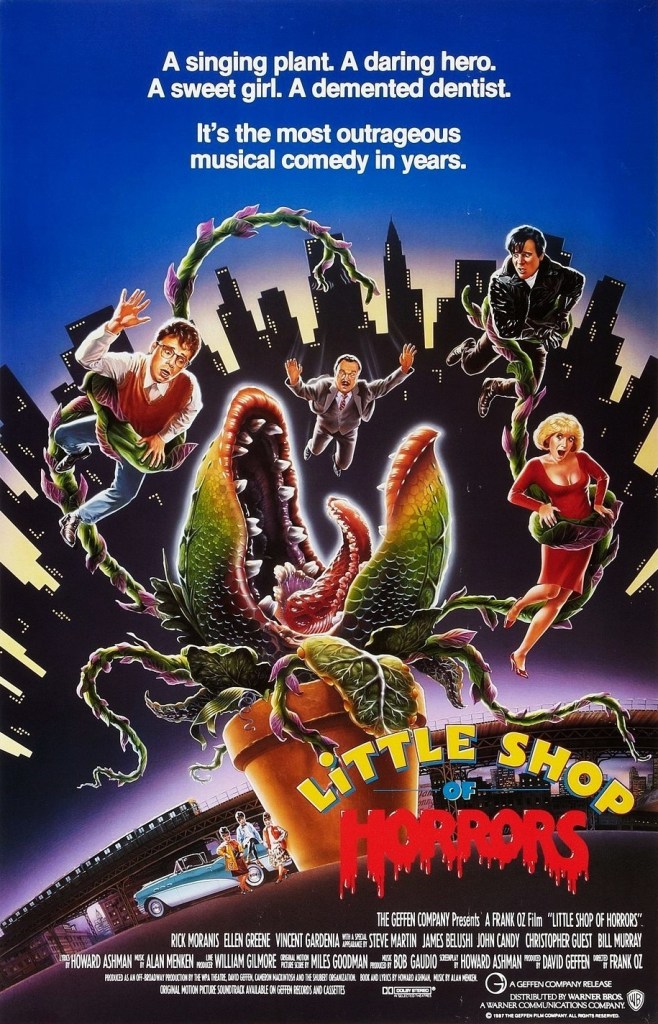
Little Shop of Horrors (1986)

LITTLE SHOP OF HORRORS (1986) ****
Little Shop of Horrors, based on the off-Broadway stage musical itself based on the 1960 Roger Corman cult film, is one of those movies that I like a little bit more every time I watch it.

I’ll just come right out and say it early on in this review: I’ll take Little Shop of Horrors over The Rocky Horror Picture Show every day of the week because the performances and characters, the science fiction and horror plot, the script, the direction, the musical production numbers, and the special effects are all far superior. Granted, to be fair, Little Shop of Horrors had more than 25 times the production budget of Rocky Horror.

I watched both films around the same time, in the late ’80s or early ’90s both on late-night local TV Saturday night movie programming. I also remember first coming across Wolfen and The Breakfast Club in this format. Anyway, I’ve always liked Little Shop of Horrors and never particularly cared for Rocky Horror, which I’ve come to like even less with every viewing so it’s Little Shop of Horrors inverted.

Rick Moranis stars as the meek, nerdy florist Seymour Krelborn. He means well but he’s extremely clumsy and pines after his beautiful coworker Audrey (Ellen Greene) who dates the abusive, sadistic, nitrous oxide fiend ’50s style greaser biker dentist Orin Scrivello (Steve Martin). Seymour’s perpetually chewed out by his boss Mr. Mushnik (Vincent Gardenia), the owner of Mushnik’s Flower Shop. Everything changes for Seymour, Audrey, and Mr. Mushnik when Seymour discovers Audrey II (voiced by Levi Stubbs, lead singer of the Four Tops), one mean green mother from outer space with an insatiable appetite and designs on taking over Planet Earth. Feeding Audrey II proves to be a nightmare for Seymour.

Moranis gives his definitive film performance, Greene returns to play Audrey from the stage production, Moranis and Greene make for a great movie couple and they’re very deserving of a happy ending, and Martin and Stubbs are both absolutely incredible in their villainous roles.

In fact, Martin and Stubbs both should have been nominated for Best Supporting Actor, but it’s understandable why they were not in a year with supporting actor winner Michael Caine for Hannah and Her Sisters and nominees Tom Berenger and Willem Dafoe for Platoon, Denholm Elliott for A Room with a View, and Dennis Hopper for Hoosiers.

Comedies, science fiction, and horror films very rarely earn nods from the Academy, a problem for Little Shop of Horrors when it encompasses all three genres.

It also became complicated when considering Stubbs (1936-2008) for a nomination, since he’s the voice of an animatronic puppet with 21 different principal puppeteers including Brian Henson. Stubbs’ authoritative, booming voice benefits the movie infinitely in both the dialogue scenes between Audrey II and poor Seymour and four musical numbers.

Audrey II’s Mean Green Mother from Outer Space, with lyrics by Howard Ashman and music by Alan Menken, received an Academy Award nomination for Best Original Song and lost to Berlin’s Take My Breath Away from Top Gun.

I’ve been known to say to pets both canine and feline Feed me, Seymour.

Crystal (Tichina Arnold), Ronette (Michelle Weeks), and Chiffon (Tisha Campbell), names borrowed from three girl groups contemporaneous with the original Little Shop of Horrors, provide a Greek chorus with sass and style.

Jim Belushi, John Candy, Christopher Guest, and Bill Murray show up in small roles.

Little Shop of Horrors originally retained the ending of the stage musical with Audrey and Seymour killed and giant Audrey II plants on a Godzilla-like rampage, but test audiences positively absolutely hated that Audrey and Seymour were killed and the original 23-minute ending became a rewritten and reshot happy ending that pushed the release date back to December 19, 1986.

I’ve only watched Little Shop of Horrors with the happy ending, and I must say that I’m more than happy with that.

Space Jam: A New Legacy (2021)

SPACE JAM: A NEW LEGACY (2021) *
I am not exactly sure why I decided to watch Space Jam: A New Legacy on a Saturday afternoon, following hot on the heels of the Disney live-action films Midnight Madness and Condorman.

I mean, I am not the biggest fan of the original Space Jam from 1996, basically a feature-length advertisement for the greatness of Michael Jordan with Looney Tunes and Bill Murray and Wayne Knight and everybody else guest stars or glorified cameos. Never thought it was all that great even back during the height of the Chicago Bulls — Space Jam came out Nov. 15, 1996, just a few months after the Bulls put together a 72-10 regular season and won an NBA title — and it has aged worse. Of course, it seems to have a major cult following, but then again, so does Howard the Duck.

Also, I have never been much of a LeBron James fan, since his arrival upon the scene in 2002. I’ve never cared for his style of play, his flopping and floundering about like he’s been shot when selling a foul despite the fact that he’s easily the size of an NFL tight end and bigger than most NBA players, his celebratory antics, his aping Michael Jordan from the shoes, money, and the uniform number to the chalk toss and now his very own Space Jam movie, his ring chasing and team hopping, and his outright hijacking of ESPN for the last two decades. He’s arguably been even more omnipresent in our lives than Jordan, one of the most famous people in the world during his glory days in the ’90s, given the social media factor.

For example, I liked and shared one LeBron traveling GIF, and the Facebook algorithms just won’t show me any mercy in the two or three years since. LeBron this, LeBron that, just because I thought it was funny to see LeBron travel across the desert with basketball in hand. Now, I have to see a brilliant quote like this one, I don’t give a fuck what nobody think. I’m him. I get shit for making the right play. Four motherfuckers on me. Motherfucker wide open right here. We are a team and I trust them. Why wouldn’t I have thrown it to them? I don’t care about the results. What?

Anyway.

You guessed it, Space Jam: A New Legacy is a $150 million and 1-hour, 55-minute advertisement for the greatness of LeBron James.

You can even play a drinking game with A New Legacy: Take a swig of the sauce every time you hear King James. It’s a lot safer than drinking every time they say Carol Anne in Poltergeist III or Cheech and Chong utter Hey, man in Up in Smoke.

I found very little to like in A New Legacy. A lot of the movie felt like watching a mash up of the plots from Hook and Space Jam. Also, the Looney Tunes more or less serve LeBron James and his greatness, aside from very fleeting isolated moments that don’t add up to any of the Looney Tunes shorts like Duck Amuck or The Great Piggy Bank Robbery or Porky in Wackyland or You Ought to Be in Pictures or any number of the brilliant shorts of the ’40s and ’50s.

Wile E. Coyote proves though he could be ideal halftime entertainment.

I absolutely hated what they did with all the Warner Brothers intellectual properties: Turn them into fans in The Big Game that closes out the picture. I mean, seriously, do you take King Kong or Pennywise for a basketball fan? I don’t see Pennywise cheering for anything. Come on, man. I didn’t catch Dirty Harry or Rick Deckard or Stanley Kowalski or Jack Torrance or Pazuzu in the crowd, but I sincerely hope that doesn’t mean we’ll see them in Space Jam 3.

I must admit to rooting for the villains, or the goons, during A New Legacy and found the greatest entertainment when they dunked on LeBron real good in the first half.

Of course, I understood the second half would take a dramatic turn and give us a great big happy ending for LeBron and his celluloid family. Wasn’t it cast in stone?

I just hope that LeBron (and his legion of fans) do not try and count his victory in A New Legacy toward his NBA titles.

Meatballs (1979)

MEATBALLS

MEATBALLS (1979) Three stars

MEATBALLS left me with a nice, warm feeling this last time I watched it and I must admit to feeling both delighted and surprised by it.

It’s certainly no comic masterpiece, to be sure, but it contains Bill Murray’s first starring role in a motion picture comedy. That alone makes it an important movie to watch … and that’s not to denigrate the contributions of the other cast members. In all honesty, though, we sit through MEATBALLS for Murray and everybody knows it.

In his first starring role, he establishes the basic Bill Murray comic persona that his fans have come to love. He’s a modern variation on Groucho Marx, playing the smartest character in the movie, always wisecracking, always finding some new angle or scheme, always putting on everything (including himself), always having fun with authority figures. Fun is the key word, because it seems like everybody had fun on MEATBALLS. We like his Tripper, who eases our way through this low-budget, ragged Canadian tax shelter comedy.

Murray also gives his first great ridiculous serious speech in MEATBALLS, something that he would return to during CADDYSHACK, STRIPES, and GHOSTBUSTERS. There’s even a boat scene in MEATBALLS that made me think fondly back on Groucho and Thelma Todd in HORSE FEATHERS.

Unlike Groucho, though, Murray showcases a kinder, gentler side through Tripper’s interactions with Chris Makepeace’s Rudy. Tripper takes a shine to the young camper and their scenes together contribute to the nice, warm feeling created by MEATBALLS. Murray does not drift far away from his comic persona, though, during his scenes with Makepeace.

Every review I have read of MEATBALLS compared it (unfavorably) with NATIONAL LAMPOON’S ANIMAL HOUSE, the huge comedy hit from 1978. The reviewers were disappointed by the sheer lack of raunchiness displayed in MEATBALLS.

Maybe it has something to do with MEATBALLS director Ivan Reitman being a producer on ANIMAL HOUSE.

Or maybe something to do with the presence of Kristine DeBell in the cast. After all, DeBell made her screen debut in 1976’s X-rated ALICE’S ADVENTURES IN WONDERLAND.

Or maybe it was expected that Murray would follow more in the physical comedy direction of “Saturday Night Live” co-star John Belushi, whose star exploded into the stratosphere with ANIMAL HOUSE.

Of course, I far prefer ANIMAL HOUSE over MEATBALLS and wish the latter film aimed for being R-rated rather than ‘PG.’

In the end, though, I like MEATBALLS and I accept that it displays a lighter comic touch.

Murray has a lot to do with the success of MEATBALLS, but I also like the rest of the main cast just fine, Makepeace and DeBell as well as Harvey Atkin, Kate Lynch, Jack Blum, and Keith Knight.

MEATBALLS, the 14th highest grossing movie from 1979, spawned three sequels, none of which feature Murray or any of the other cast members of the first movie, for that matter. MEATBALLS earned six times what Parts Two and Three combined earned. That only seems fitting in that both of them are six times worse the film as the original and they’re more like hairballs than MEATBALLS, anyway.

Good Morning, Vietnam (1987)

GOOD MORNING, VIETNAM.jpg

GOOD MORNING, VIETNAM (1987) Three-and-a-half stars

GOOD MORNING, VIETNAM director Barry Levinson knew that Louis Armstrong’s “What A Wonderful World” came out in 1967 and that his movie was set in 1965, but he overlooked that because Satchmo’s song fit the scene best.

Thus, Levinson created an anachronism or a chronological inconsistency.

Adrian Cronauer (1938-2018), played by Robin Williams (1951-2014) in GOOD MORNING, said that he liked the movie based on his time on Armed Forces Radio in Vietnam well enough, as far as it went, but that it was more about Williams and what suited him than it was about Cronauer and what actually happened. File GOOD MORNING in the “loosely based” category.

Cronauer added that Levinson did not allow Cronauer and Williams to meet each other until after filming completed, because the director did not want Williams impersonating the former disc jockey.

GOOD MORNING is the first Robin Williams movie I ever watched and it’s one of the few I watched again in the immediate aftermath of his 2014 suicide. Just this last time I watched it, though, early in 2020, I paid less attention to Williams and more to a dynamite supporting cast surrounding Williams: Bruno Kirby (1949-2006), J.T. Walsh (1943-98), Noble Willingham (1931-2004), Forest Whitaker, Robert Wuhl, and Richard Edson, as well as the various Vietnamese actors and actresses. I know Williams received most of the acclaim for his performance, a Golden Globe victory and an Academy Award nomination for Best Actor, but it’s the work of that deep supporting cast that makes GOOD MORNING a very good movie rather than merely a good one or at least if nothing else a one-man show.

Kirby plays some of the same notes as he did seven years before in WHERE THE BUFFALO ROAM with Bill Murray’s Hunter S. Thompson his adversary in that earlier film. In GOOD MORNING, Kirby plays Lt. Steven Hauk, who fails to see the humor in Cronauer and who finally bombs on the air when he replaces Cronauer for a brief spell. We patiently wait for that failure to happen, and we are rewarded. We laugh at Hauk’s failure, and the vast disconnect between his ego and his actual ability to make people laugh is the joke.

Walsh put together a decade of memorable supporting performances and he earned that memorability because he plays characters that we love to hate. Quite frankly, he played a dick better than most anybody in show business and thus, it’s no surprise that Walsh plays a character named Sgt. Major Dickerson in GOOD MORNING, because, yes, he’s a major dick. Many of us miss Walsh, a love to hate figure even after his death with both THE NEGOTIATOR and PLEASANTVILLE posthumously released.

Williams and Whitaker especially seem like they have genuine chemistry and their byplay from early in the movie all the way until the end rewards us with both laughter and emotions.

Cronauer teaches English to South Vietnamese students during some of his spare time, initially because he sets his sights on a pretty young woman. Cronauer’s friendship with her brother earns him a flight out of Vietnam, one that’s long overdue given all his trouble from the first time Cronauer shouted “Good morning, Vietnam” on the air.

In short, the soldiers love Cronauer and the brass, especially Dickerson, hate him.

Cronauer plays by his own rules, especially on-air, as he favors that Devil’s music rock and soul over that Easy Listening jive preferred by Hauk and Dickerson. That’s his first sin of many, but it all starts with that playing by one’s own rules.

Probably about half of the movie gives itself over to Williams’ manic free-form ad-libs and Cronauer is one of the few characters played by Williams where his patented comic anarchy fits and does not break away from the fabric of the movie to the point that we forget the character and only see Robin Williams being stand-up comedian Robin Williams. Williams’ anything-for-a-laugh shtick also worked for The Genie in ALADDIN.

In all honesty, I find more humor in Williams’ scenes with the supporting actors, both his fellow military men and his Vietnamese students, than I do his solo flights of fancy on his popular radio show.

GOOD MORNING is not all comedy, though, and it does thankfully give the Vietnamese more of a voice than we normally get in Hollywood films about Vietnam and the war. Cronauer’s friend Tuan (Tung Thanh Tran) expresses it during their confrontation scene late in the movie, “ENEMY? What is enemy? You killing my own people so many miles from your home. We not the enemy! You the enemy! … My mother is dead. And my older brother, who be 29 years old, he dead! Shot by Americans! My neighbor, dead! His wife, dead. WHY? Because we’re not human to them! We’re only Vietnamese.”

The film does lay it on a little too thick with sentimentality and showing that Cronauer’s a good guy at heart performing a noble service for the troops and humanity in general through humor. Critics have accused movie comedians of that weakness for sentimentality ever since the glory days of Charlie Chaplin. Williams definitely fell prey to sentimentality often throughout his career, and it works better in some films than others.

Finally, GOOD MORNING goes on a little too long and it could have been tightened, but I doubt that Levinson and gang wanted to lose any of Williams’ improvisation. Remember that moment in ANIMAL HOUSE when Tim Matheson’s Otter looks at Peter Riegert’s Boon and asks “Germans?” after Bluto says the Germans bombed Pearl Harbor. Boon quite simply and beautifully says, “Forget it, he’s rolling.” Bet that’s what they said every day on the set of GOOD MORNING, VIETNAM about Robin Williams.

Kingpin (1996)

KINGPIN (1996) Four stars

Over a period of a couple years in the late 1990s, there were two great bowling comedies released: The Farrelly Brothers’ KINGPIN and the Coen Brothers’ THE BIG LEBOWSKI. Granted, there’s far more to both movies than bowling.

A few of my friends and I watched these movies time and time again. They both played a central role in nearly a decade of regular Friday or Saturday or Sunday night bowling adventures at the Holiday Lanes in Pittsburg, Kansas. Alcohol helped too, although when the bowling alley banned outside cups, college student attendance dramatically took a dip. Eventually, though, our group sucked it up and put the money down on the watered down bowling alley beer.

A couple times during my writing career, I have mentioned KINGPIN. I reviewed ZOMBIELAND for the college newspaper and reunited Woody Harrelson and Bill Murray gave me an opportunity to reference their dueling comb-overs in KINGPIN. I just laughed thinking about it. I named KINGPIN one of my 10 favorite sports movies for The Morning Sun.

Harrelson plays Roy Munson from Ocelot, Iowa, the 1979 Iowa state bowling champion who embarks on a professional bowling career early on during KINGPIN. He’s a promising young bowler, but, unfortunately, he runs afoul veteran bowler Ernie McCracken (Murray), who cons rather than mentors the younger bowler. McCracken hated the fact that Munson beat him in bowling and in a con gone tragically bad, a gang of amateur bowlers take it out on Munson after they find out both he and McCracken are pros. McCracken gets away, of course, and leaves Munson to reap the consequences. Munson loses his right hand in a scene that’s very, very, very rough for a PG-13 comedy. It plays like a scene from a Scorsese gangster pic.

Seventeen years later, Roy Munson’s a real born loser in Scranton, Pennsylvania. Man, talk about down on his luck. He’s got a prosthetic hand and a major drinking problem. He sales bowling supplies, rather unsuccessfully, since nobody wants novelty gags in the men’s room any more. Munson is perpetually behind on his rent and that means his creepy landlady harasses the former pro bowler. They work out a debt solution I do not recommend and work in a Mrs. Robinson parody for tremendous sport Lin Shaye.

Speaking of sports, KINGPIN parodies the genre. Munson takes on a managerial role for Amish bowler Ishmael (Randy Quaid) and they decide to work their way to Reno for a $1 million winner-takes-all tournament to save Ishmael’s farm. Along the way, they gain Claudia (Vanessa Angel) and Roy and Claudia assume the roles with Ishmael that Jack Nicholson and Otis Young did with Quaid in the 1973 film THE LAST DETAIL. Needless to say, Ishmael gets hurt on the eve of the tournament in Reno, Munson makes his bowling comeback, and Munson and McCracken eventually battle for $1 million and comb-over superiority.

I find myself laughing throughout most of KINGPIN. Like the comedies of the Z-A-Z boys and Mel Brooks, or for that matter the Marx Brothers and the Three Stooges, I laugh twice at some of these jokes, a second laugh at the fact that I laughed in the first place. For example, I am laughing right now just thinking about Roger Clemens’ cameo playing a redneck named “Skidmark” and I have already mentioned Harrelson’s and Murray’s comb-overs.

Harrelson, Quaid, and Murray all have no problem looking absolutely ridiculous on screen, something they demonstrate time and time again for nearly two hours in KINGPIN. The Farrelly Brothers and the actors will stoop just that low for a laugh.

Murray has made a parallel career for himself with supporting roles and cameos, ever since CADDYSHACK. He’s done it with TOOTSIE, ED WOOD, SPACE JAM, WILD THINGS, COFFEE AND CIGARETTES, and, of course, KINGPIN, where he appears near the beginning and near the end of the picture. He just about walks away with the movie. Ernie McCracken is a real piece of work, crass, vile, womanizing, on down the line, but he seems to be a beloved figure within the movie. Of course. We love Murray and McCracken, and it’s the way he reads lines like “It’s a small world when you’ve got unbelievable tits, Roy.”

Of course, McCracken’s talking about Claudia, played by the lovely Angel. She is the discovery in KINGPIN, because we have seen Harrelson, Quaid, and Murray be funny before in several movies. At the same time, Angel could be seen on TV during her run on “Weird Science,” playing the character first essayed by Kelly LeBrock. She plays some of the same notes in both roles, with her delightful English accent and her sarcastic wit. It’s a joy watching her sock it to Munson and McCracken. It remains a mystery why Angel has never become a bigger star.

I recently talked about enjoying few comedies as much as NATIONAL LAMPOON’S ANIMAL HOUSE. Well, I just spent over 800 words on one of those few.


Caddyshack (1980)

CADDYSHACK

CADDYSHACK (1980) Three-and-a-half stars
Harold Ramis’ CADDYSHACK gives the consumer four movies for the price of one.

1) Rodney Dangerfield vs. Ted Knight.

2) Chevy Chase and his meandering philosophical musings and lady man ways.

3) Bill Murray and his bizarre shenanigans.

4) The caddies and their little melodramas.

Most films don’t even give us one.

We have four distinct comedic styles at work in CADDYSHACK: Dangerfield (1921-2004) comes on and thankfully never stops doing variations on his night club act; Knight (1923-86) plays the ultimate snob and perfect counterpoint to Dangerfield; Chase gives us Zen wisdom filtered through deadpan absurdity; and Murray creates a world of his own that combines Dalai Lama and Cinderella stories, gross out snooty old ladies Baby Ruth taste testing, hunting and blowing up animatronic gophers real good, and Bob Marley joints.

Murray’s like a gopher within CADDYSHACK itself, burrowing underneath Dangerfield vs. Knight and the caddies.

CADDYSHACK plays like a 98-minute throwback to the Marx Brothers, the Three Stooges, and W.C. Fields.

First-time director Ramis (1944-2014), in fact, envisioned Murray as Harpo Marx, Dangerfield as Groucho, and Chevy as Chico. Guess that made Ted Knight the villainous Sig Ruman (A NIGHT AT THE OPERA, A DAY AT THE RACES) and Cindy Morgan a more risqué Thelma Todd (MONKEY BUSINESS, HORSE FEATHERS).

Improvisation and cocaine fueled CADDYSHACK.

It seems like Ramis and gang threw away the script written by Brian Doyle-Murray, Ramis, and Douglas Kenney (Ramis and Kenney worked together on NATIONAL LAMPOON’S ANIMAL HOUSE) just to make it all up as they went along, especially Chase, Dangerfield, and Murray.

This is one example of how the makers of a film went in expecting to make a certain film and came out with something completely different. The original plan had been to make the movie focused on the caddies, of course with a title like that, but the comedians took over and stole the show.

To be fair, however, the caddies have their fair share of funny moments and Doyle-Murray steals every scene that he’s in as caddy master Lou.

Chris Nashawaty’s book “Caddyshack: The Making of a Hollywood Cinderella Story” details just how much of a miracle it was even that the movie got finished.

“I had never seen cocaine before I got to the set of CADDYSHACK,” actor Peter Berkrot said. “This was really good cocaine. Pure, like they had just beaten it out of a leaf in Columbia and somebody had carried the leaf to us and turned it into powder in front of us just so we knew how pure it was,” said actor Hamilton Mitchell.

Ramis and Kenney (1946-80) turned in an original cut that ran four hours. A consultant recommended a through line with Danny Noonan (Michael O’Keefe) and his quest for a caddy scholarship and his relationship with a waitress (Sarah Holcomb, who played the mayor’s daughter in ANIMAL HOUSE).

Like classics by the Marx Brothers, the Three Stooges, and Fields, though, we don’t require much of a plot when there’s so much funny going on.

Over the years, I’ve come to appreciate Knight’s asshole Judge Elihu Smails just as much as Dangerfield’s Al Czervik and Murray’s Carl Spackler.

Smails is every bit as quotable as Czervik, Spackler, and Chase’s Ty Webb.

My favorite Smails line comes right after Noonan says that he would like to go to law school after he graduates but his parents do not have enough money to put him through college.

Smails says, “Well, the world needs ditch diggers, too.”

July 1980 undoubtedly ranks among the great months for comedies: AIRPLANE! debuted July 2, USED CARS on July 11, and CADDYSHACK on July 25.

Stripes (1981)

day 66, stripes

STRIPES (1981) Three-and-a-half stars
Bill Murray was the Groucho Marx of the 1980s, especially during films like STRIPES and GHOSTBUSTERS.

STRIPES is Murray’s DUCK SOUP.

It’s not only all the one-liners and the institutional putdowns throughout both films, but a couple later scenes.

In DUCK SOUP, Groucho’s Rufus T. Firefly starts opening up machine gun fire and it only brings him immense pleasure.

Firefly boasts “Remind me to give myself the Firefly medal for this!”

Then his loyal assistant informs Firefly that he’s firing upon his own men.

Of course, Firefly offers his assistant $5 to keep it under his hat, but then Firefly withdraws the offer and keeps the five spot under his own hat.

Firefly’s joy during that sequence and the whole film, for that matter, come back when Murray’s John Winger takes on them darn Commies in STRIPES.

Murray, like Groucho, treated all this like one great big put-on.

That’s the comic attitude that informs STRIPES and like Groucho, Murray never played the fool. He’s the intelligent one, the hustler who knows the score, and sure Murray’s foil Sgt. Hulka (Warren Oates) socks it to Winger during basic training, but eventually the pair reluctantly find common ground and reach an understanding.

Winger first wanted to join the U.S. Army based on a lark, not some great conviction to serve his country.

For example, Winger thought he could pick up more women in the military.

Winger: “Chicks dig me, because I rarely wear underwear and when I do it’s usually something unusual. But now I know why I have always lost women to guys like you. I mean, it’s not just the uniform. It’s the stories that you tell. So much fun and imagination.”

Winger and his best friend Russell Ziskey (Harold Ramis) see the EM-50 Urban Assault Vehicle as an opportunity to go pick up their Military Police girlfriends (P.J. Soles, Sean Young) in West Germany and enjoy a holiday in Switzerland. Of course, this leads to their comrades seeking them out and being captured by the Soviet Army. Winger and the gang rescue their friends with that heavily-armed recreational vehicle on their side.

Winger keeps that lark attitude throughout STRIPES, even after his friends fall into Soviet hands.

Winger: “C’mon, it’s Czechoslovakia. We zip in, we pick ’em up, we zip right out again. We’re not going to Moscow. It’s Czechoslovakia. It’s like going into Wisconsin.”

Everything’s a lark to Winger (and Murray).

Murray and Ramis make a very good comedic duo. You might be surprised to find out STRIPES (directed by Ivan Reitman) had been originally intended to be a Cheech and Chong vehicle, but that pair wanted the dreaded “complete creative control.” Both Ramis himself (who scripted ANIMAL HOUSE and directed CADDYSHACK) and Columbia Pictures were reluctant to have Ramis onscreen, but Murray insisted that he would only be paired with Ramis.

Ramis is vital to the success of STRIPES. He’s the ordinary guy counterbalance to Winger, but also the loyal best friend who ends up along for the ride despite knowing that his best friend’s crazy. Ramis brings an interesting tension to the movie that might not have been there, for example, had Dennis Quaid played Russell, such as the scene when Russell starts choking Winger. Quaid seems far more the stereotypical All-American hero type. Also, Ramis and Murray shared dynamite chemistry.

Veteran character actor Warren Oates is also vital to STRIPES. Like Russell, Sgt. Hulka makes a great counterbalance to Winger. There’s just one dramatic scene in STRIPES, when Hulka confronts Winger in the latrine. Hulka dares Winger to take a swing at him. Winger obliges, and Hulka wipes the floor with Winger. Even more so than Winger, Hulka knows the score. Hulka had originally been scheduled for death in the mortar accident and to be replaced by his twin brother also played by Oates, but the creative powers-that-be thankfully scrapped that concept.

On vacation in 2017, riding over the George Rogers Clark Memorial Bridge headed into Louisville, I thought it seemed very familiar and sure enough, it’s the bridge where Winger melodramatically quits taxi driving by flinging his keys into the Ohio River. Fortunately, we did not reenact the scene that day; it definitely would have been fun making it back home.

Would it be safe to say STRIPES is the greatest movie ever shot in Louisville?

Not so fast, my friend, as former Louisville head coach Lee Corso would say.

GOLDFINGER, RAIN MAN, A LEAGUE OF THEIR OWN, and THE INSIDER, for example, might have something to say about that.