
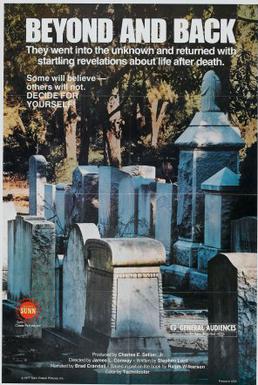
Beyond and Back (1978)

BEYOND AND BACK (1978) No stars

I am here to tell you about life after Beyond and Back.

I cannot believe that I finally watched a film that displaces The Star Wars Holiday Special as my selection for the worst film made in 1978.

Beyond and Back proved to be D.O.A. It showed no vital signs of cinematic life and brought me a micrometre closer to atheism with its faith-based and family-friendly agenda shoved down my throat, 90 minutes of bad actors monotonously gushing over near-death experiences, life after death, psychokinesis, Heaven and Hell, bright light, weighing souls, seeing dead relatives, ad nauseam.

Beyond and Back puts Benjamin Franklin, Elizabeth Barrett Browning, Eddie Rickenbacker, Thomas Edison, Louisa May Alcott, Ernest Hemingway, George S. Patton, and Harry Houdini on an equal plane with Anne Fleck, Dr. Stevens, Byron Temple, and Dr. Paul Kelly, since they’re all just cannon fodder for that agenda told through a pseudo-documentary approach with bad narration and bad reenactment.

Two of the worst films ever made (both from 1978) involve laughable disclaimers:

The African killer bee portrayed in this film bears absolutely no relationship to the industrious, hardworking American honey bee to which we are indebted for pollinating vital crops that feed our nation — The Swarm

The events you have just seen have been taken from actual accounts, but the names of the persons involved have been changed to preserve their anonymity. All such persons have been portrayed by professional actors and actresses — Beyond and Back

Of course, Beyond and Back is the same picture that starts with its narrator telling us, “You are about to see one of the most extraordinary movies of our time, a movie that dares to investigate the possibility of life after death.”

We can thank the folks at Sunn Classic Pictures for such classics, er, drivel as Beyond and Back, namely director, producer, novelist, and Sunn Classics founder Charles E. Sellier. Sellier (1943-2011) evolved from Cajun Catholicism to Mormonism and finally evangelical Christianity, but his product remained in the realm of quick-buck exploitation, whether it was Sunn Classic productions In Search of Noah’s Ark and In Search of Historic Jesus or the controversial killer Santa picture Silent Night, Deadly Night and the teenage comedy Snowballing (both directed by Sellier) or his later productions George W. Bush: Faith in the White House, Breaking the Da Vinci Code, The Search for Heaven, and Apocalypse and the End Times.

For obvious theological reasons and philosophical differences, Beyond and Back passed on many tales and famous last words.

Last words are for fools who haven’t said enough — Karl Marx

I hope the exit is joyful and hope never to return — Frida Kahlo

Dammit, don’t you dare ask God to help me — Joan Crawford

I’m bored with it all — Winston Churchill

I’m going, but I’m going in the name of the Lord — Bessie Smith (I do not recall a single black person in Beyond and Back)

My wallpaper and I are fighting a duel to the death. One or the other of us has to go — Oscar Wilde

Dear World, I am leaving because I am bored. I feel I have lived long enough. I am leaving you with your worries in this sweet cesspool. Good luck — George Sanders (a charming wit to the end)

As we depart this mortal review, I leave this joke: What’s the last thing that goes through a fly’s mind when I kill him? My fist (reporter’s notebook).

Park Row (1952)

PARK ROW (1952) Four stars

I finally watched for the first time PARK ROW, Samuel Fuller’s self-financed labor of love and love letter to newspapers, newspapermen, and the revolutionary concept of a free press.

Of course, Fuller produced his love letter decades before many newspapers became downsized, outsourced, strip-mined, gutted, and homogenized into bland soggy vanilla wafer cookie cutter clone drone carbon copies of all the other papers owned by the same media company. Fewer days printed, earlier and earlier deadlines, fewer pages (less content) because of declining ad revenue and increased printing costs, more delivery issues, and price increases at every level all factor into a worse product, more unhappy customers, and ultimately fewer subscribers, as well as fewer employees, in a vicious cycle. Less (newspaper) for more (money) will not cut it.

That once family-owned small town newspaper … once the beacon, pride and joy, and watchdog of a community (and possibly region) and once housed inside a buzzing building populated by wordsmiths and word slingers, photographers, editors of various persuasions, proof readers and fact checkers, pressmen, inserters, and many others in a diverse work environment … has been reduced over time to a skeleton crew of employees who hear the grief for the sad state of a formerly great paper. They hear the grief because the power players are hundreds if not thousands of miles away. Good luck reaching them.

Not that journalism majors and college paper staff members are forewarned a million times before their graduation about newspapers being a dying industry. It’s not a natural death, though, and it’s both maddening and saddening for the lover of the printed word to see what’s happening to so many papers.

PARK ROW inspired thoughts, reactions, and reflections by the bushel.

  • People with a vision and the character and personality necessary to carry it out have been replaced by number-crunching, bean-counting, penny-pinching, character- and personality-deficient, machine-like men and women in many decision-making positions in the newspaper industry. Just like protagonist Phineas Mitchell (Gene Evans) says in PARK ROW, “The press is good or evil according to the character of those who direct it.”
  • Remember that classic line from John Ford’s 1962 western THE MAN WHO SHOT LIBERTY VALANCE? Something like “This is the West, sir. When the legend becomes fact, print the legend.” That’s just what we shall do with PARK ROW, written, directed, produced, and financed by Fuller. That’s right, Fuller himself put up every dollar spent on PARK ROW: $200,000 since the other $1,000 of his life’s savings went toward cigars and vodka.
  • Fuller (1912-97) became a copy boy at the age of 12 for the New York Evening Journal and a crime reporter for the New York Evening Graphic at 17. He quit his newspaper gig three years later and hitchhiked the U.S.A. with the occasional freelance job. In 1934, Fuller took a temp crime reporter job for the San Francisco Chronicle and then editorial writer for the San Diego Sun. Fuller returned to New York in 1935 and published his first novel, “Burn, Baby, Burn.” Fuller wrote more novels and branched out into screenplays for Hollywood, including one from 1938 with a catchy title, GANGS OF NEW YORK, directed by James Cruze and starring Charles Bickford and Ann Dvorak. Fuller enlisted for the U.S. Army the day after Pearl Harbor and he served in the 26th Regiment, Third Battalion, Company K or the Big Red One for the rest of the war (his experiences inspired his 1980 movie THE BIG RED ONE). Two screenplays were filmed and his mystery novel “The Dark Page” was printed during World War II with Fuller overseas. Back stateside, Fuller directed his first film, I SHOT JESSE JAMES, in 1949 and his 26 films are informed by his background in newspapers and novels.
  • Fuller’s older brother Ving (1903-65) provided the editorial cartoons for PARK ROW. Ving worked as a newspaper cartoonist, among other gigs including animation and gag writing, and his best known work is the mad scientist comic strip “Doc Syke” from 1944 to 1960.
  • PARK ROW starts with a scroll through the names of the 1,772 daily newspapers in the United States circa 1952. Bold letters proclaim “ONE OF THEM IS THE PAPER YOU READ.” A few seconds later, “ALL OF THEM ARE THE STARS OF THIS STORY.” About one minute in, “DEDICATED TO AMERICAN JOURNALISM,” with “AMERICAN JOURNALISM” in much bigger letters just like a front page headline for a major news story. That sure as all get-out beats what we see and hear today, you know, all that “evil liberal media” and “fake news” hyperbole. Why, just a couple years ago Walmart sold online, through a third party seller, T-shirts featuring “Rope. Tree. Journalist.” Below that, “Some Assembly Required.” Walmart pulled the shirts after a complaint from the Radio Television Digital News Association.
  • As of 2016, the number of daily papers in the United States had dropped to 1,286.
  • After that scroll and a brief Samuel Fuller Productions fanfare, PARK ROW gives us voice-over narration, “This is Johannes Gutenberg, who invented movable type 500 years ago and printed the first Bible. Recognized as the father of modern printing, Gutenberg stands on Park Row, the most famous newspaper street in the world, where giants of journalism mixed blood and ink to make history across the front page of America. Our story takes place in the lusty days of the Golden 80s [1880s] when Park Row was the birth place and graveyard of great headlines, the street of America’s first world famous journalist, a printer’s devil who helped draft the Declaration of Independence and was one of its signers, Benjamin Franklin, patron saint of Park Row … and it is the street of Phineas Mitchell.” I’m already reeled in less than three minutes into the picture.
  • By the way, newspapers chose their location on Park Row because of the proximity to City Hall and the police department.
  • PARK ROW belongs right up there with CITIZEN KANE on the list of my favorite newspaper movies. I found myself inspired by Fuller’s depiction of media wars in 1886, of a small rogue newspaper started by an editor (Mitchell) warring against the very newspaper that fired him because he questioned their moral scruples. The Star’s cutthroat heiress publisher Charity Hackett (Mary Welch) does everything in her power to destroy the start-up Globe, a ragtag team put together on the spot in a saloon right after Mitchell’s firing and that succeeds through initiative and ingenuity, of course much to the chagrin of Hackett.
  • For example, The Globe prints its first edition on butchers’ paper.
  • Mitchell and Hackett, though, are strongly attracted to each other. The film’s poster shows them kissing with the caption “she had blood in her veins … he had ink … and guts.” Other hype on the poster: “Street of rogues … reporters … and romance!” and “The picture with the page one punch!”
  • PARK ROW wins for the best use of a Benjamin Franklin statue in a motion picture. Now, maybe, just maybe, I’ll go back and look at “The Autobiography of Benjamin Franklin,” although I prefer “The Autobiography of Malcolm X.” Both are on the nearby shelf.
  • I have a bias favoring newspapers, because, for one, I learned how to read from one. I love the reaction people have when I tell them I learned to read by the age of 4. Grandpa sat me on his lap and read me the paper. I picked it up from there and have been a passionate newspaper reader ever since.