Karloff Meets Lugosi Meets Poe: The Black Cat, The Raven

KARLOFF MEETS LUGOSI MEETS POE: THE BLACK CAT, THE RAVEN
Boris Karloff (1887-1969) and Bela Lugosi (1882-1956) endure as two icons of horror and their best movies remain essential to a greater understanding of the horror genre long after their death.

Karloff and Lugosi starred in many classic films. Dracula. Frankenstein. Island of Lost Souls. The Mummy. White Zombie. Old Dark House. Murders in the Rue Morgue. The Mask of Fu Manchu. Chandu the Magician. The Bride of Frankenstein. Mark of the Vampire. The Black Room. The Man They Could Not Hang. The Wolf Man. Frankenstein Meets the Wolf Man. The Return of the Vampire. House of Frankenstein. Isle of the Dead. Bedlam. Abbott and Costello Meet Frankenstein. Targets.

That list grows once the several films they made together are considered: The Black Cat, The Raven, The Invisible Ray, Son of Frankenstein, Black Friday (not a classic), You’ll Find Out (not seen this one), and The Body Snatcher.

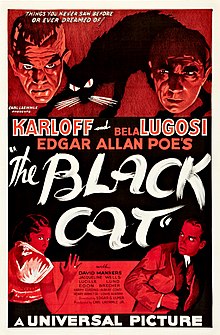
The Black Cat and The Raven, generally paired together in greatest hits packages, are the films where Karloff and Lugosi are most evenly matched on screen. They’re both immortal movie classics based on that mere fact alone; Lugosi nearly walks away with Son of Frankenstein as Ygor, while it’s sad to see how much of a nonentity part Lugosi received in The Body Snatcher, especially when compared against Karloff’s meaty role as John Gray and perhaps his best performance.

Young American lovers on their honeymoon in Hungary, a train ride beginning and ending the picture, a dark and rainy night, a road accident, an old dark house, an enigmatic doctor, a Satan worshipping priest, a story suggested by the work of Edgar Allan Poe with story and direction from Edgar G. Ulmer, and The Black Cat flies past in about 65 minutes, like a lot of the early horror classics.

Of course, there’s Karloff credited merely as Karloff, David Manners as one of the young American lovers, and Karloff and Lugosi find themselves at each other’s throat by the end of the picture.

Like the Frankenstein pictures and the Mary Shelley source material, The Black Cat departs almost entirely from Poe’s short story originally published in The Saturday Evening Post on August 19, 1843. I am okay with that, because Ulmer has a style all his own like James Whale in Frankenstein and The Bride of Frankenstein and The Black Cat pairs two movie legends for the first time.

The Raven gets done faster than even The Black Cat at 61 minutes, credits both Karloff and Lugosi with their surnames alone, and it has a lot of the same elements as The Black Cat.

Lugosi plays arguably his most diabolical and evil character in Dr. Richard Vollin, the archetype for the brilliant but troubled surgeon who has this, let’s say, morbid obsession with instruments of torture. He’s not your average doctor, obviously. Lugosi chews through the scenery, especially in the final reel, and relishes lines like Death is my talisman, I like torture, I tear torture out of myself by torturing you, and Poe, you are avenged!

Yes, he’s also obsessed with Edgar Allan Poe. The Pit and the Pendulum even makes a cameo appearance!

The Raven tilts more toward being Lugosi’s show because Karloff doesn’t even show up for his first scene until 17 minutes into the picture.

Karloff is great though, of course, and brings a certain poignancy to the tortured murderer on the run Edmond Bateman, who just wants the doctor to fix his ugly face.

EB: I’m saying, Doc, maybe because I look ugly … maybe if a man looks ugly, he does ugly things.

DRV: You are saying something profound.

Naturally, Vollin makes Bateman’s face even uglier and enlists him in a diabolical scheme.

The rest of the cast doesn’t measure up against Lugosi and Karloff, especially Irene Ware as the screaming socialite Jean Thatcher, but it doesn’t really matter because Lugosi and Karloff are so damn great.

I heartily recommend The Black Cat and The Raven, both Poe and Universal.

The Black Cat (1934) ****; The Raven (1935) ****


Abbott and Costello Meet Frankenstein (1948)

ABBOTT AND COSTELLO MEET FRANKENSTEIN (1948) ****
Over a period of a couple years, I watched all 36 Abbott and Costello feature-length comedies from their scene-stealing minor roles in One Night in the Tropics (1940) to their last disappointing picture in Dance with Me, Henry (1956).

Bud Abbott (1897-1974) and Lou Costello (1906-59) are not on the same elite level as Charlie Chaplin, Buster Keaton, Harold Lloyd, W.C. Fields, the Marx Brothers, and Laurel and Hardy, for starters, but they fit on a tier below neatly alongside the Three Stooges and Wheeler and Woolsey.

I recommend 28 out of their 36 films, and I do like the duo and their films a good bit. That said, I do not recommend binge-watching their films because they are often saddled with cornball musical numbers, cornball romantic subplots, and comedic routines that could quickly become very repetitive and tiresome after repeat exposure to their work. I spread their 36 films out very effectively, rarely ever watching any of them consecutively in a single sitting.

Until I recently watched Abbott and Costello Meet Frankenstein again, easily their most famous picture, I would have even argued they never made a truly great motion picture.

I’ve seen it several times over the years, and I’ve always liked it a lot ever since that first viewing many years ago on AMC. I always considered it nothing less than a very good film and the ultimate Abbott and Costello motion picture experience.

Anyway, this last time watching Abbott and Costello Meet Frankenstein, a meeting of Universal’s main staples, I thought Who the hell am I kidding, this is a great movie and I’m bumping it up to four stars exactly right where it belongs!

Of course, Abbott and Costello don’t actually meet Frankenstein, it’s Frankenstein’s Monster (Glenn Strange) and he plays a subservient role to Count Dracula (Bela Lugosi) and Larry Talbot / The Wolf Man (Lon Chaney Jr.), and it’s also not Abbott and Costello but Chick Young and Wilbur Gray who do the meeting within the movie. I guess Chick and Wilbur Meet Frankenstein’s Monster or Abbott and Costello Meet Glenn Strange or Abbott and Costello Meet Dracula, Frankenstein and the Wolf Man just wouldn’t have worked as titles.

If you stop and think too much about the inconsistencies and continuity gaps and logical flaws in any Universal horror movie, especially the ones made during the ’40s, you just might drive yourself stark raving mad and start foaming at the mouth.

I recommend just going with the flow. You’ll likely live a little if not a lot longer.

I’m not even going to regurgitate a plot synopsis for Abbott and Costello Meet Frankenstein because life is short, life is precious, and I honestly believe that one knows more or less what to expect from something titled Abbott and Costello Meet Frankenstein.

Abbott and Costello developed a routine in their horror comedies, as early as 1941’s Hold That Ghost and starting again with Abbott and Costello Meet Frankenstein and continuing through 1955’s Abbott and Costello Meet the Mummy, where something frightens Costello’s character and he will try (often in vain) to get Abbott’s character to believe him.

I am not exactly the biggest fan of this routine, I must admit, and it’s the first exhibit for what I wrote earlier about their comedic routines becoming repetitive and tiresome.

They never got that routine down any better than Abbott and Costello Meet Frankenstein, however, and it definitely has something to do with the presence of Lugosi (1882-1956), Chaney (1906-73), and, to a much lesser degree, Strange (1899-1973).

Lugosi, Chaney, and Strange play it straight and they help sell the laughs just by acting no differently than if they were in House of Frankenstein or House of Dracula.

Costello never played more convincingly frightened than he does throughout Abbott and Costello Meet Frankenstein.

Abbott and Costello were never more consistently funny than they are during Abbott and Costello Meet Frankenstein.

Dracula (1931)

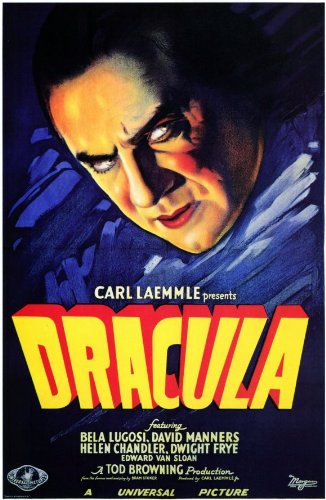
DRACULA (1931) ****
I remember being first disappointed by the 1931 Dracula and that disappointment carried over for more than two decades.

Around the turn of the 21st Century, I bought the 1999 VHS release and that’s what I first watched, the one with Classic Monster Collection across the top and then New Music by Philip Glass and Performed by Kronos Quartet immediately below. Of course, I thought Bela Lugosi as Dracula and Dwight Frye as Renfield were absolutely incredible, David Manners as Jonathan Harker and Edward Van Sloan as Professor Van Helsing and Helen Chandler as Mina Harker less so, and I loved director Tod Browning’s 1932 Freaks at first sight contemporaneous with Dracula. Freaks remains one of my absolute favorite movies, so obviously some movies hit people right from the start and others just simply take more time or sometimes they never make that deep, personal connection others do.

For the longest time, at least a decade if not longer, I thought Dracula was overrated and paled in comparison against Freaks, Frankenstein, The Bride of Frankenstein, and The Wolf Man, all of which I first saw around the same time as Dracula and I loved, absolutely loved, and still do love all of them. At the time, I also loved Abbott and Costello Meet Frankenstein more than Dracula.

It was that darn Philip Glass / Kronos Quartet score that stank up Dracula and I still get a big kick out of the Triumph the Insult Comic Dog couplet, Philip Glass, atonal ass, you’re not immune / Write a song with a fucking tune. I remember my wife complained about Glass’ score for the experimental non-narrative film Koyaanisqatsi and I bristled at his score for Candyman upon revisiting that 1992 film for the first time in several years.

Revisiting the 1931 Dracula in recent years, without the Glass / Kronos score and back closer to how it first appeared in theaters on Feb. 14, 1931, it’s risen in stock from three to three-and-a-half and finally four stars. I cannot deny that it still has a fair share of faults, like those performances I mentioned earlier and the stage-bound production quality since it’s based off the 1924 stage play adapted from Bram Stoker’s 1897 novel, but I’ve grown appreciation for everything that works from the opening scenes in Transylvania to Lugosi (1882-1956) and Frye (1899-1943), who inspired later songs from Bauhaus (Bela Lugosi’s Dead) and Alice Cooper (The Ballad of Dwight Fry).

It also helps one to catch up with the Spanish language Dracula from the same year and the same sets but a different cast, a different language, and a different director. This Spanish version, rediscovered first in 1978 and then later on video in 1992, lasts 30 minutes longer and it’s better in almost every respect than its famous counterpart. Better shot and better looking, vastly superior cleavage and far sexier women (Lupita Tovar over Helen Chandler any day of the millennium), and less wimpy men in the Spanish version, but Lugosi still prevails against Carlos Villarias.

Several lines had already entered the lexicon decades before I first watched Dracula: I never drink … wine. For one who has not lived even a single lifetime, you’re a wise man, Van Helsing. Listen to them. Children of the night. What music they make. Even I am Dracula belongs somewhere in the pantheon near Bond, James Bond. Lugosi’s ability or lack thereof speaking the English language actually benefits the otherworldly nature of his Dracula and I hold his performance in high regard alongside Max Schreck in Nosferatu, Christopher Lee in Dracula, and Gary Oldman in Dracula.

I have a long relationship with vampires.

I remember the 1985 Fright Night being the highlight of a boy slumber party circa 1988 and third or fourth grade.

I must have been 11 or 12 years old and in the fifth or sixth grade when reading the Stoker novel. Right around that point in time, I also read Sir Arthur Conan Doyle’s The Hound of the Baskervilles and Roald Dahl’s Charlie and the Chocolate Factory. I loved all three of them and they each fired up my imagination and creative spirit.

A few years later, I caught up with the Francis Ford Coppola version and talk about a movie that wowed a 14-year-old boy. I remember staying up late and sneaking around (somewhat) to watch this Dracula on my bedroom TV, captivated by all the nudity and sexuality and violence and Winona Ryder and Sadie Frost and it recalled some of what I liked about the novel all while becoming a cinematic extravaganza. I know critics of the 1992 Dracula blasted the film for being all style, no substance and for being overblown, but I think it’s overflowing with creativity and sheer cinematic beauty. I rate it right up there with F.W. Murnau’s Nosferatu as one of the best vampire films ever.

Some things simply transcend Keanu Reeves’ horrible accent and Dracula’s at one point beehive hairdo.

The vampire genre itself transcends such duds as Dracula 2000 and New Moon.

Frankenstein Meets the Wolf Man (1943)

FRANKENSTEIN MEETS THE WOLF MAN (1943) ***1/2
Frankenstein Meets the Wolf Man starts with an absolute big bang and we have possibly the greatest five minutes in any classic Universal monster movie.

That includes such immortal movies as Frankenstein, The Bride of Frankenstein, Son of Frankenstein, Dracula, The Mummy, The Invisible Man, and The Creature from the Black Lagoon, all stone cold classics essential to every horror movie lover.

The opening gets everything absolutely right: two grave robbers, a cemetery in the middle of the night, Larry The Wolf Man Talbot’s crypt, a full moon, a whole bunch of wolfbane, the revived Wolf Man’s hand, and enough overall spooky atmosphere for approximately 50 scary movie scenes. Yeah, it’s such a phenomenal sequence that director Tom McLoughlin revived it for his opening in Jason Lives, the one film during that long-running series most influenced by classic monster movies.

The rest of Frankenstein Meets the Wolf Man does not quite measure up, especially once Frankenstein’s Monster enters the picture, but it’s still a great deal of fun.

Of course, it doesn’t hurt any that Lon Chaney Jr. (1906-73) returns as Larry Talbot, one of the greatest horror movie characters. Chaney Jr. played Talbot five times from 1941 through 1948 — the original Wolf Man, Frankenstein Meets the Wolf Man, House of Frankenstein, House of Dracula, and Abbott and Costello Meet Frankenstein.

Talbot’s a tortured soul — in fact, mondoshop.com hypes its Wolf Man poster, The most tortured soul in the Universal Monsters universe is unquestionably that suffering bastard Larry Talbot, a.k.a. The Wolf Man — and we feel great empathy for this character because he essentially doesn’t want any damn part of being the Wolf Man. Your own son Bela was a werewolf. He attacked me. He changed me into a werewolf. He’s the one that put this curse on me. You watched over him until he was permitted to die. Well, now I want to die to. Won’t you show me the way?

In that way, he’s different from Dracula, Frankenstein’s Monster, the Mummy, and the Invisible Man. Lon Chaney’s Phantom in the 1925 classic The Phantom of the Opera inspires similar feelings as Talbot and the Wolf Man. To his enduring credit, Boris Karloff (1887-1969) worked some pathos into Frankenstein’s Monster, especially in Frankenstein and The Bride of Frankenstein. Still, Talbot stands apart from most cinematic monsters and maybe it’s because he’s the most explicitly human.

Bela Lugosi (1882-1956) passed on Frankenstein’s Monster in Frankenstein, much to his eternal regret, and so he signed on for the Monster in Frankenstein Meets the Wolf Man after playing Ygor in Son of Frankenstein and The Ghost of Frankenstein. During the latter film, one might remember that Dr. Ludwig Frankenstein accidentally put Ygor’s brain into the Monster’s head — he speaks poetically at one point in the film, I am Ygor. In a series that paid minuscule attention to continuity from one film to the next, the Monster originally spoke and explained his plight in Frankenstein Meets the Wolf Man, but Universal studio heads apparently laughed their heads off at Lugosi’s dialogue and demanded it be excised from the final cut, rendering the monster absolutely ridiculous and his scenes basically a washout. I am not sure why Lugosi’s voice suddenly became laughable. Lugosi’s stunt double stands in for the 61-year-old man in many scenes. Ironically, though, whenever people imitate Frankenstein’s Monster, it’s the Lugosi version from Frankenstein Meets the Wolf Man. (Lugosi played Bela in The Wolf Man and Chaney Jr. was Frankenstein’s Monster in The Ghost of Frankenstein after Karloff bowed out.)

We’re not sure exactly why the Monster’s encased in ice or why there’s a production number that must have moseyed on over from MGM. The second half of Frankenstein Meets the Wolf Man often leaves us feeling awful perplexed.

Frankenstein Meets the Wolf Man finishes strong, thankfully, and we do see our titular monsters slug it out, though it presents an internal struggle because while we’d love more battle royale between the monsters we do love the 90 seconds they give us. This movie paved the highway for King Kong vs. Godzilla and Freddy vs. Jason.

In most every way possible, Frankenstein Meets the Wolf Man proves to be a red hot mess, but a lovable and thoroughly entertaining one nonetheless.

Grand Hotel (1932)

GRAND HOTEL (1932) ***
MGM once boasted More stars than there are in Heaven and as I typed out those words, sounds and images from Grand Hotel played on the motion picture spread inside my head.

Of course, because Grand Hotel put Greta Garbo, John Barrymore, Joan Crawford, Wallace Beery, and Lionel Barrymore — five good old-fashioned movie stars — together. A commercial and critical success, Grand Hotel gave Hollywood a casting model still with us today, as well as the custom that a luxurious setting must host our stars. They even named the movie after this luxurious setting.

Part of the appeal of watching Grand Hotel to this very day — nearly 90 years after the film’s original release, for crying out loud — derives from drawing parallels between the real-life performer and their character, especially true for Garbo, John Barrymore, and Crawford.

Top billed Garbo (1905-90) plays ballerina Grusinskaya, but it’s virtually impossible to not draw the parallels with the actress herself when we hear the famous words, I want to be alone. Or I think Suzette, I’ve never been so tired in all my life. Yes, I listened to the Kinks’ “Celluloid Heroes” so many times before I watched Grand Hotel that the song informed every second of seeing Garbo in arguably her most famous movie role, Don’t step on Greta Garbo as you walk down the Boulevard / She looks so weak and fragile, that’s why she tried to be so hard / But they turned her into a princess / And they sat her on a throne / But she turned her back on stardom / Because she wanted to be alone.

Garbo appeared in eight films after Grand Hotel, her final one being George Cukor’s Two-Faced Woman in 1941. That one came with the slogan Go Gay with Garbo! Her first talking picture, 1930’s Anna Christie, simply hyped Garbo Talks!

John Barrymore (1882-1942) first made his motion picture fame as Dr. Henry Jekyll and Mr. Edward Hyde in the 1920 Dr. Jekyll and Mr. Hyde. Barrymore’s life played out like Jekyll and Hyde, seeing that his matinee idol looks earned him the nickname ‘The Great Profile’ and benefited him in romantic lead parts in Grand Hotel (as the formerly wealthy Baron Felix von Gaigern, who specializes in thievery and gambling with Garbo his potential mark) and Twentieth Century (arguably his best performance as tempestuous temperamental theatrical director Oscar Jaffe) before many years of heavy drinking finally wore him down into a shell of his former self. John Barrymore died 10 years after Grand Hotel premiered, at the age of 60 from pneumonia and cirrhosis of the liver. He’s more famous today for being Drew Barrymore’s grandfather, but his acting talents are well-preserved on celluloid and I’d start (and possibly finish) with Dr. Jekyll and Mr. Hyde, Grand Hotel, and Twentieth Century.

Crawford (1904-77) has remained a divisive figure some 50 years after her final movie — Trog in 1970 — embodied by the essay The Feminine Grotesque: On the Warped Legacy of Joan Crawford by Angelica Jade Bastien that reappeared on RogerEbert.com during Women’s History Month. No lesser authority than Crawford herself described her Grand Hotel character Flaemmchen as “the little whore stenographer,” and the actress’ eternal divisiveness stems in part from her infamous reputation for sleeping her way to the top. Bette Davis said of her arch rival, She slept with every star at MGM. Of both sexes.

Kansas City (Missouri)-born Beery (1885-1949) shared the 1933 Academy Award for Best Actor — with Fredric March from Dr. Jekyll and Mr. Hyde — for his performance as the title character in the feel good heartstring yanker The Champ. The Champ premiered Nov. 21, 1931. Grand Hotel premiered 143 days later and Beery plays a character, General Director Preysing, who proves to be a complete 180 from The Champ. Beery chews through the scenery not only on Grand Hotel but every other movie MGM had in production at that moment in time.

John’s older brother Lionel Barrymore (1878-1954) etched his place in history as the epitome of villain, Mr. Henry F. Potter from It’s a Wonderful Life. So to see him play such a likable character in Grand Hotel might be a great shock for most viewers who are only familiar with Barrymore through It’s a Wonderful Life. He’s definitely a scene stealer in Grand Hotel.

Ironically enough, Lionel Barrymore presented Beery with his Oscar statuette. Barrymore won Best Actor the previous year for his performance in A Free Soul.

I must admit, though, that I prefer International House, taglined in 1933 as ‘The Grand Hotel of Comedy’ and released by Paramount, over Grand Hotel. International House gives us a cast that includes famous gold digger Peggy Hopkins Joyce, W.C. Fields, George Burns and Gracie Allen, Rudy Vallee, and Bela Lugosi, plus Stoopnagle and Budd, Baby Rose Marie, and Cab Calloway. We have Calloway and his band performing “Reefer Man,” Fields smoking opium and driving his American Austin automobile through this grand hotel in Wuhu China, Doctor Burns and Nurse Allen bantering, and plenty more Paramount pre-Code shenanigans stuffed into a 70-minute cinematic confectionery. By comparison, Grand Hotel, lasting more than 110 minutes, seems awful staid and stodgy.

That said, Grand Hotel serves a lasting reminder of how powerful star power used to be.

The Gorilla (1939)

THE GORILLA (1939) *

When you have Bela Lugosi and Lionel Atwill in the cast, make them supporting players, and focus instead on the Ritz Brothers and Patsy Kelly, I call that a major failure.

The Gorilla, distributed by Twentieth Century-Fox and not surprisingly based on a stage play given the film’s limited sets and overall stagy feel, made that very choice. Lugosi earns more laughs than the execrable Ritz Brothers just by playing it straight. Yes, I found Al, Jimmy, and Harry execrable, as they fumbled bumbled and stumbled their way and I conversely grumbled my way through The Gorilla, a horror comedy that fails miserably at both genres. I read the Ritz Brothers walked away from The Gorilla because of the shoddy quality of the script and that’s never a good sign when the stars themselves grumble. They were right, though, because The Gorilla is shoddy, but the Ritz Brothers don’t get let off the hook. Not so fast.

The Ritz Brothers have been called a poor man’s Marx Brothers. No way, they’re not even good enough for that. Granted, to be fair, The Gorilla marked my first exposure to Al, Jimmy, and Harry, so maybe they did their best work elsewhere. Based on The Gorilla, though, I could not differentiate between Al, Jimmy, and Harry, who might as well be any Tom, Dick, and Harry off the street. They blended into one grating personality. I mean, Groucho, Harpo, and Chico created their own distinctive trademark comic personalities and they provided us a wealth of great comic material when they worked at their best (Horse Feathers, Duck Soup).

Laurel and Hardy did this horror comedy number much, much, much better in the 28-minute The Laurel-Hardy Murder Case from 1930. Watching The Gorilla, there’s one recurring gag involving a chair, a desk, a light, and disappearance that specifically makes it clear The Gorilla ripped off The Laurel-Hardy Murder Case, which parodies silent films The Cat and the Canary and The Bat. Paramount released a The Cat and the Canary remake starring Bob Hope and Paulette Goddard on Nov. 10, 1939, only about five-and-a-half months after The Gorilla.

We’ve all seen The Gorilla before, possibly many times before, through other movies, not only the fumbling bumbling stumbling detectives but also the maid who loves to shriek in just about every other scene, the wealthy uncle and the lovely young niece and her male friend and the inheritance plot, the butler who did not do it but who seems to show up at exactly the wrong time so he becomes an obvious suspect for the murders afoot, and both a killer named ‘The Gorilla’ and a real gorilla escaped from the local zoo on the loose and in the same house.

I believe that we talked about Lugosi and his great cinematic love for apes and gorillas back when I reviewed Bela Lugosi Meets a Brooklyn Gorilla. I gave that one three stars, but it actually has almost a full point lower average rating than The Gorilla on Internet Movie Database. Big whoop! I found Jerry Lewis and Dean Martin knockoffs Sammy Petrillo and Duke Mitchell a whole lot more endearing and funny than Al, Jimmy, and Harry Ritz, and Bela Lugosi Meets a Brooklyn Gorilla is not a snooze fest hopelessly dedicated to one set like The Gorilla.

Boris, Boris, Boris: The Man They Could Not Hang, The Man with Nine Lives, The Boogie Man Will Get You

BORIS, BORIS, BORIS: THE MAN THEY COULD NOT HANG, THE MAN WITH NINE LIVES, THE BOOGIE MAN WILL GET YOU

I am a big fan of the horror movies of the 1930s and 1940s and I am a big Boris Karloff (1887-1969) fan.

Older horror movies often stand out for two main reasons: atmosphere and wit. Just think DR. JEKYLL AND MR. HYDE and THE BRIDE OF FRANKENSTEIN.

Karloff’s film career began in the silent era and he was already 80 movies deep into his career when he portrayed Frankenstein’s Monster in James Whale’s 1931 FRANKENSTEIN. Karloff’s career exploded and he (along with such figures as Bela Lugosi, Peter Lorre, Basil Rathbone, Lionel Atwill, and Lon Chaney Jr.) became synonymous with a certain vintage of horror thrillers.

Watching his early Universal films like FRANKENSTEIN and THE OLD DARK HOUSE and then his work for Columbia like THE MAN THEY COULD NOT HANG, THE MAN WITH NINE LIVES, and THE BOOGIE MAN WILL GET YOU, it is fascinating to observe Karloff’s evolution from menacing mutes to mad scientists with mad elocution. In fact, during THE BOOGIE MAN WILL GET YOU, I wanted Karloff’s Professor Nathaniel Billings to just the heck shut up for a darn minute. He’s a blabbermouth, and it’s amazing to even think of Karloff playing that way after FRANKENSTEIN and THE OLD DARK HOUSE made the actor famous for playing silent but deadly.

THE MAN THEY COULD NOT HANG contains one of Karloff’s best performances. He plays Dr. Henryk Savaard, a genius who can bring the dead back to life, a feat that might come in handy for a film titled THE MAN THEY COULD NOT HANG. You guessed it, that man would be Dr. Savaard. Anyway, a medical student volunteers for Dr. Savaard and before he can be returned to life, them darn proper authorities interrupt Dr. Savaard. Call it “cadaver reanimatus interruptus.” They bring Dr. Savaard up for murder, convict him, and sentence him to death by hanging. They do in fact hang the good doctor, but his incredibly trustworthy assistant claims the body and brings the doctor back to life to enact his revenge against the judge and the jury responsible for convicting him and sentencing him to his death.

THE MAN THEY COULD NOT HANG basically splits into three movies: mad scientist, courtroom drama, and revenge thriller. It all works extremely well predominantly because of Karloff, whose performance dominates the movie. His courtroom defense scene is a thing of absolute beauty and it just might be his best single scene.

By the way, I absolutely love it when horror movies are not afraid to venture into other genres and become more than a horror movie while simultaneously maintaining the bulk of their body within the genre.

THE MAN WITH NINE LIVES tells a similar tale and Karloff plays a similar character to his role in THE MAN THEY COULD NOT HANG. Both pictures also have the same director (Nick Grinde) and the same writer (Karl Brown), as well as the same cinematographer (Benjamin Kline).

NINE LIVES picks up once we find Karloff’s Dr. Leon Kravaal frozen in an ice chamber deep in a secret passage within his home. Also found are Dr. Kravaal’s accusers … and might I add the plot of THE MAN WITH NINE LIVES gets very loopy even for its genre, despite its ties to real life.

Both THE MAN THEY COULD NOT HANG and THE MAN WITH NINE LIVES are rooted in Dr. Robert E. Cornish and his famous resuscitation experiments. Cornish successfully revived two dogs (Lazarus IV and V) and he wanted to expand his testing on humans. San Quentin inmate Thomas McMonigle, on Death Row, contacted Cornish and offered his body for experimentation, but California denied Cornish and McMonigle their petition because law enforcement officials feared a reanimated McMonigle would have to be freed due to “double jeopardy.” McMonigle was executed in early 1948. Cornish (1903-63) himself appeared in the 1935 film LIFE RETURNS, playing himself.

THE BOOGIE MAN WILL GET YOU plays around with similar material as the other Karloff films he made for Columbia, only more for laughs this fifth time. Yes, Karloff plays yet another mad scientist.

The presence of Karloff and Peter Lorre (1904-64) guarantees at minimum a certain quality and THE BOOGIE MAN WILL GET YOU definitely finds that minimum and nothing less or nothing more. The less said about it the better, and I wish the movie would have followed that policy.


THE MAN THEY COULD NOT HANG ***1/2; THE MAN WITH NINE LIVES ***; THE BOOGIE MAN WILL GET YOU **

Nosferatu (1979)

NOSFERATU

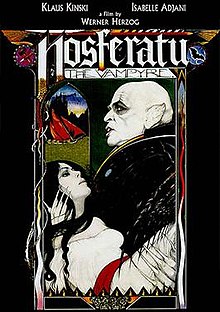
NOSFERATU (1979) ***1/2

German director Werner Herzog’s NOSFERATU THE VAMPYRE has often been described as a “slow burn” horror film and every critic seems to want to sound a fire alarm that it’s not the average “creature feature” with cheap thrills every few minutes and that it will disappoint most horror movie fans.

The former is certainly true and I cannot speak for the latter except to say this horror movie fan liked it. I’ll be honest, I did not much enjoy it the first time watching it a good 20 years before my return viewing. I remember having a more neutral reaction that first time. Not sure why.

Looking up “slow burn,” I find that it means “a filmmaking style, usually in narrative productions, wherein plot, action, and scenes develop slowly, methodically toward a (usually) explosive boiling point.”

NOSFERATU definitely fits methodical and perhaps only slow to viewers raised on Attention Deficit Cinema. I’d rather say that Herzog’s remake and F.W. Murnau’s original 1922 masterpiece subtitled A SYMPHONY OF HORROR both move at their own leisurely pace. They play more like fever dreams than the average horror movie.

NOSFERATU does not fit the back end of that slow burn definition, because there’s not an explosive boiling point. Certainly not anything resembling the stereotypical big bang grand finale to a standard Hammer Dracula picture.

Herzog marches to the beat of his own drum. That’s for sure and thank God for that, just as we should be thankful for every great director. I consider his AGUIRRE, THE WRATH OF GOD to be the best film I have seen from 1972 and I would put it on a list of the greatest films ever made. LITTLE DIETER NEEDS TO FLY and GRIZZLY MAN are on my top 10 lists for 1997 and 2005, respectively. Les Blank’s documentary BURDEN OF DREAMS, which chronicles Herzog’s great adventure making FITZCARRALDO, also makes my top 10 list for 1982. Ramin Bahrani’s 18-minute PLASTIC BAG, a top 10 entry for 2010, utilizes Herzog as its narrator.

I know that NOSFERATU was my first time watching a Herzog movie and I believe I had not yet seen the Murnau original. To be sure, I was more equipped watching NOSFERATU for a second time.

More than anything else, images stand out. Brilliant images are the heart of both the 1922 and 1979 films and both Murnau’s and Herzog’s filmography.

Musophobes should not watch NOSFERATU, because rats take over the screen at crucial points late in the picture. The rats are the source of some legendary stories: Herzog said the rats were better behaved during the shoot than star Klaus Kinski and since real grey rats proved to be unavailable, white rats were given a grey makeover, for example.

The rats call to mind the monkeys from AGUIRRE.

Of course, there’s every time Dracula (Kinski) is on the screen. Since copyright was not a concern for Herzog like it had been in 1922 for the first NOSFERATU, Herzog returned names like Dracula, Jonathan Harker, and Lucy to his version. Dracula’s look echoes Max Schreck’s iconic Count Orlok and both vampires are radically different from the classic bloodsuckers played by Bela Lugosi and Christopher Lee, as well as just about every other vampire in cinematic history. Herzog and Murnau both show how it is more of a curse to be a vampire and make it far less of a power trip. Herzog’s Dracula and Count Orlok are not suave and debonair, and their striking physical appearances echo vampire folklore. We also have far more complex reactions to the vampires played by Schreck and Kinski, since we feel more empathy for them.

Around her mid-20s at the time she made NOSFERATU, French actress Isabelle Adjani already had a strong claim on the title of most beautiful woman in the world. NOSFERATU did nothing to refute that.

Thinking about the various Jonathan Harkers over time, Bruno Ganz’s performance ranks better than David Manners in the 1931 DRACULA and Keanu Reeves in the 1992 DRACULA. He certainly goes through a wider emotional range than either Manners or Reeves, who are both “mannered” in their performances.

Ultimately, NOSFERATU leaves one with feelings different from how we normally react to a vampire picture. There’s not the standard euphoria that we experience, for example, when Lee’s Dracula spectacularly bites the dust. Instead, we are more pensive and melancholic than excited and thrilled.

Bela Lugosi Meets a Brooklyn Gorilla (1952)

LUGOSI GORILLA 1953 OWENSBORO

BELA LUGOSI MEETS A BROOKLYN GORILLA (1952) Three stars

They don’t make bad movies like BELA LUGOSI MEETS A BROOKLYN GORILLA any more and that should bring sadness to genuine bad movie connoisseurs everywhere.

It was filmed in six days with a mighty mighty production budget of $12,000. (I have read other reports that have the film down for nine days and $50,000.)

William “One Shot” Beaudine (1892-1970) directed BELA LUGOSI MEETS A BROOKLYN GORILLA and his credits between film and TV amounted to a staggering 372 with his final theatrical features JESSE JAMES MEETS FRANKENSTEIN’S DAUGHTER and BILLY THE KID VS. DRACULA both released in 1966. Beaudine’s directorial career began in 1915, the year of D.W. Griffith’s landmark feature THE BIRTH OF A NATION; in fact, Beaudine assisted Griffith on both THE BIRTH OF A NATION and INTOLERANCE (1916).

Beaudine is not the only legendary Hollywood figure associated with BELA LUGOSI MEETS A BROOKLYN GORILLA.

We have, of course, Mr. Lugosi, no stranger to bad movies, especially in the later stages of his career. He always played a good game, though, and never failed in elevating anything that he was in. One of the all-time greats, Lugosi (1882-1956) even gave great performances in death in both the Kinks’ “Celluloid Heroes” (“Avoid stepping on Bela Lugosi / ‘Cause he’s liable to turn and bite”) and especially Bauhaus’ “Bela Lugosi’s Dead.” MEETS A BROOKLYN GORILLA does not represent peak Lugosi, of course, and it’s not even as good Lugosi as Ed Wood’s GLEN OR GLENDA and BRIDE OF THE MONSTER, but any Lugosi is still good Lugosi.

Martin Landau, who earned an Academy Award for portraying Lugosi in ED WOOD, said that he prepared for his role by watching BELA LUGOSI MEETS A BROOKLYN GORILLA three times (hopefully not in a row). Landau said the film was so bad that it made Ed Wood’s films seem like GONE WITH THE WIND by comparison. Now, there’s a pull quote for the ads: “Makes Ed Wood’s films seem like GONE WITH THE WIND.”

Lugosi made THE GORILLA in 1939 with the Ritz Brothers and Lionel Atwill and THE APE MAN in 1943, a film directed by Beaudine. All three ape films are public domain.

No, please wait, we have not even got to the best part yet. There’s nightclub duo Sammy Petrillo and Duke Mitchell, who play themselves in BELA LUGOSI MEETS A BROOKLYN GORILLA. They are really playing Jerry Lewis and Dean Martin, though, and you might be forgiven for mistaking Petrillo for Lewis and Mitchell for Martin if you missed the opening credits.

I raised my grade by at least one star once I found out that Martin and Lewis considered suing Petrillo and Mitchell for appropriating (misappropriating) their act for BELA LUGOSI MEETS A BROOKLYN GORILLA.

From a 1952 story by the United Press’ Aline Mosby, “The latest ‘Martin and Lewis’ are Duke Mitchell and Sammy Petrillo. They look, talk, laugh, and sing like Dean and Jerry, and they’re in the movies now, too. … Mitchell and Petrillo have the same haircuts, expressions, gestures and even ancestries of Martin, who’s Italian, and Lewis, who is Jewish.”

Mitchell and Petrillo insisted they did not see any resemblance. (Despite the film poster, “They look like Martin & Lewis … You’ll not know the difference … but they are really SAMMY PETRILLO DUKE MITCHELL.”)

After stating that Charlie Chaplin was the only original comic and everybody in show business is a combination of everybody else anyway, Petrillo added, “If it wasn’t for Minosha Skulnic, Harry Ritz and Gene Bayless, Jerry Lewis wouldn’t have an act. And that trick he does with his upper lip he got from Huntz Hall.”

“I’m a combination of Billy Daniels, Billy Eckstine and Sarah Vaughn,” Mitchell said. “Sometimes I get up to sing and I feel like Vaughn Monroe. Nothing’s original in show business. Who do you think Martin is? Crosby. Mel Torme’s like Sinatra, and he did all right.”

Mitchell and Petrillo only made BELA LUGOSI MEETS A BROOKLYN GORILLA and Martin and Lewis split in 1956 after 17 films together beginning with MY FRIEND IRMA (1949).

Mitchell died in 1981, Martin 1995, Petrillo 2009, and Lewis 2017.

BELA LUGOSI MEETS A BROOKLYN GORILLA is one of those movies where you can remember Leonard Maltin’s entire review, let’s see here, “BOMB. One of the all-time greats. Mitchell and Petrillo (the very poor man’s Martin and Lewis) are stranded on a jungle island, where Lugosi is conducting strange experiments. Proceed at your own risk.”

After positive reviews for THE TERROR OF TINY TOWN, KING KUNG FU, THE KILLING OF SATAN, and TROLL 2, I see no problem writing one for BELA LUGOSI MEETS A BROOKLYN GORILLA, although I have mentioned that it’s a bad movie several times. C.M.A., that’s all, folks.

Plan 9 from Outer Space (1959)


PLAN 9 FROM OUTER SPACE (1959) Four stars

Discourse around Ed Wood’s 1959 feature gives us two options: it’s either the worst movie ever made or it’s so bad that it’s actually good.

Having recently watched PLAN 9 twice, once near the 60th anniversary of the film’s initial release on July 22, I find that I disagree with both options, especially the first one.

It’s a great movie, because I traditionally equate personal enjoyment with greatness and I enjoy the living dead out of PLAN 9.

Wood’s films have been called “accidental avant-garde” or Wood didn’t know what he was doing and this sheer ineptitude created something arguably more bizarre. Wood’s films, like Ray Dennis Steckler’s THE INCREDIBLY STRANGE CREATURES WHO STOPPED LIVING AND BECAME MIXED-UP ZOMBIES and RAT PFINK A BOO BOO, exist in their own realm despite taking on many genres.

For example, in PLAN 9, we have horror, science fiction, action, adventure, and drama.

Sure, that seems like nothing special because a lot of movies yesterday and today and tomorrow mix and match genres, but just wait until you see PLAN 9.

What other movie would begin with a spiel from a psychic named “The Amazing Criswell” (1907-82) who became infamous for making “wildly inaccurate predictions.” (Aside from another Ed Wood film, of course.)

Criswell sets the tone for the rest of the movie right from the very start, “Greetings, my friend. We are all interested in the future, for that is where you and I are going to spend the rest of our lives. And remember my friend, future events such as these will affect you in the future. … My friend, can your heart stand the shocking facts about grave robbers from outer space?”

Wood had originally planned for GRAVE ROBBERS FROM OUTER SPACE to be his title, but financier J. Edward Reynolds, a devout Southern Baptist, found GRAVE ROBBERS offensive and Wood changed it to the title we all know and love. Wood and several cast members were even baptized at Reynolds’ church.

Taking into consideration the fascinating nature of the cast and Wood himself, you understand why Tim Burton’s fantastic ED WOOD focused so much time on PLAN 9.

— Criswell, given name Jeron Criswell King, became a fringe celebrity in Hollywood and he cut an entertaining figure at parties with his predictions. Criswell appeared on late night TV (he predicted 1966 on Johnny Carson), published his predictions in both magazines and newspapers, and wrote three books — “From Now to the Year 2000,” “Your Next Ten Years,” and “Forbidden Predictions” — and made a record titled “The Legendary Criswell Predicts Your Incredible Future” (which can be found online). Criswell’s friend and fellow PLAN 9 cast member Paul Marco released Criswell’s song “Someone Walked Over My Grave” after Criswell’s 1982 death, apparently because Criswell wanted it released that way.

— Finnish-American actress Maila Nurmi (1922-2008) became better known as “Vampira,” who hosted horror movies on her own series, “The Vampira Show,” from 1954-55 on KABC-TV in Los Angeles. Vampira is a combination of Morticia Addams, the Dragon Lady from “Terry and the Pirates,” and the evil queen from “Snow White.” Vampira sued horror movie host Elvira for $10 million for “infringing upon her trademark, public reputation and ability to market her lucrative character.” “The character was ripped off,” Vampira’s attorney Jan Goodman said. “Hopefully, my client will be fairly compensated and Cassandra Peterson will continue with her character and share the proceeds with my client.” The court ruled in favor of Elvira, “‘Likeness’ means actual representation of another person’s appearance, and not simply close resemblance.” Vampira played a silent role in PLAN 9 reportedly because she wanted absolutely nothing to do with the dialogue written by Wood.

— Hollywood legend Bela Lugosi (1882-1956) found his roles diminished greatly because his dependence on morphine and methadone for his sciatic neuritis became known by Hollywood producers. Lugosi and Wood struck up a friendship, and Wood cast Lugosi in GLEN OR GLENDA? and BRIDE OF THE MONSTER. Wood filmed Lugosi picking a flower in front of Tor Johnson’s home, which became Lugosi’s final work on film because the great actor died five months before production on PLAN 9 began. Lugosi’s absence obviously left a major hole in PLAN 9 and chiropractor Tom Mason stepped in for Lugosi in a way that predates the Bruce Lee subterfuge in GAME OF DEATH. It’s just as effective as GAME OF DEATH, as well, to get that out of the way. Mason stalks through his every scene in PLAN 9 with a cape over his face, a classic Lugosi gesture borrowed from his final performance as Dracula in ABBOTT AND COSTELLO MEET FRANKENSTEIN (1948). Legend has it that Lugosi was even buried in his cape.

— Swedish professional wrestler Tor Johnson (1902-71) appeared in 31 movie roles over nearly 30 years, mostly as a weightlifter or a strongman. Wood let the hulking Johnson speak in PLAN 9 and you will quickly realize why Johnson’s other roles were non-speaking. In fact, you might wish that he was mute like both Lugosi and Vampira in PLAN 9, but I find his dialogue as Inspector Daniel Clay strangely endearing, just like the movie itself, especially his line “I’m a big boy now, Johnny.” Johnson scared Groucho Marx on “You Bet Your Life” in 1954, where he weighed 387 pounds “soaking wet.” Groucho said, “With those measurements, you oughta be twice as attractive as Jayne Mansfield.” Johnson — played by fellow former professional wrestler George “The Animal” Steele in ED WOOD — also became a Halloween mask.

— Character actor Duke Moore (1913-76) had the distinction of his entire character actor career being spent in Ed Wood productions: CROSSROADS OF LAREDO, FINAL CURTAIN, NIGHT OF THE GHOULS, PLAN 9, THE SINISTER URGE, and TAKE IT OUT IN TRADE. In PLAN 9, he plays Lt. Harper, who’s not a very responsible gun owner. Lt. Harper touches his gun underneath his hat, holds it on top of his trench coat, and even points it at himself several times. According to Internet Movie Database trivia, Moore pointed the gun at himself deliberately to see if Wood would notice. Of course, Wood did not.

— Speaking of character actors, Lyle Talbot (1902-96) appeared in more than 150 films over a 56-year career. Talbot’s daughter Margaret wrote a book on her father called “The Entertainer: Movies, Magic and My Father’s 20th Century,” as Lyle worked in a carnival, as a hypnotist’s assistant, in theater, in the movies, and on TV. Lyle played Joe Randolph in 71 episodes of “The Adventures of Ozzie and Harriet” from 1956 to 1966. Lyle’s son, Stephen, played Gilbert on “Leave It to Beaver” (1957-63) and later became a journalist and documentarian. You will notice Lyle Talbot real quick in PLAN 9 because of the level of his performance.

— Dudley Manlove (1914-96, not Manlike, please, Auto Correct) has a voice that will make you think he’d be great in radio. Sure enough, looking up Manlove today, I discover that he worked on radio stations in Oakland and San Francisco. Manlove plays Commander Eros in PLAN 9.

— Independently wealthy, openly gay, and sex change seeking theatrical actor John “Bunny” Breckinridge (1903-96) made his only film appearance as “The Ruler” in PLAN 9.

Breckinridge’s obituary, “John ‘Bunny’ Breckinridge, an eccentric and troubled San Francisco millionaire who entertained grandly, served time in jail for vagrancy and was sued by his mother for lack of support, died Tuesday, November 5th, 1996 of heart failure in a Monterey nursing home. …

“Mr. Breckinridge, the great grandson of U.S. Vice President John Breckinridge and of Wells Fargo Bank founder Lloyd Tevis, was born in Paris. He spent time at Eton College and Oxford University in England and at the Atascadero State Hospital for the criminally insane.

“He was known for his flamboyant lifestyle, outrageous comments and penchant for perfume and costume jewelry. He performed in Shakespearean plays in England before coming to San Francisco in the late 1920s.

“He married the daughter of a French countess in 1927. The couple was divorced in 1929.

“‘I was a little bit wild when I was young, darling, but I lived my life grandly,’ he said.”

Bill Murray played Breckinridge in ED WOOD, so they’ve both got that going for them.

— Fumbling, bumbling, stumbling cop Kelton, played by Paul Marco (1927-2006), appeared in three Ed Wood productions and they form the “Kelton Trilogy” — BRIDE OF THE MONSTER, PLAN 9 FROM OUTER SPACE, and NIGHT OF THE GHOULS. Marco introduced Breckinridge to Wood, as the circle of friends around Wood expanded into his movies.

— Gregory Walcott (1928-2015) long regretted that he ever had anything to do with PLAN 9 FROM OUTER SPACE. From a 2000 Los Angeles Times article, “Drawbacks like this [Lugosi being dead] didn’t faze Ed Wood. He used a home movie of Lugosi and an impersonator. He used non-union crews and borrowed equipment. Walcott agreed as a favor, not even telling his agent, but regretted it instantly and for years thereafter. Virtually every reference guide labels PLAN 9 FROM OUTER SPACE the worst movie ever made.”

By the time (2000) that his old hometown of Wilson, North Carolina held a two-day Gregory Walcott Film Festival, Walcott (given name Bernard Mattox) had made peace with both Wood and PLAN 9.

“I didn’t want to be remembered for that,” Walcott said in the Times. “But it’s better to be remembered for something than for nothing, don’t you think?

“So I guess I owe Ed Wood an apology after all these years. Thanks, Ed.”

— Conrad Brooks (1931-2017), along with Walcott and Marco, appeared in Tim Burton’s ED WOOD and then, in his 80s, appeared in the 2015 PLAN 9 FROM OUTER SPACE remake directed by John Johnson and featuring such notables as Brian Krause, Camille Keaton, Mr. Lobo, and James “Angry Video Game Nerd” Rolfe.

Brooks, who played Patrolman Jamie in PLAN 9, was the last of the surviving Ed Wood actors.

— Wood (1924-78) unfortunately did not live to see the cult following that built up around PLAN 9 since 1980 when authors Harry and Michael Medved named it the “worst film ever made” in their book “The Golden Turkey Awards.” That pronouncement got the ball rolling.

Tim Burton’s rather feel good film only reinvigorated interest in both Wood and his filmography. ED WOOD treats PLAN 9 like a sacred text and jumps off the life story and filmography at that point. Wood’s later career included erotica, pornography, and even sexual education movies; Wood also wrote many pulp crime, horror, and sex novels.

ED WOOD (which undoubtedly cost more than all of the real Ed Wood’s films combined) also skips Wood’s alcoholism, but, hey, at least it does not skimp on his love of angora. (It’s also the most affectionate tribute from one director to another that I have ever seen, the film’s biggest strength.)

There’s even a Church of Ed Wood and if you go to www.edwood.org, you will have to click OK to “www.edwood.org says To answer your first question — yes, we’re serious!

“Woodism is a pop-culture-based religion created in 1996 by Reverend Steve Galindo. We follow the late cult director Edward D. Wood Jr., and we look to him as a savior. We at The Church of Ed Wood use Ed and his films to inject spirituality into those who get little fulfillment from more mainstream religions like Christianity. By looking at his films and his life, we learn to lead happy, positive lives. We strive for acceptance of others and of the self.”

I first encountered BRIDE OF THE MONSTER and PLAN 9 FROM OUTER SPACE around 12 years ago when Rob Zombie hosted “TCM Underground” on Turner Classic Movies, a show that I definitely miss since not having cable TV after the 2012 Election. I taped both movies, as well as Zombie’s bookend intros and outros for both, and that’s how I watched PLAN 9 twice recently.

I don’t write over 2,000 words on just any movie, so that only shows how much I love PLAN 9 FROM OUTER SPACE.

I love all the errors (boom mics visible, night-and-day day-and-night shifts during scenes), the cheesy special effects (love them flying saucers), the incongruous stock footage, the cast of goofball characters, the loopy dialogue, and, of course, Criswell’s narration.

BRIDE OF THE MONSTER (1955) Three stars; ED WOOD (1994) Four stars; PLAN 9 FROM OUTER SPACE (1959) Four stars