The Vampire Bat (1933)

THE VAMPIRE BAT (1933) ***
The Vampire Bat would otherwise be a forgotten horror entry were it not for the presence of four members of the Horror Movie Hall of Fame, three of them surefire first ballot inductees.

Fay Wray (1907-2004) earned her claim to be the First Lady of Horror and the first scream queen through her work alone in the 1933 classic King Kong. Ann Darrow gave Wray instantaneous immortality, but she also starred in Doctor X, The Most Dangerous Game, The Vampire Bat, and Mystery of the Wax Museum in a year period leading up to King Kong. She was no one-hit wonder.

Lionel Atwill (1885-1946) appeared in a variety of horror movie roles over a 15-year period, in such entries as Doctor X, The Vampire Bat, Mystery of the Wax Museum, Mark of the Vampire, Son of Frankenstein, The Ghost of Frankenstein, Frankenstein Meets the Wolf Man, House of Frankenstein, and House of Dracula. He generally played a mad doctor or an authority figure, be it Inspector Krogh (Son of Frankenstein) or the Mayor (Frankenstein Meets the Wolf Man). Atwill essayed an inspector in several Universal horror flicks.

Salina, Kansas born Dwight Frye (1899-1943) received a tribute nearly 30 years after his death when Alice Cooper released “Ballad of Dwight Fry” on the 1971 album Love It to Death, one of those classic Cooper morbid ballads / epics. Babe Ruth once said that he was paid more than Herbert Hoover because he had a better year than the President and Frye should have been able to say the same in 1931, between his roles in Dracula and Frankenstein, but it’s doubtful Universal paid a supporting actor in any movie more than the greatest home run hitter. Renfield’s presence certainly would have made the Kamala Harris-Mike Pence vice-presidential debate more interesting.

Melvyn Douglas (1901-81) enjoyed a 50-year acting career and he won Academy Awards for his supporting performances in Hud and Being There, but he earned his spot in the hallowed halls of horror history by appearing in the 1932 classic The Old Dark House.

In other words, Wray, Atwill, Frye, and Douglas elevate The Vampire Bat.

It (1927)

IT (1927) ***1/2

“Hey, old timer, have you seen IT?”

“Yeah.”

“I bet, though, knowing you, that you liked the crusty old TV version from, like what, 1890 better than the new one.

[Silence for a couple beats]

“Well, which one did you prefer?”

“Neither.”

“What?”

“That’s right, I prefer the 1927 IT starring legendary ‘It’ girl Clara Bow over any Stephen King adaptations called IT. Boom!”

— Theoretical conversation circa ‘18


That quality possessed by some which draws all others with its magnetic force. With ‘It’ you win all men if you are a woman and all women if you are a man. ‘It’ can be a quality of the mind as well as a physical attraction.

— Definition of ‘It’


Clara Bow obviously had ‘It’ and she displays it throughout IT, the film that officially made her a sensation after it was released on February 19, 1927.

Bow’s 1927 can stand against Babe Ruth’s — .356 average with 158 runs scored, 29 doubles, eight triples, 60 home runs, 165 RBI, 137 walks vs. 89 strikeouts, and 110 victories and a 4-0 World Series sweep against Pittsburgh — and Charles Lindbergh’s, for his legendary nonstop flight from New York City to Paris.

Bow (1905-65) made six films in 1927: IT, CHILDREN OF DIVORCE, ROUGH HOUSE ROSIE, WINGS, HULA, and GET YOUR MAN.

She helped pave the way for every female sex symbol to come. For example, her skirt flew up during IT, a good 28 years before Marilyn Monroe’s most famous movie bit in THE SEVEN YEAR ITCH. WINGS also features a brief — I mean brief — Bow boob flash. Blink and you’ll miss it.

She also inspired a millinery fashion craze, for crying out loud.

From the June 10, 1927 edition of the St. Louis Dispatch — advertising Clara Bow Vacation Hats for $1.25 each — “Smart and clever are these Clara Bow Hats that are fashioned of a good quality felt in twelve attractive modes. In black, white, pink and all the Summer shades — trimmed with applique of felt in contrasting colors as well as soid effects. Are soft and crushable, easily packed in handbag or trunk.” Each hat purchased came with a 8 x 10 photograph of Bow wearing that hat. No additional charge.

In the August 16 edition of the Minneapolis Star Tribune, Clara Bow Hats were being sold for 98 cents and each hat came with a copy of Bow’s signature. Apparently, there were 12 styles and colors of hats.

From the June 19 Nebraska State Journal, “In Gold’s smart millinery collections you’ll find ‘it’ — the cutest cleverest group of Clara Bow hats and every one of ‘em has ‘it.’ These perky little felt novelties are only $1.45 but they look like a million dollars worth of Clara Bow’s vivacity.”

Bow also became tabloid fodder, like this report from the Los Angeles Times during the making of WINGS, “Clara Bow, Paramount star, is becoming destructive. The queen of the flappers wrecked one perfectly good Ford while learning to drive one for certain sequences in “Wings,” the road show which tells the story of the American Ace in France. Miss Bow plays the part of an ambulance driver. “Wings” is being directed by William Wellman, himself a flyer during the war.” The reports and the rumors became wilder.

Bow retired from acting in 1933 to move to a ranch in Nevada, where she focused her energies on being a wife and a mother.

IT provides an early example of a concept film and it uses product placement — plugging Cosmopolitan Magazine and giving source material writer Elinor Glyn a cameo where she expounds on ‘It.’

IT features a plot that’s older than the Hollywood hills: A salesgirl, Betty Lou (Bow), sets her sights on wealthy (and handsome) playboy Cyrus T. Walham (Antonio Moreno), who’s her boss. There’s plot complications left and right — not convolutions, though — like so many romantic comedies but this is a movie that moves easily beyond its plot because of the style of director Clarence Badger, the witty dialogue and inter-titles, and both the incredible style, spunk, and star power of Bow.

“I don’t go to church. Kneeling bags my nylons.” — ACE IN THE HOLE

“Alright, I’ll go manicure my gloves.” — BUGSY MALONE

“She gave me a smile I could feel in my hip pocket.” — FAREWELL, MY LOVELY

Supporting character Monty Montgomery (William Austin) gets one of the all-time great lines, “I feel so low, old chap, that I could get on stilts and walk under a dachshund.” File it alongside the three lines quoted right above.

Monty proved to be a pleasant surprise, a supporting character who at least made me smile from his very first to his very last appearance. Monty creates the film’s biggest laughs and in a different way than Bow, he’s nearly as unforgettable. I would argue his eyes are just as memorable. What could otherwise be melodramatic mugging benefits from the parameters of silent cinema and his reactions — especially his astonished double takes — are worth their weight in comic gold. He’s a genuine hoot. That statement works for IT as a whole. In movie terms, IT definitely has “it.”

The Pride of the Yankees (1942)

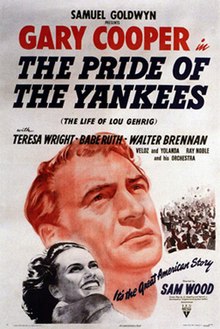
THE PRIDE OF THE YANKEES

THE PRIDE OF THE YANKEES (1942) Two stars
A “Yeah right!” movie, why that’s THE PRIDE OF THE YANKEES.

We all know what “Yeah right!” movies are, right, because, yes, they make us say “Yeah right!” It could be any plot element, a plot twist, a casting decision, et cetera.

Watching THE PRIDE OF THE YANKEES again, it left me saying “Yeah right!” more than anything I’ve seen since, oh, perhaps, CRASH (2005).

We’ll start with a defining “Yeah right!” scene.

Of course, I know, THE PRIDE OF THE YANKEES is the cinematic equivalent of those books we read in elementary school about George Washington and Abraham Lincoln. You might remember the larger-than-life stories about George and his cherry tree and Honest Abe wrestling.

THE PRIDE OF THE YANKEES does that with a bat and a glove.

Our Gehrig tall tale starts with a hospital room filled with reporters. Yankee slugger Babe Ruth (Babe Ruth) promises a boy named Billy that he will hit a home run to center field … against St. Louis in the 1926 World Series.

Why, not to be outdone, our hero Lou Gehrig (Gary Cooper) comes over to visit Billy on his own and promises the boy two home runs … in the same game, yes, the same game that Ruth’s supposed to hit a homer. What a lucky boy!

Ruth and Gehrig both get their homers out of the way in the first inning.

Well, Gehrig needs his second homer and it’s not going to be easy.

Sports writers Sam Blake (Walter Brennan) and Hank Hanneman (Dan Duryea) spend the movie bantering back-and-forth with Blake always supporting and Hanneman always doubting Gehrig. Blake and Hanneman bet on whether or not Gehrig will hit a second homer. They keep raising their stakes as the game moves on and Gehrig accumulates strikeouts. I should probably mention that Blake witnessed Gehrig making his promise.

All roads lead us to the ninth inning and why that dirty St. Louis pitcher, he’s gonna intentionally walk Gehrig.

Of course, a promise is a promise, though, and Gehrig finds a way to fulfill it in the absolute most dramatic fashion.

Later in the film, near the end of his life, Gehrig’s visited by an older Billy on Lou Gehrig Day. Billy tells Gehrig that his shining example and two homers that day inspired Billy’s full recovery.

As the reporter said in THE MAN WHO SHOT LIBERTY VALANCE, “When the legend becomes fact, print the legend.”

Opening credits: “This is the story of a hero of the peaceful paths of everyday life.

“It is the story of a gentle young man who, in the full flower of his great fame, was a lesson in simplicity and modesty to the youth of America.

“He faced death with that same valor and fortitude that has been displayed by thousands of young Americans on far-flung fields of battle. He left behind him a memory of courage and devotion that will ever be an inspiration to all men.

“This is the story of Lou Gehrig.”

Signed by famous writer Damon Runyon (1880-1946). Far out.

Yes, THE PRIDE OF THE YANKEES — made shortly after Gehrig’s death in 1941 at the age of 37 — lays it on thick right from the start.

Gehrig remains one of the greatest baseball players — his 2,130 consecutive games played streak stood as record until Cal Ripken, Jr., passed it on Sept. 6, 1995.

Great baseball players do not guarantee great movies — Babe Ruth, for example, received THE BABE RUTH STORY (1948) and THE BABE (1992), both even worse than THE PRIDE OF THE YANKEES.

In a certain mood, THE PRIDE OF THE YANKEES might be a moving experience.

Otherwise, it might be a “Yeah right!” movie for the ages.