The Man Who Knew Too Much (1956)

THE MAN WHO KNEW TOO MUCH (1956) ***
I would have liked to been a fly on the wall (but not Mike Pence’s head) for several conversations throughout motion picture history.

For example, when Chevy Chase was offered Oh Heavenly Dog. We all remember that one, right, where Chase plays a private detective who’s murdered real early in the picture and then, almost just like Warren Beatty in Heaven Can Wait, he’s reincarnated as, wait for it, Benji. We see Benji solve the murder and hear Chase on the soundtrack. Yes, it’s a real movie.

Another example would be how Alfred Hitchcock reacted when he was told his Man Who Knew Too Much star Doris Day would sing Que Sera, Sera (Whatever Will Be, Will Be) not once but twice during the movie — the first time about 12 minutes in and the second with about 12 minutes left.

Isn’t it obvious, though, that Hitchcock wasn’t into Que Sera, Sera, even before Day sings that line about 500 times.

I search it up (as the kids today say) and find this juicy bit of IMDb trivia: Throughout the filming, Doris Day became increasingly concerned that Alfred Hitchcock paid more attention to camera set-ups, lighting, and technical matters than he did to her performance. Convinced that he was displeased with her work, she finally confronted him. His reply was, ‘My dear Miss Day, if you weren’t giving me what I wanted, then I would have to direct you!’

Apparently, Day (1922-2019) herself was initially turned off by the notion of singing what became her signature song, even in death. She thought it was a forgettable children’s song.

I call this 1956 version The Woman Who Sang Too Much.

The Man Who Knew Too Much ’56 (a remake of Hitchcock’s own 1934 film) predominantly works because of the performance of James Stewart and a couple spectacular set pieces.

Despite this being the least of the four features Stewart made with Hitchcock, way behind Vertigo, Rope, and Rear Window (in that order), we follow the events from beginning to end mostly because of the inherent pull of Stewart … and we also know that even during a lesser Hitchcock film, that sly old master, that dirty old dog, would still come up with something to wow us.

Here, it’s the murder of the mysterious Frenchman in Morocco and the attempted assassination of the prime minister at Royal Albert Hall. Personally, I still prefer Jimi Hendrix’s two nights at the Royal Albert in February 1969. Que sera, sera, right?

Bernard Herrmann, the man responsible for the scores to seven Hitchcock films as well as Citizen Kane and Taxi Driver, makes a cameo as the conductor.

Hitchcock apparently made his trademark cameo around 25 minutes in, but I missed it. Que sera, sera, right?

Especially now that I’m blaring Hendrix’s Hear My Train A Comin’.

The Prowler (1981)

THE PROWLER (1981) *
Describe The Prowler in one word.

Excess.

Yes, indeed, director Joseph Zito goes for an excess of false alarms and jump scares. It seems like there’s a scene like that every couple minutes. I mean, for crying out loud, somebody (usually her policeman significant other) sneaks up on our main female protagonist alone at least five times. Keep in mind The Prowler (hopefully not confused with the 1951 Joseph Losey thriller) earned Zito the opportunity to direct Friday the 13th: The Final Chapter.

Tom Savini’s gore effects ran into considerably less interference than earlier 1981 slasher films My Bloody Valentine and Friday the 13th Part 2, both released in the immediate aftermath of John Lennon’s murder and the subsequent MPAA tougher stance against graphic violence. Savini’s effects are quite frankly almost too good for their own good, as the blood gushes like a geyser at regular intervals. I found them a little much, just as I did in Maniac, and I usually love Savini’s work, especially Dawn of the Dead and Day of the Dead.

In addition to all the false alarms and jump scares, The Prowler relies too much on cat-and-mouse or a ‘contrived action involving constant pursuit, near captures, and repeated escapes.’ The main female protagonist and her dashing cop significant other recall Nancy Drew and one of the Hardy Boys. At one point late in the picture, she even attempts the old hiding underneath the bed with a deranged, psychopathic killer nearby trick.

The Prowler begins with a 1945 newsreel and a ‘Dear John’ letter, before getting down to brass tacks with a double homicide in the distant past that will trigger a present-day murder spree. After the success of Halloween, this flashback style of storytelling to start the whole shebang in style became the vogue for slasher films. Let’s see, Friday the 13th, Prom Night, Terror Train, and The Burning all started up this way and Happy Birthday to Me and My Bloody Valentine were both not too far behind with tours of the past. The plots of The Prowler and My Bloody Valentine have striking parallels, especially the overall look of the killer.

The Prowler conceals the identity of the killer until nearly the end of the movie and that’s probably best … but, who are we kidding, since I found some or even most of the Prowler’s behavior laughable even before the unveiling that calls into question every murder in the past hour. Fortunately, though, we have only a brief unmasking and then our heroine unceremoniously shotgun blasts the Prowler’s head to smithereens. We are spared any big speech or further character motivation and the frenzied scenery chewing of, let’s say, Betsy Palmer late in Friday the 13th. Unfortunately, we are not spared yet another jump scare in the film’s last scene, as if Zito received a bonus for overloading the picture with jump scares. Jump scares are cheap, though, and eventually some audience members turn against any picture that abuses jump scares, false alarms, cat-and-mouse, flashbacks, and dream sequences or whatever combination of them.

Casting Farley Granger as Sheriff George Fraser proved to be a strike against The Prowler, because I flashed back on two of the greatest thrillers ever made, Rope and Strangers on a Train, directed by none other than the Master of Suspense, Alfred Hitchcock. All the marvels of modern cinematic technology like nudity, gore, and profanity galore cannot make up for the difference between Zito and Hitchcock or the difference between a hack and a master.

Alice, Sweet Alice (1976)

ALICE, SWEET ALICE (1976) ***

They really tried hard with ALICE, SWEET ALICE, the horror film that’s best known for being Brooke Shields’ film debut.

It appeared in November 1976 at the Chicago International Film Festival, where it competed against such films as ALLEGRO NON TROPPO, GREY GARDENS, SMALL CHANGE, THE DEVIL’S PLAYGROUND, and Best Feature winner KINGS OF THE ROAD.

It received theatrical release (and mostly negative reviews) in 1977, 1978, and 1981. Viewers might have seen it as either ALICE, SWEET ALICE or COMMUNION (the original title) or HOLY TERROR depending on when they watched it.

The promotional forces especially played on the Brooke Shields angle in ‘78 and ‘81.

One of the ‘78 ALICE, SWEET ALICE ads proclaimed at its top, “PRETTY BABY Brooke Shields, America’s New Star,” a reference to Shields being in Louis Malle’s contemporaneous PRETTY BABY.

Three years later, the film returned as HOLY TERROR with a hard sell promotional campaign again built around exploiting Shields’ notoriety from her Calvin Klein advertisements and her film projects like THE BLUE LAGOON. Shields put up a fight, though, because she had more clout and ENDLESS SUMMER coming down the pike; “Brooke was concerned that film goers could only be disappointed if led into the theater with the promise that the film was of recent vintage or that she had a central part in it,” said her attorney. See, the original HOLY TERROR ads used a photo of Shields circa ‘81 rather than one of her from the film that was made during a different administration. Those naughty ad men, they did a bad, bad thing.

Roger Ebert made the advertising campaign for HOLY TERROR his “Dog of the Week.” “The ads promise that it stars Brooke Shields,” Ebert said. “That’s where the trouble begins, because HOLY TERROR was first released five years ago under the title of COMMUNION and then it was released three years ago as ALICE, SWEET ALICE. Now, when this movie was originally shot, Brooke Shields was a little girl, only 10 years old, and as Calvin Klein can tell you, she’s not 10 years old anymore. Shields has a supporting role in the movie as an apparently demented little girl and it’s an effective thriller alright, but how many title changes is it going to go through in an attempt to cash in on Brooke Shields’ recent popularity?” Gene Siskel replied, “Maybe they ought to try GONE WITH THE WIND.”

Truth in advertising: Shields, listed 10th in the cast in the end credits, appears in the picture for about the first 10 minutes. For those of us who think she’s one of the worst mainstream actresses ever committed to celluloid, that’s a major blessing in disguise. She’s not a demented little girl, though, but the first murder victim. Attending her first communion, her character Karen gets killed real good before she can receive it, strangled to death and then incinerated by a masked figure in a costume that should make one think back to the superior thriller DON’T LOOK NOW. Only this raincoat is yellow rather than red like DON’T LOOK NOW.

Deceptive promotional campaigns are not anything new. They’ve happened before and they will happen again. It happens all the time, and not only (but especially) during election years.

For example, John Travolta made his debut (briefly) in the ridiculous 1975 thriller THE DEVIL’S RAIN, which features Ernest Borghine, Eddie Albert, Ida Lupino, Tom Skerritt, William Shatner, and Keenan Wynn in the cast, as well as the special participation of Anton LaVey, high priest of the Church of Satan. Anyway, in the original 1975 ads, not a mention of Travolta. Instead, we have mug shots of “Satan on Earth” (Borghine), “Devil Destroyer” (Albert), “Demon Sacrifice” (Lupino), “Tortured Soul” (Shatner), and “Faceless Follower” (Wynn) right above the claim “Absolutely the most incredible ending of any motion picture ever!”

Preying on Travolta’s success in SATURDAY NIGHT FEVER and GREASE, THE DEVIL’S RAIN made a comeback. Siskel named it a “Dog of the Week” the same week in 1978 his colleague Ebert picked that awful monster movie SLITHIS. “My dog this week is a four-year old film named THE DEVIL’S RAIN that’s suddenly come back to a lot of theaters advertised as starring John Travolta,” Siskel said. “Well, that’s a complete lie. THE DEVIL’S RAIN stars Ernest Borghine as a Devil’s helper trying to hang on to some lost souls. Travolta is on screen for less than a minute, this was his first film. He had only one line of dialogue in it. Most of the time, he has red and green wax melting all over his face. Looks like he fell asleep on a pizza. … Beware of films you’ve never heard of promising big stars. One reason you’ve never heard of them, they’re lousy.”

These promotional campaigns definitely backfired in the case of ALICE, SWEET ALICE, because it’s a good little thriller often compared with the works of Alfred Hitchcock and called a prototype of the slasher film. That should have been more than enough to sell the film.

ALICE, SWEET ALICE involves a series of murders in 1961 in Paterson, New Jersey, around a church and an apartment building. Our title character, a 12-year-old girl played by a 18- or 19-year-old Paula Sheppard, becomes the first suspect and she’s sent to a psychiatric institution for evaluation. She was always mean to her little sister and besides, she’s just plain “weird.” Their parents are divorced and they live with their mother Catherine (Linda Miller) and attend St. Michael’s Parish Girls’ School. We also have the girls’ father Dom (Niles McMaster) and their aunt (Jane Lowry), Father Tom (Rudolph Willrich), his housekeeper Mrs. Tredoni (Mildred Clinton), the creepy obese landlord (Alphonso DeNoble), and assorted policemen and minor characters. Dom leaves behind his new wife to more or less become a detective on behalf of his oldest daughter, and that leads to his demise in a scene that echoes Donald Sutherland’s death at the end of DON’T LOOK NOW.

ALICE, SWEET ALICE reminds one of not only DON’T LOOK NOW, but also any number of giallos or Italian thrillers because of the anti-Catholic themes, dark humor, and familial dysfunction. Lucio Fulci’s DON’T TORTURE A DUCKLING and Dario Argento’s PROFONDO ROSSO quickly come to mind. Of course, all these films have their roots in Hitchcock.

Director, producer, and co-writer Alfred Sole, who shared the screenplay with Rosemary Ritvo, reveals the real killer around the two-thirds mark and that’s a departure from the modus operandi of the thriller.

ALICE, SWEET ALICE stands up long after the promotional campaign has become a faded memory. Anyway, I’ll still call it Brooke Shields’ best movie.

The Car (1977)

THE CAR

THE CAR (1977) *

The Devil and cars were huge in the movies of the 1970s.

Building on the momentum of ROSEMARY’S BABY in 1968, we saw THE BROTHERHOOD OF SATAN, THE EXORCIST (the biggest hit of them all that spawned many imitators and successors), THE DEVIL’S RAIN, THE DEVIL WITHIN HER, BEYOND THE DOOR, BEYOND THE DOOR II, THE OMEN and DAMIEN: OMEN II, and THE AMITYVILLE HORROR.

As far as cars, we had TWO-LANE BLACKTOP, DUEL, THE SUGARLAND EXPRESS, GONE IN 60 SECONDS, DEATH RACE 2000, THE GUMBALL RALLY, EAT MY DUST, GRAND THEFT AUTO, and SMOKEY AND THE BANDIT.

THE CAR, directed by Elliot Silverstein and distributed by Universal, combines The Devil and cars to make one stupefying, awful, patently ridiculous horror movie.

Yes, that’s right, a homicidal maniac automobile seemingly possessed … or just having a really, really, really bad day. Maybe the latter was just me watching THE CAR.

This movie just doesn’t know when to quit and it starts early with the murders of two bicycling teenagers in the majestic desert of Utah. We’re talking first few minutes and the film wastes absolutely no time in establishing its basic pattern. Maybe I should have turned off the subtitles, because they provided the evocative forewarning “Ominous instrumental music.” I knew the bludgeoning music was coming, though, because I’ve seen a movie or two before, especially a horror movie. Ominous instrumental music indeed, especially when it sounds like 50 horror film musical scores piled up into one super bad score. Forget the killer car next time, I want the movie about the killer musical score. Tagline: “They could not believe their ears, until it was too late. … THE MUSICAL SCORE FROM HELL will make your eardrums bleed. Coming soon to a theater near you.”

Every 10-15 minutes, at least, we are beaten with a ridiculous death scene or, barring that, a scene of peril just for variety. That ominous instrumental music, all them close-ups of the customized 1971 Lincoln Continental Mark III (built by George Barris, who previously brought us the Batmobile for the 1966 BATMAN), and Silverstein’s overall poor handling of action. At times, the vehicles look like they’re being artificially sped up.

Unfortunately, in between those violent scenes, we are served a steady diet of banalities and unpleasantries, only adding insult to injury.

For example, just about every scene with veteran character actor R.G. Armstrong (1917-2012) applies the unpleasant extra thick. He beats on his wife and insults just about everybody in sight. Never mind his slurs against Native American character Chas (played by Henry O’Brien in his final feature film). He’s a nasty old man. Honestly, why is his character Amos not killed? You’re right, it must have something to do with the explosives needed for the grand finale … and, before that, Sheriff Everett (John Marley) needs to be killed rather than Amos so Wade (James Brolin, who seems to be hired when Sam Elliott is unavailable), our main human protagonist, can take charge. It all makes sense.

Our title character is maddening to the nth degree and we have already touched on why, but let’s pursue it more.

Sure, it can kill a main character by driving through her house in the ultimate display of supernatural power. This character, Lauren (Kathleen Lloyd), the lover of the protagonist, turns her back to the window as she speaks to Wade on the phone. This means, however, that we can see the car coming straight for her through her window. This scene is supposed to be a highlight, a real heart breaker or at least a real tense moment since we see the murderous car well before her, but, like virtually every other scene in THE CAR, it’s laughably bad in a bad way.

Just like the scene that establishes the car’s need for revenge against Lauren. Safe on the hollowed grounds of a cemetery, Lauren really lets our title character have it, resorting to chickenshit and a son of a bitch. That’s obviously going too far, even before she tosses a tree branch at it. She asked for her auto demise. I should mention that she’s a school teacher whose marching band students were chased into that cemetery by you know who. We have seen that scene archetype before, namely in Alfred Hitchcock’s 1963 classic THE BIRDS. THE CAR just drags this entire sequence out.

Then again, dragging it out describes the entire movie.

Our title character is especially maddening because it wastes two perfect opportunities to flatten Wade like a pancake. What’s that all about? We get the feeling that were it any other character and not the protagonist, it would be “Sayonara, sucker!” The first opportunity even gives us a cut from Wade in danger in the desert to being safe in a hospital bed. I hate cheap tricks like that.

Was there anything I liked about THE CAR? Fleeting moments, like glimpses of the Utah scenery as seen through filming locations St. George, Snow Canyon, Zion National Park, Glen Canyon, Hurricane, the Mount Carmel Tunnel, and Kanab. I would have preferred a 96-minute nature documentary on this area over THE CAR.

I knew I was in trouble when THE CAR starts out with a quote from Church of Satan leader Anton LaVey (1930-97) and The Satanic Bible.

LaVey also previously had a hand in the making of THE DEVIL’S RAIN, another godawful horror movie.

Sometimes, it seems like even the Devil just can’t buy a break.

Night of the Lepus (1972)

NIGHT OF THE LEPUS (1972) Three stars

Janet Leigh (1927-2004) famously said that she never took another shower after her iconic scene in PSYCHO.

Wonder what she said after her performance in William F. Claxton’s NIGHT OF THE LEPUS.

Reportedly, Leigh said “I’ve forgotten as much as I could about that picture.”

Well, Claxton ain’t quite Hitchcock and NIGHT OF THE LEPUS ain’t quite PSYCHO, but this 1972 picture certainly deserves a far better reputation. Like PLAN 9 FROM OUTER SPACE, it’s simply just too darn entertaining to be anywhere near the “worst movie ever made.”

After all, it’s not every day that you see a bad movie featuring Leigh, Stuart Whitman, Rory Calhoun (1922-99), DeForest Kelley (1920-99), Paul Fix (1901-83), and a cast of all-star killer rabbits. They’re playing it straight and not condescending to the material. Give them at least that much credit.

The single biggest gripe against NIGHT OF THE LEPUS: The killer rabbits are not scary. I don’t know if there’s ever been a single review of NIGHT OF THE LEPUS that’s gone without making a major note about the premise itself and then the botched execution of that bad idea.

Claxton and crew obviously worked very hard to make the homicidal rabbits more imposing and terrifying. They constructed miniature sets for regular-sized rabbits to run wild through, filmed them from angles conducive to making the rabbits appear larger-than-life, and cooked up very convincing guttural noises for our furry friends when they’re in full-on beast mode. Basically, our title characters look like they’re running wild on the set of a Western filmed in the back lots of Arizona … and I believe that’s exactly what happened.

Maybe one day they’ll cross NIGHT OF THE LEPUS with THE TERROR OF TINY TOWN.

As far as rabbits not being scary, I do believe these complainers have not encountered that dynamite rabbit from MONTY PYTHON AND THE HOLY GRAIL and Ted “Theodore” Logan’s brush with the Easter Bunny from Hell in BILL AND TED’S BOGUS JOURNEY.

Rabbits can be scary. In theory, anything could be scary, if done right.

Honestly, I don’t know if I could handle a truly scary killer rabbit picture.

The producers did their best to obscure the nature of the killers in promoting NIGHT OF THE LEPUS, apparently booking on the fact that millions did not know the Latin word for rabbit.

They believed that people would not waste their time and money on a killer rabbit picture.

Idiom: “A fool and his money are soon parted.”

Well, here we are at least 47 years after the release of NIGHT OF THE LEPUS and I received a DVD copy of the film for an early Christmas present. It’s a gift that’s already kept on giving.

On first re-watch, I enjoyed NIGHT OF THE LEPUS all over again and I actually enjoyed it more at the age of 41 being able to see all its flaws more clearly than when I first watched the film in late prepubescence. I enjoyed all the melodramatic efforts to make the rabbits scary (especially the bloody aftermath of rabbits on the rampage scenes), all the scientific mumbo-jumbo, all the scenes of the rabbits on their attack route (Pamplona with rabbits and no people), all the blatantly obvious set-ups for blatantly obvious payoffs, the ridiculous final plan to exterminate the rabbits and restore natural order, and I especially loved watching the all-star cast diligently keep a straight face through all the silliness and earn their paychecks.

It’s still a notch below such contemporaneous classics as FROGS, GODZILLA VS. THE SMOG MONSTER, and INVASION OF THE BEE GIRLS.

Foul Play (1978)

FOUL PLAY

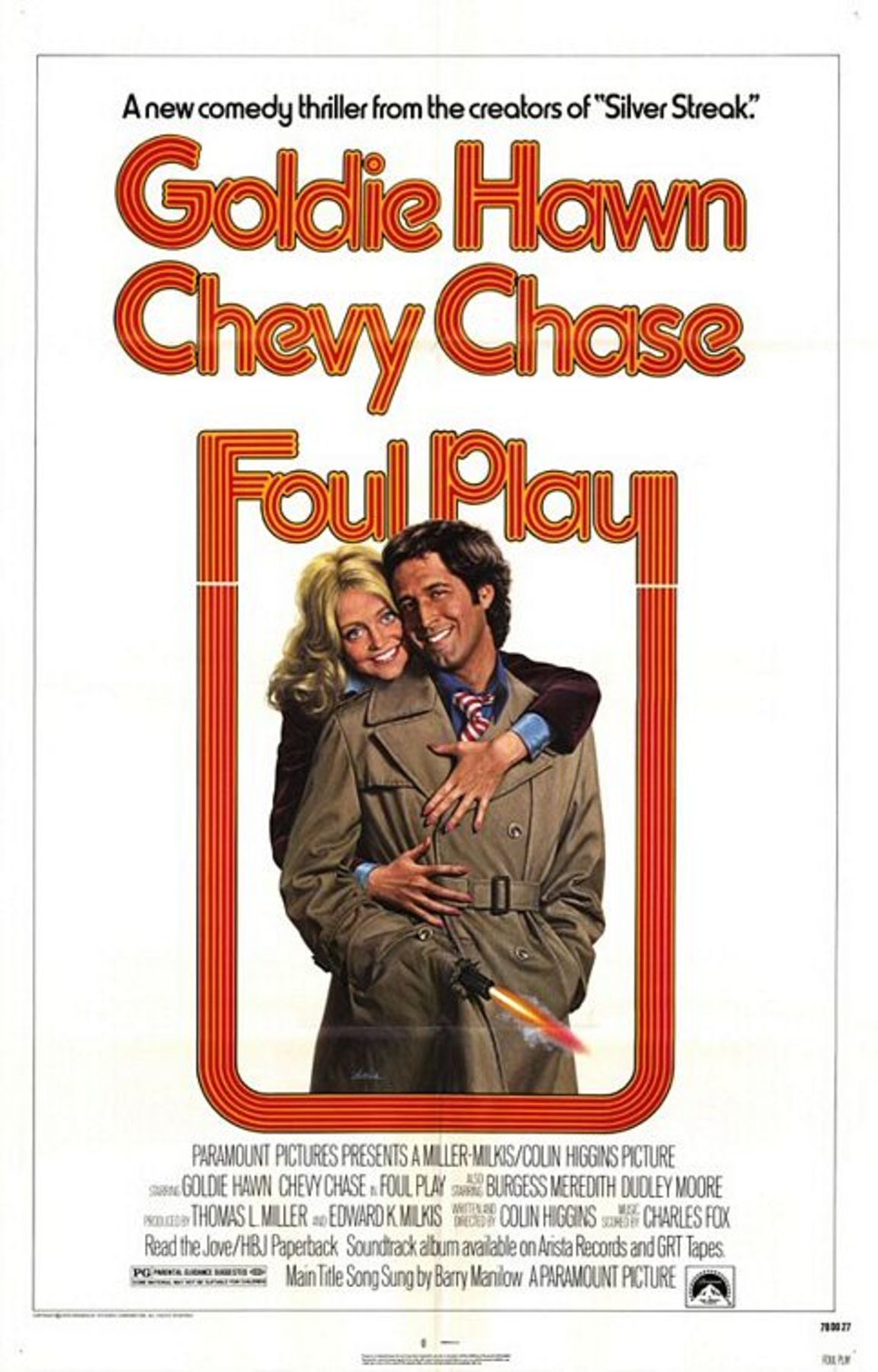
FOUL PLAY (1978) Three stars

Universal Studios demanded that Chevy Chase, the first breakout star from “Saturday Night Live,” be cast in NATIONAL LAMPOON’S ANIMAL HOUSE. However, in a lunch between ANIMAL HOUSE director John Landis, producers Matty Simmons and Ivan Reitman, and Chase, Landis played a Jedi mind trick on Chase, telling him that ANIMAL HOUSE would be an ensemble piece whereas FOUL PLAY would let Chase be a star. Chase stayed with FOUL PLAY and ANIMAL HOUSE cast Tim Matheson in the Otter role.

FOUL PLAY debuted July 14, 1978, and ANIMAL HOUSE came out two weeks later.

ANIMAL HOUSE made $141.6 million on a $3 million budget and changed the face of comedy forever. Yes, every year we get at least one comedy that would not have been possible without the example set by ANIMAL HOUSE. Meanwhile, FOUL PLAY generated $45 million and has been consigned to the margins of history.

It’s certainly not a bad movie by any stretch of the imagination, but it does pale in comparison when stacked up against ANIMAL HOUSE. Granted, FOUL PLAY chased different goals than the undeniably anarchic, anti-establishment ANIMAL HOUSE.

FOUL PLAY is the byproduct of writer and director Colin Higgins (1941-88). He’s one of those cases where you just might not know the name but you definitely know his movies. He made his name in Hollywood by penning the screenplay for the legendary cult favorite HAROLD AND MAUDE (1971). Five years later, he wrote the screenplay to SILVER STREAK, a comedic thriller hit pairing Gene Wilder and Richard Pryor. Higgins made his directorial debut with FOUL PLAY and would end with three directorial credits, 9 TO 5 and THE BEST LITTLE WHOREHOUSE IN TEXAS his second and third efforts. Additionally, Higgins wrote the screenplay for all three comedies he directed. All five comedies enjoyed some level of success.

Nominally Chase and Goldie Hawn are the stars of FOUL PLAY, but the writing and directing style of Higgins should not go unappreciated.

Both SILVER STREAK and FOUL PLAY stand out from HAROLD AND MAUDE, 9 TO 5, and THE BEST LITTLE WHOREHOUSE, in the fact they are heavily influenced by Alfred Hitchcock. SILVER STREAK screams Hitchcock’s 1938 thriller THE LADY VANISHES and FOUL PLAY references THE 39 STEPS, SABOTEUR, NORTH BY NORTHWEST, THE MAN WHO KNEW TOO MUCH, NOTORIOUS, VERTIGO, and PSYCHO. Fans of the Master of Suspense will also be delighted by Higgins’ inclusion of what the maestro called “The MacGuffin,” which is a roll of film hidden in a pack of cigarettes in FOUL PLAY.

I know that Hitchcock himself loved Mel Brooks’ HIGH ANXIETY, a 1977 affectionate spoof of suspense films mostly focused on Hitchcock’s SPELLBOUND, VERTIGO, PSYCHO, and THE BIRDS, so it is quite possible that he enjoyed FOUL PLAY.

In FOUL PLAY, librarian Gloria Mundy (Hawn) finds herself in the midst of a bizarre plot that ultimately involves an assassination attempt on the pope. We have a dwarf, an albino, a wild and crazy guy who attempts to seduce Miss Mundy, a karate fight between two highly unlikely combatants, an endless chase scene, and a pair of Japanese tourists who are big fans of Kojak and bang, bang! This is a pleasantly silly concoction and Hawn takes us through what turns out to be an overlong motion picture at 115 minutes. Or maybe it just felt that way every single damn time I heard the song “Ready to Take a Chance Again,” which predated the similar use of the song “That’s What Friends Are For” a few years later in NIGHT SHIFT. In both cases, I was ready to hear another song again instantly.

What about Chase? He’s part of an ensemble and he almost gets lost in the shuffle at times in his first movie leading role, but this is one of his better performances and his best films. Chase plays a capable leading man paired with Hawn.

Dudley Moore (1935-2002) basically steals every scene that he’s in and his work here led to his being cast in Blake Edwards’ 10, Burgess Meredith (1907-97) made four movies in 1978 and this is the one where his character knows martial arts, and Rachel Roberts’ last screen credit before FOUL PLAY was the eccentric Australian thriller PICNIC AT HANGING ROCK. Moore and Brian Dennehy, Chase’s partner, appeared together in 10.

FOUL PLAY is a minor film with minor charms, but sometimes that’s more than enough or just enough to hit the spot.

Frenzy (1972)

FRENZY

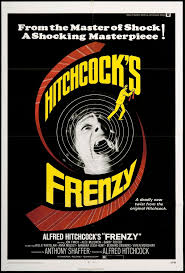
FRENZY (1972) Four stars
Legendary director Alfred Hitchcock (1899-1980) used the theme of the falsely accused several times: THE LODGER (1929), MURDER! (1930), THE 39 STEPS (1935), YOUNG AND INNOCENT (1937), THE TROUBLE WITH HARRY (1955), THE WRONG MAN (1956), NORTH BY NORTHWEST (1959), and, for the last time, FRENZY.

FRENZY, Hitchcock’s penultimate film in a 53-film career that lasted from silent through sound, found Hitchcock returning to not only one of his favorite themes but also to his native land of England for the third and final time since his exodus to Hollywood that began in 1940 with REBECCA, Hitchcock’s only Academy Award for Best Picture winner.

I have not seen every one of Hitchcock’s falsely accused movies (MURDER! and THE TROUBLE WITH HARRY have eluded me thus far in life), but I believe it is safe to say that Richard Ian “Dick” Blaney (Jon Finch) in FRENZY presents us with the Hitchcock falsely accused protagonist with the greatest odds against him in proving his innocence during the movie. Blaney’s not an inherently likeable character, he’s not played by a big charismatic movie star like Henry Fonda or Cary Grant, so it does take some time for this Blaney to grow on us. We have all had stretches in our lives where we’ve been down on our luck and it seems everything’s against us. Blaney has it even worse.

We viewers know Blaney’s not the killer. That’s because we are shown the true identity of “The Necktie Killer,” a serial killer and rapist terrorizing London town, early on in the picture, Blaney’s friend Bob (Barry Foster). Blaney definitely seems like the most obvious suspect as the circumstantial evidence piles up against him, with a little help from his old friend Bob. We root for Blaney to prove his innocence and for Bob to be caught because this “Necktie Killer” is one of the nastiest pieces of work that we have ever seen on a movie screen.

FRENZY takes it down to the very end of the movie before playing its final hand. The film is a reminder why Hitchcock is still called “The Master of Suspense” decades after his death.

Where did the themes of the falsely accused and fear of the police come from in Hitchcock? A childhood experience, of course.

One day, Hitchcock’s father decided upon an unique punishment for the troublesome young lad. You can just imagine how much of a devious little brat Hitchcock was as a child.

“I must have been about 4 or 5 years old,” Hitchcock told Francois Truffaut in 1966. “My father sent me to the police station with a note. The chief of police read it and locked me in a cell for five or 10 minutes, saying, ‘This is what we do to naughty boys.’”

Truffaut followed up with the question why did Hitchcock’s father punish him.

“I haven’t the faintest idea,” Hitchcock said. “As a matter of fact, my father used to call me his ‘little lamb without a spot.’ I truly cannot imagine what it was I did.”

Hitchcock was in his early 70s when he made FRENZY, and it’s not a work that one would necessarily associate with an older man. It pulsates with a certain anger, especially through the down-on-his-luck protagonist, and that’s a state associated with younger men.

There’s a rape and murder sequence in FRENZY that’s even more unsettling than anything in PSYCHO, since it goes on far longer than any of the murders in PSYCHO.

Anthony Shaffer’s screenplay also expresses a tremendously morbid sense of humor that befits Hitchcock. For example, a doctor in a pub says, “We haven’t had a good juicy series of sex murders since Christie. And they’re so good for the tourist trade. Foreigners somehow expect the squares of London to be fog-wreathed, full of hansom cabs and *littered* with ripped whores, don’t you think?”

In the midst of all this murder and mayhem, we get an unique relationship between Chief Inspector Tim Oxford (Alec McCowan) and his wife (Vivien Merchant) that’s both funny and touching. Mrs. Oxford serves her husband a variety of culinary delights and then dishes up her own take on the case of “The Necktie Killer” and these Blaney and Bob characters.

FRENZY is a powerful work by a grand master, one of many great films by Hitchcock.

Psycho (1960)

day 22, psycho

PSYCHO (1960) Four stars
Oh, to get into any one of the seven DeLorean DMC-12s used in BACK TO THE FUTURE and rev that sonuvabitch up to 88.8 MPH with the date set for June 16, 1960, the release date for Alfred Hitchcock’s PSYCHO.

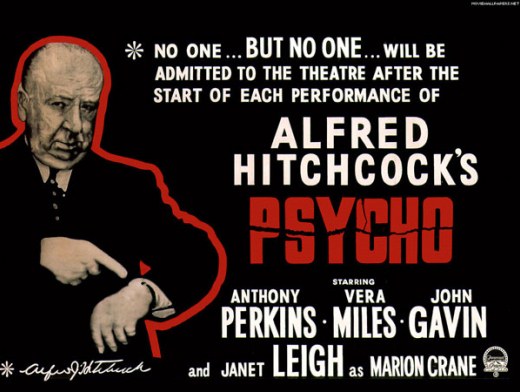
I’d go find the nearest theatre where it’s playing and put down the 69 cents. Of course, I would be sure to arrive early and hang around the lobby if necessary since Hitchcock made sure theaters enforced a strict “no late admission” policy.

Hitchcock even wrote a beautiful note, “Surely you do not have your meat course after your dessert at dinner. You will therefore understand why we are so insistent that you enjoy PSYCHO from start to finish, exactly as we intended that it be served.

“We won’t allow you to cheat yourself. Every theatre manager, everywhere, has been instructed to admit no one after the start of each performance of PSYCHO. We said no one — not even the manager’s brother, the President of the United States or the Queen of England (God bless her).

“To help you cooperate with this extraordinary policy, we are listing the starting times below. Treasure them with your life — or better yet, read them and act accordingly.”

Gotta love that Hitchcock and his ripped, twisted sense of humor.

Anyway, I would go back in time to see PSYCHO just to observe others’ reactions to it, to see their shock, to see their absolute terror at certain moments. They would not have possibly known all the surprises in store for them, while viewers for the last nearly 60 years have not had the benefit of watching PSYCHO with a clean slate. Since its release, PSYCHO has been analyzed, overanalyzed, parodied, satirized, and its famous shower scene long ago replaced the Odessa Steps sequence from BATTLESHIP POTEMKIN (1925) as the most fetishized scene in movie history.

Every time I watch PSYCHO, I am gobsmacked by just how audacious Hitchcock and gang were in making it. Start the movie with a love affair in a seedy hotel? Check. Show the heroine in her bra multiple times? Check. Kill off the heroine played by a big movie star halfway through the film? Check. Start out with the theft of $40,000 and more or less drop it after the death of the heroine? Check.

That’s just the tip of the iceberg.

Of course, none of that might seem the least bit audacious in 2018, but please keep in mind the Motion Picture Production Code dominated Hollywood movies from the early 1930s through 1968. PSYCHO helped chip away at that damn archaic code.

Everybody knows the plot by now. Marion Crane (Janet Leigh) steals $40,000 from her employer’s client and she’s on the lam hoping to get together with her lover Sam (Sam Loomis, played by John Gavin). We hear the voices that are inside her head (her mind and by extension our minds are obsessed with the money) and Hitchcock once again proved he’s the Master of Suspense by making a policeman’s stop and Marion’s drive in the pouring rain as tension-filled as any of the death scenes. With the rain beating down on her poor, weary windshield wipers, a conscience-stricken Marion stops at the famous Bates Motel with its 12 cabins and 12 vacancies.

There we meet proprietor Norman Bates (Anthony Perkins), a fictional character in Robert Bloch’s novel and Hitchcock’s film with roots in the real-life Wisconsin murderer and grave robber Ed Gein (an inspiration for THE TEXAS CHAINSAW MASSACRE’s Leatherface). Gein, for example, loved to make wastebaskets from human skin. Unlike later slasher movie super villains Michael Myers and Jason Voorhees, Norman speaks and he does not wear a mask. This makes Norman Bates far more fascinating than any of the slasher film madmen descended from PSYCHO.

Norman loves taxidermy and he’s got mother issues.

Otherwise, he seems like a good, old-fashioned All-American boy.

Oh, what happens to Marion? Let’s just say that in real life, Leigh stopped taking showers for years, preferring a bath after the fate of her character in PSYCHO.

Sam teams up with Marion’s sister Lila Crane (Vera Miles) and they try and track down Marion. Of course, all roads lead them and poor, poor Detective Arbogast (Martin Balsam) to Bates Motel and Norman Bates and his dear old mother.

In arguably his most audacious move, Hitchcock substituted protagonists from Marion Crane to Norman Bates. Perkins gives one of the great performances, one that will be discussed and cherished for centuries. He walks away with the movie.

The HALLOWEEN sequels continued to add more and more back story to the detriment of Michael Myers. Near the end of PSYCHO, Hitchcock gives us a phony baloney psychiatrist (Simon Oakland) and his phony baloney explanation for Norman Bates, but it’s taken to such an extreme that it plays like a parody. We could have done without this sequence, though, unlike the rest of the movie.

Early on in this review, I shared a note from Hitchcock. Now we go full circle.

A woman complained to Hitchcock that the PSYCHO shower scene had such a deleterious effect on her daughter that the young girl refused to shower.

Hitchcock replied, “Then Madam I suggest you have her dry cleaned.”