Creature from the Haunted Sea (1961)

CREATURE FROM THE HAUNTED SEA (1961) *
Lemme tell you about Jack from Creature from the Haunted Sea.

His real name is Happy Jack Monahan and he’s a crew member of crook Renzo Capetto, who has this real genius plan backfire on him miserably. Renzo wants to systematically eliminate his hapless crew and blame their deaths on a certain legendary sea monster, and that monster turns out to be real. Who could have guessed such a phenomenon? Anyway, Happy Jack’s played by Robert Bean and not by Jim Beam, which might improve Creature from the Haunted Sea.

This Happy Jack character, who probably once lived in the sand at the Isle of Man, imitates all form of animal life and it’s not a good sign for any sort of a good movie when Happy Jack lets out his inner yak. Happy Jack undoubtedly could have had a great future in “Farmer Says” toys, had he not been cast in Creature from the Haunted Sea.

That’s a roundabout way to get to the main point: Creature from the Haunted Sea ranks with the absolute dregs of the monster movie, down there buried at the bottom of the sea alongside Robot Monster and Slithis and APE, three other infamous monster movie titles featuring infamous movie monsters. You might feel sorry for this poor creature from the haunted sea and for all those associated with him, but mostly you’ll just laugh at him in that same way many people often do when they come across old movies and their antiquated special effects.

I am thankful, however, for Creature from the Haunted Sea, because its tedium afforded me the opportunity for an afternoon nap. I woke up and I felt like I didn’t miss a thing, not a beat; even if I did miss a thing, I would be grateful for it. That afternoon nap earned Creature from the Haunted Sea one-half star more than Slithis and APE, for example, I do believe.

I have not watched every Roger Corman monster movie, but Creature from the Haunted Sea is definitely the worst so far, leagues below Attack of the Crab Monsters from 1957 that’s for certain. Hell, Creature from the Haunted Sea is so bad that it makes The Wasp Woman look almost like Citizen Kane by comparison.

Charles B. Griffith (1930-2007), credited or not but more often credited, wrote screenplays for Corman spectaculars It Conquered the World, Attack of the Crab Monsters, A Bucket of Blood, and The Little Shop of Horrors, as well as later Corman productions Death Race 2000 and Eat My Dust. In other words, the man definitely had his better moments like Bucket of Blood and Little Shop of Horrors. Alas, Creature from the Haunted Sea is not one of them.

Rather, it’s a compendium of crap.

For example, Creature from the Haunted Sea gives us more voiceover narration than what’s necessary for any creature feature. I mean, for crying out loud, I bet there’s more voiceover in Creature from the Haunted Sea than in all the other films combined from 1961. Sure that’s why I fell asleep for a while. Airplane spoofed voiceover fantastically, although thankfully I did not meet the same fate as the characters on that infamous cinematic flight.

It doesn’t even matter that future Academy Award-winning screenwriter Robert Towne delivers this narration or that he’s credited for ‘Sparks Moran / Agent XK150 / Narrator.’

I have not talked much about the actual creature in Creature from the Haunted Sea and there’s a good reason for that. Yes, that’s right, the creature from the haunted sea just might be the worst movie monster I have ever seen, and please keep in mind I’ve seen Robot Monster.
Bomb, Bomb, Bomb: Partners, Charlie Chan and the Curse of the Dragon Queen, When Time Ran Out

BOMB, BOMB, BOMB: PARTNERS, CHARLIE CHAN AND THE CURSE OF THE DRAGON QUEEN, WHEN TIME RAN OUT

I could only make it through about 30 minutes of Partners and that’s more than enough for at least about 10 lifetimes, I’d say. I gave up on the picture for good around the fourth time star Ryan O’Neal uttered the epithet faggot. Yeah, Partners basically plays Cruising for laughs. Ha-ha, funny … about as funny as punching somebody’s mother in the face.

I consider Partners the absolute worst film from 1982, at least among the 70 or so films that I have seen thus far in my 42 years on this planet. It supplanted Amityville II: The Possession, a lovely little number incorporating blood, vomit, incest, matricide and patricide, fratricide and sororicide, and demonic possession. Never mind Inchon, a $46 million Korean War epic that bombed mightily at the box office with only a $5.2 million return. Never mind Halloween III: Season of the Witch, which features one of the least likable lead characters (Dr. Dan Challis) and lead performances (Tom Atkins) in recent memory. Believe it or not, Partners beats those other films in sheer unpleasantness.

Did longtime TV director James Burrows use Partners for his audition for Will and Grace? I seriously doubt it, because Partners is one of the nastiest pieces of work I have ever seen. Burrows has directed more than 1,000 TV episodes, including 237 Cheers and 75 Taxi and 32 Frasier. Thankfully, Burrows stuck with television after Partners.

Early in the picture, O’Neal asks his boss how he got stuck partnering up (literally) with gay records clerk Kerwin (John Hurt) to infiltrate and investigate a series of murders in the Los Angeles gay community. Anyway, Chief Wilkins (Kenneth McMillan) tells our matinee idol, “Because you’re a good cop, a real good cop. And because of your cute ass.” Maybe that’s how O’Neal himself got the gig. O’Neal certainly dressed up for the part, wearing a ridiculous tank top and then a leather garb in just the portion I watched before saying Roberto Duran on Partners.

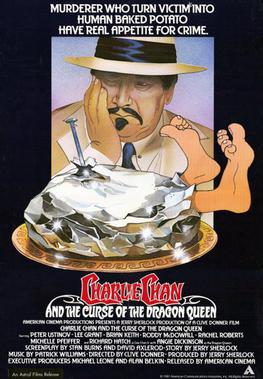
— As I sit here before this keyboard and ponder my next direction, I consider how I endured all 95 minutes or so of Charlie Chan and the Curse of the Dragon Queen, another great big smelly turd from the early ’80s like the ones mentioned about three paragraphs up.

When folks express this incredible nostalgia for the ’80s, undoubtedly it’s not Charlie Chan or Partners or Inchon, for that matter, they’re nostalgic about, because they SUCK in the immortal words of Al from Caddyshack. Then again, if I have learned anything over the years writing about movies or music online, it’s that somewhere in this great big world there’s a cult following Howard the Duck or Halloween III, for example, and they just might flame you for not cherishing their cult object in the same way they do.

Charlie Chan asks us to believe Peter Ustinov (1921-2004), Richard Hatch (1945-2017), and Angie Dickerson as characters of Asian descent. Sure, I believe the Englishman Ustinov as fictional Belgian detective Hercule Poirot (a character he played six times, including features Death on the Nile, Evil Under the Sun, and Appointment with Death) and Roman emperor Nero in Quo Vadis, but I call it more of a stretch to consider him as Chan in 2020, nearly 40 years after the film was made. It’s even worse for both Hatch and Dickerson.

Charlie Chan features plenty of the broadest comedy and frenzied overacting by a rather distinguished cast that also includes Lee Grant, Brian Keith, Roddy McDowall, Rachel Roberts, and Michelle Pfeiffer early in her career. Hatch plays Chan’s fumbling bumbling stumbling grandson Lee Chan Jr. and I’ve watched so many films lately with fumbling stumbling bumbling would-be detectives that I now grumble and rumble when I see them on the screen. I’m thankful my Grandma never behaved like the one played by Grant in Charlie Chan. Keith’s police chief says ‘Goddamn’ about 50 times. McDowall and Roberts play Grant’s domestic helpers, Gillespie and Mrs. Dangers respectively, but they both provide little help to Charlie Chan since they are both in the grand tradition of melodramatic domestic help in the movies; Mrs. Dangers calls to mind Patsy Kelly’s frantic maid in The Gorilla. Pfeiffer could have dialed the perkiness down a notch or few and still have saved enough for the rest of her career. Nearly all of these characters are cringeworthy.

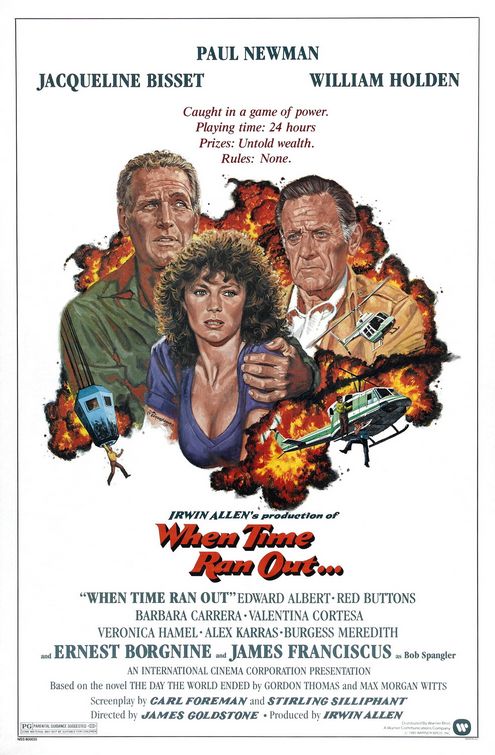
When Time Ran Out came out Mar. 28, 1980 and it eventually fell about $16 million short of making its $20 million production budget back at the American box office.

Later that year, on July 2, Airplane parodied Airport specifically and disaster movies in general, and became one of the biggest hits of the summer and the entire calendar year.

The failure of When Time Ran Out and the success of Airplane signaled the end of the disaster movie, at least in the form that dominated the first half of the seventies with The Poseidon Adventure, Earthquake, and Towering Inferno and then dribbled out pure unadulterated dreck the final half of that decade like The Swarm, Beyond the Poseidon Adventure, and Meteor. Since I mentioned Meteor, I also have to mention Avalanche, which provided disaster footage recycled in Meteor as if being in one disaster of a disaster movie just simply was not enough.

Master of disaster Irwin Allen (1916-91) produced at least half the films mentioned in the paragraph right above this one and he even stepped in the director’s chair for the turkey bombs The Swarm and Beyond the Poseidon Adventure. Allen called on Rollercoaster director James Goldstone for When Time Ran Out, which features the required number of old time movie stars, hot commodities, and fledgling character actors. When Time Ran Out should have been called Take the Money and Run, though Woody Allen and Steve Miller already used it for a comedy (1969) and a hit song (1976).

We have William Holden (1918-81), Paul Newman (1925-2008), Jacqueline Bisset, Ernest Borgnine (1917-2012), James Franciscus (1934-91), Burgess Meredith (1907-97), Red Buttons (1919-2006), Barbara Carrera, Pat Morita (1932-2005), Veronica Hamel, Edward Albert (1951-2006), and Alex Karras (1935-2012), as well as a volcano, a tidal wave, etc.

Seemingly half of the cast takes part in a glorified soap opera before the molten lava really begins to flow and they have to repeat business from Beyond the Poseidon and seemingly every other disaster movie of the era. Here’s that glorified soap opera: Holden proposes to Bisset very early in the movie and she turns him down because she’s in love with Newman, who’s not the marrying kind and anyway he does not seem to much care for Bisset but maybe he’s just masking his true feelings toward her with standard male bluster. Franciscus is married to Hamel but he’s fooling around with half-brother Albert’s significant other Carrera. Just wait, it gets better, Albert does not know that he’s Franciscus’ half-brother … and Holden and Hamel are sleeping together. I think I just about nailed it down and you’re right if you’re thinking all that seems like too much plot for such a dimwitted movie.

You’re also right that I hated these characters and their miserable lives, and rooted for the volcano to wipe them all out.

Especially Franciscus, who takes chronic disbelief in the face of impending disaster to new lows in When Time Ran Out. Unfortunately, an incredibly shoddy special effect leads to an incredibly unsatisfying death for Franciscus’ character. We crave to see him bite the dust or eat molten lava in spectacular fashion, and what we get is just plain laughable.

Of course, just plain laughable describes about 99 percent of When Time Ran Out.

Believe it or not, costume designer Paul Zastupnevich earned an Academy Award nomination for Best Costume Design and went against winner Tess, The Elephant Man, My Brilliant Career, and Somewhere in Time, all of them period films where the look of the film itself becomes another important character.

Yeah, I hope the 1981 Oscar broadcast used a shot of Newman in his utterly ridiculous Urban Cowboy garb.

Zastupnevich received a nomination for the same award two years before for his edgy, state-of-the-art costume work on The Swarm, beekeeper outfits. The Agatha Christie Hercule Poirot period murder mystery Death on the Nile won the prize.

I hate to say it, but time ran out on this review because I don’t want to consider When Time Ran Out any longer than I already have.

Partners No stars; Charlie Chan and the Curse of the Dragon Queen 1/2*; When Time Ran Out *

The In-Flight Double Feature: Airplane!, Airplane II: The Sequel

AIRPLANE!, AIRPLANE II: THE SEQUEL

AIRPLANE! contributed to the demise of the dominance of the disaster film just as much as beyond lackluster disaster films AVALANCHE, THE SWARM, WHEN TIME RAN OUT, BEYOND THE POSEIDON ADVENTURE, and AIRPORT ‘77 and THE CONCORDE … AIRPORT ‘79. It was like the decisive blow and disaster movies disappeared for many years.

AIRPLANE satirized disaster films in general and the AIRPORT series in particular. The team of Jim Abrahams, David Zucker, and Jerry Zucker ripped their ridiculous plot straight from the 1957 Paramount Pictures film ZERO HOUR starring an exclamatory title and Dana Andrews, Linda Darnell, Sterling Hayden, and Elroy “Crazy Legs” Hirsch. I watched ZERO HOUR (sans exclamation) after learning of the fact that it directly inspired AIRPLANE, and it’s scary how much AIRPLANE lifted from the earlier film. It is also fitting, because Arthur Hailey co-wrote the screenplay for ZERO HOUR and wrote the 1968 novel AIRPORT that became the beginning of the disaster film craze when AIRPORT hit box office gold upon its March 1970 release.

A decade later, millions were obviously clamoring for a sledgehammer attack on disaster films, because AIRPLANE finished behind only THE EMPIRE STRIKES BACK, 9 TO 5, and STIR CRAZY at the American box office in 1980.

Abrahams, Zucker, and Zucker not only had their way with disaster films, but they ripped to shreds both famous individual scenes (SATURDAY NIGHT FEVER, FROM HERE TO ETERNITY, KNUTE ROCKNE ALL-AMERICAN) and standard narrative devices. They especially had some devious fun with flashbacks and voice-over narration courtesy our rather square, good-looking protagonist with a troubled past (Robert Hays’ Ted Striker a perfect match for Dana Andrews’ Ted Stryker in ZERO HOUR. Andrews’ Stryker also brings to mind his troubled character 11 years earlier in THE BEST YEARS OF OUR LIVES).

In the process of satirizing movie genres, AIRPLANE created its own genre that has endured far longer than disaster films and gave birth to new old movie stars like Leslie Nielsen, Lloyd Bridges, Robert Stack, and Peter Graves, whose ability to play it straight at every moment made at least half the joke work.

(Disaster films have periodically made huge comebacks like when INDEPENDENCE DAY, TWISTER, and ARMAGEDDON became super blockbusters late in the apocalypse-minded 20th Century. Definitely not my favorite trend. For the record, I hate both TWISTER and ARMAGEDDON, and I have never managed to make it through INDEPENDENCE DAY in spite or more precisely because of all the hype and euphoric glee that came with it and still comes with it years later.)

Yes, we have seen virtually every movie genre under the sun parodied, quoted, and (less frequently) satirized. We have lived through all the immediate AIRPLANE imitations, the Z-A-Z Boys’ own movies, and everything from the works of the Wayans Brothers to Jason Friedberg and Aaron Seltzer. At some point, let’s say early in the 21st Century, I dreaded the parody movie even more than its various targets.

Most of these later parodies miss the satirical bent that gave AIRPLANE, TOP SECRET, and THE NAKED GUN, as well as Mel Brooks’ YOUNG FRANKENSTEIN, BLAZING SADDLES, HISTORY OF THE WORLD PART 1, and SPACEBALLS, their special verve. The later parodies seem far more willing to merely quote from a blockbuster movie and to just leave it at that. “You’ve seen it before and now, let’s see it again, only done less effectively.” Honestly, what’s the point and more precisely, what’s so funny about that?

For many years, I passed on AIRPLANE II: THE SEQUEL, especially after learning that Zucker, Abrahams, and Zucker were not involved. The boys apparently sent out a press release before the release of the sequel that stated just that.

The crack research team just unearthed this David Zucker gem from 2015: “Jim just said, ‘If your daughter became a prostitute, would you go and watch her work?’” That’s one way to look at THE SEQUEL, one of the cheaper, less essential AIRPLANE imitations out there. The addition of more stars (Raymond Burr, Chuck Connors, William Shatner) makes it even cheaper.

I laughed a couple and smiled a few times during THE SEQUEL, but mostly I watched this comedy that attempts maybe 500 jokes in an indifferent state. The laughs were front-loaded and I found it challenging to even remember them at the back end of the picture. Have you ever had that feeling, where you’re stuck in the middle of a movie thinking about how much you were enjoying it earlier and now you’re dreading it and the remaining seconds and minutes?

There’s almost nothing worse in the movie world than a comedy that fails, since most human life forms love to laugh, even or especially at the dumbest and corniest jokes. We are prepared to laugh during a comedy. We want to laugh. So, when you find very little or absolutely nothing to laugh at over 84 minutes, all this hostility builds up inside you and you get very upset about how you have wasted 84 minutes of precious time which you could have wasted on something else.

Never mind, I should have passed on THE SEQUEL and just watched AIRPLANE one more time.


AIRPLANE! ***1/2; AIRPLANE II: THE SEQUEL **

Code of Silence (1985)

CODE OF SILENCE

CODE OF SILENCE (1985) Three-and-a-half stars

CODE OF SILENCE and LONE WOLF McQUADE are the best Chuck Norris movies.

They are the ones for people who otherwise grunt and groan at the possibility of watching a Chuck Norris movie. You know, individuals who go, “Ugh, I don’t like Chuck Norris, his movies are so dumb and stupid. They’re ridiculous and redneck.” Then, there’s other people who only want to watch Norris on “Walker, Texas Ranger” re-runs 24 hours a day 365 days a year because they have little tolerance for movie violence and vulgarity.

Let’s get a few things straight: I don’t especially care for Norris’ ultra-conservative politics (he predicted 1,000 years of darkness if Obama won a second term). I hate those darn infomercials that he did with Christie Brinkley plugging exercise machines. I cannot stand “Walker, Texas Ranger,” except for when clips were used for the “Walker, Texas Ranger Lever” on Conan O’Brien. I hate that he sued “Chuck Norris Facts” author Ian Specter because “Mr. Norris is known as an upright citizen to whom God, country, and values are of paramount importance” and “Mr. Norris also is concerned that the book may conflict with his personal values and thereby tarnish his image and cause him significant personal embarrassment.” I often dislike the use of slow motion in many Norris pictures, like, for example, at the end of A FORCE OF ONE and I cannot decide if that ridiculous echoed voice-over in THE OCTAGON is the worst or the funniest thing I have ever heard. Finding all his voice-overs compiled into a 4-minute, 20-second YouTube video, I vote for the latter. I will one day write a review of THE OCTAGON in the style of that voice-over; I remember Richard Meltzer’s review of the Creedence album PENDULUM with a built-in echo. For whatever reason, Norris’ inner monologues in THE OCTAGON call to mind Ted Striker’s cockpit moment when he hears echo and Manny Mota pinch-hitting for Pedro Borbon. THE OCTAGON voice-over is even funnier than the one in AIRPLANE! I understand that I like watching old Norris movies for their camp and nostalgic value. I’d rather watch one than listen to a Ted Nugent album (or song). I apologize for (possibly) coming on so defensive about Carlos.

In the pantheon of action stars, Norris rates below Clint Eastwood, Steve McQueen, Jackie Chan, Bruce Lee, Arnold Schwarzenegger, and Sylvester Stallone. He’s never made a movie quite at the level of THE GOOD, THE BAD AND THE UGLY, THE GREAT ESCAPE, DRUNKEN MASTER, ENTER THE DRAGON, the first two TERMINATOR movies, and ROCKY. Norris belongs in the second tier of action stars.

Back to CODE OF SILENCE (and LONE WOLF McQUADE).

Both movies have good supporting casts — for example, CODE OF SILENCE surrounds Norris with quality character actors like Henry Silva, Bert Remsen, Dennis Farina (before he became a full-time actor), Ralph Foody, Ron Dean, and Joseph F. Kosala.

Andrew Davis directed CODE OF SILENCE, his first action picture, and his later credits include ABOVE THE LAW, THE PACKAGE, UNDER SIEGE, THE FUGITIVE, CHAIN REACTION, and COLLATERAL DAMAGE. THE FUGITIVE, one of the best films of 1993, was nominated for seven Academy Awards, including Best Picture, and good old grizzled Tommy Lee Jones won an Oscar for Best Supporting Actor. He’s a good director, certainly the best of any Norris movie.

At this point in his career, Norris wanted to distance himself somewhat from his karate and become a more polished, all-purpose action star. If all his subsequent movies were more like CODE OF SILENCE, he would have been onto something, but, alas, Norris returned to third- and fourth-rate product like FIREWALKER and MISSING IN ACTION III before finding his greatest commercial success on TV.

In CODE OF SILENCE, Norris plays Chicago policeman Eddie Cusack, who finds himself in the middle of a gang war all while he’s alienated himself from his fellow officers (barring one, his former partner) for breaking the “code of silence” by standing and testifying lone wolf like against a veteran officer (Foody) accused of killing an unarmed teenager.

Norris enlists Prowler on his side for the final confrontation, Prowler a police robot with a tremendous arsenal that kills bad guys good.

We do see one particularly rare scene in any Norris movie: He gets knocked around real good by a group of thugs. That’s not happened often to Norris since he took on Bruce Lee late in WAY OF THE DRAGON.

Between his work in CODE OF SILENCE, ABOVE THE LAW, and THE FUGITIVE, Davis showed himself to be a master of scenes involving the ‘L,’ Chicago’s elevated train rapid transit system that we have seen on many films and shows. There’s a chase and fight scene on top of the ‘L’ in CODE OF SILENCE that belongs with Norris’ flying kick through a windshield in GOOD GUYS WEAR BLACK and driving his super-charged Dodge Ramcharger out of the grave in LONE WOLF McQUADE as the best Norris moments.