Samurai Cop (1991)

SAMURAI COP

SAMURAI COP (1991) ***

An outtake is defined as “a scene or sequence filmed or recorded for a movie or program but not included in the final version.”

Blown lines and stunts, we all know the routine by now.

Hal Needham and Jackie Chan may have made outtakes for the end credits a cinematic institution, but Iranian “jack of all trades and master of none” Amir Shervan (1929-2006) directed SAMURAI COP, a feature movie solely comprised of outtakes.

Shervan trumped such legendary figures as Dwain Esper, William “One Shot” Beaudine, Bert I. Gordon, Bill Rebane, Ray Dennis Steckler, and even Ed Wood in absolute sheer incompetence.

Like a select few bad movies, SAMURAI COP is so, so, so bad in so, so, so many marvelous ways that it passes all the way through bad into good. It belongs filed next to Efren C. Pinon’s THE KILLING OF SATAN and Claudio Fragasso’s TROLL 2.

— Mathew Karedas, a.k.a. Matt Hannon, stars as Joe Marshall. Most people, though, just call him “Samurai Cop.” Joe must be the least convincing samurai in all history, cinematic and otherwise. For one, Joe’s entire look screams more Fabio and Kato Kaelin than, let’s say, Toshiro Mifune and his most dangerous weapon brandished is that damn speedo he spends what feels like the entire second half of the movie in. Anyway, for somebody allegedly well-versed in the Japanese vernacular, he sure does struggle pronouncing the name “Fujiyama.” When asked by his partner Frank Washington (Mark Frazer) what “katana” means, Joe snaps back “It means Japanese sword.” You don’t say, you don’t say.

— Samurai Cop arguably spends more time being a ladies man than anything else. No, seriously, he beds three, er, two women and he even blatantly talks about the beauty of another woman in the presence of his lover. Smooth, real smooth. Late in the 96-minute spread, he tells his future conquest, “Let’s just say … I can read eyes.” I wish that you couldn’t read dialogue.

Here’s a dialogue exchange from the Planet-X:


Nurse: Do you like what you see?

Joe Marshall: I love what I see.

N: Would you like to touch what you see?

JM: Yes. Yes, I would.

N: Would you like to go out with me?

JM: Uh, yes I would.

N: Would you like to fuck me?

JM: Bingo.

N: Well, then let’s see what you’ve got …

[Nurse investigates Joe’s bulge]

N: Doesn’t interest me. Nothing there.

JM: Nothing there? Just exactly what would interest you, something the size of a jumbo jet?

N: Have you been circumcised?

JM: Yeah, I have, why?

N: Your doctor must have cut a large portion off.

JM: No, uh, he was a, he was a good doctor.

N: Good doctors make mistakes too, that’s why they have insurance.

JM: Hey … don’t worry. I got enough. It’s big.

N: I want bigger.

[Nurse walks away]


I doubt that any screen lothario has ever partaken in dialogue that bad and the sound that we just heard is Rudolph Valentino saying “Thank you” for having made only silent movies.

That dialogue plays like a combination of a porno movie and “Dick and Jane” (most of the rest of the movie belongs to knocking off LETHAL WEAPON) and it belongs alongside the SHARK ATTACK 3: MEGALODON interchange in the anals, er, annals of cinematic history:


Cataline Stone: I’m exhausted.

Ben Carpenter: Yeah, me too. But you know I’m really wired. What do you say … I take you home and eat your pussy.


Boy, that’s just about as great as the whole “Fini can water you” debacle from YES, GIORGIO.

— Lead actor Matt Hannon thought he was done with the picture and got himself a short haircut. Several months later, Shervan looked up Hannon and informed him they were going to reshoot scenes. Unfortunately, Hannon still had short hair. I say unfortunately because Hannon wears one of the least convincing wigs ever made during SAMURAI COP. It does not help that Hannon’s wig flies off during a late fight scene and the actor also displays his obvious displeasure having to wear his wig. Yeah, it’s that bad.

— The chase scenes alternate between moving incredibly slow (nothing like slow-moving cars …) and being artificially sped up (… except for cars that zip along unnaturally). Yes, there are times when the action in SAMURAI COP plays like a silent film projected at the wrong speed.

— Not sure that I want to spend that much more time and space on SAMURAI COP, because I don’t want to risk writing a dissertation. Yes, over 750 words feels like I have been writing on this movie for a long time. However, there’s so many more things wrong but right about SAMURAI COP that we could be here all day, ironic for a movie that lasts a meager 96 minutes. Just imagine SAMURAI COP at GONE WITH THE WIND length.

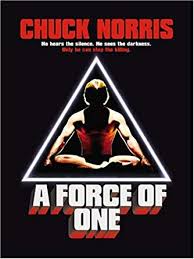
— In a review long ago, I wrote that the 1979 Chuck Norris action vehicle A FORCE OF ONE combines a standard issue cops and criminals plot acted out by a good cast with martial arts and a “very subtle” anti-drug message that plays like one of those infamous 1980s TV commercials, only featuring roundhouse kicks.

On that note, we can end this review with a public service announcement from SAMURAI COP: “Now I’m telling these son-of-a-bitches that we respect the Japanese of this country, who are honest businessmen. And yeah, this is the land of opportunity for legitimate business, not for death merchants who distribute drugs to our children through schools and on the streets. Now I’m telling these motherfuckers that if they continue killing our children to make their precious millions that they deposit in their secret Swiss bank accounts, counselor, before your lawsuit even gets off the court clerk’s desk, I’ll have their stinking bodies in garbage bags and ship them back to Japan for fertilizer.”

Beautiful, absolutely beautiful, and it makes me want to pop a top on an ice cold one and blast Alice Cooper’s “I Love America.”
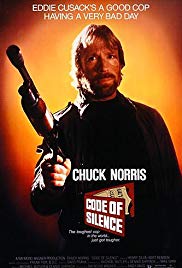
Code of Silence (1985)

CODE OF SILENCE

CODE OF SILENCE (1985) Three-and-a-half stars

CODE OF SILENCE and LONE WOLF McQUADE are the best Chuck Norris movies.

They are the ones for people who otherwise grunt and groan at the possibility of watching a Chuck Norris movie. You know, individuals who go, “Ugh, I don’t like Chuck Norris, his movies are so dumb and stupid. They’re ridiculous and redneck.” Then, there’s other people who only want to watch Norris on “Walker, Texas Ranger” re-runs 24 hours a day 365 days a year because they have little tolerance for movie violence and vulgarity.

Let’s get a few things straight: I don’t especially care for Norris’ ultra-conservative politics (he predicted 1,000 years of darkness if Obama won a second term). I hate those darn infomercials that he did with Christie Brinkley plugging exercise machines. I cannot stand “Walker, Texas Ranger,” except for when clips were used for the “Walker, Texas Ranger Lever” on Conan O’Brien. I hate that he sued “Chuck Norris Facts” author Ian Specter because “Mr. Norris is known as an upright citizen to whom God, country, and values are of paramount importance” and “Mr. Norris also is concerned that the book may conflict with his personal values and thereby tarnish his image and cause him significant personal embarrassment.” I often dislike the use of slow motion in many Norris pictures, like, for example, at the end of A FORCE OF ONE and I cannot decide if that ridiculous echoed voice-over in THE OCTAGON is the worst or the funniest thing I have ever heard. Finding all his voice-overs compiled into a 4-minute, 20-second YouTube video, I vote for the latter. I will one day write a review of THE OCTAGON in the style of that voice-over; I remember Richard Meltzer’s review of the Creedence album PENDULUM with a built-in echo. For whatever reason, Norris’ inner monologues in THE OCTAGON call to mind Ted Striker’s cockpit moment when he hears echo and Manny Mota pinch-hitting for Pedro Borbon. THE OCTAGON voice-over is even funnier than the one in AIRPLANE! I understand that I like watching old Norris movies for their camp and nostalgic value. I’d rather watch one than listen to a Ted Nugent album (or song). I apologize for (possibly) coming on so defensive about Carlos.

In the pantheon of action stars, Norris rates below Clint Eastwood, Steve McQueen, Jackie Chan, Bruce Lee, Arnold Schwarzenegger, and Sylvester Stallone. He’s never made a movie quite at the level of THE GOOD, THE BAD AND THE UGLY, THE GREAT ESCAPE, DRUNKEN MASTER, ENTER THE DRAGON, the first two TERMINATOR movies, and ROCKY. Norris belongs in the second tier of action stars.

Back to CODE OF SILENCE (and LONE WOLF McQUADE).

Both movies have good supporting casts — for example, CODE OF SILENCE surrounds Norris with quality character actors like Henry Silva, Bert Remsen, Dennis Farina (before he became a full-time actor), Ralph Foody, Ron Dean, and Joseph F. Kosala.

Andrew Davis directed CODE OF SILENCE, his first action picture, and his later credits include ABOVE THE LAW, THE PACKAGE, UNDER SIEGE, THE FUGITIVE, CHAIN REACTION, and COLLATERAL DAMAGE. THE FUGITIVE, one of the best films of 1993, was nominated for seven Academy Awards, including Best Picture, and good old grizzled Tommy Lee Jones won an Oscar for Best Supporting Actor. He’s a good director, certainly the best of any Norris movie.

At this point in his career, Norris wanted to distance himself somewhat from his karate and become a more polished, all-purpose action star. If all his subsequent movies were more like CODE OF SILENCE, he would have been onto something, but, alas, Norris returned to third- and fourth-rate product like FIREWALKER and MISSING IN ACTION III before finding his greatest commercial success on TV.

In CODE OF SILENCE, Norris plays Chicago policeman Eddie Cusack, who finds himself in the middle of a gang war all while he’s alienated himself from his fellow officers (barring one, his former partner) for breaking the “code of silence” by standing and testifying lone wolf like against a veteran officer (Foody) accused of killing an unarmed teenager.

Norris enlists Prowler on his side for the final confrontation, Prowler a police robot with a tremendous arsenal that kills bad guys good.

We do see one particularly rare scene in any Norris movie: He gets knocked around real good by a group of thugs. That’s not happened often to Norris since he took on Bruce Lee late in WAY OF THE DRAGON.

Between his work in CODE OF SILENCE, ABOVE THE LAW, and THE FUGITIVE, Davis showed himself to be a master of scenes involving the ‘L,’ Chicago’s elevated train rapid transit system that we have seen on many films and shows. There’s a chase and fight scene on top of the ‘L’ in CODE OF SILENCE that belongs with Norris’ flying kick through a windshield in GOOD GUYS WEAR BLACK and driving his super-charged Dodge Ramcharger out of the grave in LONE WOLF McQUADE as the best Norris moments.

Shaft (1971)

SHAFT

SHAFT (1971) Three-and-a-half stars

A whole new generation of fans discovered Isaac Hayes (1942-2008) through his work for Trey Parker and Matt Stone on “South Park.”

I’m talking about Chef, Hayes’ animated alter ego, his songs like “Chocolate Salty Balls” and “Love Gravy,” his lines “Hello there, children” and “Damn, woman, I just gave you sweet loving five minutes ago” (oh, for just one game of South Park pinball right about now), and his overall cool until everything went all screwy there at the end between Mr. Hayes and the boys.

I went back in time and delved through Hayes’ previous work.

At some point in the late 20th or early 21st century, I watched Gordon Parks’ SHAFT for the first time, roughly the same time as I watched the John Singleton remake, er, sequel starring Samuel Jackson and featuring Christian Bale, Toni Collette, and Jeffrey Wright. It would have been nice if the suburban multiplex paired the ‘71 and ‘00 pictures together, but, no, of course not, and my ears still feel like they’re ringing from the 110-minute action spectacular. Nigel Tufner must have been the projectionist that day, because it was cranked up to 11 x 11.

(For crying out loud, why do we need three movies simply titled SHAFT? This is just as bad as HALLOWEEN.)

I vastly prefer the ‘71 SHAFT over any of the later SHAFT films (I, of course, have not seen the 2019 one) and there’s not one scene in either ‘70s sequel, BIG SCORE and GOES TO AFRICA, or the 2000 sequel or the rest of the first picture itself that even approaches the opening five minutes. Talk about iconic.

It all starts with the multifaceted sounds of the modern day big city rumble, then it moves on to the sights. Burt Lancaster and Telly Savalas in THE SCALPHUNTERS and George Peppard and Dean Martin in ROUGH NIGHT IN JERICHO. Robert Redford, Michael Pollard, and Lauren Hutton in LITTLE FAUSS … never mind, the first 42nd Street showing of HE AND SHE and second big hit THE ANIMAL. There’s more hype, then the first notes of Hayes’ “Theme from Shaft” hit us.

Nearly 45 seconds into the movie, we’re given our introduction to the title character with a close-up of the man coming out from the subway and we’re already interested. He walks across six lanes of traffic and flashes an obscene gesture and shouts “Up yours!” at somebody who had the audacity to honk their horn. We’re interested some more, as we observe what must be just another day in the life of this angry black man.

We see more commercialization and Shaft walks through a crowd of picketers. One sign: “I GOT MY JOB THROUGH THE New York Times.” Another: “WANT YOUR SEX LIFE PUBLISHED?” One more: “I LOST MY JOB THRU Fidelifacts.” Just before making his way through picketers, Shaft flashes his badge at a street peddler, who promptly skedaddles to somewhere else. “Theme from Shaft” has been playing this whole time and picking up momentum as the opening credits scroll and our title character strolls.

It’s been about 150 seconds into the number before Hayes matter-of-factly asks “Who’s the black private dick that’s a sex machine to all the chicks?” Backing vocalists Pat Lewis, Rose Williams, Mitchell Butler, and Telma Hopkins answer “Shaft” and Hayes replies “Damn right.” We are hooked, that’s damn right for sure.

“Theme from Shaft” won the 1972 Academy Award for Best Original Song, and it’s a stone cold classic especially in its single form. We can file the opening scene in SHAFT under “Great Opening Scenes.”

Hayes wrote the lyrics, handled lead vocals, made the arrangements, and played the keyboards. Lester Snell (electric piano), David Becker (viola), Charles Pitts (guitar), Michael Toles (guitar), Marc “Dr. Love” Davis (guitar solo), James Alexander (bass guitar), Richard “Johnny” Davis (trumpet), John Fonville (flute), Gary Jones (congas), and Willie Hall (drums) all played their parts masterfully.

Despite the fact that none of the remaining 90 or so minutes can measure up against the opening five, SHAFT affords one additional pleasures. That should be of little surprise, since this material puts a black spin on James Bond and Mike Hammer.

White author Ernest Tidyman (1928-84) adapted his own 1970 novel for the screen and Tidyman became a household name in Hollywood with SHAFT and THE FRENCH CONNECTION both major hits in 1971. Tidyman won the Academy Award for Best Adapted Screenplay for THE FRENCH CONNECTION, a Best Picture winner.

Tidyman, who FRENCH CONNECTION producer Philip D’Antoni thought would be black, did not like the SHAFT rewrite by John D.F. Black, a writer hired by Parks. Despite his displeasure, Tidyman returned to write the sequel also directed by Parks (1912-2006). The former newspaperman wrote more Shaft novels, “Shaft Among the Jews” (1972), “Shaft’s Big Score” (1972), “Shaft Has a Ball” (1973), “Goodbye, Mr. Shaft” (1973), “Shaft’s Carnival of Killers” (1974), and “The Last Shaft” (1975). Tidyman also wrote HIGH PLAINS DRIFTER and the early Chuck Norris pic A FORCE OF ONE.

Former model turned actor Richard Roundtree makes such a strong impression as Shaft that he’s been called the first black action hero. Not a bad screen debut. Hayes’ opening number greatly assists Roundtree, his character, and us audience members because it paints a portrait of Shaft’s basic personality and makes him a bit larger-than-life. We like this character a great deal already within the film’s first five minutes. We applaud him, especially when he sticks it to the man. Every now and then, all of us wish that we could stick it to the man, just like John Shaft.

Good Guys Wear Black (1978)

GOOD GUYS WEAR BLACK

GOOD GUYS WEAR BLACK (1978) Two-and-a-half stars
The late Steve McQueen gave his friend Chuck Norris some advice for his motion picture career. McQueen said that Norris talked too much in GOOD GUYS WEAR BLACK and that, in the future, he should let his supporting actors do more talking, since it would have the effect of making what Norris says more important.

I quoted McQueen in a review of A FORCE OF ONE, Norris’ third feature. McQueen’s right about GOOD GUYS WEAR BLACK: Norris does talk too much and he should have allowed his talented supporting cast more of an opportunity to carry the speaking.

Norris stars in GOOD GUYS as John T. Booker and there’s Anne Archer as Booker’s romantic interest and smaller roles for James Franciscus, Dana Andrews, and Jim Backus. It is especially nice to see Andrews on the screen, because we remember him from classics like LAURA and especially THE BEST YEARS OF OUR LIVES. Backus deserved better, especially since, all things considered, he probably enjoyed C.H.O.M.P.S. more than what he did GOOD GUYS.

Because I saw the later film before the earlier one, GOOD GUYS’ plot reminded me of the 1985 Arnold Schwarzenegger vehicle COMMANDO. Booker’s surviving Vietnam War comrades are being systemically eliminated five years after the first scene in the movie when they survive a death trap set for them. We have a shady diplomat on the verge of becoming Secretary of State, who is blackmailed into pursuing the elimination of the Black Tigers, the elite group of CIA assassins headed by Norris’ Booker. This plot was written on the back of a much larger napkin than COMMANDO.

GOOD GUYS, like A FORCE OF ONE, exists as middle-of-the-road Norris, not quite as inspired as his best films CODE OF SILENCE and LONE WOLF McQUADE, but still better than his starring debut BREAKER! BREAKER! and THE OCTAGON, his fourth picture.

CODE OF SILENCE and LONE WOLF are his best pictures mainly because they have the best supporting casts. They also have their fair share of exciting moments.

I mean, who could ever forget that classic scene in LONE WOLF when David Carradine’s treacherous villain buries Norris alive in his super-charged Dodge Ramcharger. After coming to and pouring beer on himself, Norris and his Dodge rise up out of the ground and he gets out and guns down several of Carradine’s anonymous henchmen. Capping it all off, Norris tells his young partner to get him a beer. Epic.

There’s just one scene in GOOD GUYS that even approaches that great LONE WOLF scene.

Booker faces down an assassin, who just blew up the plane carrying Archer’s reporter character and Booker’s romantic interest Margaret, and eventually Booker takes out this formidable foe with a flying kick through the bad guy’s windshield as he attempts to run over Booker. This moment alone is worth the price of a rental or a more long-term purchase, and it could play as the front end of a highlight reel with LONE WOLF.

Unfortunately, the rest of GOOD GUYS does not live up to that incredible flying kick, reportedly performed by Norris’ brother Aaron, but it still has a certain value, especially in seeing Norris portray a college professor and a race car driver in addition to being a cold-blooded assassin. Boy, that Norris sure could do anything.

NOTES: In 2017, a 22-year-old John T. Booker, from Topeka (Kansas), was sentenced to 30 years in prison for his vehicle bomb detonation attempt at Fort Riley. Booker wanted to kill American soldiers and assist the Islamic State of Iraq and al-Sham (ISIS) in their fight against the United States.

There’s also a Dr. John T. Booker who’s an Associate Professor of French at the University of Kansas. His teaching and research focus on the French novel of the 19th and 20th centuries.

Kansas seems to have the market cornered on the John T. Booker name.

A Force of One (1979)

A FORCE OF ONE

A FORCE OF ONE (1979) Two-and-a-half stars
We should all thank Steve McQueen (1930-80) for the acting career of Chuck Norris, because it was McQueen who encouraged Norris to get into acting.

After all, without Norris’ acting career would there ever have been “Chuck Norris Facts?” Or the lever on “Conan?”

So, thank you, Steve McQueen.

McQueen also had some important advice for Norris after GOOD GUYS WEAR BLACK (1978).

“They said I was the worst thing in 50 years,” Norris said in a 1983 New York Times article. “Well, I wasn’t good, but my feelings were hurt. I said, ‘I’m not trying to be Dustin Hoffman; I just want to project a strong positive hero image on the screen.’ I went to Steve, and he said, ‘In GOOD GUYS, you talk too much. Too much dialogue. Let the character actors lay out the plot. Then, when there’s something important to say, you say it, and people will listen. Anyway, you’ll get better as an actor. You should have seen me in THE BLOB.’”

McQueen seemed to be onto something regarding the quality of Norris movies, because Norris’ best pictures LONE WOLF McQUADE and CODE OF SILENCE both rely on strong casts around Norris: David Carradine, Barbera Carrera, Leon Isaac Kennedy, Robert Beltran, L.Q. Jones, Dana Kimmell, R.G. Armstrong, Sharon Farrell, and William Sanderson (LONE WOLF); Henry Silva, Bert Remsen, Molly Hagan, Dennis Farina, Mike Genovese, and Ralph Foody (CODE OF SILENCE).

A FORCE OF ONE, alas, features a decent supporting cast around Norris — Jennifer O’Neill (she actually receives top billing), Clu Gulager, Ron O’Neal, and Charles Cyphers — and they handle the awfully generic material rather well. We should be grateful for a good supporting cast because. …

I mean, how many times have we seen this plot filmed on TV or even in the movies? We’ve all been here many, many, many times before, sitting through cops, drugs, cop killers, drug lords, et cetera.

Screenwriter Ernest Tidyman’s credits include SHAFT, THE FRENCH CONNECTION, and HIGH PLAINS DRIFTER, heavy duty action credentials.

Tidyman (1928-84), however, was not impressed by A FORCE OF ONE, called it his least successful effort, and said that he only wrote the script to buy his mother a house.

I understand Tidyman’s disappointment with his script.

That said, I enjoyed most of A FORCE OF ONE because it combines a standard issue cops and criminals plot acted out by a good cast with martial arts and a “very subtle” anti-drug message that plays like one of those infamous 1980s TV commercials, only featuring roundhouse kicks.

Wish they would have showed A FORCE OF ONE in D.A.R.E.

Oops, never mind, since all us kiddos are supposed to resist violence.

A FORCE OF ONE loses points and a positive review because of two negative elements.

Dick Halligan’s music hits the viewer like a roundhouse upside the head. I would love to make a joke here referencing either “blood,” “sweat,” or “tears” because Halligan founded the jazz-rock band Blood, Sweat & Tears and played in that group from 1967 through 1972. I just don’t have it today.

All plot roads lead to a final karate showdown between Norris and the main heavy. This is what we wait for all 80 minutes.

Unfortunately, the final karate showdown quickly devolves into slow motion and distorted / echoed vocal effects, plus Halligan’s music returns with a vengeance.