AN EYE FOR AN EYE (1981) *** An Eye for an Eye is one of the better Chuck Norris movies and that’s because it fits the bill for what helps define a better Chuck Norris movie — the quality of the supporting cast, something it has in common with Lone Wolf McQuade, Code of Silence, The Delta Force, and Silent Rage.
Let’s see, we have Christopher Lee, Richard Roundtree, Matt Clark, Mako, Maggie Cooper, Rosalind Chao, Professor Toru Tanaka, Stuart Pankin, Terry Kiser and Mel Novak, and they’re basically all good in their standard hero and villain roles.
Lee (1922-2015) enjoyed a truly marvelous career that intersected with Sherlock Holmes, Dracula, James Bond, Star Wars, Ichabod Crane, Kharis, Victor Frankenstein, Gandalf, and Hercules. Never mind acting alongside Slim Pickens and Toshiro Mifune in Steven Spielberg’s 1941. Often playing the villain, Lee had the ability to maximize his minimal screen time and An Eye for an Eye benefits from his presence.
Roundtree made his fame as the title character in Shaft and sequels Shaft’s Big Score and Shaft in Africa, and so I must admit to being somewhat amused that he’s played a cop so often throughout his career. It was both amusing and frustrating to watch his police superior character bust Norris’ chops. I told my wife during An Eye for an Eye, ‘At least he’s not killed by a winged serpent in this movie.’
Cooper plays Norris’ obligatory romantic interest and she gets a rare female nude scene in a Norris movie. Writing on Silent Rage, I noted that it was refreshing to see somebody’s chest other than Norris and I second that emotion after An Eye for an Eye.
Tanaka’s dossier begins, ‘Was an American professional wrestler, professional boxer, college football player, soldier, actor, and martial artist.’ What did the Professor earn his degree in? Judging by An Eye for an Eye and the vast majority of his filmography and his professions, it’s safe to say Tanaka earned a doctorate in pain. Like others in the An Eye for an Eye cast, he’s good at maximizing minimal screen time and in his case, minimal dialogue. Norris vs. Tanaka proved to be one of the film’s greatest highlights.
Before she went to sleep, I told my wife that Norris’ partner will be dead very shortly and it did not help the character’s survival odds being played by Terry Kiser, an actor best known for playing a corpse. Bernie from Weekend at Bernie’s and Weekend at Bernie’s II ring any bells? Yeah, I still argue that dead Bernie still shows more life than nominal leads Andrew McCarthy and Jonathan Silverman. For a man later hacked and whacked by Jason Voorhees, Kiser’s character died spectacularly in An Eye for an Eye — shot in the chest, crushed between not one but two cars, and caught on fire. His death haunts Norris’ Sean Kane during two flashback scenes.
An Eye for an Eye director Steve Carver died in January 2021 of complications from COVID-19 and he was 75. Carver also directed arguably Norris’ best picture, Lone Wolf McQuade, and the infamous 1974 Roger Corman / New World Productions films The Arena and Big Bad Mama. No doubt that Pam Grier and Angie Dickinson, as well as William Shatner, prepared Carver for Chuck Norris.
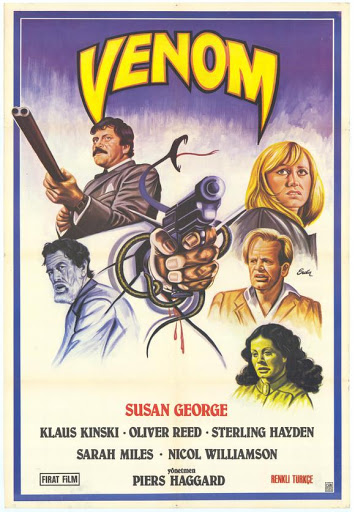
VENOM (1981) *** I just finished considering Silent Rage, a film that runs Chuck Norris, a Western, Animal House, mad scientists, and a madman killer made indestructible through a cinematic blender.
Thus, I feel safe in saying that Silent Rage prepared me for Venom, a British horror film that has a distinguished multinational cast, kidnapping and hostage negotiation, and only the world’s deadliest snake, the dreaded Black mamba from sub-Saharan Africa. The mamba gets a few closeups, more than Norma Desmond in Sunset Boulevard and Daffy Duck in Duck Amuck, and its own POV. Yeah, we’ll call it the Black Mamba Cam.
That distinguished cast includes kidnappers Klaus Kinski and Oliver Reed, Scotland Yard commander and lead negotiator Nicol Williamson, snake expert Sarah Miles, slinky (won’t call her slutty or a snake expert in her own right) nurse Susan George, and lovable crusty old grandfather Sterling Hayden.
Basically, Venom contains three movies within one — the kidnapping inside the house, the hostage negotiation and the behind-the-scenes police maneuvering on the outside, and the deadly snake on the loose. We’ve all seen kidnapping and hostage negotiation plenty before, on TV cop shows and in the movies, but very rarely do the kidnappers have to deal with the world’s deadliest snake. And Lord knows we’ve all seen a bad snake movie or two, like for example the 1972 disaster Stanley, which populated its killer snake scenario with thoroughly unpleasant and despicable characters, a somewhat heavy-handed environmental message, and some of the dopiest music ever heard by man this side of Jonathan Livingston Seagull.
Venom turned out to be a far more enjoyable motion picture experience than Stanley. For example, the scene in Venom where the boy picks up the mamba by mistake and unknowingly transports the world’s deadliest snake from one side of London to another brought to mind the classic sequence in Sabotage that ends in the death of a young boy named Stevie. The inevitable scenes late in the picture when the mamba strikes Reed and Kinski are both well worth their wait, and the mamba’s strike at George about 30 minutes into the picture lets us know that we’re in for a treat when Reed and Kinski do meet their demise.
Later that day, much later in the day to be precise, though, I watched Murders in the Zoo from 1933 and imagine my delightful little surprise when a mamba figured prominently in that older film’s plot. The gruesome hits in Murders in the Zoo just keep on coming down the home stretch, especially when a boa constrictor consumes the dastardly big-game hunter, bastardly zoologist, and insanely jealous husband played by Lionel Atwill.
Venom and Murders in the Zoo both find perfect ways to deal with snakes in the grass.
SILENT RAGE (1982) *** Michael Miller’s 1982 feature Silent Rage combines several American movie hallmarks into one barely coherent package: Chuck Norris, a small Texas town (never sleepy when Norris plays Sheriff), a madman killer, mad scientists, shots borrowed straight from John Carpenter’s Halloween, two love scenes, Stephen Furst basically playing his character from Animal House again, bar fights, roundhouse kicks, biker gangs, breasts (inc. Norris but not Furst), and a schizophrenic musical score, not in any particular order.
We also have at least five wildly different acting styles for the price of one. We’ve already covered Norris and Furst, then there’s Ron Silver and he’s playing it straight in easily the best dramatic acting that one can find in anything starring Chuck Norris. Silver plays the voice of reason and let’s do the right thing scientist, whereas his colleagues played by Steven Keats and William Finley are variants on Universal horror archetypes updated for a new generation. Keats, of course, wants to push science further than any one ever before even when it’s not prudent and Finley, best known for his roles in Brian De Palma and Tobe Hooper films Phantom of the Paradise and Eaten Alive, occupies the middle ground between Silver and Keats. Brian Libby’s madman killer continues in the proud screen tradition of Frankenstein’s Monster and Michael Myers, especially after our mad scientists flat out turn him posthumously into an indestructible killing machine whose stalking does all the talking. I wanted Dr. Loomis to show up and say THIS ISN’T A MAN. Bummer that it didn’t happen.
Norris battles the mad killer and later the virtually indestructible mad killer in the opening and concluding scenes. Otherwise, he alternates between mentoring and supporting unsure and unsteady rookie cop Furst, rekindling his romance with a former lover played by Toni Kalem, and questioning Silver and Keats. For Norris fans, apparently the scariest parts of Silent Rage involved Kalem’s bare breasts and Norris favoring jazz music because our favorite roundhouse specialist returned to only love scenes between men for the rest of his career, barring his rolling around in the mud with the sultry Barbara Carrera in the 1983 Walker, Texas Ranger precursor Lone Wolf McQuade. I for one like Silent Rage because it’s nice to see more chests on display than just Chuck’s for a change.
Silent Rage unfortunately drags at two main points. The death of Silver’s wife literally feels like it takes forever, like one of the filler killings in a Friday the 13th sequel. Ditto for the bar fight, which are drags both in real life and in the movies. A couple moments in this otherwise humdrum bar fight sequence redeem it, just barely though. If you’ve seen Silent Rage, you know exactly what I mean.
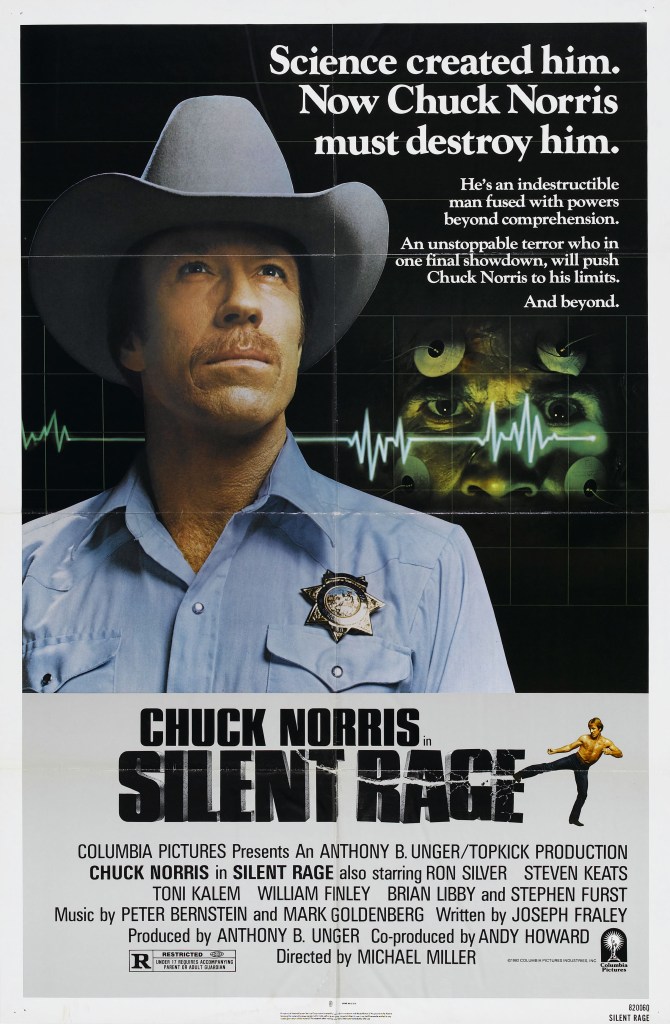
The poster for Silent Rage rates with Breaker! Breaker as the best Norris film poster. There’s really no arguing with a mini-Norris roundhouse cracking the movie’s title and the promotional hype Science created him. Now Chuck Norris must destroy him. He’s an indestructible man fused with powers beyond comprehension. An unstoppable terror who in one final showdown, will push Chuck Norris to his limits. And beyond.
Once upon a review, I believe I wrote that I wanted to see Chuck Norris vs. Jason Voorhees and Silent Rage is the closest that I will ever get to seeing that dream come true.
TWO LONG-WINDED, SELF-IMPORTANT BEST PICTURES FROM DECADES AGO: GENTLEMAN’S AGREEMENT, ALL THE KING’S MEN It makes perfect sense that I watched Gentleman’s Agreement and All the King’s Men back-to-back on a cold December night, despite the fact that both pictures were made and first released in the first half of the twentieth century and that makes them both officially older than ‘boomer,’ a phrase sure to replace older than dirt in the lexicon.
Gentleman’s Agreement and All the King’s Men keep a certain relevance at this particular junction in time because their main issues — racism (Gentleman’s Agreement) and demagoguery (All the King’s Men) — have been major concerns throughout a turbulent 2020, once we get beyond the fact that we’re trying to get out of the year alive more than any other year.
Gentleman’s Agreement is one of those movies where the plot summary undoubtedly causes immediate discomfort in many of our fellow humans, “A reporter pretends to be Jewish in order to cover a story on anti-Semitism, and personally discovers the true depths of bigotry and hatred.” Boring, old hat subject matter, right? I am already sensing audible moans and groans from people who believe that racism does not exist or more precisely if racism does exist, it’s ultimately marginal and distorted beyond all reason by evil liberal media and evil liberal politicians setting their ultimate agenda — all-out Race War. Hoax — a humorous or malicious deception — made a huge comeback in 2020 for, let’s see here, at least approximately 75 million Americans, who have been seen and heard (rather quite clearly) blasting this, blasting that as hoax this, hoax that, especially anything and everything related to COVID-19. If it’s not hoax, it’s conspiracy and it’s reached a point where I don’t even want to even come across the latter word any longer. Once is all that I will aid and abet it writing this piece.
During Gentleman’s Agreement, I flashed back on Lester Bangs’ White Noise Supremacists from Psychotic Reactions and Carburetor Dung, particularly the moment in the article when Bangs gets to the contradictory, sometimes nasty gist of a human being, “Whereas you don’t have to try at all to be a racist. It’s a little coiled clot of venom lurking there in all of us, white and black, goy and Jew, ready to strike out when we feel embattled, belittled, brutalized. Which is why it has to be monitored, made taboo and restrained, by society and the individual.” With the availability of social (antisocial) media, broadcasting thoughts and feelings potentially to a mass audience with one click of the mouse, it certainly does feel like there’s never been a more venomous year in history than 2020.
Gentleman’s Agreement, based on the Laura Z. Hobson novel of the same name and the same year as the prestigious motion picture adaptation, nearly talks itself (and its audience) to death. Of all the thousands and thousands of words spoken during Gentleman’s Agreement, I’d like to hone in on Gregory Peck’s dialogue late in the picture, “I’ve come to see lots of nice people who hate it and deplore it and protest their own innocence, then help it along and wonder why it grows. People who would never beat up a Jew. People who think anti-Semitism is far away in some dark place with low-class morons. That’s the biggest discovery I’ve made. The good people. The nice people.”
Then again, maybe we’re not so good, not so nice.
Over the last dozen years, it’s been disturbing to see and hear not only the return but the prominence of poisonous ideas and emotions. I first noticed it back in August 2008, returning to Southeast Kansas from a two-week vacation in Oregon to be gobsmacked by a phenomenon. Keep in mind this was a couple weeks before Barack Obama formally received the nomination for President, but “Death to Obama” graffiti started cropping up in Southeast Kansas and Southwest Missouri. IN BIG LETTERS, just to get the point across ever more forcefully. Obama being half-Black proved to be more than enough and his undoing for many, even before our 44th President took office.
Growing up, I remember the Ku Klux Klan and Neo-Nazis being routinely made the butts of jokes on talk shows and in motion picture entertainments. They had considerably lost their power. They became tools in ridiculous outfits with philosophies and practices long past their sell date. We had dispelled their poison from our collective hearts and minds, or so many of us wrongly thought.
After the election of first Obama and then Donald Trump, extremist organizations came back louder and nastier than ever before. Obama gave them a target and Trump a platform for their poison, although other individuals and groups use Trump for their target. They’re mad as hell about this and that and they’re not going to take it anymore. They also seem to be here to stay, unfortunately, and proud and loud, even more unfortunately, because they seem bent on drowning out and even silencing alternative voices by any means possible. They want the world, and they want it now.
At this point, before I forget and get tangled in a tangent, I should mention what I liked best about Gentleman’s Agreement: Celeste Holm steals every scene that she’s in and Peck and child actor Dean Stockwell must have had a great working relationship because their scenes together work better than the majority of the rest of the picture.
— Near the end of All the King’s Men, it being past her bedtime and everything, my wife entered the room, laid down, encountered the political talk and the crowd scenes emanating from the screen to her immediate left, and asked me point blank, “Are you watching this movie because of the election?”
I told her, “No. Just a coincidence.”
Yeah, no more and no less than a mere happy coincidence that I watched Gentleman’s Agreement and All the King’s Men back-to-back, just because they won Best Picture for their particular years and not because they concern two of the three hot button issues of The Now.
Let’s get down to brass tacks.
Comparisons have been made between Huey Long — the inspiration for the fictional Willie Stark in both the 1946 Robert Penn Warren novel and the 1949 film adaptation — and Donald Trump, since our 45th President began his political ascendance several years ago.
On Sept. 10, 1935, Dr. Carl Weiss shot and killed Long at the Louisiana State Capitol. Long wrote a fictional novel called My First Days in the White House, posthumously released.
Trump became President and wrote his Russian hack novel 280 characters at a time, most of them disputed since Nov. 3, 2020.
What kind of populist loses the popular vote twice? Once more and Trump could match William Jennings Bryan. Though, between all the recounts and frivolous lawsuits (1-59 in court with their preponderance of preposterous evidence) and cult rallies after the election, Trump has already surpassed Bryan. Bryan never had Jon Voight and Randy Quaid and Scott Baio and James Woods on his side, not to mention all the politicians and “entertainers” on state TV stirring up sedition, but Fredric March played lawyer and former politician Matthew Harrison Brady — based on Bryan — in Stanley Kramer’s Inherit the Wind, a 1960 film based on the 1955 play based on the 1925 Scopes Trial, so beat that.
Outgoing Michigan Republican Congressman Paul Mitchell said it best, “Stop the stupid.”
As far as All the King’s Men goes, it mirrors demagoguery in that it’s more compelling in the beginning and end stages and something that believers and nonbelievers alike attempt to survive in between. Of course, All the King’s Men proved to be considerably easier than 2020.
Since I just want to survive 2020, that’s why I should never tell a Trump supporter, “You’ve aroused my anthropological curiosity.” Oops, guess I let that one slip. Oh well.
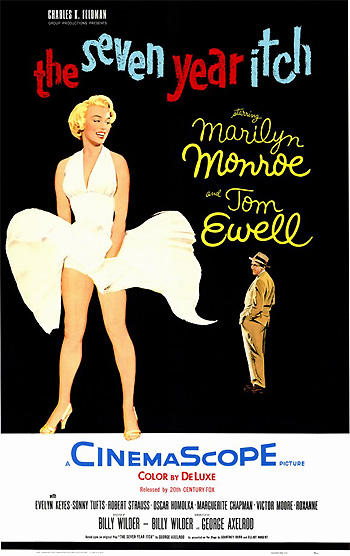
NEVER FELT MORE LIKE SINGING THE QUARANTINE BLUES: THE SEVEN YEAR ITCH, MARTY, ROMAN HOLIDAY, STALAG 17 I have become a huge Billy Wilder (1906-2002) fan after watching the great films Double Indemnity, The Lost Weekend, Sunset Boulevard, Ace in the Hole, Some Like It Hot, The Private Life of Sherlock Holmes, and Avanti. Having made it about halfway through his 26 directorial credits, I have found my least favorite Wilder film so far, the 1955 comedy The Seven Year Itch.
The Seven Year Itch bombs for two main reasons — it is significantly hampered by the Production Code because the movie can’t even suggest an extramarital love affair between our protagonist and the ultimate temptation next door (Marilyn Monroe) and it centers around one of the great insufferable drips in cinematic history, Richard Sherman, played by Tom Ewell (1909-94) on a single note that won him a Golden Globe for Best Performance by an Actor in a Motion Picture Comedy or Musical. Ewell also played the part in the Broadway play.
The film’s legendary scene — Monroe’s Ultimate Upskirt — even proved to be a great letdown not worth the wait and I wish they’d have stayed with Creature from the Black Lagoon instead.
There’s nothing wrong with Monroe, of course, and she’s great in the ‘Chopsticks’ scene, but it’s that darn drip played by Ewell who ruined The Seven Year Itch for yours truly. I traveled beyond tired of his overactive imagination by about his fourth or fifth daydream, which I calculate to be about 15 minutes into a 105-minute motion picture, and having Ewell talk to himself in scene-after-scene also miserably backfired. Richard Sherman called to mind the daydreaming drip played by Gael Garcia Bernal in The Science of Sleep (2006), although Ewell did not sport a ridiculous hat.
I felt the seven year itch for another motion picture real early during The Seven Year Itch and only dearest Marilyn had me stick it out until the bitter end. It’s still no Some Like It Hot.
— What kind of world did people live in when the 29-year-old high school chemistry teacher Clara Snyder was considered a dog?
That’s the main question raised by the 1955 Best Picture winner, Marty, directed by Delbert Mann (1920-2007) in his feature debut, written by Paddy Chayefsky (1923-81) whose later credits include Network and Altered States, and starring Ernest Borghine (1917-2012) in the title role that won Borgnine the Academy Award for Best Actor over James Cagney in Love Me or Leave Me, James Dean in East of Eden, Frank Sinatra in The Man with the Golden Arm, and Spencer Tracy in Bad Day at Black Rock. Mann also won Best Director.
I asked that opening question because Gene Kelly’s then wife Betsy Blair (1923-2009) played Clara. She’s not Marilyn Monroe or Jayne Mansfield, of course, or Elizabeth Taylor or Audrey Hepburn, granted, but she’s definitely not a dog in any world. I mean, I question the eyesight and the sanity of characters like Marty’s harried mother Teresa (Esther Minciotti) and Marty’s jilted best friend Angie (Joe Mantell) when they separately confront homely 34-year-old butcher Marty late in the picture about Clara and her questionable looks. Mother Teresa goes as far to accuse Clara of being at least 10-15 years older than 29, while Angie sounds the canine dialogue until he sure does come across like a smug little prick. Marty should have belted his best friend right smack dab in the kisser, just once.
Marty devotes at least 30 minutes easy to Marty and Clara on their first date and they’re mostly just talking. Marty does the majority of the talking and Clara has this real fetching way of listening to him that makes her incredibly attractive. He cannot believe that he’s become such a blabber mouth with Clara. He’s never acted this way before. He talks about his father’s death just a month after he graduated from high school nearly 17 years ago and he considers her opinion about his notion to buy out his boss and start a community grocery store that can go head-to-head against big chain grocery stores. Marty takes Clara to his house and they are home alone for about 10 minutes. They finally kiss for the first time, right before Teresa comes home and conducts a very awkward first conversation with Clara. Marty and Clara obviously like each other, and the movie ends on Marty finally calling up Clara late in the day after their first date.
I doubt that Borgnine has ever been more likable over his lengthy screen career and the relationship between Marty and Clara undoubtedly influenced Rocky Balboa (Sylvester Stallone) and Adrian (Talia Shire) in the first two Rocky movies, especially their first date and first kiss in Rocky. I like Marty for some of the same reasons I like Rocky and Rocky II.
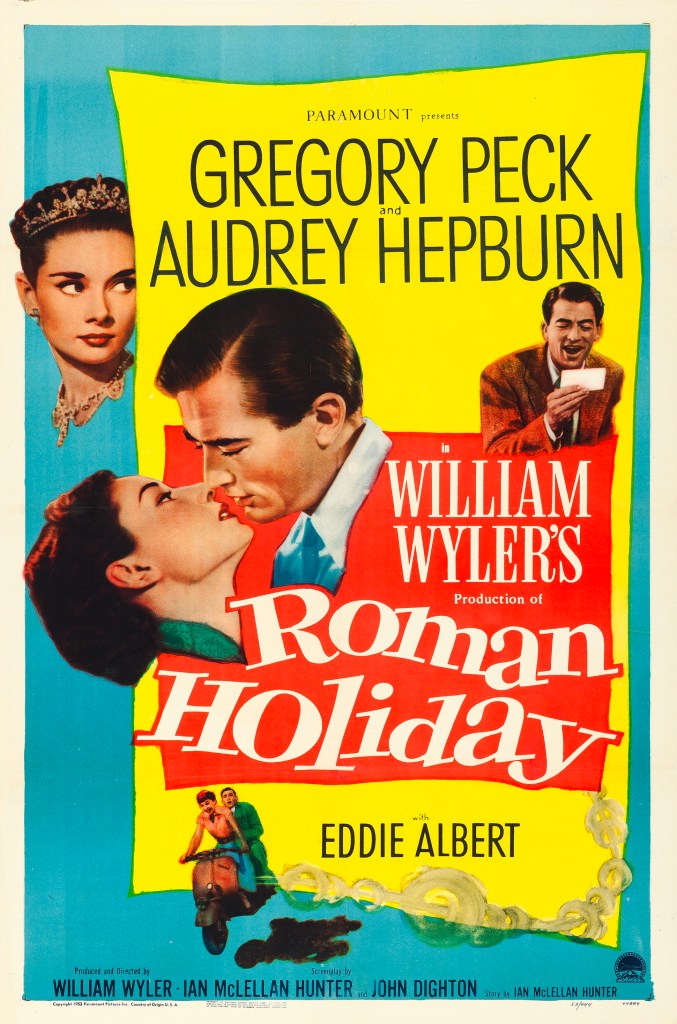
— Audrey Hepburn dominates Roman Holiday in such a way that it’s one of the performances we can point to when somebody asks for the definition of a movie star. Hepburn absolutely shimmers and sparkles throughout Roman Holiday.
Hepburn stars as Princess Ann, a traveling dignitary on a grueling schedule who just wants to have fun in historic and scenic but wild Rome. She sneaks away from her embassy, but the sedative a doctor gave her kicks in all delayed like and she begins to late night pass out on a park bench. That’s where expatriate American newspaper reporter Joe Bradley (Gregory Peck) comes in, who discovers this poor young thing that he believes got inebriated real good and therefore he eventually lets her crash that night at his apartment. One darn thing leads to another the next day: Joe discovers her true identity, decides that he will do an exclusive story and interview with Ann and he rounds up his photographer friend (Eddie Albert), and they spend one tremendous day together. Let’s see, Ann gets a haircut, she drives Joe around for a spell on a Vespa scooter, and our princess finds the opportunity to participate in a fracas with government agents called on by her embassy to grab her. Well, naturally, Ann and Joe also find time for a little suck face and other tender, bittersweet moments.
Hepburn (1929-93) turned 24 years old just a few months before Roman Holiday premiered and it marked her first motion picture starring role. She had appeared in a small role in The Lavender Hill Mob, the British picture that won the Academy Award in 1952 for Best Original Screenplay, and a few other pictures without making any significant mark. Hepburn’s breakthrough started as the title character in the Broadway play Gigi in the year or two before Roman Holiday.
Winning the Academy Award for Best Actress for Roman Holiday legitimized Hepburn’s ascent to motion picture stardom; she beat out Leslie Caron from Lili, Ava Gardner from Mogambo, Deborah Kerr from From Here to Eternity, and Maggie McNamara from The Moon Is Blue for the prize. Hepburn followed Roman Holiday with Sabrina, Love in the Afternoon, Funny Face, Breakfast at Tiffany’s, Charade, and My Fair Lady in the first decade after her first huge success and became one of the most beloved movie stars ever.
In his review of Roman Holiday, San Francisco Examiner film critic Jeffrey M. Anderson argued that Roman Holiday would have been even better had somebody with great style like Howard Hawks or Billy Wilder directed it rather than plain old staid conservative actors’ director William Wyler. Wilder directed Hepburn in Sabrina and Love in the Afternoon, and are they any better than Roman Holiday? Anderson himself gives Roman Holiday three-and-a-half and both Sabrina and Love in the Afternoon three stars. Unfortunately, I’ve not yet seen either Sabrina or Love in the Afternoon.
I’ve been on a bit of a Wyler kick lately — watching Dodsworth, Jezebel, Wuthering Heights, and Roman Holiday all for the first time — and I gained a tremendous amount of respect for the man after seeing the Netflix series Five Came Back about directors Wyler, Frank Capra, John Ford, John Huston, and George Stevens and their experiences making combat and propaganda films during World War II, and how it affected each director for the rest of their lives. Wyler lost hearing in one ear from a bombing mission over Italy; he regained hearing in that ear after the war with the help of a hearing aid. One of Wyler’s cameramen, Harold J. Tannenbaum (1896-1943), perished filming Memphis Belle; from the American Air Museum, “Shot down 16 April 1943 in B-24 41-23983. Some crew members had bailed out when the plane exploded blowing some crew clear. Tannenbaum was a passenger as a photographer from the 8AF Combat Film Unit. Losses report he bailed out but slipped out of his parachute. KIA. He was William Wyler’s first sound man on the Memphis Belle film project and was tasked to take pictures from the B-24 when it exploded on its return from Brest.”
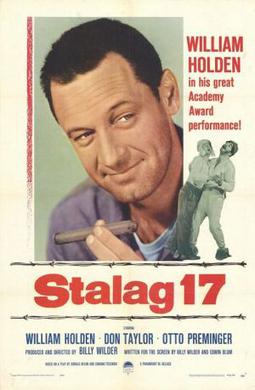
— Watching Billy Wilder’s Stalag 17 for the first time, unfortunately I became distracted by thoughts of comparing and contrasting Stalag 17 star William Holden’s appearance in 1953 versus circa 1980 when he starred in the disastrous disaster film When Time Ran Out.
In particular, I flashed back on that wretched scene in When Time Ran Out between Holden and Charlton Heston approximate James Franciscus. Holden looks bloody awful and he can barely make it through a tiresome disaster movie scene — let’s leave it at Franciscus plays the resident nonbeliever in the impending doom. Not surprisingly, Holden spent six days in the hospital during production of When Time Ran Out to battle his alcoholism; director James Goldstone convinced producer Irwin Allen that Holden’s alcoholism posed a danger to everyone on the set, including Holden himself. Holden died at the age of 63 on Nov. 12, 1981 from exsanguination, or a severe loss of blood, and blunt laceration of scalp; an inebriated Holden slipped on a rug, hit a bedside table, lacerated his forehead, and bled to death in his penthouse apartment in Santa Monica.
Hogan’s Heroes lasted 168 episodes from 1965-71, and I must admit that I have never watched an episode in full. Back in the day, I watched many an old TV show in syndication, everything from I Love Lucy and The Honeymooners to Mannix and Quincy and beyond, but I turned the channel every time I crossed paths with Hogan’s Heroes. I doubt that all the brief time I watched it would possibly add up to the length of a single episode.
For the longest time, I held off watching Stalag 17 — despite the fact that it’s directed by Wilder — because it’s been said to have inspired Hogan’s Heroes. I watched both Robert Altman’s M*A*S*H and Martin Scorsese’s Alice Doesn’t Live Here Anymore, and they inspired TV shows that were borderline inescapable for a youth growing up in the ’80s. So, why not Stalag 17?
Of course, Wilder had the audacity to make a comedy about a Nazi World War II prisoner of war camp less than a decade after the official end of the war.
Interrupting this regularly scheduled review, I announce that I am conceding this review. The writing’s on the wall, rather than on the page, because after 40 days it’s finally clear that I am not going to discuss in any significant detail Wilder’s clashes with Paramount, how Stalag 17 both established and subverted the P.O.W picture, etc. I thought about writing all that more than actually writing it, you know, and that just doesn’t work in the long run. Too bad, there’s not a way to directly transfer dreams and inspirations from the brain to the page. Then again, on deeper thought, maybe it’s good there’s not that way.
Looking back at the permanent record, I watched Roman Holiday, Stalag 17, and The Seven Year Itch on Nov. 17 and Marty on Nov. 18, all four near the end of a 18-day quarantine period, so it’s not exactly been 40 days as I write this concession speech. It just feels like 40 days or maybe 400 or maybe even 400 thousand, because in this crazy year called 2020 perspective’s been permutated, warped, contaminated, mangled, displaced, isolated, and disputed. Here’s to a major comeback for a bruised and battered human race in 2021.
The Seven Year Itch **; Marty ***1/2; Roman Holiday ***1/2; Stalag 17 ***1/2
SIX WEEKS (1982) * My wife awoke in the middle of the night, it took her quite some time falling back asleep, and so naturally she joined me for about the last 30 minutes or so of Six Weeks. She asked me some basic journalistic questions like ‘What’s the little girl dying from?’ ‘I believe it’s leukemia.’ ‘No, it can’t be. It’s got to be something else. I don’t think she’d just suddenly die like that.’
At some point during our discussion, I said that actually this poor little girl has got the dread movie disease where the invariably dead-by-the-end-of-the-movie character becomes ever more beautiful and noble until her big death scene. Yes, the late film critic Roger Ebert named this affliction ‘Ali MacGraw Disease’ after the star of Love Story, the film based on the best-selling novel that one might say started it all way back in 1970.
Movies derived in way or another from Love Story invariably pour it on awful darn thick with the sentiment, until the movie in question becomes a real maudlin exercise. Six Weeks pulls out the stops more than most in this dubious category and that’s why I was utterly amazed that it did not feature a hot-air balloon scene like fellow maudlin tearjerkers Bobby Deerfield, Yes Giorgio, and Just the Way You Are. That’s about the only restraint practiced by Six Weeks.
Casting 101 pairs Dudley Moore (1935-2002) and Mary Tyler Moore (1936-2017), fresh off critical and commercial hot commodities Arthur and Ordinary People, respectively. Yes, wow, how far out, both actors have the same last name and they’re apparently not related. They don’t even have the same national origin. Anyway, like Walter Matthau and Jill Clayburgh in the turkey bomb First Monday in October, Moore and Moore do not share the slightest bit chemistry either, that’s for darn sure. Dudley plays a California politician who’s running for Congress, Mary’s a wealthy cosmetics heiress with the precocious 12-year-old daughter already discussed in the opening paragraph. Dudley’s hopelessly lost in an early scene, very late to a political fundraiser where he’s the featured speaker, and the 12-year-old gives him directions and a whole lot more. She wants Dudley to win his election and Moore² to hook up and become the ultimate happy family for her life’s remaining duration.
Katherine Healy plays the dying little girl and she’s a bit, what’s the word, insufferable. She’s one of those movie children with an unlimited supply of wannabe sharp dialogue and snappy comebacks. She’s dying, remember, and that makes her dialogue even worse and her fantasies ever more powerful. Yes, that’s right, she’s got six weeks left and she’s going to live out as many of her fantasies as possible within the production budget of a 107-minute feel good extravaganza.
Moore² and the little girl hit the bright lights of New York City because what better place to live out fantasies on the big screen and little Niki skates at The Rink at Rockefeller Center, takes on the lead in The Nutcracker, and rounds up Moore² for a smug little cutesy pie wedding ceremony that almost extracted wholesale vomit from the pit of my stomach. Not exactly in that order, though, because the wedding ceremony happens before the grandstanding grand finale ballet number. Niki performed her ballet number on center stage, I looked at my wrist like there’s a watch attached to it and said to my wife, ‘It’s about time for the little girl to die.’ Sure enough, that’s what happened in the very next scene.
I left out the part (until now, anyway) about Dudley’s family, his dutiful wife and teenage son. That’s OK, because they’re not that important and don’t stand in the way of the main body of the plot. Speaking of the plot, Six Weeks pushes and pulls so many emotional levers that it becomes one of the most shameful tearjerkers ever made. They finally resorted to yanking them emotions with pliers. Thankfully, I still resisted and this review signals my protest on aesthetic and emotional grounds.
BOMB, BOMB, BOMB: PARTNERS, CHARLIE CHAN AND THE CURSE OF THE DRAGON QUEEN, WHEN TIME RAN OUT
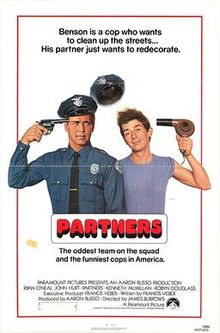
I could only make it through about 30 minutes of Partners and that’s more than enough for at least about 10 lifetimes, I’d say. I gave up on the picture for good around the fourth time star Ryan O’Neal uttered the epithet faggot. Yeah, Partners basically plays Cruising for laughs. Ha-ha, funny … about as funny as punching somebody’s mother in the face.
I consider Partners the absolute worst film from 1982, at least among the 70 or so films that I have seen thus far in my 42 years on this planet. It supplanted Amityville II: The Possession, a lovely little number incorporating blood, vomit, incest, matricide and patricide, fratricide and sororicide, and demonic possession. Never mind Inchon, a $46 million Korean War epic that bombed mightily at the box office with only a $5.2 million return. Never mind Halloween III: Season of the Witch, which features one of the least likable lead characters (Dr. Dan Challis) and lead performances (Tom Atkins) in recent memory. Believe it or not, Partners beats those other films in sheer unpleasantness.
Did longtime TV director James Burrows use Partners for his audition for Will and Grace? I seriously doubt it, because Partners is one of the nastiest pieces of work I have ever seen. Burrows has directed more than 1,000 TV episodes, including 237 Cheers and 75 Taxi and 32 Frasier. Thankfully, Burrows stuck with television after Partners.
Early in the picture, O’Neal asks his boss how he got stuck partnering up (literally) with gay records clerk Kerwin (John Hurt) to infiltrate and investigate a series of murders in the Los Angeles gay community. Anyway, Chief Wilkins (Kenneth McMillan) tells our matinee idol, “Because you’re a good cop, a real good cop. And because of your cute ass.” Maybe that’s how O’Neal himself got the gig. O’Neal certainly dressed up for the part, wearing a ridiculous tank top and then a leather garb in just the portion I watched before saying Roberto Duran on Partners.
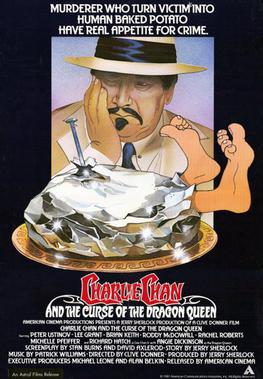
— As I sit here before this keyboard and ponder my next direction, I consider how I endured all 95 minutes or so of Charlie Chan and the Curse of the Dragon Queen, another great big smelly turd from the early ’80s like the ones mentioned about three paragraphs up.
When folks express this incredible nostalgia for the ’80s, undoubtedly it’s not Charlie Chan or Partners or Inchon, for that matter, they’re nostalgic about, because they SUCK in the immortal words of Al from Caddyshack. Then again, if I have learned anything over the years writing about movies or music online, it’s that somewhere in this great big world there’s a cult following Howard the Duck or Halloween III, for example, and they just might flame you for not cherishing their cult object in the same way they do.
Charlie Chan asks us to believe Peter Ustinov (1921-2004), Richard Hatch (1945-2017), and Angie Dickerson as characters of Asian descent. Sure, I believe the Englishman Ustinov as fictional Belgian detective Hercule Poirot (a character he played six times, including features Death on the Nile, Evil Under the Sun, and Appointment with Death) and Roman emperor Nero in Quo Vadis, but I call it more of a stretch to consider him as Chan in 2020, nearly 40 years after the film was made. It’s even worse for both Hatch and Dickerson.
Charlie Chan features plenty of the broadest comedy and frenzied overacting by a rather distinguished cast that also includes Lee Grant, Brian Keith, Roddy McDowall, Rachel Roberts, and Michelle Pfeiffer early in her career. Hatch plays Chan’s fumbling bumbling stumbling grandson Lee Chan Jr. and I’ve watched so many films lately with fumbling stumbling bumbling would-be detectives that I now grumble and rumble when I see them on the screen. I’m thankful my Grandma never behaved like the one played by Grant in Charlie Chan. Keith’s police chief says ‘Goddamn’ about 50 times. McDowall and Roberts play Grant’s domestic helpers, Gillespie and Mrs. Dangers respectively, but they both provide little help to Charlie Chan since they are both in the grand tradition of melodramatic domestic help in the movies; Mrs. Dangers calls to mind Patsy Kelly’s frantic maid in The Gorilla. Pfeiffer could have dialed the perkiness down a notch or few and still have saved enough for the rest of her career. Nearly all of these characters are cringeworthy.
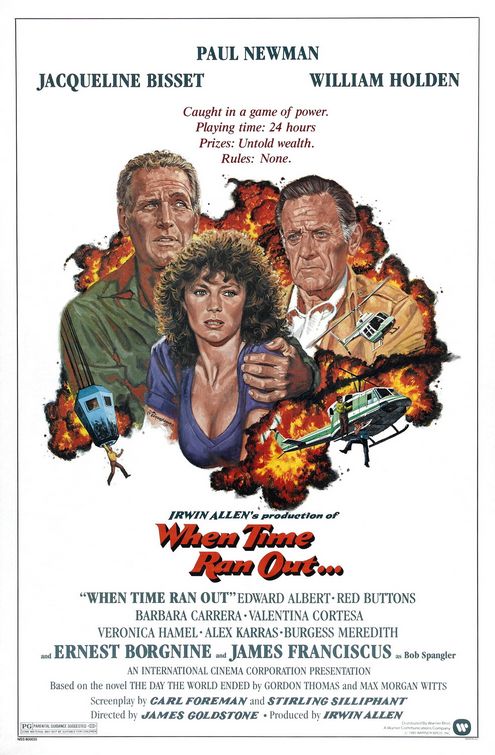
— When Time Ran Out came out Mar. 28, 1980 and it eventually fell about $16 million short of making its $20 million production budget back at the American box office.
Later that year, on July 2, Airplane parodied Airport specifically and disaster movies in general, and became one of the biggest hits of the summer and the entire calendar year.
The failure of When Time Ran Out and the success of Airplane signaled the end of the disaster movie, at least in the form that dominated the first half of the seventies with The Poseidon Adventure, Earthquake, and Towering Inferno and then dribbled out pure unadulterated dreck the final half of that decade like The Swarm, Beyond the Poseidon Adventure, and Meteor. Since I mentioned Meteor, I also have to mention Avalanche, which provided disaster footage recycled in Meteor as if being in one disaster of a disaster movie just simply was not enough.
Master of disaster Irwin Allen (1916-91) produced at least half the films mentioned in the paragraph right above this one and he even stepped in the director’s chair for the turkey bombs The Swarm and Beyond the Poseidon Adventure. Allen called on Rollercoaster director James Goldstone for When Time Ran Out, which features the required number of old time movie stars, hot commodities, and fledgling character actors. When Time Ran Out should have been called Take the Money and Run, though Woody Allen and Steve Miller already used it for a comedy (1969) and a hit song (1976).
We have William Holden (1918-81), Paul Newman (1925-2008), Jacqueline Bisset, Ernest Borgnine (1917-2012), James Franciscus (1934-91), Burgess Meredith (1907-97), Red Buttons (1919-2006), Barbara Carrera, Pat Morita (1932-2005), Veronica Hamel, Edward Albert (1951-2006), and Alex Karras (1935-2012), as well as a volcano, a tidal wave, etc.
Seemingly half of the cast takes part in a glorified soap opera before the molten lava really begins to flow and they have to repeat business from Beyond the Poseidon and seemingly every other disaster movie of the era. Here’s that glorified soap opera: Holden proposes to Bisset very early in the movie and she turns him down because she’s in love with Newman, who’s not the marrying kind and anyway he does not seem to much care for Bisset but maybe he’s just masking his true feelings toward her with standard male bluster. Franciscus is married to Hamel but he’s fooling around with half-brother Albert’s significant other Carrera. Just wait, it gets better, Albert does not know that he’s Franciscus’ half-brother … and Holden and Hamel are sleeping together. I think I just about nailed it down and you’re right if you’re thinking all that seems like too much plot for such a dimwitted movie.
You’re also right that I hated these characters and their miserable lives, and rooted for the volcano to wipe them all out.
Especially Franciscus, who takes chronic disbelief in the face of impending disaster to new lows in When Time Ran Out. Unfortunately, an incredibly shoddy special effect leads to an incredibly unsatisfying death for Franciscus’ character. We crave to see him bite the dust or eat molten lava in spectacular fashion, and what we get is just plain laughable.
Of course, just plain laughable describes about 99 percent of When Time Ran Out.
Believe it or not, costume designer Paul Zastupnevich earned an Academy Award nomination for Best Costume Design and went against winner Tess, The Elephant Man, My Brilliant Career, and Somewhere in Time, all of them period films where the look of the film itself becomes another important character.
Yeah, I hope the 1981 Oscar broadcast used a shot of Newman in his utterly ridiculous Urban Cowboy garb.
Zastupnevich received a nomination for the same award two years before for his edgy, state-of-the-art costume work on The Swarm, beekeeper outfits. The Agatha Christie Hercule Poirot period murder mystery Death on the Nile won the prize.
I hate to say it, but time ran out on this review because I don’t want to consider When Time Ran Out any longer than I already have.
Partners No stars; Charlie Chan and the Curse of the Dragon Queen 1/2*; When Time Ran Out *
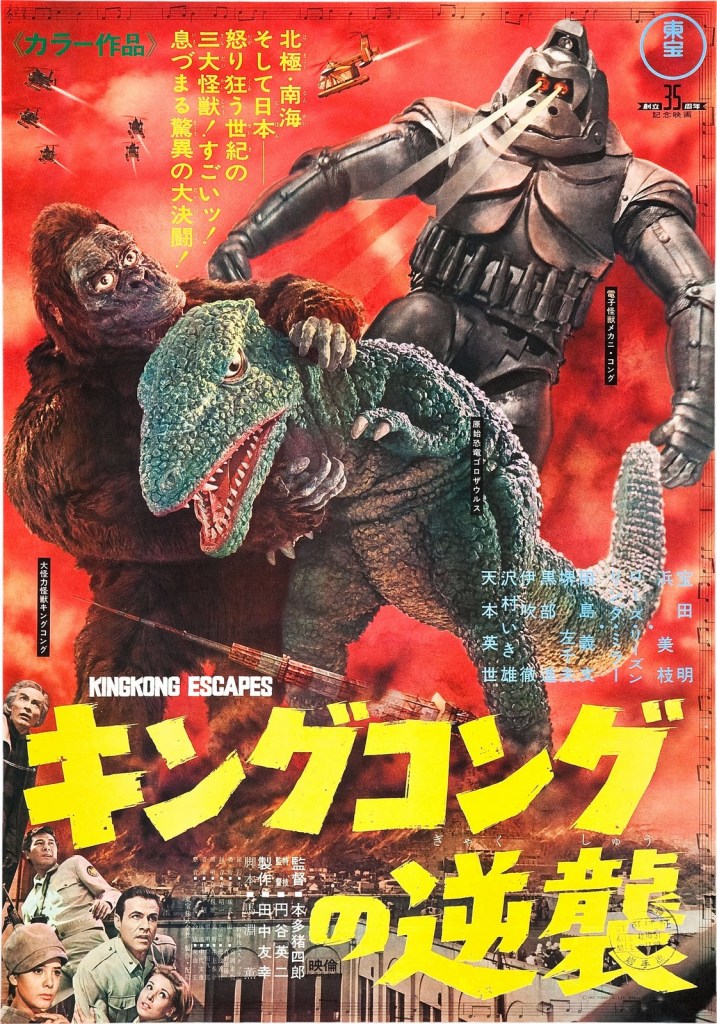
KING KONG ESCAPES (1967) **** I must be a sucker for movies like King Kong Escapes, but I just can’t help myself when it features so many awesome characters, plot details, and scenes.
Of course, we have the title character who’s obviously back from King Kong vs. Godzilla, one of Japan’s biggest Solid Gold hits of the early ’60s.
King Kong Escapes, a Toho Studios and Rankin/Bass Productions co-production, topped King Kong vs. Godzilla for me and I’d like to share how it did just that.
Not only do we have the iconic man-in-a-suit Kong, rather than the Willis O’Brien stop motion Kong from the immortal King Kong, the one that started it all, but we have Mechani-Kong, a giant robot double of Kong that first appeared in the 1966 animated TV series The King Kong Show (hence the Rankin/Bass involvement) and returned for live-action duty in King Kong Escapes.
King Kong Escapes also gives us Gorosaurus and a giant sea serpent, and Kong battles them near their home Mondo Island. See, Kong’s become obviously smitten with the lovely nurse Susan Watson (Linda Miller) and he’ll take on any beast to protect her. She holds sway on the big lug, and that naturally puts her life in danger from the bad guys. Kong saves her several times over the course of a 100-minute spectacular. All in a day’s work.
I believe it’s the human villains who put King Kong Escapes over into greatness for me — the evil mad scientist Dr. Who (not that Doctor Who) and the shady representative of an unknown Asian nation, Madame Piranha. She’s also called Madame X, but I’m sticking with Madame Piranha because I like that name better and she’s played by the pretty Mie Hama. 1967 proved to be a vintage year for Hama, who turned 24 that year and played Kissy Suzuki in the fifth James Bond film, You Only Live Twice. I believe Madame Piranha wins over Kissy Suzuki and ditto for their respective films. Madame Piranha, in fact, belongs right up there with Pussy Galore and Princess Dragon Mom.
Anyway, back to Dr. Who, played by the veteran character actor Hideyo Amamoto (1926-2003). He’s a cross between, I don’t know, Dracula (it’s the cape) and a Bond megalomaniac. He’s one of those characters that we absolutely love to hate and we savor his inevitable demise late in the picture. He’s so vain, so darn smart, so reckless, so persistent, so evil. Dr. Who created Mechani-Kong and when it fails him about 30 minutes into King Kong Escapes, Dr. Who captures first Kong and then Susan Watson, Commander Carl Nelson (Rhodes Reason), and Lt. Commander Jiro Nomura (Akira Takarada), Watson’s human interest. Needless to say, Kong and Mechani-Kong and Watson and gang escape from Dr. Who and his henchmen, which leads us to a battle royale atop Tokyo Tower.
I admit upfront that King Kong Escapes is silly, preposterous, and outright bloody ridiculous, in everything from its plot to its English dubbing, but it came as such a rejuvenation to my spirit after I watched The Gorilla, The Screaming Skull, The Robot vs. The Aztec Mummy, and The Curse of the Aztec Mummy earlier that same day, four exploitation films that if added together still did not provide as much entertainment value as King Kong Escapes.
When you have Bela Lugosi and Lionel Atwill in the cast, make them supporting players, and focus instead on the Ritz Brothers and Patsy Kelly, I call that a major failure.
The Gorilla, distributed by Twentieth Century-Fox and not surprisingly based on a stage play given the film’s limited sets and overall stagy feel, made that very choice. Lugosi earns more laughs than the execrable Ritz Brothers just by playing it straight. Yes, I found Al, Jimmy, and Harry execrable, as they fumbled bumbled and stumbled their way and I conversely grumbled my way through The Gorilla, a horror comedy that fails miserably at both genres. I read the Ritz Brothers walked away from The Gorilla because of the shoddy quality of the script and that’s never a good sign when the stars themselves grumble. They were right, though, because The Gorilla is shoddy, but the Ritz Brothers don’t get let off the hook. Not so fast.
The Ritz Brothers have been called a poor man’s Marx Brothers. No way, they’re not even good enough for that. Granted, to be fair, The Gorilla marked my first exposure to Al, Jimmy, and Harry, so maybe they did their best work elsewhere. Based on The Gorilla, though, I could not differentiate between Al, Jimmy, and Harry, who might as well be any Tom, Dick, and Harry off the street. They blended into one grating personality. I mean, Groucho, Harpo, and Chico created their own distinctive trademark comic personalities and they provided us a wealth of great comic material when they worked at their best (Horse Feathers, Duck Soup).
Laurel and Hardy did this horror comedy number much, much, much better in the 28-minute The Laurel-Hardy Murder Case from 1930. Watching The Gorilla, there’s one recurring gag involving a chair, a desk, a light, and disappearance that specifically makes it clear The Gorilla ripped off The Laurel-Hardy Murder Case, which parodies silent films The Cat and the Canary and The Bat. Paramount released a The Cat and the Canary remake starring Bob Hope and Paulette Goddard on Nov. 10, 1939, only about five-and-a-half months after The Gorilla.
We’ve all seen The Gorilla before, possibly many times before, through other movies, not only the fumbling bumbling stumbling detectives but also the maid who loves to shriek in just about every other scene, the wealthy uncle and the lovely young niece and her male friend and the inheritance plot, the butler who did not do it but who seems to show up at exactly the wrong time so he becomes an obvious suspect for the murders afoot, and both a killer named ‘The Gorilla’ and a real gorilla escaped from the local zoo on the loose and in the same house.
I believe that we talked about Lugosi and his great cinematic love for apes and gorillas back when I reviewed Bela Lugosi Meets a Brooklyn Gorilla. I gave that one three stars, but it actually has almost a full point lower average rating than The Gorilla on Internet Movie Database. Big whoop! I found Jerry Lewis and Dean Martin knockoffs Sammy Petrillo and Duke Mitchell a whole lot more endearing and funny than Al, Jimmy, and Harry Ritz, and Bela Lugosi Meets a Brooklyn Gorilla is not a snooze fest hopelessly dedicated to one set like The Gorilla.
SHE-WOLF OF LONDON (1946) * I have an alternate title for the 1946 Universal Studios anti-horror classic She-Wolf of London: She-Wolf of Tedium.
Since there’s no actual she-wolf, our new alternate title downsizes to Tedium.
Over a 31-year period, Universal made 31 films that are grouped together as the Classic Monsters series, featuring Dracula, Frankenstein’s Monster, the Wolf Man, the Invisible Man, the Phantom, the Mummy, and/or the Werewolf of London, not to mention Abbott and Costello.
She-Wolf of London falls outside the Classic Monsters jurisdiction and it’s worse than any of them. Yes, it’s even worse than The Invisible Woman, the nadir of the Classic Monsters series.
Since I watched The Wolf Man and Werewolf of London, I expected a she-wolf in London, transformation scenes, and scenes of mayhem.
No, director Jean Yarbrough (The Devil Bat), screenwriter George Bricker, and producer Ben Pivar give us a standard issue murder mystery.
June Lockhart, then a 21-year-old ingenue years before her mother roles on Lassie and Lost in Space, stars as poor, poor Phyllis Allenby, whose deep, deep belief in the so-called ‘Curse of the Allenbys’ leads her to believe that she’s the werewolf responsible for all the deaths in the local park. Good old Aunt Martha (Sara Haden), that good old Aunt Martha, anyway, she owns dogs that bark all night and they take a real shining to poor, poor Phyllis. Between all the murders that point toward her and dogs barking and curse talk, Phyllis gets worse over the course of She-Wolf of London. That’s all part of Aunt Martha’s master plan, since she wants to drive Phyllis insane and inside an asylum so Aunt Martha and her daughter remain living inside the mansion rather than Phyllis and her doting barrister, boyfriend, and potential husband Barry Lanfield (Don Porter). Barry sees through it all, believes in Phyllis, and it’s all so touching when he proves her innocence. Instead, Aunt Martha becomes one of those less than convincing movie murderers, you know, in a revelation that renders the rest of the movie, what’s the word, ridiculous … and not the good ridiculous either.
Yeah, that’s a whole lot of plot synopsis and She-Wolf of London surrenders itself to many exposition scenes during a 61-minute motion picture spread. All that exposition becomes the source of all that pesky tedium, which is not exactly what I was expecting from a movie titled (incorrectly) She-Wolf of London. There I go again, my own worst enemy.









 Attack of the Killer Librarian