Halloween III: Season of the Witch (1982)

HALLOWEEN III

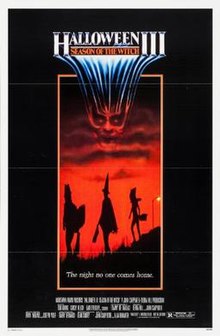
HALLOWEEN III: SEASON OF THE WITCH (1982) One star

The late critic Roger Ebert (1942-2013) took a lot of heat from readers for his review of HALLOWEEN III, mainly because his review contained glaring factual errors, including the biggie that Michael Myers was in HALLOWEEN III. Even those who agree with his basic finding that HALLOWEEN III sucks wish that Ebert had written a better review.

Recently, a Facebook post on a cult and exploitation film group referenced Ebert’s HALLOWEEN III review from one of his video companion books as just one more reason why the critic sucked. Going back nearly five years ago, the “Halloween III: Season of the Witch Appreciation” group posted his entire review. Would it be too much to say get over it? I mean, I hope Ebert never looked back and moved on past HALLOWEEN III.

Here’s the part, though, referencing Myers: “It begins at the end of HALLOWEEN II, when the monster was burned up in the hospital parking lot, but it’s not still another retread of the invincible monster. In fact, the monster is forgotten, except for a lab technician who spends the whole movie sifting through his ashes.”

Here’s what I find most fascinating: There’s a “Halloween III: Season of the Witch Appreciation” group. Certain fans of the film stick up for it very, very, very intensely and go after those who do not believe in their cult favorite, a phenomenon that also exists with other flicks like, for example, HOWARD THE DUCK. Be careful, very very very careful indeed, when expressing a “negative” opinion these days about somebody’s misunderstood, neglected cult favorite.

As one might gather from the star rating, I think HALLOWEEN III sucks. Yeah, I said it, just like how Rodney Dangerfield said it during CADDYSHACK. (HALLOWEEN III fans believe their movie’s been treated like Dangerfield’s most famous line.)

At just about this moment in time, somebody might be saying that I just don’t understand the conceptual brilliance throughout HALLOWEEN III.

No, believe me, I get HALLOWEEN III, I understand it, hell I even admire it for trying something completely different than being just one more damn assembly line horror movie sequel, I think it fails miserably.

I find HALLOWEEN III to be a drag, a real downer of a movie, redeemed only somewhat by two performances, including one by veteran Irish character actor Dan O’Herlihy as diabolical villain Conal Cochran, the world’s greatest practical joker. Though I enjoyed O’Herlihy more in both THE LAST STARFIGHTER and ROBOCOP, he brings that same ebullient spirit to HALLOWEEN III. He’s just like a James Bond super villain.

Unfortunately, though, I would be hard-pressed to name a main protagonist in any horror movie I like less than Dan Challis in HALLOWEEN III. Maybe somebody from THE AMITYVILLE HORROR series, perhaps. It’s no coincidence that HALLOWEEN III co-writer and director Tommy Lee Wallace also wrote AMITYVILLE II: THE POSSESSION (1982), giving him the distinction of being involved with two of the most unpleasant mainstream horror films I’ve ever seen. Both films come from the Dino DeLaurentiis Corporation. Not sure if there’s an “Amityville II: The Possession Appreciation” group in this great big world.

Challis, getting back on track, he’s played by Tom Atkins. I do like Atkins, especially in the cult favorite NIGHT OF THE CREEPS. He’s traditionally a supporting actor, but I don’t think Atkins proved himself up to the task of being the lead actor. He’s too much of a creep in HALLOWEEN III.

Because of that, HALLOWEEN III features one of the most awkward, most unbelievable, and creepiest love scenes in history between Atkins and Stacey Nelkin.

I do believe Ebert nailed it on Nelkin: “The one saving grace in HALLOWEEN III is Stacey Nelkin, who plays the heroine. She has one of those rich voices that makes you wish she had more to say and in a better role. But watch her, too, in the reaction shots: When she’s not talking, she’s listening. She has a kind of rapt, yet humorous, attention that I thought was really fetching. Too bad she plays her last scene without a head.”

Though enjoying both Nelkin and O’Herlihy (file them under good performances in bad movies), the majority of the movie bludgeons me over the head every few minutes with a gory murder scene involving characters I don’t give a damn about. This is one of those movies where you apply ice to the back of your head after it’s over because it’s been hitting you for 100 minutes.

In a nutshell, we have mostly unpleasant characters in unpleasant situations, topped off by ultra-annoying commercial jingles for Silver Shamrock (I get that it’s the point of these jingles) and plots and scenes recycled wholesale from better movies like INVASION OF THE BODY SNATCHERS (1956 version) and James Bond.

Other than that, how was the play, Mrs. Lincoln?
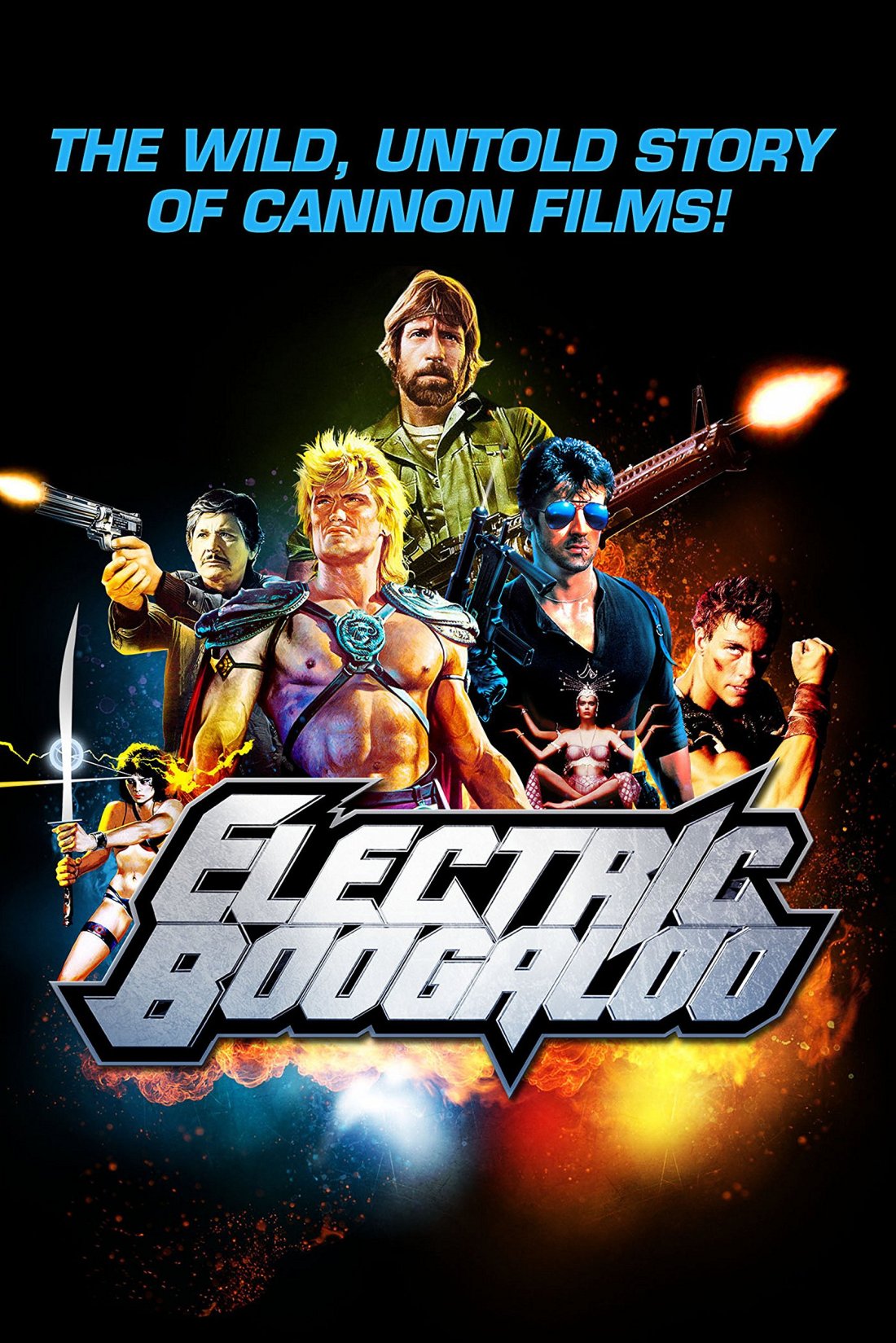
Electric Boogaloo: The Wild, Untold Story of Cannon Films (2014)

ELECTRIC BOOGALOO, THE WILD UNTOLD STORY OF CANNON FILMS

ELECTRIC BOOGALOO: THE WILD, UNTOLD STORY OF CANNON FILMS (2014) Three-and-a-half stars
There’s bad movies and then there’s movies released by Cannon Films.
Cannon became one of the most productive motion picture studios in the 1980s, known for producing schlock on an epic scale.
You might remember Cannon from their productions SUPERMAN IV: THE QUEST FOR PEACE, THE DELTA FORCE, MASTERS OF THE UNIVERSE, BLOODSPORT, OVER THE TOP, KING SOLOMON’S MINES, THE TEXAS CHAINSAW MASSACRE 2, THE LAST AMERICAN VIRGIN, and, of course, BREAKIN’ 2: ELECTRIC BOOGALOO.
Once upon a time, I believe I wrote that cousins and Cannon heads Menahem Golan (1929-2014) and Yoram Globus were never responsible for a “good” film.
It sure does seem that way at times with their Cannon canon, but I might have been guilty of practicing a little bit of hyperbole. Never. And it’s not like Cannon was never guilty of the same.
I watched many of these films growing up and thus, I watched ELECTRIC BOOGALOO: THE WILD, UNTOLD STORY OF CANNON FILMS with a certain nostalgia.
I’ll take a bad film produced by Cannon over many, many good films. They’re never ever boring, unlike so many prestigious prize winners over the years.
For example, I’ve never considered OVER THE TOP a good movie in any traditional sense, but it’s always been great fun watching this incredible cinematic train wreck that combines “arm wrestling, child custody, and truck driving” into a macho soap opera for the ages. See, your regular bad movie would not take on all three of those subjects and play them full tilt. Child actor David Mendenhall mugs so heavily that I check my wallet every single time I watch OVER THE TOP and his emotional moments with Stallone are so cringe worthy.
Anyhoo, ELECTRIC BOOGALOO is filled with many, many nuggets of juicy information.
— Golan honestly believed that Brooke Shields would win an Academy Award for her performance in SAHARA. Come on, are we talking about the same Brooke Shields, one of the worst actresses ever to disgrace the screen? SAHARA marked the last Cannon picture that MGM distributed; MGM called it “Dry as the Sahara desert … it was awful.” During his review of the 1985 Chevy Chase and Dan Akyroyd comedy SPIES LIKE US, Gene Siskel mentioned that he watched the film while he was on vacation in Hawaii and that Hollywood studios should show him a movie every time he’s on vacation in Hawaii because he’d like anything … then he remembered that a year-and-a-half before, he saw SAHARA in Hawaii and it nuked his see-a-movie-in-Hawaii-and-like-it theory.
Rather than winning an Oscar, Shields instead became the first and so far only actress to win both Worst Actress and Worst Supporting Actor (“Brooke Shields (with a mustache)”) at the 1984 Razzies.
— Cannon wanted “that Stone woman” for their RAIDERS OF THE LOST ARK and ROMANCING THE STONE rip-off KING SOLOMON’S MINES.
Golan meant Kathleen Turner, star of both ROMANCING THE STONE and JEWEL OF THE NILE, but instead “that Stone woman” was interpreted to mean Sharon Stone, who had a limited filmography at that point in her career.
Seemingly everybody hated Stone during the production.
Legend has it that crew members pissed on Stone’s bathtub in her trailer.
Stone said that her contribution to both KING SOLOMON’S MINES and the sequel ALLAN QUATERMAIN AND THE LOST CITY OF GOLD was her bad hairdo running through the jungle. She took work on POLICE ACADEMY 4: CITIZENS ON PATROL next to have some fun after the stress of both King Solomon films and her divorce.
Here I thought it was a chance to work with both Brian Backer and Billie Bird (1908-2002).
— SUPERMAN IV: THE QUEST FOR PEACE is one of the worst super hero movies of all-time and rates with JAWS THE REVENGE as the worst third sequel released in 1987.
This is a film where the IMDb trivia is infinitely more interesting than the final product.
For example, the SUPERMAN IV entry begins promisingly, “Christopher Reeve publicly regretted his involvement in the film. He stated, ‘SUPERMAN IV was a catastrophe from start to finish. That failure was a huge blow to my career.’”
The special effects on the picture are shoddier than probably anything you’ve ever seen, as Cannon slashed the budget by $20 million during the film’s production.
Another juicy bit from the IMDb, “Christopher Reeve’s flying harness was concealed under a larger version of the red shorts he wore for the costume, making his waist look bigger. In previous SUPERMAN movies, the bigger waist was hidden by the cape, quick cuts, or creative camera angles. In this movie, the bigger waist is clearly visible, leading some reviewers to speculate that the thicker waist was Reeve’s actual waistline.”
You could say SUPERMAN IV: THE QUEST FOR PEACE rates a 10 on IMDb, if you add 6.3 points from the trivia section to the 3.7 score the film earned after 39,268 votes.
You could also say that Cannon had no business making pictures like SUPERMAN IV, would-be blockbusters that proved to be dead in the water.
— ELECTRIC BOOGALOO reminds (or informs) one that Cannon took chances on John Cassavetes’ LOVE STREAMS, Andrei Konchalovsky’s RUNAWAY TRAIN, and Jean-Luc Godard’s KING LEAR, for example, respectable films coming from a studio not known for respectability.
— Overall, taking in the wide (and wild) variety of films produced by Cannon, everything from break dancing to ninjas and Michael Dudikoff to Chuck Norris and Bronson to Indiana Jones rip-offs, you might be tempted to conclude — like I do — that yesterday’s bad movies are sometimes better than today’s good movies.
— ELECTRIC BOOGALOO itself surpasses all of the Cannon “classics” in entertainment value.

American Pop (1981)

AMERICAN POP

AMERICAN POP (1981) Four stars
From 1972 to 1983, British Mandate of Palestine born and New York City and Washington D.C. raised Ralph Bakshi directed eight animated features: FRITZ THE CAT, HEAVY TRAFFIC, COONSKIN, WIZARDS, THE LORD OF THE RINGS, AMERICAN POP, HEY GOOD LOOKIN’, and FIRE AND ICE.

Bakshi definitely proved to be a game changer: Feature-length animation could be combative, satirical, adult entertainment and more than just good, clean, wholesome family entertainment as in the socially accepted definition for animated films. His films — especially his first three — paved the way for “The Simpsons,” “Beavis & Butt-Head,” “South Park,” “Family Guy,” “Adult Swim,” et cetera.

FRITZ THE CAT, loosely based on Robert Crumb’s comic strip, became a landmark motion picture, the first animated feature to earn the ‘X’ rating in the United States.

HEAVY TRAFFIC, COONSKIN, AMERICAN POP, and HEY GOOD LOOKIN’ are ‘R’ and WIZARDS, THE LORD OF THE RINGS, and FIRE AND ICE are ‘PG,’ although that rating once packed a punch with the first two Indiana Jones, JAWS, POLTERGEIST, GREMLINS, and LONE WOLF McQUADE, arguably the most violent ‘PG’ ever made, being some of the most notorious ‘PG’ entries before ‘PG-13’ debuted in August 1984 with the release of RED DAWN.

I’ve watched seven of the eight Bakshi films listed above, liked nearly all of them, and FRITZ THE CAT, THE LORD OF THE RINGS, and AMERICAN POP have earned a spot on my personal top 10 lists for 1972, 1978, and 1981, respectively.

I just watched AMERICAN POP last night and I was once again impressed by the overall sweep of the enterprise — narratively and musically and, of course, its animation — just like I had been several years back watching it for the first time.

AMERICAN POP tells the story of four generations of Russian Jewish immigrants who all have some involvement with American popular music.

First, we meet Zalmie around the late 19th and early 20th century and follow him for a series of years. Zalmie, who started hanging around burlesque shows at an early age, wants to be a singer, but a wound to his throat during World War I kills his singing career. After the war, back home in New York City, he falls in love and marries a stripper named Bella, and Zalmie transfers his star-making ambition to his wife. She’s killed opening a letter bomb intended for him. See, Zalmie used money from mob boss Nicky Palumbo for his wedding to Bella and eventually, Zalmie testifies against Palumbo on TV, calling the mob boss “a rat.”

Zalmie and Bella have a son named Benny, who becomes a very talented jazz pianist. Benny fights in World War II and in one of the film’s best scenes, he finds an abandoned piano in a bombed-out building that leads to his demise. When we first see Benny in Nazi Germany, he’s playing the harmonica (not exactly his musical forte) and even he quips to two fellow troops who call out his lousy playing, “I know, but it’s hard to fit a piano in a foxhole.” At this abandoned piano, Benny first riffs on “As Time Goes By” (Dooley Wilson’s Sam had to play it — again — in CASABLANCA) and his playing quickly draws the attention of an awakened, armed Nazi soldier who approaches Benny from the rear. Benny changes tune to “Lili Marleen” (Marlene Dietrich made it especially famous) and the appreciative Nazi waits to shoot down Benny until he’s done playing “Lili Marleen.” The Nazi even says thanks in German before firing his shots.

Third generation Tony experiences the Beats and the Hippies as he migrates from East to West and back again — of course, we hear Allen Ginsberg’s “I saw the best minds of my generation destroyed by madness,” one of the best starts to any poem — and he gets poetic himself first over “The Blonde” from Kansas. “Yeah, I’m crazy,” Tony tells her. “I’m crazy in love with your blue eyes … and your corn-sulked hair. Your corn-sulked hair. I’ll never eat corn again without thinkin’ about you. Canned corn, candy corn, popcorn, Crackerjacks! You’re the prize in my box! And my box is this country. It’s all tinfoil on the outside. Corn and sweetness on the inside.”

Tony’s journey leads him next to California and he writes songs for a rock band on the edge of stardom. Tony and female lead singer Frankie Hart — a character archetype obviously inspired by Grace Slick and Janis Joplin — become heroin addicts. With the band set to play after Jimi Hendrix one night in Kansas, two important events happen to Tony: his lover Frankie overdoses backstage and he meets his son Pete, who came from the one night with the corn-sulked hair girl.

Tony moves back to New York City, joined by his son. Both Tony and Pete become drug dealers and Pete begins selling drugs to rock bands. Pete finally seizes the moment and gives the band members an ultimatum: They must listen to Pete’s music before they can have any more cocaine. Pete chooses to play Bob Seger’s “Night Moves” for the band and the management. Next thing we know, before we can get all the way through “Night Moves,” Pete’s on stage with the band playing “Blue Suede Shoes,” “Devil in a Blue Dress,” and “Crazy on You.” Late in the medley, we start to see images from earlier in the movie — Zalmie, Benny, and Tony — with Pete on stage.

Of course, Lynyrd Skynyrd’s “Free Bird” plays over the end credits.

AMERICAN POP guides us through 80 years of popular music — everything from standards to Jimi Hendrix’s “Purple Haze,” Janis Joplin’s “Summertime,” and Lou Reed’s “I’m Waiting for the Man,” in addition to the songs already mentioned. That list barely hints at the music heard throughout AMERICAN POP.

Stylistically, we not only have rotoscoping (a process where live actors are filmed and then animators draw over the live-action footage), but also water colors, computer graphics, live-action shots, and archival footage.

Bakshi swung for the fences making AMERICAN POP — an epic achieved in 96 minutes with any failures consumed by the successful elements.

If you still have, somehow at this point in time after many advances in the field, a belief that animated films occupy a limited range aesthetically, emotionally, and intellectually, then Ralph Bakshi’s AMERICAN POP just might free and expand your mind.

In other words, “Whether you dance to it, drive to it, sing with it or swing to it … if you can crank it up, plug it in, or switch it on … if it assaults your senses, rocks your body, or touches your soul, it’s AMERICAN POP.”

King Kong (1976)

KING KONG 1976

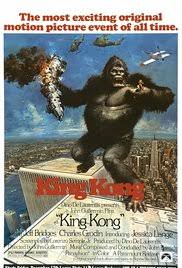
KING KONG (1976) Three-and-a-half stars
Of course this 1976 KING KONG cannot hold a candle to the 1933 version, one of the all-time screen classics.

If and when you and I can get past that fact, admittedly not an easy hurdle, the 1976 version stands out for being a great entertainment.

Jeff Bridges and Jessica Lange are improvements over Bruce Cabot and Fay Wray, respectively, in the male and female leads and Charles Grodin’s not far below what Robert Armstrong did in a similar role.

Of course, you can immediately tell when this movie was made by all the contemporaneous dialogue (especially from Lange) and Grodin plays an executive with Petrox Corporation, a fictional American oil company referencing the “pet rock” phenomenon. This KONG is more bound to 1976 than the original is to 1933.

Beset with production issues of a wide variety, including a complicated legal battle between Paramount, Universal, RKO, and the Cooper estate before filming even started (at one point, both Paramount and Universal had KONG projects lined up), and a first-time leading lady, as well as practical effects that often look more dated than what Willis O’Brien accomplished in 1933, KONG 1976 still works on a basic level.

It is fun.

The stories around the film, though, are more interesting than the finished product and help explain why the hype for the film took on epic proportions before its December 17 premiere.

Italian producer Dino DeLaurentiis (1919-2010) had the Carl Denham quotes in real life: “No one cry when JAWS die,” he said in Time. “But when the monkey die, people gonna cry. Intellectuals gonna love Kong. Even film buffs who love the first Kong gonna love ours.”

Or how about this one about Barbra Streisand told by Roger Ebert: “It’s-a no good, have two monsters in one movie.”

Unfortunately, when Meryl Streep auditioned for the Jessica Lange part, Dino said to his son in Italian that she was “too ugly” for the role; Streep understood Italian and replied in Italian to Dino, “I’m sorry I’m not beautiful enough to be in KING KONG.” We are printing legends, and that only seems appropriate for KING KONG.

Dino talked more smack about JAWS with ORCA THE KILLER WHALE (1977).

Gotta love Dino, whose mouth bit off more than his productions could chew.

Rather than Universal’s competing KONG movie (not released until Peter Jackson’s remake in 2005), the public first received A*P*E, an American / South Korean co-production with its Grade Z special effects, an early appearance for future TV mother Joanna (“Growing Pains”) Kerns, and an infamous shot where the ape uses the middle finger to show his disgust with the helicopters shooting at him.

Either that or he’s just showing his disgust at being trapped in that damn gorilla suit in a shitty movie.

A*P*E would later be topped, in the KING KONG ripoff department, by the Shaw Brothers’ MIGHTY PEKING MAN, the best of the King Kong ripoffs.

There’s also KING KUNG FU from 1976, where a gorilla trained in martial arts wreaks havoc on Wichita, Kansas. Financial constraints forced the makers into not being able to finish their film until 1987.

A*P*E invaded movie screens in October 1976, beating DeLaurentiis’ KONG by a good two months. MIGHTY PEKING MAN came out April 10, 1977, and Quentin Tarantino’s Rolling Thunder Pictures re-released the film on April 23, 1999.

Carlo Rambaldi, Glen Robinson, and Frank Van der Veer won a Special Achievement Award from the Academy of Motion Picture Arts and Sciences for the visual effects in KING KONG, believe it or not.

Legendary make-up artist Rick Baker played Kong, or he’s the man in the ape suit. The original plan had been for KONG ’76 to feature a 40-foot high mechanical ape, but that mechanical monster worked even less than Bruce the Shark in JAWS. JAWS director Steven Spielberg worked around the frequent mechanical failure to make an even better film than if the mechanical shark had been fully operational.

That’s not exactly the case with KONG ’76, partially because musical cues would not be a proper substitute for an ape like John Williams’ musical score proved to be for the shark or even Harry Manfredini’s score for the psycho killer in FRIDAY THE 13TH.

In other words, you have to see the ape.

“KING KONG offered the one chance to do a really perfect gorilla suit,” Baker said. “With the money and the time, it could have been outstanding. Unfortunately, it wasn’t. There were compromises and enforced deadlines.”

Let’s face it, KONG director John Guillermin, he’s no Spielberg.

At the same time, though, I give KONG ’76 and JAWS both three-and-a-half stars. Why?

A) Because life (and my brain) work in mysterious ways.

B) Because star ratings are basically arbitrary.

C) Because both films tap into the same primordial appeal and work as great entertainments for a couple hours each.

Any Which Way You Can (1980)

ANY WHICH WAY YOU CAN

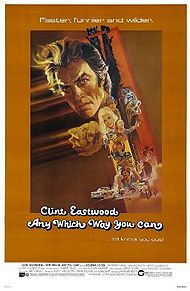
ANY WHICH WAY YOU CAN (1980) Three stars
If I believed in feeling any guilt whatsoever about feeling pleasure, I might call ANY WHICH WAY YOU CAN a guilty pleasure.

It’s another one of those sublimely ridiculous movie packages that I can’t help but not to like. I mean, it could play on a double bill with ROAD HOUSE.

We all have “guilty pleasures,” and they form one of the most rewarding experiences that we can have at the movies.

If you describe ANY WHICH WAY YOU CAN as a movie with a little bit of everything, that’s still selling it short. I mean, it’s not every day that you have Clint Eastwood in a comedic role, an orangutan named Clyde (played by Buddha and C.J., although there’s no screen credit) who steals every scene that he’s in, a concluding fight scene that can go head-to-head with the later ROCKY sequels and THEY LIVE, a buffoonish motorcycle gang, Ruth Gordon (1896-1985) in what can only be called the “Ruth Gordon” role, and a country song played seemingly every few seconds.

This is the only motion picture that starts with an Eastwood and Ray Charles duet on a little ditty over the opening credits named “Beers for You.”

Personally, I feel the movie could have used more Clyde scenes — more “Right Turn Clyde,” more flipping the bird, more smashing cars, et cetera — and fewer scenes between Eastwood and his real-life partner at the time Sondra Locke. Locke generally became the weak link in Eastwood’s films of the period, and both EVERY WHICH WAY BUT LOOSE and ANY WHICH WAY YOU CAN dramatically prove that as Eastwood demonstrates better chemistry with the orangutan than Locke.

Back to Clyde and Buddha and C.J. Buddha and C.J. assumed the Clyde role for the sequel since Manis — who alone played the role in EVERY WHICH WAY BUT LOOSE — apparently had grown too much between films. Manis returned to his act in Las Vegas.

Reports have it Buddha alone played the role in ANY WHICH WAY YOU CAN and C.J. came on in publicity because Buddha was caught stealing doughnuts on the set near the end of filming and he was brought back to his training facility and beaten for 20 minutes, according to the book “Visions of Caliban: On Chimpanzees and People” by Jane Goodall and Dale Peterson.

Buddha then died soon after of a cerebral hemorrhage.

C.J. went on to star in Bo Derek’s TARZAN THE APE MAN and a NBC sitcom named MR. SMITH.

Executive producer Ed Weinberger said of C.J. in the Washington Post, “It’s a Buddha-like presence. He has wisdom about him. You have to know the animal; I’m in love with him. I’d have him in my house any time.”

MR. SMITH lasted all of 13 episodes from Sept. 22 through Dec. 16 in 1983 and finished a dismal 95th in the Nielsens.

So much for a talking orangutan and who knows if Weinberger had C.J. over at his house after the show flopped big time.

I remember loving ANY WHICH WAY YOU CAN as a young child. It was an affinity for Clyde. He’s what I remembered about the movie for many years before I revisited it decades later.

Not every movie I loved in childhood holds up revisited in adulthood. For example, CANNONBALL RUN, an entertainment I found to be an endurance contest several years back. (For the record, I recently watched SMOKEY AND THE BANDIT, another childhood favorite, again and it held up. I enjoyed Burt Reynolds, Sally Field, Jerry Reed, and Jackie Gleason.)

ANY WHICH WAY YOU CAN is not quite at the same high level as COMMANDO, LONE WOLF McQUADE, and ROAD HOUSE.

That’s because it’s a little flabby with a running time of 1 hour, 56 minutes. Granted, that concluding fight scene between Eastwood and William Smith eats up a good 10 percent of a nearly two-hour experience.

LONE WOLF McQUADE and ROAD HOUSE do have similar run times, but fewer bad scenes than ANY WHICH WAY YOU CAN.

The great director Howard Hawks (1896-1977), born the same year as Ruth Gordon, said that a good movie is “three great scenes and no bad ones.” Not sure that he had movies like ANY WHICH WAY YOU CAN in mind, which does have three great scenes but also some bad ones.

ANY WHICH WAY YOU CAN, though, is one of those sequels better than the original.

Road House (1989)

ROAD HOUSE

ROAD HOUSE (1989) Three-and-a-half stars
This is the Patrick Swayze (1952-2009) movie that ate all his other movies. More like ripped all the other movies’ throats out. We are talking about ROAD HOUSE, after all.

You can weep to GHOST, you can boogie to DIRTY DANCING, and you can kill Commies to RED DAWN, that’s fine and dandy, whatever floats your boat and tickles your fancy, but ROAD HOUSE is the ultimate Swayze viewing experience, at least for this magnificent bastard.

It is Swayze in Testosterone Hyperdrive, or it should have been titled OVER THE TOP rather than Sylvester Stallone’s epic about child custody, arm wrestling, and truck driving.

“Dalton lives like a loner, fights like a professional. And loves like there’s no tomorrow.”

“The dancing’s over. Now it gets dirty.”

“Dalton’s the best bouncer in the business. His nights are filled with fast action, hot music and beautiful women. It’s a dirty job, but somebody’s got to do it.”

Three taglines for ROAD HOUSE that only hit at the surface of the epic sleaze within the film.

Swayze plays Dalton, who’s not only the world’s greatest bouncer, he’s got a degree in philosophy from NYU. At one point, Dalton shares his general bouncer philosophy to his bouncer troops at the Double Deuce, the world’s roughest bar and the pride of the fictional Jasper, Missouri. (Bet the film’s producers did not know there’s a real Jasper, Missouri.)

“All you have to do is follow three simple rules. 1) Never underestimate your opponent. Expect the unexpected. 2) Take it outside. Never start anything inside the bar unless it’s absolutely necessary. And 3) Be nice.”

I enjoy hearing these rules — every single time — just like in GREMLINS when inventor Rand Peltzer tells his son about his new pet Mogwai, “First of all, keep him out of the light, he hates bright light, especially sunlight, it’ll kill him. Second, don’t give him any water, not even to drink. But the most important rule, the rule you can never forget, no matter how much he cries, no matter how much he begs, never feed him after midnight.”

I enjoy hearing both the rules in GREMLINS and ROAD HOUSE because I know that rules are meant to be broken in the movies. The rules — and a whole lot more, namely bones and plate glass windows — are definitely broken in ROAD HOUSE.

ROAD HOUSE is the most quotable Swayze movie by far.

“Pain don’t hurt.”

“Prepare to die.”

“Nobody ever wins a fight.”

“A polar bear fell on me.”

“You’re too stupid to have a good time.”

“Calling me ‘sir’ is like putting an elevator in an outhouse, it don’t belong.”

“Elvis! Play something with balls!”

“I thought you’d be bigger.”

“I’ll get all the sleep I need when I’m dead.”

“I sure ain’t gonna show you my dick.”

Three lines that you might want to pass on: “I used to fuck guys like you in prison.” “I heard you had balls big enough to come in a dump truck.” “Whaddaya say we get nipple to nipple?”

Sam Elliott strolls into Jasper as Wade Garrett, Dalton’s mentor and friend who rates second best bouncer in the world. Garrett’s salty language would not pass muster with Elliott’s ‘The Stranger’ in THE BIG LEBOWSKI — The Stranger asked The Dude at one point, “Do you have to use so many cuss words?” The Dude replied “What the fuck are you talking about?”

ROAD HOUSE is a Western cast in bar room terms all the way down the line, from the hero to the old mentor to the businessman with an offer for the hero to come in and calm down a rowdy scene to the super villain to the henchmen to the leading lady to the watering hole to a guy named Red. Kelly Lynch plays “Doc,” Dalton’s love interest, and ROAD HOUSE might have showed its only restraint in not choosing “Kitty” for the character’s name. Doc’s real name is the film’s big twist.

Guess we should have expected ROAD HOUSE from a director named Rowdy Herrington.

It was destined to be, especially since Herrington adopted the correct approach: “I saw it as a cartoon,” he said. “Broader than life. Brighter than life.”

Epic bar fights. Live music from a real band. A monster truck. Bouncer philosophy. Boobs. Obligatory Swayze butt shot. All that eminently quotable dialogue, although it would be hard saying any of it if we met arch henchman Jimmy’s fate. By the way, Jimmy’s wardrobe approved by Chuck Norris from INVASION U.S.A. and Ramon Revilla from THE KILLING OF SATAN.

In the film’s bravura climax, we encounter super villain Brad Wesley’s trophy room. True story: Recently visiting the Wonders of Wildlife National Museum in Springfield, Missouri, it called to mind Wesley’s trophy room.

Roger Ebert (1942-2013) found this late scene the key to unlocking the film’s guiding spirit: “His hunting trophies include not only the usual deer and elk and antelopes, but also orangutans, llamas and a matched set of tropical monkeys. This guy went hunting in the zoo.

“We are expected to believe that the sadist financed these hunting expeditions by shaking down the businessmen in a town that, on the visible evidence, contains a bar, a general store, a Ford dealership and two residences. ROAD HOUSE is the kind of movie that leaves reality so far behind that you have to accept it on its own terms.”

That’s right. It’s so ridiculous, so cartoonish, so over-the-top that it becomes highly enjoyable, just like COMMANDO and LONE WOLF McQUADE.

There’s a lot (not a whole lot, though) more that I have to say about ROAD HOUSE, but that can wait for another time down at the Double Deuce.

Don’t worry, it’s cooled down considerably since 1989.

Three favorite character actors in ROAD HOUSE: Sunshine Parker, John Doe (rock musician), and Terry Funk (professional wrestler).

Miles Ahead (2016)

MILES AHEAD

MILES AHEAD (2016) Three-and-a-half stars
Jazz trumpeter, composer, and band leader Miles Davis (1926-91) made some of the best albums of all-time: KIND OF BLUE, SKETCHES OF SPAIN, and IN A SILENT WAY among them.

He’s listed for 51 studio albums, 36 live albums, 35 compilation albums, 17 box sets, four soundtrack albums, 57 singles, and three remix albums in a solo career that lasted over 40 years.

MILES AHEAD (also the title of a 1957 album) works as a meditation on Davis’ public image and Samuel L. Jackson’s favorite word.

Actor, director, and writer Don Cheadle, who stars as Davis, has not fashioned a traditional screen biography and I am very thankful for that. I mean, I gave that genre up for good after the double whammy of RAY (2004) and WALK THE LINE (2005) nearly 15 years ago. I don’t think an old-fashioned screen biography could possibly contain Davis, anyway, just like it failed with Johnny Cash; Kris Kristofferson captured Cash better than a two-hour motion picture with these lyrics, “He’s a poet, he’s a picker / He’s a prophet, he’s a pusher / He’s a pilgrim and a preacher, and a problem when he’s stoned / He’s a walkin’ contradiction, partly truth and partly fiction.”

A Rolling Stone article titled “The Two Sides of Miles Davis” begins, “There was never one Miles Davis. Depending on whom you ask, there may have been as many as five. But those would be the jazz fans, those who charted his every artistic move. They’re right. The composer/trumpeter blew through styles with a restless energy unlike any other 20th century musician. But for our purposes, let’s step back from Davis’ stylistic devices and creations and look at the two fundamental Miles Davises: the public and the private.”

The article goes on to discuss Davis’ 1989 autobiography.

It definitely seems that Cheadle and gang read “Miles Davis: An Autobiography,” with detailed notes from Davis’ vocabulary.

Here’s a few samples:

“Anybody can play. The note is only 20 percent. The attitude of the motherfucker who plays it is 80 percent.”

“I remember one time — it might have been a couple times — at the Fillmore East in 1970, I was opening for this sorry-ass cat named Steve Miller. Steve Miller didn’t have his shit going for him, so I’m pissed because I got to open for this non-playing motherfucker just because he had one or two sorry-ass records out. So I would come late and he would have to go on first and then we got there we smoked the motherfucking place, everybody dug it.”

“We were all up in that shit like a muthafucka. It’s cleaner than a broke dick dog.”

“You can tell whether a person plays or not by the way he carries the instrument, whether it means something to him or not. Then the way they talk and act. If they act too hip, you know they can’t play shit.”

Davis would probably tell me to go eat a dead dog’s dick for using the word “jazz” to categorize his music at the start of this review. He rants about that early on during MILES AHEAD.

“I don’t like that word ‘jazz.’ Don’t … don’t call it ‘jazz,’ man. That’s some made-up word. Trying to box somebody in. Don’t call my music ‘jazz.’ It’s social music.”

There’s no effort to soften or sugarcoat or make Davis more palatable for the masses in MILES AHEAD, unlike both RAY and WALK THE LINE.

That’s probably why Cheadle, unlike Jamie Foxx in RAY and Joaquin Phoenix in WALK THE LINE, did not get showered during awards season.

We do hear Davis’ music throughout MILES AHEAD — notably “So What” from KIND OF BLUE, “Solea” from SKETCHES OF SPAIN, “Seven Steps to Heaven” from SEVEN STEPS TO HEAVEN, “Frelon Brun (Brown Hornet)” from FILLES DE KILIMANJARO, and “Black Satin” from ON THE CORNER.

Just incredible music.

You wouldn’t have been able to tell that to Davis. Bless him.

Enjoy this excerpt from Nick Kent’s “Lightening Up with the Prince of Darkness”:

“It’s (music’s) never been better!” Davis said. “Damn right! Are there drawbacks? None whatsoever! Hell, some damn critic’ — the word is spat out — ‘might disagree, but, you see, he don’t know! All this shit about me bein’ better in the old days … music bein’ better. That’s reactionary thinking from motherfuckers who weren’t even there. The old days … shit!”

That’s something that Davis could have easily said during MILES AHEAD.

Cheadle’s film bounces back between Davis’ hiatus period and his relationship and subsequent decade-long marriage (1958-68) with his first wife Frances Taylor (1929-2018).

Several articles have called MILES AHEAD’s factual accuracy into question.

More importantly, though, MILES AHEAD captures the spirit of Miles Davis accurately.

Alligator (1980)

ALLIGATOR

ALLIGATOR (1980) Three stars
At the three-quarters mark of the 20th Century, beginning June 20, 1975, the JAWS phenomenon changed the game forever.

Since then, we’ve seen a deluge of killer shark pictures and Nature Attacks flicks, not to mention summer blockbuster after summer blockbuster.

Two of the best films in the JAWS mold are Joe Dante’s PIRANHA (Steven Spielberg himself endorsed PIRANHA) and Lewis Teague’s ALLIGATOR, both written by John Sayles.

Sayles’ surprisingly witty script for ALLIGATOR starts with the urban legend about what happens if you flush a pet alligator down the toilet. Of course, Ramon — our alligator — grows to gigantic proportions by feeing off discarded animal corpses spiked with growth hormones. Awesome sewer chow, no doubt, for a growing boy alligator.

We’ll go through a couple more examples of the film’s wit.

Ramon’s first victim, why he’s named Edward Norton. We all remember Ed Norton from “The Honeymooners” and his occupation. “Ol Ed Norton, reliable ol’ Ed Norton, working 17 years in the sewer. And now everything’s down the drain.” I believe Mr. Norton talked about them damn alligators in the sewer.

Late in the movie, graffiti on the sewer wall states “Harry Lime Lives.” Fans of the late show might remember Harry Lime’s fate in THE THIRD MAN. I wonder if Orson Welles ever caught this cinematic tribute before his 1985 death.

ALLIGATOR has a great cast, very distinguished for a B-movie indeed, and Ramon munches on some big names. This is all part of the fun, watching these actors chew the scenery before they’re chewed up by a giant alligator.

Dean Jagger (1903-91) won an Academy Award for Best Supporting Actor for his performance in TWELVE O’CLOCK HIGH (1949). ALLIGATOR marked Jagger’s last feature film; Jagger died in both his last two features, this one and GAME OF DEATH. What a way to go out!

Jack Carter (1922-2015) plays the weasel mayor who finds his reelection campaign deadly. Carter made his name being a comedian’s comedian, but he’s no laughing matter in ALLIGATOR. The Mayor certainly received no support from Ramon, though.

Sydney Lassick (1922-2003) proved to be one of those memorable character actors. You might remember him best from ONE FLEW OVER THE CUCKOO’S NEST; he played Cheswick, who tells Nurse Ratched, “Rules?! Piss on your fucking rules, Miss Ratched! I want you to know something right here and now, Miss Ratched! I’m no little kid! I ain’t no little kid!” We all can relate.

Henry Silva (who turned 90 in 2018) plays arrogant big game hunter Brock and we all know what happens to arrogant big game hunters in pictures like ALLIGATOR. Silva accumulated 138 acting credits from 1950 through 2001, and he could tell us about Frank Sinatra, Burt Reynolds, Chuck Norris, Steven Seagal, and Forrest Whitaker, not to mention Alfred Hitchcock, John Frankenheimer, and Jim Jarmusch.

Baby face Perry Lang — in his early 20s at the time — made 1941, ALLIGATOR, and THE BIG RED ONE within a year’s period.

Robert Forster and Robin Riker play our main protagonists, he a frazzled police detective with a troubled past and she a perky herpetologist who once was the proud owner of poor Ramon. Forster’s a legitimate good actor and that serves ALLIGATOR well.

Michael V. Gazzo (1923-95), another veteran character actor, plays the crusty but lovable police chief and you might remember Gazzo from THE GODFATHER PART II as Frankie Pentangeli. Gazzo received a nomination for Best Supporting Actor for his work in THE GODFATHER PART II.

I just wish they could have found a role for Keenan Wynn (1916-86), whose characters met their demise in both ORCA THE KILLER WHALE and PIRANHA.

ALLIGATOR proves to be a lot of fun.

Q: The Winged Serpent (1982)

Q

Q: THE WINGED SERPENT (1982) Three-and-a-half stars
I admit loud and proud a weakness for time travel, robots, monsters, and mad scientists.

Maybe weakness is the wrong choice of word. How about predilection?

Q: THE WINGED SERPENT definitely fits the bill for monsters, a grand homage to the great monster movies of the 1950s.

It’s directed, written, and produced by Larry Cohen (1941-2019) and it’s financed by Samuel Z. Arkoff (1918-2001) as the first release from Arkoff International Pictures.

Of course, Arkoff was involved with Q.

Arkoff’s producer credits include THE PHANTOM FROM 10,000 LEAGUES, IT CONQUERED THE WORLD, THE SHE-CREATURE, INVASION OF THE SAUCER MAN, THE AMAZING COLOSSAL MAN, HOW TO MAKE A MONSTER, and REPTILICUS.

Arkoff even provided a great quote in a conversation between the producer and critic Rex Reed (relayed by Roger Ebert).

Reed: “Sam! I just saw THE WINGED SERPENT! What a surprise! All that dreck — and right in the middle of it, a great Method performance by Michael Moriarty!”

Arkoff: “The dreck was my idea.”

That brings us to Michael Moriarty, whose performance elevates Q to another level.

He plays Jimmy Quinn (though he’s not the “Q” of the film’s title), a cheap dime store hood with aspirations of being a jazz pianist.

Quinn’s like Jeffrey Combs’ Herbert West in RE-ANIMATOR and Thomas Wilson’s Biff Tannen (and various historical offshoots) in the BACK TO THE FUTURE series.

In other words, he’s a lovable asshole or we love hating Jimmy Quinn.

Personally, I love what he does after his discovery of the Quetzalcoatl (the real source for the film’s title) responsible for several deaths.

A pair of hoods lean on Quinn after his part in a botched diamond heist and he leads them to the Chrysler Building, nesting ground of the Quetzalcoatl. The hoods don’t know that.

Quinn’s priceless reaction to the fate of the hoods: “Eat ‘em, eat ‘em! Crunch! Crunch!”

Then Quinn comes up with a plan, a ransom deal for New York City authorities: $1 million in cold, hard cash in exchange for divulging the nest location. “All my life I’ve been a nobody and right now I’ve got the chance of being somebody important,” Quinn said.

Seems like Quinn served as New York City’s preparation for the Ghostbusters, especially dealing with one Peter Venkman.

Guess we’ve covered a little bit of the plot.

If you’re not satisfied, though, I found this plot summary on Amazon: “Its name is Quetzalcoatl, a dragon-like Aztec god that is summoned to modern-day Manhattan by a mysterious cult. But just call it Q … because that is all you’ll be able to say before it tears you apart!”

Okay, that’s enough plot.

Moriarty headlines a very capable cast also including David Carradine, Richard Roundtree, and Candy Clark.

Carradine and Roundtree play NYPD detectives, who almost matter-of-factly react to a winged serpent and ritualistic Aztec murder.

Just another day on the beat.

That’s the beauty of a Larry Cohen film.

In the opening paragraph, I mentioned a taste for time travel, robots, monsters, and mad scientists. I should go back and put “stop-motion” in front of monsters, loving everything from Willis O’Brien’s pioneering work in KING KONG (1933) to Ray Harryhausen’s grand finale CLASH OF THE TITANS (1981).

Randall William Cook and David Allen worked on Q, a deliberate throwback to O’Brien and Harryhausen.

Between Moriarty’s performance and a stop-motion winged serpent, as well as Cohen’s work both writing and directing, Q rates as one of the great not-so-guilty pleasures.

Swamp Thing (1982)

SWAMP THING

SWAMP THING (1982) Three stars
This is the “green” movie I should have watched on St. Patrick’s Day.

Either that or perhaps any of the Incredible Hulk movies or the first SHREK.

Anything, just about anything, would have been preferred over LEPRECHAUN.

SWAMP THING rates as one of those indelible films that leave me with a goofy smile on my face and a warm glow in my heart, probably green colored in this particular case.

It’s been duly noted that filmmaker Wes Craven (1939-2015) earned an undergraduate degree in English and psychology from Wheaton College and a master’s in philosophy and writing from Johns Hopkins. He worked as English teacher before a four-decade film career predominantly associated with exploitation and horror.

Believe it or not, many of his films are informed by his educational, literary background.

Craven’s feature debut THE LAST HOUSE ON THE LEFT (1972) updated Ingmar Bergman’s THE VIRGIN SPRING (1960) for modern times in America; THE VIRGIN SPRING itself told a tale based on a 13th Century Swedish folk ballad incorporating rape, murder, and revenge.

Craven’s third film THE HILLS HAVE EYES (1977) took inspiration from 16th Century Scotland with Sawney Bean and His Cannibal Clan (45 members), responsible for the mass murder and cannibalization of over 1,000 people.

Even Craven’s arguably most famous film, A NIGHTMARE ON ELM STREET (1984), started after Craven read stories in the Los Angeles Times about how Southeast Asian refugees — who fled to the United States after the atrocities in Laos, Cambodia, and Vietnam — began experiencing terrifying nightmares and refused to sleep. Some of these men, ranging from age 19 to 57, even died in their sleep.

Based on a comic book, SWAMP THING, Craven’s fifth feature, was his first attempt to break away from the horror genre that would both be his blessing and his curse.

I suspect that one’s enjoyment of SWAMP THING depends on an individual’s level of sympathy for mad scientists, a megalomaniac and his nasty henchmen, a damsel-in-distress, secret formulas, mutations, comic book action, and Harry (FRIDAY THE 13TH) Manfredini’s relentless music that sounds echoes of his most famous work.

Busty actress Adrienne Barbeau proved to be at the peak of her film career at the time of SWAMP THING — it was the fifth picture in a six-picture run beginning with THE FOG (1980) and continuing with ESCAPE FROM NEW YORK, THE CANNONBALL RUN, THE THING (“Computer Voice”), and SWAMP THING before concluding later in 1982 with CREEPSHOW. She’s at her very best in SWAMP THING, and her very worst in CREEPSHOW.

Barbeau was married to filmmaker John Carpenter from 1979 to 1984, and half of those films listed in the above paragraph came from Carpenter in a flurry of films after HALLOWEEN.

Barbeau’s most famous talents are on display in the “international version” and the original DVD copies in America before viewers complained and had that “smut” recalled. Seriously, who would complain about Barbeau’s boobies, them magnificent mammaries? American DVD and Blu-ray issues since 2005 feature the American theatrical ‘PG’ version, and it would make America great again if we could have the “international version” of SWAMP THING.

Barbeau herself understands what makes SWAMP THING better than one more run-of-the-mill “creature feature.”

“When I read it, I fell in love with the screenplay,” Barbeau said of SWAMP THING. “It was whimsical, and charming, and lovely. I didn’t see it as a horror film. I guess I don’t see it as a horror film to this day, actually. It’s Beauty and the Beast — it’s more of a fantasy or a fairy tale, maybe, in my mind.”

I’ve long had admiration for Boris Karloff as Frankenstein’s Monster and Peter Weller as RoboCop. We can add stunt man and actor Dick Durock (1937-2009) as Swamp Thing to that list.

Like both Karloff and Weller, Durock creates great sympathy for Swamp Thing.

That human element — pieced together with Swamp Thing’s relationship with Alice Cable (Barbeau) — lifts SWAMP THING out of the swamp, if you will.

Just as when the Monster speaks in BRIDE OF FRANKENSTEIN, there’s poignancy when Swamp Thing says a line like “Much beauty in the swamp, if you only look.”

Swamp Thing and Cable have a better relationship than what the Monster and His Bride had in BRIDE OF FRANKENSTEIN. Cable gets far more screen time than the poor Bride, as well.

SWAMP THING has some of the same wit and same spirit as BRIDE OF FRANKENSTEIN.

I always say, “There’s much beauty in B-movies, if you only look.”