I had wondered long and hard for many years where Al Jourgensen found a certain sample for a cover version of Black Sabbath’s “Supernaut” that appeared on the Ministry greatest hits compilation “Greatest Fits.”
This incredible sample about halfway through “Supernaut” goes something like, “I’ve come to tell you what I see. There are great darknesses. Farther than time itself. And beyond the darkness … a light that glows, changes … and in the center of the universe, the eye … the eye … the eye … the eye … the eye.”
There I was minding my own fucking business on a hot Saturday night in early June 2020, watching the thrilling conclusion of a pretty damn good little science fiction horror movie called X: THE MAN WITH THE X-RAY EYES, directed by Roger Corman and starring the reliably good Ray Milland. Then, hot dog, what do I hear but “I’ve come to tell you what I see. There are great darknesses. Farther than time itself. And beyond the darkness … a light that glows, changes … and in the center of the universe, the eye that sees us all.” I said to myself, “You magnificent bastard! That’s that sample from ‘Supernaut!’”
Before that discovery, I already thought X was one groovy movie. After that discovery, though, I am convinced it’s a great movie.
I must admit upfront to having a bias in favor of Ray Milland (as well as Roger Corman, for that matter). Milland (1907-86) has never let me down so far and that includes his Academy Award-winning performance as a struggling alcoholic writer in Billy Wilder’s THE LONG WEEKEND, his battle of minds with John Williams’ Chief Inspector Hubbard in DIAL M FOR MURDER, his ultimate cantankerous old coot Jason Crockett in FROGS, his ultimate hateful old bigot Maxwell Kirshner in THE THING WITH TWO HEADS, and his better-than-average Disney live-action villain Aristotle Bolt in the better-than-average Disney live-action film ESCAPE TO WITCH MOUNTAIN. To be honest, I enjoy FROGS every bit as much as DIAL M FOR MURDER and Milland proves responsible for much of the enjoyment of both films.
He’s very good in X as Dr. James Xavier, whose name immediately puts the X-Man character Charles Xavier to mind. Are they related?
In X, Xavier develops special eye drops that give himself X-ray vision and with this great power comes terrible repercussions, of course. Xavier just cannot stop himself from pushing the limits farther and farther. He must see what no man has ever seen before. His friend and colleague Dr. Brant (Harold J. Stone) tries stopping Xavier and Xavier accidentally kills Brant. Xavier goes on the run, first to a carnival, then to a Las Vegas casino, and finally to a religious tent revival that leads to one helluva conclusion.
One of the great scenes begins when Xavier’s lovely colleague Dr. Diane Fairfax (Diana Van der Vlis) takes the X-Man to a groovy little party where everybody just loves to do the Twist. Xavier’s X-ray vision kicks in at some point and we ponder what this scene would have been like had the movie came out in 1969. Even greater.
Before closing soon, I should mention Don Rickles’ strong performance and Dick Miller’s enjoyable one as carny heckler.
X: THE MAN WITH THE X-RAY EYES should be a treat for Corman, Milland, science fiction, horror, American International, sample, Black Sabbath, Ministry, Rickles, and/or Miller connoisseurs. Speaking only from personal experience, it was for me.
A tale of two movies, both from 1962 and both dealing with racism.
Other than their year of release, some of their subject matter, and their being filmed in black-and-white, the films are worlds apart in virtually every other way, including how they have been received by the establishment and the general public.
Roger Corman directed and co-produced (alongside his younger brother Gene) THE INTRUDER for $80,000 and it was filmed on location for three-and-a-half weeks in Southeast Missouri towns East Prairie, Charleston, and Sikeston. William Shatner stars as race hate inciter and outside agitator Adam Cramer and the young Canadian actor was still years away from becoming a household name for “Star Trek.” THE INTRUDER takes place contemporaneously with the civil rights movement and school integration; Charles Beaumont adapted his screenplay from his own 1959 novel of the same name and he even plays school principal Mr. Paton in the film.
Robert Mulligan directed TO KILL A MOCKINGBIRD behind a $2 million budget and major studio backing with a screenplay by future Pulitzer Prize winner Horton Foote adapted from Harper Lee’s 1960 Pulitzer Prize-winning novel of the same name that had already become an institution even before a prestigious film adaptation. Gregory Peck, nominated for an Academy Award for Best Actor four times before his most famous role (THE KEYS OF THE KINGDOM, THE YEARLING, GENTLEMAN’S AGREEMENT, TWELVE O’CLOCK HIGH), stars as noble lawyer Atticus Finch. TO KILL A MOCKINGBIRD filmed on Hollywood back lots and sets designed to recreate the Monroeville, Alabama of Lee’s Great Depression youth.
THE INTRUDER premiered May 14, 1962 in New York City and it would be reissued as I HATE YOUR GUTS and SHAME. In other words, it flopped and Corman has never quite made another picture like THE INTRUDER again. His later exploitation productions hid and obscured their social commentary behind and beneath protective layers of nudity, sex, and violence.
TO KILL A MOCKINGBIRD debuted Dec. 25, 1962 and just like the Lee source material, it became an almost instantaneous social institution and beloved classic. It received eight Academy Award nominations, including Best Picture, and won three, including Best Actor for Peck. It has been a longtime staple of the American Film Institute: No. 34 on the 1997 “100 Years … 100 Movies” list and No. 25 on the 10th Anniversary list and the AFI voted it the No. 1 courtroom drama and Atticus Finch the No. 1 hero on its list of the 100 greatest heroes and villains.
I watched both films in close proximity of each other (both for the first time) and THE INTRUDER absolutely shames TO KILL A MOCKINGBIRD.
Sorry, folks, Adam Cramer presents a far more interesting character than Atticus Finch and Shatner’s incendiary performance blows away Peck and its relentless note of nobility.
Cramer, a non-Southerner decked in a bright white suit, rides into the fictional small Southern town of Caxton and quickly comes on strong as a gentleman. This clever conman and charlatan then goes to work and preys on the racist, anti-integration sympathies of many of the residents to meet his goal of inciting a race war town-by-town. Cramer’s a master manipulator and rabble-rouser who also sets his sights on a high school girl and a frustrated housewife. His manipulative powers lead to one of the black students, Joey Greene (Charles Barnes), being falsely accused of rape by a white girl. That, of course, ties in with the absolute worst nightmare of a racist, one infinitely worse than integration. In a chilling final scene, the inflamed mob interrogates Mr. Greene about this rape. The mob believes it has become judge, jury, and executioner.
Fact and fiction must have blurred for novice actor Charles Barnes, a 19-year-old young man from Charleston (one of the three towns used in filming) whom Corman instructed to draw from real-life experiences attending an integrated high school in his hometown his senior year. The Pittsburgh Courier ran a story on Barnes in May 1962, headlined “Negro Actor’s Reel Role Too Real for Whites … And He Has to Leave Hometown.”
THE INTRUDER plays real, and that sealed its commercial doom and consignment to the dustbin (at least the margins) of cinematic history.
On the other hand, TO KILL A MOCKINGBIRD plays like a series of pat moral lessons for two hours, interrupted by youthful shenanigans and occasional voice-over narration to put us in a proper nostalgic mood.
Enter “To Kill a Mockingbird moral lessons” into a search engine and it returns 1,340,000 hits.
Is that why so many people love TO KILL A MOCKINGBIRD?
Are fans of the film made to feel virtuous watching it?
Just asking for a friend.
Atticus Finch comes across so darn noble maybe because an older Scout Finch, his daughter, narrates the story.
She begins, “Maycomb was a tired old town, even in 1932 when I first knew it. Somehow, it was hotter then. Men’s stiff collars wilted by nine in the morning; ladies bathed before noon, after their 3 o’clock naps, and by nightfall were like soft teacakes with frosting from sweating and sweet talcum. The day was twenty-four hours long, but it seemed longer. There was no hurry, for there was nowhere to go and nothing to buy … and no money to buy it with. Although Maycomb County had recently been told that it had nothing to fear but fear itself … That summer, I was six years old.”
The narration put me off right from the start and it all translated as “Grandma, tell me about the good ole days.”
Between the narration and the sets and the characters, TO KILL A MOCKINGBIRD feels like experiencing a show called “The South 1932” at Universal Studios Hollywood. LOOK! It’s a one-dimensional racist white trash caricature! LOOK! It’s busybody neighbors! LOOK! It’s a crotchety old bag! LOOK! It’s a sheriff named “Heck Tate”! FEEL GOOD ENTERTAINMENT! I don’t know why I need to pay money to see that when I could experience all that for real somewhere in Small Town U.S.A. Never mind, I’ll pass on both.
TO KILL A MOCKINGBIRD stitches together multiple narrative threads, some more successfully than others.
— Scout (Mary Badham), her older brother Jem (Phillip Alford), and her best friend Dill (John Megna), and their larger-than-life misadventures.
— Scout and Jem and their relationship with Atticus, as well as their black maid Calpurnia (Estelle Evans).
— Atticus defends Tom Robinson (Brock Peters), a black man falsely accused of rape by Mayella Ewell (Collin Wilcox) and her father Robert E. Lee “Bob” Ewell (James Anderson), during a trial when the odds are stacked dramatically against both men. Before the trial, townspeople — including Scout’s school mates — call Atticus a “nigger lover” and some of the most concerned citizens form a lynch mob.
— The children’s obsession with Boo Radley (Robert Duvall).
Badham and Alford both give very good performances and their rapport with each other and Peck forms the strongest part of the movie. Badham’s debut performance received a well-deserved nomination for Academy Award for Best Supporting Actress. I understand why multiple generations of young women have responded so favorably toward TO KILL A MOCKINGBIRD. (Mulligan later directed Reese Witherspoon in a similarly affecting performance in the 1991 film THE MAN IN THE MOON.)
On the race level, though, that’s where TO KILL A MOCKINGBIRD fails and it fails miserably.
The black characters remain predominantly in the background, Tom Robinson dies offscreen, and Bob Ewell belongs to a movie racist tradition called “Ku Klux Klown.”
We also have quite possibly the only mob in history ever talked down by a 6- or 7-year-old girl.
By comparison, in THE INTRUDER, a mob burns a cross in a black neighborhood, blows up the local black church and kills the preacher in the blast, and severely beats up the white character who takes a stand alongside the blacks and encourages them to return to school after the bombing. This conscientious white character gets so beaten that he receives broken ribs and loses one eye.
Nobody lays a hand on Atticus.
Meanwhile, only Peters and Evans received screen credit among the black actors in TO KILL A MOCKINGBIRD.
All the others were not credited.
That includes William “Bill” Walker in the small but pivotal role of Reverend Sykes, who delivers the famous line “Miss Jean Louise? Miss Jean Louise, stand up. Your father’s passin’.” Peck himself said this scene — where all the black people in the balcony stand up for Atticus Finch after he defended Tom Robinson — wrapped up his Academy Award for Best Actor.
To be fair, some of the white actors, including Kim Stanley as the narrator, also were not credited.
By the point late in the movie when Bob Ewell attacks Jem and Scout and Boo Radley comes to their rescue, it was basically too little too late for this viewer. I was just ready for TO KILL A MOCKINGBIRD to be over.
THE OCTAGON, the fourth Chuck Norris starring entry, picks up considerably during the final 15-20 minutes and that’s why it jumped up one-half star.
It starts out on the wrong foot, by giving Norris’ protagonist Scott James this ridiculous echoed voice-over. I guess I can best describe it as a whisper doused in reverb. Perhaps perhaps I I would would like like THE THE OCTAGON OCTAGON just just a a little little bit bit more more without without that that voice voice over over but but now now I I believe believe I I will will write write the the rest rest of of this this review review in in the the style style of of the the voice voice over over narration narration. Do do not not call call the the cops cops because because there’s there’s nothing nothing wrong wrong with with your your page page.
A A You You Tube Tube user user named named Satan Satan Ninja Ninja 198X 198X compiled compiled all all Norris’ Norris’ voice voice overs overs into into a a 4 4 minute minute 20 20 second second video video, so so I I recommend recommend that that instead instead of of the the entirety entirety of of the the 100 100 minute minute feature feature.
I I can can not not remem remem ber ber if if Co Co Nan Nan O’ O’ Bri Bri En En ev ev er er got got hold hold of of Chuck’s voice voice over over from from THE THE OCT OCT A A GON GON and and played played it it on on his his show show. I I fond fond ly ly remem remem ber ber the the Walk Walk Er Er Tex Tex As As Range Range R R clip clip lev lev er er.
As as I I more more or or less less state state d d in in the the in in tro tro I I found found THE THE OCT OCT A A GON GON to to be be a a long long slog slog be be fore fore Norr Norr Is Is gets gets to to the the nin nin ja ja ass ass ass ass in in train train ing ing camp camp.
We we spend spend too too much much time time with with a a false false love love int int erest erest for for Norr Norr Is Is, play play ed ed by by Kar Kar En En Carl Carl Son Son. Their their scenes scenes are are def def initely initely a a wash wash.
Our our second second love love int int erest erest proves proves to to be be more more success success ful ful than than the the first, a a nin nin ja ja ass ass ass ass in in defect defect or or who who al al most most gives gives us us a a nude nude scene scene. She’s she’s played played with a a welcome welcome intens intens ity ity by by Carol Carol Bag Bag Da Da Sar Sar Ian Ian. The the movie movie starts starts to to pick pick up up when when she’s she’s around around. Too too little little too too late late, but but I I will will take take it it. Glad glad I I al al ready ready learned learned that that less less on on.
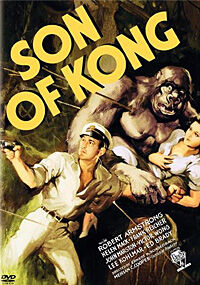
Released on Mar. 7, 1933, in New York City and a month later nationally, King Kong quickly took the nation by storm and became a cinematic landmark.
Nine months later, incredibly, RKO released the sequel Son of Kong and Hollywood did not make another Kong picture for more than 40 years.
Son of Kong just might be Hollywood’s first rush job and one of its first sequels*. It is a pleasant enough movie to watch, but obviously it’s not a patch on an all-time classic. I’ve watched the original numerous times, but I doubt I’ll want to return to Son of Kong a second time.
That’s because it’s virtually dull as dishwater. It takes approximately 45 minutes to get to our title character. That’s way too long for a movie that lasts only 69 minutes. Despite the return of Carl Denham, the most interesting human character in King Kong, played by the reliably entertaining Robert Armstrong, Son of Kong does not maintain the interest level high enough for a Kong movie. Of course, the original set the bar incredibly high.
They give Denham a potential romantic interest, because lovebirds Ann Darrow (Fay Wray) and John Driscoll (Bruce Cabot) quite naturally did not return for the sequel after their harrowing experiences, and Helen Mack’s Helene Peterson epitomizes the movie as a whole, since she’s pleasant but dull. She’s a singer, not an actress like the lovely Miss Darrow, and gets a production number. Again, pleasant but dull.
Kong co-directors Ernest B. Schoedsack and Merian C.Cooper returned as director and producer. Special effects guru Willis O’Brien and composer Max Steiner also returned, as did some of the supporting cast.
They were on a tight budget, an even tighter schedule, and they obviously knew there was no way they could topple King Kong. Armstrong himself preferred Son of Kong, but that’s because Denham received greater character arc. He’s probably the only person to ever prefer Son over its father. Both the son and the sequel are kinder, gentler — not good for a creature feature.
Sequels very rarely even approach their predecessors, and that was true in 1933 every bit as it is this very day.
For every Bride of Frankenstein and The Empire Strikes Back, we have a million failures and footnotes, like Son of Kong.
*United Artists released Don Q, Son of Zorro in 1925, a sequel to the 1920 classic Mark of Zorro. Swashbuckler supreme Douglas Fairbanks starred in both films. Son of Zorro also predates Son of Kong, Son of Frankenstein, Son of Godzilla, and Son of the Mask. To be fair, though, the sound of a toilet flushing predates Son of the Mask.
RAY HARRYHAUSEN SPECIAL EFFECTS TITAN, CORMAN’S WORLD AND THAT GUY DICK MILLER
It’s often been said that Ray Harryhausen’s stop motion animation creatures are the best features of their respective films, everything from “Mighty Joe Young” and “Earth vs. The Flying Saucers” to “Jason and the Argonauts” and “Clash of the Titans.” He became the auteur.
It’s not often that a visual effects artist overshadows both directors and performers, no offense to Nathan R. Juran (“The 7th Voyage of Sinbad”), Don Chaffey (“Jason and the Argonauts”), and the all-star cast in “Clash of the Titans,” Harryhausen’s grand finale.
In fact, in reviewing “Clash of the Titans” a while back, I wrote that it amounts to Harryhausen vs. nominal star Harry Hamlin. Harryhausen wins. Every. Single. Time.
Then again, maybe not. Not when People Magazine featured Hamlin as the “Sexiest Man Alive” in 1987 and it felt like taking a potshot or two at “Clash of the Titans.”
“And there’s always the possibility of doing a remake of ‘Clash of the Titans.’ ‘I brought my toga home,’ says Harry, raising hopes of another glimpse of those knees. He’s kidding, of course. Frivolous flicks are a thing of the past for The Sexiest Man Alive. Besides, says Harry, laughing, ‘I used the toga to wash my car.'”
While pretty boys are a frivolous matter of the past, even in the present, Harryhausen’s creatures will live on forever.
“Special Effects Titan” allows us the opportunity to hear who and what inspired Harryhausen, his thought and work process on his creations, what challenges he faced, and to see the actual models used. Harryhausen (1920-2013) kept the most minute details in his garage.
— Roger Corman, who turned 94 a month to the day before I watched this documentary, has accumulated 415 producer and 56 director credits over a 65-year period. American International and New World produced some of the best exploitation films ever made along with a ton of schlock (some enjoyable, some not so much).
Peter Bogdanovich, Francis Ford Coppola, Monte Hellman, Martin Scorsese, Ron Howard, Jonathan Demme, Jonathan Kaplan, Joe Dante, Allan Arkush, Jack Nicholson, Peter Fonda, and Pam Grier all had their start or their break working for Corman and most of them appear in “Corman’s World: Exploits of a Hollywood Rebel.” Several more big names also appear in “Corman’s World,” but I would like to move on to the next paragraph.
We see Corman working on location as producer on the 2010 TV movie “Dinoshark,” which instantly calls to mind previous Corman productions like “Piranha” and “Humanoids from the Deep.” Near the end of “Corman’s World,” we also see the Hollywood outsider receive an honorary Oscar for “his unparalleled ability to nurture aspiring filmmakers by providing an environment that no film school could match.” It’s only fitting, though, that “Corman’s World” goes out with a set of clips scored by the Ramones’ explosive title song from “Rock ‘N’ Roll High School.” That’s more in the Corman spirit than any award, as Riff Randell blows up Vince Lombardi High School.
“Corman’s World” reminds me that I should watch “The Intruder” (Corman’s most atypical directorial entry, called “one of the most brutal, honest, and unflinching examinations of American racism in cinema history” by Wheeler Winston Dixon in “Senses of Cinema”), thankfully touches on New World’s distribution of films by Bergman, Truffaut, Kurosawa and Herzog, and shows us Jack Nicholson crying over Corman.
Nicholson made his film debut in Corman’s 1958 production “The Cry Baby Killer” and most of his credits before 1969’s smash hit “Easy Rider” are Corman productions, including most famously “The Little Shop of Horrors” and “The Terror.” Corman productions “The Wild Angels” and “The Trip” paved the highway for “Easy Rider.”
Matter of fact, Corman laid a lot of pavement for the road ahead.
— I generally prefer character actors over stars and that group of character actors includes Sydney Greenstreet, Margaret Hamilton, John Cazale, M. Emmet Walsh, Harry Dean Stanton, Brad Dourif, and, of course, perhaps my all-time favorite Dick Miller, who the Academy Awards left out of their “In Memoriam.” Miller died Jan. 30, 2019, at the age of 90.
Miller began his career in Roger Corman productions in the 1950s and he became director Joe Dante’s favorite actor. No matter the size of the role, whether it’s starring like “Bucket of Blood” (the immortal Walter Paisley) or just one scene like “The Terminator” and “Rock ‘N’ Roll High School,” I fondly remember Miller. Sure many of us movie lovers of a certain persuasion do.
— Miller played Murray Futterman in both “Gremlins” films. In “Gremlins,” World War II veteran Futterman keeps going on and on ’bout foreign cars, foreign this, that and everything, and especially “gremlins” before they even attack the fictional upstate New York town of Kingston Falls. Futterman drunkenly rambles, “They put em in cars, they put em in yer TV. They put em in stereos and those little radios you stick in your ears. They even put em in your watches, they have teeny gremlins for our watches!”
— Miller ad-libbed his “They’re ugly. Ugly, ugly people” line about the Ramones in “Rock ‘N’ Roll High School.” Apparently, that’s what he actually thought when he looked at Joey, Johnny, Dee Dee, and Marky.
— Miller originally had aspirations to be a screenwriter and his writing credits are “Four Rode Out,” “Which Way to the Front?,” and the immortal “TNT Jackson.” Miller predominantly stuck to acting, thankfully, with 184 credits listed at IMDb. He played a character named “Walter Paisley” several times. He left behind a tremendous body of work.
RAY HARRYHAUSEN SPECIAL EFFECTS TITAN (2011) Four stars; CORMAN’S WORLD (2011) Four stars; THAT GUY DICK MILLER (2014) Four stars
ATTACK OF THE FANTASTICAL MOVIES: ATTACK OF THE 50 FOOT WOMAN, EARTH VS. THE FLYING SAUCERS, PLANET OF THE VAMPIRES, MOTORPSYCHO!, GALAXINA, REPTILICUS, BIG BAD MAMA, REAL LIFE, NINJA III: THE DOMINATION, NIGHT OF THE DEMONS
How do I grade something like ATTACK OF THE 50 FOOT WOMAN from 1958? It has a setup that could be called “laborious” or “lackluster” or “lugubrious.” I’m not going to call it any of those words, but I can see exactly why somebody else would. In other words, it’s not until about the 45-minute mark that we get to the 50 foot woman. Yes, I wish they had reversed the numbers, 15 minutes of setup and 45 minutes of 50 foot woman. Simple mathematics. At least, 45 minutes of setup and 45 minutes of 50 foot woman. Yes, that sounds even better than “15 then 45.” The final 15 or 20 minutes of ATTACK OF THE 50 FOOT WOMAN, though, are solid gold. Rating: ***
— It’s virtually impossible to watch EARTH VS. THE FLYING SAUCERS and not think about MARS ATTACKS! (flying saucers) and INDEPENDENCE DAY (Washington D.C. invaded), two blockbusters from 1996 with a combined production budget of $145 million and big, big, big stars, including Jack Nicholson in dual roles in MARS ATTACKS! In EARTH VS. THE FLYING SAUCERS from 1956, Ray Harryhausen’s stop-motion flying saucers are the real star of the show (step aside, Hugh Marlowe) and the film thankfully wastes very little time in showcasing them. It’s the inverse of ATTACK OF THE 50 FOOT WOMAN. ***1/2
— Italian director Mario Bava (1914-80) became especially known for his stylish horror films. From his British Film Institute profile, “Mario Bava took a vital role in the creation of the modern horror film. If there was to be a a Mount Rushmore-style monument dedicated to four directors whose work pioneered a new form of big screen chills and thrills, those giant faces etched in granite on the mountainside would be: Bava, Alfred Hitchcock, Georges Franju and Michael Powell.” In the words of a Pavement song, a Bava film has style, miles and miles. Case in point: PLANET OF THE VAMPIRES, a low-budget science fiction and horror production from 1965 that masked its cheap sets through smoky skullduggery. Bava said in Fangoria, “Do you know what that unknown planet was made of? A couple of plastic rocks — yes, two: one and one! — left over from a mythological movie made at Cinecitta! To assist the illusion, I filled the set with smoke!” Watching PLANET OF THE VAMPIRES for the first time, you might think you’ve seen this basic plot somewhere before … ahem … Ridley Scott’s ALIEN. ***1/2
— 1965 proved to be a great year for titles with exclamation points and for director, producer, writer, cinematographer, and editor Russ Meyer (1922-2004), whose films often proved to be ahead of their time. Meyer contributed two exclamation point titles — FASTER, PUSSYCAT! KILL! KILL! and MOTORPSYCHO! — during a 1965 in which he directed three films overall; Meyer’s greatest cinematic year began with MUDHONEY. Proof of being ahead of its time: MOTORPSYCHO! (what a title) gives us a psychotic motorcycle trio led by a deeply disturbed Vietnam vet — before TAXI DRIVER, before ROLLING THUNDER, before THE DEER HUNTER, before FIRST BLOOD — in addition to all the elements (large-breasted women and endless cleavage, campy humor, satire, and quotable dialogue) we expect from a Meyer film. ***
— GALAXINA lands a few successful jabs at STAR WARS, STAR TREK, and ALIEN, but otherwise it’s a real long slog through 90-plus minutes of a lowbrow and low-budget science fiction and western parody set in the 31st century. Here’s just one example of the film’s humor: Avery Schreiber (1935-2002) plays a character named “Capt. Cornelius Butt.” Then again, I probably should have just said that it’s a Crown International Pictures release. Surely you remember Crown International Pictures? They brought us such immoral, er, immortal classics as THE BEAST OF YUCCA FLATS, THEY SAVED HITLER’S BRAIN, SEXTETTE, and THE BEACH GIRLS. The late former Playboy Playmate of the Year Dorothy Stratten fills the title role and she’s been described as “a voluptuous blonde android servant.” Galaxina works better when she’s silent (the first half of the picture), because Stratten proves that she was a true novice thespian every time she speaks during GALAXINA. Stratten reportedly complained to film director and her paramour Peter Bogdanovich that the ads for GALAXINA promoted her being the Playmate of the Year, because she wanted to be taken seriously as an actress. GALAXINA would not do good for anybody wanting to be taken seriously for anything. Unfortunately, Stratten’s estranged husband Paul Snider murdered her two months after the release of GALAXINA. Stratten would be immortalized on film by the 1981 TV movie DEATH OF A CENTERFOLD: THE DOROTHY STRATTEN STORY and the 1983 theatrical release STAR 80, played by Jamie Lee Curtis and Mariel Hemingway, respectively. In case you were wondering, you see a lot more of Stratten in Playboy than GALAXINA. *1/2
— Recent weeks, mostly under self-quarantine, have included a few first-time watch monster movies: GODZILLA VS. MECHAGODZILLA and TERROR OF MECHAGODZILLA, SLITHIS (possibly the worst monster movie ever made), THE GIANT CLAW, and, most recently, REPTILICUS, Denmark’s infamous first entry in the monster movie sweepstakes. Judging by REPTILICUS, the Danish should stick to pastries. They make a mean strudel, not so much a Godzilla rip-off. Apparently, there’s never been a second Danish monster movie, so I guess they have stuck to pastries for nearly 50 years since this 1961 turkey. Anyway, I wanted to find the Danish version of REPTILICUS, but, of course, I had to settle for the English dub from good old American International. The plot: Copper miners find the tail of a prehistoric reptile and it eventually regenerates into Reptilicus, a hand puppet (close-up) and a marionette (wide shot) that give the $50 Giant Claw its money for being the “best” worst movie monster of all-time. I enjoyed REPTILICUS even less than THE GIANT CLAW, though. For example, when Reptilicus eats an extra or two, the victims look like they have been cut out of a magazine and they are being thrown into the puppet’s mouth. In THE GIANT CLAW, at least its victims being eaten scene brought me back to the “Eat ‘em! Eat ‘em! Crunch! Crunch!” scene from Q: THE WINGED SERPENT. I even called out “Crunch! Crunch!” during THE GIANT CLAW. No such luck during REPTILICUS. **
— Arthur Penn’s 1967 film BONNIE AND CLYDE proved to be one of the watershed films of the second half of the 20th century and one indication was that for several years, BONNIE AND CLYDE inspired many sensationalistic crime films set during the Great Depression. Roger Corman produced a whole slew of them, with the most famous being 1974’s BIG BAD MAMA starring Angie Dickinson, Tom Skerritt, and William Shatner and directed by Steve Carver (who later directed the Chuck Norris spectacular LONE WOLF McQUADE). BIG BAD MAMA mixes in a hippie-like free love sensibility and showcases bed hopping and generous amounts of nudity between all the murder and mayhem. The title character (Dickinson) and her two not long past jailbait daughters (Susan Sennett, Robbie Lee) all have multiple nude scenes, highlighted by Dickinson’s full-frontal shot late in the picture. One of the picture’s tag lines: “Wilma gave her daughters everything — her looks, her lovers and the crime of their lives!” Dick Miller (1928-2019), yes, that guy, plays a crime fighter and you know you can’t go too wrong with a picture that features an old-fashioned bloody crime spree, much nudity and shenanigans (Dickinson looked absolutely sensational in 1974), Shatner, and Dick Miller. ***
— Many years before the proliferation of reality TV, Albert Brooks skewered it with his 1979 directorial debut REAL LIFE, a satire of the 1973 PBS documentary “An American Family.” Brooks plays an exaggerated version of himself and watching this movie for the first time in 2020, it’s difficult not to conjure up memories of all the obnoxious or obsequious hosts and participants on reality TV shows from years ago — “The Real World,” “The Bachelor,” et cetera, they’re all terrible and I’m fortunate to have survived all my encounters with them. All those creeps still give me the willies just thinking about it now, but unfortunately reality TV seems like it’s here and it’s here to stay. Take that from somebody who’s not watched a whole lot of TV in the last decade, with reality TV being one of the big reasons. I laughed a lot during REAL LIFE, from the epic sight gag on the head of every cameraman (I laughed every single time) to the fiery grand finale Brooks borrows from GONE WITH THE WIND. ****
— The Cannon Group’s best of the worst films could generously be called “sublime stupidity” and I believe that description fits NINJA III: THE DOMINATION perfectly. Part ENTER THE NINJA, part FLASHDANCE, and part EXORCIST, THE DOMINATION must be seen to not be believed. Imagine Jennifer Beals possessed by the evil spirit of a ninja with an Oriental Max von Sydow attempting to bring it out. THE DOMINATION starts out with its very best scene, a golf course massacre that leads to the bad ninja transferring his spirit into the body of telephone lineman and aerobics instructor Christie (Lucinda Dickey). Also happening in the first 30 minutes of the picture: Christie’s aerobics class, her fight against a handful of creeps who were harassing one of her students, and possibly the most awkward bedroom seduction scene in the history of cinema. Christie won’t give this creepy cop the time of day and then, practically the next moment, they end up in embrace and she pours V-8 on herself … this is the beginning of a beautiful friendship. There’s also a bizarre sequence involving Christie’s Bouncer arcade game. On the International Arcade Museum page for Bouncer, it says “Bouncer was seen in the low budget martial arts film NINJA 3: THE DOMINATION. The game is in the main character’s apartment and she is seen playing it. The character becomes possessed by the spirit of the ninja, and as he overtakes her body, the arcade cabinet begins to bellow out smoke and hypnotizes her with a little laser show from the screen.” I thought she was already possessed. Yeah, I know, bizarre. Then again, bizarre basically describes both THE DOMINATION and Cannon films in general. We wouldn’t have them any other way. ***
— We’ve seen NIGHT OF THE DEMONS done better before, especially the first two EVIL DEAD movies and RETURN OF THE LIVING DEAD, which it seems to reference through both Linnea Quigley and punk rock. We’ve seen this plot before: 10 (mostly) horny high school kids have a Halloween party inside an abandoned funeral parlor. You can fill in the rest, down to every detail both personality and plot. It’s not a bad movie, exactly, it’s just after having seen EVIL DEAD and RETURN OF THE LIVING DEAD and EVIL DEAD 2, why settle for less? Seemingly just about every movie from the ‘80s — the good, the bad, and the ugly — has developed a cult following over time and NIGHT OF THE DEMONS is one of them, spoken about in an enthusiastic tone by admirers. I can sympathize, because I feel similarly about numerous movies. I have mixed feelings on NIGHT OF THE DEMONS. On one hand, I can’t think very highly of a movie that goes for three jump scares very early on. That loses points for it real quickly. It’s also one of those movies that I started liking less down the home stretch and I wished it would get to its inevitable conclusion sooner rather than later. On the other hand, it does have a few good moments, just not enough for a recommendation. **
Vernon Zimmerman wrote and directed FADE TO BLACK, a horror film that shows the darkest side of an obsession with movies. Its main character, Eric Binford (Dennis Christopher), takes cinemania literally, as he kills his victims in the guise of his favorite movie characters. They include Dracula, the Mummy, and Hopalong Cassidy.
FADE TO BLACK reached theaters on October 14, 1980. Nearly two months later, disillusioned Beatles fan Mark David Chapman killed former Beatle member John Lennon outside his residence at the Dakota Apartments in New York City. Chapman shot Lennon four times in the back with a .38 special. Chapman stayed at the scene and read from J.D. Salinger’s “The Catcher in the Rye” until the police arrived to arrest him. Chapman became fixated on “Catcher” protagonist Holden Caulfield, who loved to rail against “the phonies,” and Chapman surely considered Lennon a phony.
Eric is barely hanging on at the beginning of FADE TO BLACK. His wheelchair bound Aunt Stella (Eve Brent Ashe), who we later find out is actually his mother, nags at him; for example, her first lines are “Eric! Get up! Well, lookie here. Mister Smart Mouth fell asleep with his nose buried in the screen again! Your one-eyed monster is gonna soften your eyes, much less rot your brain! You spend all your time daydreaming and watching those silly movies on the TV and your projector.” Aunt Stella even blames Eric for her accident and her subsequent paralysis many years ago.
Had she ever seen KISS OF DEATH, she might not have been so hateful to the kid. Eric, though, seems to have a special affinity for Richard Widmark’s Tommy Udo, a precursor to Heath Ledger’s Joker in THE DARK KNIGHT. Udo’s the type of guy who thinks nothing of pushing an old lady in a wheelchair down a flight of stairs to her eventual demise.
Eric is a perpetual fuck up at his job at a film distributor’s warehouse and his boss Mr. Berger (Norman Burton), well, you know, he does what a good boss does in a horror movie built around revenge. Eric discovers Mr. Berger’s weakness, a weak heart that could stop ticking any time if Mr. Berger proved unable to reach his precious medication.
Co-workers Richie (Mickey Rourke) and Bart (Hennen Chambers), especially Richie, give Eric grief every chance they get.
One day, Eric spots Australian model and Marilyn Monroe lookalike Marilyn O’Connor (Linda Kerridge, in a sensational movie debut) eating in a cafe with her friend. Eric works up the courage to strike up a conversation with Marilyn and he asks her what movie Marilyn Monroe and Tom Ewell watched in THE SEVEN YEAR INCH. (I know this one. May I please answer? THE CREATURE FROM THE BLACK LAGOON.) Eric asks Marilyn out to a movie that night and she says yes. He’s all excited, for a change, about something in the “real world.” …
Marilyn unintentionally stands up Eric, a prostitute treats him like shit, Stella smashes his film projector, and, yes, Eric loses his shit and for the rest of the picture, he seeks vengeance against those who he feels have wronged him.
Even a shady filmmaker named Gary Bially (Morgan Paull) crosses Eric by stealing his idea for a nifty low-budget film named ALABAMA AND THE FORTY THIEVES, which Eric says would be made in the early 1950s style of Samuel Fuller.
I’ve read in several places that FADE TO BLACK fails because Christopher gives a bad performance and/or Eric Binford proves to be such a detestable protagonist. Reviews mentioned that Christopher plays a character totally unlike his Dave Stoller in BREAKING AWAY, Christopher’s last big film before FADE TO BLACK.
An unhinged character like Eric Binford — especially since he loves imitating his favorite movie characters in both appearance and speech — allows the actor latitude to push a performance over-the-top and Christopher definitely pushes those limits for even somebody (like me, for example) who admires his performance in FADE TO BLACK.
I give Christopher a tremendous amount of slack after his breakout performance in BREAKING AWAY; he created one of the more lovable characters in cinematic history and I’ll always be grateful to Christopher for that.
Reviewers, though, apparently forgot Dave Stoller’s obsession with bicycling and everything Italian. Did they not remember “cutter” Dave pretending to be Italian exchange student Enrico Gimondi to impress and then date a cute Indiana University co-ed? Dave even renamed poor Jake the Cat “Fellini.”
Eric and Dave are not as different as reviewers have suggested. Eric just lived a tougher life right from the start and he was definitely not blessed with great friends and family like Dave Stoller. We could get into the whole “Nature vs. Nurture” discussion and when’s the last time a horror movie spurred on that.
What I especially liked about FADE TO BLACK is that it follows Eric’s descent into madness all the way to its inevitable conclusion — especially inevitable since Eric becomes Cody Jarrett from WHITE HEAT — and then it finishes in such a flourish atop legendary movie palace Grauman’s Chinese Theatre to make WHITE HEAT director Raoul Walsh and star Jimmy Cagney proud. “Made it Ma! Top of the world!”
THE VILLAIN, a comic western directed by stunt man turned filmmaker Hal Needham (1931-2013), gives us a feature-length, live-action take on those classic “Road Runner” cartoons.
Please stick with them old “Road Runner” cartoons, because even the absolute worst one of those is still loads better than THE VILLAIN.
Please try and find “Adventures of the Road-Runner” from 1962, which accomplishes more in about one-fourth the overall running time as THE VILLAIN. Better songs, better stunts, better gags, better technical credits. “Adventures of the Road-Runner” alone outclasses THE VILLAIN during the scene a few minutes in when Wile E. Coyote analyzes his own failings as diabolical genius. In the next scene, two child viewers discuss the Coyote and the Road Runner as their adventures play out on TV; one child says, “Sometimes I feel very sorry for the Coyote. Sometimes, I wish he’d catch him.” The other counters, “If he caught him, there wouldn’t be any more Road Runner.” That’s smarter than anything found during THE VILLAIN.
Kirk Douglas (1916-2020) stars as Cactus Jack, who’s played as the human equivalent of Wile E. Coyote. I believe that he even reads from Coyote’s handbook for most of the picture. To see Douglas involved in a series of pitfalls and pratfalls for 90 minutes, it’s embarrassing for both him and for those of us who are not moved by this lower-than-lowbrow humor. For crying out loud, this man gave us SPARTACUS and CHAMPION and ACE IN THE HOLE and PATHS OF GLORY. At some point during THE VILLAIN, a first-time watch not long after Douglas’ passing in early 2020, I started thinking about those other Douglas films and performances. I am thinking now of his patented intensity and determination. I am thinking specifically of that scene in PATHS OF GLORY where his anger builds against General Broulard, “I apologize … for not being entirely honest with you. I apologize for not revealing my true feelings. I apologize, sir, for not telling you sooner that you’re a degenerate, sadistic old man. And you can go to hell before I apologize to you now or ever again!” Classic scene, classic Douglas moment.
Arnold Schwarzenegger and Ann-Margret are supposed to represent the Road Runner, I suppose. Schwarzenegger plays (get this) Handsome Stranger and Ann-Margret’s Miss Charming Jones, though it should be Chesty Jones because that’s where the camera directs its attention right from her very first appearance. You’ll never believe this, but Chesty, er, Charming throws herself at her protector Handsome Stranger and he goes to fetch some more wood … or something … while Cactus Jack pursues the booty. What these characters have to say to each other, why it made me pine away for the sophisticated dialogue of the Road Runner.
Not sure who was responsible for Schwarzenegger’s costume as the Handsome Stranger — Bob Mackie and Derek Crane are named as costuming Ann-Margret and Douglas, respectively, while Betsy Heimann, Bud Clark, and Michael Castellano are just listed as mere costumers (without the mere, of course) — but the responsible individual should have been the one shot or been the target of a boulder. That powder blue get-up, it almost defies comprehension, and I believe Arnold fared better in HERCULES IN NEW YORK. I mean, at least there he played Hercules.
Now, we come to the portion of the program where I cover the absolute worst part of the movie: Paul Lynde (1926-82) dresses up as an Indian chief named (prepare yourself) Nervous Elk. Believe it or not, his jokes are even worse than his name and his costume. In this movie tribe’s chosen vernacular, I have found the perfect way to describe THE VILLAIN: dum-dum. Forgive me for leaving this review, but I have to check on myself after being drummed over the head with dum-dum for nearly 90 minutes by THE VILLAIN.
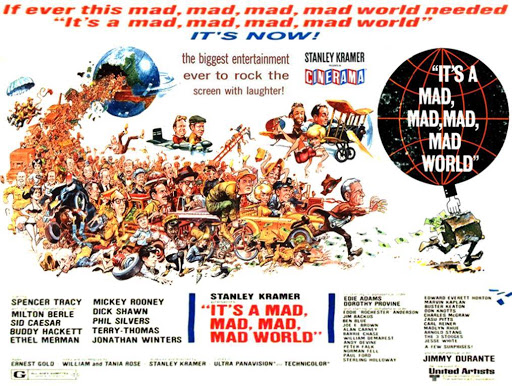
Let’s start this review with a bold statement and prediction: IT’S A MAD, MAD, MAD, MAD WORLD is the worst comedy I have ever seen and it will remain that way for all my life, even if I would be blessed to reach 100 years old.
Fact: I did not laugh once during the 3-hour, 19-minute duration of IT’S A MAD, MAD, MAD, MAD WORLD.
I consider it a lock on being the worst comedy I will ever see because of that length. Sure, I can go 90 or 95 or even 100 minutes not laughing at some dumb or aggressively stupid comedy, no problem, but 189 minutes proved to be a new personal record for remaining in a state of stone cold silence during a comedy. I only broke that silence to express disbelief with a grunt or a sigh. To be honest these intermittent sighs were deep enough to fill the Grand Canyon.
Yes, I almost forgot LEONARD PART 6 (believe me, how I tried forgetting), which I gave no stars and called “the worst movie ever made.” That’s right, it passes comedy straight into being bad enough to encompass all genres.
Why the half-star for a repetitive, repetitive, repetitive, repetitive comedy? Because I liked looking at the cast members during any fleeting moments when they were quiet. Once they resumed talking, well, shit, IT’S A MAD, MAD, MAD, MAD WORLD turned back into unfunny shit on a stick. Yeah, I felt like IT’S A MAD, MAD, MAD, MAD WORLD beat me over the head with unfunny shit on a stick for roughly a quarter of a quarantine day. I will do my best to utilize past tense during this review because I have no intent to ever watch IT’S A MAD, MAD, MAD, MAD WORLD ever, ever, ever, ever again.
I should rephrase one portion of the paragraph immediately above. Very, very, very, very rarely do any of the characters merely talk during IT’S A MAD, MAD, MAD, MAD WORLD. Just imagine a crowded room populated by people who feel compelled to compete with each other for who can be the loudest (and most obnoxious) person in the world, forget the room. And then being trapped inside that room for over three hours describes this movie in a nutshell. Perhaps it would be too much to add real cars to the room. Nah, instead, we’ll have a movie theater size TV in the room playing a loop of car chases at full volume intensity.
Here’s a main character who speaks in a voice resembling that of a normal person: Emeline-Marcus Finch (Dorothy Provine), whose character seems like the movie loaned her from a library amidst the chaos in this loud, loud, loud, loud movie. They no doubt used the Frances Howard Goldwyn – Hollywood Regional Branch Library, only a three-minute walk from the Walk of Fame.
The film establishes a basic tone early on, when five of the characters stand around and squabble over their potential take of the stolen $350,000 hidden under the ‘Big W’ in the Santa Rosita State Park. Yes, IT’S A MAD, MAD, MAD, MAD WORLD is basically one long argument over money interrupted by chases, overacting, mugging, pitfalls and pratfalls, dancing, overacting, cameo appearances, police chatter, overacting, an intermission, pitfalls and pratfalls, plane crashes, explosions, and (for old times’ sake) overacting.
Just take a look at some of the cast: Spencer Tracy, Milton Berle, Sid Caesar, Buddy Hackett, Ethel Merman, Mickey Rooney, Dick Shawn, Phil Silvers, Terry-Thomas, Jonathan Winters, Jim Backus, William Demarest, Jimmy Durante, Peter Falk, Jack Benny, Joe E. Brown, Norman Fell, Stan Freberg, Leo Gorcey, Edward Everett Horton, Buster Keaton, Don Knotts, Jerry Lewis, ZaSu Pitts, Carl Reiner, Arnold Stang, and the Three Stooges, with more than half of them in minute roles. What a sad, sad, sad, sad waste of talent!
Among the main characters, it’s easy to pick my least favorite: Mrs. Marcus, played by Merman. She’s awful from the start and remains awful for the entire length of the picture. IT’S A MAD, MAD, MAD, MAD WORLD partisans argue that she’s a character that people love to hate. I, however, am not one of those people, because I only hate this character. Thankfully, Merman closed out her career with a hilarious cameo in AIRPLANE!
Gordon Gekko told us “Greed is good” during WALL STREET. Meanwhile, nearly 25 years earlier, IT’S A MAD, MAD, MAD, MAD WORLD told us “Greed is bad, mkay?”
One more zinger before closing time: I laughed more during Stanley Kramer’s INHERIT THE WIND than I did IT’S A MAD, MAD, MAD, MAD WORLD. (If I ever watch Kramer’s JUDGMENT AT NUREMBERG, I’ll be sure to revise this final paragraph and gag.)
Seems like only yesterday — time’s such an elusive concept during quarantine — that I highlighted the deceptive print ads and posters for THE GIANT CLAW.
Today, we return to that beat with Roger Corman’s 1959 wasploitation “non-classic” THE WASP WOMAN — do not fear, it’s not another movie about yet another “White Anglo-Saxon Protestant” woman. Instead, in this one, our protagonist takes, no, abuses an experimental potion made from the royal jelly of wasps that can apparently reverse the aging progress. Unfortunate side effect that even more unfortunately only kicks in during the film’s last 20 minutes: It turns her into the title character or “A BEAUTIFUL WOMAN BY DAY — A LUSTING QUEEN WASP BY NIGHT.”
Anyway, the poster for THE WASP WOMAN, it lies. Oh, how it lies. The poster “Wasp Woman” has a woman’s head and a wasp’s body. In the film, it’s flipped and she resembles a distant cousin of the title character in the much, much better THE FLY from 1958.
THE WASP WOMAN itself could make one feel appreciably older, rather than younger, because it’s extremely dull for the first hour.
We have a crusty old scientist named Zinthrop (Michael Mark). He’s not fun in any traditional mad scientist way … and, then, he’s ran over by a car and subsequently bed ridden for most of the rest of the picture … of course, his accident happened before he could warn our protagonist Janice Starlin (Susan Cabot) of some of the unfortunate side effects found in the other non-human test subjects. He redeems himself in the final act. Actually, no, he does not.
Believe it or not, most of this movie takes place in an office building, the location for the monster movie of your dreams. On top of a dull scientist, we have multiple cosmetic company staff meetings, just exactly what the viewers want during a movie called THE WASP WOMAN. Less wasp woman, more staff meetings, bingo! This movie should have been titled CLUELESS in roughly all 6,500 languages of the world.
By the way, I do believe the film shows bees rather than wasps, most notably in both the opening and closing title screens. I might be wrong, but I don’t want to be stung for being wrong. Please, have mercy on me, I’ve been stung bad enough watching THE WASP WOMAN, which definitely pales against ATTACK OF THE CRAB MONSTERS in the Roger Corman monster movie filmography.
In 1993, TNT’s MonsterVision featured THE WASP WOMAN alongside THE GIANT CLAW, THE CYCLOPS, CREATURE WITH THE ATOM BRAIN, FROM HELL IT CAME, VALLEY OF THE DRAGONS, and THE WEREWOLF during a bad movie marathon called “A Christmas Nightmare.” THE WASP WOMAN played between THE CYCLOPS and CREATURE WITH THE ATOM BRAIN.
At that point in my life, I did not watch “MonsterVision”; I started watching it only during the Joe Bob years. I would love to go back in time to the early ‘90s and talk my teenage self into watching (and taping) “MonsterVision,” so I could have all them old tapes to watch at this critical junction in time. Also, I am sure that I would have already converted them from VHS to DVD. Preservation of the species of bad movies is an imperative.







 Attack of the Killer Librarian