Let’s Dance! Let’s Sing! Let’s Nostalgia!: That’s Entertainment I, II, III

LET’S DANCE! LET’S SING! LET’S NOSTALGIA!: THAT’S ENTERTAINMENT I, II, III

I dutifully watched THAT’S ENTERTAINMENT, the 2-hour, 15-minute compilation of clips from MGM highlighting their hallowed “Golden Age of Musicals.” MGM, founded on April 17, 1924 by Louis B. Mayer and Marcus Loew, commemorated its 50th anniversary and then released THAT’S ENTERTAINMENT two months later commemorating it even more.

I have two immediate spoilsport thoughts, the first which originally occurred to me on June 22, 2004, watching the American Film Institute unveil the super bland “100 Years, 100 Songs.”

THAT’S ENTERTAINMENT brought it all back with a vengeance.

That night in 2004, I said aloud, “Are they going to put every single fucking song ever sung by Judy Garland on the list?” Ditto for Gene Kelly, Barbra Streisand, Julie Andrews, et cetera, who dominated the AFI list with their 20 or 25 songs seeming more like 80 or 100; Kelly and Garland, who passed away in 1969 at the age of 47, dominate THAT’S ENTERTAINMENT.

We get a double dose of heavy duty Judy in THAT’S ENTERTAINMENT, first through her Mickey (Rooney) and Judy “Hey gang, let’s put on a show” Era montage and then a tribute presented by her daughter Liza Minnelli, not long after CABARET. Garland also sings “You Made Me Love You” over a montage of Clark Gable that allows GONE WITH THE WIND (MGM’s most famous production) to be shoehorned into the song-and-dance ballyhoo.

Second spoilsport thought: Aside from THE WIZARD OF OZ and SINGIN’ IN THE RAIN, most of my favorite musicals are not from MGM. For example, Fred Astaire, who’s featured in THAT’S ENTERTAINMENT, did most of his best work at RKO — including TOP HAT and SWING TIME — in the 1930s paired with Ginger Rogers. Never mind alternative musicals like THE 5,000 FINGERS OF DR. T (Columbia and Stanley Kramer Productions) and ONE FROGGY EVENING and WHAT’S OPERA, DOC?, both famous Warner Bros. animated shorts.

What do I like about THAT’S ENTERTAINMENT?

Well, it’s always great seeing the usual suspects from THE WIZARD OF OZ and SINGIN’ IN THE RAIN no matter how many times I have seen them, especially Donald O’Connor’s showstopper “Make ‘Em Laugh.” Clark Gable singing “Puttin’ on the Ritz” from IDIOT’S DELIGHT. Jimmy Stewart’s jab at Robert “He tries his best” Montgomery. The Esther Williams montage. Somebody once said about Williams, “Dry, she ain’t much. Wet, she’s a star.” Madeline Kahn impersonating Marlene Dietrich in BLAZING SADDLES said, “It’s twue, it’s twue.”

We get more or less the same from PART 2, only we get token appearances from MGM employees Groucho Marx, Laurel and Hardy, Buster Keaton, and W.C. Fields and, of course, musical numbers that did not appear in PART I.

It would have been nice to see a musical number from the Marx Brothers or Laurel and Hardy or Fields, despite the fact they all did their best work somewhere else. I mean, would it have killed PART II director Gene Kelly to have aired Groucho’s “Lydia the Tattooed Lady” from AT THE CIRCUS … for example … instead of, I don’t know, one more variation on the song “That’s Entertainment” offered up by contemporaneous Astaire, contemporaneous Kelly together again and for the last time.

After watching PART II, I began hating Arthur Schwartz’s chestnut “That’s Entertainment” unlike ever before, although honestly I hardly ever gave it much thought until it was the (bludgeoning) recurring theme in a darn movie. They must have trotted it out 50 freaking times.

Eventually, to counterbalance the effects of cornball showbiz schmaltz, though, I started humming “That’s Entertainment” from the Jam. Let’s get all misty-eyed nostalgic over a song that starts “A police car and a screaming siren / A pneumatic drill and ripped up concrete / A baby wailing and stray dog howling / The screech of brakes and lamp light blinking.” I particularly love the second verse, “A smash of glass and the rumble of boots / An electric train and a ripped up phone booth / Paint splattered walls and the cry of a tomcat / Lights going out and a kick in the balls.”

I should just stop bitching and moaning and groaning about PART I and PART II of THAT’S ENTERTAINMENT, perhaps because life is short and also perhaps because I realize that I am not the target audience for these nostalgic entertainments. First and foremost, I was born in 1978 and my generation did not grow up on “classic” American musicals. In fact, a lot of us came to hate musicals in our teenage years, especially of the vintage celebrated endlessly by the THAT’S ENTERTAINMENT series. I have come to appreciate some of them corny old classics somewhat more in middle age, but I still prefer musical numbers from Monty Python, Mel Brooks, and “South Park” and I still grumble like nobody’s business at 21st Century schmaltz like FROZEN, MOANA, and THE GREATEST SHOWMAN, entertainment packages that give me fleas. I don’t even have to watch them to get fleas, because it seems like 90 percent of the people around me have memorized every single darn word of every single darn song and they don’t mind singing ‘em every single darn time they feel like singing in their darn glorious off-key melodramatic voice.

Recently, I conducted some independent research by watching MILLION DOLLAR MERMAID (a.k.a. THE ONE PIECE BATHING SUIT in the U.K.) from 1952 and starring Esther Williams, Victor Mature, and Walter Pidgeon. It was directed by Mervyn LeRoy, produced by Arthur Hornblow Jr., and replayed in at least one THAT’S ENTERTAINMENT. I watched it for Williams and the numbers choreographed by the legendary Busby Berkeley (who might be more fondly remembered today for being parodied in early 80s comedies CADDYSHACK and HISTORY OF THE WORLD). I enjoyed it and I realize that I probably would have enjoyed it for the same reasons at a younger age had I given it even half a chance. Now, that’s progress!

MGM returned to the vaults for a third time for THAT’S ENTERTAINMENT! III in 1994, only 18 years after PART II and 20 after the very first greatest hits-golden cinematic oldies compilation.

Anyway, who’d have ever thought that PART III tops both PART I and PART II and does it by including outtakes and unfinished numbers more than greatest hits and golden oldies.

We have Lena Horne’s “Ain’t It the Truth,” a sultry little number cut from CABIN IN THE SKY because a sexy black woman in a bathtub in 1943 would have spurred on a third American Revolution, yes, even in the middle of World War II.

We have two lip-sync takes on “Two-Faced Woman,” presented side-by-side, outtake Cyd Charisse from THE BAND WAGON and black face Joan Crawford from TORCH SONG (both dubbed by India Adams). Crawford’s scene made me think of Pauline Kael’s review of TROG, “Joan Crawford plays Stella Dallas with an ape instead of a baby girl. Some actors will do anything to be in movies: she probably would have played the ape.”

We have another Esther Williams montage and I must say that I am in favor of Esther Williams montages, especially ones that work in Tom and Jerry. Eat your hearts out, Frank and Gene, your movie (ANCHORS AWEIGH) only had Jerry dancing with Gene! In all honesty, the Esther Williams montages in PART I and PART III pushed me to seek out MILLION DOLLAR MERMAID and I have a feeling that I will be consuming Esther, Tom, and Jerry in DANGEROUS WHEN WET soon.

I also prefer PART III because it has much less of the elitist, self-congratulatory, self-important tone that marred the first two installments, as much as I enjoyed seeing all the “old” entertainers that have not been matched (let alone surpassed) since their heyday. PART III hints at the MGM that treated the cast of FREAKS like “freaks” and it at least delves beyond the surface glitz and glamour to the showbiz ugliness beneath.

That’s entertainment.

THAT’S ENTERTAINMENT PART I ***; PART II ***; PART III ****

Boris, Boris, Boris: The Man They Could Not Hang, The Man with Nine Lives, The Boogie Man Will Get You

BORIS, BORIS, BORIS: THE MAN THEY COULD NOT HANG, THE MAN WITH NINE LIVES, THE BOOGIE MAN WILL GET YOU

I am a big fan of the horror movies of the 1930s and 1940s and I am a big Boris Karloff (1887-1969) fan.

Older horror movies often stand out for two main reasons: atmosphere and wit. Just think DR. JEKYLL AND MR. HYDE and THE BRIDE OF FRANKENSTEIN.

Karloff’s film career began in the silent era and he was already 80 movies deep into his career when he portrayed Frankenstein’s Monster in James Whale’s 1931 FRANKENSTEIN. Karloff’s career exploded and he (along with such figures as Bela Lugosi, Peter Lorre, Basil Rathbone, Lionel Atwill, and Lon Chaney Jr.) became synonymous with a certain vintage of horror thrillers.

Watching his early Universal films like FRANKENSTEIN and THE OLD DARK HOUSE and then his work for Columbia like THE MAN THEY COULD NOT HANG, THE MAN WITH NINE LIVES, and THE BOOGIE MAN WILL GET YOU, it is fascinating to observe Karloff’s evolution from menacing mutes to mad scientists with mad elocution. In fact, during THE BOOGIE MAN WILL GET YOU, I wanted Karloff’s Professor Nathaniel Billings to just the heck shut up for a darn minute. He’s a blabbermouth, and it’s amazing to even think of Karloff playing that way after FRANKENSTEIN and THE OLD DARK HOUSE made the actor famous for playing silent but deadly.

THE MAN THEY COULD NOT HANG contains one of Karloff’s best performances. He plays Dr. Henryk Savaard, a genius who can bring the dead back to life, a feat that might come in handy for a film titled THE MAN THEY COULD NOT HANG. You guessed it, that man would be Dr. Savaard. Anyway, a medical student volunteers for Dr. Savaard and before he can be returned to life, them darn proper authorities interrupt Dr. Savaard. Call it “cadaver reanimatus interruptus.” They bring Dr. Savaard up for murder, convict him, and sentence him to death by hanging. They do in fact hang the good doctor, but his incredibly trustworthy assistant claims the body and brings the doctor back to life to enact his revenge against the judge and the jury responsible for convicting him and sentencing him to his death.

THE MAN THEY COULD NOT HANG basically splits into three movies: mad scientist, courtroom drama, and revenge thriller. It all works extremely well predominantly because of Karloff, whose performance dominates the movie. His courtroom defense scene is a thing of absolute beauty and it just might be his best single scene.

By the way, I absolutely love it when horror movies are not afraid to venture into other genres and become more than a horror movie while simultaneously maintaining the bulk of their body within the genre.

THE MAN WITH NINE LIVES tells a similar tale and Karloff plays a similar character to his role in THE MAN THEY COULD NOT HANG. Both pictures also have the same director (Nick Grinde) and the same writer (Karl Brown), as well as the same cinematographer (Benjamin Kline).

NINE LIVES picks up once we find Karloff’s Dr. Leon Kravaal frozen in an ice chamber deep in a secret passage within his home. Also found are Dr. Kravaal’s accusers … and might I add the plot of THE MAN WITH NINE LIVES gets very loopy even for its genre, despite its ties to real life.

Both THE MAN THEY COULD NOT HANG and THE MAN WITH NINE LIVES are rooted in Dr. Robert E. Cornish and his famous resuscitation experiments. Cornish successfully revived two dogs (Lazarus IV and V) and he wanted to expand his testing on humans. San Quentin inmate Thomas McMonigle, on Death Row, contacted Cornish and offered his body for experimentation, but California denied Cornish and McMonigle their petition because law enforcement officials feared a reanimated McMonigle would have to be freed due to “double jeopardy.” McMonigle was executed in early 1948. Cornish (1903-63) himself appeared in the 1935 film LIFE RETURNS, playing himself.

THE BOOGIE MAN WILL GET YOU plays around with similar material as the other Karloff films he made for Columbia, only more for laughs this fifth time. Yes, Karloff plays yet another mad scientist.

The presence of Karloff and Peter Lorre (1904-64) guarantees at minimum a certain quality and THE BOOGIE MAN WILL GET YOU definitely finds that minimum and nothing less or nothing more. The less said about it the better, and I wish the movie would have followed that policy.


THE MAN THEY COULD NOT HANG ***1/2; THE MAN WITH NINE LIVES ***; THE BOOGIE MAN WILL GET YOU **

The In-Flight Double Feature: Airplane!, Airplane II: The Sequel

AIRPLANE!, AIRPLANE II: THE SEQUEL

AIRPLANE! contributed to the demise of the dominance of the disaster film just as much as beyond lackluster disaster films AVALANCHE, THE SWARM, WHEN TIME RAN OUT, BEYOND THE POSEIDON ADVENTURE, and AIRPORT ‘77 and THE CONCORDE … AIRPORT ‘79. It was like the decisive blow and disaster movies disappeared for many years.

AIRPLANE satirized disaster films in general and the AIRPORT series in particular. The team of Jim Abrahams, David Zucker, and Jerry Zucker ripped their ridiculous plot straight from the 1957 Paramount Pictures film ZERO HOUR starring an exclamatory title and Dana Andrews, Linda Darnell, Sterling Hayden, and Elroy “Crazy Legs” Hirsch. I watched ZERO HOUR (sans exclamation) after learning of the fact that it directly inspired AIRPLANE, and it’s scary how much AIRPLANE lifted from the earlier film. It is also fitting, because Arthur Hailey co-wrote the screenplay for ZERO HOUR and wrote the 1968 novel AIRPORT that became the beginning of the disaster film craze when AIRPORT hit box office gold upon its March 1970 release.

A decade later, millions were obviously clamoring for a sledgehammer attack on disaster films, because AIRPLANE finished behind only THE EMPIRE STRIKES BACK, 9 TO 5, and STIR CRAZY at the American box office in 1980.

Abrahams, Zucker, and Zucker not only had their way with disaster films, but they ripped to shreds both famous individual scenes (SATURDAY NIGHT FEVER, FROM HERE TO ETERNITY, KNUTE ROCKNE ALL-AMERICAN) and standard narrative devices. They especially had some devious fun with flashbacks and voice-over narration courtesy our rather square, good-looking protagonist with a troubled past (Robert Hays’ Ted Striker a perfect match for Dana Andrews’ Ted Stryker in ZERO HOUR. Andrews’ Stryker also brings to mind his troubled character 11 years earlier in THE BEST YEARS OF OUR LIVES).

In the process of satirizing movie genres, AIRPLANE created its own genre that has endured far longer than disaster films and gave birth to new old movie stars like Leslie Nielsen, Lloyd Bridges, Robert Stack, and Peter Graves, whose ability to play it straight at every moment made at least half the joke work.

(Disaster films have periodically made huge comebacks like when INDEPENDENCE DAY, TWISTER, and ARMAGEDDON became super blockbusters late in the apocalypse-minded 20th Century. Definitely not my favorite trend. For the record, I hate both TWISTER and ARMAGEDDON, and I have never managed to make it through INDEPENDENCE DAY in spite or more precisely because of all the hype and euphoric glee that came with it and still comes with it years later.)

Yes, we have seen virtually every movie genre under the sun parodied, quoted, and (less frequently) satirized. We have lived through all the immediate AIRPLANE imitations, the Z-A-Z Boys’ own movies, and everything from the works of the Wayans Brothers to Jason Friedberg and Aaron Seltzer. At some point, let’s say early in the 21st Century, I dreaded the parody movie even more than its various targets.

Most of these later parodies miss the satirical bent that gave AIRPLANE, TOP SECRET, and THE NAKED GUN, as well as Mel Brooks’ YOUNG FRANKENSTEIN, BLAZING SADDLES, HISTORY OF THE WORLD PART 1, and SPACEBALLS, their special verve. The later parodies seem far more willing to merely quote from a blockbuster movie and to just leave it at that. “You’ve seen it before and now, let’s see it again, only done less effectively.” Honestly, what’s the point and more precisely, what’s so funny about that?

For many years, I passed on AIRPLANE II: THE SEQUEL, especially after learning that Zucker, Abrahams, and Zucker were not involved. The boys apparently sent out a press release before the release of the sequel that stated just that.

The crack research team just unearthed this David Zucker gem from 2015: “Jim just said, ‘If your daughter became a prostitute, would you go and watch her work?’” That’s one way to look at THE SEQUEL, one of the cheaper, less essential AIRPLANE imitations out there. The addition of more stars (Raymond Burr, Chuck Connors, William Shatner) makes it even cheaper.

I laughed a couple and smiled a few times during THE SEQUEL, but mostly I watched this comedy that attempts maybe 500 jokes in an indifferent state. The laughs were front-loaded and I found it challenging to even remember them at the back end of the picture. Have you ever had that feeling, where you’re stuck in the middle of a movie thinking about how much you were enjoying it earlier and now you’re dreading it and the remaining seconds and minutes?

There’s almost nothing worse in the movie world than a comedy that fails, since most human life forms love to laugh, even or especially at the dumbest and corniest jokes. We are prepared to laugh during a comedy. We want to laugh. So, when you find very little or absolutely nothing to laugh at over 84 minutes, all this hostility builds up inside you and you get very upset about how you have wasted 84 minutes of precious time which you could have wasted on something else.

Never mind, I should have passed on THE SEQUEL and just watched AIRPLANE one more time.


AIRPLANE! ***1/2; AIRPLANE II: THE SEQUEL **

Sequels Second to None: The Empire Strikes Back, Indiana Jones and the Temple of Doom

SEQUELS SECOND TO NONE: THE EMPIRE STRIKES BACK, INDIANA JONES AND THE TEMPLE OF DOOM

Having recently watched THE EMPIRE STRIKES BACK and INDIANA JONES AND THE TEMPLE OF DOOM for the first time in a movie theater, I have asked myself one tough question: Why are they my favorite Star Wars and Indiana Jones movies?

THE EMPIRE STRIKES BACK, the second installment in George Lucas’ space opera series eventually taken over by the fine folks at Disney, has the best direction (Irvin Kershner), best writing (courtesy Leigh Brackett and Lawrence Kasdan), best acting, best environs (the icy planet Hoth, the swampy Dagobah, and Cloud City), and the characters display their greatest emotional range and depth. Yoda, Boba Fett, and Lando are iconic additions, especially Yoda. Only the very first STAR WARS (A NEW HOPE) even approaches EMPIRE and please just forget about the prequels (REVENGE OF THE SITH by far the best of them) and the entries post-Disney takeover. It seems like the majority of STAR WARS fans agree.

Meanwhile, I seem to be in the minority who prefer TEMPLE OF DOOM over RAIDERS OF THE LOST ARK. I understand that it’s dark and disgusting, and that Kate Capshaw’s nightclub singer Willie Scott annoys the hell out of you with all that darn histrionic screaming that she does from the first reel to the very last. I grant all those points. Regardless, I prefer TEMPLE OF DOOM because it’s very dark and very disgusting, and yes, I do believe that it is one of the all-time best gross out movies. We’re talking such pleasantries as monkey brains, eels, snakes, bats, bugs, child slavery, heart removal, and bad, bad, bad men eaten by alligators. To be fair and honest, the Shanghai and Indian characters are grotesque caricatures even more disgusting than any of the creature and culinary discomforts, but then again so are the Nazis and Commies in the other Indiana Jones pictures. Understandably, though, India once banned TEMPLE OF DOOM.

TEMPLE OF DOOM does call to mind such classics as BLACK NARCISSUS, GUNGA DIN, THE STEEL HELMET (Short Round borrowed from Samuel Fuller’s 1951 Korean War picture), and THE GENERAL. Scott’s opening production number (Spielberg has long said that he’d love to do a musical and this scene and the jitterbug sequence in 1941 shows that he could make a very good even great one) clues us in on what’s exactly up the sleeves of director Steven Spielberg, screenwriters Willard Huyck and Gloria Katz, story writer Lucas, and gang. What’s that number called? “Anything Goes,” the Cole Porter standard. TEMPLE OF DOOM works because it is oversized and over-the-top like Spielberg’s earlier comedy 1941. Perhaps it is only fitting that Spielberg apparently likes 1941 and TEMPLE OF DOOM the least among his filmography. Does he recoil from their being so politically incorrect?

As far as Willie Scott goes, she epitomizes the sister or girlfriend or wife perpetually grossed out and disgusted by the shenanigans of all the boys surrounding her. I find that element fun. Yes, I do agree that Karen Allen’s Marion Ravenwood is a better match for Indiana Jones and it’s great they brought her character back for KINGDOM OF THE CRYSTAL SKULL. Scott remains more consistent throughout TEMPLE OF DOOM, though, whereas Marion switches between several modes and moods — just one of the boys, spitfire, damsel-in-distress, and wounded woman chief among them. I enjoy both characters, for different reasons. Capshaw’s performance and her character do not mar TEMPLE OF DOOM for me.

It’s been said numerous times before that Lucas endured a divorce around the time of the making of TEMPLE OF DOOM and that seeped into the movie — in the overall tone but specifically the Willie Scott character and the heart removal. Spielberg, two years after his divorce from actress Amy Irving, married Capshaw and they have been together nearly three decades.

It also must be said TEMPLE OF DOOM was my first Indiana Jones movie, because it was the only VHS tape she kept from a mid-1980s Christmas present from her children. Between that and her later acquisition, THE ADVENTURES OF ROBIN HOOD, I must have thrilled on them 100 times. Maybe nostalgia and sentimentality for old movies, even older movies, grand adventure, brassy dames from the Midwest, and politically incorrect characters and gross out gags animates my overall affection for TEMPLE OF DOOM. (I watched RAIDERS OF THE LOST ARK at the drive-in a couple weeks before TEMPLE OF DOOM. I passed on THE LAST CRUSADE for THE EMPIRE STRIKES BACK.)

As I watched THE EMPIRE STRIKES BACK in the Fort Cinema in the town where I attended high school and the first couple years of college, I periodically momentarily flashed back on how I must have first felt watching the movie some more than 35 years ago in the even smaller Southeast Kansas town Arcadia. I felt that way again, despite having seen EMPIRE 30-40-50 times.

Just one nagging thought occasionally spoiled the mood: We were not seeing the original theatrical version of EMPIRE, rather we had one of them dang blasted Special Editions that genius George Lucas masterminded in the mid-’90s for theatrical and home video release circa 1997 where he touched up some of the old school special effects and made some cringe-worthy insertions that will be mocked until the end of time. Lucas has sadly tinkered with A NEW HOPE, EMPIRE, and RETURN OF THE JEDI even more since then, until I think we fans have to ask him, “Why, George, why?” Some outraged STAR WARS fans have gone as far to proclaim “George Lucas Raped My Childhood.” (I do have both VHS and DVD copies of the original theatrical version of EMPIRE.)

Fortunately, I feel that Lucas has mangled EMPIRE considerably less than both A NEW HOPE and RETURN, which alone points to it being the best entry in the entire series. The uncanny valley effect: “An eerie feeling of unfamiliarity people get while observing or interacting with robots that resemble humans almost but not quite perfectly.” I believe we can add the “Star Wars Special Edition” corollary, as well as separate corollaries for both the prequels and the Disney Star Wars, to the uncanny valley effect. George, you should have just kept your ILM CGI magic in the prequels.

As EMPIRE played out more and more and we got deeper into the plot, though, any thoughts about Lucas, Special Edition, cringe-worthy insertions, etc., faded away and I became swept up in the spectacle more than ever before, because it was up there on the big screen for the first time. I felt wonderment and exhilaration, as well as the broader spectrum of emotions that other STAR WARS movies usually do not reach.

THE EMPIRE STRIKES BACK ****; INDIANA JONES AND THE TEMPLE OF DOOM ***1/2

Ninja Rap: Enter the Ninja, Revenge of the Ninja

NINJA RAP: ENTER THE NINJA, REVENGE OF THE NINJA

An instant word search on ninja returns this definition, “A ninja or shinobi was a covert agent or mercenary in feudal Japan. The functions of a ninja included espionage, deception, and surprise attacks. Their covert methods of waging irregular warfare were deemed dishonorable and beneath the honor of the samurai.” Buh.

It goes without saying but we’ll say it anyway that ninja survived a gratuitous Vanilla Ice rap number and mass flatulence, er, mass gas in a kiddie picture.

There’s also “A person who excels in a particular skill or activity. ‘The courses vary — you don’t have to be a computer ninja to apply.’”

I contribute: “An iconic action movie bad ass character archetype epitomized by the legendary ‘Ninja Trilogy’ from Cannon Films, ENTER THE NINJA (1981), REVENGE OF THE NINJA (1983), and NINJA III: THE DOMINATION (1984).”

I’ve already discussed NINJA III at some length — any movie that combines ENTER THE NINJA, THE EXORCIST, and FLASHDANCE must have something brilliant up her sleeve — and only very recently caught up with ENTER THE NINJA and REVENGE OF THE NINJA on the same night.

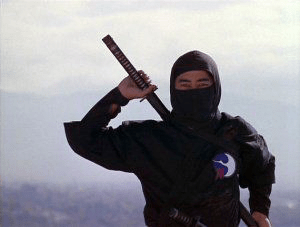
Of course, any definition of “ninja” would be greatly served by a picture of Japanese martial artist Sho Kosugi. In fact, this review would be vastly improved just by the mere insertion of a picture of The Man, The Myth, The Legend. A picture speaks louder than a thousand words … regardless, it’s not like any action movie hero worth their celluloid ever spoke a thousand words.

SHO KOSUGI

I’ve made it through most of the collected film works of Eastwood, Bruce Lee, Jackie Chan, Norris, Stallone, Schwarzenegger, et cetera, and now I am grateful for the opportunity to delve into Kosugi’s filmography. It’s a safe bet that I will eventually seek out PRAY FOR DEATH, DEATHS OF THE NINJA, and RAGE OF HONOR because they’re great titles and have great cover art in addition to starring Mr. Kosugi.

I’ll start with REVENGE OF THE NINJA, the second and best overall installment of the so-called ‘Ninja Trilogy.’ Kosugi takes on a starring role after playing second (or third or fourth) fiddle in ENTER THE NINJA, behind at least Franco Nero, Susan George, and Christopher George. The Kosugi parts are arguably the best parts of ENTER, so REVENGE serves up a full course of Kosugi with hors d’oeuvres, wine (or beer or liquor), and dessert included.

The nominal plot: “After his family is killed in Japan by ninjas, Cho and his son Kane come to America to start a new life. He opens a doll shop but is unwittingly importing heroin in the dolls. When he finds out that his friend has betrayed him, Cho must prepare for the ultimate battle he has ever been involved in.”

The actual plot: ACTION! PLENTY OF ACTION! We’re talking serious hardcore ninja action here. I’m no expert on ninja weaponry, but I do believe that REVENGE (as did ENTER before and THE DOMINATION after it) employs the ninjato, the katana, nunchaku, blowgun, shuriken, crossbow, and many, many more weapons of mass dismemberment. Gore hounds have a lot of howling to do over the ‘Ninja Trilogy.’

REVENGE prevails over ENTER because it spends more time focused on the actual plot than the nominal plot.

We have not only two fierce ninja warriors, Kosugi’s hero Cho Osaki opposed by the dastardly bastard Braden (Arthur Roberts), but we also have two, er, 1 1/2 Kosugis in this picture, since Sho’s real-life son Kane Kosugi plays Cho’s son Kane. We say 1/2 because Kane was around 9 years old when he made his memorable motion picture debut in REVENGE. He’s not one of those insufferable movie brats who mugs so heavily that I check my wallet after their every scene. He’s not David Mendenhall in OVER THE TOP, for example. Yes, he’s basically a miniaturized Sho Kosugi.

Both REVENGE and THE DOMINATION ultimately win over ENTER because they’re more entertaining and off-the-wall in that classic crazy Cannon way.

Nero, of course, makes for an effective action hero in a more traditional sense and I find his filmography very fascinating, from playing the title character in the 1966 Spaghetti Western DJANGO and Lancelot in the lavish 3-hour 1967 American musical CAMELOT (singing voice by Gene Merlino) to roles in Quentin Tarantino’s DJANGO UNCHAINED (naturally) and JOHN WICK: CHAPTER 2. Nero plays a character named “Cole” in ENTER and that has seemed to be one of the more common given names for both action movies and soap operas; Roger Ebert’s Little Movie Glossary includes The Cole Rule: “No movie made since 1977 containing a character with the first name ‘Cole’ has been any good.”

I commented during ENTER that it marked the first time I had seen English actress Susan George (STRAW DOGS) in a movie without her getting naked.

Christopher George almost walks away with the picture as the nefarious businessman Charles Venarius. He’s so bad that he’s good because George savors every single line. It is indelible fun hearing George deliver “This is 20th Century Manila, not feudal Japan.”

Kosugi appeared in all three NINJA films, as three different characters, and ultimately it is his screen presence that makes all three such enjoyable and memorable experiences.

Kickboxer 2 (1991)

KICKBOXER 2

KICKBOXER 2 (1991) *1/2

En route to the cinematic crapper, Albert Pyun’s KICKBOXER 2 abuses two of the worst cinematic devices: slow motion and an offscreen death.

On their review program, Gene Siskel and Roger Ebert pointed out how much Pyun and the picture relied on slow motion during the fight scenes. Ebert claimed they used slow motion for every single moment of every single fight scene in the movie, including for the voices of the announcer and the referee, but that the sound effects guy must not have got the same memo because all the punches and kicks sounded like they were in regular motion. Siskel accused Ebert of eating spiked popcorn. Bottom line: If only KICKBOXER 2 had been half as entertaining as the Siskel & Ebert review.

Let’s take the fight that’s right smack dab in the middle of the picture, between our principled, reluctant-to-fight hero David Sloan’s former protege Brian “The Hammer” Wagner (Vince Murdocco) and the super villainous Tong Po (Michel Qissi) who’s back from KICKBOXER: THE MOTION PICTURE (not its real title). Brian Wagner dies in the ring from a series of brutal slow motion kicks and punches and other blows to the body. Coming that slow, he should have seen it coming and got out of the way. No, no, no, of course not, Brian Wagner wanted to die. Okay, maybe not wanted to die per se, but he was destined to die in that post-Apollo Creed ROCKY IV way. Anyway, we knew he was going to die from early in the picture, when his worried mother told David Sloan (Sasha Mitchell) that she’s afraid for her son and made Mr. Sloan promise to look after him. Brian Wagner further sealed his cinematic doom by walking away from David Sloan and cursing him on the way to greener pastures, by taking the easy fights and that cheap nickname, by allowing himself to be pumped full of steroids, and finally by his defiant overconfidence and his blatant refusal to surrender to his opponent. Yes, yes, he deserved to die.

The final buildup to Wagner’s death hits us over the head with a slow-moving sledge hammer. Not only are Tong Po and Brian Wagner in super duper excruciating slow motion, but Wagner’s poor mother and David Sloan are both moving like that in the crowd … in a cinematic technique derived especially from the later ROCKY pictures, you know when Clubber Lang and Ivan Drago are beating the brain stuffing out of Rocky (or Apollo Creed) and Rocky’s corner men or even his poor, poor wife Adrian are laboriously freaking out but ultimately helpless in the face of slow motion annihilation. I am so, so glad this overdone cinematic technique eventually faded away.

Offscreen deaths are usually cheap and sometimes, they’re even worse. For example, Hicks and Newt at the beginning of ALIEN 3. That one left millions reeling and they’re still talking about it today flabbergasted and frustrated.

In KICKBOXER 2, we are informed that Tong Po killed both David Sloan’s older brothers, including KICKBOXER protagonist Kurt Sloane (Jean-Claude Van Damme), after the events of the first movie and before the events of the second one. And to think Kurt avenged his paralyzed older brother Eric Sloane (played by former world kickboxing champion Dennis Alexio) against Tong Po for the big thrilling conclusion of KICKBOXER.

Yes, that’s right, Sloan and Sloane, that’s what really confused this unfrozen caveman writer. Sloan’s older brothers each have an ‘e’ on the end of their surname. Fascinating. Let’s see here: Van Damme speaks with a thick Franco-Belgian accent, while Sasha Mitchell, why he’s just a poor man’s Keanu Reeves. Bizarre family that must really get around. Ironically enough, though, Mitchell has been called both a poor man’s Keanu and a poor man’s Jean-Claude. Mitchell’s not without a slight charm, however, and he’s definitely not the biggest problem in KICKBOXER 2. The film’s biggest problem is that we’ve seen it all done before … and better numerous times.

KICKBOXER 2 lacks the off-the-wall qualities of a Shaw Brothers spectacular or a truly batty WTF exploitation picture like NINJA III: THE DOMINATION and SAMURAI COP, as well as the genuine pathos of ROCKY and THE KARATE KID. It is neither truly good enough nor bad enough to be any good.

Kill and Kill Again, Firecracker, Circle of Iron

KILL AND KILL AGAIN, FIRECRACKER, CIRCLE OF IRON

In his 1981 TV review of the South African martial arts spectacular KILL AND KILL AGAIN, Roger Ebert predicted action movie stardom for James Ryan and invoked the names Eastwood, Bronson, and Bruce Lee.

Well, in this business and life in general for that matter, you win some, you lose some.

James Ryan, who? Yeah, not exactly a household name.

Describing the plot, I would like to just string together a bunch of random words: martial arts champion for hire undercover government agent top secret rescue mission kidnapped scientist recruit colleagues alternative energy source megalomaniac uniformed cult mind control world domination bar fight mushy romance mushy talk middle-of-nowhere fight storming fortress explosions fisticuffs flips plot revelations not particularly revelatory.

There you go. KILL AND KILL AGAIN, the sequel to KILL OR BE KILLED, in a nutshell.

KILL AND KILL AGAIN works predominantly because it has a good sense of humor and it finds just the right tone to pull off being a successful action comedy.

There’s one especially fun supporting character and supporting performance, the diabolical genius’ assistant and (significant other) Minerva played by Marloe Scott-Wilson. She looks like she drifted over from ROCK ‘N’ ROLL HIGH SCHOOL or THE DECLINE OF WESTERN CIVILIZATION, especially with that ridiculous Day-Glo hairdo. She’s a lot of fun in every scene, especially when she calls residential madman Marduk (Michael Mayer) by these absolutely ridiculous pet names. She comes up with a fresh one every single time. And it rankles Marduk, because good old Minerva says her little terms of endearment right in front of everybody. At one point, Marduk tells her, “I said don’t call me Popsicle.” This running gag even has an explosive payoff in the end.

Guess we should mention that South African beauty queen Anneline Kriel — Miss World 1974 — does her own stunts in the movie. She has to overcome playing a character named “Kandy Kane.” I almost wish they would have named her character “Susan Alexander Kane” or “Emily Kane,” for all us CITIZEN KANE fans in the audience. Now, that would have been an impressive stunt.

Impressive stunts are at the heart of FIRECRACKER, especially during the film’s last 30 minutes.

We’re talking about topless kickboxing and what must surely be one of the weirdest love scenes ever committed to celluloid.

Two sicko creeps pursue our heroine Susanne Carter, played by the luscious Jillian Kesner, and they eventually shed her of her top and bra. She then proceeds to kick their asses viciously. Meanwhile, in the background, we have “Rack Master” boxes. Perfect!

“Rack Master” should have been Carter’s martial arts name and it also should have been a title for FIRECRACKER.

That’s not too much of a stretch, especially since FIRECRACKER traveled as NAKED FIST in Australia.

FIRECRACKER director Cirio H. Santiago plagiarized this topless kickboxing scene from his earlier New World Pictures extravaganza TNT JACKSON.

Now, let us consider that weird love scene. Oh Susanna and her love interest Chuck Donner (Darby Hinton) consummate their relationship, but not before they remove each other’s clothes stitch-by-stitch with a knife. Kinky. Chuck Donner and his incredible mustache, especially his incredible mustache, just scream “Creepy seducer of the ladies who killed Susanna’s sister.” Of course, Susanna does not learn of this fact until after their lovemaking.

Susanna exacts her revenge against Chuck in the ring and we all can be sure that he will never look at another woman ever again.

Kesner passed away in 2007 and she and her late husband Gary Graver (1938-2006) became known for their efforts to preserve the work and legacy of legendary director Orson Welles. I do believe it is time for another reference to CITIZEN KANE.

CIRCLE OF IRON attempts to be something bigger, greater than KILL AND KILL AGAIN and FIRECRACKER. It wants to be a transcendent exploitation film.

We are given the only clue we need as soon as the following title card appears on screen: “Prior to the death of the legendary Bruce Lee he helped to create a movie story that might capture not only the spirit of martial arts but a part of the Zen philosophy he lived by. He was aware that a film with these dynamics would cause controversy, particularly among those unfamiliar with Zen beliefs. But it was this very uniqueness that he believed wound enthrall the moviegoer. Bruce set the story in a land that never was and always is. It is to Bruce Lee that this film is posthumously dedicated.”

I was definitely not enthralled by CIRCLE OF IRON. Not very often.

It certainly did not help that Captain Hairdo, er, Jeff Cooper plays the lead character Cord and this character and performance never quite resonated with me because I kept seeing Roger Daltrey instead and I pretended it was TOMMY.

I kept waiting for Cooper’s cord to break out into song, “Listening to you, I get the music / Gazing at you I get the heat / Following you I climb the mountain / I get excitement at your feet!” and “See me, feel me, touch me, heal me.”

It never happened and I felt extremely disappointed.

David Carradine plays about four roles too many in CIRCLE OF IRON. Okay, I’ll say three roles too many, because we get one of the film’s most entertaining scenes when Carradine assumes the guise of “Monkeyman.” At one point, Carradine’s wig came off and I thought shit like that only happened in SAMURAI COP.

Christopher Lee passed on THE LEGEND OF THE 7 GOLDEN VAMPIRES, a joint venture between Hammer Studios and the Shaw Brothers, because he did not want to play Dracula for the millionth time … but he plays what turns out to be a role that sucks even more in CIRCLE OF IRON, Zoltar, er, Zetan. This is one of those quest movies where you’ll become irritated after hearing a certain name — Zetan, maybe — many, many, many, many, many, many times.

Orson Welles asked me not to reference a certain movie during this review of CIRCLE OF IRON. I must respect his wishes.


KILL AND KILL AGAIN ***; FIRECRACKER ***; CIRCLE OF IRON **

Bride of Re-Animator (1990)

BRIDE OF RE-ANIMATOR

BRIDE OF RE-ANIMATOR (1990) ***

Jeffrey Combs’ Herbert West is one of the all-time great movie characters and his presence alone makes BRIDE OF RE-ANIMATOR, a sequel to the 1985 cult favorite RE-ANIMATOR, worth a recommendation.

H.P. Lovecraft first created Herbert West for the 1922 short story “Herbert West-Reanimator.” RE-ANIMATOR took inspiration from “From the Dark” and “The Plague-Demon” (the first two sections), while BRIDE OF RE-ANIMATOR turned to “The Horror from the Shadows” and “The Tomb Legions” (the final two). West is the central human character in both films.

How to describe West for the uninitiated, that’s a challenge I face during this review. I first think of comparing West to a horror movie character archetype like Colin Clive’s Victor Frankenstein or, to be more precise, Peter Cushing’s Victor Frankenstein from the Hammer FRANKENSTEIN series. He’s brilliant, narcissistic, intense, intensely driven, and essentially amoral. He’s even far less interested in the ladies than Cushing’s Frankenstein. He’s only focused on his work.

West is one of those characters that we love to hate, like Cushing’s Victor Frankenstein and Michael Moriarty’s Jimmy Quinn in Q: THE WINGED SERPENT. There’s that great pencil breaking scene in RE-ANIMATOR, for example, that epitomizes West. He’s one of the great movie assholes.

Alas, most of the rest of BRIDE OF RE-ANIMATOR does not measure up against both West and the first picture. First and foremost, RE-ANIMATOR director and co-writer Stuart Gordon did not return for the sequel and instead Brian Yuzna directed from his own script. Yuzna earned production credits on his friend Gordon’s films RE-ANIMATOR, FROM BEYOND, and DOLLS.

Basically, I find that BRIDE OF RE-ANIMATOR drags more than RE-ANIMATOR or it’s a bit of a slog to get to the sequel’s rather nifty grand finale. I was really struggling around the hour mark and I even contemplated exiting BRIDE OF RE-ANIMATOR.

West’s arch nemesis from the first movie, Dr. Carl Hill (David Gale), returns for the sequel or at least his infamous disembodied head shows up for work. We do not get enough scenes with Hill in the sequel and that helps explain why BRIDE OF RE-ANIMATOR sputters a bit during its middle portion.

The incredible tension between West and Hill contributed a great deal to the success of RE-ANIMATOR. That’s predominantly missing from BRIDE OF RE-ANIMATOR and West battling a persistent burly policeman simply does not possess the same magic. However, we do ultimately have a great payoff when Hill and West are finally reunited.

Bruce Abbott’s Dan Cain returns for the sequel in his role of the straight man and main audience identification figure. He’s not as effective as he was in the first movie.

Kathleen Kinmont and Fabiana Udenio do not make up for the first movie’s Barbara Crampton.

The one area where the sequel trumps the original is special effects, especially during the final 20 minutes. Credited artists include John Carl Buechler, Screaming Mad George, Greg Nicotero, and David Allen, who rank among the best in their field.

Combs’ West and the special effects make BRIDE OF RE-ANIMATOR one of those relatively difficult to come-by sequels that works.

Samurai Cop (1991)

SAMURAI COP

SAMURAI COP (1991) ***

An outtake is defined as “a scene or sequence filmed or recorded for a movie or program but not included in the final version.”

Blown lines and stunts, we all know the routine by now.

Hal Needham and Jackie Chan may have made outtakes for the end credits a cinematic institution, but Iranian “jack of all trades and master of none” Amir Shervan (1929-2006) directed SAMURAI COP, a feature movie solely comprised of outtakes.

Shervan trumped such legendary figures as Dwain Esper, William “One Shot” Beaudine, Bert I. Gordon, Bill Rebane, Ray Dennis Steckler, and even Ed Wood in absolute sheer incompetence.

Like a select few bad movies, SAMURAI COP is so, so, so bad in so, so, so many marvelous ways that it passes all the way through bad into good. It belongs filed next to Efren C. Pinon’s THE KILLING OF SATAN and Claudio Fragasso’s TROLL 2.

— Mathew Karedas, a.k.a. Matt Hannon, stars as Joe Marshall. Most people, though, just call him “Samurai Cop.” Joe must be the least convincing samurai in all history, cinematic and otherwise. For one, Joe’s entire look screams more Fabio and Kato Kaelin than, let’s say, Toshiro Mifune and his most dangerous weapon brandished is that damn speedo he spends what feels like the entire second half of the movie in. Anyway, for somebody allegedly well-versed in the Japanese vernacular, he sure does struggle pronouncing the name “Fujiyama.” When asked by his partner Frank Washington (Mark Frazer) what “katana” means, Joe snaps back “It means Japanese sword.” You don’t say, you don’t say.

— Samurai Cop arguably spends more time being a ladies man than anything else. No, seriously, he beds three, er, two women and he even blatantly talks about the beauty of another woman in the presence of his lover. Smooth, real smooth. Late in the 96-minute spread, he tells his future conquest, “Let’s just say … I can read eyes.” I wish that you couldn’t read dialogue.

Here’s a dialogue exchange from the Planet-X:


Nurse: Do you like what you see?

Joe Marshall: I love what I see.

N: Would you like to touch what you see?

JM: Yes. Yes, I would.

N: Would you like to go out with me?

JM: Uh, yes I would.

N: Would you like to fuck me?

JM: Bingo.

N: Well, then let’s see what you’ve got …

[Nurse investigates Joe’s bulge]

N: Doesn’t interest me. Nothing there.

JM: Nothing there? Just exactly what would interest you, something the size of a jumbo jet?

N: Have you been circumcised?

JM: Yeah, I have, why?

N: Your doctor must have cut a large portion off.

JM: No, uh, he was a, he was a good doctor.

N: Good doctors make mistakes too, that’s why they have insurance.

JM: Hey … don’t worry. I got enough. It’s big.

N: I want bigger.

[Nurse walks away]


I doubt that any screen lothario has ever partaken in dialogue that bad and the sound that we just heard is Rudolph Valentino saying “Thank you” for having made only silent movies.

That dialogue plays like a combination of a porno movie and “Dick and Jane” (most of the rest of the movie belongs to knocking off LETHAL WEAPON) and it belongs alongside the SHARK ATTACK 3: MEGALODON interchange in the anals, er, annals of cinematic history:


Cataline Stone: I’m exhausted.

Ben Carpenter: Yeah, me too. But you know I’m really wired. What do you say … I take you home and eat your pussy.


Boy, that’s just about as great as the whole “Fini can water you” debacle from YES, GIORGIO.

— Lead actor Matt Hannon thought he was done with the picture and got himself a short haircut. Several months later, Shervan looked up Hannon and informed him they were going to reshoot scenes. Unfortunately, Hannon still had short hair. I say unfortunately because Hannon wears one of the least convincing wigs ever made during SAMURAI COP. It does not help that Hannon’s wig flies off during a late fight scene and the actor also displays his obvious displeasure having to wear his wig. Yeah, it’s that bad.

— The chase scenes alternate between moving incredibly slow (nothing like slow-moving cars …) and being artificially sped up (… except for cars that zip along unnaturally). Yes, there are times when the action in SAMURAI COP plays like a silent film projected at the wrong speed.

— Not sure that I want to spend that much more time and space on SAMURAI COP, because I don’t want to risk writing a dissertation. Yes, over 750 words feels like I have been writing on this movie for a long time. However, there’s so many more things wrong but right about SAMURAI COP that we could be here all day, ironic for a movie that lasts a meager 96 minutes. Just imagine SAMURAI COP at GONE WITH THE WIND length.

— In a review long ago, I wrote that the 1979 Chuck Norris action vehicle A FORCE OF ONE combines a standard issue cops and criminals plot acted out by a good cast with martial arts and a “very subtle” anti-drug message that plays like one of those infamous 1980s TV commercials, only featuring roundhouse kicks.

On that note, we can end this review with a public service announcement from SAMURAI COP: “Now I’m telling these son-of-a-bitches that we respect the Japanese of this country, who are honest businessmen. And yeah, this is the land of opportunity for legitimate business, not for death merchants who distribute drugs to our children through schools and on the streets. Now I’m telling these motherfuckers that if they continue killing our children to make their precious millions that they deposit in their secret Swiss bank accounts, counselor, before your lawsuit even gets off the court clerk’s desk, I’ll have their stinking bodies in garbage bags and ship them back to Japan for fertilizer.”

Beautiful, absolutely beautiful, and it makes me want to pop a top on an ice cold one and blast Alice Cooper’s “I Love America.”

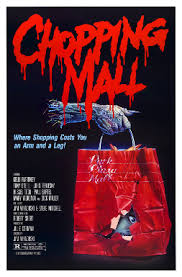
Chopping Mall (1986)

CHOPPING MALL (1986) ***1/2

Jim Wynorski’s CHOPPING MALL has just about everything anybody would ever want from a mid-80s horror film.

— An iconic shopping mall shooting location.

— Three killer robots who shoot real frickin’ laser beams. By the way, these kill-bots could eat Paul Blart for breakfast, lunch, dinner, and three desserts, plus in-between snacks.

— Big hair and big boobs.

— A Barbara Crampton topless scene that rates below RE-ANIMATOR and FROM BEYOND. Still, though, it’s topless Barbara Crampton.

— Other familiar teeny bopper horror movie bods and faces.

— The great character actor Dick Miller playing a character named Walter Paisley (his character’s name from BUCKET OF BLOOD).

— A Corman Factory production with posters from previous cult classics (including one directed by Wynorski, his debut film LOST EMPIRE) and clips from Roger Corman’s 1957 epic ATTACK OF THE CRAB MONSTERS.

— Cameos from Corman favorites Paul Bartel and Mary Woronov playing their characters from EATING RAOUL.

— Outdated special effects that were outdated even before the movie’s release. However, that’s all part of their charm.

— Gore galore highlighted by a gnarly head explosion.

— A plot that plays like a fast and loose combination of FAST TIMES AT RIDGEMONT HIGH, FRIDAY THE 13TH, and THE TERMINATOR.

CHOPPING MALL does not muck around, giving us our first killer robot scene right from the start and hey, let’s face it, it breezes past in 76 minutes. For crying out loud, that’s a running time straight from an earlier time in cinematic history. That not mucking around quality is one of the most admirable traits of CHOPPING MALL, that and its desire to give the people what they want in terms of meeting and exceeding the demands of an exploitation film.

It has a basic plot: Three security robots go haywire after a lightning storm, turn rogue and run amok in Park Plaza Mall, actually the Sherman Oaks Galleria in the Sherman Oaks neighborhood in Los Angeles. The galleria, on the corner of Ventura and Sepulveda Boulevards, has been given credit for inspiring the Frank and Moon Unit Zappa satirical hit single “Valley Girl” and FAST TIMES and COMMANDO famously utilized the location.

Of course, with this genre and location, we have four teenage couples who stay after hours to frolic and fool around inside a furniture store, naturally and predominantly hot and horny couples who make up the majority of our body count. That contributes the FRIDAY THE 13TH element, and the presence of Russell Todd aids and abets that mental connection. Todd played Scott in FRIDAY THE 13TH PART 2, a real smug horny bastard adept with a slingshot. Not that did him any bit of damn good against burlap sack Jason Voorhees.

CHOPPING MALL has a good cast and Kelli Maroney and Alan O’Dell make for appealing, likeable female and male leads, especially Maroney. With her big hair, her struggles working in a restaurant, her spunky attitude, and her way around weaponry, Maroney’s Alison Parks feels very reminiscent of Sarah Conner (Linda Hamilton) from the first TERMINATOR.

What I especially like about the teenagers in CHOPPING MALL is that they load up on guns (echoes of DAWN OF THE DEAD) almost immediately after discovering the killer robots. They are far more proactive than the average horror movie teenager, and that helps separate CHOPPING MALL from the pack of run-of-the-mill exploitation films.

File CHOPPING MALL right alongside cult classics from that moment in time like RE-ANIMATOR, FROM BEYOND, and NIGHT OF THE CREEPS.