
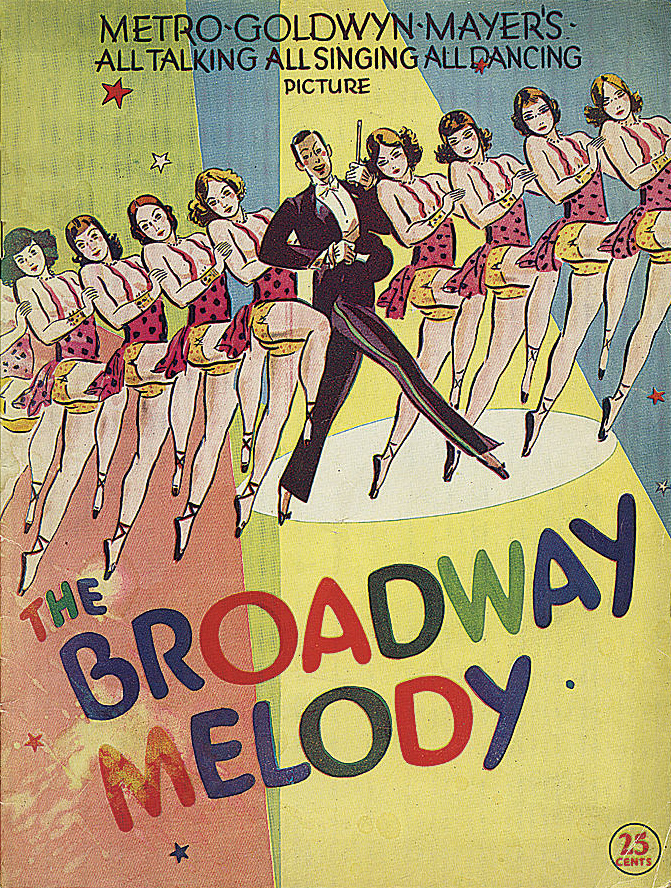
Broadway Melody, Cimarron Won Best Picture! So What, Because They Suck!

BROADWAY MELODY, CIMARRON WON BEST PICTURE! SO WHAT, BECAUSE THEY SUCK!
The Broadway Melody and Cimarron are horrible, terrible, horrible movies and the first two examples of how winning the Academy Award for Best Picture does not guarantee quality.

The Broadway Melody (1929) owns the distinction of being the first talking picture and the first musical to win Best Picture, thus it has a permanent place in cinematic history. Otherwise, though, The Broadway Melody makes me wonder how come the motion picture industry did not return to silent pictures, because the dialogue and the songs both stink up the screen every step of the way. (Apparently, MGM also released The Broadway Melody in a silent version.)

Likewise, Cimarron (1931) is the first Western to win Best Picture and it’s one of those movies, well, near the end of its 130-minute duration, I told my wife, “I feel like I’ve aged 40 years watching this movie.” In fact, I had to use hedge trimmers on my facial hair and step in the barber’s chair after Cimarron, and perhaps I should be thankful Cimarron only covered 1889 to 1929 and not a longer historical span. I might have been in deep trouble, at least six feet under, had the Howard Estabrook and Louis Sarecky screenplay and the 1929 Edna Ferber novel instead considered 50 or 60 years of Yancey and Sabra Cravat.

The first in a series of musicals for MGM, The Broadway Melody stars Charles King as Eddie Kearns and Anita Page and Bessie Love as sisters Queenie and Harriet ‘Hank’ Mahoney. See, what happens, Eddie and Hank have had a thing, but then he lays his eyes on a now grown up Queenie and boy oh boy, his eyes nearly pop out their head. Whee, Queenie lays off Eddie, sister loyalty, and lets New York high society playboy Jock Warriner (reference to studio mogul Jack Warner) play her. Eddie and Queenie realize they’re in love, Hank finally accepts it, and it all ends happily ever after with the closing line delivered by the character with a stutter. It was so good that I forgot it.

Charles King should have been renamed ‘Charles Sing’ because he sings much better than he acts and the scenes between Eddie and Hank (and Queenie) (and Jock) try and ultimately fail my test for strained melodrama. Yap! Yap! Yap! Yap! That’s right, one yap for every piece in the romantic square. Love and Page are easy on the eyes, especially Page, but difficult on the ears with all their hemming and hawing (more Page than Love) and perpetually melodramatic carrying on (more Love than Page). Either way, their dialogue scenes are destined for the mute button and subtitles.

I learned a lesson from Cimarron and it has nothing to do with Oklahoma’s state history before and after statehood on Nov. 16, 1907.

The Lesson: Do not start your movie with a land rush scene, because it’s highly unlikely that you will find something else to approach the excitement of that slambang opener.

After the intense thrills of the land rush, I must admit that I started paralleling Yancey Cravat’s restlessness and I desperately wanted to move to another movie, one that doesn’t even have to be a Best Picture winner, just as long as it can involve me from beginning to end and does not leave me contemplating how many years I have aged just watching it. That’s about the bare minimum I expect from a movie, any movie, and that isn’t asking for too much, now, is it?
Comin’ at Ya! (1981)

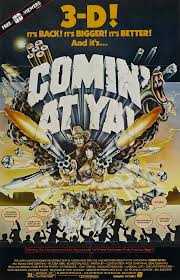
COMIN’ AT YA! (1981) ***
Certain movie titles just don’t lie about their contents and intents.

For example, Comin’ at Ya (Bye-bye, exclamation point! You only get one, baby), because it keeps every object and every Spaghetti Western hallmark coming straight at us for 90 minutes. We get the objects because Comin’ at Ya inaugurated the resurgence of 3-D movies, a wave of exploitation that included such followers as Spacehunter: Adventures in the Forbidden Zone and The Man Who Wasn’t There, not to mention Friday the 13th Part III, Jaws 3-D, and Amityville 3-D.

I’ll try and not spoil all the fun by revealing every object thrown at the screen, but I will say that Comin’ at Ya absolutely loves arrows and works in a yo-yo showcase. Trust me on this one, you’ll go bats during Comin’ at Ya.

American actor, writer, producer, and director Tony Anthony, not the British Christian evangelist or the retired professional wrestler better known by his professional name Dirty White Boy, made a living in recycled Spaghetti Westerns like A Stranger in Town, The Stranger Returns, The Silent Stranger, Blindman, and Get Mean before writing the original story and starring in Comin’ at Ya. He certainly knows his way around a cowboy hat and a horse.

Veteran movie viewers will recognize just about every Spaghetti Western standard trotted out by Comin’ at Ya, especially its revenge revenge revenge plot, landscapes derived from Leone, music derived from Morricone, and mannerisms derived from Eastwood. Comin’ at Ya director Ferdinando Baldi and his writing team of Wolfe Lowenthal, Lloyd Battista, Gene Quintano, Anthony, Esteban Cuenca, and Ramon Plana also use clichés older than cinema or even dirt itself, like a dying old man who musters just enough life to give our hero critical informational bits and then dies from his wounds after muttering his remaining life, er, his final word. How many times have we seen that one? No, please, don’t tell me, it’s a rhetorical question.

It’s about time I get around to mentioning Comin’ at Ya shells out big doses of bad dubbing.

Between all the 3-D and Spaghetti Western brandishing and bludgeoning, mostly badly dubbed, one might think that’s more than enough to recommend a single movie. That’s wrong, though, because Comin’ at Ya features one of the most beautiful women in the world, Spanish actress and singer Victoria Abril, early in her career. Abril later starred in four Pedro Almodovar films and played the bisexual housewife in the acclaimed French sex farce French Twist.

I recommend Comin’ at Ya for any true connoisseur of clunky cinematic junk.

The Terror of Tiny Town (1938)

THE TERROR OF TINY TOWN

THE TERROR OF TINY TOWN (1938) Three-and-a-half stars

This is obviously the shortest Western ever made.

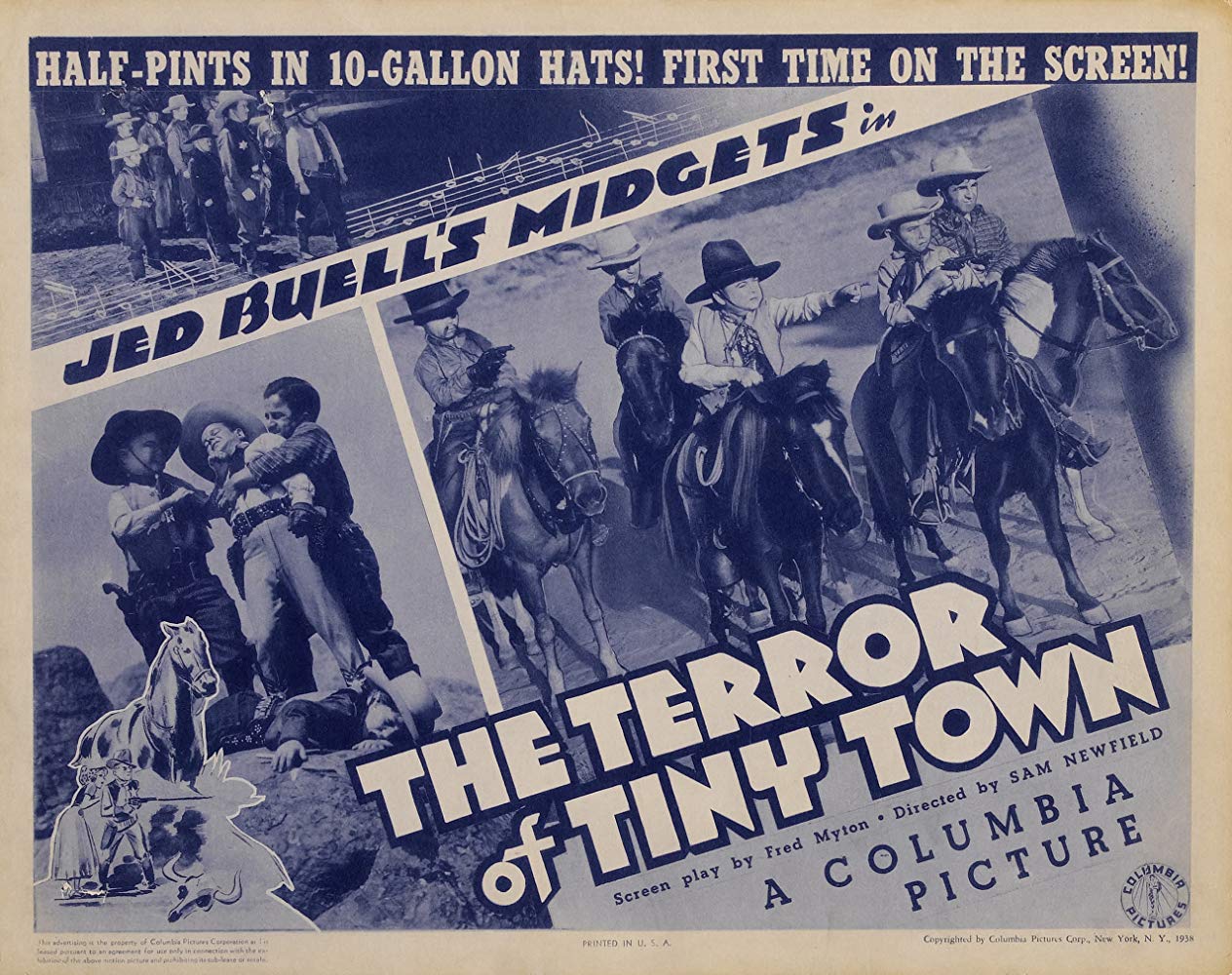
THE TERROR OF TINY TOWN owns the distinction of being the world’s only known Western musical starring midgets, hence the cheap wisecrack about it being the shortest Western ever made. We can be sure there’s many Westerns shorter than 62 minutes.

Exploitation film producer Jed Buell put out a casting call and he more or less put together the cast of the Munchkins before THE WIZARD OF OZ. We see just one non-vertically challenged cast member and that’s in the opening sequence.

Our announcer begins, “Ladies and gentlemen and children of all ages, we’re going to present for your approval a novelty picture with an all-midget cast, the first of its kind to ever be produced. I’m told that it has everything, that is everything that a Western should have.”

During this introduction, our hero Buck Lawson (Billy Curtis) and our villain Bat Haines (‘Little Billy’ Rhodes) just about shoot it out over who’s the star of the picture.

Buck Lawson, “I’m the hero. After this picture’s out, I’ll be the biggest cowboy star in Hollywood.”

Bat Haines, “I’m the villain. I’m the toughest hombre that ever lived, and I ain’t afraid o’ the biggest one o’ you. I’m the Terror of Tiny Town, and that’s the star part.”

Finally, the announcer, who could have been qualified to broker world peace or at least peace in the Middle East, gets Buck Lawson and Bat Haines to agree to let the motion picture play and prove who’s the star.

Judging by their subsequent careers, Curtis (1909-88) easily won.

You may remember him from his role as Mordecai in Clint Eastwood’s HIGH PLAINS DRIFTER.

Frankly, I was floored after looking up Curtis’ screen credits.

He appeared (mostly uncredited) in THE WIZARD OF OZ, MEET JOHN DOE, HELLZAPOPPIN’, SABOTEUR, BUCK PRIVATES COME HOME, LIMELIGHT, THE COURT JESTER, THE INCREDIBLE SHRINKING MAN, and PLANET OF THE APES, plus a multitude of TV shows. Apparently, Curtis hit on Judy Garland during the making of THE WIZARD OF OZ.

Curtis made his debut in THE TERROR OF TINY TOWN.

THE WIZARD OF OZ marked his third role and his first not in a Western. Curtis appeared in THREE TEXAS STEERS — a John Wayne picture — between TINY TOWN and OZ.

You can see why Curtis enjoyed the most successful career in TINY TOWN, because he gives the least stilted line readings.

If you watch THE TERROR OF TINY TOWN, please do not hunt me down if you hated all 62 minutes and then want to give me a piece of your mind because TINY TOWN sucked.

I’ll tell you a little secret right now: THE TERROR OF TINY TOWN, it’s not exactly a good movie and you can just ignore the three-and-a-half stars rating because these are not normal circumstances. I love it and enjoy it a great deal because it’s bad on an epic scale … it belongs in a special place in cinematic history alongside such infamous features as REEFER MADNESS and PLAN 9 FROM OUTER SPACE. I find all of them good for their own distinct reasons.

The announcer proved to be correct, in that THE TERROR OF TINY TOWN does have everything that a Western should have, at least plot wise. They filmed this basic plot a million times before TINY TOWN, I have no doubt. I mean, our villain pits two families against each other and the townspeople must organize to defeat “The Terror of Tiny Town,” and it all leads to an explosive final act. This basic plot was ancient many years before 1938.

Bottom line: THE TERROR OF TINY TOWN is a novelty picture, for sure, and I enjoy the novelty. If we’re being honest, every film exploits some form of novelty.

I find immense enjoyment from the sight gag of characters entering a saloon under the swinging doors, for example, and the ridiculous final showdown between hero and villain.

Unlike ZORRO THE GAY BLADE, TINY TOWN plays its Western musical story straight and does not beat us over the head with either its gags or its premise, at least after the credits and the announcer scene. It’s not a nudge-nudge wink-wink comedy like ZORRO THE GAY BLADE. It’s more funny than it might be otherwise because it’s played straight. The actors made no effort to be campy, but their stilted line readings help THE TERROR OF TINY TOWN achieve bad movie infamy.

Trivia: Jerry Maren (1920-2018) played one of the townspeople in THE TERROR OF TINY TOWN and he was the last surviving WIZARD OF OZ cast member and the last surviving Marx Brothers film cast member.