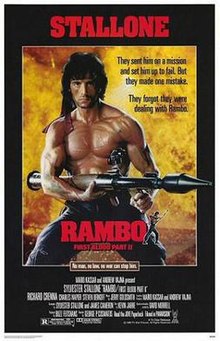
Rambo: First Blood Part II (1985)

day 67, first blood part ii

RAMBO: FIRST BLOOD PART II (1985) Three stars
Sylvester Stallone has proven responsible for two movie franchises, ROCKY and RAMBO, that have produced a combined 12 films over the last four decades.

Outside those franchises, though, it’s been a struggle for the actor, writer, and director, barring a $255 million worldwide hit like CLIFFHANGER. (We’ll see how many EXPENDABLES installments they make.)

Honestly, it’s been a struggle for this viewer to stay interested through sheer crap like STOP! OR MY MOM WILL SHOOT!, for example, or to enjoy something like OVER THE TOP as more than an exercise in overblown ridiculousness (arm wrestling, child custody, and truck driving).

Given a choice between Stallone franchises, I’ll take ROCKY.

RAMBO: FIRST BLOOD PART II works best on a comic book level, just like a couple of the ROCKY pictures from that era.

Just the other day, we took a look back at COMMANDO, a similar cinematic action comic strip with a muscular actor whose surname begins with the same letter.

FIRST BLOOD PART II came out May 22, 1985, while COMMANDO blew up screens beginning October 4, 1985. Only during the Cold War, baby!

Just like I prefer ROCKY over RAMBO, I prefer COMMANDO over FIRST BLOOD PART II for a similar reason.

FIRST BLOOD PART II makes a dread mistake with the female character Co-Bao, played by Julia Nickson. Why did they create her character in the first place?

Let’s be honest, Rambo and FIRST BLOOD PART II don’t know what to do with her. We don’t have time for love in this universe. It just bogs everything down.

Outside the first couple ROCKY movies, it’s often been a struggle for women characters in Stallone movies.

Rambo and Co-Bao are no Rocky and Adrian, for sure.

Rae Dawn Chong’s Cindy provided an unexpected bright spot in COMMANDO and helped elevate it above FIRST BLOOD PART II.

I don’t know, I just cringe when I hear Co-Bao ask Rambo to take her with him.

Then, she’s killed because, let’s face it, FIRST BLOOD PART II handles violence better than any other human attribute.

Her death means that a distraction’s out of the way and we can get back to the true love at the heart of FIRST BLOOD PART II.

I found the number of kills in the RAMBO movies: one in FIRST BLOOD, 74 in the first sequel, 115 in the third edition, and 254 in the fourth installment.

According to moviebodycounts.com, COMMANDO featured 88 kills, including 74 in the grand finale.

HOT SHOTS! PART DEUX satirized this rather well.

Frank Stallone’s big musical number over the FIRST BLOOD PART II end credits, why, you guessed it, it’s called “Peace In Our Life.” Yeah right, there’s barely even a moment of peace in the entire movie.

On a big, dumb action movie level, though, I enjoy both FIRST BLOOD PART II and RAMBO III. That’s about the only level I can enjoy them. I love that we have a protagonist who speaks less and less over time. When he does speak, though, we go back to enjoying the silence. “To survive war, you gotta become war,” I believe Gizmo adapted that mighty well in GREMLINS 2: THE NEW BATCH.

If you think about FIRST BLOOD PART II, it falls apart or it disgusts you.

For example, let’s start with the premise that Rambo’s assigned to go to Vietnam to only take reconnaissance photographs of possible POWs. No engagement of the enemy whatsoever.

Yeah, sure, he’s a regular Henri Cartier-Bresson (1908-2004).

Murdock (Charles Napier) should have known better.

I mean, he only reads the following aloud, “Rambo, John J. Born 7-6-47 in Bowie, Arizona. Of Indian-German descent, that’s a hell of a combination. Joined the army 8-6-64. Accepted special forces, specialization: light weapon, medic, helicopter, and language qualified. 59 confirmed kills. Two Silver Stars, four Bronze, four Purple Hearts. Distinguished Service Cross and Medal of Honor. You got around, didn’t you? Incredible.”

Yeah, sure, no engagement of the enemy. Only photos. I mean, where does it say that in Rambo’s dossier?

We know, of course, that Murdock set Rambo up to fail and that Rambo will not fail … again, Murdock should have known better. You should have picked somebody else. Kurtwood Smith, coming off his performance as one of the sleaziest villains ever in ROBOCOP, inherited the sleaze mantle from Napier in RAMBO III.

In the RAMBO series, the early scenes in FIRST BLOOD (1982) are the ones that stick with me the most over time.

These scenes tell us everything that we need to know about John Rambo and his sad plight in his own country after coming home from Vietnam, and say more than Rambo’s actual concluding monologue.

FIRST BLOOD PART II works better on that level of articulation with Rambo’s “I want what they want and every other guy who came over here and spilled his guts and gave everything he had wants! For our country to love us as much as we love it! That’s what I want!” That’s about as good as any of the speechmaking in RAMBO gets.

Hey, do you remember when I said I liked FIRST BLOOD PART II more than COMMANDO? I lied.
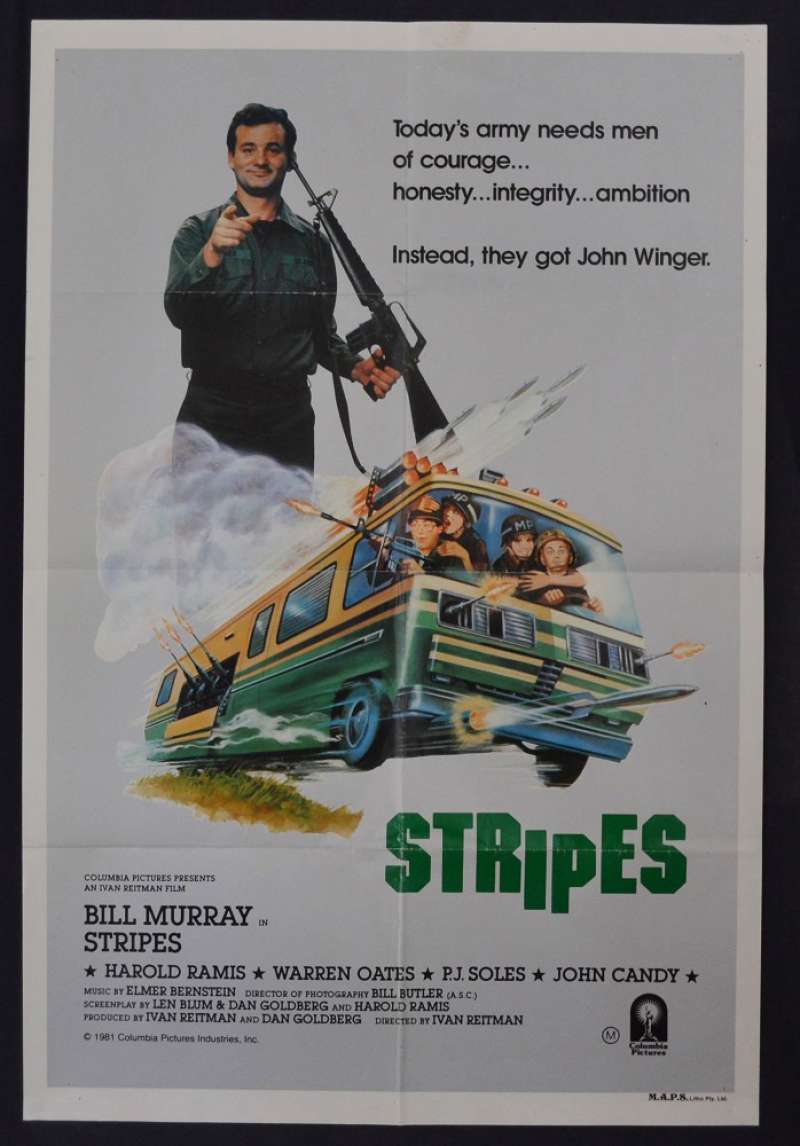
Stripes (1981)

day 66, stripes

STRIPES (1981) Three-and-a-half stars
Bill Murray was the Groucho Marx of the 1980s, especially during films like STRIPES and GHOSTBUSTERS.

STRIPES is Murray’s DUCK SOUP.

It’s not only all the one-liners and the institutional putdowns throughout both films, but a couple later scenes.

In DUCK SOUP, Groucho’s Rufus T. Firefly starts opening up machine gun fire and it only brings him immense pleasure.

Firefly boasts “Remind me to give myself the Firefly medal for this!”

Then his loyal assistant informs Firefly that he’s firing upon his own men.

Of course, Firefly offers his assistant $5 to keep it under his hat, but then Firefly withdraws the offer and keeps the five spot under his own hat.

Firefly’s joy during that sequence and the whole film, for that matter, come back when Murray’s John Winger takes on them darn Commies in STRIPES.

Murray, like Groucho, treated all this like one great big put-on.

That’s the comic attitude that informs STRIPES and like Groucho, Murray never played the fool. He’s the intelligent one, the hustler who knows the score, and sure Murray’s foil Sgt. Hulka (Warren Oates) socks it to Winger during basic training, but eventually the pair reluctantly find common ground and reach an understanding.

Winger first wanted to join the U.S. Army based on a lark, not some great conviction to serve his country.

For example, Winger thought he could pick up more women in the military.

Winger: “Chicks dig me, because I rarely wear underwear and when I do it’s usually something unusual. But now I know why I have always lost women to guys like you. I mean, it’s not just the uniform. It’s the stories that you tell. So much fun and imagination.”

Winger and his best friend Russell Ziskey (Harold Ramis) see the EM-50 Urban Assault Vehicle as an opportunity to go pick up their Military Police girlfriends (P.J. Soles, Sean Young) in West Germany and enjoy a holiday in Switzerland. Of course, this leads to their comrades seeking them out and being captured by the Soviet Army. Winger and the gang rescue their friends with that heavily-armed recreational vehicle on their side.

Winger keeps that lark attitude throughout STRIPES, even after his friends fall into Soviet hands.

Winger: “C’mon, it’s Czechoslovakia. We zip in, we pick ’em up, we zip right out again. We’re not going to Moscow. It’s Czechoslovakia. It’s like going into Wisconsin.”

Everything’s a lark to Winger (and Murray).

Murray and Ramis make a very good comedic duo. You might be surprised to find out STRIPES (directed by Ivan Reitman) had been originally intended to be a Cheech and Chong vehicle, but that pair wanted the dreaded “complete creative control.” Both Ramis himself (who scripted ANIMAL HOUSE and directed CADDYSHACK) and Columbia Pictures were reluctant to have Ramis onscreen, but Murray insisted that he would only be paired with Ramis.

Ramis is vital to the success of STRIPES. He’s the ordinary guy counterbalance to Winger, but also the loyal best friend who ends up along for the ride despite knowing that his best friend’s crazy. Ramis brings an interesting tension to the movie that might not have been there, for example, had Dennis Quaid played Russell, such as the scene when Russell starts choking Winger. Quaid seems far more the stereotypical All-American hero type. Also, Ramis and Murray shared dynamite chemistry.

Veteran character actor Warren Oates is also vital to STRIPES. Like Russell, Sgt. Hulka makes a great counterbalance to Winger. There’s just one dramatic scene in STRIPES, when Hulka confronts Winger in the latrine. Hulka dares Winger to take a swing at him. Winger obliges, and Hulka wipes the floor with Winger. Even more so than Winger, Hulka knows the score. Hulka had originally been scheduled for death in the mortar accident and to be replaced by his twin brother also played by Oates, but the creative powers-that-be thankfully scrapped that concept.

On vacation in 2017, riding over the George Rogers Clark Memorial Bridge headed into Louisville, I thought it seemed very familiar and sure enough, it’s the bridge where Winger melodramatically quits taxi driving by flinging his keys into the Ohio River. Fortunately, we did not reenact the scene that day; it definitely would have been fun making it back home.

Would it be safe to say STRIPES is the greatest movie ever shot in Louisville?

Not so fast, my friend, as former Louisville head coach Lee Corso would say.

GOLDFINGER, RAIN MAN, A LEAGUE OF THEIR OWN, and THE INSIDER, for example, might have something to say about that.

Full Metal Jacket (1987)

day 65, full metal jacket

FULL METAL JACKET (1987) Four stars
I’m a firm believer in the “Full Metal Jacket Fallacy.”

Why, that’s when fools argue the first half of Stanley Kubrick’s FULL METAL JACKET is just brilliant and the second half flat-out sucks donkey testicles.

I’ve heard that argument many, many times in high school, college, and probably will continue to hear it for all my living days. You’re all wrong and I have no problem saying that.

Yes, I would agree the first half’s superior to the second, especially thanks to the powerhouse performances by R. Lee Ermey (1944-2018) and Vincent D’Onofrio, but the second half does not suck.

Granted, I do believe Kubrick’s Vietnam begins with our main protagonist Private Joker (Matthew Modine) and his sidekick Rafterman (Kevyn Major Howard) picking up a Da Nang hooker. In dialogue sampled by infamous rap group 2 Live Crew, she says, “Me so HORNY. Me love you long time.” Anyway, she goes on to guarantee “Me sucky-sucky. Me love you too much” and later on, we hear “Sucky! Sucky! Five dolla!,” rather infamous words. She’s relentless, I’ll give her that.

So, yeah, I can see why people think FULL METAL JACKET sucks during its second half, since hearing “suck” so many times conditioned them into believing the Vietnam portion sucked. I get it now, after many years of being mystified.

FULL METAL JACKET, as many already know, made several great contributions to the English language and it furthered cursing more than just about any other film in cinematic history. Ermey, in particular, used profanity like other artists use clay.

For example, I learned such timid little phrases as “I didn’t know they stacked shit that high,” “Only steers and queers come from Texas” (an Oklahoma variation on this line used in AN OFFICER AND A GENTLEMAN), and “I bet you’re the kind of guy that would fuck a person in the ass and not even have the goddamn common courtesy to give him a reach-around.”

Not that I ever use such phrases, I promise.

That’s good, since I first watched FULL METAL JACKET around the age of 10 on home video. Right around that same moment in time, I first watched films like COMMANDO, THE TERMINATOR, PREDATOR, PLATOON, and STAND BY ME, all films that definitely had an impact on me, though I found their vulgarity funny at the time in a different way than years later. I did not know what most of the words meant upon first viewing, but found them funny in just how they sounded and how they were delivered. I picked up the meanings in later viewings, and I still find them all funny.

STAND BY ME, as well as THE BAD NEWS BEARS, especially proved revelatory, in that kids from different eras cussed.

I mean, STAND BY ME gave us the line “A pile of shit has a thousand eyes” and Tanner Boyle in THE BAD NEWS BEARS, why he’s one of the greatest foul-mouthed hooligans in history.

Ermey and D’Onofrio give two brilliant performances, but since they’re in a film directed by Kubrick (1927-99), they were not nominated for the Academy Awards.

That’s because Kubrick’s often considered the real star in his movies and he’s one of the greatest directors ever whose credits include THE KILLING (watch this one followed by RESERVOIR DOGS), PATHS OF GLORY, SPARTACUS, DR. STRANGELOVE, 2001, A CLOCKWORK ORANGE, BARRY LYNDON, THE SHINING, and EYES WIDE SHUT.

Kubrick made 13 feature films during his career from 1953 through 1999. He was a photographer for Look magazine in the late 1940s and early 1950s, and that background informs all his films. They all have indelible scenes.

Kubrick’s films grow better over time and they’re generally perceived more favorably after cold or hostile receptions during their first theatrical release. They have a timeless quality about them.

How often were the actors’ performances saluted by the industry?

Seemingly not very often.

Peter Ustinov won the 1961 Academy Award for Best Supporting Actor for SPARTACUS, probably the project least satisfactory personally to Kubrick.

Sue Lyon won the Golden Globe for Most Promising Newcomer for her work in LOLITA and James Mason, Shelley Winters, and James Mason were nominated along with Lyon.

Peter Sellers received a 1965 Academy Award Best Actor nomination for DR. STRANGELOVE. Sellers played three roles … and he lost the award to Rex Harrison, Professor Henry Higgins in MY FAIR LADY. (Lee Marvin won the next year for two roles in CAT BALLOU, so it must have been easier to win for two roles rather than three.)

All of the awards and nominations for 2001 were either technical (visual effects, cinematography, production design) or for Kubrick and writer Arthur C. Clarke, though Douglas Rain, as the voice of HAL 9000, gives one of the best performances in any film. How would you like to have been beaten out by a sentient computer? No, instead, the 1969 Academy Award nominees for Best Actor were Cliff Robertson in CHARLY, Alan Arkin in THE HEART IS A LONELY HUNTER, Alan Bates in THE FIXER, Ron Moody in OLIVER!, and Peter O’Toole in THE LION IN WINTER … with the prize to Robertson. Who remembers their performances? Honestly … we all remember HAL 9000, “Look Dave, I can see you’re really upset about this. I honestly think you ought to sit down calmly, take a stress pill, and think things over.”

Nearly all the kudos for A CLOCKWORK ORANGE were technical or for the director, like before, but Malcolm McDowell earned a Golden Globe nomination for his performance as larger-than-life Alex DeLarge.

BARRY LYNDON won 1976 Academy Awards for best production design, best costume design, best cinematography, and best original score.

Jack Nicholson won Academy Awards for Best Actor in 1976 (ONE FLEW OVER THE CUCKOO’S NEST) and 1998 (AS GOOD AS IT GETS) and for Best Supporting Actor in 1984 (TERMS OF ENDEARMENT), but he got no love for THE SHINING though his flamboyant performances before and after Kubrick received nominations. I mean, for example, is Nicholson’s performance in THE SHINING all that different from his one in ONE FLEW OVER THE CUCKOO’S NEST?

EYES WIDE SHUT received no Academy Award nominations, just like THE SHINING before it, although Tom Cruise and Nicole Kidman do some of their best work.

Back to FULL METAL JACKET.

Kubrick, Michael Herr, and Gustav Hasford received the film’s lone Academy Award nomination for Best Adapted Screenplay, while both Ermey and D’Onofrio were both separately nominated for Best Supporting Actor, Ermey by the Golden Globes and D’Onofrio by the Boston Society of Film Critics.

I doubt there were better performances from any films released in 1987.

Erney and D’Onofrio bring their characters Gunnery Sergeant Hartman and Private Leonard “Gomer Pyle” Lawrence to such life that they stay with us for the rest of the movie after their unfortunate, tragic demise at the end of the Parris Island sequence. Their characters stay with us forever, in fact, and I venture to say that’s a definition of a great performance.

If somebody mentions Gomer Pyle, for example, I think first of FULL METAL JACKET and not Jim Nabors of “The Andy Griffith Show” and “Gomer Pyle, U.S.M.C.” Please consider that, for a second.

D’Onofrio gained 70 pounds for the role of the overweight Gomer Pyle, who finds that he’s only got one true skill in basic training. Those 70 pounds surpassed what Robert DeNiro did for RAGING BULL, and that performance earned an Academy Award.

Ermey served as a U.S. Marine drill instructor during the Vietnam War and this real experience informed his performance as Hartman.

Kubrick allowed Ermey to ad lib his dialogue, something that does not jibe with Kubrick’s reputed uncompromising perfectionism. In fact, Google “Kubrick perfectionist” and see results like a Telegraph article titled “The relentless, ridiculous perfectionism of Stanley Kubrick.”

I don’t know, Kubrick earned his reputation for relentless perfectionism, of course, but what about Sellers in DR. STRANGELOVE or, for that matter, George C. Scott’s War Room stumble in that same film? Or McDowell’s “Singin’ in the Rain” number in A CLOCKWORK ORANGE? Or Nicholson’s “Here’s Johnny” in THE SHINING? Ad libs, ad libs, ad libs.

Kubrick and his films are complex, contradictory, and controversial, and that’s part of why they stand the test of time.

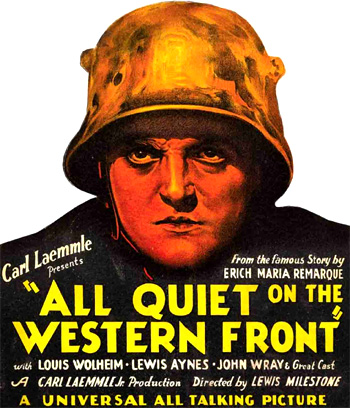
All Quiet on the Western Front (1930)

day 64, all quiet on the western front

ALL QUIET ON THE WESTERN FRONT (1930) Four stars
Working on a master’s degree in history (world history emphasis), the last three credit hours I needed were from an internship.

In the summer of 2005, I worked a three-week, 120-hour internship at the National Archives (no, I did not see Benjamin Gates or Nicolas Cage playing another character, for that matter) on Bannister Road, Kansas City. I worked a week on a file project, utilized a spatula to remove “sensitive” staples from at least 100-year-old Fort Leavenworth prisoner files (another week), spent a day looking up family history, and visited what became the National WWI Museum and Memorial. In the past, before September 11, 2001, of course, interns were allowed to keep both their federal employee badges (needed to enter the facility) and their spatula. I settled for a picture of the badge.

At that point in time in the WWI museum, they only had the gift shop completed and open to the public, so I bought a Buffalo Soldier T-shirt (absolutely loved that design) and German author Erich Maria Remarque’s remarkable book “All Quiet on the Western Front,” a book originally released in 1929 and made into an Academy Award for Best Picture winner in 1930.

I wanted to go back to the Archives as full-time employee, but alas, it did not come to be after multiple tries. Finally, in 2008, after three years of frustration and substitute teaching (just another phrase that means “frustration”), I returned to Pittsburg State and embarked on a new path that led to where I am today.

(Of course, when I did the internship, I enjoyed telling people, “I work for the government. … I could tell you, but I’d have to kill you.”)

I watched the movie before I read the book and both are essentials. However, I’ll just focus on the movie (directed by Lewis Milestone) within this space.

We follow a group of German young men, predominantly Paul Baumer (Lew Ayres), from when they’re idealistic prep school students who are inspired to enlist by their jingoistic teacher to their inevitable disillusionment after being hit straight in the face with the brutal realities of World War I. Death, mutilation, rations, starvation, trench warfare, on down the line, and finally Paul asks the fundamental questions of life and death and what exactly is he fighting for.

When he returns to his old classroom where his former teacher still gives the students the same old propagandistic spiel as before, Paul confronts him and the students, “We used to think you knew. The first bombardment taught us better. It’s dirty and painful to die for your country. When it comes to dying for your country, it’s better not to die at all! There are millions out there dying for their countries, and what good is it?”

The students yell and scream COWARD at Paul.

Of course, one would be easily tempted to say that it’s much easier telling an anti-war story from a German perspective, since war is more Hell for the “losing” side. Notice the difference in World War II movies from Germany and Japan versus movies from Great Britain and the United States, for example.

Francois Truffaut (1932-84), first a film critic and then a director himself whose credits include THE 400 BLOWS, JULES AND JIM, and THE WILD CHILD, reportedly told Gene Siskel in a 1973 interview, “I find that violence is very ambiguous in movies. For example, some films claim to be anti-war, but I don’t think I’ve really seen an anti-war film. Every film about war ends up being pro-war.”

Anyway, Truffaut became famous for saying “There’s no such thing as an anti-war film”; for example Roger Ebert used it when reviewing PLATOON. The actual original Truffaut anti-war film quote seems to be quite elusive.

The thinking behind the quote (whether Truffaut said it or not) is that movies glorify whatever behaviors are being shown or war movies make war seem attractive, glamorous, et cetera, basically cinematic propaganda that’s an upgrade on what Paul’s school teacher tells generations of young men in the classroom.

On that train of thought, it makes ALL QUIET ON THE WESTERN FRONT pro-war rather than anti-war, despite any noble intentions and whatever dialogue comes out of the characters’ mouths.

However, ALL QUIET ON THE WESTERN FRONT definitely had an impact on Lew Ayres, the 22-year-old actor who played Paul.

Ayres became a conscientious objector during World War II, basing it on his pacifism. Ayres said, “To me, war was the greatest sin. I couldn’t bring myself to kill other men,” and he told the draft board in Beverly Hills, “Don’t think I am trying to save my neck. I would like to be of service to my country in a constructive way and not a destructive way.”

Since Ayres did not belong to any organized religion and did not have any formal religious training, he faced long odds in being classified a CO. The draft board deliberated on Ayres’ case for months and they mistakenly classified him IV-E, meaning that he objected to all military service. Ayres preferred to be I-A-O, meaning that he could have noncombatant military service like the medical corps he most desired. The draft board assigned the IV-E Ayres to a labor camp in Wyeth, Oregon.

The public, especially the Hollywood community, hit Ayres with a major wave of backlash. Of course, this was early 1942, months after Pearl Harbor and months after the United States surrendered neutrality and joined World War II against the Axis powers (basically Germany, Italy, and Japan). It looked extremely bad for a Hollywood actor to be a conscientious objector.

A soldier, though, wrote a letter of support to Time, “Lew Ayres, instead of being detrimental to our public good, is indicative of what the American people wrote into their Bill of Rights and what we fight our wars about, the right to freedom in a democracy.”

Over a month later, the draft board reclassified Ayres I-A-O.

Ayres received the assignment to the medical corps that he desired. He served 3 1/2 years in the medical corps and earned three battle stars.

In a story called “The ‘Good’ Conscientious Objector Lew Ayres,” writer Joseph Connor quoted Ayres on his experiences, “I had imagined that war was a horrible thing. But it actually surpassed anything I’d dreamed of. It’s bad enough in the field, where soldiers expect cruelty and death; but in cities, among helpless civilians, the picture is far worse.”

Ayres said that he found it the most difficult to attend to children with bullet holes in them.

Pearl Harbor (2001)

DAY 62, PEARL HARBOR

PEARL HARBOR (2001) One star
If you’re a fan of Turner Classic Movies, surely at one point or another you’ve come across the old-fashioned screen romance set in the midst of wartime be it World War I or World War II or (even) Vietnam.

A FAREWELL TO ARMS and WATERLOO BRIDGE are just a couple of the classic titles.

You might have noticed a hallmark or two at work from the Meet Cute and the romantic, lyrical interludes (before Simon & Garfunkel, Cat Stevens, and every other overly sensitive singer-songwriter provided the songs) to the departure scenes before the soldier goes off to fight and finally tragedy for the star-crossed lovers in such harrowing times for all humanity.

They become a microcosm.

Right or wrong, such cinematic hallmarks should be laughed right off the screen in postmodern times when they’re played wrong.

For example, Michael Bay’s PEARL HARBOR, one of the most insulting, most cloying excuses for mass entertainment ever made. (Keep in mind that Harrison Ford’s worst movie just might be HANOVER STREET, another weeper from Hell.)

PEARL HARBOR not only borrows scenes and themes wholesale from those earlier wartime romances, but it smuggles in good old-fashioned World War II films to form a half-soap opera and half-war epic for the Attention Deficit Cinema. It turns out to be all-crock and all-crook.

I don’t know about you, but the romantic triangle between would-be matinee idols Ben Affleck, Kate Beckinsale, and Josh Hartnett does not belong in the same picture with the Japanese attack on Pearl Harbor.

Be prepared for the attack on both elements.

How about that romantic triangle?

Let us break them down angle-by-angle-by-angle.

I’ve never been a big Affleck fan, Hartnett’s not much better, and Beckinsale nearly always proved to be easy on the eyes but difficult on every other sense.

They’re no Gary Cooper, Robert Taylor, Helen Hayes or Vivien Leigh.

Basically, we’re dealing with three dubious actors in the first degree, then …

Give them dialogue that would have sank greater actors, like “Returning from the dead wasn’t all that I expected … but that’s life”; “You are so beautiful it hurts,” “It’s your nose that hurts,” and “I think it’s my heart”; “You know, the only thing that scares me is that you might love him more than you love me,” and they’re flirting with disaster.

How dare them Japanese attack a romantic triangle? Do they have a heart?

There’s not one scene between the lovers in PEARL HARBOR that even approaches indelible screen moments like Burt Lancaster and Deborah Kerr’s love scene on the beach in FROM HERE TO ETERNITY and Humphrey Bogart and Ingrid Bergman’s farewell in CASABLANCA.

PEARL HARBOR unfortunately does not get any better in the war scenes and since this is historical fiction, we see fictional characters intertwined with impressions of real-life characters Franklin D. Roosevelt and Lt. Col. Jimmy Doolittle, who are portrayed respectively by Jon Voight and Alec Baldwin.

If the actors playing the romantic triangle get dialogue rejected by a soap opera, Voight and Baldwin chew on dialogue that’s just as recycled from old war movies, especially for Baldwin’s Doolittle.

Doolittle: “There’s nothing stronger than the heart of a volunteer” and “Victory belongs to those who believe in it the most and believe in it the longest. We’re gonna believe. We’re gonna make America believe too.”

I believe in victory, sure enough, and that’s every time I have survived the 3-hour, 4-minute cheesefest (that’s an insult to cheese) that will live in cinematic infamy.

There was the time my sister and I watched it in a suburban St. Louis multiplex because she refused to watch anything else. Oh, I would have paid extra to watch anything other than PEARL HARBOR or hell, I should have stayed home and watched paint dry. At least the paint won’t explode after an hour of the worst dialogue.

After the movie, I looked around for military recruiters creeping and crawling through an Affton theatre.

A few years down the line, our History in Film & Fiction class at Pittsburg State brought out Michael Bay’s disaster, and it still epically sucked or in the past tense of a hit song, it felt like the first time.

PEARL HARBOR’s lasting positive contribution to culture was that it provided the inspiration for one of the memorable songs in TEAM AMERICA: WORLD POLICE, Trey Parker and Matt Stone’s satire on lamebrained action movies, “Pearl Harbor Sucks.”

I could have quoted the lyrics for this review, believing in every line except for the one about how Cuba Gooding Jr. needed a bigger part.

Anyway, those lyrics are definitely better than this blurb found on Movieweb: “On a sleepy Sunday morning in December, as children played and families prayed, squadrons of Japanese warplanes screamed across the skies of a Hawaiian paradise and launched a surprise attack on the U.S. armed forces at Pearl Harbor. The infamous day that jolted America from peaceful isolationism to total war and altered the course of world history is relived in this epic tale of patriotism, passion and romance from producer Jerry Bruckheimer, producer/director Michael Bay and screenwriter Randall Wallace.

“PEARL HARBOR focuses on the life-changing events surrounding December 7, 1941, and the war’s devastating impact on two daring young pilots (Ben Affleck and Josh Hartnett) and a beautiful, dedicated nurse (Kate Beckinsale). It is a tale of catastrophic defeat, heroic victory, personal courage and overwhelming love set against a stunning backdrop of spectacular wartime action.”

Hey, please keep in mind that you don’t have to believe in the bullshit you write.

I, however, believe in every single word when I tell you that PEARL HARBOR sucks.