The Wild Geese (1978)

THE WILD GEESE (1978) *
We’ve seen The Wild Geese many times before and we’ve also seen it done a lot better many times before — the rounding up of the mercenary troops for their new mission, the basic training, the jail break, the great escape, the big double cross, the death scenes, etc.

If we pool our collective resources, undoubtedly we could brainstorm 50 or 100 titles easily and recall their overall plots and specific individual developments.

Worse, far worse, infinitely worse even, how do I describe the pace of The Wild Geese?

I thought about saying it moves at a snail’s pace, but then I quickly realized that it more accurately moves like a three-toed sloth dipped in molasses. This is one action movie that does not require slow motion because it’s already slow enough.

In fact, I am hard pressed to come up with an action movie that moves slower than The Wild Geese. I just can’t do it and I don’t want to ever find out if any do exist in this great big universe.

Anyway, we have the first 30 minutes to meet our stars Richard Burton, Richard Harris, and Roger Moore, then around the 45-minute mark it’s basic training and finally around one hour in we get into the main action. I almost said jump, but that’s way too much activity for The Wild Geese. To be fair, The Wild Geese picks up the pace in the last hour to such a degree that only two of the three sloth toes are molasses drenched. Guess what, though, it’s still dull as dishwater.

Yes, indeed, there’s not an exciting moment to be found in The Wild Geese.

Of course, that incredible pace might have something to do with the fact Burton, Harris, and Moore were in their late 40s (Harris) and early 50s (Burton, Moore) when they made The Wild Geese. Harris and especially Burton are not the least bit convincing in their action hero roles. Moore was nearly halfway through his run playing British secret agent James Bond, so he’s more credible than his counterparts and looks much less a fool than either Harris or Burton.

It is ironic that Burton, Harris, and Moore are playing middle-aged mercenaries and the film drops mercenary dialogue routinely during a 135-minute spread, because the three main actors fit the adjective definition of mercenary — primarily concerned with making money at the expense of ethics.

It seems like they paid Burton, Harris, and Moore by the word during The Wild Geese, because they yap and yammer constantly, their barrage of banter only interrupted by the generic requirements of the action movie. Granted, it takes a (long) while before the prerequisite explosions and gunfire.

By my reckoning, a long, long, long, long, long, long while and The Wild Geese lives up only to the geese portion because it is something foul alright. Wild, however, it is most certainly not.

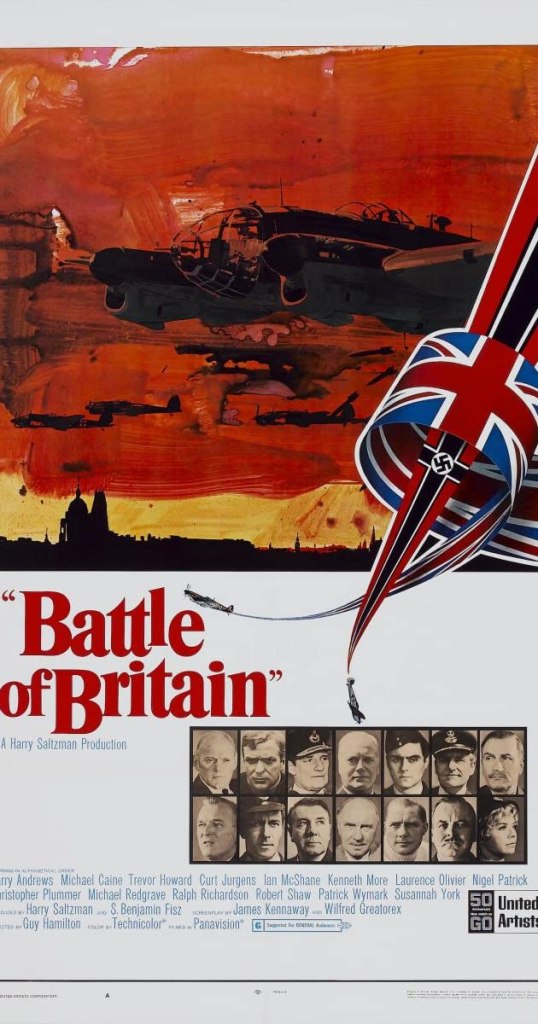
Battle of Britain (1969)

BATTLE OF BRITAIN (1969) One star
Never in the field of motion pictures were so few scenes owed by so few to so many.

— Harry Saltzman

As far as we know, Harry Saltzman never actually said that, nor did Winston Churchill or, for that matter, Yogi Berra and Yogi the Bear.

Anyway, that would-be quote came to mind several times during Battle of Britain and it’s been on my mind preparing this review inside my ripped, twisted brain.

Just look at the cast: Harry Andrews, Michael Caine, Trevor Howard, Curt Jurgens, Ian McShane, Kenneth More, Laurence Olivier, Nigel Patrick, Michael Redgrave, Ralph Richardson, Robert Shaw, Patrick Wymark, Susannah York, Michael Bates. Anyway, we get the point and to fill in the rest of the cast might take every bit as long as Battle of Britain.

Battle of Britain lasts approximately 2 hours, 12 minutes, and yeah, that’s exactly right, very little screen time for each actor since there’s so many of them.

Regardless, the planes get all the good lines in Battle of Britain.

Beyond the planes, though, Michael Caine’s dog gives the best dramatic performance. Unfortunately, I couldn’t even find the dog’s name in the seemingly neverending end credits.

Battle of Britain invested so much into the planes that it forgot about the characters, the people, you know, the reason why audiences engage with any successful motion picture spread. They spent so much on the planes, in fact, they couldn’t even afford subtitles for the German dialogue spoken often throughout Battle of Britain, for crying out loud.

I am not always the biggest fan in the world of these cast-of-thousands World War II epics and Battle of Britain joins The Longest Movie, Boring! Boring! Boring!, and A Movie Too Long in the cinematic wreckage of bloated, ponderous war movies.

It especially doesn’t help when the musical score for Battle of Britain has me thinking that’s what it must feel like to be trapped inside a tuba for a two-hour concert.

The Kinks’ incredible, indelible concept album Arthur (Or the Decline and Fall of the British Empire) came out two weeks before Battle of Britain in October 1969 and coincidentally, I put Arthur on almost immediately after Battle of Britain. Arthur provided the emotional and intellectual content missing from Battle of Britain, as well as a great sense of humor and sharp wit, not to mention tunes out the wazoo.

Arthur lasts all of 49 minutes, 17 seconds, and travels from the Victorian era to World War I to World War II to post-war England to Australia in a mere 12 songs. Ray Davies proved himself once again to be one of the great storytellers in popular music on this album, from opener “Victoria” and “Shangri-La” to “Mr. Churchill Says” and closer “Arthur.”

I get more from one song on Arthur than all of Battle of Britain; for example, these rather cinematic lyrics from “Some Mother’s Son,” Some mother’s son lies in a field / Someone has killed some mother’s son today / Head blown up by some soldier’s gun / While all the mothers stand and wait / Some mother’s son ain’t coming home today / Some mothers son ain’t got no grave / Two soldiers fighting in a trench / One soldier glances up to see the sun / And dreams of games he played when he was young / And then his friend calls out his name / It stops his dream and as he turns his head / A second later he is dead / Some mother’s lies in a field / Back home they put his picture in a frame / But all dead soldiers look the same.

Hanover Street (1979)

HANOVER STREET

HANOVER STREET (1979) One star

In a review of the Michael Bay cinematic bomb PEARL HARBOR, “one of the most insulting, most cloying excuses for mass entertainment ever made” I called that one, I mentioned HANOVER STREET and called it both possibly Harrison Ford’s worst movie and a weeper from Hell.

HANOVER STREET establishes a basic plot scenario that worked much better in films contemporaneous with World War II, films like WATERLOO BRIDGE, CASABLANCA, THE CLOCK, and BRIEF ENCOUNTER. Outside that immediate context, though, a film had better be very good because otherwise it will not get away with a period romance. In fact, played badly, we just might laugh it right off the screen. That’s what I did, for example, to survive PEARL HARBOR.

We have all seen HANOVER STREET many times before, even before seeing the film for the first time. Peter Hyams both directed and wrote HANOVER STREET, so he definitely has nobody but himself to blame for such ridiculous tripe.

David (Ford), American pilot.

Margaret (Lesley-Anne Down), English nurse.

She’s married.

He’s not.

Instant love / lust.

They start a love affair in the midst of a London blown up real good.

She keeps her husband a secret from her new lover.

He’s assigned to escort a British secret agent into France.

They’re shot down behind enemy lines.

David discovers that secret agent, you guessed it, is Margaret’s husband, Paul (Christopher Plummer).

David and Paul must work together to survive.

Enough is enough, because I think anybody with an IQ of at least 100 can finish the rest of the synopsis of HANOVER STREET.

With the staggering success of both ROCKY and STAR WARS in back-to-back years (1976 and 1977), both good old-fashioned popular entertainments, Hollywood began churning out light, feel good, escapist pictures by the dozens. It especially became even more pronounced in 1979 (and beyond), since 1978 releases GREASE, HEAVEN CAN WAIT, and SUPERMAN proved to be major hits in the ROCKY and STAR WARS mold.

Just take a look at the poster for HANOVER STREET.

The words at the top: LOVE HASN’T BEEN LIKE THIS SINCE 1943.

Below that an illustration of Harrison Ford and Lesley-Anne Down looking each other passionately in the eyes, foreshadowing or merely shadowing a key scene in the movie.

More text (hype): “It was a time of courage and honor – of passion and sacrifice. This is the story of two people swept up in that time – who met – and fell in love.”

There’s also a map and two planes on the poster.

Ford worked so effectively as both Han Solo and Indiana Jones in eight films partly because he found a way to work in humor that counterbalanced all the cornball surrounding him. There’s also that priceless scene in THE EMPIRE STRIKES BACK when Princess Leia (Carrie Fisher) tells Han that she loves him and he merely says, “I know.”

In HANOVER STREET, Ford stumbles his way though dialogue like “Think of me when you drink tea,” “I love you enough to let you go, which is more than I’ve ever felt about anyone in my life,” and “You’ve got to go to him, and I’ve got to turn and walk away.” To be fair, everybody stumbles in HANOVER STREET and there’s no counterbalance to cornball.

Christopher Plummer legendarily disliked working on THE SOUND OF MUSIC (he called it “The Sound of Mucus”) and he said this about his co-star, “Working with Julie Andrews is like getting hit over the head with a valentine.” (Plummer and Andrews have remained friends.)

I just wonder what Plummer has to say about HANOVER STREET.

Avatar (2009)

AVATAR

AVATAR (2009) One-and-a-half stars
After I watched James Cameron’s AVATAR for the first time in nearly 10 years, numerous things hit me over the head like a (Hebrew) hammer.

Mental notes:

1) This movie sucks. I mean it, man, and I’m not sure how or why I ever liked it in the first place. I’ll blame it on the alcoholic consumption during my first watch in late ’09 and my love/lust relationship at the time with a woman who loved AVATAR.

2) It never ends. AVATAR is not the cinematic equivalent of the late ’60s Jefferson Airplane chestnut “3/5 of a Mile in 10 Seconds” or 216 miles per hour. The final act of AVATAR, in fact, could be called “3/4 of a Hour in 10 Years.”

3) Will Cameron ever direct a film again that comes in under 120 minutes? The 161-minute AVATAR followed hot on the heels (12 years later) of the 195-minute TITANIC. Here are the run times for TRUE LIES (141), TERMINATOR 2 (137), THE ABYSS (140), and ALIENS (137). In fact, you’d have to go all the way back in time to the 107-minute TERMINATOR (1984) for the last Cameron-directed picture under 120 minutes. (For the record, I like TERMINATOR 2, ALIENS, and THE ABYSS, I’ll pass on TRUE LIES, and I’ll have to revisit TITANIC to see how it holds up removed from all the hype and hysteria in late ’97 and early ’98.)

4) It’s been said that no good film is too long and no bad film is short enough. In that case, AVATAR will be cinematically torturous for people who think it’s no good. Let me put it yet another way: AVATAR and my last dentist appointment lasted about the same length of time, and I’ll go back to the dentist before I ever watch AVATAR again.

5) AVATAR just might be the preachiest movie ever made, even more so than any movie about, you know, preachers. Apparently, even 20th Century Fox asked Cameron to remove “some of this tree-hugging, FERN GULLY crap” from AVATAR. This preachiness makes AVATAR a real drag at times, and why it feels more like an endurance contest than an enjoyable, visionary motion picture experience.

6) Cameron practices what he preaches, though, because AVATAR recycles from DANCES WITH WOLVES, POCAHONTAS, FERN GULLY, ALIENS, and several Hayao Miyazaki films (just a short list). We’ve seen this movie before, and better.

7) AVATAR uncannily illustrates the “uncanny valley.” Definition: “The uncanny valley is a common unsettling feeling people experience when androids (humanoid robots) and audio/visual simulations closely resemble humans in many respects but are not quite convincingly realistic.”

8) Blue is not my favorite color.

9) Black is my favorite color. I loved AVATAR most when it finally faded to black.

10) I liked the Na’vi subtitles much better when they were in German on the bootleg copy I first consumed.

11) I must follow the THIS IS SPINAL TAP rule, which means this list must go to 11.

The Manchurian Candidate (1962)

DAY 81, THE MANCHURIAN CANDIDATE

THE MANCHURIAN CANDIDATE (1962) Four stars
John Frankenheimer’s political thriller is one ripped, twisted movie, borrowing famous words from Hunter S. Thompson.

It should make one reconsider both Frank Sinatra and Angela Lansbury, for example.

I did.

Before I first watched THE MANCHURIAN CANDIDATE, I held Sinatra in very little (miniscule) esteem. Maybe it was Phil Hartman’s savage impersonation on “Saturday Night Live.” Maybe it was Sinatra’s appearances on Jerry Lewis’ MDA telethon on Labor Day and when you only have three channels and one of them’s gone all weekend, all booked up, man, we’re talking about Pits City. Maybe it was his crooning that provided the soundtrack for seemingly innocuous yuppie consumption (we all know what seemingly innocuous really means) and little old swooning ladies and every movie that wants to evoke a certain mood just by slapping one of Ol’ Blue Eyes’ standards on every few minutes. Maybe it was the fact that he lived and breathed crusty, old guard establishment, whose reactions to Elvis and the Beatles were not surprising. There was just something about that man that gave me the creeps.

Why, of course, like any child of the 1980s and 1990s, I knew Lansbury from “Murder, She Wrote” and I know I saw her in old Disney entertainments somewhere along the line. I knew that she wasn’t quite this doddering old lady, because, man, if I saw her Jessica Fletcher coming my way, I would have moved to another town or put a down payment on a passport and an one-way plane ticket and move to another country because I know that homicide’s afoot and I want no damn part of it. The homicide rate in Cabot Cove, Maine, must have rivaled Chicago.

So, yeah, in many different ways, THE MANCHURIAN CANDIDATE warped my fragile little mind, including seeing Sinatra as a legitimate dramatic actor and Lansbury as the most wicked mother in screen history. I have no doubt she plays the most wicked mother in screen history, because I don’t want to see anybody else more wicked.

I don’t know if reading or having somebody tell you the plot summary for THE MANCHURIAN CANDIDATE can even adequately convey how messed up the movie’s events are, like this one I just read on the Internets: “Near the end of the Korean War, a platoon of U.S. soldiers is captured by communists and brainwashed. Following the war, the platoon is returned home, and Sergeant Raymond Shaw (Laurence Harvey) is lauded as a hero by the rest of his platoon. However, the platoon commander, Captain Bennett Marco (Sinatra), finds himself plagued by strange nightmares and, together with fellow soldier Allen Melvin (James Edwards), races to uncover a terrible plot.”

Strange nightmares, you can say that again, because they incorporate those Communist brainwashing sessions.

It seems that Shaw’s platoon are surrounded by sweet little old ladies, when in fact they are Chinese and Soviet officials performing their brainwashing routine. Shaw murders two of his men, one by strangulation and one by gunshot through the head. Yet when they come back home, Shaw’s a military hero, just all part of the plan.

These nightmares are very disturbing to watch, of course, and establish the movie’s disorienting tone. We rarely catch a break.

This was one dark movie for 1962 and like DR. STRANGELOVE (1964), it holds up today because of that darkness. In her 1962 review, Pauline Kael said that it may be the most sophisticated political satire ever made in Hollywood. Here we are, decades later, and her statement holds true.

There’s a lot about the plot I don’t want to consider in this space, but there’s still a lot one can discuss considering THE MANCHURIAN CANDIDATE.

For example, it was released October 24, 1962, right in the midst of the Cuban Missile Crisis during which Cold War tensions between the United States and the Soviet Union reached their coldest.

On November 22, 1963, John F. Kennedy was assassinated in Dallas. (THE MANCHURIAN CANDIDATE builds up to an assassination.)

For over two decades, THE MANCHURIAN CANDIDATE became withdrawn from circulation.

Some believe it was because JFK’s assassination had such a toll on Sinatra that he sat on the film.

Apparently, Sinatra had made such a poor deal with United Artists on the film that his attorneys planned for Sinatra to buy the movie’s rights himself and bury his mistake. Sinatra’s plan succeeded in 1972.

Eventually, though, the New York Film Festival organized a 25th anniversary screening of the movie in 1987 and its success led to a theatrical re-release in 1988. Apparently, Sinatra got a better deal this second time. We all got a better deal when THE MANCHURIAN CANDIDATE saw the light of day once again.

The film’s tagline certainly gets at the truth of the matter: “If you come in five minutes after this picture begins, you won’t know what it’s all about! When you’ve seen it all, you’ll swear there’s never been anything like it!”

Patton (1970)

DAY 79, PATTON

PATTON (1970) Four stars
That darn cat Patton has been wanting me to get around to writing this review all month.

He’s especially been frustrated with his humanoid friend the last couple days. “Will you stop writing about sports long enough to sit down and write on PATTON? Will you do it for me?” He’s been asking such tough questions the last couple days.

I told him, “I worked a 13-hour day Saturday and wrote up over 4,200 words for Tuesday’s paper. I covered a few games in person and I’m dog tired. Then, I stayed up all night Sunday formatting everything into the system and posting it online.”

Patton the Cat did not want to hear such excuses. He said, “Don’t be a candy ass, suck it up Buttercup, and write me a few hundred words on PATTON. It’s where I got my name, you know, of course.” He knows how to bust a fellow’s balls, that’s for sure, that darn cat.

Just in a dirty look, one which he normally directs at the dog.

Alright, I’ll get you that darn review. Sure thing, boss, and I’ll give it everything I got just for you because I know you’ll come over and check out Facebook.

Fortunately, I’ve watched PATTON quite a few times over the years. Many years ago, I would slide the VHS into the player and just sit back and relax for nearly 3 hours. I did that on a regular basis. Sometimes, I would fall to sleep and take a little nap.

On a certain level, I’m a sucker for epics like BRIDGE ON THE RIVER KWAI, LAWRENCE OF ARABIA, THE TEN COMMANDMENTS, and even ones of more recent vintage like THE PATRIOT and THE LORD OF THE RINGS trilogy, for example. There’s just something innately appealing about the form itself. Like a baseball game, you can just lose yourself inside an epic for three hours at a time.

PATTON wisely starts out with a speech based on George S. Patton’s rabble-rouser to the Third Army. Of course, we see an abbreviated and less profane version, but it’s an effective curtain raiser that gets at the heart of the character and how we find this contradictory, larger-than-life character so fascinating despite any objections we might have to this man of war.

“Now, I want you to remember that no bastard ever won a war by dying for his country. He won it by making the other poor dumb bastard die for his country.

“Men, all this stuff you’ve heard about America not wanting to fight, wanting to stay out of the war, is a lot of horse dung. Americans, traditionally, love to fight. All real Americans love the sting of battle.

“When you were kids, you all admired the champion marble shooter, the fastest runner, the big league ball players, the toughest boxers. Americans love a winner and will not tolerate a loser. Americans play to win all the time. Now, I wouldn’t give a hoot in hell for a man who lost and laughed. That’s why Americans have never lost and will never lose a war. Because the very thought of losing is hateful to Americans.

“Now, an army is a team. It lives, eats, sleeps, fights as a team. This individuality stuff is a bunch of crap. The bilious bastards who wrote that stuff about individuality for the Saturday Evening Post don’t know anything more about real battle than they do about fornicating.

“Now, we have the finest food and equipment, the best spirit, and the best men in the world. You know, by God, I actually pity those poor bastards we’re going up against. By God, I do. We’re not just going to shoot the bastards. We’re going to cut out their living guts and use them to grease the treads of our tanks. We’re going to murder those lousy Hun bastards by the bushel.

“Now, some of you boys, I know, are wondering whether or not you’ll chicken-out under fire. Don’t worry about it. I can assure you that you will all do your duty. The Nazis are the enemy. Wade into them. Spill their blood. Shoot them in the belly. When you put your hand into a bunch of goo that a moment before was your best friend’s face, you’ll know what to do.

“Now there’s another thing I want you to remember. I don’t want to get any messages saying that we are holding our position. We’re not holding anything. Let the Hun do that. We are advancing constantly and we’re not interested in holding onto anything — except the enemy. We’re going to hold onto him by the nose, and we’re gonna kick him in the ass. We’re gonna kick the hell out of him all the time, and we’re gonna go through him like crap through a goose!

“Now, there’s one thing that you men will be able to say when you get back home, and you may thank God for it. Thirty years from now when you’re sitting around your fireside with your grandson on your knee, and he asks you, “What did you do in the great World War II?” — you won’t have to say, “Well, I shoveled shit in Louisiana.”

“Alright now you sons-of-bitches, you know how I feel. Oh, I will be proud to lead you wonderful guys into battle anytime, anywhere. That’s all.”

That speech definitely sets the mood for the rest of the picture, and George C. Scott commands the screen.

Francis Ford Coppola and Edmund H. North’s screenplay effectively plays both sides of the street and director Franklin J. Schaffner (PLANET OF THE APES) helmed a film that can appeal to both hawks and doves, a divide that was especially sharp in 1970 America.

(Or you can simultaneously or alternately be attracted to and repulsed by Patton and PATTON.)

Historical movies undoubtedly say more about the era when they are made, rather than whatever era in time they are depicting.

For example, three events from a turbulent April-May 1970 are tied together.

PATTON premiered on April 2.

Richard Nixon announced the invasion of Cambodia on national TV on April 30.

The Kent State shootings happened on May 4 after four days of protest by college students against invading Cambodia.

PATTON was Nixon’s favorite movie.

Philip D. Beidler wrote “Just Like in the Movies: Richard Nixon and Patton,” which appeared in “The Georgia Review” in the fall of 1995.

Beidler’s opening paragraph: “I began this examination of the strange and often dreadful reciprocity between American life and American entertainment—a commemorative essay, one might call it, in several meanings of that term—by adducing two parallel narratives, both essentially factual and both spanning roughly the same period twenty-five years ago. Each began in early April 1970 and ended slightly more than a month later, after the US Army invasion of Cambodia and the killing of four students by Ohio National Guardsmen at Kent State University. The first involves a US president and his obsession with a war movie. The second involves a US Army lieutenant and his experiences in a war being conducted at that time by that president. The president was Richard Nixon. The war movie was PATTON. The army lieutenant was me. The war, of course, was Vietnam.”

I am unable to read past the first page of Biedler’s essay because I do not have a JSTOR account.

Nixon, of course, instantly identified with PATTON and Patton, because I am sure Nixon was aware that he’s one of those people who many folks loved to hate, just like Patton. We have little doubt that PATTON inspired Nixon to get on with Cambodia.

Nixon’s official response to Kent State: “We think we’ve done a rather good job here in Washington in that respect. As you know, we handled the two demonstrations, Oct. 15 and Nov. 15 of last year, without any significant casualties. That took a lot of doing, because there were some rough people who were involved. A few were rough. Most of them were very peaceful.

“I would hope that the experience that we have had in that respect could be shared by the National Guards, which of course are not under Federal control but under state control. … I do know that when you have a situation with a crowd throwing rocks and the National Guard is called in, that there is always a chance that it will escalate into the kind of tragedy that happened at Kent State. … I saw the pictures of those four youngsters in the Evening Star the day after that tragedy. I vowed then that we were going to find methods that would be more effective to deal with these problems of violence, methods that would deal with those who would use force and violence and endanger others, but at the same time would not take the lives of innocent people.”

Kent State inspired Neil Young to write “Ohio” and it was released in June 1970, “Tin soldiers and Nixon coming / We’re finally on our own / This summer I hear the drumming / Four dead in Ohio” and “Gotta get down to it / Soldiers are cutting us down / Should have been done long ago / What if you knew her / And found her dead on the ground / How can you run when you know?”

Young on the song in the liner notes to 1977’s DECADE, “It’s still hard to believe I had to write this song. It’s ironic that I capitalized on the death of these American students. Probably the biggest lesson ever learned at an American place of learning. My best CSNY cut. Recorded totally live in Los Angeles. David Crosby cried after this take.”

And the sad saga pushed Jerry Casale, then a Kent State student, into forming Devo and using “De-evolution” (a.k.a. backward human evolution) as the conceptual framework of the band. Jeffrey Miller and Allison Krause, two of the four killed on May 4, were Casale’s friends.

“Until then I was a hippie,” Casale said in a 2005 interview. “I thought that the world is essentially good. If people were evil, there was justice … and that the law mattered. All of those silly naïve things. I saw the depths of the horrors and lies and the evil. The paper that evening, the Akron Beacon Journal, said that students were running around armed and that officers had been hurt. So deputy sheriffs went out and deputized citizens. They drove around with shotguns and there was martial law for 10 days. 7 p.m. curfew. It was open season on the students. We lived in fear. Helicopters surrounding the city with hourly rotating runs out to the West Side and back downtown. All first amendment rights are suspended at the instant the governor gives the order. All of the class-action suits by the parents of the slain students were all dismissed out of court, because once the governor announced martial law, they had no right to assemble.”

Dr. Strangelove (1964)

day752cdr.strangelove

DR. STRANGELOVE (1964) Four stars
Stanley Kubrick’s DR. STRANGELOVE (abbreviated title) OR: HOW I LEARNED TO STOP WORRYING AND LOVE THE BOMB (long title) contains one of my favorite lines of dialogue in any movie.

President Merkin Muffley, played by Peter Sellers in one of his three roles in the movie, tells the Americans and Commies both, “Gentlemen, you can’t fight in here! This is the War Room!”

I don’t give a damn that it placed No. 64 on the American Film Institute’s 100 Years … 100 Movie Quotes list.

Oh, sorry, “Frankly, my dear, I don’t give a damn” from GONE WITH THE WIND came in at No. 1, followed by quotes from Marlon Brando characters in THE GODFATHER and ON THE WATERFRONT that bums just can’t refuse.

Kansans will be sure thrilled that “Toto, I’ve a feeling we’re not in Kansas anymore” came in at No. 4.

CASABLANCA led that list with six quotes and freaking JERRY MAGUIRE picked up two. Are you kidding?

Anyhoo, DR. STRANGELOVE certainly lives up to such a title: It’s a strange movie about strange people doing and saying the strangest things.

I’ve heard it described as a movie about what could happen if the wrong person pushed the wrong button.

That wrong person would be General Jack D. Ripper (Sterling Hayden), who believes them damn commies have conspired to pollute our “precious bodily fluids.” To say that it’s an obsession for Gen. Ripper would be one of the great understatements.

Gen. Ripper orders a first strike nuclear attack on the Soviet Union.

Then we get a mad gallery of characters that are just slightly less mad than Ripper: Muffley, Group Captain Lionel Mandrake, and Dr. Strangelove played by Sellers; General Buck Turgidson by George C. Scott; Colonel Bat Guano by Keenan Wynn; and Major T.J. “King” Kong by Slim Pickens, for example. Muffley and Turgidson are predominantly inside the War Room, one of the great movie sets.

Sellers originally had been slated to play four roles, including Kong, but it went down to three after he hurt his ankle.

Sellers predominantly improvised most of his dialogue and his ad-libs were retroscripted into the screenplay.

Sellers modeled Muffley after 1952 and 1956 U.S. Presidential candidate Adlai Stevenson and former Nazi scientist Dr. Strangelove after Wernher von Braun. Strangelove’s very reminiscent stylistically of mad scientist Rotwang from Fritz Lang’s METROPOLIS.

Strangelove comes aboard late in the movie as humanity faces nuclear destruction.

Scott, who later won an Oscar for Gen. Patton in the Best Picture-winning PATTON, played Gen. Turgidson a lot differently than he intended and he was apparently tricked by Kubrick into acting ridiculously like in the final film. Scott never worked with Kubrick again. Kubrick and Scott played each other at chess and Kubrick got the edge on Scott, a skilled player, often.

John Wayne and Dan Blocker, of course, turned down Kong because, you know, DR. STRANGELOVE was just way too darn pinko for their persuasions.

The role ended up in the hands of the one-and-only Pickens, whom the makers of DR. STRANGELOVE did not understand was a genuine cowboy.

They did not tell Pickens that it was a black comedy and he played it straight, gloriously straight.

He gets one of the great exit scenes in film history.

There’s a whole lot about DR. STRANGELOVE that I don’t want to talk about in this space, especially for those who have not yet seen the movie.

I believe, however, that you will find it to be one of the great movie experiences.

It’s definitely the satire the Cold War deserved.

It’s an incredibly smart and sneaky movie, truly ahead of its time.

For example, a Cornell University professor Legrace G. Benson wrote Kubrick a fan letter and the professor interpreted DR. STRANGELOVE as being very sexually-layered. (Not sure how people could miss it.)

Kubrick wrote Benson back, “Seriously, you are the first one who seems to have noticed the sexual framework from intromission (the planes going in) to the last spasm (Kong’s ride down and detonation at target).”

And, for sure, after DR. STRANGELOVE you will never hear “We’ll Meet Again” the same way again.

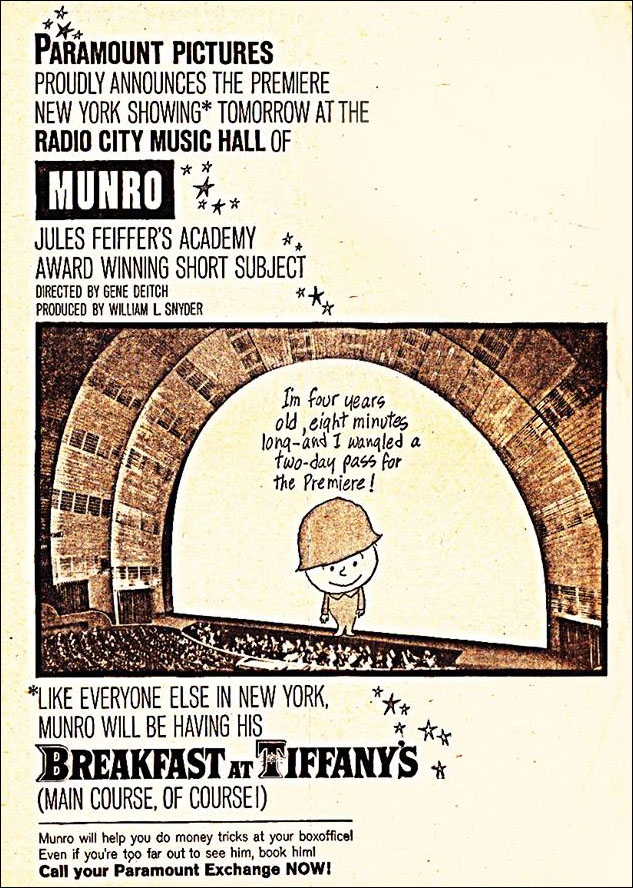
Munro (1960)

day 74, munro

MUNRO (1960) Four stars
I’ll make the review of this 1960 Czechoslovak-American animated short directed by Gene Deitch a short one, I promise.

It centers on a basic premise: The army drafts a 4-year-old boy.

Munro starts out your average little boy and then just a minute into the film, his life changes when he receives something in the mail. He can’t read, so a bigger person reads it to him. Cue that military music.

“At the age of 4, he’d been drafted.”

Then we join Munro for his physical. He’s the runt of the litter, for sure, and he’s the only one not talking about all his physical ailments, like a bad back.

Munro gets classified as “1A” or “eligible for military service.”

Munro goes to war.

It’s a foreign world for the little man with foreign words flying at him. This Sgt. couldn’t speak English very well, according Munro.

“Tenhoot,” “Foorit hoo,” “Hup haw hee haw hip hee haw hip,” et cetera.

Munro becomes a full-blown soldier and he plays all the games that soldiers play, like “Face.” Let’s see, there’s “Ri’,” “Lef’,” “Up,” “Down,” “In,” “Out,” and “Face” variances in “Face.”

Munro eventually becomes very tired.

Why?

“I’m only 4.”

They do not believe him.

Go back out and march in the rain.

They believe Munro’s faking that he’s only 4.

The experts think he’s a malinger.

The Colonel wants to shove him in the stockade.

They still won’t believe that he’s only 4.

Munro decides that he will be the best soldier.

Recruits pass by Munro and they’re told, “See that man, that’s a soldier. That’s what we’re gonna train you to be. We’re gonna separate the men from the boys.”

Munro then begins to cry.

They’re all embarrassed.

The General finally gets to the bottom of it, “You’re nothing but a baby boy.”

Munro signs his release form, and he gets a big parade in his honor with a message from the President himself.

American syndicated cartoonist and author Jules Feiffer, who’s considered the most widely read satirist in the country, wrote MUNRO. Feiffer won a Pulitzer Prize in 1986 and he was inducted into the Comic Book Hall of Fame in 2004. MUNRO won the 1961 Academy Award for Best Animated Short.

Feiffer wrote MUNRO when he was in the U.S. Army from January 1951 to January 1953.

“Every day I was enraged,” Feiffer said in an interview with Bookslut. “Every day I hated it. So much so that when they tried to promote me just as an automatic gesture to getting out, to raise your pay scale so you could get more, I refused to accept the raise in rank from private to PFC.”

Feiffer wrote MUNRO at his desk.

“With the full support of the man who supervised me,” Feiffer said, “who was this lllustrator who had a career that never took off in magazine illustration and this was his way of supporting the family. And his name was Perc Couse, who looked a very daunting, formidable man. He had a deep voice and scary, but he turned out to be a very warm, lovely, generous-hearted fellow who thought I and another G.I. there named Harvey Dinnerstein were much too talented to waste our time on Army stuff. So he let Harvey paint and he let me do my subversive satire. And I’m not sure he understood what I was doing, but after the war (Korea) he certainly did. After we were out, he took great pride, because we remained great friends until his death.”

MUNRO beat out some prestigious films and filmmakers for that Academy Award: Walt Disney Studios’ GOLIATH II, Warner Bros. cartoons HIGH NOTE and MOUSE AND GARDEN (the former directed by Chuck Jones and the latter by Friz Freleng, two of the legendary animators), and A PLACE IN THE SUN (not much info on this one).

George S. Kaufman said the famous words “Satire is what closes on Saturday night” after his play closed in Philadelphia and failed to make it to Broadway.

Though, in the 1960s, we had MUNRO and more prominently Stanley Kubrick’s dark Cold War satire DR. STRANGELOVE OR: HOW I LEARNED TO STOP WORRYING AND LOVE THE BOMB, one that still holds up rather well today.

MUNRO holds up rather well today, as well.

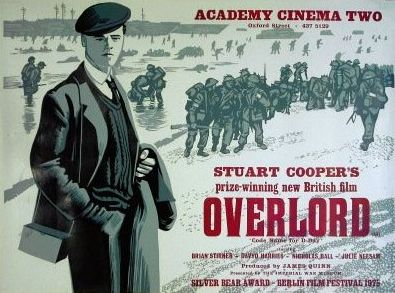
Overlord (1975)

day 73, overlord

OVERLORD (1975) Four stars
American director Stuart Cooper did something very interesting for his fourth film, 1975’s OVERLORD.

Cooper integrated archival footage of British training missions and the D-Day Invasion (a.k.a. Operation Overlord) into a fictional film about a young man’s journey from call up to the grave. Cooper and his very talented cinematographer John Alcott (he won the Academy Award for Best Cinematography for his work on Stanley Kubrick’s BARRY LYNDON, another 1975 film) did their best to make a consistent look so one could not tell any difference between the archival footage and the fictional story.

The Imperial War Museum granted Cooper access to its vaults and that’s where he found all that historical footage. Cooper had originally planned to make a documentary on the Overlord Embroidery, which commemorates scenes from wartime photos housed by the Imperial War Museum. Sandra Lawrence designed it and the Royal School of Needlework provided the handiwork.

Cooper told The Guardian in 2008, “I spent approximately 3,000 hours in that dark cell between 1971 and 1975, briefly interrupted by a couple of other projects. It was during the archival research that I developed the idea of a dramatised feature film about an English soldier who sees his first action on D-Day, interweaving the archive footage to expand and tell the story. …

“A major concern for my cinematographer, John Alcott, was how to match the texture of the archive footage. In an unprecented move, the museum granted us access to the original nitrate negatives. The quality of the original nitrate negatives was pristine. After Alcott examined them, we decided to film OVERLORD on period lenses. Alcott scoured England and found two sets of 1936 and 1938 German Goetz and Schneider lenses. Alcott then applied a lighting style in keeping with the war photography, seamlessly blending the archive and dramatised story. Seventy percent of the film is live action, which was completed in 10 days of filming.”

OVERLORD, though it won the Silver Bear at the 25th Berlin International Film Festival, seemed to have fallen through the cracks of history for many, many years.

Cooper again in The Guardian, “In spite of OVERLORD’s festival success, it never gained distribution in the U.S., which I suspect hurt its chances of being properly remembered. It may also have been because it was made during the tail end of the Vietnam War, as well as being a black-and-white film with a very British story. The only airing the film received in the U.S. was on Jerry Harvey’s Z Channel in 1982, a forerunner to U.S. cable stations. Twenty-two years later, Xan Cassavetes, John Cassavetes’ daughter, included several clips of OVERLORD in her 2004 documentary, Z CHANNEL: A MAGNIFICENT OBSESSION. As a result, OVERLORD was invited to the Telluride Film Festival, where it was a surprise success. Shortly afterwards, it was belatedly picked up for U.S. distribution.”

Better late than never, for sure.

I found out about the film from Roger Ebert’s 4-star review in 2006.

Ebert first wrote about the film at Telluride in 2004, “The most remarkable discovery at this year’s Telluride is OVERLORD, an elegiac 1975 film that follows the journey of one young British soldier to the beaches of Normandy. … Unlike SAVING PRIVATE RYAN and other dramatizations based on D-Day, OVERLORD is an intimate film, one that focuses closely on Tom Beddoes (Brian Stirner), who enters the British army, goes through basic training and is one of the first ashore on D-Day. Beddoes is not a macho hero but a quiet, nice boy, who worries about his cocker spaniel and takes along ‘David Copperfield’ when he goes off to war.”

Christopher Hudson’s screenplay built scenes based on diaries and letters from real servicemen, again providing something unique from the average war film.

Unique is definitely one word for OVERLORD.

You sometimes feel like you’re watching a real young man’s life, as if Tom Beddoes had been a real person and had been followed around by a documentary film crew who managed to conceal themselves from the real people being filmed.

That’s a different feeling than just about every other fictional war movie.

Of course, OVERLORD includes all the standard issue scenes: Tom’s call up, his basic training, his meeting a young woman whom he falls in love with (she’s called “The Girl” in the credits), his journey overseas, and finally his death on D-Day.

OVERLORD reminds us that clichés have their roots in things commonly happening to people.

Who knows how many Tom Beddoes there have been and will be throughout the pages of history.

I drift back to the following lyrics from the Clash’s “The Call Up,” “There is a rose that I want to live for / Although, God knows, I may not have met her / There is a dance an’ I should be with her / There is a town unlike any other.”

1941 (1979)

day 68, 1941

1941 (1979) Three-and-a-half stars
I have a general rule: Any movie featuring Slim Pickens, Christopher Lee, and Toshiro Mifune in the same scene will automatically be given a positive review, so Steven Spielberg’s 1941 has that going for it right off the bat.

I am sure you remember Pickens, Lee, and Mifune.

Pickens (1919-83) played many, many supporting roles in Westerns, but he also had a great role in Stanley Kubrick’s DR. STRANGELOVE as Major T.J. “King” Kong that incorporated his cowboy flair.

Lee (1922-2015) played Count Dracula seven times, I do believe, in Hammer productions like TASTE THE BLOOD OF COUNT DRACULA and later appeared in one James Bond, five Tim Burton, two STAR WARS, and three LORD OF THE RINGS films. There’s a story that Lee was once pulled over by a Hollywood traffic cop, who asked Lee if he should be driving in daylight.

Mifune (1920-97) appeared in over 150 movies during his career and none are more famous than his 16 collaborations with director Akira Kurosawa (ordered from last to first): RED BEARD, HIGH AND LOW, SANJURO, YOJIMBO, THE BAD SLEEP WELL, THE HIDDEN FORTRESS, THE LOWER DEPTHS, THRONE OF BLOOD, I LIVE IN FEAR, SEVEN SAMURAI, THE IDIOT, RASHOMON, SCANDAL, STRAY DOG, THE QUIET DUEL, and DRUNKEN ANGEL.

All three actors are each speaking different languages.

Awesome.

Pickens, Lee, and Mifune appear together early on in 1941 and we get the first shark victim in JAWS (actress and stuntwoman Susan Backlinie) as bonus opening scene treat.

1941 is the bastard child on Spielberg’s filmography, seemingly the film that even he doesn’t like all that much.

Just how much of a bastard child?

John Wayne and Charlton Heston were both offered the role of General Stilwell and turned it down because they believed 1941 to be unpatriotic.

I believe Wayne even told Spielberg that he should be ashamed … and called the script the most anti-American piece of drivel he ever read.

Robert Stack took on Stilwell and looking at photos of the real Joseph Stilwell, the actor looks just like the real person.

1941 came between CLOSE ENCOUNTERS OF THE THIRD KIND (1977) and RAIDERS OF THE LOST ARK in Spielberg’s filmography, so of course the $94 million worldwide gross of 1941 would be considered a huge bust compared to $300 million for CLOSE ENCOUNTERS and $390 million for RAIDERS.

It’s an oversized, loud comedy that mostly fails on that intended level, but succeeds in other ways. That’s very strange and yes, 1941 is very strange indeed.

Spielberg himself said, “Some people think (1941) was an out-of-control production, but it wasn’t. What happened on the screen was pretty out of control, but the production was pretty much in control. I don’t dislike the movie at all. I’m not embarrassed by it. I just think that it wasn’t funny enough.”

Spielberg has said that Robert Zemeckis, who co-wrote the picture with Bob Gale, should have directed the picture.

Though I don’t laugh at the vast majority of 1941, I am never bored and I end up smiling through a lot of the picture.

I’ve already mentioned Pickens, Lee, Mifune, and Stack, and that just scratches the surface of the star power on board.

We also have Dan Aykroyd, Ned Beatty, John Belushi, Lorraine Gary, Murray Hamilton, Tim Matheson, Warren Oates, and Nancy Allen, and several more familiar faces in Treat Williams, Bobby DiCicco, Eddie Deezen, Wendie Jo Sperber, Perry Lang, Penny Marshall, Michael McKean, Joe Flaherty, Mickey Rourke, and John Candy.

In addition to Pickens, we have a couple more of the great old-time character actors in Dub Taylor and Elisha Cook Jr.

Williams, DiCicco, Dianne Kay, and especially Sperber are particularly delightful and basically steal the movie away from the bigger names. They are fun, fun, fun, that’s for sure, and their work peaks at the USO club sequence, by far the best part of the movie that incorporates a dance contest and a brawl. This sequence found inspiration from both a film and real life: Universal Pictures’ HELLZAPOPPIN’ (1941) and the Zoot Suit Riots of 1943. I rate this sequence with any Spielberg’s ever done throughout his nearly five-decade career; Spielberg thought about making 1941 an old-fashioned musical, but he said he didn’t have the guts to go through with it at the time.

There’s just a lot of enjoyable moments during 1941, plain and simple.

For example, Stilwell watched DUMBO twice in real life during the month of December 1941 when he was a commander in the Los Angeles area. Stilwell, I believe, even cries watching DUMBO in 1941. Sure difficult being a cinephile.