
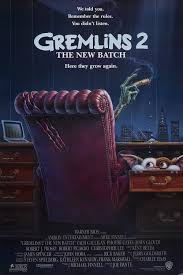
Gremlins 2: The New Batch (1990)

GREMLINS 2

GREMLINS 2: THE NEW BATCH (1990) Four stars

I watched GREMLINS 2: THE NEW BATCH for the first time sometime that summer after it first attacked multiplexes on June 15, 1990.

I wanted to see it badly, since I absolutely loved the original GREMLINS and felt hyped up additionally by the TV ads. I saw it at the Pittsburg 8 during a calendar year (1989-90) that brought multiplex trips to BATMAN, BACK TO THE FUTURE PART II, PARENTHOOD, and TEENAGE MUTANT NINJA TURTLES.

GREMLINS 2 did not let me down, I loved it then and I love it now after having seen it several times, and it has remained one of the most pleasurable multiplex experiences of my life. It’s lingered in my head all these years.

For example, every time since watching GREMLINS 2, when I hear Frank Sinatra’s “New York, New York,” I cannot help but replace it with the Gremlins’ grand production number inside my head. Watching the horribly overrated SHAME (2011) quite a few years back, I wished that GREMLINS 2 and SHAME were spliced together and the little beasties would ruin Carey Mulligan’s showcase rendition.

I’ve heard that GREMLINS 2 is an acquired taste and that you have to be in a certain mood to watch it. Well, I can say that I have acquired that taste and I don’t know, I’m always in the mood to watch a good movie.

“Silly rather than scary like the first GREMLINS” is the verdict on GREMLINS 2 and what people really mean when they spew the party line about being in that certain mood.

— GREMLINS 2 is a running commentary on sequels — everything from merchandising to an endless supply of new characters to sharp but affectionate jabs at the rules of the GREMLINS world and movie sequels in general.

It attempts to be an anti-sequel.

“When I was asked to do the sequel, which I originally turned down because it was so hard to make the first one,” director Joe Dante said in a 2015 interview. “The only reason I decided to make the sequel was because years later they had tried to make a sequel and couldn’t figure out how to do it, and they really wanted another one. So they said to me, ‘If you give us a couple of cans of film with gremlins in them next summer, you can do whatever you want.’ And they gave me three times the money we had to make the first one. So I made GREMLINS 2, which was essentially about how there didn’t need to be a sequel to GREMLINS.”

— We all know the three rules from GREMLINS: Don’t get them wet; Don’t expose them to bright light (especially sunlight, it will kill them); Don’t feed them after midnight.

Naturally, in GREMLINS 2, supporting characters in a control room challenge the hero Billy after he shares the rules.

“What if one of them eats something at 11:00, but then he gets something stuck in his teeth?”

“Like a caraway seed or a sesame seed?”

“And after 12:00, it comes out. Now, he didn’t eat that after midnight.”

It goes on.

“Wait, what if they’re eating in an airplane and they cross a time zone? I mean, it’s always midnight somewhere.”

I am sure many of us asked the burning question, “Isn’t it always after midnight?”

— Mr. and Mrs. Murray Futterman, whom we all thought met their demise in GREMLINS, return for the sequel. That guy Dick Miller (1928-2019) and Jackie Joseph (born 1933) reprise their roles, partly because it’s a Joe Dante movie and what’s a Joe Dante movie without Dick Miller.

— GREMLINS sparked much controversy over its ‘PG’ rating and parents complained about the film, a fact incorporated into GREMLINS 2.

From a 1984 article in The Christian Science Monitor, “Recent releases such as INDIANA JONES AND THE TEMPLE OF DOOM and GREMLINS have spurred controversy about their PG ratings. Many parents felt the violent content and some of the special effects warranted a stiffer rating. A significant number of directors, producers, and theater owners agreed and pushed for a change.”

Hence, the PG-13 rating was born and it debuted with the release of RED DAWN on Aug. 10, 1984.

— Film critic Leonard Maltin, a fan of Dante and his work, gave a negative review to GREMLINS.

“A teenager’s unusual new pet spawns a legion of vicious, violent monsters who turn picture-postcard town into living hell. Comic nightmare is a cross between Capra’s IT’S A WONDERFUL LIFE and THE BLOB; full of film-buff in-jokes but negated by too-vivid violence and mayhem.”

Maltin then makes a gratuitous cameo appearance in GREMLINS 2, where he’s mauled by the new batch for his negative review of the original film. Maltin’s famous last words, “Ow. I was just kidding. Ah. It’s a 10. It’s a 10.”

— At one point in GREMLINS 2, the title monsters disrupt their own film and it takes a threat from Hulk Hogan to get the picture back on track. …

“Okay you guys, listen up! People pay good money to see this movie! When they go out to a theater they want cold sodas, hot popcorn, and no monsters in the projection booth! Do I have to come up there myself? Do you think the Gremsters can stand up to the Hulkster? Well, if I were you, I’d run the rest of GREMLINS 2! Right now! Sorry folks, it won’t happen again.”

— Phoebe Cates became famous predominantly for two scenes: doffing her bikini top to the tune of the Cars’ “Moving in Stereo” in FAST TIMES AT RIDGEMONT HIGH and her ‘Why I hate Christmas’ speech in GREMLINS. In GREMLINS 2, Cates’ Kate starts on a speech why she also hates Lincoln’s birthday.

— GREMLINS and GREMLINS 2 main protagonist Billy Peltzer’s inept inventor father Rand (Hoyt Axton) played a pivotal role in the first movie. Rand Peltzer gets an upgrade in GREMLINS 2. We get eccentric billionaire Daniel Clamp (John Glover), a combination of Donald Trump and Ted Turner, whose technological innovations inside his wonderful Clamp Tower never seem to work properly. I get a kick from the building announcements, for example “Tonight, on the Clamp Cable Classic Movie Channel, don’t miss CASABLANCA, now in full color with a happier ending.”

The title characters take over Clamp Tower, creating all sorts of memorable scenes.

— I should perhaps mention the diabolical Dr. Catheter (Christopher Lee), identical twins Martin and Lewis played by identical twin actors Don and Dan Stanton, Grandpa Fred (Robert Prosky) clearly inspired by Grandpa (Al Lewis) from “The Munsters,” the appearance of the Batman logo, and a talking Gremlin named Brain (voiced by Tony Randall) who gets an opportunity to sum up the ethos of the beasts.

“The fine points: diplomacy, compassion, standards, manners, tradition … that’s what we’re reaching toward. Oh, we may stumble along the way, but civilization, yes. The Geneva Convention, chamber music, Susan Sontag. Everything your society has worked so hard to accomplish over the centuries, that’s what we aspire to; we want to be civilized.”

Of course, in the very next moment, Brain takes out his gun and shoots dead a goofy acting Gremlin.

Civilization is very hard to come by.
The Blob (1958)

THE BLOB 2

THE BLOB (1958) Four stars

Watching the original BLOB just the other day, once again it hit me how much THE BLOB seems to be influenced by the 1955 classic REBEL WITHOUT A CAUSE.

THE BLOB leads Steven McQueen and Aneta Corseaut respectively call to mind James Dean and Natalie Wood (McQueen even a few years older than Dean playing a high schooler), there’s a more friendly policeman in both films (Ray in REBEL WITHOUT A CAUSE, Dave in THE BLOB), and they both are iconographic time capsule films that appeal to all generations.

Plain and simple, THE BLOB is a goofy, ridiculously fun time at the movies.

It sets the tone with that glorious theme song over the opening credits — “Theme from the Blob” by the Five Blobs and it’s a real catchy little ditty written by Burt Bacharach and Mack David. It sure beats “Raindrops Keep Falling on My Head.”

“Beware of the Blob, it creeps

And leaps and glides and slides

Across the floor

Right through the door

And all around the wall

A splotch, a blotch

Be careful of the Blob.”

What’s the Blob? A modified weather balloon in early shots and colored silicone gel in later shots. From outer space.

It’s also been compared to cherry Jell-O.

THE BLOB was inspired by a real event that happened in  1950 Philadelphia. The Philadelphia Inquirer headline on Sept. 27, 1950: FLYING ‘SAUCER’ JUST DISSOLVES. Joe Keenan and John Collins, a pair of veteran police officers who probably both thought they had seen just about everything before the night in question, spotted a mysterious object falling from the sky, of course, just like in THE BLOB and KILLER KLOWNS FROM OUTER SPACE, for that matter. They pursued this mysterious object and eventually encountered a large mass which they described as “purple jelly.” Collins decided that he would reach out and touch the mysterious object … by that point, backup (two more officers) had arrived, so four policemen were taking on the case. Collins had much better luck than the old man at the beginning of both ’58 BLOB and ’88 BLOB. He survived. Within 30 minutes of the first sighting, this blob-like object disappeared. The police told their story to the local media the next day, and the rest is history.

Made for $240,000 (though numbers vary, as low as $110,000 has been reported), THE BLOB predates later George Romero horror films made in Pennsylvania.

THE BLOB filmed at Valley Forge Studios — destroyed by a fire in 1962 — and the towns of Phoenixville, Downingtown, Chester Springs, and Royersford. These locations give THE BLOB an unique flavor and I do enjoy how eventually young and old alike work together to defeat the monster.

Phoenixville (2018 estimated pop.: 16,957) features the historic Colonial Theatre, one of the town’s claims to fame. Since 2000, Phoenixville and the Colonial commemorate THE BLOB with the annual “Blobfest.” The 21st edition will be held July 10-12, 2020. Every year, of course, they reenact the famous run out from the Colonial when the title character attacks. In addition to THE BLOB, FORBIDDEN PLANET and TEENAGERS FROM OUTER SPACE will be featured in 2020.

(BTW, Phoenixville ranks in the top 10 in the U.S. in breweries per capita. Let’s see, there’s Root Down, Crowded Castle, Stable 12, Rebel Hill, Rec Room, Iron Hill, Sly Fox, Baba’s Brew, A Culture Factory, Stickman Brews, Tuned Up, Steel City, et cetera, on the map.)

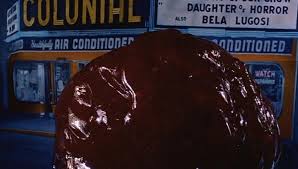
It just doesn’t get much better than when the title character attacks The Colonial during DAUGHTER OF HORROR, a real movie that’s the altered version of the 1955 movie DEMENTIA. The Kino Video DVD cover highlights three great reviews for DEMENTIA. Variety: “May be the strangest film ever offered for theatrical release.” Preston Sturges: “A work of art. It stirred my blood and purged my libido.” New York Censor Board: “Overflows with horror, hopelessness, sadism, violent acts of terror and outbursts of panic.”

Anyway, the Blob hates the cold. In that case, though, the Colonial must not have been too “Healthfully Air Conditioned,” because the Blob seems to thrive as it engorges the poor projectionist and heads into the auditorium.

Sometimes, during a bad bad bad movie at the multiplex, I’ve wanted the Blob to strike our screen and send us running.

The Bad News Bears (1976)

THE BAD NEWS BEARS

THE BAD NEWS BEARS (1976) Four stars

I can hear somebody out there shout that THE BAD NEWS BEARS is not an underrated movie.

Sure, it’s not an underrated comedy or an underrated baseball movie, but I believe THE BAD NEWS BEARS is underrated as a serious consideration of competition and the effects of winning both individually and collectively on a team. Perhaps it’s because of director Michael Ritchie (1938-2001), whose other credits include THE CANDIDATE, SMILE, DOWNHILL RACER, and both FLETCH movies, that we get a sports comedy that goes a little deeper.

It’s that additional level that makes THE BAD NEWS BEARS my favorite baseball movie.

The Bears are, of course, the worst team in a prestigious California Little League. They’re a motley crew of misfits or as their firebrand shortstop Tanner Boyle (Chris Barnes) puts it in his inimitable way, “All we got on this team are a buncha Jews, spics, niggers, pansies, and a booger-eatin’ moron.”

Of course, they’re not wanted in this elite league — in fact, city councilman and attorney Bob Whitewood (Ben Piazza) sued and won a lawsuit against that prestigious Little League to allow the least skilled athletes (including his son Toby) to play in the first place. The Bears are made up of those bottom-of-the-barrel players.

Whitewood hires Morris Buttermaker (Walter Matthau), a former Minor League pitcher who turned to a life of beer and cleaning swimming pools … but mostly beer. Whitewood pays Buttermaker under the table to coach the Bears.

Buttermaker and the Bears are opposed by Coach Roy Turner (Vic Morrow) and the Yankees, namely Coach Turner’s son and star pitcher Joey Turner (Brandon Cruz, later a punk rock singer), at every turn. The Yankees are a juggernaut, of course, and the assholes and the bullies.

Along the way the Bears pick up two critical acquisitions: 11-year-old tomboy pitcher Amanda Whurlizer (Tatum O’Neal) and local hoodlum Kelly Leak (Jackie Earle Haley), who joins the Bears to get back at Coach Turner and to pursue his crush on Amanda.

The Bears start winning and they make it to the championship game against the hated Yankees.

Please keep in mind THE BAD NEWS BEARS does not end like so many sports movies with the underdog winning the Big Game. It’s funny that both THE BAD NEWS BEARS and ROCKY end differently than all the movies they influenced.

It’s more important that Buttermaker and the Bears finally see the effects winning had on them and how they started becoming more and more like them damn Yankees.

By the final scene, when the Yankees sing an obligatory and condescending cheer for the Bears, they’ve already had it and Tanner speaks for the entire Bears team when he tells the Yankees, “You can take your apology and your trophy and shove ‘em straight up your ass!”

Honestly, that’s a more satisfying finish than a win in the big game.

THE BAD NEWS BEARS IN BREAKING TRAINING and THE BAD NEWS BEARS GO TO JAPAN followed in successive years for three movies in three years and both sequels are lesser movies, especially the latter as the Bears resembled a high school baseball team. Kelly Leak, in fact, looks ready to join the cast of BREAKING AWAY. Yeah, GO TO JAPAN should be titled LONG IN THE TOOTH.

Matthau is perfect for the role of Buttermaker and the sequels miss him dearly, as William Devane (BREAKING TRAINING) and Tony Curtis (GO TO JAPAN) lack both the comedic and dramatic touches of Matthau. They’re just not as good as Matthau, who takes on a wide range in THE BAD NEWS BEARS. Matthau (1920-2000) handles the scenes where Buttermaker’s drunk, the quiet moments with Amanda, the screaming matches against Turner, and the shift in his personality after the Bears start winning. Matthau gives a great performance. He’s one of those actors that we’ll follow all the way through a turn toward asshole. Buttermaker takes a major asshole turn.

For example, Buttermaker pitches Amanda into early retirement, instructs Kelly Leak to go chase down and catch every fly ball even the ones hit to the other fielders, and commands godawful hitter Rudi Stein (David Pollock) to purposely get hit by pitches to give the Bears a runner on base.

The younger actors do not wear out their welcome and they’re not too damn cute for their (and our) own good. Yes, thankfully, it’s not one of those movies where the younger actors mug so heavily that I have to check my back pocket for my wallet.

There are many big laughs and moments of truth in THE BAD NEWS BEARS and the film deftly maneuvers between farce and slapstick, satire, sentiment, and drama.

Mad Max (1979)

MAD MAX

MAD MAX (1979) Four stars
12 weeks. $350,000. Guerrilla style filmmaking in and around Melbourne, Australia. A first-time feature film director and a largely unknown cast. A legitimate motorcycle gang. A refurbished 35mm camera somehow left behind from Sam Peckinpah’s THE GETAWAY.

You just read a success story.

Part of the Australian New Wave that invaded American theaters in the late 1970s and early 1980s, George Miller’s MAD MAX plays like a ripped, twisted cross between an American Western like HIGH NOON, Sergio Leone Westerns, Jack Kerouac’s “On the Road” and Hunter S. Thompson’s “Hell’s Angels,” American International biker pics, dystopian science fiction, horror films, good old-fashioned hyperkinetic action, and ultra-violent vigilante justice like DEATH WISH and TAXI DRIVER.

When good old American International Pictures released MAD MAX in America in 1980, they played up the film’s action content in promotion since lead actor Mel Gibson was not yet the international star that he would soon become and they Americanized the language with a new dub replacing the original Australian dialogue. (I own both versions, and I prefer the original Australian dub.)

After the prerequisite title card (Miller said the film’s low budget created the need for a post apocalyptic world), MAD MAX wisely jumps straight into the action with a fantastic, slam-bang chase scene that lasts 10 minutes. I rate this chase among the very best during an era that included many great chase scenes, like BULLITT and THE FRENCH CONNECTION.

In those chases, you feel like anything could happen at any given time. They look real. They feel real. Real cars, real danger.

Understatement: MAD MAX starts on a high note.

The setup for the chase: A ripped, twisted individual named “The Nightrider” kills a Main Force Patrol rookie officer and takes off in the officer’s Pursuit Special. MFP officers are in hot pursuit and the Nightrider eludes them until he meets his match in Max Rockatansky (Gibson).

Vincent Gil plays the Nightrider and his brief appearance proves to be absolutely essential in establishing the entire MAD MAX series.

He’s crazy, yeah, crazier than a shit house rat. I believe one of the officers calls him a terminal psychotic. He’s got verbal style, though, and this is one of the elements that defines MAD MAX, although words became fewer over time.

Max asks his best friend Goose (Steve Bisley) “Much damage?” over the radio and the Nightrider gives one of the great responses, helped out by a quote from Australian hard rock band AC/DC: “You should see the damage, bronze. Huh? Metal damage, brain damage. Heheheh. Are you listening, bronze? I am the Nightrider. I’m a fuel injected suicide machine. I am a rocker, I am a roller, I am a out-of-controller! I’m the Nightrider, baby!”

It’s an indelible sight as the Nightrider turns from brashness to sheer terror in his final moments.

The Nightrider’s motorcycle gang brethren, namely the Toecutter (Hugh Keays-Byrne), Bubba Zanetti (Geoff Parry), and Johnny the Boy (Tim Burns), pursue their revenge and enact their reign of terror on the Australian countryside.

Max loses his faith in justice, his best friend, and his family, his wife Jessie (Joanne Samuel) and his infant son.

At one point, Max tells his boss, “Any longer out on that road and I’m one of them, you know? A terminal crazy … only I got a bronze badge to say I’m one of the good guys.”

Max goes AWOL from the MFP, steals their Pursuit Special, and he stalks and kills the Toecutter, Bubba Zanetti, and finally Johnny the Boy.

Max drives off into the wasteland, a shell of his former self. We’re unsure of the future of this man.

I favor MAD MAX over both THE ROAD WARRIOR and MAD MAX: FURY ROAD because of a greater emotional investment. It shows us everything Max lost, and it’s less spectacle than the later films, obviously due to the difference in budget constraints. (FURY ROAD, for example, cost a cool $150 million. That’s 428.571428571 times the budget of the original.)

Miller, whose credits include BABE: PIG IN THE CITY and THE WITCHES OF EASTWICK in addition to the Mad Max films, is a former medical doctor and that profession informs MAD MAX.

Miller worked as an emergency room doctor to earn funds to make MAD MAX.

The surname “Rockatansky” derives from 19th century Bohemian pathologist Carl von Rokitansky, who originated a procedure that became the most common method for the removal of internal organs during an autopsy.

Miller’s experiences in the emergency room with motorcycle and automobile accidents are played out in MAD MAX.

Five great Australian New Wave films:
— PICNIC AT HANGING ROCK (1975)
— THE LAST WAVE (1977)
— THE CHANT OF JIMMIE BLACKSMITH (1978)
— MAD MAX (1979)
— BREAKER MORANT (1980)