Frankenstein Meets the Wolf Man (1943)

FRANKENSTEIN MEETS THE WOLF MAN (1943) ***1/2
Frankenstein Meets the Wolf Man starts with an absolute big bang and we have possibly the greatest five minutes in any classic Universal monster movie.

That includes such immortal movies as Frankenstein, The Bride of Frankenstein, Son of Frankenstein, Dracula, The Mummy, The Invisible Man, and The Creature from the Black Lagoon, all stone cold classics essential to every horror movie lover.

The opening gets everything absolutely right: two grave robbers, a cemetery in the middle of the night, Larry The Wolf Man Talbot’s crypt, a full moon, a whole bunch of wolfbane, the revived Wolf Man’s hand, and enough overall spooky atmosphere for approximately 50 scary movie scenes. Yeah, it’s such a phenomenal sequence that director Tom McLoughlin revived it for his opening in Jason Lives, the one film during that long-running series most influenced by classic monster movies.

The rest of Frankenstein Meets the Wolf Man does not quite measure up, especially once Frankenstein’s Monster enters the picture, but it’s still a great deal of fun.

Of course, it doesn’t hurt any that Lon Chaney Jr. (1906-73) returns as Larry Talbot, one of the greatest horror movie characters. Chaney Jr. played Talbot five times from 1941 through 1948 — the original Wolf Man, Frankenstein Meets the Wolf Man, House of Frankenstein, House of Dracula, and Abbott and Costello Meet Frankenstein.

Talbot’s a tortured soul — in fact, mondoshop.com hypes its Wolf Man poster, The most tortured soul in the Universal Monsters universe is unquestionably that suffering bastard Larry Talbot, a.k.a. The Wolf Man — and we feel great empathy for this character because he essentially doesn’t want any damn part of being the Wolf Man. Your own son Bela was a werewolf. He attacked me. He changed me into a werewolf. He’s the one that put this curse on me. You watched over him until he was permitted to die. Well, now I want to die to. Won’t you show me the way?

In that way, he’s different from Dracula, Frankenstein’s Monster, the Mummy, and the Invisible Man. Lon Chaney’s Phantom in the 1925 classic The Phantom of the Opera inspires similar feelings as Talbot and the Wolf Man. To his enduring credit, Boris Karloff (1887-1969) worked some pathos into Frankenstein’s Monster, especially in Frankenstein and The Bride of Frankenstein. Still, Talbot stands apart from most cinematic monsters and maybe it’s because he’s the most explicitly human.

Bela Lugosi (1882-1956) passed on Frankenstein’s Monster in Frankenstein, much to his eternal regret, and so he signed on for the Monster in Frankenstein Meets the Wolf Man after playing Ygor in Son of Frankenstein and The Ghost of Frankenstein. During the latter film, one might remember that Dr. Ludwig Frankenstein accidentally put Ygor’s brain into the Monster’s head — he speaks poetically at one point in the film, I am Ygor. In a series that paid minuscule attention to continuity from one film to the next, the Monster originally spoke and explained his plight in Frankenstein Meets the Wolf Man, but Universal studio heads apparently laughed their heads off at Lugosi’s dialogue and demanded it be excised from the final cut, rendering the monster absolutely ridiculous and his scenes basically a washout. I am not sure why Lugosi’s voice suddenly became laughable. Lugosi’s stunt double stands in for the 61-year-old man in many scenes. Ironically, though, whenever people imitate Frankenstein’s Monster, it’s the Lugosi version from Frankenstein Meets the Wolf Man. (Lugosi played Bela in The Wolf Man and Chaney Jr. was Frankenstein’s Monster in The Ghost of Frankenstein after Karloff bowed out.)

We’re not sure exactly why the Monster’s encased in ice or why there’s a production number that must have moseyed on over from MGM. The second half of Frankenstein Meets the Wolf Man often leaves us feeling awful perplexed.

Frankenstein Meets the Wolf Man finishes strong, thankfully, and we do see our titular monsters slug it out, though it presents an internal struggle because while we’d love more battle royale between the monsters we do love the 90 seconds they give us. This movie paved the highway for King Kong vs. Godzilla and Freddy vs. Jason.

In most every way possible, Frankenstein Meets the Wolf Man proves to be a red hot mess, but a lovable and thoroughly entertaining one nonetheless.

Odds and Odds: The Vikings, Dolls, The Monster Squad, Scream Blacula Scream

ODDS AND ODDS: THE VIKINGS, DOLLS, THE MONSTER SQUAD, SCREAM BLACULA SCREAM
Richard Fleischer’s The Vikings calls to mind epic grand adventure pictures Captain Blood, The Adventures of Robin Hood, The Sea Hawk, and The Sea Wolf, not to mention The Seventh Voyage of Sinbad from the same year (1958) and John Boorman’s Excalibur from 1981.

Kirk Douglas’ lust for life recalls Errol Flynn’s in Captain Blood, Robin Hood, and Sea Hawk and Janet Leigh’s incredible beauty compares with Olivia de Havilland’s in Captain Blood and Robin Hood, as well as Helen Mirren’s in Excalibur. Never mind that Leigh and Mirren play characters named Morgana; however, their beauty and first name are where their characters’ similarities begin and end.

In other words, The Vikings belongs to the fine cinematic tradition of swashbucklers, hair-raisers, cliff-hangers, nail-biters, period costume pieces, and historical fiction.

Of course, it doesn’t hurt that it has an uncredited Orson Welles narrate. The Vikings, in Europe of the eighth and ninth century, were dedicated to a pagan god of war, Odin. Trapped by the confines of their barren ice-bound northlands, they exploited their skill as shipbuilders to spread a reign of terror, then unequaled in violence and brutality in all the records of history. Good stuff.

Highlights include Douglas’ Einar and Curtis’ Eric having key body parts removed, the former his eye by a falcon and the latter his hand in a bout of capital punishment. These moments undoubtedly make The Vikings one of the most gruesome films in 1958 this side of the British classic Fiend Without a Face. Oh, that’s a golden oldie.

Naturally, one can’t go too wrong with any picture where Ernest Borgnine plays a character named Ragnar and spouts screenwriter Calder Willingham’s dialogue like a bountiful fountain, for example What man ever had a finer son? Odin could have sired him, but I did … and Look how he glares at me. If he wasn’t fathered by the black ram in the full of the moon my name is not Ragnar.

Back in the day, my friend would call on quotes from Airplane and Austin Powers for our amusement, and it’s a crying shame that we had no idea about The Vikings, because I think lines such as You sound like a moose giving birth to a hedgehog and The sun will cross the sky a thousand times before he dies, and you’ll wish a thousand times that you were dead would have perfectly fit a night of carousing, especially for two byproducts of a school with Vikings for its mascot.

Rating: Four stars.

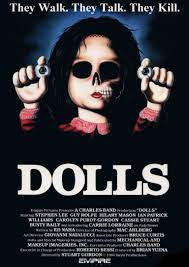
— I finally got around to watching Stuart Gordon’s Dolls for the first time.

Finally, because I love Gordon’s first two features Re-Animator and From Beyond.

I must say that I wasn’t disappointed by Dolls, though it’s a step down from From Beyond and a good two or three from Re-Animator.

Alas, Dolls belongs to a slightly different but no less venerable tradition than Re-Animator and From Beyond, both of which cross mad scientists and low-budget exploitation (nudity, gore, etc.). Think Frankenstein meets Dawn of the Dead.

Dolls, meanwhile, recalls such touchstones as The Old Dark House and The Devil-Doll, not to mention the 1979 Tourist Trap. See if this plot sounds familiar: On a dark and stormy night, six people — a dysfunctional family (husband and father, wife and stepmother, and daughter / stepdaughter) and a young man with two hitchhikers — find the nearest house (The Old Dark House) and they have to fight to make it out of the other end of the motion picture alive because their kindly old hosts are magical toy makers with killer dolls (The Devil-Doll, Tourist Trap).

Like both Re-Animator and From Beyond, Gordon and Dolls screenwriter Ed Naha jump off from their basic old-fashioned plot structure with inspired moments of madness.

Dolls also predates Child’s Play by more than a year and rather than just one killer doll, it has a horde … but Child’s Play, created by Don Mancini, spawned Child’s Play 2, Child’s Play 3, Bride of Chucky, Seed of Chucky, Curse of Chucky, Cult of Chucky, and Child’s Play (2019), plus short films Chucky’s Vacation Slides and Chucky Invades and the TV series Chucky.

So, apparently, not all killer doll films are created equal.

Rating: Three stars.

The Monster Squad starts with an absolute genius idea: Take a group of kids, horror movie fans one and all, and have them do battle against Dracula, Frankenstein’s Monster, Wolf Man, Mummy, and Gill Man.

Yes, what an absolutely positively brilliant idea by screenwriters Shane Black and Fred Dekker, whose names ring a bell loud and clear for genre fans. Others will be familiar with their work regardless whether they know their names or not.

Black made his fame and fortune first for the script of the buddy cop picture Lethal Weapon and some of his other credits include Predator (he plays Hawkins), The Last Boy Scout, and The Long Kiss Goodnight.

Dekker’s other feature directorial credits are the fantastic Night of the Creeps and the not-so-fantastic RoboCop 3.

The Monster Squad gives us both protagonists and monsters that we like, and that goes a long way toward producing a memorable motion picture experience.

The Wolf Man gets his due for a change. The fat kid Horace kicks the Wolf Man in the groin and unleashes the film’s trademark line Wolfman’s got nards! In 2018, Andre Gower, one of the stars of The Monster Squad, directed a documentary named Wolfman’s Got Nards, which looks at the impact one little cult horror film made on fans, cast and crew, and the movie industry.

Anyway, in a movie filled with nifty little moments, I love it when the Wolf Man regenerates after he’s blown up real good.

On the site Drinking Cinema, I found a game for The Monster Squad so drink whenever: 1. Dynamite EXPLODES! 2. A monster dies! 3. You hear a sweet insult. 4. You learn a new monster fact. 5. The cops are having a really hard time figuring out that, um, hello, the perps are various Jack Pierce creations. 6. You see amazing dog acting. 7. You witness a patented Monster Slow-Walk. 8. There’s a monster scare!

I give The Monster Squad a slight deduction for the obligatory music video montage right around the midway point of the picture.

Rating: Three-and-a-half stars.

— Vampirism and voodoo go together rather well and their combination helps Scream Blacula Scream become one of those rare sequels I prefer over the original.

I thought William Marshall’s performance as the title character was the redeeming factor in Blacula and he’s every bit as good in Scream Blacula Scream. Marshall just has a commanding screen presence and he brings both a gravitas to a character and legitimacy to a movie that otherwise might be laughable with the wrong person in the main role. He’s equally effective in every guise of this character — the debonair Mamuwalde who has a definite charm with the ladies befitting an African prince (which he indeed was before the racist Dracula cursed him and imprisoned in a coffin until Blacula awakened in 1972 Los Angeles), the menacing Blacula with his fangs bared, and the more reflective Mamuwalde who hates the dreaded vampire curse.

A highly respectable box office return — not voodoo, no matter what the plot synopsis might read — brought Mamuwalde / Blacula / Marshall back.

In the first movie, Mamuwalde / Blacula comes to believe the lovely Tina’s the reincarnation of his long dead wife Luva. Well, it definitely helps that Vonetta McGee plays both Tina and Luva. By golly, doesn’t this plot thread just get you every single time?

In the sequel, Mamuwalde / Blacula believes in the voodoo powers of Lisa Fortier. She can provide a cure and exorcise the curse once and forever.

Scream Blacula Scream came out two weeks after Coffy and had it been made later in 1973 after Pam Grier busted out as a star playing Coffy, her Lisa Fortier character in Scream Blacula Scream would have undoubtedly been different. Grier plays a more traditional leading lady and screaming and shrinking damsel in distress in Scream Blacula Scream, and she’s definitely no shrinking violet in either Coffy or Foxy Brown. So if Scream Blacula Scream had been produced more in the aftermath of both Coffy and Cleopatra Jones, which came out a month after both Coffy and Scream Blacula Scream, surely American-International — one of the best exploitation film outlets — would have wanted Grier to play one badass mama jama vampire killer rather than her more stereotypical role.

Fair warning: Scream Blacula Scream ends on an extremely jarring note. I remember thinking, in the immortal song title of Peggy Lee, is that all there is? Despite the fact of that ending, you might be surprised to find that I am granting Scream Blacula Scream three-and-a-half stars. Yes, it is just that good.

Robin and Marian (1976)

ROBIN AND MARIAN (1976) ****
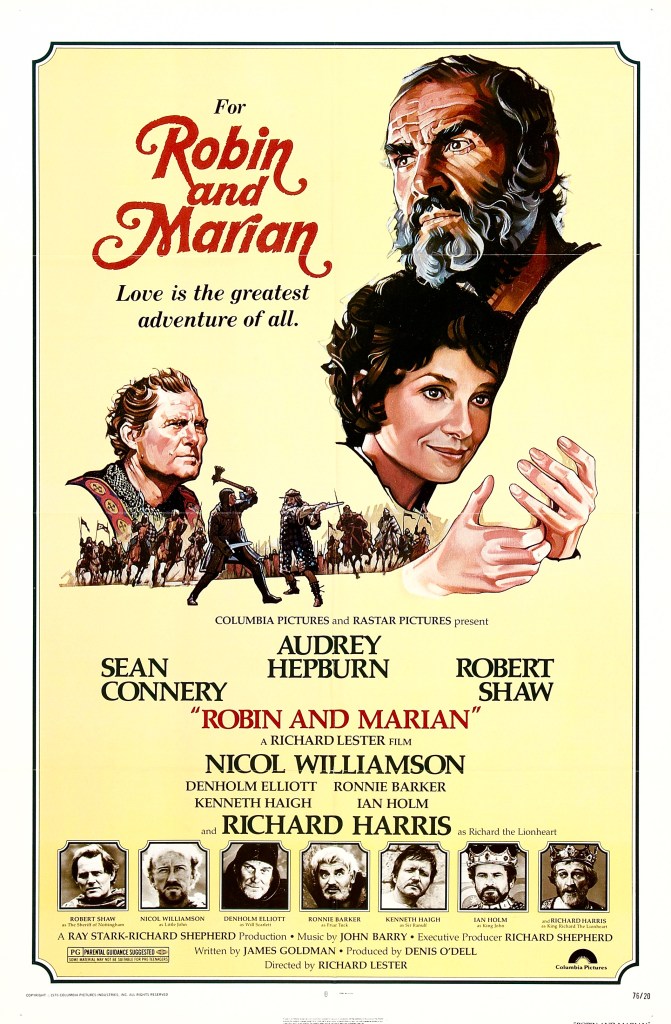
Richard Lester’s Robin and Marian definitely made a strong first impression.

I placed it on my top 10 films list for 1976, based on just viewing it a single time on cable TV many years ago.

Granted, Robin and Marian crossed my mind several times in recent months, especially after Robin and Marian star Sean Connery died last Halloween and then after I watched both the Disney (1973’s Robin Hood) and the Mel Brooks (1993’s Robin Hood: Men in Tights) takes on the legendary old warhorse. Disney and Brooks both left me feeling often unimpressed and ultimately supremely disappointed, for very different reasons, and I started thinking instead about superior Robin Hood films The Adventures of Robin Hood and Robin and Marian, both of which I first encountered during childhood or teenage years.

The Adventures of Robin Hood remains my favorite take on Robin Hood and I’ve watched it numerous times over the years. Of course, it helped that The Adventures of Robin Hood ranked among the select few titles Grandma Sisney had on VHS and I played it — along with Indiana Jones and the Temple of Doom and Fun in Acapulco — so many times before Grandma took over her TV for a day of game shows and soap operas. There’s always been something so indelible about Errol Flynn’s Robin Hood that I judge all others portraying Robin Hood against Flynn’s standard, Claude Rains and Basil Rathbone make incredibly satisfying villains, and Olivia de Havilland’s Maid Marian simply radiates a MOST BEAUTIFUL WOMAN IN THE WORLD AT THIS VERY MOMENT glow. Plus, it’s hard to forget the colors (and costumes) that argue for three-strip Technicolor superiority.

Robin and Marian left a mark for similar reasons — Connery and Audrey Hepburn both carry some of the same appeal as Flynn and de Havilland do in their iconic roles. Flynn was just a month shy of 29 years old when The Adventures of Robin Hood first came out in May 1938 and similarly, De Havilland was two months shy of a mere 22. However, Connery and Hepburn play older Robin Hood and older Maid Marian — please consider both Connery and Hepburn were in their mid-40s during Robin and Marian and each had a solid 15-20 years of stardom behind them. Connery and Flynn both have an undeniable robust humor and physicality (both men seemed tailor-made for James Bond, for example) and Hepburn could make claims on de Havilland’s radiant MBWITW glow several times during her career, from Roman Holiday and My Fair Lady to Robin and Marian.

Anyway, I finally watched Robin and Marian for a second time and it holds up as a great movie, right behind only The Adventures of Robin Hood in the Robin Hood cinematic pantheon.

Because of centering around middle age characters, Robin and Marian plays different notes and takes on a greater emotional range than any other Robin Hood film I have ever seen.

It’s definitely not the lusty adventure like The Adventures of Robin Hood. Sure, Robin and Marian has sword fights and scenic vistas and soaring music and horses and romantic clinches and every prerequisite of the genre, as well as King John, King Richard the Lionhearted, the Sheriff of Nottingham, Little John, Friar Tuck, Will Scarlett, and Sherwood Forest, but they’re all — both people and places, and every plot event — suffused with melancholy.

To be fair, though, Lester and Connery inject enough good humor and spirit into Robin and Marian to help it avoid being a more downbeat experience like the 1991 Robin Hood starring Kevin Costner. And the scenes between Connery and Hepburn are simply flat-out appealing, rooted in seeing two of the most attractive, most ebullient performers to ever grace the screen share time with each other (and us audience members).

It should also be mentioned that supporting players Nicol Williamson, Richard Harris, Denholm Elliott, and Ian Holm contribute to an absolute dynamite cast.

Didn’t we always ponder how it all turned out for Robin Hood, Maid Marian, the Sheriff, Little John, Friar Tuck, and Will Scarlett?

Lester’s film, with a screenplay written by James Goldman (writer of the play, film adaptation, and TV movie version of The Lion in Winter), answers those very questions, but do we viewers feel comfortable with the answers? Are we prepared to see Maid Marian as a nun because Robin Hood, off on his damn crusades and holy wars with Richard and Little John, didn’t write her for the last 20 years? We also found out that she attempted suicide. He’s back, though, and it’s obvious that Robin Hood and Maid Marian are destined to be together. They might initially hate it and initially fight it, she invariably more than he, but they are pulled together rather than apart.

All roads lead toward a final showdown between Robin Hood and the Sheriff (Robert Shaw). They fight like two worn-out, downtrodden men with many, many battles behind them and none ahead of them, who have resigned themselves to their final destiny. They fight because it’s their duty, or their almost perverse obligation to each other as hero and villain. They really don’t want to be fighting each other at this precise historical moment, it feels like, BUT THEY MUST FIGHT TO THE DEATH. There’s none of the joy in this fight that can be found in great film sword fights like the one, for example, between Robin Hood (Flynn) and the Sheriff (Rathbone) in The Adventures of Robin Hood. This final showdown, just like Robin and Marian overall, gives us something that’s different from any other purely adventure movie. All the main players have lived through considerable pain, considerable disappointment, and the film serves a reminder (from early on and throughout) there’s flesh-and-blood and real-life experience behind every legend, every song, every ode, every hymn, every myth.

Maid Marian gives Robin Hood (and us) some final words, “I love you. More than all you know. I love you more than children. More than fields I’ve planted with my hands. I love you more than morning prayers or peace or food to eat. I love you more than sunlight, more than flesh or joy or one more day. I love you more than God.”

Alice, Sweet Alice (1976)

ALICE, SWEET ALICE (1976) ***

They really tried hard with ALICE, SWEET ALICE, the horror film that’s best known for being Brooke Shields’ film debut.

It appeared in November 1976 at the Chicago International Film Festival, where it competed against such films as ALLEGRO NON TROPPO, GREY GARDENS, SMALL CHANGE, THE DEVIL’S PLAYGROUND, and Best Feature winner KINGS OF THE ROAD.

It received theatrical release (and mostly negative reviews) in 1977, 1978, and 1981. Viewers might have seen it as either ALICE, SWEET ALICE or COMMUNION (the original title) or HOLY TERROR depending on when they watched it.

The promotional forces especially played on the Brooke Shields angle in ‘78 and ‘81.

One of the ‘78 ALICE, SWEET ALICE ads proclaimed at its top, “PRETTY BABY Brooke Shields, America’s New Star,” a reference to Shields being in Louis Malle’s contemporaneous PRETTY BABY.

Three years later, the film returned as HOLY TERROR with a hard sell promotional campaign again built around exploiting Shields’ notoriety from her Calvin Klein advertisements and her film projects like THE BLUE LAGOON. Shields put up a fight, though, because she had more clout and ENDLESS SUMMER coming down the pike; “Brooke was concerned that film goers could only be disappointed if led into the theater with the promise that the film was of recent vintage or that she had a central part in it,” said her attorney. See, the original HOLY TERROR ads used a photo of Shields circa ‘81 rather than one of her from the film that was made during a different administration. Those naughty ad men, they did a bad, bad thing.

Roger Ebert made the advertising campaign for HOLY TERROR his “Dog of the Week.” “The ads promise that it stars Brooke Shields,” Ebert said. “That’s where the trouble begins, because HOLY TERROR was first released five years ago under the title of COMMUNION and then it was released three years ago as ALICE, SWEET ALICE. Now, when this movie was originally shot, Brooke Shields was a little girl, only 10 years old, and as Calvin Klein can tell you, she’s not 10 years old anymore. Shields has a supporting role in the movie as an apparently demented little girl and it’s an effective thriller alright, but how many title changes is it going to go through in an attempt to cash in on Brooke Shields’ recent popularity?” Gene Siskel replied, “Maybe they ought to try GONE WITH THE WIND.”

Truth in advertising: Shields, listed 10th in the cast in the end credits, appears in the picture for about the first 10 minutes. For those of us who think she’s one of the worst mainstream actresses ever committed to celluloid, that’s a major blessing in disguise. She’s not a demented little girl, though, but the first murder victim. Attending her first communion, her character Karen gets killed real good before she can receive it, strangled to death and then incinerated by a masked figure in a costume that should make one think back to the superior thriller DON’T LOOK NOW. Only this raincoat is yellow rather than red like DON’T LOOK NOW.

Deceptive promotional campaigns are not anything new. They’ve happened before and they will happen again. It happens all the time, and not only (but especially) during election years.

For example, John Travolta made his debut (briefly) in the ridiculous 1975 thriller THE DEVIL’S RAIN, which features Ernest Borghine, Eddie Albert, Ida Lupino, Tom Skerritt, William Shatner, and Keenan Wynn in the cast, as well as the special participation of Anton LaVey, high priest of the Church of Satan. Anyway, in the original 1975 ads, not a mention of Travolta. Instead, we have mug shots of “Satan on Earth” (Borghine), “Devil Destroyer” (Albert), “Demon Sacrifice” (Lupino), “Tortured Soul” (Shatner), and “Faceless Follower” (Wynn) right above the claim “Absolutely the most incredible ending of any motion picture ever!”

Preying on Travolta’s success in SATURDAY NIGHT FEVER and GREASE, THE DEVIL’S RAIN made a comeback. Siskel named it a “Dog of the Week” the same week in 1978 his colleague Ebert picked that awful monster movie SLITHIS. “My dog this week is a four-year old film named THE DEVIL’S RAIN that’s suddenly come back to a lot of theaters advertised as starring John Travolta,” Siskel said. “Well, that’s a complete lie. THE DEVIL’S RAIN stars Ernest Borghine as a Devil’s helper trying to hang on to some lost souls. Travolta is on screen for less than a minute, this was his first film. He had only one line of dialogue in it. Most of the time, he has red and green wax melting all over his face. Looks like he fell asleep on a pizza. … Beware of films you’ve never heard of promising big stars. One reason you’ve never heard of them, they’re lousy.”

These promotional campaigns definitely backfired in the case of ALICE, SWEET ALICE, because it’s a good little thriller often compared with the works of Alfred Hitchcock and called a prototype of the slasher film. That should have been more than enough to sell the film.

ALICE, SWEET ALICE involves a series of murders in 1961 in Paterson, New Jersey, around a church and an apartment building. Our title character, a 12-year-old girl played by a 18- or 19-year-old Paula Sheppard, becomes the first suspect and she’s sent to a psychiatric institution for evaluation. She was always mean to her little sister and besides, she’s just plain “weird.” Their parents are divorced and they live with their mother Catherine (Linda Miller) and attend St. Michael’s Parish Girls’ School. We also have the girls’ father Dom (Niles McMaster) and their aunt (Jane Lowry), Father Tom (Rudolph Willrich), his housekeeper Mrs. Tredoni (Mildred Clinton), the creepy obese landlord (Alphonso DeNoble), and assorted policemen and minor characters. Dom leaves behind his new wife to more or less become a detective on behalf of his oldest daughter, and that leads to his demise in a scene that echoes Donald Sutherland’s death at the end of DON’T LOOK NOW.

ALICE, SWEET ALICE reminds one of not only DON’T LOOK NOW, but also any number of giallos or Italian thrillers because of the anti-Catholic themes, dark humor, and familial dysfunction. Lucio Fulci’s DON’T TORTURE A DUCKLING and Dario Argento’s PROFONDO ROSSO quickly come to mind. Of course, all these films have their roots in Hitchcock.

Director, producer, and co-writer Alfred Sole, who shared the screenplay with Rosemary Ritvo, reveals the real killer around the two-thirds mark and that’s a departure from the modus operandi of the thriller.

ALICE, SWEET ALICE stands up long after the promotional campaign has become a faded memory. Anyway, I’ll still call it Brooke Shields’ best movie.

Trog (1970)

TROG

TROG (1970) ***

Joan Crawford began her long cinematic career in 1925 as the double for Norma Shearer in LADY OF THE NIGHT.

She appeared in small roles in Erich von Stroheim’s THE MERRY WIDOW, King Vidor’s THE BIG PARADE, and Fred Niblo’s BEN-HUR: A TALE OF THE CHRIST and first made her fame in Tod Browning’s THE UNKNOWN, her 20th screen credit already by 1927.

Crawford survived the transition from silent to sound and she won the Academy Award for Best Actress for her performance in the 1945 film noir MILDRED PIERCE.

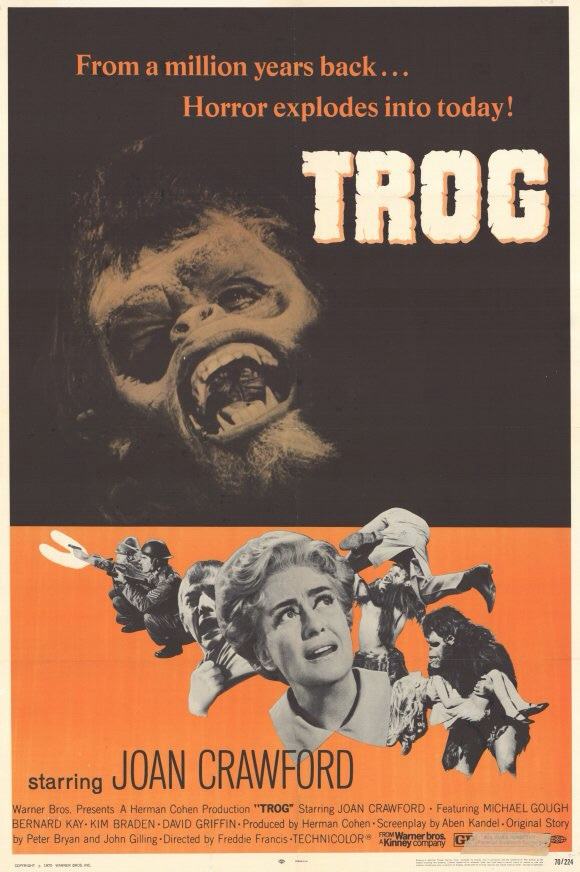
That brings us to her final screen appearance, TROG.

To the best of all knowledge, Crawford (1906-77) is the only Academy Award winner to star in a caveman movie and speak lines “Please, Trog, let me have the girl!” and “Music hath charms that soothes the savage beast.” Aben Kandel wrote the screenplay and Peter Bryan and John Gilling received credit for original story.

Granted, she’s also the only Academy Award winner to star in a Blue Öyster Cult song, a ditty inspired by the book and the film MOMMIE DEAREST written by Crawford’s far beyond estranged daughter Christina. The boys turned Joan Crawford into more of a monster than Godzilla. That part in the song where Mommie Dearest is calling for bad little Christina, it just doesn’t get much better than that in this oh so cruel bitch of a world. “Joan Crawford has risen from the grave,” indeed.

Back on point: I enjoyed TROG a good deal, and it’s one of those films that inspires the very best stories.

Film critic Pauline Kael (1919-2001) wrote, “Joan Crawford plays Stella Dallas with an ape instead of a baby girl. Some actors will do anything to be in movies: she probably would have played the ape.”

Herman Cohen (1925-2002), a producer whose credits include BELA LUGOSI MEETS A BROOKLYN GORILLA and I WAS A TEENAGE WEREWOLF, said that Crawford’s alcoholism raged during TROG and she had 100-proof vodka in her frosted Pepsi Cola glass. He added that Crawford brought four cases of the juice with her to England, because of its unavailability in Merrie Olde. (Speaking of Pepsi, Crawford, once married to the chairman of the board and CEO of Pepsi and then herself a board of the directors member, works in one brief moment of product placement during an early scene.)

Freddie Francis (1917-2007), a two-time Academy Award winner for Best Cinematography for SONS AND LOVERS and GLORY, said that he regretted directing TROG (which he called terrible) and that Crawford had so much trouble remembering her lines they had to resort to using “idiot cards” to get through her scenes.

Former English professional wrestler Joe Cornelius played the title character in TROG and he defended Crawford against those accusations in a 2015 interview with cult film director and fan John Waters after the British Film Institute retrospective of the film.

In the ring, they called Cornelius “The Dazzler.” From the Online World of Wrestling, “What a presence ‘The Dazzler’ made when he entered the ring, the wavy jet black hair, the dazzling smile, the eyebrows! Damn! He had it all, a personality as big as the Royal Albert Hall and ring savvy second to none, he was like a puppet master with strings fastened to the hearts of every member of the audience.”

Guess at this point we should discuss exactly what’s a Trog.

Trog is short for “troglodyte” or a person who lived in a cave, especially in prehistoric times. He’s proclaimed, in promotion of the film, as having the strength of 20 demons, so it makes perfect sense to have Cornelius play the role.

Crawford stars as Dr. Brockton, who of course represents science against those who just want to destroy the “monster.” She wants to reach and teach Mr. Trog. She wants to domesticate “The Missing Link,” half-man and half-ape with a costume borrowed from 2001. These domestication scenes are worth their weight in gold, especially the one when Trog learns how to play catch. “Good boy, Trog!”

Thankfully, for the sake of the movie and its cult following, Crawford does not condescend to her role. She plays it absolutely 100 percent straight and resolutely serious. In other words, Crawford plays it just like she did in MILDRED PIERCE. That makes TROG even funnier than if she just played it winking at the audience the entire time.

Michael Gough (1916-2011) opposes Brockton and Trog from his very first appearance. I doubt Gough used TROG in his audition for Tim Burton’s BATMAN, because his bad manners here as Sam Murdock do not mesh with Alfred Pennyworth, Bruce Wayne’s dedicated butler. We await the fate that waits for Mr. Murdock and it is well worth the wait.

During his attempted domestication, Trog freaks out both at the color red and more upbeat music.

That got me thinking: What if they played Trog the Troggs’ “Love is All Around” from 1967? Just forget about “Wild Thing.” Yes, the Troggs, an English rock band originally called the Troglodytes before the name was shortened, had a huge impact on future noise with their songs covered by Jimi Hendrix, the Buzzcocks, and Hüsker Dü.

Code of Silence (1985)

CODE OF SILENCE

CODE OF SILENCE (1985) Three-and-a-half stars

CODE OF SILENCE and LONE WOLF McQUADE are the best Chuck Norris movies.

They are the ones for people who otherwise grunt and groan at the possibility of watching a Chuck Norris movie. You know, individuals who go, “Ugh, I don’t like Chuck Norris, his movies are so dumb and stupid. They’re ridiculous and redneck.” Then, there’s other people who only want to watch Norris on “Walker, Texas Ranger” re-runs 24 hours a day 365 days a year because they have little tolerance for movie violence and vulgarity.

Let’s get a few things straight: I don’t especially care for Norris’ ultra-conservative politics (he predicted 1,000 years of darkness if Obama won a second term). I hate those darn infomercials that he did with Christie Brinkley plugging exercise machines. I cannot stand “Walker, Texas Ranger,” except for when clips were used for the “Walker, Texas Ranger Lever” on Conan O’Brien. I hate that he sued “Chuck Norris Facts” author Ian Specter because “Mr. Norris is known as an upright citizen to whom God, country, and values are of paramount importance” and “Mr. Norris also is concerned that the book may conflict with his personal values and thereby tarnish his image and cause him significant personal embarrassment.” I often dislike the use of slow motion in many Norris pictures, like, for example, at the end of A FORCE OF ONE and I cannot decide if that ridiculous echoed voice-over in THE OCTAGON is the worst or the funniest thing I have ever heard. Finding all his voice-overs compiled into a 4-minute, 20-second YouTube video, I vote for the latter. I will one day write a review of THE OCTAGON in the style of that voice-over; I remember Richard Meltzer’s review of the Creedence album PENDULUM with a built-in echo. For whatever reason, Norris’ inner monologues in THE OCTAGON call to mind Ted Striker’s cockpit moment when he hears echo and Manny Mota pinch-hitting for Pedro Borbon. THE OCTAGON voice-over is even funnier than the one in AIRPLANE! I understand that I like watching old Norris movies for their camp and nostalgic value. I’d rather watch one than listen to a Ted Nugent album (or song). I apologize for (possibly) coming on so defensive about Carlos.

In the pantheon of action stars, Norris rates below Clint Eastwood, Steve McQueen, Jackie Chan, Bruce Lee, Arnold Schwarzenegger, and Sylvester Stallone. He’s never made a movie quite at the level of THE GOOD, THE BAD AND THE UGLY, THE GREAT ESCAPE, DRUNKEN MASTER, ENTER THE DRAGON, the first two TERMINATOR movies, and ROCKY. Norris belongs in the second tier of action stars.

Back to CODE OF SILENCE (and LONE WOLF McQUADE).

Both movies have good supporting casts — for example, CODE OF SILENCE surrounds Norris with quality character actors like Henry Silva, Bert Remsen, Dennis Farina (before he became a full-time actor), Ralph Foody, Ron Dean, and Joseph F. Kosala.

Andrew Davis directed CODE OF SILENCE, his first action picture, and his later credits include ABOVE THE LAW, THE PACKAGE, UNDER SIEGE, THE FUGITIVE, CHAIN REACTION, and COLLATERAL DAMAGE. THE FUGITIVE, one of the best films of 1993, was nominated for seven Academy Awards, including Best Picture, and good old grizzled Tommy Lee Jones won an Oscar for Best Supporting Actor. He’s a good director, certainly the best of any Norris movie.

At this point in his career, Norris wanted to distance himself somewhat from his karate and become a more polished, all-purpose action star. If all his subsequent movies were more like CODE OF SILENCE, he would have been onto something, but, alas, Norris returned to third- and fourth-rate product like FIREWALKER and MISSING IN ACTION III before finding his greatest commercial success on TV.

In CODE OF SILENCE, Norris plays Chicago policeman Eddie Cusack, who finds himself in the middle of a gang war all while he’s alienated himself from his fellow officers (barring one, his former partner) for breaking the “code of silence” by standing and testifying lone wolf like against a veteran officer (Foody) accused of killing an unarmed teenager.

Norris enlists Prowler on his side for the final confrontation, Prowler a police robot with a tremendous arsenal that kills bad guys good.

We do see one particularly rare scene in any Norris movie: He gets knocked around real good by a group of thugs. That’s not happened often to Norris since he took on Bruce Lee late in WAY OF THE DRAGON.

Between his work in CODE OF SILENCE, ABOVE THE LAW, and THE FUGITIVE, Davis showed himself to be a master of scenes involving the ‘L,’ Chicago’s elevated train rapid transit system that we have seen on many films and shows. There’s a chase and fight scene on top of the ‘L’ in CODE OF SILENCE that belongs with Norris’ flying kick through a windshield in GOOD GUYS WEAR BLACK and driving his super-charged Dodge Ramcharger out of the grave in LONE WOLF McQUADE as the best Norris moments.

Bill & Ted’s Bogus Journey (1991)

BILL & TED’S BOGUS JOURNEY (1991) ***1/2

A great supporting character can elevate a movie.

Take, for example, the Grim Reaper from BILL & TED’S BOGUS JOURNEY. I mean, it’s not every day that a supposedly lowbrow comedy puts a novel spin on a character and plot thread from Ingmar Bergman’s THE SEVENTH SEAL.

In that one, you might remember a medieval knight (Max von Sydow) plays a game of chess against a personification of Death (Bengt Ekerot) to prolong his life. The mere image of the knight and Death playing chess by the sea had become one of the most revered in movie history by the time BOGUS JOURNEY director Peter Hewitt, writers Chris Matheson and Ed Solomon, and Grim Reaper player William Sadler, as well as co-stars Keanu Reeves and Alex Winter, got their grubby little mitts on it.

In BOGUS JOURNEY, our two most excellent dudes Bill S. Preston Esquire (Winter) and Ted “Theodore” Logan (Reeves) find themselves in a most hellish predicament. They are killed by evil robot Bill & Teds, called the Evil Robot Usses by our poetic lead characters, and wind up in Hell. What else would happen to a pair of heavy metal fans? Bill & Ted, who quickly discover their album covers lied to them, man, are greeted by Granny Preston, an evil Easter Bunny, Colonel Oats, and eternal boot camp, a plight highlighted by infinity push-ups and verbal abuse, in their own personal Hell. Colonel Oats tells Bill & Ted they are silky boys and silk comes from the butts of Chinese worms.

Back to the Grim Reaper. “How’s it hanging, Death?” asks Ted.

Bill & Ted play The Reaper dude in a series of games, including Battleship, Clue, and Twister, because Death is a sore loser and Bill & Ted must win two out of three or was that three out of five. Nah, believe it’s best five out of seven. The Reaper finally relents, “I will take you back.”

Bill & Ted are the first to ever beat The Reaper, and before that the first to melvin him. “Ted, don’t fear the reaper.” Cue them celestial cowbells.

I love just about everything about the Grim Reaper in BOGUS JOURNEY and he contributes to BOGUS JOURNEY being a step up from EXCELLENT ADVENTURE.

Sadler should have been at least nominated for Best Supporting Actor for his performance here. No, instead, the Academy of Motion Picture Arts and Sciences saw fit to nominate Harvey Keitel and Ben Kingsley from BUGSY, Michael Lerner from BARTON FINK, Tommy Lee Jones from JFK, and winner Jack Palance from CITY SLICKERS. Keitel and Kingsley should have faced off against Sadler in a best-of-seven to see if we could get one less nomination for BUGSY. Colonel Oats would certainly have approved of Palance’s victory with his celebratory one-armed push-ups.

EXCELLENT ADVENTURE takes on time travel, historical figures, and historical fiction. Bill & Ted need to earn an A+ on their final report in history … and the future of the human race hangs in the balance. Literally, because in a mere 700 years in the future, humanity exists in an utopia built around the music of the Wyld Stallions, Bill & Ted’s most excellent rock band.

BOGUS JOURNEY adds depictions of the afterlife, Heaven, and Hell to the mix, and it gives us good and evil robot Bill & Teds in addition to living and dead Bill & Teds. Winter and Reeves compete with Michael J. Fox and Thomas F. Wilson for most permutations in a time travel comedy. Peter Sellers and Tony Randall would have been proud of all of them.

Additionally, the universe’s most brilliant scientific genius uses a single word vocabulary and that’s his name, Station. Station builds the “good robot usses” or “Station’s creations.”

I should not forget Joss Ackland as arch villain Chuck DeNomolos, who programs the evil robots to kill the good Bill & Ted because he hates their ideas and their insipid music. Don’t feel too bad for Chuck, because he gets a shot with Missy. Doesn’t just about everybody?

In the end, though, remember “You might be a king or a street sweeper, but sooner or later you dance with the reaper.”

That and, of course, “Be excellent to each other.”

Kingpin (1996)

KINGPIN (1996) Four stars

Over a period of a couple years in the late 1990s, there were two great bowling comedies released: The Farrelly Brothers’ KINGPIN and the Coen Brothers’ THE BIG LEBOWSKI. Granted, there’s far more to both movies than bowling.

A few of my friends and I watched these movies time and time again. They both played a central role in nearly a decade of regular Friday or Saturday or Sunday night bowling adventures at the Holiday Lanes in Pittsburg, Kansas. Alcohol helped too, although when the bowling alley banned outside cups, college student attendance dramatically took a dip. Eventually, though, our group sucked it up and put the money down on the watered down bowling alley beer.

A couple times during my writing career, I have mentioned KINGPIN. I reviewed ZOMBIELAND for the college newspaper and reunited Woody Harrelson and Bill Murray gave me an opportunity to reference their dueling comb-overs in KINGPIN. I just laughed thinking about it. I named KINGPIN one of my 10 favorite sports movies for The Morning Sun.

Harrelson plays Roy Munson from Ocelot, Iowa, the 1979 Iowa state bowling champion who embarks on a professional bowling career early on during KINGPIN. He’s a promising young bowler, but, unfortunately, he runs afoul veteran bowler Ernie McCracken (Murray), who cons rather than mentors the younger bowler. McCracken hated the fact that Munson beat him in bowling and in a con gone tragically bad, a gang of amateur bowlers take it out on Munson after they find out both he and McCracken are pros. McCracken gets away, of course, and leaves Munson to reap the consequences. Munson loses his right hand in a scene that’s very, very, very rough for a PG-13 comedy. It plays like a scene from a Scorsese gangster pic.

Seventeen years later, Roy Munson’s a real born loser in Scranton, Pennsylvania. Man, talk about down on his luck. He’s got a prosthetic hand and a major drinking problem. He sales bowling supplies, rather unsuccessfully, since nobody wants novelty gags in the men’s room any more. Munson is perpetually behind on his rent and that means his creepy landlady harasses the former pro bowler. They work out a debt solution I do not recommend and work in a Mrs. Robinson parody for tremendous sport Lin Shaye.

Speaking of sports, KINGPIN parodies the genre. Munson takes on a managerial role for Amish bowler Ishmael (Randy Quaid) and they decide to work their way to Reno for a $1 million winner-takes-all tournament to save Ishmael’s farm. Along the way, they gain Claudia (Vanessa Angel) and Roy and Claudia assume the roles with Ishmael that Jack Nicholson and Otis Young did with Quaid in the 1973 film THE LAST DETAIL. Needless to say, Ishmael gets hurt on the eve of the tournament in Reno, Munson makes his bowling comeback, and Munson and McCracken eventually battle for $1 million and comb-over superiority.

I find myself laughing throughout most of KINGPIN. Like the comedies of the Z-A-Z boys and Mel Brooks, or for that matter the Marx Brothers and the Three Stooges, I laugh twice at some of these jokes, a second laugh at the fact that I laughed in the first place. For example, I am laughing right now just thinking about Roger Clemens’ cameo playing a redneck named “Skidmark” and I have already mentioned Harrelson’s and Murray’s comb-overs.

Harrelson, Quaid, and Murray all have no problem looking absolutely ridiculous on screen, something they demonstrate time and time again for nearly two hours in KINGPIN. The Farrelly Brothers and the actors will stoop just that low for a laugh.

Murray has made a parallel career for himself with supporting roles and cameos, ever since CADDYSHACK. He’s done it with TOOTSIE, ED WOOD, SPACE JAM, WILD THINGS, COFFEE AND CIGARETTES, and, of course, KINGPIN, where he appears near the beginning and near the end of the picture. He just about walks away with the movie. Ernie McCracken is a real piece of work, crass, vile, womanizing, on down the line, but he seems to be a beloved figure within the movie. Of course. We love Murray and McCracken, and it’s the way he reads lines like “It’s a small world when you’ve got unbelievable tits, Roy.”

Of course, McCracken’s talking about Claudia, played by the lovely Angel. She is the discovery in KINGPIN, because we have seen Harrelson, Quaid, and Murray be funny before in several movies. At the same time, Angel could be seen on TV during her run on “Weird Science,” playing the character first essayed by Kelly LeBrock. She plays some of the same notes in both roles, with her delightful English accent and her sarcastic wit. It’s a joy watching her sock it to Munson and McCracken. It remains a mystery why Angel has never become a bigger star.

I recently talked about enjoying few comedies as much as NATIONAL LAMPOON’S ANIMAL HOUSE. Well, I just spent over 800 words on one of those few.


Time After Time (1979)

TIME AFTER TIME

TIME AFTER TIME (1979) Three-and-a-half stars

Screenwriter and director Nicholas Meyer created some nifty concepts for his 1979 directorial debut TIME AFTER TIME: what if writer Herbert George Wells (1866-1946) really did invent a time machine, what if surgeon John Stephenson (“Jack the Ripper”) steals Wells’ time machine and travels from 1893 London to 1979 San Francisco, what if Wells tracks down Stephenson in San Francisco and becomes more like Sherlock Holmes (Meyer wrote the novel and screenplay THE SEVEN-PER-CENT SOLUTION), and what if Wells falls in love with a modern woman and they find themselves in danger from Mr. Stephenson.

Malcolm McDowell as Wells, David Warner as Stephenson, and Mary Steenburgen as Amy Robbins flesh out Meyer’s concepts.

McDowell brought a devilish charm to Alex in A CLOCKWORK ORANGE, another high concept picture with literary roots, and he’s a lovable English eccentric in TIME AFTER TIME.

Warner makes for a suitably menacing antagonist, who’s more in his element in late 20th Century America than he was in late 19th Century England. Meyer works the juxtaposition of Wells and Stephenson to maximum impact.

Steenburgen plays a character who almost instantly falls in love with Wells. There’s just something about the way that she tells Wells that she will believe him. She later played basically the same character in Robert Zemeckis’ BACK TO THE FUTURE PART THREE, and it works in both films.

McDowell and Steenburgen fell in love making TIME AFTER TIME together and they were married from 1980 to 1990.

They do have that extra special glow during TIME AFTER TIME, and they do create a screen couple that we fervently desire to stay together.

I have at least liked virtually every movie I have ever seen that incorporates time travel, from BACK TO THE FUTURE and TIME AFTER TIME to THE TERMINATOR, MEN IN BLACK 3, and X-MEN: DAYS OF FUTURE PAST. I find time travel movies endearingly silly and goofy in the best possible way, if nothing else, and the best ones are profound.

TIME AFTER TIME especially has fun with Wells being a stranger in a strange land … and time. Mileage will invariably vary on these gags. Of course, we have to keep in mind this Wells (1893 model) would not know about the 1906 San Francisco earthquake or about the Golden Gate Bridge which opened in 1937.

Meyer’s other credits include writing the delightfully whacked out INVASION OF THE BEE GIRLS and writing the two best STAR TREK films, THE WRATH OF KHAN and THE VOYAGE HOME. Meyer said that he tried out ideas for THE VOYAGE HOME that he did not use in TIME AFTER TIME.

TIME AFTER TIME works as comedy, science fiction, romance, and thriller. I revisited it recently as the second half of a double feature with BREAKING AWAY and both films left me feeling all nice and fuzzy inside.

NOTE: Of course, it must be a September 21 thing, since H.G. Wells, Stephen King, Bill Murray, Chuck Jones, Leonard Cohen, Ethan Coen, and David Coulier were all born Sept. 21 in their respective years.

The Blair Witch Project (1999)


THE BLAIR WITCH PROJECT (1999) Four stars

I occasionally find myself looking back fondly on all the multiplex experiences I had during 1999 and 2000.

Please bear with me as I rattle off the titles: THE PHANTOM MENACE, SOUTH PARK BLU, SLEEPY HOLLOW, AMERICAN BEAUTY, GLADIATOR, THE PATRIOT, THE LEGEND OF DRUNKEN MASTER, and CROUCHING TIGER, HIDDEN DRAGON. Just for variety and to balance the bad with the good, there was also DRACULA 2000, THE LADIES MAN, ROMEO MUST DIE, and THE SKULLS. There’s even one more.

I shall never forget when I watched THE BLAIR WITCH PROJECT on the first night it played at the Pittsburg 8.

This was a major event for my generation (let’s say those of us born from 1965 through 1981), because the BLAIR WITCH hype was inescapable that summer and fall in 1999 and the seemingly inevitable backlash proved even stronger and more lasting. For at least a couple years, you just had to watch THE BLAIR WITCH PROJECT and form your own strong opinion. You either loved or hated THE BLAIR WITCH PROJECT with no middle ground whatsoever and everybody felt like expressing their opinion about it, something that cannot be said for the average movie. Nowadays, though, how many people give this 20-year-old movie the time of day.

Anyway, I myself walked into the late show that night stoked, not only because of the insane buzz around the film but also because of the four-star review written by Roger Ebert that I read when the film opened July 16. “At a time when digital techniques can show us almost anything, THE BLAIR WITCH PROJECT is a reminder that what really scares us is the stuff we can’t see. The noise in the dark is almost always scarier than what makes the noise in the dark. Any kid can tell you that. Not that he believes it at the time” finishes off Ebert’s review. BLAIR WITCH later rounded out Ebert’s list of the 10 most influential films of the 20th Century.

Of course, leading up to whenever we first watched it, we heard all the noise about THE BLAIR WITCH PROJECT being the “scariest movie ever made.” How many times have we heard that about the latest horror movie and then found it out to be a lie, a hype, a con?

Sitting down in the Pittsburg 8 that night, though, we knew that we were in for a treat, a transcendent experience. THE BLAIR WITCH PROJECT, whether you love it or hate it, delivered.

I have never seen a movie in a theater setting before or after create such an intense reaction. As the end credits rolled, members of the packed house cheered and booed. I remember more people cheering, but the boos were both louder and longer. Debates broke out across the theater as we slowly exited. I loved the film and defended it in the midst of some intense hostility from individuals who felt they had been cheated. They expected something different than what they got from THE BLAIR WITCH PROJECT. And hated main protagonist Heather Donahue and found her incredibly annoying. And hated hated hated that darn ending. I started thinking even more positively about the film after each hate-filled editorial I heard.

A strange thing happened in the first couple years after THE BLAIR WITCH PROJECT: I encountered several people who enjoyed the sequel BOOK OF SHADOWS more than the original. It was here that I developed a little theory: People who hated THE BLAIR WITCH PROJECT but liked or even loved BOOK OF SHADOWS wanted a more traditional horror movie or at least one more beholden to the conventions of the late 20th Century horror movie. Meanwhile, people who loved THE BLAIR WITCH PROJECT loved it partly because it broke away from the conventions of contemporary horror movies. It was not SCREAM, not I KNOW WHAT YOU DID LAST SUMMER, not URBAN LEGENDS, et cetera, populated by late 20th Century pretty boy or hip actors and lovely actresses with that nudge-nudge wink-wink we’re so contemporary and hip tone. I know I dig BLAIR WITCH mostly because it is different from the horror movies of its time and belongs to another tradition. At the time, most of us had probably never seen a found footage movie before, although everybody who believed the whole “true story” bit should have known better. I mean, come on, after THE TEXAS CHAINSAW MASSACRE and FARGO, you fell for that jive?

THE BLAIR WITCH PROJECT set itself up perfectly for a backlash of epic proportions. We already mentioned anything touted as “the scariest movie ever made” will create large numbers of viewers laughing and scoffing at such a ridiculous claim. The film made nearly $250 million on a $60,000 budget … with the help of a groundbreaking marketing plan that ultimately backfired, at least in terms of perception of the film itself.

Here’s the third paragraph of a story by MWP Digital Media, “So perhaps you’d be surprised to learn the most successful viral marketing campaign of all time took place before social media existed. Even before mainstream use of the Internet. The most successful viral marketing campaign of all time centred on a small, low-budget indie flick in 1999 called THE BLAIR WITCH PROJECT.” Just thinking about it even now, yeah, it’s crazy to conceive of a frenzied audience in small college town Pittsburg, Kansas, for a low-budget horror movie with no-name performers.

The filmmakers decided to use a website to promote their little movie, not just any website though since this one creates an entire world treating THE BLAIR WITCH PROJECT like it really happened rather than it being a fictional work. More than 20 years later, we can still check out blairwitch.com/project. We’re greeted with a familiar title card upon visiting the site, “In October of 1994, three student filmmakers disappeared in the woods near Burkittsville, Maryland while shooting a documentary. A year later their footage was found.”

There’s “Mythology,” a timeline of major events in the history of the Blair Witch: February 1785, November 1786, November 1809, 182, August 1825, March 1886, November 1940-May 1941, and several dates from October 1994-October 1997. The front page of “Mythology” ends on this note, “The found footage of their children’s last days is turned over to the families of Heather Donahue, Joshua Leonard, and Michael Williams. Angie Donahue contracts Haxan Films to examine the footage and piece together the events of October 20-28, 1994.”

We can see a picture of “Montgomery College film students Michael Williams, Joshua Leonard, and Heather Donahue less than a week before their disappearance” and several stills from their documentary.

The “Aftermath” section includes evidence, search, interviews, and news. Evidence includes crime scene photos from the Frederick County Sheriff’s Office and anthropology professor David Mercer describing how there is no scientific explanation for a certain event. Search provides a MISSING poster for Donahue, Leonard, and Williams with their photos, measurements, and features; “Last seen camping in the Black Hills Forrest area, near Burkittsville.” If you look closely, you can see the famous 555 extension listed for the Frederick County Sheriff’s Office. Interviews are clips featuring such figures as Sheriff Ron Cravens and search party members. News offers clips from coverage by Channel 11 and Channel 6.

“The Legacy” takes in discovered footage, audio, and Heather’s journal, which was found buried beneath a 100-year-old cabin in the woods. Her journal amounted to 37 pages; from Page 21, “It is freezing and we are still out here. We’re completely fucking lost now, we’ve decided basically to just keep heading south, but it doesn’t seem to be getting us anywhere fast and weird shit keeps happening which is, to be totally honest, sitting here with gloves and sweaters in a cold tent in the middle of nowhere and the guys asleep – beginning to scare me. I’m hungry. I’m cold. I want to see what we shot. We didn’t light a campfire tonight because we wanted to lay low. Not that there’s anything left to cook on it anyway. I feel like we are bound to cross a road of something soon, it’s not like Maryland has wilds that go on forever or some shit. We have got to get out of here. As much as I would like…”

Personally, I appreciate that THE BLAIR WITCH PROJECT deals in myths and legends and makes a valiant effort to create its own timeless story. It belongs most to a tradition of American storytelling that started with Washington Irving (1783-1859), namely his 1820 work “The Legend of Sleepy Hollow.” This tradition also involves more local stories, like, for example, haunted McCray Hall at Pittsburg State; “Sightings of a lady in a black dress. The Pipe organ is heard playing at night. Sudden temperature variations. Strange movements from corners of eyes” highlights the listing on “Dark Kansas.” BLAIR WITCH remembers the power of imagination.

Daniel Myrick and Eduardo Sanchez, BLAIR WITCH directors, talked about the genesis for their movie in Little White Lies, “We came up with the basic premise for what eventually became THE BLAIR WITCH PROJECT back in the early ‘90s. We were studying at the University of Central Florida at the time, and like most college students we didn’t have any money. … One day we got to talking about this show called “In Search of…,” which Leonard Nimoy hosted in the ‘70s. We started thinking about all these pseudo-documentaries like THE LEGEND OF BOGGY CREEK, IN SEARCH OF NOAH’S ARK, CHARIOTS OF THE GODS, exploratory, investigative films linked to paranormal encounters, and how they really freaked us out as kids. So we rented a bunch of those movies and we were surprised how much they still freaked us out. …

“We shot [BLAIR WITCH] in two sections: Phase One, which is everything in the woods, and then Phase Two, which ended up being used for the “Curse of the Blair Witch” TV documentary. The Phase One stuff was shot over about eight pretty intensive days. It was a continuous shoot, where the actors were the cameramen and all the dialogue was improvised.”

Lead performer Donahue took a great deal of the backlash against BLAIR WITCH, as she was the most publicly visible; she won Worst Actress from the Golden Raspberry Awards, for example, beating out Melanie Griffith in CRAZY IN ALABAMA, Milla Jovovich in THE MESSENGER: THE STORY OF JOAN OF ARC, Sharon Stone in GLORIA, and Catherine Zeta-Jones in ENTRAPMENT and THE HAUNTING. Her acting career persisted until 2008, for example she appeared in the billion times worse than BLAIR WITCH romantic comedy BOYS AND GIRLS, and she left the profession to grow medical marijuana. She then became an author and delivered the 2012 memoir “Growgirl: How My Life After the Blair Witch Project Went to Pot.”

Two movies from 1999 became parodied to what seemed like no end at the time, THE MATRIX and BLAIR WITCH. This endless parodying did not help either film. I especially got beyond exasperated at MATRIX parodies. Anybody who lived during that era knows which two scenes that we’re talking about without even mentioning them. Just say THE MATRIX and BLAIR WITCH, and we can bet they’re the first scenes that come to mind.

Myrick and Sanchez filmed apology scenes for both Donahue and Williams, and decided upon Donahue for the finished product because she had the most reason to apologize. Reactions to her apology are the most extreme in a film that creates extreme reactions. Ebert said that it reminded him of explorer Robert Scott’s notebook entries as he froze to death in the Terra Nova expedition (1910-13). Others have laughed at it like it was the funniest thing they have ever seen.

Leonard and Williams have both maintained acting careers, Leonard being far more busy. BLAIR WITCH marked the feature debuts for Donahue, Leonard, and Williams and I like them all because they have an everyman appeal not typically found in horror movies of the late 90s and early 00s.

The promotion for BLAIR WITCH proved so effective that Donahue’s mother even received sympathy cards from people who believed that her daughter was either dead or missing. Sanchez’s experience in web design proved to be a godsend. It was probably just some elective that he barely thought about at the time he took it.