An Interesting Story (1904)

AN INTERESTING STORY (1904) ****
One of the best qualities of the best early silent films is how they would regularly take a simple idea and play it to the hilt in a short time, like the explosive 150-second The Man with the Rubber Head from 1901 and the nearly 6-minute That Fatal Sneeze from 1907.

That hilt-playing simplicity also helps define An Interesting Story from 1904, where a man, who knows it might even be director James Williamson himself, gets so taken by a book that he simply cannot put it down to the point that he becomes a virtual danger to society, including himself. This short could be made today, of course in color rather than black & white if you so prefer, but the protagonist would (most likely) be engrossed by the latest, greatest, most upgraded cellular device. Since I returned to college in 2008, it’s been about 13 years then since I first started noticing that I would regularly be the one person in the room (crowded or not) looking up and not down into the abyss of a cellular device. Generation gap most clearly expressed through differences in phones? Possibly.

Anyway, what book could the unnamed protagonist be reading in An Interesting Story? The Bobbsey Twins of Lakeport by Laura Lee Hope? Green Mansions by William H. Hudson? The Country of the Blind by H.G. Wells? The Book of the Law by Aleister Crowley? Dreamers by Knut Hamsun? Peter Pan by J.M. Barrie? Nostromo by Joseph Conrad? The Sea Wolf by Jack London? Just to take a sampling from works first published in 1904. Naturally, it could have been an older book.

Off the top of my head, Franz Kafka’s The Metamorphosis and J.D. Salinger’s The Catcher in the Rye are the books I plowed through in one sitting, but I remained safely within the confines of my isolation chamber and No animals were harmed during the reading of this book each time. Just think I didn’t even turn into an insect like Gregor Samsa, the protagonist of The Metamorphosis.

Getting somewhat back on track here, An Interesting Story utilizes a steamroller for comedic effect some 84 years before The Naked Gun (which also gave arch villain Ricardo Montalban a great big fall from a baseball stadium, a bus, and a marching band with the steamroller between the bus and the band) and A Fish Called Wanda (when Ka-Ka-Ka-Ken gets his great desserts against Otto, that stupid, brute, vulgar American).

Yes, you could definitely say that An Interesting Story was ahead of its time.

Gentleman’s Agreement, All the King’s Men

TWO LONG-WINDED, SELF-IMPORTANT BEST PICTURES FROM DECADES AGO: GENTLEMAN’S AGREEMENT, ALL THE KING’S MEN
It makes perfect sense that I watched Gentleman’s Agreement and All the King’s Men back-to-back on a cold December night, despite the fact that both pictures were made and first released in the first half of the twentieth century and that makes them both officially older than ‘boomer,’ a phrase sure to replace older than dirt in the lexicon.

Gentleman’s Agreement and All the King’s Men keep a certain relevance at this particular junction in time because their main issues — racism (Gentleman’s Agreement) and demagoguery (All the King’s Men) — have been major concerns throughout a turbulent 2020, once we get beyond the fact that we’re trying to get out of the year alive more than any other year.

Gentleman’s Agreement is one of those movies where the plot summary undoubtedly causes immediate discomfort in many of our fellow humans, “A reporter pretends to be Jewish in order to cover a story on anti-Semitism, and personally discovers the true depths of bigotry and hatred.” Boring, old hat subject matter, right? I am already sensing audible moans and groans from people who believe that racism does not exist or more precisely if racism does exist, it’s ultimately marginal and distorted beyond all reason by evil liberal media and evil liberal politicians setting their ultimate agenda — all-out Race War. Hoax — a humorous or malicious deception — made a huge comeback in 2020 for, let’s see here, at least approximately 75 million Americans, who have been seen and heard (rather quite clearly) blasting this, blasting that as hoax this, hoax that, especially anything and everything related to COVID-19. If it’s not hoax, it’s conspiracy and it’s reached a point where I don’t even want to even come across the latter word any longer. Once is all that I will aid and abet it writing this piece.

During Gentleman’s Agreement, I flashed back on Lester Bangs’ White Noise Supremacists from Psychotic Reactions and Carburetor Dung, particularly the moment in the article when Bangs gets to the contradictory, sometimes nasty gist of a human being, “Whereas you don’t have to try at all to be a racist. It’s a little coiled clot of venom lurking there in all of us, white and black, goy and Jew, ready to strike out when we feel embattled, belittled, brutalized. Which is why it has to be monitored, made taboo and restrained, by society and the individual.” With the availability of social (antisocial) media, broadcasting thoughts and feelings potentially to a mass audience with one click of the mouse, it certainly does feel like there’s never been a more venomous year in history than 2020.

Gentleman’s Agreement, based on the Laura Z. Hobson novel of the same name and the same year as the prestigious motion picture adaptation, nearly talks itself (and its audience) to death. Of all the thousands and thousands of words spoken during Gentleman’s Agreement, I’d like to hone in on Gregory Peck’s dialogue late in the picture, “I’ve come to see lots of nice people who hate it and deplore it and protest their own innocence, then help it along and wonder why it grows. People who would never beat up a Jew. People who think anti-Semitism is far away in some dark place with low-class morons. That’s the biggest discovery I’ve made. The good people. The nice people.”

Then again, maybe we’re not so good, not so nice.

Over the last dozen years, it’s been disturbing to see and hear not only the return but the prominence of poisonous ideas and emotions. I first noticed it back in August 2008, returning to Southeast Kansas from a two-week vacation in Oregon to be gobsmacked by a phenomenon. Keep in mind this was a couple weeks before Barack Obama formally received the nomination for President, but “Death to Obama” graffiti started cropping up in Southeast Kansas and Southwest Missouri. IN BIG LETTERS, just to get the point across ever more forcefully. Obama being half-Black proved to be more than enough and his undoing for many, even before our 44th President took office.

Growing up, I remember the Ku Klux Klan and Neo-Nazis being routinely made the butts of jokes on talk shows and in motion picture entertainments. They had considerably lost their power. They became tools in ridiculous outfits with philosophies and practices long past their sell date. We had dispelled their poison from our collective hearts and minds, or so many of us wrongly thought.

After the election of first Obama and then Donald Trump, extremist organizations came back louder and nastier than ever before. Obama gave them a target and Trump a platform for their poison, although other individuals and groups use Trump for their target. They’re mad as hell about this and that and they’re not going to take it anymore. They also seem to be here to stay, unfortunately, and proud and loud, even more unfortunately, because they seem bent on drowning out and even silencing alternative voices by any means possible. They want the world, and they want it now.

At this point, before I forget and get tangled in a tangent, I should mention what I liked best about Gentleman’s Agreement: Celeste Holm steals every scene that she’s in and Peck and child actor Dean Stockwell must have had a great working relationship because their scenes together work better than the majority of the rest of the picture.

— Near the end of All the King’s Men, it being past her bedtime and everything, my wife entered the room, laid down, encountered the political talk and the crowd scenes emanating from the screen to her immediate left, and asked me point blank, “Are you watching this movie because of the election?”

I told her, “No. Just a coincidence.”

Yeah, no more and no less than a mere happy coincidence that I watched Gentleman’s Agreement and All the King’s Men back-to-back, just because they won Best Picture for their particular years and not because they concern two of the three hot button issues of The Now.

Let’s get down to brass tacks.

Comparisons have been made between Huey Long — the inspiration for the fictional Willie Stark in both the 1946 Robert Penn Warren novel and the 1949 film adaptation — and Donald Trump, since our 45th President began his political ascendance several years ago.

On Sept. 10, 1935, Dr. Carl Weiss shot and killed Long at the Louisiana State Capitol. Long wrote a fictional novel called My First Days in the White House, posthumously released.

Trump became President and wrote his Russian hack novel 280 characters at a time, most of them disputed since Nov. 3, 2020.

What kind of populist loses the popular vote twice? Once more and Trump could match William Jennings Bryan. Though, between all the recounts and frivolous lawsuits (1-59 in court with their preponderance of preposterous evidence) and cult rallies after the election, Trump has already surpassed Bryan. Bryan never had Jon Voight and Randy Quaid and Scott Baio and James Woods on his side, not to mention all the politicians and “entertainers” on state TV stirring up sedition, but Fredric March played lawyer and former politician Matthew Harrison Brady — based on Bryan — in Stanley Kramer’s Inherit the Wind, a 1960 film based on the 1955 play based on the 1925 Scopes Trial, so beat that.

Outgoing Michigan Republican Congressman Paul Mitchell said it best, “Stop the stupid.”

As far as All the King’s Men goes, it mirrors demagoguery in that it’s more compelling in the beginning and end stages and something that believers and nonbelievers alike attempt to survive in between. Of course, All the King’s Men proved to be considerably easier than 2020.

Since I just want to survive 2020, that’s why I should never tell a Trump supporter, “You’ve aroused my anthropological curiosity.” Oops, guess I let that one slip. Oh well.

NEVER FELT MORE LIKE SINGING THE QUARANTINE BLUES: The Seven Year Itch, Marty, Roman Holiday, Stalag 17

NEVER FELT MORE LIKE SINGING THE QUARANTINE BLUES: THE SEVEN YEAR ITCH, MARTY, ROMAN HOLIDAY, STALAG 17
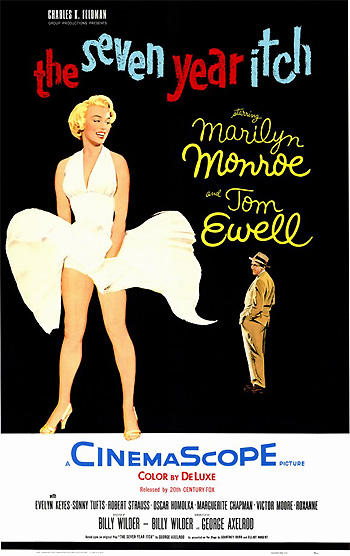
I have become a huge Billy Wilder (1906-2002) fan after watching the great films Double Indemnity, The Lost Weekend, Sunset Boulevard, Ace in the Hole, Some Like It Hot, The Private Life of Sherlock Holmes, and Avanti. Having made it about halfway through his 26 directorial credits, I have found my least favorite Wilder film so far, the 1955 comedy The Seven Year Itch.

The Seven Year Itch bombs for two main reasons — it is significantly hampered by the Production Code because the movie can’t even suggest an extramarital love affair between our protagonist and the ultimate temptation next door (Marilyn Monroe) and it centers around one of the great insufferable drips in cinematic history, Richard Sherman, played by Tom Ewell (1909-94) on a single note that won him a Golden Globe for Best Performance by an Actor in a Motion Picture Comedy or Musical. Ewell also played the part in the Broadway play.

The film’s legendary scene — Monroe’s Ultimate Upskirt — even proved to be a great letdown not worth the wait and I wish they’d have stayed with Creature from the Black Lagoon instead.

There’s nothing wrong with Monroe, of course, and she’s great in the ‘Chopsticks’ scene, but it’s that darn drip played by Ewell who ruined The Seven Year Itch for yours truly. I traveled beyond tired of his overactive imagination by about his fourth or fifth daydream, which I calculate to be about 15 minutes into a 105-minute motion picture, and having Ewell talk to himself in scene-after-scene also miserably backfired. Richard Sherman called to mind the daydreaming drip played by Gael Garcia Bernal in The Science of Sleep (2006), although Ewell did not sport a ridiculous hat.

I felt the seven year itch for another motion picture real early during The Seven Year Itch and only dearest Marilyn had me stick it out until the bitter end. It’s still no Some Like It Hot.

— What kind of world did people live in when the 29-year-old high school chemistry teacher Clara Snyder was considered a dog?

That’s the main question raised by the 1955 Best Picture winner, Marty, directed by Delbert Mann (1920-2007) in his feature debut, written by Paddy Chayefsky (1923-81) whose later credits include Network and Altered States, and starring Ernest Borghine (1917-2012) in the title role that won Borgnine the Academy Award for Best Actor over James Cagney in Love Me or Leave Me, James Dean in East of Eden, Frank Sinatra in The Man with the Golden Arm, and Spencer Tracy in Bad Day at Black Rock. Mann also won Best Director.

I asked that opening question because Gene Kelly’s then wife Betsy Blair (1923-2009) played Clara. She’s not Marilyn Monroe or Jayne Mansfield, of course, or Elizabeth Taylor or Audrey Hepburn, granted, but she’s definitely not a dog in any world. I mean, I question the eyesight and the sanity of characters like Marty’s harried mother Teresa (Esther Minciotti) and Marty’s jilted best friend Angie (Joe Mantell) when they separately confront homely 34-year-old butcher Marty late in the picture about Clara and her questionable looks. Mother Teresa goes as far to accuse Clara of being at least 10-15 years older than 29, while Angie sounds the canine dialogue until he sure does come across like a smug little prick. Marty should have belted his best friend right smack dab in the kisser, just once.

Marty devotes at least 30 minutes easy to Marty and Clara on their first date and they’re mostly just talking. Marty does the majority of the talking and Clara has this real fetching way of listening to him that makes her incredibly attractive. He cannot believe that he’s become such a blabber mouth with Clara. He’s never acted this way before. He talks about his father’s death just a month after he graduated from high school nearly 17 years ago and he considers her opinion about his notion to buy out his boss and start a community grocery store that can go head-to-head against big chain grocery stores. Marty takes Clara to his house and they are home alone for about 10 minutes. They finally kiss for the first time, right before Teresa comes home and conducts a very awkward first conversation with Clara. Marty and Clara obviously like each other, and the movie ends on Marty finally calling up Clara late in the day after their first date.

I doubt that Borgnine has ever been more likable over his lengthy screen career and the relationship between Marty and Clara undoubtedly influenced Rocky Balboa (Sylvester Stallone) and Adrian (Talia Shire) in the first two Rocky movies, especially their first date and first kiss in Rocky. I like Marty for some of the same reasons I like Rocky and Rocky II.

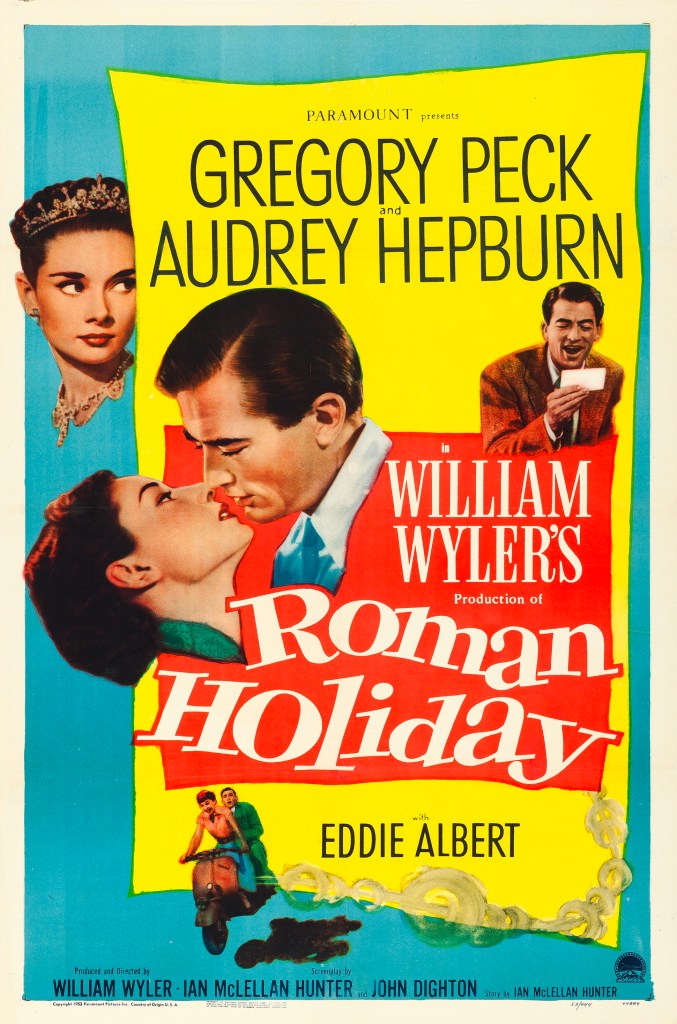
— Audrey Hepburn dominates Roman Holiday in such a way that it’s one of the performances we can point to when somebody asks for the definition of a movie star. Hepburn absolutely shimmers and sparkles throughout Roman Holiday.

Hepburn stars as Princess Ann, a traveling dignitary on a grueling schedule who just wants to have fun in historic and scenic but wild Rome. She sneaks away from her embassy, but the sedative a doctor gave her kicks in all delayed like and she begins to late night pass out on a park bench. That’s where expatriate American newspaper reporter Joe Bradley (Gregory Peck) comes in, who discovers this poor young thing that he believes got inebriated real good and therefore he eventually lets her crash that night at his apartment. One darn thing leads to another the next day: Joe discovers her true identity, decides that he will do an exclusive story and interview with Ann and he rounds up his photographer friend (Eddie Albert), and they spend one tremendous day together. Let’s see, Ann gets a haircut, she drives Joe around for a spell on a Vespa scooter, and our princess finds the opportunity to participate in a fracas with government agents called on by her embassy to grab her. Well, naturally, Ann and Joe also find time for a little suck face and other tender, bittersweet moments.

Hepburn (1929-93) turned 24 years old just a few months before Roman Holiday premiered and it marked her first motion picture starring role. She had appeared in a small role in The Lavender Hill Mob, the British picture that won the Academy Award in 1952 for Best Original Screenplay, and a few other pictures without making any significant mark. Hepburn’s breakthrough started as the title character in the Broadway play Gigi in the year or two before Roman Holiday.

Winning the Academy Award for Best Actress for Roman Holiday legitimized Hepburn’s ascent to motion picture stardom; she beat out Leslie Caron from Lili, Ava Gardner from Mogambo, Deborah Kerr from From Here to Eternity, and Maggie McNamara from The Moon Is Blue for the prize. Hepburn followed Roman Holiday with Sabrina, Love in the Afternoon, Funny Face, Breakfast at Tiffany’s, Charade, and My Fair Lady in the first decade after her first huge success and became one of the most beloved movie stars ever.

In his review of Roman Holiday, San Francisco Examiner film critic Jeffrey M. Anderson argued that Roman Holiday would have been even better had somebody with great style like Howard Hawks or Billy Wilder directed it rather than plain old staid conservative actors’ director William Wyler. Wilder directed Hepburn in Sabrina and Love in the Afternoon, and are they any better than Roman Holiday? Anderson himself gives Roman Holiday three-and-a-half and both Sabrina and Love in the Afternoon three stars. Unfortunately, I’ve not yet seen either Sabrina or Love in the Afternoon.

I’ve been on a bit of a Wyler kick lately — watching Dodsworth, Jezebel, Wuthering Heights, and Roman Holiday all for the first time — and I gained a tremendous amount of respect for the man after seeing the Netflix series Five Came Back about directors Wyler, Frank Capra, John Ford, John Huston, and George Stevens and their experiences making combat and propaganda films during World War II, and how it affected each director for the rest of their lives. Wyler lost hearing in one ear from a bombing mission over Italy; he regained hearing in that ear after the war with the help of a hearing aid. One of Wyler’s cameramen, Harold J. Tannenbaum (1896-1943), perished filming Memphis Belle; from the American Air Museum, “Shot down 16 April 1943 in B-24 41-23983. Some crew members had bailed out when the plane exploded blowing some crew clear. Tannenbaum was a passenger as a photographer from the 8AF Combat Film Unit. Losses report he bailed out but slipped out of his parachute. KIA. He was William Wyler’s first sound man on the Memphis Belle film project and was tasked to take pictures from the B-24 when it exploded on its return from Brest.”

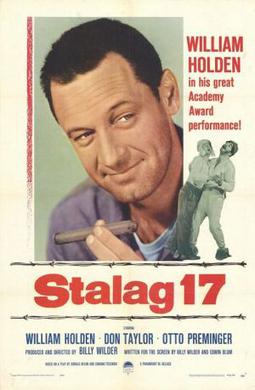
— Watching Billy Wilder’s Stalag 17 for the first time, unfortunately I became distracted by thoughts of comparing and contrasting Stalag 17 star William Holden’s appearance in 1953 versus circa 1980 when he starred in the disastrous disaster film When Time Ran Out.

In particular, I flashed back on that wretched scene in When Time Ran Out between Holden and Charlton Heston approximate James Franciscus. Holden looks bloody awful and he can barely make it through a tiresome disaster movie scene — let’s leave it at Franciscus plays the resident nonbeliever in the impending doom. Not surprisingly, Holden spent six days in the hospital during production of When Time Ran Out to battle his alcoholism; director James Goldstone convinced producer Irwin Allen that Holden’s alcoholism posed a danger to everyone on the set, including Holden himself. Holden died at the age of 63 on Nov. 12, 1981 from exsanguination, or a severe loss of blood, and blunt laceration of scalp; an inebriated Holden slipped on a rug, hit a bedside table, lacerated his forehead, and bled to death in his penthouse apartment in Santa Monica.

Hogan’s Heroes lasted 168 episodes from 1965-71, and I must admit that I have never watched an episode in full. Back in the day, I watched many an old TV show in syndication, everything from I Love Lucy and The Honeymooners to Mannix and Quincy and beyond, but I turned the channel every time I crossed paths with Hogan’s Heroes. I doubt that all the brief time I watched it would possibly add up to the length of a single episode.

For the longest time, I held off watching Stalag 17 — despite the fact that it’s directed by Wilder — because it’s been said to have inspired Hogan’s Heroes. I watched both Robert Altman’s M*A*S*H and Martin Scorsese’s Alice Doesn’t Live Here Anymore, and they inspired TV shows that were borderline inescapable for a youth growing up in the ’80s. So, why not Stalag 17?

Of course, Wilder had the audacity to make a comedy about a Nazi World War II prisoner of war camp less than a decade after the official end of the war.

Interrupting this regularly scheduled review, I announce that I am conceding this review. The writing’s on the wall, rather than on the page, because after 40 days it’s finally clear that I am not going to discuss in any significant detail Wilder’s clashes with Paramount, how Stalag 17 both established and subverted the P.O.W picture, etc. I thought about writing all that more than actually writing it, you know, and that just doesn’t work in the long run. Too bad, there’s not a way to directly transfer dreams and inspirations from the brain to the page. Then again, on deeper thought, maybe it’s good there’s not that way.

Looking back at the permanent record, I watched Roman Holiday, Stalag 17, and The Seven Year Itch on Nov. 17 and Marty on Nov. 18, all four near the end of a 18-day quarantine period, so it’s not exactly been 40 days as I write this concession speech. It just feels like 40 days or maybe 400 or maybe even 400 thousand, because in this crazy year called 2020 perspective’s been permutated, warped, contaminated, mangled, displaced, isolated, and disputed. Here’s to a major comeback for a bruised and battered human race in 2021.

The Seven Year Itch **; Marty ***1/2; Roman Holiday ***1/2; Stalag 17 ***1/2

Son of Kong (1933)

SON OF KONG

Son of Kong (1933) Two stars

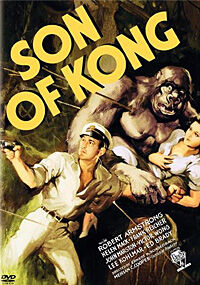
Released on Mar. 7, 1933, in New York City and a month later nationally, King Kong quickly took the nation by storm and became a cinematic landmark.

Nine months later, incredibly, RKO released the sequel Son of Kong and Hollywood did not make another Kong picture for more than 40 years.

Son of Kong just might be Hollywood’s first rush job and one of its first sequels*. It is a pleasant enough movie to watch, but obviously it’s not a patch on an all-time classic. I’ve watched the original numerous times, but I doubt I’ll want to return to Son of Kong a second time.

That’s because it’s virtually dull as dishwater. It takes approximately 45 minutes to get to our title character. That’s way too long for a movie that lasts only 69 minutes. Despite the return of Carl Denham, the most interesting human character in King Kong, played by the reliably entertaining Robert Armstrong, Son of Kong does not maintain the interest level high enough for a Kong movie. Of course, the original set the bar incredibly high.

They give Denham a potential romantic interest, because lovebirds Ann Darrow (Fay Wray) and John Driscoll (Bruce Cabot) quite naturally did not return for the sequel after their harrowing experiences, and Helen Mack’s Helene Peterson epitomizes the movie as a whole, since she’s pleasant but dull. She’s a singer, not an actress like the lovely Miss Darrow, and gets a production number. Again, pleasant but dull.

Kong co-directors Ernest B. Schoedsack and Merian C.Cooper returned as director and producer. Special effects guru Willis O’Brien and composer Max Steiner also returned, as did some of the supporting cast.

They were on a tight budget, an even tighter schedule, and they obviously knew there was no way they could topple King Kong. Armstrong himself preferred Son of Kong, but that’s because Denham received greater character arc. He’s probably the only person to ever prefer Son over its father. Both the son and the sequel are kinder, gentler — not good for a creature feature.

Sequels very rarely even approach their predecessors, and that was true in 1933 every bit as it is this very day.

For every Bride of Frankenstein and The Empire Strikes Back, we have a million failures and footnotes, like Son of Kong.

*United Artists released Don Q, Son of Zorro in 1925, a sequel to the 1920 classic Mark of Zorro. Swashbuckler supreme Douglas Fairbanks starred in both films. Son of Zorro also predates Son of Kong, Son of Frankenstein, Son of Godzilla, and Son of the Mask. To be fair, though, the sound of a toilet flushing predates Son of the Mask.

Attack of the Fantastical Movies

ATTACK OF THE FANTASTICAL MOVIES: ATTACK OF THE 50 FOOT WOMAN, EARTH VS. THE FLYING SAUCERS, PLANET OF THE VAMPIRES, MOTORPSYCHO!, GALAXINA, REPTILICUS, BIG BAD MAMA, REAL LIFE, NINJA III: THE DOMINATION, NIGHT OF THE DEMONS

How do I grade something like ATTACK OF THE 50 FOOT WOMAN from 1958? It has a setup that could be called “laborious” or “lackluster” or “lugubrious.” I’m not going to call it any of those words, but I can see exactly why somebody else would. In other words, it’s not until about the 45-minute mark that we get to the 50 foot woman. Yes, I wish they had reversed the numbers, 15 minutes of setup and 45 minutes of 50 foot woman. Simple mathematics. At least, 45 minutes of setup and 45 minutes of 50 foot woman. Yes, that sounds even better than “15 then 45.” The final 15 or 20 minutes of ATTACK OF THE 50 FOOT WOMAN, though, are solid gold. Rating: ***

— It’s virtually impossible to watch EARTH VS. THE FLYING SAUCERS and not think about MARS ATTACKS! (flying saucers) and INDEPENDENCE DAY (Washington D.C. invaded), two blockbusters from 1996 with a combined production budget of $145 million and big, big, big stars, including Jack Nicholson in dual roles in MARS ATTACKS! In EARTH VS. THE FLYING SAUCERS from 1956, Ray Harryhausen’s stop-motion flying saucers are the real star of the show (step aside, Hugh Marlowe) and the film thankfully wastes very little time in showcasing them. It’s the inverse of ATTACK OF THE 50 FOOT WOMAN. ***1/2

— Italian director Mario Bava (1914-80) became especially known for his stylish horror films. From his British Film Institute profile, “Mario Bava took a vital role in the creation of the modern horror film. If there was to be a a Mount Rushmore-style monument dedicated to four directors whose work pioneered a new form of big screen chills and thrills, those giant faces etched in granite on the mountainside would be: Bava, Alfred Hitchcock, Georges Franju and Michael Powell.” In the words of a Pavement song, a Bava film has style, miles and miles. Case in point: PLANET OF THE VAMPIRES, a low-budget science fiction and horror production from 1965 that masked its cheap sets through smoky skullduggery. Bava said in Fangoria, “Do you know what that unknown planet was made of? A couple of plastic rocks — yes, two: one and one! — left over from a mythological movie made at Cinecitta! To assist the illusion, I filled the set with smoke!” Watching PLANET OF THE VAMPIRES for the first time, you might think you’ve seen this basic plot somewhere before … ahem … Ridley Scott’s ALIEN. ***1/2

— 1965 proved to be a great year for titles with exclamation points and for director, producer, writer, cinematographer, and editor Russ Meyer (1922-2004), whose films often proved to be ahead of their time. Meyer contributed two exclamation point titles — FASTER, PUSSYCAT! KILL! KILL! and MOTORPSYCHO! — during a 1965 in which he directed three films overall; Meyer’s greatest cinematic year began with MUDHONEY. Proof of being ahead of its time: MOTORPSYCHO! (what a title) gives us a psychotic motorcycle trio led by a deeply disturbed Vietnam vet — before TAXI DRIVER, before ROLLING THUNDER, before THE DEER HUNTER, before FIRST BLOOD — in addition to all the elements (large-breasted women and endless cleavage, campy humor, satire, and quotable dialogue) we expect from a Meyer film. ***

— GALAXINA lands a few successful jabs at STAR WARS, STAR TREK, and ALIEN, but otherwise it’s a real long slog through 90-plus minutes of a lowbrow and low-budget science fiction and western parody set in the 31st century. Here’s just one example of the film’s humor: Avery Schreiber (1935-2002) plays a character named “Capt. Cornelius Butt.” Then again, I probably should have just said that it’s a Crown International Pictures release. Surely you remember Crown International Pictures? They brought us such immoral, er, immortal classics as THE BEAST OF YUCCA FLATS, THEY SAVED HITLER’S BRAIN, SEXTETTE, and THE BEACH GIRLS. The late former Playboy Playmate of the Year Dorothy Stratten fills the title role and she’s been described as “a voluptuous blonde android servant.” Galaxina works better when she’s silent (the first half of the picture), because Stratten proves that she was a true novice thespian every time she speaks during GALAXINA. Stratten reportedly complained to film director and her paramour Peter Bogdanovich that the ads for GALAXINA promoted her being the Playmate of the Year, because she wanted to be taken seriously as an actress. GALAXINA would not do good for anybody wanting to be taken seriously for anything. Unfortunately, Stratten’s estranged husband Paul Snider murdered her two months after the release of GALAXINA. Stratten would be immortalized on film by the 1981 TV movie DEATH OF A CENTERFOLD: THE DOROTHY STRATTEN STORY and the 1983 theatrical release STAR 80, played by Jamie Lee Curtis and Mariel Hemingway, respectively. In case you were wondering, you see a lot more of Stratten in Playboy than GALAXINA. *1/2

— Recent weeks, mostly under self-quarantine, have included a few first-time watch monster movies: GODZILLA VS. MECHAGODZILLA and TERROR OF MECHAGODZILLA, SLITHIS (possibly the worst monster movie ever made), THE GIANT CLAW, and, most recently, REPTILICUS, Denmark’s infamous first entry in the monster movie sweepstakes. Judging by REPTILICUS, the Danish should stick to pastries. They make a mean strudel, not so much a Godzilla rip-off. Apparently, there’s never been a second Danish monster movie, so I guess they have stuck to pastries for nearly 50 years since this 1961 turkey. Anyway, I wanted to find the Danish version of REPTILICUS, but, of course, I had to settle for the English dub from good old American International. The plot: Copper miners find the tail of a prehistoric reptile and it eventually regenerates into Reptilicus, a hand puppet (close-up) and a marionette (wide shot) that give the $50 Giant Claw its money for being the “best” worst movie monster of all-time. I enjoyed REPTILICUS even less than THE GIANT CLAW, though. For example, when Reptilicus eats an extra or two, the victims look like they have been cut out of a magazine and they are being thrown into the puppet’s mouth. In THE GIANT CLAW, at least its victims being eaten scene brought me back to the “Eat ‘em! Eat ‘em! Crunch! Crunch!” scene from Q: THE WINGED SERPENT. I even called out “Crunch! Crunch!” during THE GIANT CLAW. No such luck during REPTILICUS. **

— Arthur Penn’s 1967 film BONNIE AND CLYDE proved to be one of the watershed films of the second half of the 20th century and one indication was that for several years, BONNIE AND CLYDE inspired many sensationalistic crime films set during the Great Depression. Roger Corman produced a whole slew of them, with the most famous being 1974’s BIG BAD MAMA starring Angie Dickinson, Tom Skerritt, and William Shatner and directed by Steve Carver (who later directed the Chuck Norris spectacular LONE WOLF McQUADE). BIG BAD MAMA mixes in a hippie-like free love sensibility and showcases bed hopping and generous amounts of nudity between all the murder and mayhem. The title character (Dickinson) and her two not long past jailbait daughters (Susan Sennett, Robbie Lee) all have multiple nude scenes, highlighted by Dickinson’s full-frontal shot late in the picture. One of the picture’s tag lines: “Wilma gave her daughters everything — her looks, her lovers and the crime of their lives!” Dick Miller (1928-2019), yes, that guy, plays a crime fighter and you know you can’t go too wrong with a picture that features an old-fashioned bloody crime spree, much nudity and shenanigans (Dickinson looked absolutely sensational in 1974), Shatner, and Dick Miller. ***

— Many years before the proliferation of reality TV, Albert Brooks skewered it with his 1979 directorial debut REAL LIFE, a satire of the 1973 PBS documentary “An American Family.” Brooks plays an exaggerated version of himself and watching this movie for the first time in 2020, it’s difficult not to conjure up memories of all the obnoxious or obsequious hosts and participants on reality TV shows from years ago — “The Real World,” “The Bachelor,” et cetera, they’re all terrible and I’m fortunate to have survived all my encounters with them. All those creeps still give me the willies just thinking about it now, but unfortunately reality TV seems like it’s here and it’s here to stay. Take that from somebody who’s not watched a whole lot of TV in the last decade, with reality TV being one of the big reasons. I laughed a lot during REAL LIFE, from the epic sight gag on the head of every cameraman (I laughed every single time) to the fiery grand finale Brooks borrows from GONE WITH THE WIND. ****

— The Cannon Group’s best of the worst films could generously be called “sublime stupidity” and I believe that description fits NINJA III: THE DOMINATION perfectly. Part ENTER THE NINJA, part FLASHDANCE, and part EXORCIST, THE DOMINATION must be seen to not be believed. Imagine Jennifer Beals possessed by the evil spirit of a ninja with an Oriental Max von Sydow attempting to bring it out. THE DOMINATION starts out with its very best scene, a golf course massacre that leads to the bad ninja transferring his spirit into the body of telephone lineman and aerobics instructor Christie (Lucinda Dickey). Also happening in the first 30 minutes of the picture: Christie’s aerobics class, her fight against a handful of creeps who were harassing one of her students, and possibly the most awkward bedroom seduction scene in the history of cinema. Christie won’t give this creepy cop the time of day and then, practically the next moment, they end up in embrace and she pours V-8 on herself … this is the beginning of a beautiful friendship. There’s also a bizarre sequence involving Christie’s Bouncer arcade game. On the International Arcade Museum page for Bouncer, it says “Bouncer was seen in the low budget martial arts film NINJA 3: THE DOMINATION. The game is in the main character’s apartment and she is seen playing it. The character becomes possessed by the spirit of the ninja, and as he overtakes her body, the arcade cabinet begins to bellow out smoke and hypnotizes her with a little laser show from the screen.” I thought she was already possessed. Yeah, I know, bizarre. Then again, bizarre basically describes both THE DOMINATION and Cannon films in general. We wouldn’t have them any other way. ***

— We’ve seen NIGHT OF THE DEMONS done better before, especially the first two EVIL DEAD movies and RETURN OF THE LIVING DEAD, which it seems to reference through both Linnea Quigley and punk rock. We’ve seen this plot before: 10 (mostly) horny high school kids have a Halloween party inside an abandoned funeral parlor. You can fill in the rest, down to every detail both personality and plot. It’s not a bad movie, exactly, it’s just after having seen EVIL DEAD and RETURN OF THE LIVING DEAD and EVIL DEAD 2, why settle for less? Seemingly just about every movie from the ‘80s — the good, the bad, and the ugly — has developed a cult following over time and NIGHT OF THE DEMONS is one of them, spoken about in an enthusiastic tone by admirers. I can sympathize, because I feel similarly about numerous movies. I have mixed feelings on NIGHT OF THE DEMONS. On one hand, I can’t think very highly of a movie that goes for three jump scares very early on. That loses points for it real quickly. It’s also one of those movies that I started liking less down the home stretch and I wished it would get to its inevitable conclusion sooner rather than later. On the other hand, it does have a few good moments, just not enough for a recommendation. **

The Villain (1979)

CTHE1037041 A

THE VILLAIN (1979) *

THE VILLAIN, a comic western directed by stunt man turned filmmaker Hal Needham (1931-2013), gives us a feature-length, live-action take on those classic “Road Runner” cartoons.

Please stick with them old “Road Runner” cartoons, because even the absolute worst one of those is still loads better than THE VILLAIN.

Please try and find “Adventures of the Road-Runner” from 1962, which accomplishes more in about one-fourth the overall running time as THE VILLAIN. Better songs, better stunts, better gags, better technical credits. “Adventures of the Road-Runner” alone outclasses THE VILLAIN during the scene a few minutes in when Wile E. Coyote analyzes his own failings as diabolical genius. In the next scene, two child viewers discuss the Coyote and the Road Runner as their adventures play out on TV; one child says, “Sometimes I feel very sorry for the Coyote. Sometimes, I wish he’d catch him.” The other counters, “If he caught him, there wouldn’t be any more Road Runner.” That’s smarter than anything found during THE VILLAIN.

Kirk Douglas (1916-2020) stars as Cactus Jack, who’s played as the human equivalent of Wile E. Coyote. I believe that he even reads from Coyote’s handbook for most of the picture. To see Douglas involved in a series of pitfalls and pratfalls for 90 minutes, it’s embarrassing for both him and for those of us who are not moved by this lower-than-lowbrow humor. For crying out loud, this man gave us SPARTACUS and CHAMPION and ACE IN THE HOLE and PATHS OF GLORY. At some point during THE VILLAIN, a first-time watch not long after Douglas’ passing in early 2020, I started thinking about those other Douglas films and performances. I am thinking now of his patented intensity and determination. I am thinking specifically of that scene in PATHS OF GLORY where his anger builds against General Broulard, “I apologize … for not being entirely honest with you. I apologize for not revealing my true feelings. I apologize, sir, for not telling you sooner that you’re a degenerate, sadistic old man. And you can go to hell before I apologize to you now or ever again!” Classic scene, classic Douglas moment.

Arnold Schwarzenegger and Ann-Margret are supposed to represent the Road Runner, I suppose. Schwarzenegger plays (get this) Handsome Stranger and Ann-Margret’s Miss Charming Jones, though it should be Chesty Jones because that’s where the camera directs its attention right from her very first appearance. You’ll never believe this, but Chesty, er, Charming throws herself at her protector Handsome Stranger and he goes to fetch some more wood … or something … while Cactus Jack pursues the booty. What these characters have to say to each other, why it made me pine away for the sophisticated dialogue of the Road Runner.

Not sure who was responsible for Schwarzenegger’s costume as the Handsome Stranger — Bob Mackie and Derek Crane are named as costuming Ann-Margret and Douglas, respectively, while Betsy Heimann, Bud Clark, and Michael Castellano are just listed as mere costumers (without the mere, of course) — but the responsible individual should have been the one shot or been the target of a boulder. That powder blue get-up, it almost defies comprehension, and I believe Arnold fared better in HERCULES IN NEW YORK. I mean, at least there he played Hercules.

Now, we come to the portion of the program where I cover the absolute worst part of the movie: Paul Lynde (1926-82) dresses up as an Indian chief named (prepare yourself) Nervous Elk. Believe it or not, his jokes are even worse than his name and his costume. In this movie tribe’s chosen vernacular, I have found the perfect way to describe THE VILLAIN: dum-dum. Forgive me for leaving this review, but I have to check on myself after being drummed over the head with dum-dum for nearly 90 minutes by THE VILLAIN.

Young Frankenstein (1974)

YOUNG FRANKENSTEIN

YOUNG FRANKENSTEIN (1974) Four stars

Over a 20-year period from the late ‘60s to the late ’80s, Mel Brooks directed a series of inspired comedies: THE PRODUCERS, THE TWELVE CHAIRS, BLAZING SADDLES, YOUNG FRANKENSTEIN, SILENT MOVIE, HIGH ANXIETY, HISTORY OF THE WORLD PART I, and SPACEBALLS.

I’ll choose YOUNG FRANKENSTEIN as his best (i.e. my favorite) work.

It’s not his funniest work, per se, but you could put it on a DVD following FRANKENSTEIN, BRIDE OF FRANKENSTEIN, SON OF FRANKENSTEIN, and THE GHOST OF FRANKENSTEIN and it would be perfect. In fact, YOUNG FRANKENSTEIN nearly gives you the feeling that it’s a lost classic from Universal Studios during their reign of terror.

Brooks and co-writer and star Gene Wilder obviously loved Universal classics like FRANKENSTEIN. Brooks’ last feature film, DRACULA: DEAD AND LOVING IT, came in 1995, so Brooks took on Universal’s two most legendary monsters.

We can be sure the big boys at 20th Century Fox did not want YOUNG FRANKENSTEIN made in black & white. Some folks are guaranteed to say, “Black & white will never work again,” but what about every time it has worked over the years.

Wilder and Brooks based their characters on Mary Wollstonecraft Shelley’s original classic novel. They might as well have credited the screenwriters for the old Universal FRANKENSTEIN pictures.

All the technical people deserve their fair share of the credit for YOUNG FRANKENSTEIN: John Morris’ musical score, Gerald Hirschfeld’s cinematography, John C. Howard’s editing, Dale Hennesy’s production design, Robert De Vestel’s set decoration, Dorothy Jeakins’ costume design, and Edwin Butterworth’s, Mary Keats’, and William Tuttle’s work in the makeup department.

YOUNG FRANKENSTEIN benefits from using some of the same sets the original FRANKENSTEIN used.

Beyond the overall look and style of the picture, though, both the performances and the jokes are their usual grab bag that’s found in a Mel Brooks film.

Wilder’s obits called him “A Master of Hysteria” and he gave some of his defining performances in Mel Brooks comedies, namely THE PRODUCERS, BLAZING SADDLES, and YOUNG FRANKENSTEIN. There’s even the legendary “I’m hysterical and I’m wet” scene in THE PRODUCERS. Honestly, though, I prefer Wilder when he’s more calmer, more restrained and that patented hysteria did not work as well in his later pictures.

Wilder’s hysteria fits Dr. Frederick Frankenstein, the grandson of Victor Frankenstein, because British actor Colin Clive (1900-37) specialized in a bit of hysteria in FRANKENSTEIN and BRIDE OF FRANKENSTEIN.

Brooks himself does not appear as a main character in YOUNG FRANKENSTEIN, which differentiates it from later Brooks productions like SILENT MOVIE, HIGH ANXIETY, and HISTORY OF THE WORLD PART I.

Marty Feldman (1934-82) was perfect for the role of Igor (pronounced “EYE-gore”), Frankenstein’s hunchback compadre. Madeline Kahn (1942-99), Cloris Leachman, and Teri Garr insure that it’s not all about the boys — Kahn eventually makes a perfect bride for The Monster after being engaged to Frankenstein, Leachman plays a character and a name (Frau Blucher) loved by horses, and Garr’s cleavage deserves its own screen credit. Kenneth Mars’ police inspector Hans Wilhelm Friedrich Kemp calls to mind Dr. Strangelove in addition to his FRANKENSTEIN precursors. Gene Hackman makes a cameo as the blind hermit who befriends The Monster.

That brings us to The Monster, played by the great character actor Peter Boyle (1935-2006). I’ll make a case for Boyle being the second best actor to play The Monster, behind only the immortal Boris Karloff (1887-1969) who initiated the role. Boyle definitely gives a better performance than his TAXI DRIVER co-star Robert DeNiro did as “The Creation” in Kenneth Branagh’s MARY SHELLEY’S FRANKENSTEIN (1994). Of course, Boyle is the only Monster required to perform a soft-shoe number and he enjoys a domestic life.

Brooks practiced “saturation comedy,” a style where the jokes fly past fast and furious. It’s been said to not worry if you missed one joke because another one will be coming any moment. Brooks’ comedies are not quite as saturated as the works of the Zucker Brothers and Jim Abrahams during AIRPLANE!, TOP SECRET!, and THE NAKED GUN, which have jokes in virtually every inch of the frame. Saturation comedies are special because they believe in the intelligence of the audience, that we’re smart enough to get the jokes.

I’ll say that my favorite moment in YOUNG FRANKENSTEIN involves a revolving bookcase.