
Ice Castles (1979)

ICE CASTLES

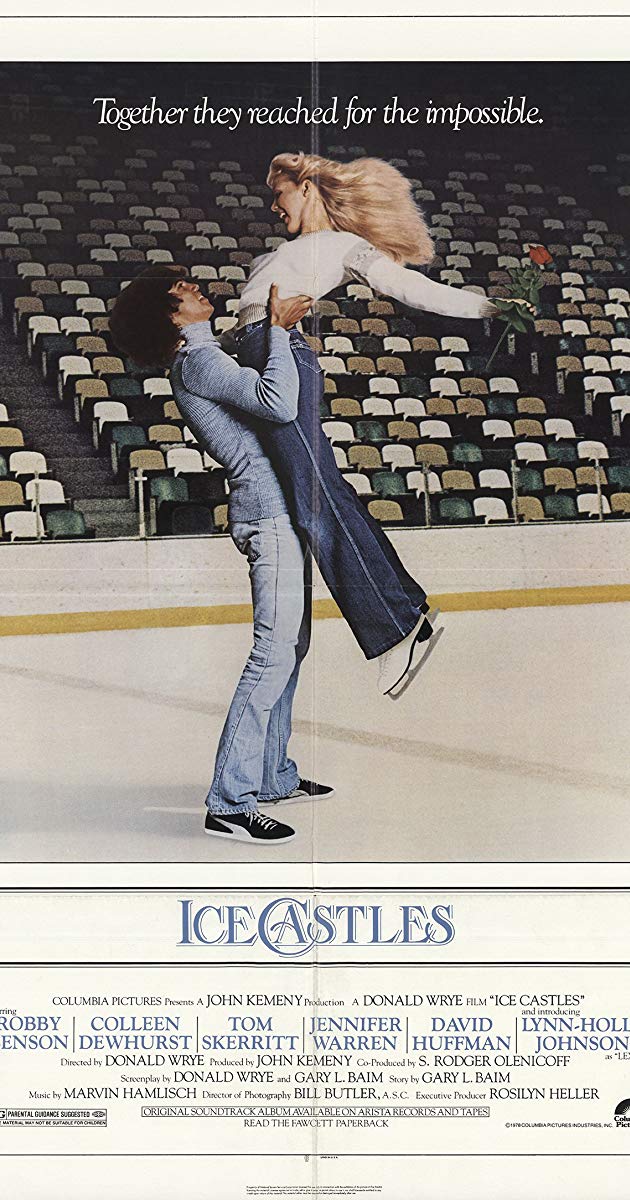
ICE CASTLES (1978) **

Not that I have a problem with either figure skating or movie romance — I like THE CUTTING EDGE, for example — but ICE CASTLES is not a very good movie and that’s because it makes one (like yours truly) mad due to its relentlessly manipulative nature.

We know entering ICE CASTLES that it centers on a blind figure skater and her personal and amateur figure skating travails. Naturally, she does not start out the movie blind, so that means we are waiting for her freak accident. That makes it the pièce de résistance of the picture and that makes the picture quite sick and perverse because her disability itself becomes more important than her state before or after her disability.

When skater-on-the-rise Alexis “Lexie” Winston tries a difficult triple jump and takes a mighty fall, we see it drawn out in explicit slow motion. None of her other jumps play out in this fashion. She ends up with a blood clot in her brain and loses 90 percent of her sight. There goes her shot at the 1980 Winter Olympics, right?

Director and screenwriter Donald Wyre and fellow screenwriter Gary L. Baim undercut their own movie with such a focus on the accident.

They gave first-time actress and former amateur figure skater Lynn-Holly Johnson one helluva challenge for her debut. Let’s see here, her 16-year-old character goes through not only a debilitating accident, but she breaks up with her jealous boyfriend (Robby Benson), hooks up with a television reporter (David Huffman) who helped out her career and made all her figure skating cohorts upset by all her publicity, argues with her father (Tom Skerritt) at different points throughout the picture, eventually hashes it out with her former boyfriend, and makes her triumphant comeback — despite her blindness — for a grand finale. Johnson gives a good performance and it’s certainly better than her work in subsequent films THE WATCHER IN THE WOODS, FOR YOUR EYES ONLY, and WHERE THE BOYS ARE ‘84.

Benson can be one of the most irritating movie actors and he’s especially awful with emotional scenes; he so often turns them into bad soap opera with fake anger his dread specialty. Benson does that a handful of times during the last half of ICE CASTLES, especially in the scene at the dinner table when the four main characters (I have not mentioned Colleen Dewhurst as rink operator and trainer Beulah Smith, but she’s the fourth main character) are debating whether or not Lexie should return to competition. The melodrama hits its high point when Benson’s Nick Peterson feasts on the line “Don’t give me that. Not trying is pointless and cruel. Not trying is wondering your whole life if you gave up too soon. Who the hell needs that?” It’s all so phony baloney, but it’s nowhere as bad as Benson in HARRY & SON. In that horrible movie, I wanted Paul Newman’s character Harry to punch out his son Howard as played by Benson. Time Out London called it “a curiously indigestible phenomenon, like being forced to eat five courses of avocado by an overbearing dinner-party host.” One of Benson’s immortal lines in HARRY & SON, “Want a Cherry Coke, pa?”

American adult contemporary singer Melissa Manchester performed her two nominated songs at the 1980 Academy Awards ceremony: “Through the Eyes of Love (Theme from Ice Castles)” and “I’ll Never Say Goodbye” from THE PROMISE, another soap opera. “It Goes Like It Goes” (wow, oh wow, what a title) beat out both Manchester numbers for “Best Original Song.” “Rainbow Connection” from THE MUPPET MOVIE was obviously robbed. For many years, the Academy seemed to nominate the most forgettable songs 90 percent of the time.

I promise that I’m not a hater of figure skating or movie romance, but I will often bristle at manipulation and melodrama — ICE CASTLES, despite some good elements at work, offers large portions of both manipulation and melodrama.

Then again, RogerEbert.com writers Christy Lemire, Sheila O’Malley, and Susan Wloszczyna contributed to a 2017 piece titled “Through the Eyes of Love: On the Timelessness of ‘Ice Castles.’” But, then again, so what?

Fat City (1972)

FAT CITY

FAT CITY (1972) ****

I would not be surprised if writer and director John Huston (1906-87) had the nickname “The Great Adapter.”

Huston directed 37 feature films from 1941 through 1987 and his films adapted from works by Dashiell Hammett, Ellen Glasgow, Robert Carson, B. Traven, Maxwell Anderson, Robert Sylvester, W.R. Burnett, Stephen Crane, C.S. Forester, Pierre LaMure, Claud Cockburn, Herman Melville, Charles Shaw, Romain Gary, Alan LeMay, Philip McDonald, Tennessee Williams, the Book of Genesis, Carson McCullers, Ian Fleming, David Haggart, Hans Koningsberger, Noel Behn, Leonard Gardner, Desmond Bagley, Rudyard Kipling, Flannery O’Conner, Zoltan Fabri, Harold Gray, Malcolm Lowry, Richard Condon, and James Joyce.

Huston co-wrote some of those adaptations, but it was Gardner himself who adapted his own novel, “Fat City,” for the big screen.

In a 2019 interview with the Paris Review, celebrating the 50th anniversary of his novel, Gardner spoke about Huston and the film adaptation.

“Before I started to write it (the screenplay), he invited me to come over to his place in Ireland for a couple of weeks for a discussion about how it was going to go,” Gardner said. “He was a funny guy. He trusted me, I think, because we didn’t talk all day about the script. We talked maybe a half an hour. Then he wanted to paint. He was always painting.

“He’d been an amateur boxer. It was lucky because my objection to boxing movies back then was that they were all the same. It’s a fixed fight and the hero won’t take a dive and maybe they break his hands afterward. I thought there needed to be a boxing film done another way. He was all for it.”

FAT CITY set itself within the city of Stockton, California, population over 100,000 at the time of the making of the film. The scenes are played out in skid row bars, restaurants and living spaces, work on a migrant labor farm, bowling alleys, a boxing gym, and boxing venues in a gritty, street-level fashion. Huston and Gardner definitely created a boxing film that’s done another way.

Stockton, now with a population above 300,000, received a dubious recognition from Forbes Magazine in 2012: “The Most Miserable City in the U.S.”

“I think that this is such a rough place that people who are highly educated use it as a springboard to get jobs in other places, and what it leaves behind is not the cream of the crop. The really smart people don’t want to stay here. They don’t want to be here with the violence and the crime and everything,” said substitute teacher Ronald Schwartz in a story for PBS News Hour.

So things only seemed to get worse in Stockton since 1972.

Creedence Clearwater Revival released the song “Lodi” as the B-side to “Bad Moon Rising,” the lead single from their third album “Green River,” in April 1969. Farrar, Straus & Giroux published “Fat City” in 1969.

Lodi is approximately 15-20 miles north of Stockton.

Creedence songwriter John Fogerty has said that he picked Lodi because it had the coolest-sounding name. The song’s refrain “Oh Lord, stuck in Lodi again” has truly stuck with Lodi for more than 50 years, unfairly or not.

FAT CITY utilizes Kris Kristofferson’s “Help Me Make It Through the Night” and the lyrics and the way Kristofferson sings them suit FAT CITY perfectly. Kristofferson said that he got his inspiration for the song from an interview with Frank Sinatra, who said “Booze, broads, or a bible … whatever helps me make it through the night.”

Any of the characters in FAT CITY could have said that.

We follow two boxers in FAT CITY: 29-year-old Billy Tully (Stacy Keach) and 18-year-old Ernie Munger (Jeff Bridges). Tully meets Ernie in a Stockton gym, sees potential in the young man after they spar, and encourages him to get into the fight game. Tully recommends manager and trainer Ruben (the great character actor Nicholas Colasanto).

Keach and Bridges play off or against each other perfectly. Bridges, in his early 20s and on his fifth feature overall, fits the part of a promising up-and-coming talent like a glove; Bridges had already received an Academy Award nomination for Best Supporting Actor for his performance in THE LAST PICTURE SHOW. Keach’s own struggles to get a part like Billy Tully infuses his characterization of a washed-up boxer clawing and scratching (and drinking) his way through life; for example, Mike Nichols fired Keach from CATCH-22 a week into rehearsals. Keach’s propensity for overacting and Bridges’ for underacting factored in.

“FAT CITY is a good film,” Keach said in Dennis Brown’s “Actors Talk: Profiles and Stories from the Acting Trade,” “but 20 minutes were cut. Twenty minutes longer, FAT CITY is a great film, a classic. Unfortunately, 20 minutes longer made it 20 minutes more depressing.”

A theory: All good films are not depressing and all bad films are.

Boxing takes Ernie away from the pressures of a young wife (Candy Clark) and the start of a nuclear family. Tully, a shell of himself since his wife left him and since his defeat in the ring in Panama City, takes up with Oma (Susan Tyrrell), a character described as a “woozy boozy floozy” in the New York Times. Booze initially lubricates their relationship, of course, but it fizzles out spectacularly down the home stretch.

Tully tells Oma “You can count on me!” so many times that you wonder if he’s attempting to get himself to believe that more than even this woman.

Kingpin (1996)

KINGPIN (1996) Four stars

Over a period of a couple years in the late 1990s, there were two great bowling comedies released: The Farrelly Brothers’ KINGPIN and the Coen Brothers’ THE BIG LEBOWSKI. Granted, there’s far more to both movies than bowling.

A few of my friends and I watched these movies time and time again. They both played a central role in nearly a decade of regular Friday or Saturday or Sunday night bowling adventures at the Holiday Lanes in Pittsburg, Kansas. Alcohol helped too, although when the bowling alley banned outside cups, college student attendance dramatically took a dip. Eventually, though, our group sucked it up and put the money down on the watered down bowling alley beer.

A couple times during my writing career, I have mentioned KINGPIN. I reviewed ZOMBIELAND for the college newspaper and reunited Woody Harrelson and Bill Murray gave me an opportunity to reference their dueling comb-overs in KINGPIN. I just laughed thinking about it. I named KINGPIN one of my 10 favorite sports movies for The Morning Sun.

Harrelson plays Roy Munson from Ocelot, Iowa, the 1979 Iowa state bowling champion who embarks on a professional bowling career early on during KINGPIN. He’s a promising young bowler, but, unfortunately, he runs afoul veteran bowler Ernie McCracken (Murray), who cons rather than mentors the younger bowler. McCracken hated the fact that Munson beat him in bowling and in a con gone tragically bad, a gang of amateur bowlers take it out on Munson after they find out both he and McCracken are pros. McCracken gets away, of course, and leaves Munson to reap the consequences. Munson loses his right hand in a scene that’s very, very, very rough for a PG-13 comedy. It plays like a scene from a Scorsese gangster pic.

Seventeen years later, Roy Munson’s a real born loser in Scranton, Pennsylvania. Man, talk about down on his luck. He’s got a prosthetic hand and a major drinking problem. He sales bowling supplies, rather unsuccessfully, since nobody wants novelty gags in the men’s room any more. Munson is perpetually behind on his rent and that means his creepy landlady harasses the former pro bowler. They work out a debt solution I do not recommend and work in a Mrs. Robinson parody for tremendous sport Lin Shaye.

Speaking of sports, KINGPIN parodies the genre. Munson takes on a managerial role for Amish bowler Ishmael (Randy Quaid) and they decide to work their way to Reno for a $1 million winner-takes-all tournament to save Ishmael’s farm. Along the way, they gain Claudia (Vanessa Angel) and Roy and Claudia assume the roles with Ishmael that Jack Nicholson and Otis Young did with Quaid in the 1973 film THE LAST DETAIL. Needless to say, Ishmael gets hurt on the eve of the tournament in Reno, Munson makes his bowling comeback, and Munson and McCracken eventually battle for $1 million and comb-over superiority.

I find myself laughing throughout most of KINGPIN. Like the comedies of the Z-A-Z boys and Mel Brooks, or for that matter the Marx Brothers and the Three Stooges, I laugh twice at some of these jokes, a second laugh at the fact that I laughed in the first place. For example, I am laughing right now just thinking about Roger Clemens’ cameo playing a redneck named “Skidmark” and I have already mentioned Harrelson’s and Murray’s comb-overs.

Harrelson, Quaid, and Murray all have no problem looking absolutely ridiculous on screen, something they demonstrate time and time again for nearly two hours in KINGPIN. The Farrelly Brothers and the actors will stoop just that low for a laugh.

Murray has made a parallel career for himself with supporting roles and cameos, ever since CADDYSHACK. He’s done it with TOOTSIE, ED WOOD, SPACE JAM, WILD THINGS, COFFEE AND CIGARETTES, and, of course, KINGPIN, where he appears near the beginning and near the end of the picture. He just about walks away with the movie. Ernie McCracken is a real piece of work, crass, vile, womanizing, on down the line, but he seems to be a beloved figure within the movie. Of course. We love Murray and McCracken, and it’s the way he reads lines like “It’s a small world when you’ve got unbelievable tits, Roy.”

Of course, McCracken’s talking about Claudia, played by the lovely Angel. She is the discovery in KINGPIN, because we have seen Harrelson, Quaid, and Murray be funny before in several movies. At the same time, Angel could be seen on TV during her run on “Weird Science,” playing the character first essayed by Kelly LeBrock. She plays some of the same notes in both roles, with her delightful English accent and her sarcastic wit. It’s a joy watching her sock it to Munson and McCracken. It remains a mystery why Angel has never become a bigger star.

I recently talked about enjoying few comedies as much as NATIONAL LAMPOON’S ANIMAL HOUSE. Well, I just spent over 800 words on one of those few.


The Bad News Bears (1976)

THE BAD NEWS BEARS

THE BAD NEWS BEARS (1976) Four stars

I can hear somebody out there shout that THE BAD NEWS BEARS is not an underrated movie.

Sure, it’s not an underrated comedy or an underrated baseball movie, but I believe THE BAD NEWS BEARS is underrated as a serious consideration of competition and the effects of winning both individually and collectively on a team. Perhaps it’s because of director Michael Ritchie (1938-2001), whose other credits include THE CANDIDATE, SMILE, DOWNHILL RACER, and both FLETCH movies, that we get a sports comedy that goes a little deeper.

It’s that additional level that makes THE BAD NEWS BEARS my favorite baseball movie.

The Bears are, of course, the worst team in a prestigious California Little League. They’re a motley crew of misfits or as their firebrand shortstop Tanner Boyle (Chris Barnes) puts it in his inimitable way, “All we got on this team are a buncha Jews, spics, niggers, pansies, and a booger-eatin’ moron.”

Of course, they’re not wanted in this elite league — in fact, city councilman and attorney Bob Whitewood (Ben Piazza) sued and won a lawsuit against that prestigious Little League to allow the least skilled athletes (including his son Toby) to play in the first place. The Bears are made up of those bottom-of-the-barrel players.

Whitewood hires Morris Buttermaker (Walter Matthau), a former Minor League pitcher who turned to a life of beer and cleaning swimming pools … but mostly beer. Whitewood pays Buttermaker under the table to coach the Bears.

Buttermaker and the Bears are opposed by Coach Roy Turner (Vic Morrow) and the Yankees, namely Coach Turner’s son and star pitcher Joey Turner (Brandon Cruz, later a punk rock singer), at every turn. The Yankees are a juggernaut, of course, and the assholes and the bullies.

Along the way the Bears pick up two critical acquisitions: 11-year-old tomboy pitcher Amanda Whurlizer (Tatum O’Neal) and local hoodlum Kelly Leak (Jackie Earle Haley), who joins the Bears to get back at Coach Turner and to pursue his crush on Amanda.

The Bears start winning and they make it to the championship game against the hated Yankees.

Please keep in mind THE BAD NEWS BEARS does not end like so many sports movies with the underdog winning the Big Game. It’s funny that both THE BAD NEWS BEARS and ROCKY end differently than all the movies they influenced.

It’s more important that Buttermaker and the Bears finally see the effects winning had on them and how they started becoming more and more like them damn Yankees.

By the final scene, when the Yankees sing an obligatory and condescending cheer for the Bears, they’ve already had it and Tanner speaks for the entire Bears team when he tells the Yankees, “You can take your apology and your trophy and shove ‘em straight up your ass!”

Honestly, that’s a more satisfying finish than a win in the big game.

THE BAD NEWS BEARS IN BREAKING TRAINING and THE BAD NEWS BEARS GO TO JAPAN followed in successive years for three movies in three years and both sequels are lesser movies, especially the latter as the Bears resembled a high school baseball team. Kelly Leak, in fact, looks ready to join the cast of BREAKING AWAY. Yeah, GO TO JAPAN should be titled LONG IN THE TOOTH.

Matthau is perfect for the role of Buttermaker and the sequels miss him dearly, as William Devane (BREAKING TRAINING) and Tony Curtis (GO TO JAPAN) lack both the comedic and dramatic touches of Matthau. They’re just not as good as Matthau, who takes on a wide range in THE BAD NEWS BEARS. Matthau (1920-2000) handles the scenes where Buttermaker’s drunk, the quiet moments with Amanda, the screaming matches against Turner, and the shift in his personality after the Bears start winning. Matthau gives a great performance. He’s one of those actors that we’ll follow all the way through a turn toward asshole. Buttermaker takes a major asshole turn.

For example, Buttermaker pitches Amanda into early retirement, instructs Kelly Leak to go chase down and catch every fly ball even the ones hit to the other fielders, and commands godawful hitter Rudi Stein (David Pollock) to purposely get hit by pitches to give the Bears a runner on base.

The younger actors do not wear out their welcome and they’re not too damn cute for their (and our) own good. Yes, thankfully, it’s not one of those movies where the younger actors mug so heavily that I have to check my back pocket for my wallet.

There are many big laughs and moments of truth in THE BAD NEWS BEARS and the film deftly maneuvers between farce and slapstick, satire, sentiment, and drama.

The Pride of the Yankees (1942)

THE PRIDE OF THE YANKEES

THE PRIDE OF THE YANKEES (1942) Two stars
A “Yeah right!” movie, why that’s THE PRIDE OF THE YANKEES.

We all know what “Yeah right!” movies are, right, because, yes, they make us say “Yeah right!” It could be any plot element, a plot twist, a casting decision, et cetera.

Watching THE PRIDE OF THE YANKEES again, it left me saying “Yeah right!” more than anything I’ve seen since, oh, perhaps, CRASH (2005).

We’ll start with a defining “Yeah right!” scene.

Of course, I know, THE PRIDE OF THE YANKEES is the cinematic equivalent of those books we read in elementary school about George Washington and Abraham Lincoln. You might remember the larger-than-life stories about George and his cherry tree and Honest Abe wrestling.

THE PRIDE OF THE YANKEES does that with a bat and a glove.

Our Gehrig tall tale starts with a hospital room filled with reporters. Yankee slugger Babe Ruth (Babe Ruth) promises a boy named Billy that he will hit a home run to center field … against St. Louis in the 1926 World Series.

Why, not to be outdone, our hero Lou Gehrig (Gary Cooper) comes over to visit Billy on his own and promises the boy two home runs … in the same game, yes, the same game that Ruth’s supposed to hit a homer. What a lucky boy!

Ruth and Gehrig both get their homers out of the way in the first inning.

Well, Gehrig needs his second homer and it’s not going to be easy.

Sports writers Sam Blake (Walter Brennan) and Hank Hanneman (Dan Duryea) spend the movie bantering back-and-forth with Blake always supporting and Hanneman always doubting Gehrig. Blake and Hanneman bet on whether or not Gehrig will hit a second homer. They keep raising their stakes as the game moves on and Gehrig accumulates strikeouts. I should probably mention that Blake witnessed Gehrig making his promise.

All roads lead us to the ninth inning and why that dirty St. Louis pitcher, he’s gonna intentionally walk Gehrig.

Of course, a promise is a promise, though, and Gehrig finds a way to fulfill it in the absolute most dramatic fashion.

Later in the film, near the end of his life, Gehrig’s visited by an older Billy on Lou Gehrig Day. Billy tells Gehrig that his shining example and two homers that day inspired Billy’s full recovery.

As the reporter said in THE MAN WHO SHOT LIBERTY VALANCE, “When the legend becomes fact, print the legend.”

Opening credits: “This is the story of a hero of the peaceful paths of everyday life.

“It is the story of a gentle young man who, in the full flower of his great fame, was a lesson in simplicity and modesty to the youth of America.

“He faced death with that same valor and fortitude that has been displayed by thousands of young Americans on far-flung fields of battle. He left behind him a memory of courage and devotion that will ever be an inspiration to all men.

“This is the story of Lou Gehrig.”

Signed by famous writer Damon Runyon (1880-1946). Far out.

Yes, THE PRIDE OF THE YANKEES — made shortly after Gehrig’s death in 1941 at the age of 37 — lays it on thick right from the start.

Gehrig remains one of the greatest baseball players — his 2,130 consecutive games played streak stood as record until Cal Ripken, Jr., passed it on Sept. 6, 1995.

Great baseball players do not guarantee great movies — Babe Ruth, for example, received THE BABE RUTH STORY (1948) and THE BABE (1992), both even worse than THE PRIDE OF THE YANKEES.

In a certain mood, THE PRIDE OF THE YANKEES might be a moving experience.

Otherwise, it might be a “Yeah right!” movie for the ages.