The Legend of the 7 Golden Vampires (1974)

THE LEGEND OF THE 7 GOLDEN VAMPIRES

THE LEGEND OF THE 7 GOLDEN VAMPIRES (1974) ***

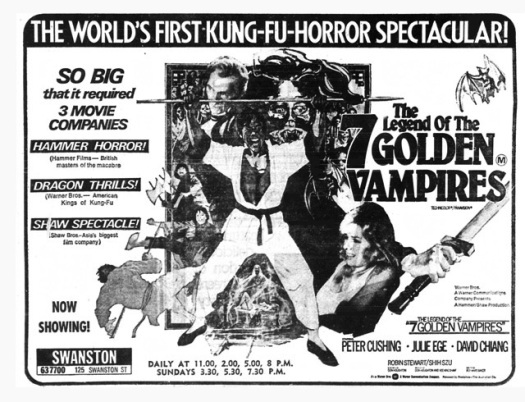
It was really only a matter of time before Hammer, the British masters of the macabre, and the Shaw Brothers, the Hong Kong masters of martial arts, would combine forces and make the world’s first martial arts vampire movie spectacular. An exploitation movie fan’s wet dream come true, in other words.

They created THE LEGEND OF THE 7 GOLDEN VAMPIRES in 1974, not the greatest vampire or martial arts movie ever made, of course, but still an enjoyable romp for those who have a hankering for (in no particular order, except for the last item) vampire hunting, neck biting, blood letting, boiling blood, severed hands, throat slitting, stabbings through the heart, vampires turning to dust, fake bats, fake castles, sword fights, martial arts combat between warriors and vampires & their minions, archery, breasts, romance, and one ridiculous, anticlimactic ending. Three stars, check it out.

Christopher Lee first played Dracula for Hammer in 1958 and he returned for PRINCE OF DARKNESS (1966), DRACULA HAS RISEN FROM THE GRAVE (1968), TASTE THE BLOOD OF DRACULA (1970), SCARS OF DRACULA (1970), DRACULA 1972 (1972), and THE SATANIC RITES OF DRACULA (1973). Lee’s animosity toward the series increased over time and he finally refused to participate in THE LEGEND OF THE 7 GOLDEN VAMPIRES after seven times as the Count. Lee read the script and said “No deal.”

That’s a bummer, especially since John Forbes-Robinson makes for a horrible Dracula. How horrible? They dubbed him with David de Keyser and Dracula only appears in a few minutes at the beginning and end of the picture. In the opening scene, Dracula kills a Chinese monk and takes on his form. (Reportedly, Forbes-Robinson was furious about being dubbed. Hey, it’s not the first time in history. A few years after GOLDEN VAMPIRES, SATURN 3 director Stanley Donen felt dissatisfied with Harvey Keitel’s Brooklyn accent and since Mr. Keitel refused participation in post-production, Donen dubbed over Keitel with a British actor using a Mid-Atlantic accent.)

Granted, we do have Peter Cushing for the fifth time as Professor Van Helsing. Who else would handle the plot exposition through dialogue scenes? How about that plot? Van Helsing, on a lecture stop in China, agrees to help seven siblings (six men, one woman) take back their ancestral mountain village that’s been taken over by seven “golden” vampires (including Dracula trapped in another body) and their living dead minions. Then again, I already described the plot in 44 words in the second paragraph.

THE LEGEND OF THE 7 GOLDEN VAMPIRES can stand with any of the goofiest Shaw Brothers spectaculars and it ranks among the best of the Hammer Dracula films.
The Mighty Peking Man (1977)

THE MIGHTY PEKING MAN

THE MIGHTY PEKING MAN (1977) ***

The Shaw Brothers (Runme 1901-85 and Run Run 1907-2014) have rarely ever let me down and they provided some of the greatest entertainments of all-time, like THE ONE-ARMED SWORDSMAN, FIVE FINGERS OF DEATH, INFRA-MAN, THE 36TH CHAMBER OF SHAOLIN, and CLAN OF THE WHITE LOTUS.

The Shaw Brothers did not (and still do not, in death) cheat us.

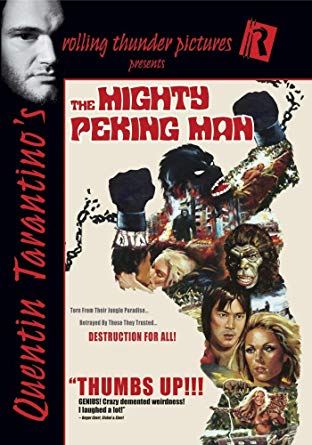
For example, in THE MIGHTY PEKING MAN, their 1977 spin on King Kong, Mighty Joe Young, and Tarzan (not to mention Godzilla) that’s not quite peak but still good Shaw Brothers, we don’t have to wait very long whatsoever to see the title character. No, life is short, time is precious, so director Ho Meng-hua gives us our first monster encounter in the first minute of screen time. Okay, to be exact, it’s 1:45 into the movie, but that still beats most every other entry in this distinguished genre.

That establishes a tone for a very generous entertainment package. Find a copy and buy it for somebody, and it’s the gift that keeps on giving.

THE MIGHTY PEKING MAN not only provides a sympathetic monster in the grand tradition, but also (in no particular order) a plucky explorer hero (Danny Lee) who’s been betrayed by his lover with his playboy brother so he’s drowning his sorrows in booze when he’s recruited for a jungle mission, a scantily-clad leading lady (Evelyne Kraft, a regular Swedish Fay Wray) who’s grown up with the animals in the jungle after her parents died in a plane crash (she’s been raised by the Mighty Peking Man, in fact), an earthquake, elephants, tigers and leopards (oh my!), a fight between a leopard and a snake, quicksand, vine swinging, flashbacks to key moments in both the hero’s and the leading lady’s life, callous and shady businessmen, heartless authority figures, mucho destruction of miniatures galore, and a grand finale that boggles the mind even after everything that came before.

My favorite scene, however, begins around the 33-minute mark.

It involves the Semi-Obligatory Lyrical Interlude, a term made famous by the late Roger Ebert. Here’s the definition from Ebert: “Scene in which soft focus and slow motion are used while a would-be hit song is performed on the sound track and the lovers run through a pastoral setting. Common from the mid-1960s to the mid-1970s; replaced in 1980s with the Semi-Obligatory Music Video.”

The Simon and Garfunkel songs in THE GRADUATE epitomize the Semi-OLI.

The one in THE MIGHTY PEKING MAN rates below Louis Armstrong singing “We Have All the Time in the World” over George Lazenby and Diane Rigg in ON HER MAJESTY’S SECRET SERVICE and the foreboding use of Roberta Flack’s “The First Time Ever I Saw Your Face” in Clint Eastwood’s PLAY MISTY FOR ME. Ebert himself said Eastwood filmed the first Semi-OLI that works.

In THE MIGHTY PEKING MAN, our hero and leading lady embrace and lock lips for the first time (watch her eyes after this first kiss) and they unleash the awesomely banal love song “Could It Be I’m in Love, Maybe.”

This is one helluva old-fashioned love song and one helluva Semi-OLI.

I mean, I believe it’s the only Semi-OLI in the history of motion pictures to incorporate a leopard.

Not only that, but the leading lady seems more interested in the leopard than our poor, poor hero. You really sympathize for this guy even more after this scene.

Let’s get back to those lyrics for a second here.

“The love you gave me then showed me a thing or two / I guess I saw it in your eyes / And the look of love upon your face is too hard to disguise / Maybe just a smile will say [cannot make out, even after watching this scene 500 times] / Could it be I’m in love (Maybe? Baby?)” (To hell with it, I already chose “Maybe.” Why does life have to be so difficult?)

“I can’t begin to say what makes me feel like this / I never knew what love could do / But if this is love, it’s here to stay / [Don’t want to make this part out] / So all I have to hear is I’ll give it all to you.”

There’s more lyrics, but we all catch the drift and there’s not any need to drown in banality.

It all totals about 3:30 of pure junk food cinema bliss.

I definitely love it because it’s so utterly ridiculous.

Then again, utterly ridiculous describes THE MIGHTY PEKING MAN.

I should end this review with a consideration of the ending of THE MIGHTY PEKING MAN. Just imagine the ending of KING KONG times 10 times 10.

Five Deadly Venoms (1978)

day 47, five deadly venoms

FIVE DEADLY VENOMS (1978) Three-and-a-half stars
Years ago, I finally tracked down (i.e. bought) a subtitled copy of FIVE DEADLY VENOMS and it made all the difference in the world after having extreme technical difficulties watching a dubbed copy the week before the subtitled version, failing twice to make it through because of the haphazard dub job.

The plot in a nutshell: A wise old martial arts master, on his death bed, gives his latest young martial arts pupil a dying wish to go track down some wayward pupils who have done “evil” with the master’s teachings, the “Five Deadly Venoms” that provide our lovely and oh so poetic title, and redeem the master and his martial arts philosophy and teachings forever.

Like DRUNKEN MASTER, FIVE DEADLY VENOMS provides us with multiple idiosyncratic martial artists, fighting styles, and personalities: The Centipede, The Snake, The Scorpion, The Gecko (lizard), and The Toad. The young pupil combines all five styles, although he’s not as potent as the older pupils because he only knows a little about each style.

The old man describes their styles in some detail on his deathbed. Honestly, this scene gets us hyped for the movie ahead, filled with great expectations.

Each fighter and fighting style have their own distinct strengths and weaknesses, some more apparent than others.

The Centipede: Based on speed and quickness. Fastest of the fast.

The Snake: Based on agility and flexibility. This flexibility makes for mad defensive skills and the pinpoint ability to attack the opponents’ weak spots.

The Scorpion: Based on acrobatic kicks or “the sting.” The style resembles the scorpion pincer in the hand techniques of the artist.

The Lizard: Nimble, quick footwork, also described on the FAQs at the IMDb as “Spider-Man with a black belt” because of The Lizard’s mastery of walls.

The Toad: Based on power and resilience. Once mastered, this style lends itself to becoming immune to physical harm. Well, we’ll all see how well that stands up in FIVE DEADLY VENOMS.

These fascinating artists and styles are placed inside an old-fashioned movie plot involving an old man’s treasure, imperial politics, and secret identities. We also have the age-old themes of redemption and revenge that seem to be at the core of the genre.

The different artists each wear masks that prominently feature their animal at the top of the mask.

Of course, you might find FIVE DEADLY VENOMS silly, very silly indeed, almost by default with this genre. I’ve always found that “silliness” in martial arts entertainments to be one of their most endearing features. Your mileage may vary.

Granted, THE FIVE DEADLY VENOMS takes itself seriously. It’s not attempting to be a comedy in any way shape or form.

There’s several twists and turns in the plot and we have to figure out the alignment of the “Five Deadly Venoms.”

We know that certain fighters will be more deadly than the others. To the film’s credit, I couldn’t guess it straight out. We align ourselves with the young pupil early on and follow him on his journey through such deadly waters.

Just a cut below DRUNKEN MASTER and THE 36TH CHAMBER OF SHAOLIN, two fabulous martial arts entertainments from 1978, THE FIVE DEADLY VENOMS nonetheless proves itself a damn good time at the movies and another iconic entry in the Shaw Brothers’ filmography. (Another martial arts film referenced by multiple hip-hop artists over the years, as well as Quentin Tarantino. It was also the inspiration for a series of Sprite commercials in the late 1990s.)

Please seek out the subtitled version. The dubbing proved deadliest venom in the English dubbed version. It took effect almost immediately.

Clan of the White Lotus (1980)

DAY 45, CLAN OF THE WHITE LOTUS.jpg

CLAN OF THE WHITE LOTUS (1980) Three-and-a-half stars
The Shaw Brothers (Runme and Run Run Shaw) rapidly became my favorite old school movie factory producers, following hot on the trails of the spectacles of the incomparable INFRA-MAN and THE 36TH CHAMBER OF SHAOLIN with CLAN OF THE WHITE LOTUS, a 1980 effort directed by Lo Lieh.

Like Sam Elliott’s rustic narrator said to the Dude in THE BIG LEBOWSKI, “I like your style.”

I get all giddy when I see and hear the Shaw Brothers fanfare before their every movie.

CLAN OF THE WHITE LOTUS quickly dispenses with its standard issue martial arts plot and focuses on exciting fight sequences centered on choreographed punches and kicks that play like violent ballet or Fred Astaire and Gene Kelly meets Bruce Lee.

Gordon Liu made his fame in THE 36TH CHAMBER OF SHAOLIN and stars here as our bald protagonist with the wicked cool handle. In THE 36TH CHAMBER, it was San Te (pronounced like the jolly fat guy from the North Pole) and in WHITE LOTUS, it’s Hong Wen-Ting but the subtitles tell us it’s “Hung Man Ting.”

Anyway, Liu plays the hot-tempered fiery young martial artist who faces many unbelievable hardships through the first couple acts before finally triumphing over every obstacle and the resident evil antagonist holding our main man back during the first couple acts through his sheer dedication, hard work, and martial arts talent.

As we discussed at some length in THE 36TH CHAMBER review, Liu is a genuine movie star and holds the camera and our attention and rooting interest.

Director Lo Lieh doubles as the resident evil antagonist Priest White Lotus and he’s virtually untouchable in the first two reels and he undoubtedly could take on an entire cast of doubles and extras just with his glorious white beard alone.

Tarantino fans will immediately recognize White Lotus.

CLAN OF THE WHITE LOTUS depends on a durable storytelling formula (underdog triumphs over evil) and, like DRUNKEN MASTER and THE 36TH CHAMBER OF SHAOLIN, WHITE LOTUS puts enough quirky twists and turns on the formula without diluting its very purity and making it unrecognizable from its basic elements.

For example, CLAN OF THE WHITE LOTUS co-stars needles, a martial artist getting in touch with his feminine side and martial arts style, a child, and pressure points. I believe I’ll skip more generic action movies and stick to films like CLAN OF THE WHITE LOTUS.

I mean, just look at a poster that hypes “Deadly Needle Kung-Fu Against the Invincible Armor of White Lotus.”

I would certainly have bought tickets for that extravaganza.

Alternate titles: HONG WENDING SAN PO BAI LIAN JIAO and FISTS OF THE WHITE LOTUS.

The 36th Chamber of Shaolin (1978)

day 38, the 36th chamber of shaolin

THE 36TH CHAMBER OF SHAOLIN (1978) Four stars
Wu Tang Clan founder RZA said that he’s probably watched THE 36TH CHAMBER OF SHAOLIN more than 300 times, beginning with a dub on TV (called THE MASTER KILLER) and then continuing through many, many viewings in seedy urban theaters.

RZA has shown the movie the same devotion that its central character Liu Yude / Monk San Te (Gordon Liu) shows in THE 36TH CHAMBER OF SHAOLIN.

THE 36TH CHAMBER OF SHAOLIN truly takes off into the stratosphere of the highest level of martial arts entertainment when our protagonist arrives at the Shoalin Temple around the 31st minute.

Training sequences have long been a staple of action movies, in everything from THE DIRTY DOZEN and FULL METAL JACKET to ROCKY, DRUNKEN MASTER, and THE KARATE KID, just a few prominent examples.

However, I’ve never seen anything quite like the training sequences in THE 36TH CHAMBER. They’re on another level, taken far more seriously than usual.

Training sequences in a lot of movies seem to end up being consolidated into a couple montages and topped off with an uplifting song along the lines of Bill Conti’s “Gonna Fly Now” (ROCKY). We’ve seen it time and time again, a standard of the action movie relentlessly satirized in TEAM AMERICA: WORLD POLICE.

THE 36TH CHAMBER gives us a good 45 minutes of training, helped out by the fact there’s 35 chambers in the Shaolin Temple. San Te advances more rapidly than any student ever before, six years that, through the magic of movies, goes by quickly. I could have gone for the entire movie being nothing but training sequences, though.

It all leaves you with an unbelievably giddy feeling as he cracks every level, bests every challenge. The challenges are not merely physical, and there’s a rigorous attention to detail rare for any genre.

San Te wants to create a 36th chamber to teach the common man the basics of Kung Fu. He’s rebuffed and sent back out into the larger world.

San Te sought sanctuary at the temple because, as a young student named Liu Yude, he took part in an uprising against the Manchu government.

Now, back in the world, equipped with his three section staff invention, San Te’s ready for combat against those heartless Manchu oppressors.

After vanquishing his foes, San Te eventually returns to the temple and establishes that 36th chamber.

Of course, he becomes a folk legend.

Beyond the usual suspects Bruce Lee and Jackie Chan, Gordon Liu is one of my absolute favorite martial arts stars. In addition to THE 36TH CHAMBER, notable titles in his filmography include CLAN OF THE WHITE LOTUS, RETURN TO THE 36TH CHAMBER, and EIGHT DIAGRAM POLE FIGHTER.

Western audiences likely know Liu best from his role in Quentin Tarantino’s KILL BILL movies, where he played Johnny Mo and Pai Mei in the two parts, respectively. Pai Mei in EXECUTIONERS FROM SHAOLIN and Priest White Lotus in CLAN OF THE WHITE LOTUS, both villains, inspired Tarantino’s Pai Mei.

(Please watch CLAN OF THE WHITE LOTUS if you want another screw loose entertainment. Liu defeats Priest White Lotus in one memorable final fight that incorporates the fine art of needlepoint.)

Liu had the necessary movie star charisma and joy of performing to carry viewers from one end of the picture to the next or stay interested through 35 chambers, to be more precise. Riveting is the word for it.

Liu’s at his best in THE 36TH CHAMBER and the movie does not waste any time in showcasing him, with an opening credits sequence that previews the final hour of the film when it kicks into a high level.

Lo Lieh played the villain General Tien Ta in THE 36TH CHAMBER and he also played both Pai Mei and Priest White Lotus. He played the heavy in a lot of Shaw Brothers films, but one should remember that he played the protagonist in FIVE FINGERS OF DEATH, a film (along with ENTER THE DRAGON) that broke martial arts films in the Western world. Lieh also directed himself as Priest White Lotus.

This is not his best villain, but that’s alright because the training sequences and Liu’s starmaking performance alone make THE 36TH CHAMBER one for the ages.

We know what RZA has to say on that.

“Me and Dirty (Ol’ Dirty Bastard) were probably the most fanatical about it,” RZA said in Rolling Stone. “36TH CHAMBER to me has had a strong spiritual connection that set me and Dirty on the path.

“It’s one film I’ve never gotten sick of. I’ve probably seen this movie more than any other, especially now that it’s something I perform with, but I don’t get tired of it. More than anything, I love watching people discover it. When I was in California doing it at the Egyptian Theater, that was the first time my son, 10 years old, watched the movie. And he loved it. Turning somebody onto a film that’s so dear to you is, to me, for me, the coolest thing.”

RZA provided a live score to THE 36TH CHAMBER at various Alamo Drafthouse Cinema screenings.

The One-Armed Swordsman (1967)

day 37, the one-armed swordsman

THE ONE-ARMED SWORDSMAN (1967) Three-and-a-half stars
Last month, our glossary of cinematic terms included “giallo,” the Italian thriller genre that definitely had an impact on the American slasher film.

Just a few days into November, now we have “wuxia,” a genre of Chinese fiction incorporating martial arts, sorcery, and chivalry.

The genre enjoyed its 15 minutes of fame in America during the successful run of CROUCHING TIGER, HIDDEN DRAGON (2000). (I’ll never forget the tittering of some in the audience throughout its two hours at the Pittsburg 8 Cinema. I loved the movie.)

There’s just something about handicapped swordsman movies from the 1960s, but, then again, maybe only I have this problem.

Back in the days of a free Hulu account, I enjoyed the heck out of the Japanese ZATOICHI THE FUGITIVE, ZATOICHI ON THE ROAD, and ZATOICHI AND THE CHEST OF GOLD, starring Shintaro Katsu as the blind swordsman Zatoichi.

Just a couple years ago, I caught up with THE ONE-ARMED SWORDSMAN and its sequel released two years later, RETURN OF THE ONE-ARMED SWORDSMAN, both part of the Dragon Dynasty DVD series of releases that will give viewers a greater sense of where Quentin Tarantino found his inspiration. (One should also seek out 1976’s THE ONE-ARMED BOXER VS. THE FLYING GUILLOTINE, another highly entertaining concoction in the same league with INFRA-MAN and DRUNKEN MASTER.)

Jimmy Wang Yu stars as the titular protagonist, Fang Kang, whose servant father sacrifices his life to save his teacher and the Chi school of Golden Sword Kung Fu in the opening scene. The servant father’s dying wish is to have his son be taught at his master’s school. Fang Kang’s fellow students, especially the teacher’s daughter, grow to resent him and they do their best to make him leave. On a snowy night, Pei-er, the teacher’s daughter, challenges Fang Kang to a fight and in anger over his refusal to fight her, she chops off his arm. Dang, girl! Fang Kang flees through the woods.

A young woman named Xiao Man inadvertently finds Fang Kang (he falls into her boat) and nurses him back to good health. He decides that he will give up swordsmanship (we know how that’ll work, especially with the movie’s title) and become a farmer with Xiao Man.

Meanwhile, the bad, bad men led by The Long-Armed Devil and The Smiling Tiger have it out for Fang Kang’s teacher, Qi Ru Feng, and have developed a “sword-lock” device that will be the demise of Qi Ru Feng and all his disciples.

(Wouldn’t you love to be called “The Long-Armed Devil”? Well, that’s not a question for “the short-armed.”)

Fang Kang becomes depressed over not being able to practice his martial arts and the ever-reluctant Xiao Man gives him a half-burned out kung fu manual that she inherited from her dead parents. Fang Kang, of course, becomes a new master, yeah, you guessed it, “The One-Armed Swordsman.”

The One-Armed Swordsman learns of the plot to kill Qi Ru and saves the day.

We could have written this script with one arm tied behind our backs. Just please make it the weak arm.

I should now mention THE ONE-ARMED SWORDSMAN includes much bloodletting, a year’s worth of production at the blood bank in 117 minutes. This bloodletting will likely interest contemporary audiences more than anything else.

Not sure how they made the fake blood in THE ONE-ARMED SWORDSMAN, but there’s recipes for it throughout the Interwebs.

Bet we’ll have to start with corn syrup.

THE ONE-ARMED SWORDSMAN (influenced by American Westerns and Japanese Samurais) ushered in a new era of Hong Kong movies built around male anti-heroes, swordplay, and bloodletting.

This pioneering Shaw Brothers production became the first Hong Kong film to gross HK $1M in returns and made Jimmy Wang Yu an early martial arts star.

Mad Monkey Kung Fu (1979)

DAY 97, MAD MONKEY KUNG FU.png

MAD MONKEY KUNG FU (1979) Three stars
Been told I’ve been difficult to shop for when it comes to movies.

Yeah, I guess I can see that, but I don’t know, I believe that you should buy a truly unique product like MAD MONKEY KUNG FU and you can’t go wrong.

I broke in 2019 with this Shaw Brothers spectacular from 40 years ago, one which I bought a couple months back during a spree. Sometimes, titles alone just grip you in the supermarket, like Charles Bukowski’s NOTES OF A DIRTY OLD MAN, and you are compelled to put down the hardly earned immediately on that product. After the title, I saw the center MAD MONKEY KUNG FU cover image (double hooked) and then I found out that it was a Shaw Brothers production from their golden era (triple hooked). Nobody could change my mind or wallet.

I didn’t even need to see a plot summary to buy that sucker. I found this one on the Internet: “A martial artist seeks revenge on those who assaulted the elderly master who taught him a specialized form of kung fu.” Not sure about that one, especially the elderly part. I like this one better on IMDb, “A disgraced former Kung Fu expert makes a living as a merchant with the help of a hot headed friend. When the men are harassed by gangsters, the merchant decided to teach his friend monkey boxing so they can defend their business.” A smidge better plot summary, though a title like MAD MONKEY KUNG FU and a background in consuming martial arts entertainment can probably have you working out the plot in short time.

MAD MONKEY KUNG FU truly kicks into gear around the 49-minute mark and gives us an effective final hour that leaves us on a high note. Yeah, it’s not as great as other Shaw Brother spectaculars, like INFRA-MAN, THE 36TH CHAMBER OF SHAOLIN, and FIVE DEADLY VENOMS, because unlike those other films, MAD MONKEY KUNG FU drags in certain spots and needs, oh, what’s the phrase, where’s Archie Bell and his Drells when you need ’em, tightening up.

That final hour includes training sequences and faithful readers know that I am a sucker for training sequences. They are excellent in MAD MONKEY KUNG FU, and I wish they had started a lot sooner.

In 2015, Screen Rant’s Victoria Robertson ranked the 10 best training montages in movies and her list included 10) BATMAN BEGINS, 9) BLOODSPORT, 8) EDGE OF TOMORROW, 7) THE EMPIRE STRIKES BACK, 6) G.I. JANE, 5) MULAN, 4) ROCKY, 3) TEAM AMERICA: WORLD POLICE, 2) THE INCREDIBLES, and 1) THE KARATE KID. I suppose only American films were considered for the list, but I am suspicious of any training montage list that misses THE 36TH CHAMBER OF SHAOLIN and DRUNKEN MASTER.

Now, I would add MAD MONKEY KUNG FU to such a list.

All the spectacular acrobatics on display in MAD MONKEY KUNG FU brought on flashbacks of a recent mini-vacation to Branson and a two-hour show of the Acrobats of China on a Saturday afternoon.

I enjoyed both the Acrobats of China and MAD MONKEY KUNG FU for similar reasons, swept up in an old-fashioned story that’s old-fashioned for a very good reason but also captivated by the amazing physicality of the performers. Martial artists have that ability more than other action stars and I am dazzled by the three main performers in MAD MONKEY KUNG FU.

Chia-Liang Liu (1936-2013) serves as both the star and the director, and he was 42 around the time of the making of MAD MONKEY KUNG FU, definitely not elderly like it said in that one plot summary. Among his 26 directorial credits are some dynamite entertainments: THE 36TH CHAMBER OF SHAOLIN, RETURN TO THE 36TH CHAMBER, THE 8 DIAGRAM POLE FIGHTER, and DRUNKEN MASTER II. He’s obviously a name who you can trust when it comes to martial arts movies.

Hou Hsiao, the young disciple in the film, is most famous for MAD MONKEY KUNG FU and his physicality, including the ability to imitate a monkey, will stick with you arguably more than anything else in the movie. Reportedly, in a 2004 interview, Hsiao said that he doesn’t watch any of the 40-odd movies that he was in, except for MAD MONKEY KUNG FU. Hsiao worked as assistant stunt coordinator on the second 36TH CHAMBER film and the very, very entertaining CLAN OF THE WHITE LOTUS, and served as stunt coordinator for THE 8 DIAGRAM POLE FIGHTER.

Of course, we cannot leave behind Lo Lieh (1939-2002), the first kung fu superstar who became known predominantly for playing the heavy. For example, he’s the villain in THE 36TH CHAMBER OF SHAOLIN and CLAN OF THE WHITE LOTUS, as well as here. He’s great at it, and there’s just something about him that you love to hate and you want to see him served his revenge. A movie like MAD MONKEY KUNG FU needs an effective villain and Lieh fills that niche … so MAD MONKEY KUNG FU sewed up the critical roles of teacher, student, and villain.

Infra-Man (1975)

day 36, infra-man

INFRA-MAN (1975) Four stars
I just looked at DRUNKEN MASTER, one of the most entertaining movies ever made, and here we are back with INFRA-MAN, another one.

Roger Ebert wrote an enthusiastic review in March 1976: “And so we’re off and running, in the best movie of its kind since INVASION OF THE BEE GIRLS. I’m a pushover for monster movies anyway, but INFRA-MAN has it all: Horrendous octopus men, a gigantic beetle man with three eyes who sprays his victims with sticky cocoons, savage robots with coiled spring necks that can extend ten feet, a venomous little critter that looks like a hairy mutant footstool, elaborately staged karate fights, underground throne rooms, damsels in distress, exploding volcanoes, and a whip-cracking villainess named Princess Dragon Mom.”

Believe it or not, Ebert originally gave INFRA-MAN only two-and-a-half stars and later changed his star rating to three after the re-release of MIGHTY PEKING MAN, another incredibly goofy movie by the same studio.

However, obviously, I don’t think Ebert went far enough, because INFRA-MAN should be four stars.

I just called DRUNKEN MASTER “sublime ridiculousness.”

That’s an understatement for INFRA-MAN.

No, seriously.

Not just because I’ve seen the movie in a print with a Mandarin soundtrack and Spanish subtitles.

It really is the most ridiculous movie I have seen, especially in the English dub.

This Shaw Brothers production combines super heroes, Kung Fu, and science fiction into one explosive 90-minute entertainment package influenced by the Japanese TV shows ULTRAMAN and KAMEN RIDER that were popular in Hong Kong.

It’s not only explosive because shit blows up real good throughout INFRA-MAN.

Seriously, there might be a land speed record for explosions in the movie.

Everything blows up.

Not convinced yet?

The short plot summary from IMDb: “Princess Dragon Mom and her mutant army have arisen, and only Infra-Man can stop them!”

A longer plot summary: “The ten million year-old Princess Dragon Mom (Terry Liu) attempts to conquer the Earth with her legion of mutant monsters. In response, Professor Chang (Wang Hsieh) creates Infra-Man, turning a young volunteer into a bionic superhero to save the world. However, the Princess kidnaps Chang’s daughter. Can Infra-Man save her and the planet before it’s too late?” (IMDb)

Princess Dragon Mom is one of the great villains of all-time, definitely ahead of her time in having cones on her breasts well before Madonna.

Not only that, which is no small feat, but when Infra-Man tries decapitating her when she’s in her dragon form with his energy blades, Princess Dragon Mom regenerates a new head. Every single time, and I mean every single time. Finally, he must use his solar beam to destroy her forever.

Princess Dragon Mom leads one of the more interesting groups of villains. Her minions include Witch-Eye, second-in-command who shoots great beams from eyes on her palms, and Skeleton Ghosts, who have explosive metal spears and wear black and white suits with a lovely skeleton decor that really holds it all together. Princess Dragon Mom’s villainous crew includes several monsters: Fire Dragon, Spider Monster (or the Will Not Stop Growling Spider Monster), Plant Monster, Mutant Drill, Long-Haired Monster, and Iron Armor Monster Brothers. How would you like to have portrayed any one of these minions or monsters?

Where does a performer go after playing Princess Dragon Mom? Did she get to keep any of the costume?

Terry Liu has some interesting titles among her 50 credits from 1973 to 2016, including THE BAMBOO HOUSE OF DOLLS, THAT’S ADULTERY (PART 1), SPIRIT OF THE RAPED, EROTIC NIGHTS, THE OILY MANIAC, and DEADLY HANDS OF KUNG FU.

She’ll always have a soft spot in my heart for her Princess Dragon Mom.

The rest of the world could call her Demon Princess Elzebub, but Princess Dragon Mom will more than suffice for me.

I’ll have more on the Shaw Brothers later.