Predator and The Most Dangerous Game


PREDATOR (1987) & THE MOST DANGEROUS GAME (1932)

It’s been duly noted over the years that PREDATOR combines elements from ALIENS and RAMBO into one blockbuster.

Until only recently, I did not realize PREDATOR also updated a 1932 horror movie named THE MOST DANGEROUS GAME for modern times and weaponry. That relatively unknown classic centers around the concept of a big game hunter (Leslie Banks) who moved on from animals to humans on his own island reserve. The big game hunter finally meets his match in another legendary hunter (Joel McCrea) shipwrecked on the island, due to the big game hunter’s dastardly design of sabotaging ships and hosting then hunting the shipwrecked survivors. The two great hunters contest their most dangerous game on the same jungle sets as KING KONG. Ernest B. Schoedsack co-directed both MOST DANGEROUS GAME and KING KONG, films released several months apart. Fay Wray and Robert Armstrong appeared in both. I say go check out THE MOST DANGEROUS GAME.

In a two-star review for THE PREDATOR, I summed up the difference between the 1987 original and the 2018 retread.

“PREDATOR ‘87 does not have perfunctory dialogue and dead weight, and it does not drag. It plays like ‘a lean, mean fighting machine’ (in the great words from STRIPES) and it’s a streamlined entertainment that moves faster than this, er, last year’s model (an Elvis Costello reference following STRIPES).

“The cast of the original PREDATOR amounted to 16 actors.

“By comparison, THE PREDATOR features approximately 50 credited and 20 uncredited cast members.

“Favorite character: ‘Sobbing veterinarian.’ Second favorite: ‘Cantina bartender.’ Show: ‘Halloween mom.’”

Let’s face it: PREDATOR star Arnold Schwarzenegger could do very little wrong at this stage in his career and he’s a presence missing from the PREDATOR movies that have followed. This is a different Schwarzenegger film in one key aspect: When his Dutch faces off against the title character in the final act, it’s an incredibly tense final showdown because, for a change, we are not sure Schwarzenegger’s character will make it out alive. Kevin Peter Hall’s Predator knocks Schwarzenegger around real good, something that we just don’t see every day. Hall stood at 7-foot-2 and he towers over everybody, including Schwarzenegger.

The film’s marketing campaign proved to be misleading, since Schwarzenegger is not the predator, he’s the prey.

The supporting cast around Schwarzenegger forms one of the most macho in history, with such luminaries as Carl Weathers, Jesse Ventura, and Bill Duke around to chew the scenery. Their machismo ultimately descends into terror as the title character begins systematically eliminating them. They sure do make great trophies for the intergalactic hunter. They’re the best of the best, at least on this planet.

PREDATOR director John McTiernan (DIE HARD) and crew made the film in the real jungles of Mexico rather than some back lot. Like PLATOON, PREDATOR turns the jungle into another character and it exerts a force seemingly every bit as potent as the title character. If that intergalactic hunter don’t kill you, then the damn jungle will for sure.

Like JAWS, behind-the-scenes difficulties benefited the finished product. Originally, Jean-Claude Van Damme signed on to play the Predator, but was fired during production for reasons that nobody has ever been able to agree on. Apparently, some of his footage survived and made the final cut. The 5-foot-10 Van Damme would have made a radically different Predator, one definitely not quite as imposing and intimidating and one more ninja-like than Hall, who played the role in the first two PREDATOR movies before his 1991 death.

The first Predator suit failed, so the filmmakers called on special effects guru Stan Winston (1946-2008) to solve the problem. Winston is another one of those behind-the-scenes figures who developed a legendary reputation and just reading some of his credits justify the legend: PREDATOR, ALIENS, THE TERMINATOR and TERMINATOR 2, STARMAN, A.I., FRIDAY THE 13TH PART III (uncredited), THE THING, and PUMPKINHEAD (Winston also made his directorial debut with this 1988 horror feature).

Like a classic horror movie, we have a gradual build-up to the full reveal of the monster in PREDATOR. Characters also build him up in our imaginations with their dialogue. Of course, we see the effects of an escalating body count and this only fuels our anticipation for seeing this predator in his true form. When we do see this intergalactic villain, it’s worth the wait. The final showdown between Schwarzenegger and Predator definitely lives up to our expectations, and it’s on par with the big fights in KING KONG VS. GODZILLA and FREDDY VS. JASON, though PREDATOR is overall a better film than both KING KONG VS. GODZILLA and FREDDY VS. JASON.

You have not lived a full cinematic life until you have seen Schwarzenegger’s Dutch tell the Predator, “You’re one ugly motherfucker,” as he takes off his mask.

PREDATOR (1987) Three-and-a-half stars; THE MOST DANGEROUS GAME (1932) Three-and-a-half stars

Laserblast (1978)

LASERBLAST

LASERBLAST (1978) Two-and-a-half stars

LASERBLAST is a clunky piece of low-budget junk, but it is not without its charms.

For example, LASERBLAST takes a pot shot at STAR WARS, literally when our teenage protagonist Billy Duncan (Kim Milford) blows up a STAR WARS billboard on the side of the road with his laser cannon. It blows up real good. For that matter, just about everything blows up real good in LASERBLAST.

We’ll get back to that later.

For now, however, I’d like to touch on a couple of the contemporaneous pot shots taken at JAWS.

THE GIANT SPIDER INVASION, which came out a few months after JAWS in 1975, has Sheriff Jeff Jones (Alan Hale Jr.) say over the CB radio of the spider, “You ever see the movie JAWS? It makes that shark look like a goldfish!”

THE HILLS HAVE EYES includes a ripped poster of JAWS.

ORCA: THE KILLER WHALE has a killer whale kill a great white shark early on in the proceedings.

Coincidentally, both THE HILLS HAVE EYES and ORCA were released on the same day (July 22) in 1977.

Anyway, back to LASERBLAST, a quickie exploitation picture made to cash in on the teenybopper science fiction craze between STAR WARS movies. It later became known for being one of the worst movies ever made, especially after Mystery Science Theater 3000 lampooned LASERBLAST in a 1996 episode.

I feel almost bad for giving a mixed review to LASERBLAST, especially after writing positive reviews for THE KILLING OF SATAN, TROLL 2, THE TERROR OF TINY TOWN, and PLAN 9 FROM OUTER SPACE. Almost. Believe it or not, all four of those other films have a higher IMDb rating than LASERBLAST.

LASERBLAST surrenders itself to filler scenes that just scream out TACKY SEVENTIES. It feels like a bloated production even at 80-85 minutes.

David W. Allen (1944-99) worked on 48 films in visual effects or puppetry or stop motion animation over nearly a 30-year career. His notable credits include FLESH GORDON, THE HOWLING, CAVEMAN, Q: THE WINGED SERPENT, THE STUFF, WILLOW, and GHOSTBUSTERS II.

Allen’s alien stop motion work in LASERBLAST received better reviews than any other aspect of the film.

Unfortunately, the stop motion aliens do not have more screen time in LASERBLAST.

Milford is not exactly playing the greatest hero in the history of cinema. For example, he’s the first and only hero ever to be picked on by screen nerd extraordinaire Eddie Deezen; both Milford and Deezen made their screen debuts in LASERBLAST. Milford (1951-88) became known for his work in the musicals “Jesus Christ Superstar” and “The Rocky Horror Picture Show.” He plays most of the movie without a shirt.

Let’s face it, Billy Duncan has a bad, bad, bad life: His mother always seems to be going to Acapulco, his girlfriend’s grandpa freaks out on him and runs poor, poor Billy off, two dope-smoking cops love writing up Billy for speeding tickets, and Chuck (Mike Bobenko) and Froggy (Deezen) bully him. Froggy, by the way, has seen STAR WARS five times, according to one of the dope-smoking deputies (played by veteran character actor Dennis Burkley in the early stages of his career).

Billy’s life changes for the better when he finds that darn laser cannon in the desert. As it says on the poster, Billy was a kid who got pushed around then he found the power.

Billy, of course, uses the laser cannon to blow up a bunch of stuff real good before the stop-motion aliens come for him.

One car blows up about five times in LASERBLAST. They give us just about every conceivable angle.

Yes, it’s that kind of a movie.

Keenan Wynn and Roddy McDowall (his last name spelled “McDowell” in the credits) make glorified cameo appearances.

LASERBLAST is bad enough that McDowall’s Peter Vincent could have played it on the TV series “Fright Night” featured in FRIGHT NIGHT.

On the bright side, LASERBLAST is considerably better than “The Star Wars Holiday Special,” which has gone down in history as the biggest STAR WARS rip-off of them all.

Plan 9 from Outer Space (1959)


PLAN 9 FROM OUTER SPACE (1959) Four stars
Discourse around Ed Wood’s 1959 feature gives us two options: it’s either the worst movie ever made or it’s so bad that it’s actually good.

Having recently watched PLAN 9 twice, once near the 60th anniversary of the film’s initial release on July 22, I find that I disagree with both options, especially the first one.

It’s a great movie, because I traditionally equate personal enjoyment with greatness and I enjoy the living dead out of PLAN 9.

Wood’s films have been called “accidental avant-garde” or Wood didn’t know what he was doing and this sheer ineptitude created something arguably more bizarre. Wood’s films, like Ray Dennis Steckler’s THE INCREDIBLY STRANGE CREATURES WHO STOPPED LIVING AND BECAME MIXED-UP ZOMBIES and RAT PFINK A BOO BOO, exist in their own realm despite taking on many genres.

For example, in PLAN 9, we have horror, science fiction, action, adventure, and drama.

Sure, that seems like nothing special because a lot of movies yesterday and today and tomorrow mix and match genres, but just wait until you see PLAN 9.

What other movie would begin with a spiel from a psychic named “The Amazing Criswell” (1907-82) who became infamous for making “wildly inaccurate predictions.” (Aside from another Ed Wood film, of course.)

Criswell sets the tone for the rest of the movie right from the very start, “Greetings, my friend. We are all interested in the future, for that is where you and I are going to spend the rest of our lives. And remember my friend, future events such as these will affect you in the future. … My friend, can your heart stand the shocking facts about grave robbers from outer space?”

Wood had originally planned for GRAVE ROBBERS FROM OUTER SPACE to be his title, but financier J. Edward Reynolds, a devout Southern Baptist, found GRAVE ROBBERS offensive and Wood changed it to the title we all know and love. Wood and several cast members were even baptized at Reynolds’ church.

Taking into consideration the fascinating nature of the cast and Wood himself, you understand why Tim Burton’s fantastic ED WOOD focused so much time on PLAN 9.

— Criswell, given name Jeron Criswell King, became a fringe celebrity in Hollywood and he cut an entertaining figure at parties with his predictions. Criswell appeared on late night TV (he predicted 1966 on Johnny Carson), published his predictions in both magazines and newspapers, and wrote three books — “From Now to the Year 2000,” “Your Next Ten Years,” and “Forbidden Predictions” — and made a record titled “The Legendary Criswell Predicts Your Incredible Future” (which can be found online). Criswell’s friend and fellow PLAN 9 cast member Paul Marco released Criswell’s song “Someone Walked Over My Grave” after Criswell’s 1982 death, apparently because Criswell wanted it released that way.

— Finnish-American actress Maila Nurmi (1922-2008) became better known as “Vampira,” who hosted horror movies on her own series, “The Vampira Show,” from 1954-55 on KABC-TV in Los Angeles. Vampira is a combination of Morticia Addams, the Dragon Lady from “Terry and the Pirates,” and the evil queen from “Snow White.” Vampira sued horror movie host Elvira for $10 million for “infringing upon her trademark, public reputation and ability to market her lucrative character.” “The character was ripped off,” Vampira’s attorney Jan Goodman said. “Hopefully, my client will be fairly compensated and Cassandra Peterson will continue with her character and share the proceeds with my client.” The court ruled in favor of Elvira, “‘Likeness’ means actual representation of another person’s appearance, and not simply close resemblance.” Vampira played a silent role in PLAN 9 reportedly because she wanted absolutely nothing to do with the dialogue written by Wood.

— Hollywood legend Bela Lugosi (1882-1956) found his roles diminished greatly because his dependence on morphine and methadone for his sciatic neuritis became known by Hollywood producers. Lugosi and Wood struck up a friendship, and Wood cast Lugosi in GLEN OR GLENDA? and BRIDE OF THE MONSTER. Wood filmed Lugosi picking a flower in front of Tor Johnson’s home, which became Lugosi’s final work on film because the great actor died five months before production on PLAN 9 began. Lugosi’s absence obviously left a major hole in PLAN 9 and chiropractor Tom Mason stepped in for Lugosi in a way that predates the Bruce Lee subterfuge in GAME OF DEATH. It’s just as effective as GAME OF DEATH, as well, to get that out of the way. Mason stalks through his every scene in PLAN 9 with a cape over his face, a classic Lugosi gesture borrowed from his final performance as Dracula in ABBOTT AND COSTELLO MEET FRANKENSTEIN (1948). Legend has it that Lugosi was even buried in his cape.

— Swedish professional wrestler Tor Johnson (1902-71) appeared in 31 movie roles over nearly 30 years, mostly as a weightlifter or a strongman. Wood let the hulking Johnson speak in PLAN 9 and you will quickly realize why Johnson’s other roles were non-speaking. In fact, you might wish that he was mute like both Lugosi and Vampira in PLAN 9, but I find his dialogue as Inspector Daniel Clay strangely endearing, just like the movie itself, especially his line “I’m a big boy now, Johnny.” Johnson scared Groucho Marx on “You Bet Your Life” in 1954, where he weighed 387 pounds “soaking wet.” Groucho said, “With those measurements, you oughta be twice as attractive as Jayne Mansfield.” Johnson — played by fellow former professional wrestler George “The Animal” Steele in ED WOOD — also became a Halloween mask.

— Character actor Duke Moore (1913-76) had the distinction of his entire character actor career being spent in Ed Wood productions: CROSSROADS OF LAREDO, FINAL CURTAIN, NIGHT OF THE GHOULS, PLAN 9, THE SINISTER URGE, and TAKE IT OUT IN TRADE. In PLAN 9, he plays Lt. Harper, who’s not a very responsible gun owner. Lt. Harper touches his gun underneath his hat, holds it on top of his trench coat, and even points it at himself several times. According to Internet Movie Database trivia, Moore pointed the gun at himself deliberately to see if Wood would notice. Of course, Wood did not.

— Speaking of character actors, Lyle Talbot (1902-96) appeared in more than 150 films over a 56-year career. Talbot’s daughter Margaret wrote a book on her father called “The Entertainer: Movies, Magic and My Father’s 20th Century,” as Lyle worked in a carnival, as a hypnotist’s assistant, in theater, in the movies, and on TV. Lyle played Joe Randolph in 71 episodes of “The Adventures of Ozzie and Harriet” from 1956 to 1966. Lyle’s son, Stephen, played Gilbert on “Leave It to Beaver” (1957-63) and later became a journalist and documentarian. You will notice Lyle Talbot real quick in PLAN 9 because of the level of his performance.

— Dudley Manlove (1914-96, not Manlike, please, Auto Correct) has a voice that will make you think he’d be great in radio. Sure enough, looking up Manlove today, I discover that he worked on radio stations in Oakland and San Francisco. Manlove plays Commander Eros in PLAN 9.

— Independently wealthy, openly gay, and sex change seeking theatrical actor John “Bunny” Breckinridge (1903-96) made his only film appearance as “The Ruler” in PLAN 9.

Breckinridge’s obituary, “John ‘Bunny’ Breckinridge, an eccentric and troubled San Francisco millionaire who entertained grandly, served time in jail for vagrancy and was sued by his mother for lack of support, died Tuesday, November 5th, 1996 of heart failure in a Monterey nursing home. …

“Mr. Breckinridge, the great grandson of U.S. Vice President John Breckinridge and of Wells Fargo Bank founder Lloyd Tevis, was born in Paris. He spent time at Eton College and Oxford University in England and at the Atascadero State Hospital for the criminally insane.

“He was known for his flamboyant lifestyle, outrageous comments and penchant for perfume and costume jewelry. He performed in Shakespearean plays in England before coming to San Francisco in the late 1920s.

“He married the daughter of a French countess in 1927. The couple was divorced in 1929.

“‘I was a little bit wild when I was young, darling, but I lived my life grandly,’ he said.”

Bill Murray played Breckinridge in ED WOOD, so they’ve both got that going for them.

— Fumbling, bumbling, stumbling cop Kelton, played by Paul Marco (1927-2006), appeared in three Ed Wood productions and they form the “Kelton Trilogy” — BRIDE OF THE MONSTER, PLAN 9 FROM OUTER SPACE, and NIGHT OF THE GHOULS. Marco introduced Breckinridge to Wood, as the circle of friends around Wood expanded into his movies.

— Gregory Walcott (1928-2015) long regretted that he ever had anything to do with PLAN 9 FROM OUTER SPACE. From a 2000 Los Angeles Times article, “Drawbacks like this [Lugosi being dead] didn’t faze Ed Wood. He used a home movie of Lugosi and an impersonator. He used non-union crews and borrowed equipment. Walcott agreed as a favor, not even telling his agent, but regretted it instantly and for years thereafter. Virtually every reference guide labels PLAN 9 FROM OUTER SPACE the worst movie ever made.”

By the time (2000) that his old hometown of Wilson, North Carolina held a two-day Gregory Walcott Film Festival, Walcott (given name Bernard Mattox) had made peace with both Wood and PLAN 9.

“I didn’t want to be remembered for that,” Walcott said in the Times. “But it’s better to be remembered for something than for nothing, don’t you think?

“So I guess I owe Ed Wood an apology after all these years. Thanks, Ed.”

— Conrad Brooks (1931-2017), along with Walcott and Marco, appeared in Tim Burton’s ED WOOD and then, in his 80s, appeared in the 2015 PLAN 9 FROM OUTER SPACE remake directed by John Johnson and featuring such notables as Brian Krause, Camille Keaton, Mr. Lobo, and James “Angry Video Game Nerd” Rolfe.

Brooks, who played Patrolman Jamie in PLAN 9, was the last of the surviving Ed Wood actors.

— Wood (1924-78) unfortunately did not live to see the cult following that built up around PLAN 9 since 1980 when authors Harry and Michael Medved named it the “worst film ever made” in their book “The Golden Turkey Awards.” That pronouncement got the ball rolling.

Tim Burton’s rather feel good film only reinvigorated interest in both Wood and his filmography. ED WOOD treats PLAN 9 like a sacred text and jumps off the life story and filmography at that point. Wood’s later career included erotica, pornography, and even sexual education movies; Wood also wrote many pulp crime, horror, and sex novels.

ED WOOD (which undoubtedly cost more than all of the real Ed Wood’s films combined) also skips Wood’s alcoholism, but, hey, at least it does not skimp on his love of angora. (It’s also the most affectionate tribute from one director to another that I have ever seen, the film’s biggest strength.)

There’s even a Church of Ed Wood and if you go to www.edwood.org, you will have to click OK to “www.edwood.org says To answer your first question — yes, we’re serious!

“Woodism is a pop-culture-based religion created in 1996 by Reverend Steve Galindo. We follow the late cult director Edward D. Wood Jr., and we look to him as a savior. We at The Church of Ed Wood use Ed and his films to inject spirituality into those who get little fulfillment from more mainstream religions like Christianity. By looking at his films and his life, we learn to lead happy, positive lives. We strive for acceptance of others and of the self.”

I first encountered BRIDE OF THE MONSTER and PLAN 9 FROM OUTER SPACE around 12 years ago when Rob Zombie hosted “TCM Underground” on Turner Classic Movies, a show that I definitely miss since not having cable TV after the 2012 Election. I taped both movies, as well as Zombie’s bookend intros and outros for both, and that’s how I watched PLAN 9 twice recently.

I don’t write over 2,000 words on just any movie, so that only shows how much I love PLAN 9 FROM OUTER SPACE.

I love all the errors (boom mics visible, night-and-day day-and-night shifts during scenes), the cheesy special effects (love them flying saucers), the incongruous stock footage, the cast of goofball characters, the loopy dialogue, and, of course, Criswell’s narration.

BRIDE OF THE MONSTER (1955) Three stars; ED WOOD (1994) Four stars; PLAN 9 FROM OUTER SPACE (1959) Four stars

Mad Max (1979)

MAD MAX

MAD MAX (1979) Four stars
12 weeks. $350,000. Guerrilla style filmmaking in and around Melbourne, Australia. A first-time feature film director and a largely unknown cast. A legitimate motorcycle gang. A refurbished 35mm camera somehow left behind from Sam Peckinpah’s THE GETAWAY.

You just read a success story.

Part of the Australian New Wave that invaded American theaters in the late 1970s and early 1980s, George Miller’s MAD MAX plays like a ripped, twisted cross between an American Western like HIGH NOON, Sergio Leone Westerns, Jack Kerouac’s “On the Road” and Hunter S. Thompson’s “Hell’s Angels,” American International biker pics, dystopian science fiction, horror films, good old-fashioned hyperkinetic action, and ultra-violent vigilante justice like DEATH WISH and TAXI DRIVER.

When good old American International Pictures released MAD MAX in America in 1980, they played up the film’s action content in promotion since lead actor Mel Gibson was not yet the international star that he would soon become and they Americanized the language with a new dub replacing the original Australian dialogue. (I own both versions, and I prefer the original Australian dub.)

After the prerequisite title card (Miller said the film’s low budget created the need for a post apocalyptic world), MAD MAX wisely jumps straight into the action with a fantastic, slam-bang chase scene that lasts 10 minutes. I rate this chase among the very best during an era that included many great chase scenes, like BULLITT and THE FRENCH CONNECTION.

In those chases, you feel like anything could happen at any given time. They look real. They feel real. Real cars, real danger.

Understatement: MAD MAX starts on a high note.

The setup for the chase: A ripped, twisted individual named “The Nightrider” kills a Main Force Patrol rookie officer and takes off in the officer’s Pursuit Special. MFP officers are in hot pursuit and the Nightrider eludes them until he meets his match in Max Rockatansky (Gibson).

Vincent Gil plays the Nightrider and his brief appearance proves to be absolutely essential in establishing the entire MAD MAX series.

He’s crazy, yeah, crazier than a shit house rat. I believe one of the officers calls him a terminal psychotic. He’s got verbal style, though, and this is one of the elements that defines MAD MAX, although words became fewer over time.

Max asks his best friend Goose (Steve Bisley) “Much damage?” over the radio and the Nightrider gives one of the great responses, helped out by a quote from Australian hard rock band AC/DC: “You should see the damage, bronze. Huh? Metal damage, brain damage. Heheheh. Are you listening, bronze? I am the Nightrider. I’m a fuel injected suicide machine. I am a rocker, I am a roller, I am a out-of-controller! I’m the Nightrider, baby!”

It’s an indelible sight as the Nightrider turns from brashness to sheer terror in his final moments.

The Nightrider’s motorcycle gang brethren, namely the Toecutter (Hugh Keays-Byrne), Bubba Zanetti (Geoff Parry), and Johnny the Boy (Tim Burns), pursue their revenge and enact their reign of terror on the Australian countryside.

Max loses his faith in justice, his best friend, and his family, his wife Jessie (Joanne Samuel) and his infant son.

At one point, Max tells his boss, “Any longer out on that road and I’m one of them, you know? A terminal crazy … only I got a bronze badge to say I’m one of the good guys.”

Max goes AWOL from the MFP, steals their Pursuit Special, and he stalks and kills the Toecutter, Bubba Zanetti, and finally Johnny the Boy.

Max drives off into the wasteland, a shell of his former self. We’re unsure of the future of this man.

I favor MAD MAX over both THE ROAD WARRIOR and MAD MAX: FURY ROAD because of a greater emotional investment. It shows us everything Max lost, and it’s less spectacle than the later films, obviously due to the difference in budget constraints. (FURY ROAD, for example, cost a cool $150 million. That’s 428.571428571 times the budget of the original.)

Miller, whose credits include BABE: PIG IN THE CITY and THE WITCHES OF EASTWICK in addition to the Mad Max films, is a former medical doctor and that profession informs MAD MAX.

Miller worked as an emergency room doctor to earn funds to make MAD MAX.

The surname “Rockatansky” derives from 19th century Bohemian pathologist Carl von Rokitansky, who originated a procedure that became the most common method for the removal of internal organs during an autopsy.

Miller’s experiences in the emergency room with motorcycle and automobile accidents are played out in MAD MAX.

Five great Australian New Wave films:
— PICNIC AT HANGING ROCK (1975)
— THE LAST WAVE (1977)
— THE CHANT OF JIMMIE BLACKSMITH (1978)
— MAD MAX (1979)
— BREAKER MORANT (1980)

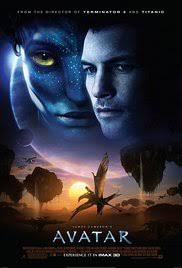
Avatar (2009)

AVATAR

AVATAR (2009) One-and-a-half stars
After I watched James Cameron’s AVATAR for the first time in nearly 10 years, numerous things hit me over the head like a (Hebrew) hammer.

Mental notes:

1) This movie sucks. I mean it, man, and I’m not sure how or why I ever liked it in the first place. I’ll blame it on the alcoholic consumption during my first watch in late ’09 and my love/lust relationship at the time with a woman who loved AVATAR.

2) It never ends. AVATAR is not the cinematic equivalent of the late ’60s Jefferson Airplane chestnut “3/5 of a Mile in 10 Seconds” or 216 miles per hour. The final act of AVATAR, in fact, could be called “3/4 of a Hour in 10 Years.”

3) Will Cameron ever direct a film again that comes in under 120 minutes? The 161-minute AVATAR followed hot on the heels (12 years later) of the 195-minute TITANIC. Here are the run times for TRUE LIES (141), TERMINATOR 2 (137), THE ABYSS (140), and ALIENS (137). In fact, you’d have to go all the way back in time to the 107-minute TERMINATOR (1984) for the last Cameron-directed picture under 120 minutes. (For the record, I like TERMINATOR 2, ALIENS, and THE ABYSS, I’ll pass on TRUE LIES, and I’ll have to revisit TITANIC to see how it holds up removed from all the hype and hysteria in late ’97 and early ’98.)

4) It’s been said that no good film is too long and no bad film is short enough. In that case, AVATAR will be cinematically torturous for people who think it’s no good. Let me put it yet another way: AVATAR and my last dentist appointment lasted about the same length of time, and I’ll go back to the dentist before I ever watch AVATAR again.

5) AVATAR just might be the preachiest movie ever made, even more so than any movie about, you know, preachers. Apparently, even 20th Century Fox asked Cameron to remove “some of this tree-hugging, FERN GULLY crap” from AVATAR. This preachiness makes AVATAR a real drag at times, and why it feels more like an endurance contest than an enjoyable, visionary motion picture experience.

6) Cameron practices what he preaches, though, because AVATAR recycles from DANCES WITH WOLVES, POCAHONTAS, FERN GULLY, ALIENS, and several Hayao Miyazaki films (just a short list). We’ve seen this movie before, and better.

7) AVATAR uncannily illustrates the “uncanny valley.” Definition: “The uncanny valley is a common unsettling feeling people experience when androids (humanoid robots) and audio/visual simulations closely resemble humans in many respects but are not quite convincingly realistic.”

8) Blue is not my favorite color.

9) Black is my favorite color. I loved AVATAR most when it finally faded to black.

10) I liked the Na’vi subtitles much better when they were in German on the bootleg copy I first consumed.

11) I must follow the THIS IS SPINAL TAP rule, which means this list must go to 11.

Howard the Duck (1986)

HOWARD THE DUCK

HOWARD THE DUCK (1986) One star

KODE-TV in Joplin once aired movies on Saturday nights and I recall watching THE ROCKY HORROR PICTURE SHOW, THE BREAKFAST CLUB, WOLFEN, and HOWARD THE DUCK in my impetuous youth.

Sometimes movies that we liked during our childhood and teenage years do not hold up during later viewings. Unfortunately, I do not remember how I reacted to HOWARD THE DUCK upon first viewing it some 30 years ago.

I do know that I caught up with HOWARD THE DUCK in 2009, though, wrote a negative review centered around the question “What were they thinking?” when Universal Pictures made HOWARD THE DUCK, and listed it as one of the worst movies of the 1980s, right down there with such “classics” as LEONARD PART 6 and THE GARBAGE PAIL KIDS.

That’s when I first encountered online defenders of bad movies. They’re vehement, and will leave you digital pleasantries like, for example, “Opinions are like assholes. …” Genius, pure genius, never heard that one before, Internet tough guy. I mean, how dare somebody think both HOWARD THE DUCK and LEONARD PART 6 stink it up. HOWARD THE DUCK and LEONARD PART 6 are both not so bad they’re good, they’re both so bad that they’re really really really bad. Every once in a great while, I dust them off just to remember what a bad movie plays like.

HOWARD THE DUCK is one of the great cinematic follies of all-time.

It wanted dearly to be like GHOSTBUSTERS, a combination of dazzling special effects and wisecracking comedy.

It fails in both departments and it starts with that live action duck, the biggest special effect mistake and comedic failure.

Howard’s a creepy little duck, a rather fowl protagonist despite the fact that director Willard Huyck (Huyck rhyme with duck?) and producer Gloria Katz toned him down and tried making him a nicer duck from his comic book origins.

It does not help the character that the film trots out every duck pun for 111 minutes, a running time a few minutes longer than GHOSTBUSTERS. Every single character must get at least one and I got tired of all the puns by the 5-minute mark.

Eight actors are credited as having some role in playing Howard the Duck: Ed Gale, Chip Zien, Tim Rose, Steve Sleap, Peter Baird, Mary Wells, Lisa Sturz, and Jordan Prentice. Six of the actors and actresses inside the duck suit (at different times) won the Razzie for Worst Performance in a Motion Picture. This is almost as impressive as the fact Harvey Stephens began his career as the Antichrist in THE OMEN. Where does one go from the Antichrist and where does one go from Howard the Duck? These are tough questions, and I have some more.

Do those actors and actresses put Howard the Duck on their resume? Or brag down at the pub “Oh yeah, man, you better not fuck with Howard the Duck” and “I played a talking duck from another planet in the movies. How about you, asshole, what the fuck have you done that’s so great?” Have any of these actors exploited their playing Howard the Duck to pick up women? Stranger lines have been spouted.

Howard’s not a funny duck and he must try a thousand jokes. He’s a lame duck, instead, that wishes he could have been the Groucho Marx or Bill Murray of ducks.

The last 40-45 minutes surrender to chase scenes and special effect showcases with lame duck pun interludes, then we’re treated to a thrilling grand finale of the “Howard the Duck” song, written by Thomas “She Blinded Me with Science” Dolby and George “Atomic Dog” Clinton.

The last 40-45 minutes feel like they run on as long as BEN-HUR and GONE WITH THE WIND combined.

Every time I see Lea Thompson, it brings me back to the strange trajectory of her early screen career: attacked by shark in JAWS 3-D, a creepy love affair with a married police officer who should have arrested himself for sex crimes in THE WILD LIFE, and unknowingly lusting after her own future son in BACK TO THE FUTURE. In HOWARD THE DUCK, the fetching Thompson smooches Howard all while she’s in her skimpies. It’s bad enough that her hairdo attacked the ozone layer, but she has to go the extra mile in HOWARD THE DUCK.

(We believe that Thompson’s hairdo in HOWARD THE DUCK contributed to the Montreal Protocol on Substances that Deplete the Ozone Layer that became effective in August 1989.)

Every time I watch HOWARD THE DUCK, I marvel at the fact that Tim Robbins somehow survived his performance and managed to sustain a career in such high-quality films as BULL DURHAM, JACOB’S LADDER, and THE SHAWSHANK REDEMPTION. His performance in HOWARD THE DUCK ranks among the most annoying supporting performances in history. Believe it or not, this was his fifth credited screen performance … and we have one more believe it or not.

HOWARD THE DUCK is the first feature-length Marvel Comics adaptation. When will Disney take a crack at remaking this remedial GHOSTBUSTERS?

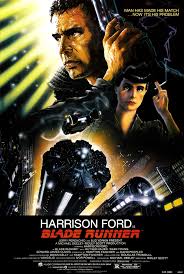
Blade Runner (1982)

BLADE RUNNER

BLADE RUNNER (1982) Four stars

Rutger Hauer’s death at the age of 75 brought me back a day later to BLADE RUNNER, one of the key movies in understanding the cinema of the last four decades.

It seems ironic that Hauer died in 2019, the same year as his character in BLADE RUNNER.

I can’t believe I’ve never written in detail about BLADE RUNNER, which has long been my No. 5 favorite movie of all-time behind CITY LIGHTS, DUCK SOUP, FREAKS, and TAXI DRIVER. Well, now is just as good a time as any to change that.

Watching the theatrical version from 1982, seeing BLADE RUNNER in any cut for what must have been the 100th time, faces especially stood out.

Title character Rick Deckard (Harrison Ford) as he takes in the death of main replicant Roy Batty (Hauer). We can read many different thoughts going through Deckard’s mind. The theatrical cut articulates it through Decker’s voice-over narration. I’ll get back to the narration later.

Batty throughout, from his entrance to his exit. Hauer’s so damn good that he almost steals the movie from both Ford and the incredible production design.

Batty’s punk pleasure model replicant lover Pris (Daryl Hannah) when she ambushes and assaults Deckard late in the picture.

J.F. Sebastian (William Sanderson) as he bears unfortunate witness to Batty settling his account with his creator Tyrell (Joe Turkel, best known as Lloyd from THE SHINING).

Leon Kowalski (Brion James) as he’s shot dead by replicant and Deckard romantic interest Rachel (Sean Young), just when it seemed Kowalski had Deckard near his demise.

Capt. Harry Bryant (M. Emmet Walsh) and his oily charm, and the enigma of Gaff (Edward James Olmos).

I’ve never exactly understood the criticism leveled at BLADE RUNNER that it’s great to look at but difficult to care about any of the characters.

I wonder if those critics saw the same movie.

I’ve always been moved by the plight of the replicants, the bio-engineered people who are “more human than human.”

The Nexus-6 model of replicants — represented by Batty, Pris, Leon, and Zhora (Joanna Cassidy) — look exactly like your average adult human being, but they have superior strength, speed, agility, resilience, and intelligence, especially combat model Batty. For the protection of the human race, replicants have a four-year life span and were given false memories.

Imagine finding out your childhood never happened.

The cold, hard facts of life.

Indeed.

The replicants bring a wide range of responses.

They’re slave labor off Earth … and illegal on Earth. “Quite an experience to live in fear, isn’t it? That’s what it is to be a slave.”

They’re at least complex villains, if they’re even the “bad guys.” We can make a strong case for Tyrell being more of a villain.

Then, we have the ambiguous title character who’ll probably always inspire debate: Is or isn’t Deckard a replicant? Ford argues human, director Ridley Scott replicant, but it’s been left for each viewer to determine.

Deckard plays like the detective hero lifted straight from THE BIG SLEEP or CHINATOWN and that comes across even more in the theatrical version with Ford’s gruff narration explicitly putting over Deckard’s world-weary cynicism.

Deckard gets no pleasure from his job “retiring” replicants. And the narration makes Deckard sound like he’s just woke up from a long hangover. (Ford’s hatred of the narration could not be more obvious.)

Later releases excised the voice-over narration, a device the executives wanted to make the film seem less confusing.

I watched the 1992 Director’s Cut first and so it took some adjustment to the narration. I find it works, except for one scene very late in the film where it’s sheer overkill. I mean, try it out:

“I don’t know why he saved my life. Maybe in those last moments he loved life more than he ever had before. Not just his life — anybody’s life; my life. All he’d wanted were the same answers the rest of us want. Where did I come from? Where am I going? How long have I got? All I could do was sit there and watch him die.” Do we need that? No.

That brings us to Batty’s final speech, “I’ve seen things you people wouldn’t believe. Attack ships on fire off the shoulder of Orion. I watched C-beams glitter in the dark near the Tannhauser gate. All those moments will be lost in time … like tears in rain … Time to die.”

In a sports column way back in 2012, I called Batty’s final speech my favorite movie dialogue.

In office conversation about this column, the late, great Morning Sun writer Nikki Patrick said that Hauer improvised Batty’s speech.

That made the speech even greater and Nikki even cooler.

Back to the Future Trilogy (1985-90)


BACK TO THE FUTURE TRILOGY (1985-1990)
The BACK TO THE FUTURE trilogy stands up better now than when the films were originally released.

That’s partly because we’ve not seen any more sequels or remakes, retcons, reboots, and ripoffs.

The three films have been allowed to stand on their own.

They stand up tall and straight.

Once upon a time, I wrote that DAWN OF THE DEAD, THE TERMINATOR, and THE FLY are great films because they not only succeed at giving audiences satisfaction on genre terms but they also work on additional levels. For example, the satire that equates mall shoppers with zombies (DAWN OF THE DEAD), the romance between Kyle Reese and Sarah Connor (THE TERMINATOR), and the romance between Seth Brundle and Veronica (THE FLY). All three films have a lot going on for and in them.

The same greatness principle holds true for all three BACK TO THE FUTURE films: They’re all successful comedies that work on a deeper level, mostly thanks to time travel.

Speaking of time travel, I’m definitely a fan because I love THE TERMINATOR, TIME AFTER TIME, X-MEN: DAYS OF FUTURE PAST, and MEN IN BLACK 3 and enjoy BILL & TED’S EXCELLENT ADVENTURE, STAR TREK IV: THE VOYAGE HOME, and FREQUENCY, for example.

The BACK TO THE FUTURE films — especially PART II — play around with the paradoxes of time travel, both for comedic and dramatic effect. It allows certain actors to play multiple roles in different times — 1885, 1955, 1985, alternate 1985, and 2015.

BACK TO THE FUTURE starts with the inspiration of containing a time machine in a DeLorean and the movie revs up when that baby moves 88 mph because, as Christopher Lloyd’s Dr. Emmett “Doc” Brown says, “If my calculations are correct, when this baby hits 88 miles per hour, you’re gonna see some serious shit.”

We do.

Anyway, our teenage protagonist Marty McFly (played by a 23-year-old Michael J. Fox), he’s bummed out by his parents George (Crispin Glover) and Lorraine (Lea Thompson), a hopeless nerd picked on by eternal bully Biff Tannen (Thomas F. Wilson) for one parent and a drunk for the other.

Sitting at the dinner table with his family, Marty’s not too interested in how his parents met: Lorraine’s father hit George with his car and Lorraine nursed George back to health. Lorraine experienced a real Florence Nightingale effect.

However, no kid’s ever all that interested in how their parents met. Especially parents like George and Lorraine.

The DeLorean hits 88 mph and Marty ends up back in 1955 — Nov. 5, 1955, stuck there, without any plutonium to return.

BACK TO THE FUTURE then becomes an even greater movie when it takes on the premise of a teenager meeting their parents when they’re teenagers. Marty’s a lot more interested in how his parents met, that’s for sure.

Not long after their first meeting in 1955, Marty saves George from being hit by that fateful car. Marty’s knocked unconscious instead and Nurse Lorraine grows “amorously infatuated” (Doc’s words) with her future son rather than her future husband. She’s in hot pursuit, and we remember her 1985 self warning her teenaged son about girls that chase after boys.

Just be glad that Marty finds a younger Doc to sort it all out and get him “back to the future.”

We especially need Doc around for PART II to explain the movie’s convoluted plot.

PART II gives us a version of 2015 highlighted by technological advancements. It was great fun watching the 2015 scenes in 1989 based on future speculation and it’s still great fun watching them 30 years later as we reflect what they got right and what they got wrong. The Royals, not the Cubs though, won the World Series and Universal mercifully stopped at four JAWS films.

(The Cubs ended the longest world championship drought in North American professional sports history — only 108 years — by winning the 2016 World Series.)

Futurepedia even provided a list of the new technology: Air traffic control; auto-adjusting and auto-drying jacket; automatic dog walker; automated Texaco service station; barcode license plate; binocular card; bionic implants; Compu-Fax; Compu-Serve; computerized breastplate; cosmetic factory; data-court; dehydrated pizza; dust-repellent paper; flying circuits; fruit dispenser; hands free video games; holobillboard; holofilms a la JAWS 19; hoverboards; hovercam; hover conversion; hydrator; Identa-pad; Internet; Kirk Gibson Jr. Slugger 2000 adjustable bat; Litter Bugs; Master-cook; Mr. Fusion; multi-channel video screen; neon curbing; Ortho-lev; Pac Fax; portable thumb unit; power-lacing shoes; rejuvenation clinic; scene screen; skyway; slam ball; sleeping device; soda bottles with built-in straws; flying cars; tablet computer; thumb pad; tranquilization; transponder; U.S. Weather Service; video glasses and video telephone glasses; video simulacrum; video telephone.

PART II ends up back in Nov. 12, 1955 (Marty’s final day in 1955 in BACK TO THE FUTURE), so we have two Martys and two Docs running breathlessly around Hill Valley.

Given all the plot convolutions and time permutations in PART II, it’s fitting that the 1955 Doc faints during a scene late in the movie.

Lightning strikes the DeLorean and sends Doc back to 1885 near the end of PART II … and Marty tracks him down in PART III.

We get a Western comedy in a year that included Best Picture winner DANCES WITH WOLVES and QUIGLEY DOWN UNDER.

PART III finds employment for veteran character actors Pat Buttram (1915-94), Harry Carey Jr. (1921-2012), and Dub Taylor (1907-94) in the 1885 scenes. It’s nice to see and hear them codgers.

Their presence lets us know that PART III is a different kind of Western than DANCES WITH WOLVES and QUIGLEY DOWN UNDER, more like a TV Western.

Marty takes Clint Eastwood for his 1885 name.

PART III casts Mary Steenburgen as Doc’s love interest and we remember Steenburgen as H.G. Wells’ love interest in TIME AFTER TIME (1979). Wells wrote “The Time Machine.” In TIME AFTER TIME, Jack the Ripper uses Wells’ time machine to travel to modern day San Francisco and Wells follows and pursues Jack the Ripper. During his pursuit, Wells meets bank clerk Amy (Steenburgen) and falls in love with her. (In real life, McDowell and Steenburgen became married in 1980, separated in 1989, and divorced in 1990. They met and began dating making TIME AFTER TIME.)

The BACK TO THE FUTURE trilogy ends on a satisfying note.

More notes on BACK TO THE FUTURE:

— Michael J. Fox is one of the most likable actors of all-time. He was the first choice for Marty, but “Family Ties” producer Gary David Goldberg refused to allow Fox away from that show to make a movie. That’s why BACK TO THE FUTURE originally cast Eric Stoltz as Marty. Stoltz worked a few weeks on the film before director Robert Zemeckis and screenwriter Bob Gale realized there’s something wrong with Stoltz as Marty: He’s not the Marty they wanted. Stoltz lacked screwball energy and he played scenes more dramatically. They let Stoltz go and recast with Fox, who became free to make the movie. Fox did not have to reach very far to portray Marty, “All I did in high school was skateboard, chase girls, and play in bands. I even dreamed of becoming a rock star.”

For two months, Fox worked on “Family Ties” during the day and BACK TO THE FUTURE at night, giving him at most a few hours of sleep each day.

Re-shooting added $3 million to the film’s budget, a number more than made up for by grosses for all three films that have amassed nearly $1 billion in returns.

— Christopher Lloyd’s boundless madcap energy earns Doc a place in the annals of great mad scientists and nutty professors. He becomes more than that, though, over the course of three movies. We love Doc, perhaps more than any other character in the series.

— Thomas F. Wilson makes any variation on the bully, whether it’s Buford “Mad Dog,” Biff, or Griff Tannen and whether it’s 1885, 1955, 1985, alternate 1985, or 2015, a lovable asshole. We love to hate “Mad Dog,” Biff, and Griff, especially Biff. We love every time Biff screws up a phrase like “Make like a tree … and get out of here.” We love every time he’s doused in manure. We love every time he’s burned and showed up by our protagonists. How do you feel after learning Donald Trump inspired the Biff character?

— Crispin Glover proved to be the next evolution in screen nerd, taking off from Eddie Deezen and REVENGE OF THE NERDS. Glover stepped in that direction in FRIDAY THE 13TH: THE FINAL CHAPTER, but he gets a fuller character in BACK TO THE FUTURE.

— Lea Thompson is quite fetching in the 1955 scenes and her character unknowingly lusting after her future son fits into a career where she was attacked by The Great White Mother in JAWS 3-D, yelled at and embarrassed by her sexually frustrated and football obsessed boyfriend in ALL THE RIGHT MOVES, involved with a married police officer who should have arrested himself for his own sex crimes in THE WILD LIFE, and kissed by an animatronic duck in HOWARD THE DUCK. John Hughes at least gave her the name Amanda Jones in SOME KIND OF WONDERFUL, from the Rolling Stones song “Miss Amanda Jones.” What a career.

— Huey Lewis and the News’ “Power of Love” achieves being their only song that does not inspire my thoughts of giving the nearest person a pencil and having them stab my eardrums. For example, it seemed that for the longest time at the Pittsburg Subway I’d hear their hit song “The Heart of Rock & Roll.” Every damn single time. I survived by wisecracking, “If Huey Lewis is the heart of rock ’n’ roll, then rock ’n’ roll needs a defibrillator.” I suppose I think more positively of “Power of Love” from being in BACK TO THE FUTURE.

— Zemeckis produced some of the best mass entertainments for nearly a decade-and-a-half, everything from 1941 (directed by Steven Spielberg) and USED CARS to BACK TO THE FUTURE and WHO FRAMED ROGER RABBIT.

I just hope that Hollywood leaves those films alone and does not burden us with remakes, retcons, reboots, or any other ripoff.

Is that too much to ask?

BACK TO THE FUTURE (1985) Four stars; BACK TO THE FUTURE PART II (1989) Three-and-a-half stars; BACK TO THE FUTURE PART III (1990) Four stars

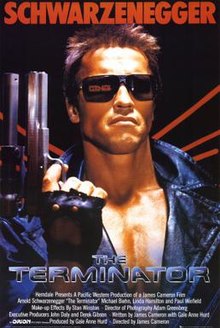
The Terminator (1984)

DAY 29, THE TERMINATOR

THE TERMINATOR (1984) Four stars
James Cameron said that John Carpenter’s HALLOWEEN inspired him to make THE TERMINATOR, and it’s easy to see that with Arnold Schwarzenegger’s T-800 and Michael Myers, both (virtually) unstoppable killing machines.

Apparently, while in Rome around the time of PIRANHA II: THE SPAWNING, Cameron had a dream about a metallic torso equipped with kitchen knives in hand and dragging itself from an explosion, which almost sounds exactly like a scene late in THE TERMINATOR. This dream became the basis for the film.

Then again, late author Harlan Ellison (1934-2018) claimed that Cameron was inspired by Ellison’s 1964 Outer Limits episode “Soldier” (adapted from Ellison’s own short story) where a future soldier goes back in time to save a present-day woman from another future soldier. I believe Ellison (although he liked the movie) used that nasty ‘P’ word, plagiarism. Ellison received a financial settlement from Hemdale and Orion Pictures, and home video releases of THE TERMINATOR subsequently read “The Producers Acknowledge the Works of Harlan Ellison.”

THE TERMINATOR benefits greatly from the casting of the central roles: Schwarzenegger as the literal force of death and destruction, Michael Biehn as the feisty freedom fighter of the future brought back to the present Kyle Reese, and Linda Hamilton as the present-day young woman Sarah Connor who initially can’t quite believe that she’s in the middle of such a ridiculous plot until Reese (and the corpses) convince her. They fit the roles to a T.

Schwarzenegger has largely played heroic characters and in fact, he’s on the good side for the rest of THE TERMINATOR series. Playing the villain, though, he benefits greatly from speaking few lines (keep in mind his first movie, HERCULES IN NEW YORK, dubbed Schwarzenegger); granted, we have less of the great humor that permeates COMMANDO, PREDATOR, and TOTAL RECALL, but it’s still there with Schwarzenegger as villain with his infamous line “I’ll be back,” for example.

That good spirit and joy of performance still comes through for Schwarzenegger in THE TERMINATOR.

Schwarzenegger plays a more interesting variation on Michael Myers and Jason Voorhees, because those roles in theory can be played by anybody. (Please don’t tell that to Ted White or Kane Hodder.)

Reese explains the situation to Sarah Connor, “That Terminator is out there! It can’t be bargained with. It can’t be reasoned with. It doesn’t feel pity, or remorse, or fear. And it absolutely will not stop … ever, until you are dead!”

Schwarzenegger originally read for the Kyle Reese role and Cameron wanted Lance Henriksen to be the Terminator. Wow, Henriksen as the Terminator just boggles the mind, although Cameron used Robert Patrick to great success as T-1000 in TERMINATOR 2: JUDGMENT DAY. Kristianna Loken as T-X in TERMINATOR 3, well, let’s just say epic fail.
Biehn works better in the Reese role because of all the dialogue and in some ways, he’s like Donald Pleasence’s Dr. Sam Loomis in HALLOWEEN. He understands T-800, even though, of course, nobody believes him until it’s too late.

The Dr. Silberman character (Earl Boen) gets one great scene interrogating Reese and then playing the video back for the Paul Winfield and Henriksen police characters. Dr. Silberman just got out of the police station in the nick of time, and he returns for the sequel.

THE TERMINATOR works as horror movie, as science fiction, and as action, in a streamlined combination of some of the best aspects of HALLOWEEN, BLADE RUNNER, and THE ROAD WARRIOR.

On top of all that, we have a great love story and this element gives THE TERMINATOR the slight edge over JUDGMENT DAY.

Just that scene alone when Reese explains why he accepted the assignment to come back through time and save Sarah Connor, mother of a future resistance leader.

“John Connor gave me a picture of you once,” Reese said. “I didn’t know why at the time. It was very old … torn, faded. You were young like you are now. You seemed just a little sad. I used to always wonder what you were thinking at that moment. I memorized every line, every curve. … I came across time for you, Sarah. I love you; I always have.”

When you go see a movie called THE TERMINATOR, bet you weren’t expecting a genuinely touching love story.

It’s the element of the unexpected that makes for the most rewarding experiences, movies or in general.

Q: The Winged Serpent (1982)

Q

Q: THE WINGED SERPENT (1982) Three-and-a-half stars
I admit loud and proud a weakness for time travel, robots, monsters, and mad scientists.

Maybe weakness is the wrong choice of word. How about predilection?

Q: THE WINGED SERPENT definitely fits the bill for monsters, a grand homage to the great monster movies of the 1950s.

It’s directed, written, and produced by Larry Cohen (1941-2019) and it’s financed by Samuel Z. Arkoff (1918-2001) as the first release from Arkoff International Pictures.

Of course, Arkoff was involved with Q.

Arkoff’s producer credits include THE PHANTOM FROM 10,000 LEAGUES, IT CONQUERED THE WORLD, THE SHE-CREATURE, INVASION OF THE SAUCER MAN, THE AMAZING COLOSSAL MAN, HOW TO MAKE A MONSTER, and REPTILICUS.

Arkoff even provided a great quote in a conversation between the producer and critic Rex Reed (relayed by Roger Ebert).

Reed: “Sam! I just saw THE WINGED SERPENT! What a surprise! All that dreck — and right in the middle of it, a great Method performance by Michael Moriarty!”

Arkoff: “The dreck was my idea.”

That brings us to Michael Moriarty, whose performance elevates Q to another level.

He plays Jimmy Quinn (though he’s not the “Q” of the film’s title), a cheap dime store hood with aspirations of being a jazz pianist.

Quinn’s like Jeffrey Combs’ Herbert West in RE-ANIMATOR and Thomas Wilson’s Biff Tannen (and various historical offshoots) in the BACK TO THE FUTURE series.

In other words, he’s a lovable asshole or we love hating Jimmy Quinn.

Personally, I love what he does after his discovery of the Quetzalcoatl (the real source for the film’s title) responsible for several deaths.

A pair of hoods lean on Quinn after his part in a botched diamond heist and he leads them to the Chrysler Building, nesting ground of the Quetzalcoatl. The hoods don’t know that.

Quinn’s priceless reaction to the fate of the hoods: “Eat ‘em, eat ‘em! Crunch! Crunch!”

Then Quinn comes up with a plan, a ransom deal for New York City authorities: $1 million in cold, hard cash in exchange for divulging the nest location. “All my life I’ve been a nobody and right now I’ve got the chance of being somebody important,” Quinn said.

Seems like Quinn served as New York City’s preparation for the Ghostbusters, especially dealing with one Peter Venkman.

Guess we’ve covered a little bit of the plot.

If you’re not satisfied, though, I found this plot summary on Amazon: “Its name is Quetzalcoatl, a dragon-like Aztec god that is summoned to modern-day Manhattan by a mysterious cult. But just call it Q … because that is all you’ll be able to say before it tears you apart!”

Okay, that’s enough plot.

Moriarty headlines a very capable cast also including David Carradine, Richard Roundtree, and Candy Clark.

Carradine and Roundtree play NYPD detectives, who almost matter-of-factly react to a winged serpent and ritualistic Aztec murder.

Just another day on the beat.

That’s the beauty of a Larry Cohen film.

In the opening paragraph, I mentioned a taste for time travel, robots, monsters, and mad scientists. I should go back and put “stop-motion” in front of monsters, loving everything from Willis O’Brien’s pioneering work in KING KONG (1933) to Ray Harryhausen’s grand finale CLASH OF THE TITANS (1981).

Randall William Cook and David Allen worked on Q, a deliberate throwback to O’Brien and Harryhausen.

Between Moriarty’s performance and a stop-motion winged serpent, as well as Cohen’s work both writing and directing, Q rates as one of the great not-so-guilty pleasures.