Little Shop of Horrors (1986)

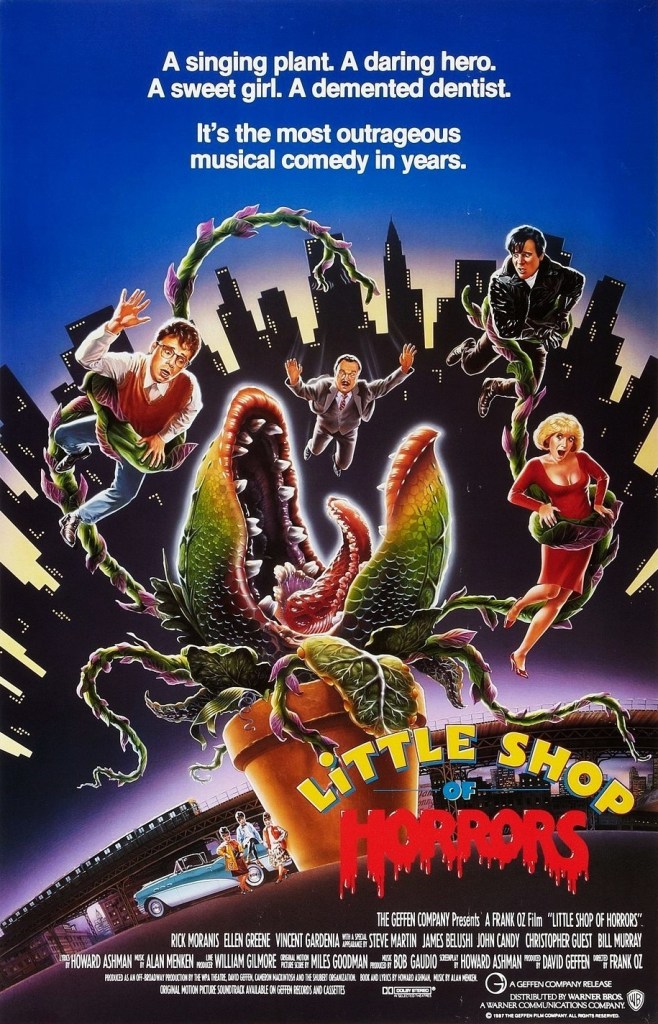
LITTLE SHOP OF HORRORS (1986) ****
Little Shop of Horrors, based on the off-Broadway stage musical itself based on the 1960 Roger Corman cult film, is one of those movies that I like a little bit more every time I watch it.

I’ll just come right out and say it early on in this review: I’ll take Little Shop of Horrors over The Rocky Horror Picture Show every day of the week because the performances and characters, the science fiction and horror plot, the script, the direction, the musical production numbers, and the special effects are all far superior. Granted, to be fair, Little Shop of Horrors had more than 25 times the production budget of Rocky Horror.

I watched both films around the same time, in the late ’80s or early ’90s both on late-night local TV Saturday night movie programming. I also remember first coming across Wolfen and The Breakfast Club in this format. Anyway, I’ve always liked Little Shop of Horrors and never particularly cared for Rocky Horror, which I’ve come to like even less with every viewing so it’s Little Shop of Horrors inverted.

Rick Moranis stars as the meek, nerdy florist Seymour Krelborn. He means well but he’s extremely clumsy and pines after his beautiful coworker Audrey (Ellen Greene) who dates the abusive, sadistic, nitrous oxide fiend ’50s style greaser biker dentist Orin Scrivello (Steve Martin). Seymour’s perpetually chewed out by his boss Mr. Mushnik (Vincent Gardenia), the owner of Mushnik’s Flower Shop. Everything changes for Seymour, Audrey, and Mr. Mushnik when Seymour discovers Audrey II (voiced by Levi Stubbs, lead singer of the Four Tops), one mean green mother from outer space with an insatiable appetite and designs on taking over Planet Earth. Feeding Audrey II proves to be a nightmare for Seymour.

Moranis gives his definitive film performance, Greene returns to play Audrey from the stage production, Moranis and Greene make for a great movie couple and they’re very deserving of a happy ending, and Martin and Stubbs are both absolutely incredible in their villainous roles.

In fact, Martin and Stubbs both should have been nominated for Best Supporting Actor, but it’s understandable why they were not in a year with supporting actor winner Michael Caine for Hannah and Her Sisters and nominees Tom Berenger and Willem Dafoe for Platoon, Denholm Elliott for A Room with a View, and Dennis Hopper for Hoosiers.

Comedies, science fiction, and horror films very rarely earn nods from the Academy, a problem for Little Shop of Horrors when it encompasses all three genres.

It also became complicated when considering Stubbs (1936-2008) for a nomination, since he’s the voice of an animatronic puppet with 21 different principal puppeteers including Brian Henson. Stubbs’ authoritative, booming voice benefits the movie infinitely in both the dialogue scenes between Audrey II and poor Seymour and four musical numbers.

Audrey II’s Mean Green Mother from Outer Space, with lyrics by Howard Ashman and music by Alan Menken, received an Academy Award nomination for Best Original Song and lost to Berlin’s Take My Breath Away from Top Gun.

I’ve been known to say to pets both canine and feline Feed me, Seymour.

Crystal (Tichina Arnold), Ronette (Michelle Weeks), and Chiffon (Tisha Campbell), names borrowed from three girl groups contemporaneous with the original Little Shop of Horrors, provide a Greek chorus with sass and style.

Jim Belushi, John Candy, Christopher Guest, and Bill Murray show up in small roles.

Little Shop of Horrors originally retained the ending of the stage musical with Audrey and Seymour killed and giant Audrey II plants on a Godzilla-like rampage, but test audiences positively absolutely hated that Audrey and Seymour were killed and the original 23-minute ending became a rewritten and reshot happy ending that pushed the release date back to December 19, 1986.

I’ve only watched Little Shop of Horrors with the happy ending, and I must say that I’m more than happy with that.

Prey (2022)

PREY (2022) ***1/2
Even if you do not care for Prey, the latest entry and one of the best entries in the often-lackluster Predator series, you have to admit they cooked up one hell of a great idea for a new Predator movie: Have the action take place in the Northern Great Plains in North America in 1719 with Comanche warriors and French trappers up against the first Predator alien to arrive on Earth.

I’ll come straight to the main point: Prey left me gobsmacked because it far exceeded my feeble expectations for the fifth (or seventh) installment of not exactly my favorite series.

Prey approaches the 1987 original in overall quality, and I never thought I would ever say that because of the track record of the series other than Predator.

There were other significant areas that created trepidation before I sat down and watched Prey on August 15.

I watched The Predator, the previous installment, and wrote a two-star review of it back in 2018 which I closed out with At the end of the day, The Predator is not a bad movie, nor a good one, and I doubt that I’ll be able to remember it for too much longer. I’ll say that I’ve killed two hours of my life in worse fashion many times before and hopefully not as many times after. I was right, because I had to go back and read the review to even remember it.

Prey bypassed theaters and began streaming on Hulu in August 2022.

Prey received several enthusiastic reviews, and I seem to remember one or two or maybe a few voices saying that it’s even better than Predator.

Also, unfortunately I could not avoid garbage discourse like Prey is the most woke blockbuster in Hollywood and woke trash and Prey woke garbage. I don’t know, at this point in time, I bypass any writing or any opinion or any discourse that revolves around calling something and somebody woke. You lost me at woke, a word that has been overused to death in recent times and which I see as intellectual laziness.

A simple Google search returns 5,420,000 results for ‘prey woke.’

Oh, for crying out loud, I liked Prey because it hearkened back to Predator in some ways, staked out plenty territory for itself different than any other Predator film before it, and I don’t think it had one damn thing to do with racial and social justice.

Personally, I would love to see future Predator installments that give us samurai, ninjas, cowboys, bounty hunters, assassins, secret agents, saboteurs, and historic rather than contemporary soldiers.

The Comanche warriors and French trappers were so much more interesting than what passed for characters in The Predator, for example.

Prey worked because it had a strong central premise successfully executed more than not with a main character that we can give a damn about from beginning to end.

Twenty-five-year-old Amber Midthunder is the single best reason to recommend Prey.

I had never seen this actress before or at least I had thought so, but then again, I am not exactly a person who keeps up with the latest, greatest movies and shows.

Looking over her acting credits, Midthunder played Vernon Teller in Hell or High Water, a crime movie from 2016 directed by David Mackenzie and starring Chris Pine, Ben Foster, and Jeff Bridges that I love. I thought about it a little more, and I think I can remember Midthunder from that movie. Hell or High Water could be even more interesting on a revisit, given that I would be specifically looking out for one Midthunder.

Midthunder recently hit a little back at Prey haters.

I think a lot of people thought our movie would be some super woke, F-the-patriarchy kind of a story, and that’s not what it’s about at all. It’s not a girl defying what men say she can and can’t do. It’s literally an individual who feels called to something and the people who know her don’t think that is her calling. That is so much more personal and, I think, as the character, harder to deal with anything.

People don’t know a lot about native history. Period. So they don’t know what kind of warriors we were. There are people who don’t even know that there are different tribes or languages. So already that’s coming from a place of ignorance. Then you look at it and go, ‘Oh no, man. Comanche were really, really great warriors. They were known for being some of the fiercest warriors of all. And they did have female-warrior society, so there were women that fought and hunted. So yeah, I think you look at that and you just [tell yourself], ‘Alright, whatever, people are always going to say stuff.’ I’m proud of what we did.

Midthunder’s Naru works in the fine tradition of an underdog protagonist whose progress makes for compelling, emotionally involving entertainment for 100 minutes.

Right around the same time Prey came out the formal apology from the Academy of Motion Picture Arts and Sciences to Native American activist and actor Sacheen Littlefeather for her mistreatment at the 1973 Academy Awards ceremony became public.

Hello. My name is Sacheen Littlefeather. I’m Apache and I am president of the National Native American Affirmative Image Committee. I’m representing Marlon Brando this evening and he has asked me to tell you in a very long speech, which I cannot share with you presently because of time but I will be glad to share with the press afterwards, that he very regretfully cannot accept this very generous award. And the reasons for this being are the treatment of American Indians today by the film industry and on television in movie reruns, and also with recent happenings at Wounded Knee. I beg at this time that I have not intruded upon this evening and that we will in the future, our hearts and our understandings will meet with love and generosity. Thank you on behalf of Marlon Brando.

Littlefeather passed away Oct. 2, 2022, at the age of 75.

Sequels Second to None: The Empire Strikes Back, Indiana Jones and the Temple of Doom

SEQUELS SECOND TO NONE: THE EMPIRE STRIKES BACK, INDIANA JONES AND THE TEMPLE OF DOOM

Having recently watched THE EMPIRE STRIKES BACK and INDIANA JONES AND THE TEMPLE OF DOOM for the first time in a movie theater, I have asked myself one tough question: Why are they my favorite Star Wars and Indiana Jones movies?

THE EMPIRE STRIKES BACK, the second installment in George Lucas’ space opera series eventually taken over by the fine folks at Disney, has the best direction (Irvin Kershner), best writing (courtesy Leigh Brackett and Lawrence Kasdan), best acting, best environs (the icy planet Hoth, the swampy Dagobah, and Cloud City), and the characters display their greatest emotional range and depth. Yoda, Boba Fett, and Lando are iconic additions, especially Yoda. Only the very first STAR WARS (A NEW HOPE) even approaches EMPIRE and please just forget about the prequels (REVENGE OF THE SITH by far the best of them) and the entries post-Disney takeover. It seems like the majority of STAR WARS fans agree.

Meanwhile, I seem to be in the minority who prefer TEMPLE OF DOOM over RAIDERS OF THE LOST ARK. I understand that it’s dark and disgusting, and that Kate Capshaw’s nightclub singer Willie Scott annoys the hell out of you with all that darn histrionic screaming that she does from the first reel to the very last. I grant all those points. Regardless, I prefer TEMPLE OF DOOM because it’s very dark and very disgusting, and yes, I do believe that it is one of the all-time best gross out movies. We’re talking such pleasantries as monkey brains, eels, snakes, bats, bugs, child slavery, heart removal, and bad, bad, bad men eaten by alligators. To be fair and honest, the Shanghai and Indian characters are grotesque caricatures even more disgusting than any of the creature and culinary discomforts, but then again so are the Nazis and Commies in the other Indiana Jones pictures. Understandably, though, India once banned TEMPLE OF DOOM.

TEMPLE OF DOOM does call to mind such classics as BLACK NARCISSUS, GUNGA DIN, THE STEEL HELMET (Short Round borrowed from Samuel Fuller’s 1951 Korean War picture), and THE GENERAL. Scott’s opening production number (Spielberg has long said that he’d love to do a musical and this scene and the jitterbug sequence in 1941 shows that he could make a very good even great one) clues us in on what’s exactly up the sleeves of director Steven Spielberg, screenwriters Willard Huyck and Gloria Katz, story writer Lucas, and gang. What’s that number called? “Anything Goes,” the Cole Porter standard. TEMPLE OF DOOM works because it is oversized and over-the-top like Spielberg’s earlier comedy 1941. Perhaps it is only fitting that Spielberg apparently likes 1941 and TEMPLE OF DOOM the least among his filmography. Does he recoil from their being so politically incorrect?

As far as Willie Scott goes, she epitomizes the sister or girlfriend or wife perpetually grossed out and disgusted by the shenanigans of all the boys surrounding her. I find that element fun. Yes, I do agree that Karen Allen’s Marion Ravenwood is a better match for Indiana Jones and it’s great they brought her character back for KINGDOM OF THE CRYSTAL SKULL. Scott remains more consistent throughout TEMPLE OF DOOM, though, whereas Marion switches between several modes and moods — just one of the boys, spitfire, damsel-in-distress, and wounded woman chief among them. I enjoy both characters, for different reasons. Capshaw’s performance and her character do not mar TEMPLE OF DOOM for me.

It’s been said numerous times before that Lucas endured a divorce around the time of the making of TEMPLE OF DOOM and that seeped into the movie — in the overall tone but specifically the Willie Scott character and the heart removal. Spielberg, two years after his divorce from actress Amy Irving, married Capshaw and they have been together nearly three decades.

It also must be said TEMPLE OF DOOM was my first Indiana Jones movie, because it was the only VHS tape she kept from a mid-1980s Christmas present from her children. Between that and her later acquisition, THE ADVENTURES OF ROBIN HOOD, I must have thrilled on them 100 times. Maybe nostalgia and sentimentality for old movies, even older movies, grand adventure, brassy dames from the Midwest, and politically incorrect characters and gross out gags animates my overall affection for TEMPLE OF DOOM. (I watched RAIDERS OF THE LOST ARK at the drive-in a couple weeks before TEMPLE OF DOOM. I passed on THE LAST CRUSADE for THE EMPIRE STRIKES BACK.)

As I watched THE EMPIRE STRIKES BACK in the Fort Cinema in the town where I attended high school and the first couple years of college, I periodically momentarily flashed back on how I must have first felt watching the movie some more than 35 years ago in the even smaller Southeast Kansas town Arcadia. I felt that way again, despite having seen EMPIRE 30-40-50 times.

Just one nagging thought occasionally spoiled the mood: We were not seeing the original theatrical version of EMPIRE, rather we had one of them dang blasted Special Editions that genius George Lucas masterminded in the mid-’90s for theatrical and home video release circa 1997 where he touched up some of the old school special effects and made some cringe-worthy insertions that will be mocked until the end of time. Lucas has sadly tinkered with A NEW HOPE, EMPIRE, and RETURN OF THE JEDI even more since then, until I think we fans have to ask him, “Why, George, why?” Some outraged STAR WARS fans have gone as far to proclaim “George Lucas Raped My Childhood.” (I do have both VHS and DVD copies of the original theatrical version of EMPIRE.)

Fortunately, I feel that Lucas has mangled EMPIRE considerably less than both A NEW HOPE and RETURN, which alone points to it being the best entry in the entire series. The uncanny valley effect: “An eerie feeling of unfamiliarity people get while observing or interacting with robots that resemble humans almost but not quite perfectly.” I believe we can add the “Star Wars Special Edition” corollary, as well as separate corollaries for both the prequels and the Disney Star Wars, to the uncanny valley effect. George, you should have just kept your ILM CGI magic in the prequels.

As EMPIRE played out more and more and we got deeper into the plot, though, any thoughts about Lucas, Special Edition, cringe-worthy insertions, etc., faded away and I became swept up in the spectacle more than ever before, because it was up there on the big screen for the first time. I felt wonderment and exhilaration, as well as the broader spectrum of emotions that other STAR WARS movies usually do not reach.

THE EMPIRE STRIKES BACK ****; INDIANA JONES AND THE TEMPLE OF DOOM ***1/2

X: The Man with the X-Ray Eyes (1963)

X: THE MAN WITH THE X-RAY EYES (1963) ****

I had wondered long and hard for many years where Al Jourgensen found a certain sample for a cover version of Black Sabbath’s “Supernaut” that appeared on the Ministry greatest hits compilation “Greatest Fits.”

This incredible sample about halfway through “Supernaut” goes something like, “I’ve come to tell you what I see. There are great darknesses. Farther than time itself. And beyond the darkness … a light that glows, changes … and in the center of the universe, the eye … the eye … the eye … the eye … the eye.”

There I was minding my own fucking business on a hot Saturday night in early June 2020, watching the thrilling conclusion of a pretty damn good little science fiction horror movie called X: THE MAN WITH THE X-RAY EYES, directed by Roger Corman and starring the reliably good Ray Milland. Then, hot dog, what do I hear but “I’ve come to tell you what I see. There are great darknesses. Farther than time itself. And beyond the darkness … a light that glows, changes … and in the center of the universe, the eye that sees us all.” I said to myself, “You magnificent bastard! That’s that sample from ‘Supernaut!’”

Before that discovery, I already thought X was one groovy movie. After that discovery, though, I am convinced it’s a great movie.

I must admit upfront to having a bias in favor of Ray Milland (as well as Roger Corman, for that matter). Milland (1907-86) has never let me down so far and that includes his Academy Award-winning performance as a struggling alcoholic writer in Billy Wilder’s THE LONG WEEKEND, his battle of minds with John Williams’ Chief Inspector Hubbard in DIAL M FOR MURDER, his ultimate cantankerous old coot Jason Crockett in FROGS, his ultimate hateful old bigot Maxwell Kirshner in THE THING WITH TWO HEADS, and his better-than-average Disney live-action villain Aristotle Bolt in the better-than-average Disney live-action film ESCAPE TO WITCH MOUNTAIN. To be honest, I enjoy FROGS every bit as much as DIAL M FOR MURDER and Milland proves responsible for much of the enjoyment of both films.

He’s very good in X as Dr. James Xavier, whose name immediately puts the X-Man character Charles Xavier to mind. Are they related?

In X, Xavier develops special eye drops that give himself X-ray vision and with this great power comes terrible repercussions, of course. Xavier just cannot stop himself from pushing the limits farther and farther. He must see what no man has ever seen before. His friend and colleague Dr. Brant (Harold J. Stone) tries stopping Xavier and Xavier accidentally kills Brant. Xavier goes on the run, first to a carnival, then to a Las Vegas casino, and finally to a religious tent revival that leads to one helluva conclusion.

One of the great scenes begins when Xavier’s lovely colleague Dr. Diane Fairfax (Diana Van der Vlis) takes the X-Man to a groovy little party where everybody just loves to do the Twist. Xavier’s X-ray vision kicks in at some point and we ponder what this scene would have been like had the movie came out in 1969. Even greater.

Before closing soon, I should mention Don Rickles’ strong performance and Dick Miller’s enjoyable one as carny heckler.

X: THE MAN WITH THE X-RAY EYES should be a treat for Corman, Milland, science fiction, horror, American International, sample, Black Sabbath, Ministry, Rickles, and/or Miller connoisseurs. Speaking only from personal experience, it was for me.

The Wasp Woman (1959)

THE WASP WOMAN (1959) **

Seems like only yesterday — time’s such an elusive concept during quarantine — that I highlighted the deceptive print ads and posters for THE GIANT CLAW.

Today, we return to that beat with Roger Corman’s 1959 wasploitation “non-classic” THE WASP WOMAN — do not fear, it’s not another movie about yet another “White Anglo-Saxon Protestant” woman. Instead, in this one, our protagonist takes, no, abuses an experimental potion made from the royal jelly of wasps that can apparently reverse the aging progress. Unfortunate side effect that even more unfortunately only kicks in during the film’s last 20 minutes: It turns her into the title character or “A BEAUTIFUL WOMAN BY DAY — A LUSTING QUEEN WASP BY NIGHT.”

Anyway, the poster for THE WASP WOMAN, it lies. Oh, how it lies. The poster “Wasp Woman” has a woman’s head and a wasp’s body. In the film, it’s flipped and she resembles a distant cousin of the title character in the much, much better THE FLY from 1958.

THE WASP WOMAN itself could make one feel appreciably older, rather than younger, because it’s extremely dull for the first hour.

We have a crusty old scientist named Zinthrop (Michael Mark). He’s not fun in any traditional mad scientist way … and, then, he’s ran over by a car and subsequently bed ridden for most of the rest of the picture … of course, his accident happened before he could warn our protagonist Janice Starlin (Susan Cabot) of some of the unfortunate side effects found in the other non-human test subjects. He redeems himself in the final act. Actually, no, he does not.

Believe it or not, most of this movie takes place in an office building, the location for the monster movie of your dreams. On top of a dull scientist, we have multiple cosmetic company staff meetings, just exactly what the viewers want during a movie called THE WASP WOMAN. Less wasp woman, more staff meetings, bingo! This movie should have been titled CLUELESS in roughly all 6,500 languages of the world.

By the way, I do believe the film shows bees rather than wasps, most notably in both the opening and closing title screens. I might be wrong, but I don’t want to be stung for being wrong. Please, have mercy on me, I’ve been stung bad enough watching THE WASP WOMAN, which definitely pales against ATTACK OF THE CRAB MONSTERS in the Roger Corman monster movie filmography.

In 1993, TNT’s MonsterVision featured THE WASP WOMAN alongside THE GIANT CLAW, THE CYCLOPS, CREATURE WITH THE ATOM BRAIN, FROM HELL IT CAME, VALLEY OF THE DRAGONS, and THE WEREWOLF during a bad movie marathon called “A Christmas Nightmare.” THE WASP WOMAN played between THE CYCLOPS and CREATURE WITH THE ATOM BRAIN.

At that point in my life, I did not watch “MonsterVision”; I started watching it only during the Joe Bob years. I would love to go back in time to the early ‘90s and talk my teenage self into watching (and taping) “MonsterVision,” so I could have all them old tapes to watch at this critical junction in time. Also, I am sure that I would have already converted them from VHS to DVD. Preservation of the species of bad movies is an imperative.

The Giant Claw (1957)

THE GIANT CLAW (1957) ***

Funny how none of the alternate titles for THE GIANT CLAW, a low-budget monster movie from director Fred Sears and producer Sam Katzman, are BATTLESHIP or FLYING BATTLESHIP or BIG AS A BATTLESHIP, because that’s how multiple characters — especially our protagonist, electronics engineer Mitch MacAfee (Jeff Morrow) — describe “The Giant Claw” for at least the first 30 minutes.

Of course, the Giant Claw looks absolutely nothing like a battleship. Mitch himself says at one point to his lady friend’s expression of disbelief, “I said it looked like a battleship, not that it was a battleship.” Yeah, sure, whatever, best never mind.

I love how most of the movie’s promotional goods avoid revealing the Giant Claw’s face, because that act would have undoubtedly scared off potential customers or attracted only those with a taste for absolutely ridiculous movies. At least, that way — not depicting the monster honestly in cinematic propaganda — it took precisely 27 minutes before audiences had the laughter of a lifetime caused by a movie monster. This is one of those movies where I would love to get in a time machine and head for the nearest theater (or drive-in) playing THE GIANT CLAW when it opened in June 1957. How did initial audiences react to it? Did they hoot and holler and howl derisively? Did they flee in total disbelief at the latest Sam Katzman motion picture monstrosity? Did they seek a refund to absolutely no avail? Did they write their Congressmen to complain?

One poster proclaims, “Winged Monster from 17,000,000 B.C.!” “Big as a Battleship!” “Flies 4 Times The Speed of Sound!” “Atomic Weapons Can’t Hurt It!” There’s a drawing of a bird — wings, body, and talons but no face — destroying a plane and a skyscraper. Could that be the Empire State Building? All pictorial renderings of the bird are basically the same — wings, body, and talons, as well as destruction, but no face — and that’s deceptive advertising in a nutshell. (Only those who got to watch the trailer got the real dope on THE GIANT CLAW.)

The producers originally planned to get stop-motion animation titan Ray Harryhausen (MIGHTY JOE YOUNG, JASON AND THE ARGONAUTS, CLASH OF THE TITANS) to create the monster, but he proved to be too much budget and so they outsourced the bird to a model maker in Mexico City. Reportedly, Katzman spent $50 on the puppet that became known as the Giant Claw. Fifty dollars well spent, for sure, and way to go, Uncle Sam.

The film’s posters and the characters themselves fail to accurately describe the giant bird mass murderer in THE GIANT CLAW. To be fair to the actors, they had no idea during filming what the Giant Claw would look like and were left to their own imagination. The characters, though, are made to look like blithering idiots because there’s a vast disconnect between their words and “The Giant Claw” itself, beginning with the battleship description. The filmmakers especially hung out lead actor Morrow to dry, because he gives a legitimately good performance. Legend has it that Morrow ducked out of the theater in embarrassment and got drunk at home after the audience laughed at the Giant Claw’s first appearance. It apparently only took once for Morrow.

Guess that I should try myself to describe the head of the Giant Claw puppet. Extremely long neck, big teeth, flaring nostrils, bulging eyes, and a Mohawk that should be the envy of any buzzard or punk rock singer.

Over the course of the plot, we discover this killer giant bird is actually an alien avian who has come to Earth to lay eggs and wreak destruction and terror on poor, poor humanity. We learn even more, but I will leave that explanatory exposition out of this review for all those individuals who have not seen THE GIANT CLAW before. Trust me, it gets even better as the film attempts to explain the Giant Claw more and more with dialogue passages that could inspire bouts of hysterical laughter. I believe the Mayo Clinic calls it “Pseudobulbar affect.”

Bottom line: This alien avian was sabotaged by a chintzy movie producer named Sam Katzman (1901-73) and both “The Giant Claw” and THE GIANT CLAW will live in infamy as one of the great bad movie monsters and one of the great bad movies, respectively. During my first viewing, I enjoyed THE GIANT CLAW more than many so-called “good” movies.

I have one particular favorite scene in THE GIANT CLAW.

It is reminiscent of the scene in Q: THE WINGED SERPENT (produced by Samuel Z. Arkoff) when lovable hateful creep Jimmy Quinn (Michael Moriarty) leads two hoods leaning on him to the Quetzalcoatl in the Chrysler Building. We hear the Big Q take a couple bites out of crime and Quinn absolutely revels in their demise, “Eat ‘em, eat ‘em! Crunch! Crunch!” I love to hate Quinn even more after that scene.

Anyway, when the Giant Claw chomps on a pair of parachuting passengers, I said out loud, “Crunch! Crunch!” Please keep in mind that in quarantine, no one can hear you scream.

Fiend Without a Face (1958)

FIEND WITHOUT A FACE

FIEND WITHOUT A FACE (1958) ****

The 1958 British independent horror production FIEND WITHOUT A FACE contains everything this science fiction and horror fiend wants from a film of that era: a square but likeable hero (Marshall Thompson), a shapely heroine (Kim Parker), a mad scientist (Kynaston Reeves), townspeople who blame everything on the wrong people, atomic fallout, and horrible, terrifying stop motion animation monsters (created by the special effects team of Flo Nordhoff and Karl-Ludwig Ruppel) that are loads of fun.

It also has an evocative title.

The final 20 minutes or so of FIEND WITHOUT A FACE are phenomenal and push this film into the stratosphere.

The fiends of the title are floating killer brains who started as one brain materialized from the thoughts of Professor R.E. Walgate, a man who specializes in telekinesis. The nearby airbase’s nuclear power radar experiments have dire consequences and the original fiend escapes from Walgate’s lab and wreaks murder and mayhem on the surrounding community. The fiends replicate themselves through attacks on humans (looting their brains and spinal cords) and they remain invisible until the final 20 or so minutes after they crank up the nuclear power to DANGER! They must be stopped!

These fiends are one helluva brainstorm, literally. They have antennae and tentacles, and one can see their influence on later creature features creatures. (The ALIEN films leap to mind. George Romero must have watched at least the last 20 minutes of FIEND WITHOUT A FACE before he made the first NIGHT OF THE LIVING DEAD.)

When the fiends are shot in the brain (love that concept), they naturally gush out this great-looking brain glop and I honestly wish these death scenes lasted another 20 minutes. They are so much fun, and it’s just as great when our hero breaks out an axe. The fiends (love that word) finally turn into goo after our hero blows up their great power source real good.

When the fiends are in their invisible stage, we hear slurping sounds when they strike their victims’ brains and spinal cords. Awesome, totally awesome, because it’s not happening to us, of course.

Credited director Arthur Crabtree (reports have it that star Thompson worked on the film himself after Crabtree walked off the picture because directing sci-fi proved to be too much for his fragile little mind) and his team did a fantastic job with the fiends when they’re invisible or visible. FIEND WITHOUT A FACE pulls off the nifty little trick of building up high audience expectations toward a great final act, then it delivers the goods and maybe even exceeds expectations during that final act.

Believe it or not, FIEND WITHOUT A FACE apparently caused quite a storm of controversy when it was first released in early July 1958. The British Board of Film Censors demanded cuts be made before it would be certified for release and the picture still received an ‘X.’ It’s lucky to not have met the same fate as banned-for-many-years pictures like BATTLESHIP POTEMKIN (1926-54), FREAKS (1932-63), and ISLAND OF LOST SOULS (1932-58), for example.

Legend even has it that British Parliament discussed why the censors allowed FIEND WITHOUT A FACE to be released.

Over time, I’ve come to realize that I love 1950s horror and sci-fi: THE DAY THE EARTH STOOD STILL, THE THING FROM ANOTHER WORLD, HOUSE OF WAX, GODZILLA, THEM!, CREATURE FROM THE BLACK LAGOON, INVASION OF THE BODY SNATCHERS, THE INCREDIBLE SHRINKING MAN, ATTACK OF THE CRAB MONSTERS, FIEND, THE H-MAN, THE BLOB, THE FLY, HORROR OF DRACULA, PLAN 9 FROM OUTER SPACE, BUCKET OF BLOOD, and THE KILLER SHREWS all have made personal top 10 lists for their respective years and the decade also featured at least five of Hitchcock’s best works (STRANGERS ON A TRAIN, REAR WINDOW, THE WRONG MAN, VERTIGO, NORTH BY NORTHWEST) and other films that are horrifying in their own distinct ways, like film noir KISS ME DEADLY and war film FIRES ON THE PLAIN.

Message from Space (1978)

MESSAGE FROM SPACE

MESSAGE FROM SPACE (1978) *

It took two tries to make it all the way through Kinji Fukasaku’s MESSAGE FROM SPACE, one of the first of many STAR WARS rip-offs that only make you appreciate more what George Lucas and gang did in their movies.

How does MESSAGE FROM SPACE rip off STAR WARS? Let us count the ways. A soap, er, space opera, characters named Meia and Hans, a robot, interplanetary strife and destruction, aerial dogfights in space, laser beams, and a musical score by Kenichiro Morioka that should have been enough for grounds for a lawsuit from 20th Century Fox, John Williams, and the London Symphony Orchestra.

I struggled through MESSAGE FROM SPACE and it was a real cinematic endurance contest to get through its 105 minutes. I only made it through about 30 minutes the first try.

At one point in time, I thought about cutting MESSAGE FROM SPACE a little slack for its often lousy special effects, until I read that MESSAGE FROM SPACE cost $5-6 million. Okay, that’s about half of what 20th Century Fox spent on STAR WARS the previous year, but the budget for MESSAGE FROM SPACE apparently established a record (long since broken, of course) for largest budget for a Japanese movie. There went the slack, she be gone.

Vic Morrow (1929-82) sadly found himself at that stage in his career when he appeared in awful movies like HUMANOIDS FROM THE DEEP, GREAT WHITE, and MESSAGE FROM SPACE. Work is work is work, right? In MESSAGE FROM SPACE, Morrow plays a character named General Garuda and receives top billing in the cast above Sonny Chiba. Garuda Indonesia is the airline of Indonesia. Morrow seems to be drinking in every scene and if you had to act with an imitation R2-D2 named Beba, you’d be a full-blown alcoholic too.

This is one of those films not exactly helped out by a bad dubbing job.

I am normally one equipped with more empathy and enthusiasm than the average cinematic pleasure seeker for movies like MESSAGE FROM SPACE. I mean, for crying out loud, I have given four stars to INFRA-MAN, DRUNKEN MASTER, and PLAN 9 FROM OUTER SPACE, three incredibly ridiculous movies that immediately came to mind.

I just found scant pleasure to be experienced from MESSAGE FROM SPACE.

Hard to believe, right, when MESSAGE FROM SPACE features eight Liabe seeds. They resemble walnuts, glowing, magical walnuts that are the unifying plot device; bet Nuts.com would do killer business with a MESSAGE FROM SPACE remake. Rather than The Force, MESSAGE FROM SPACE only manages doze nuts. Bad joke, I know right, but the bad movie made me do it. I promise, I promise, I would never write anything like that otherwise.

A Boy and His Dog (1975)

A BOY AND HIS DOG

A BOY AND HIS DOG (1975) ***

Forgive me for giving away the ending of A BOY AND HIS DOG: The Boy chooses The Dog over The Girl.

Then again, I am not sure I gave away the ending any one bit more than a title like A BOY AND HIS DOG. Yeah, right, it’s not called A BOY AND HIS GIRL.

Character actor L.Q. Jones, a favorite of the director Sam Peckinpah (1925-84), wrote, directed, and produced A BOY AND HIS DOG, adapted from Harlan Ellison’s 1969 short story “A Boy and His Dog.” Just take a look at the film’s poster: “The year is 2024 … a future you’ll probably live to see” and “a boy and his dog: an R rated, rather kinky tale of survival.” That part about A BOY AND HIS DOG being kinky, it’s no lie. Jones, in fact, makes a cameo in the porno movie within the movie.

In post-apocalyptic times, it quickly becomes apparent that a boy and his dog need each other more than ever before.

Especially this boy. He’s named Vic (Don Johnson). He’s 18 years old. He’s obsessed with sex and food, in just that order. Both his parents are gone. He lacks formal education and his ethics and morality are naturally twisted by the world he lives in. He’s a survivor, by any means necessary.

Meanwhile, his telepathic dog named Blood (voiced by Tim McIntire) is one helluva smart and savagely witty canine. He’s better than Benji! Benji, when he was voiced by Chevy Chase in OH! HEAVENLY DOG, never uttered anything like “I hope the next time you play with yourself, you go blind” or “Pull up your pants, Romeo.”

Vic and Blood have worked themselves out a nice little survival pact, at least until the lovely and sassy lass Quilla June Holmes (Susanne Benton). She knows how to appeal to Vic, but good old hound Blood knows a no-count hooch when he sees (and smells) one.

She’s been sent above ground by her powerful father from another world (Jason Robards) to scout talent for a sperm donor to perpetuate the species of underground survivors. Of course, Vic has got the super sperm necessary for the job, a fact Miss Holmes finds out firsthand. She ditches the boy and his dog and returns below ground, proving that Blood definitely sniffed out her wily ways.

Blood advises Vic not to chase the girl and go below ground, but the perpetually horny Vic lets his libido be his guide. Vic asks Blood to wait above ground for his return.

After boy and girl escape the underworld in harrowing fashion, they find Blood and he’s barely alive. That’s when The Boy faces his choice between The Dog and The Girl. Feed her to the dogs, indeed.

A BOY AND HIS DOG makes a strong case that dames are a dime a dozen even in a post-apocalyptic world, but dogs like Blood are truly a rare breed.

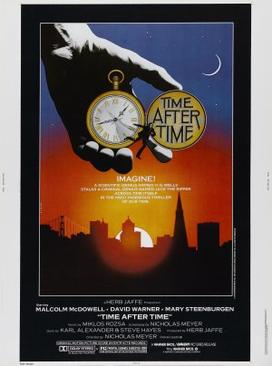
Time After Time (1979)

TIME AFTER TIME

TIME AFTER TIME (1979) Three-and-a-half stars

Screenwriter and director Nicholas Meyer created some nifty concepts for his 1979 directorial debut TIME AFTER TIME: what if writer Herbert George Wells (1866-1946) really did invent a time machine, what if surgeon John Stephenson (“Jack the Ripper”) steals Wells’ time machine and travels from 1893 London to 1979 San Francisco, what if Wells tracks down Stephenson in San Francisco and becomes more like Sherlock Holmes (Meyer wrote the novel and screenplay THE SEVEN-PER-CENT SOLUTION), and what if Wells falls in love with a modern woman and they find themselves in danger from Mr. Stephenson.

Malcolm McDowell as Wells, David Warner as Stephenson, and Mary Steenburgen as Amy Robbins flesh out Meyer’s concepts.

McDowell brought a devilish charm to Alex in A CLOCKWORK ORANGE, another high concept picture with literary roots, and he’s a lovable English eccentric in TIME AFTER TIME.

Warner makes for a suitably menacing antagonist, who’s more in his element in late 20th Century America than he was in late 19th Century England. Meyer works the juxtaposition of Wells and Stephenson to maximum impact.

Steenburgen plays a character who almost instantly falls in love with Wells. There’s just something about the way that she tells Wells that she will believe him. She later played basically the same character in Robert Zemeckis’ BACK TO THE FUTURE PART THREE, and it works in both films.

McDowell and Steenburgen fell in love making TIME AFTER TIME together and they were married from 1980 to 1990.

They do have that extra special glow during TIME AFTER TIME, and they do create a screen couple that we fervently desire to stay together.

I have at least liked virtually every movie I have ever seen that incorporates time travel, from BACK TO THE FUTURE and TIME AFTER TIME to THE TERMINATOR, MEN IN BLACK 3, and X-MEN: DAYS OF FUTURE PAST. I find time travel movies endearingly silly and goofy in the best possible way, if nothing else, and the best ones are profound.

TIME AFTER TIME especially has fun with Wells being a stranger in a strange land … and time. Mileage will invariably vary on these gags. Of course, we have to keep in mind this Wells (1893 model) would not know about the 1906 San Francisco earthquake or about the Golden Gate Bridge which opened in 1937.

Meyer’s other credits include writing the delightfully whacked out INVASION OF THE BEE GIRLS and writing the two best STAR TREK films, THE WRATH OF KHAN and THE VOYAGE HOME. Meyer said that he tried out ideas for THE VOYAGE HOME that he did not use in TIME AFTER TIME.

TIME AFTER TIME works as comedy, science fiction, romance, and thriller. I revisited it recently as the second half of a double feature with BREAKING AWAY and both films left me feeling all nice and fuzzy inside.

NOTE: Of course, it must be a September 21 thing, since H.G. Wells, Stephen King, Bill Murray, Chuck Jones, Leonard Cohen, Ethan Coen, and David Coulier were all born Sept. 21 in their respective years.