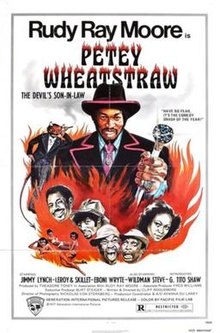
PETEY WHEATSTRAW (1977) *** Rudy Ray Moore (1927-2008) created his own comedic universe on film, featuring outrageous characters with sped up chases and kung fu, stand up and musical interludes, and sexual exhibitions articulating his vision — basically party records brought to low-budget live-action cartoon.
Imagine a foul-mouthed, sexually-explicit Sanford and Son crossed with Benny Hill and Kung Fu and populated with pimps, madams, prostitutes, crooked cops, gangsters, and other larger-than-life figures designed to amuse or titillate.
I definitely had a strong negative reaction to Disco Godfather and then worked my way back through Dolemite, The Human Tornado, and finally Petey Wheatstraw, arguably the ultimate expression of the essence of Rudy Ray Moore and his iconic characters. Full title: Petey Wheatstraw, the Devil’s Son-in-Law.
Anyway, I now know that I should have started with Dolemite and then proceeded chronologically through Moore’s filmography. Maybe I’ll go revisit Disco Godfather and like it more because Moore as either Dolemite or Petey Wheatstraw grew on me to such a degree that I became more than willing to forgive him for Disco Godfather and his overindulgence in Put your weight on it. Maybe his rhyming abilities wore me down, or maybe I just find the idea of a middle-aged stand up comedian well-versed in kung fu greatly appealing.
Petey Wheatstraw is absolutely positively ridiculous and we’d not expect anything less or want anything else from Mr. Moore and gang. Moore plays our title character, a popular stand up comic nothing like the real Moore, and rival comics Leroy (Leroy Daniels) and Skillet (Ernest Mayhand) plot and scheme to get the more popular Wheatstraw to change the date of his show. Leroy and Skillet, not the most adept smooth talkers in the world and who are under extreme pressure for their enormous debt, finally resort to deploying their henchmen in street violence. They gun down a kid in cold blood and then an entire neighborhood — inc. Petey Wheatstraw — at the kid’s funeral. In the afterlife, Petey naturally makes a deal with the Devil (G. Tito Shaw) — he can return to life if he marries the Devil’s daughter, the world’s ugliest woman, of course, and provides Lucifer a grandson. Petey also takes control of the Devil’s cane that provides Mr. Wheatstraw incredible powers. Wheatstraw was taught the martial arts relatively early in his life — Petey Wheatstraw knows kung fu and Petey Wheatstraw knows crazy.
Petey Wheatstraw doesn’t fool around one bit — like Moore and his characters themselves — and it makes a leap straight for the joyously absurd with Petey Wheatstraw’s pre-credits narration and a flashback to Wheatstraw being born in the form of a 6-year-old child. The film goes on its merry little way from that point forward and I thought I had found myself in the midst of the most sublimely ridiculous sight I’ve ever seen when Wheatstraw and his associates have to fight off the Devil’s minions. Then, they did it again and I felt like I had died and gone to Heaven.
THE HUMAN TORNADO (1976) **1/2 I have mixed feelings about this sequel to Dolemite Sometimes it sucks and sometimes it is outta sight Rudy Ray Moore returns as our title character and he’s fine He’s truly one of a kind and his bluntness will blow yo’ mind He’s grown on me since he made a terrible first impression Both Dolemite and The Human Tornado a better expression He’s not what earns The Human Tornado a mixed review I promise that I like Dolemite and Rudy Ray, I really do! It’s that rat soup eating motherfucker redneck racist sheriff piece of shit He drags the movie into the mud and his every scene’s just like a cesspit Character’s named Sheriff Beatty, played by J.D. Baron in his film debut Somebody should have kung fu kicked him to death, but they never do His all-out redneck assault often brings The Human Tornado to a halt Not sure if that’s writer Jerry Jones or director Cliff Roquemore’s fault Enough about that, how ’bout “Glorya De Lani” as Hurricane Annie Her glorious breasts distract from Rudy Ray Moore’s big fat fanny She contributes her fair share to some of the best nudity in screen history I’d trade her nude for every redneck sheriff scene and it’s sure no mystery Glorious Gloria Delaney and her breasts returned as Peaches in Penitentiary What else can be said but yes, God bless the breasts of the Twentieth Century Dolemite seeks out the sleazy crime boss’ sex pot wife and their sex wrecks the set Nympho gives Dolemite the info he wants so many times none of us will ever forget Dolemite takes out anonymous henchmen in a flurry of speeded up kung fu kicks The Human Tornado truly has everything, a gay blade and a guy with karate sticks We can’t neglect Ernie Hudson early in his career or Lady Reed and Lord Java in the cast Funky music, funky hair, miles of nudity, loads of vulgarity, mostly a blast from the past
WE HAD OURSELVES A REAL GOOD TIME: BLACULA, DOLEMITE, TNT JACKSON, THE DEVIL AND MAX DEVLIN Max Schreck, Bela Lugosi, Carlos Villarias, Lon Chaney Jr., John Carradine, Christopher Lee, Klaus Kinski, George Hamilton, Frank Langella, Gary Oldman, and Leslie Nielsen.
That’s a lot of bared fangs, deadly stares, and spectacular deaths over the decades.
Fair warning: Best get outta here with that Tom Cruise, Gerard Butler, Robert Pattinson bull.
Blacula star William Marshall deserves his rightful place among the best screen vampires. For example, he’s definitely better than, oh, let’s say, Carradine, who played Dracula in House of Frankenstein, House of Dracula, and Billy the Kid vs. Dracula and often looked like somebody had squeezed some fresh lemon juice in his eyes. A few months after Marshall debuted as Black Dracula, Lee appeared in his sixth Dracula film — cleverly titled Dracula A.D. 1972 — and Lee’s spiraling lack of enthusiasm for the role that made him famous bites you right smack dab in the neck.
With his booming voice, commanding screen presence, and legitimate acting chops, Marshall (1924-2003) owns Blacula and makes it infinitely better than some cruddy hunk of cinematic junk like Blackenstein. He brings an unexpected dignity to what might otherwise have been a throwaway film.
Rating: Three stars.
— I enjoyed Dolemite a whole lot more than Disco Godfather, my first Rudy Ray Moore experience, and not only because I’m now calling the former picture Boom Mic Motherfucker.
Disco Godfather lost me by about the millionth or maybe it was by the billionth time Moore (1927-2008) exclaimed Put your weight on it, a slogan that needless to say would not be adopted or adapted by 1980 U.S. Presidential candidates Jimmy Carter, Ronald Reagan, and John B. Anderson. Despite the fact that it tried cultivating a social conscience, Disco Godfather needed some weight put on it, because it was the cinematic equivalent of an anorexic crackhead.
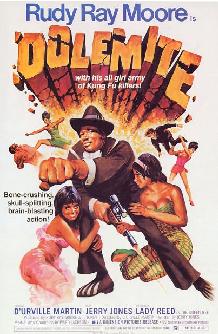
Moore has been called The Godfather of Rap and both Dolemite and the character himself almost instantly serve notice why. Jailbird Dolemite’s first lines are Oh, shit. What the hell does that rat-soup-eatin’ motherfucker want with me? One could play a reasonable drinking game with how many times Dolemite utters motherfucker in the movie, because it’s not every time Cheech & Chong say Man in Up in Smoke (reportedly 285 times) or everybody says Carol Anne in Poltergeist III (121). You won’t get wasted, best shit you ever tasted, from Dolemite. You’ll probably feel pretty good and the alcohol will help laughter.
The plot: Dolemite gets released from prison and fights the criminals and corrupt police officers who sent our favorite cinematic pimp up the river in the first place. Really, though, Dolemite is about the profanity, fight scenes, female (we’ll forget about the male) nudity, and complete utter ridiculousness, all of it done over-the-top. Never mind that it’s a time capsule into Bicentennial-Era America filed right alongside Dog Day Afternoon.
To be honest, though, I was distracted from the plot and everything else by the unpaid co-star Boom Mic Visible, who’s absolutely the funniest motherfucker in Dolemite. According to IMDb, The boom mic is visible in many shots of original Xenon VHS to DVD transfer from the 1980s. The film was originally transferred without the proper ratio ‘gate’ of 1:85.1, revealing more of the top and bottom of the frame than the film makers originally intended. The 2016 Vinegar Syndrome Bluray release was re-transferred from an archive print of the film, at the proper ratio, so the boom mics are hidden in many shots. The Bluray release also includes a ‘boom mic’ version of the new transfer, intentionally revealing the boom mics for comic effect.
Now we know.
The actor John Kerry (not that John Kerry) played Detective Mitchell in Dolemite and it’s a missed opportunity that nobody ever asked 2008 U.S. Presidential Candidate John Kerry about his experiences making Dolemite, what Rudy Ray Moore was really like, etc. That’s a real shame.
Rating: Three stars.
— TNT Jackson is definitely not a good movie, but I am still feeling a certain lingering affection for it that other (better) movies wish they could make me feel for them.
What else could be said about some of the worst martial arts sequences ever committed to celluloid, from the very first fists and feet of fury scene all the way to the grand finale. Would you believe punches and kicks that do not connect but still inflict damage? Would you believe the heroine could punch right through the villain? Well, prepare yourself for TNT Jackson.
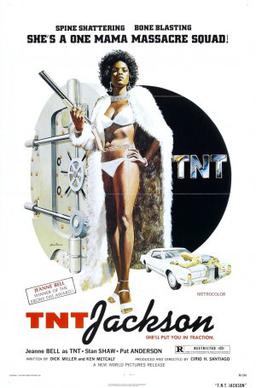
TNT Jackson falls short of the standard established by similar pictures Coffy and Cleopatra Jones, because, let’s face it, TNT Jackson star Jeannie Bell falls below Pam Grier and Tamara Dobson, respectively. Sure, former playmate and bunny Bell looks absolutely stunning with her great hair, great face, and great body, but she can’t act her way out of a paper bag and we don’t really believe that she could fight her way out of one if she wasn’t the star of the movie. Miss Jackson and her inevitable white chick nemesis (Pat Anderson) wage what’s possibly the worst cat fight ever in the history of the movies. It’s a doozy, and that describes the vast majority of the 72-minute TNT Jackson. Yes, that’s right, 72 minutes, a genuine throwback.
The late, great character actor Dick Miller (1928-2019) earned a screenwriting credit on TNT Jackson, but apparently producer Roger Corman had it rewritten by Ken Metcalfe, who plays the sleazy sub-villain Sid in TNT. Miller does not appear in TNT Jackson.
It’s amazing TNT Jackson romantic lead and main villain Stan Shaw did not get The Sensational, Smooth, Suave, Sophisticated, Stunning Stan Shaw for his screen credit, but maybe just maybe that’s because he overplays his smooth, suave, sophisticated ways so much that we’re tired of his jive real quick. Heck, even Shaw’s afro overplays it throughout TNT Jackson. I’ve not seen this much overacting by hair since, oh, let’s see, Chu Chu and the Philly Flash or maybe I’m mixing up Carol Burnett’s decorative head cover (wait, that’s just part of her costume) with her maracas.
Basically, I can’t hate too much on TNT Jackson like I do Chu Chu (more like Poo Poo and the Poopy Gas), since director Cirio H. Santiago remade TNT a few years later as Firecracker and substituted (white) Jillian Kesner for Bell in the title role. Both movies have similar plot elements, namely infamous topless fights, and Metcalfe in a similar role, but Firecracker does it better.
After watching TNT Jackson, I could not help but gravitate toward AC/DC’s song and the chorus ‘Cause I’m T.N.T., I’m dynamite / T.N.T., and I’ll win the fight / T.N.T., I’m a power load / T.N.T., watch me explode. Bonus points for TNT Jackson, ones that keep it from a two-star rating.
The best version of TNT Jackson is the two-minute promotional trailer put together by Joe Dante and Allan Arkush for New World Pictures circa 1974 or 1975. The voice-over narration takes it to greatness: TNT Jackson, Black Bombshell with a Short Fuse! This Hit Lady’s Charm Will Break Both Your Arms! She’s a One-Mama Massacre Squad! TNT’s Mad and That’s Real Bad! With That Dynamite Bod She’s a Jet Black Hit Squad! A Super Soul Sister and a Bad News Brother Under Cover and Out to Blast a Killer Army That’s Poisoning the People with Deadly China White! You Best Pay the Fine or She’ll Shatter Your Spine! Black Chinatown, Where Flesh is Cheap and Life is Cheaper! TNT Jackson, She’ll Put You in Traction!
Rating: Two-and-a-half stars. Trailer: Four stars.
— Before The Devil and Max Devlin, it had no doubt been a long time since Walt Disney Studios depicted Hell in one of their films.
For example, Hell’s Bells from 1929 and Pluto’s Judgement Day from 1935 leap first to mind, two animated shorts that might blow people’s minds who normally associate animation with cute-and-cuddly innocuous fare at this late point in history.
To be fair to the older films, which are both far superior to the main film currently under consideration, feature length The Devil and Max Devlin doesn’t spend a lot of time in Hell.
Well, actually, according to some former President, right, aren’t California and Hell the same?
I wonder, given the subject matter and the presence of Bill Cosby in one of the starring roles, if The Devil and Max Devlin will go or has already gone the way of the controversial, divisive Song of the South — suppressed for seeming eternity by the folks at Disney. I found them both in the dark, dank recesses of the Internet and I hope that I won’t go to jail or Hell for either cultural sin.
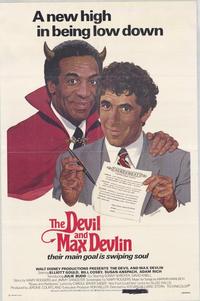
Anyway, I like the locations (especially Hell) and I like the high concepts behind The Devil and Max Devlin like a slumlord trying to save his soul by giving the bad guys three unsullied souls and it turned out to be perfect casting to have Cosby in the role of the Devil’s helper, but the movie gets so bogged down in plot details that it evolves into a real slog and we just want more than anything else in the world at the moment for the movie to finally be over. At least, if nothing else, that’s how The Devil and Max Devlin made me feel watching it.
I kept having flashbacks throughout DISCO GODFATHER.
I asked myself several times, “Am I tripping balls or have I not seen this film a few hundred times?” Then, I said, “I know, I know, this is my first time watching it, but it still feels like I have seen DISCO GODFATHER before.” Later, “It’s only a movie. It’s only a movie. It’s only a movie.” Finally, “I’ll have my revenge. I’ll write a review.”
The plot: Rudy Ray Moore plays retired cop Tucker Williams turned nightclub owner and famed DJ “Disco Godfather.” His nephew Bucky (Julius J. Carry III) gets hooked on angel dust and it warps him something fierce. Tucker decides to return to his roots and wipe out this angel dust plague. See what I mean about having seen DISCO GODFATHER before?
After the dust has settled so to speak on this movie, I mostly remember the Disco Godfather saying “Put your weight on it!” It feels like Mr. Disco Godfather says “Put your weight on it” a million times. Apparently, it’s actually only 24 times that he uttered that infamous line. I am shocked and thoroughly disappointed.
“Put your weight on it” still, though, ranks among the greats in the cinematic annals of lines / incantations / mantras.
Cheech & Chong said “Man” 285 times in UP IN SMOKE, far out, man. Characters say the name “Carol Anne” 121 times in POLTERGEIST III. With their lesser weight, both UP IN SMOKE and POLTERGEIST III had to make up for it through sheer volume of repetition.
We also cannot forget “With great power comes great responsibility” from the Sam Raimi SPIDER-MAN films (originally from the comic books written by Stan Lee). From what I understand, this phrase has become known as the Peter Parker Principle. To be honest, I have not ever written much on the SPIDER-MAN films because “Weird Al” Yankovic already criticized the first Raimi SPIDER-MAN magnificently with “Ode to a Superhero,” which is set to the tune of Billy Joel’s “Piano Man.” Here’s the part about “With great power comes great responsibility”:
“With great power comes great responsibility / That’s the catch phrase of old Uncle Ben / If you missed it, don’t worry, they’ll say the line / Again and again and again.” Yeah, that’s exactly what I thought, “Weird Al,” and you wrote “Ode to a Superhero” after just the first SPIDER-MAN film.
Anyway, through the virtual magic of searching the Internet, I found a link to Rudy Ray Moore’s “Put Your Weight on It” in song form. Rudy Ray Moore and the Fillmore Street Soul Rebellion released a single in 1971 with “Put Your Weight on It” the B-side to a monologue and “Easy Easy Baby.” Hold on for about 2 minutes, 43 seconds, I must cast aside this “Weird Al” playlist that started by listening to “Ode to a Superhero” and instead listen to “Put Your Weight on It.” I’ll report back very soon with my findings.
Holy bat shit, Robin, I found a version that’s 4 minutes, 55 seconds. It’s from the Rudy Ray Moore Singing Album “The Turning Point,” from 1972. I’ve got Mr. Rudy Ray down for saying “Put your weight on it” 21 times. I did not count the “Keep your weight on it,” which he seems to say about as many times as the name of the song. I’m not going back for another listen any time soon.
Moore (1927-2008) was a multimedia “ghetto expressionist” (his preferred nomenclature for his act) who recorded his first comedy album “Below the Belt” in 1959. Moore debuted the Dolemite character in the early 1970s and he released albums with titles like “Eat Out More Often” and “This Pussy Belongs to Me.” He then successfully financed the motion picture DOLEMITE in 1975, followed by THE HUMAN TORNADO and THE MONKEY HUSTLE in 1976, PETEY WHEATSTRAW in 1977, and DISCO GODFATHER in 1979. He’s been called “The Godfather of Rap.” Dolemite unleashed lines like “You no-business, born-insecure, jock-jawed motherfucker” and “I’m gonna let ‘em know that Dolemite is my name, and fuckin’ up motherfuckers is my game.” This influence on subsequent generations of black entertainment is undoubtedly why DISCO GODFATHER seemed so old hat and overly familiar watching it for the first time in 2020.





 Attack of the Killer Librarian