Squirm (1976)

SQUIRM

SQUIRM (1976) Three stars

You either have a predisposition for liking a silly creature feature like SQUIRM or you don’t.

I thankfully do.

Just a couple quick statements.

1) That’s a lovely title.

2) It’s produced by American International Pictures (1954-80), one of the best production outfits in the motion picture business.

3) I’d rate SQUIRM the second-best killer worm picture right after TREMORS.

Granted, I’m not exactly sure how many killer worm movies there are in existence.

SQUIRM, written and directed by Jeff Lieberman, reminds yours truly of the 1972 classic from American International, FROGS.

American International promoted FROGS with the immortal tagline “Today the pond, tomorrow the world.”

Meanwhile, SQUIRM received, “This was the night of the crawling terror!” Crawling terror in all caps! Like CRAWLING TERROR!

The opening title card informs us that SQUIRM is “based on a true story.” Are you gonna fall for that one?

Intense storms hit Fly Creek, Georgia and electricity from downed power lines + wet soil creates mad worms … and they develop an insatiable taste for human flesh. Of course, they do … or we’d not have much of a movie, at least not much of a one worthy of the title SQUIRM.

We have two gingers for our protagonists: Mick (Don Scardino), a no-count city slicker who seems to get on just about everybody’s bad side, especially good ol’ boy Sheriff Jim Reston (Peter MacLean) and creepy romantic rival Roger Grimes (R.A. Dow), and Mick’s romantic interest Geri (Patricia Pearcy).

Right off the top of the old noggin, I cannot think of another film headlined by a pair of redheads.

Mick starts off on the wrong foot real quick when he orders an egg cream. An egg cream in Fly Creek, Georgia? Only a city slicker would make such an order.

What’s an egg cream? Milk, carbonated water, and flavored syrup, apparently, and it does not contain eggs or cream. New Yorkers loved them some egg cream. Why do them old Pace Picante commercials leap to mind?

Mick encounters a worm in his egg cream and freaks out. Boy, oh boy, he’s not making friends very fast around here.

It all sort of reminds you of Dustin Hoffman’s work alienating the natives in Sam Peckinpah’s STRAW DOGS.

Many years ago, I brought in a DVD haul that included AFTER HOURS, ERASERHEAD, and FROGS.

Just from that day alone, I could have started the “So You’re Think You’re Having a Bad Day” Film Festival.

SQUIRM could make the cut, just based on what happens to Roger alone.

Shakespeare, “A coward dies a thousand times before his death, but the valiant taste of death but once. It seems to me most strange that men should fear, seeing that death, a necessary end, will come when it come.”

Roger “dies” a thousand times in SQUIRM. At least it seems that way. You can’t keep a good creep down.

He’s the SQUIRM character remembered most.

I read an interview with Lieberman where he recounted how most of the inner-city audience in a 900-seat theater rooted for Roger and wanted both redheads to die either by Roger or the worms.

SQUIRM amounts to a whole lot of fun, but take my word with a grain of salt especially since I have a predisposition to like this kind of movie.

squirm /skwərm/: wriggle or twist the body from side to side, especially as a result of nervousness or discomfort. Synonyms: wriggle, wiggle, writhe, twist, slide, slither, turn, shift, fidget, jiggle, twitch, thresh, flounder, flail, agonize.

“SQUIRM made late Atlanta Braves broadcaster Skip Caray squirm.”
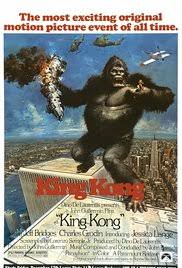
King Kong (1976)

KING KONG 1976

KING KONG (1976) Three-and-a-half stars
Of course this 1976 KING KONG cannot hold a candle to the 1933 version, one of the all-time screen classics.

If and when you and I can get past that fact, admittedly not an easy hurdle, the 1976 version stands out for being a great entertainment.

Jeff Bridges and Jessica Lange are improvements over Bruce Cabot and Fay Wray, respectively, in the male and female leads and Charles Grodin’s not far below what Robert Armstrong did in a similar role.

Of course, you can immediately tell when this movie was made by all the contemporaneous dialogue (especially from Lange) and Grodin plays an executive with Petrox Corporation, a fictional American oil company referencing the “pet rock” phenomenon. This KONG is more bound to 1976 than the original is to 1933.

Beset with production issues of a wide variety, including a complicated legal battle between Paramount, Universal, RKO, and the Cooper estate before filming even started (at one point, both Paramount and Universal had KONG projects lined up), and a first-time leading lady, as well as practical effects that often look more dated than what Willis O’Brien accomplished in 1933, KONG 1976 still works on a basic level.

It is fun.

The stories around the film, though, are more interesting than the finished product and help explain why the hype for the film took on epic proportions before its December 17 premiere.

Italian producer Dino DeLaurentiis (1919-2010) had the Carl Denham quotes in real life: “No one cry when JAWS die,” he said in Time. “But when the monkey die, people gonna cry. Intellectuals gonna love Kong. Even film buffs who love the first Kong gonna love ours.”

Or how about this one about Barbra Streisand told by Roger Ebert: “It’s-a no good, have two monsters in one movie.”

Unfortunately, when Meryl Streep auditioned for the Jessica Lange part, Dino said to his son in Italian that she was “too ugly” for the role; Streep understood Italian and replied in Italian to Dino, “I’m sorry I’m not beautiful enough to be in KING KONG.” We are printing legends, and that only seems appropriate for KING KONG.

Dino talked more smack about JAWS with ORCA THE KILLER WHALE (1977).

Gotta love Dino, whose mouth bit off more than his productions could chew.

Rather than Universal’s competing KONG movie (not released until Peter Jackson’s remake in 2005), the public first received A*P*E, an American / South Korean co-production with its Grade Z special effects, an early appearance for future TV mother Joanna (“Growing Pains”) Kerns, and an infamous shot where the ape uses the middle finger to show his disgust with the helicopters shooting at him.

Either that or he’s just showing his disgust at being trapped in that damn gorilla suit in a shitty movie.

A*P*E would later be topped, in the KING KONG ripoff department, by the Shaw Brothers’ MIGHTY PEKING MAN, the best of the King Kong ripoffs.

There’s also KING KUNG FU from 1976, where a gorilla trained in martial arts wreaks havoc on Wichita, Kansas. Financial constraints forced the makers into not being able to finish their film until 1987.

A*P*E invaded movie screens in October 1976, beating DeLaurentiis’ KONG by a good two months. MIGHTY PEKING MAN came out April 10, 1977, and Quentin Tarantino’s Rolling Thunder Pictures re-released the film on April 23, 1999.

Carlo Rambaldi, Glen Robinson, and Frank Van der Veer won a Special Achievement Award from the Academy of Motion Picture Arts and Sciences for the visual effects in KING KONG, believe it or not.

Legendary make-up artist Rick Baker played Kong, or he’s the man in the ape suit. The original plan had been for KONG ’76 to feature a 40-foot high mechanical ape, but that mechanical monster worked even less than Bruce the Shark in JAWS. JAWS director Steven Spielberg worked around the frequent mechanical failure to make an even better film than if the mechanical shark had been fully operational.

That’s not exactly the case with KONG ’76, partially because musical cues would not be a proper substitute for an ape like John Williams’ musical score proved to be for the shark or even Harry Manfredini’s score for the psycho killer in FRIDAY THE 13TH.

In other words, you have to see the ape.

“KING KONG offered the one chance to do a really perfect gorilla suit,” Baker said. “With the money and the time, it could have been outstanding. Unfortunately, it wasn’t. There were compromises and enforced deadlines.”

Let’s face it, KONG director John Guillermin, he’s no Spielberg.

At the same time, though, I give KONG ’76 and JAWS both three-and-a-half stars. Why?

A) Because life (and my brain) work in mysterious ways.

B) Because star ratings are basically arbitrary.

C) Because both films tap into the same primordial appeal and work as great entertainments for a couple hours each.

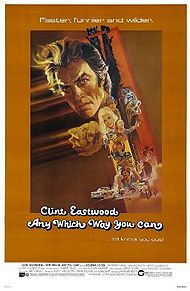
Any Which Way You Can (1980)

ANY WHICH WAY YOU CAN

ANY WHICH WAY YOU CAN (1980) Three stars
If I believed in feeling any guilt whatsoever about feeling pleasure, I might call ANY WHICH WAY YOU CAN a guilty pleasure.

It’s another one of those sublimely ridiculous movie packages that I can’t help but not to like. I mean, it could play on a double bill with ROAD HOUSE.

We all have “guilty pleasures,” and they form one of the most rewarding experiences that we can have at the movies.

If you describe ANY WHICH WAY YOU CAN as a movie with a little bit of everything, that’s still selling it short. I mean, it’s not every day that you have Clint Eastwood in a comedic role, an orangutan named Clyde (played by Buddha and C.J., although there’s no screen credit) who steals every scene that he’s in, a concluding fight scene that can go head-to-head with the later ROCKY sequels and THEY LIVE, a buffoonish motorcycle gang, Ruth Gordon (1896-1985) in what can only be called the “Ruth Gordon” role, and a country song played seemingly every few seconds.

This is the only motion picture that starts with an Eastwood and Ray Charles duet on a little ditty over the opening credits named “Beers for You.”

Personally, I feel the movie could have used more Clyde scenes — more “Right Turn Clyde,” more flipping the bird, more smashing cars, et cetera — and fewer scenes between Eastwood and his real-life partner at the time Sondra Locke. Locke generally became the weak link in Eastwood’s films of the period, and both EVERY WHICH WAY BUT LOOSE and ANY WHICH WAY YOU CAN dramatically prove that as Eastwood demonstrates better chemistry with the orangutan than Locke.

Back to Clyde and Buddha and C.J. Buddha and C.J. assumed the Clyde role for the sequel since Manis — who alone played the role in EVERY WHICH WAY BUT LOOSE — apparently had grown too much between films. Manis returned to his act in Las Vegas.

Reports have it Buddha alone played the role in ANY WHICH WAY YOU CAN and C.J. came on in publicity because Buddha was caught stealing doughnuts on the set near the end of filming and he was brought back to his training facility and beaten for 20 minutes, according to the book “Visions of Caliban: On Chimpanzees and People” by Jane Goodall and Dale Peterson.

Buddha then died soon after of a cerebral hemorrhage.

C.J. went on to star in Bo Derek’s TARZAN THE APE MAN and a NBC sitcom named MR. SMITH.

Executive producer Ed Weinberger said of C.J. in the Washington Post, “It’s a Buddha-like presence. He has wisdom about him. You have to know the animal; I’m in love with him. I’d have him in my house any time.”

MR. SMITH lasted all of 13 episodes from Sept. 22 through Dec. 16 in 1983 and finished a dismal 95th in the Nielsens.

So much for a talking orangutan and who knows if Weinberger had C.J. over at his house after the show flopped big time.

I remember loving ANY WHICH WAY YOU CAN as a young child. It was an affinity for Clyde. He’s what I remembered about the movie for many years before I revisited it decades later.

Not every movie I loved in childhood holds up revisited in adulthood. For example, CANNONBALL RUN, an entertainment I found to be an endurance contest several years back. (For the record, I recently watched SMOKEY AND THE BANDIT, another childhood favorite, again and it held up. I enjoyed Burt Reynolds, Sally Field, Jerry Reed, and Jackie Gleason.)

ANY WHICH WAY YOU CAN is not quite at the same high level as COMMANDO, LONE WOLF McQUADE, and ROAD HOUSE.

That’s because it’s a little flabby with a running time of 1 hour, 56 minutes. Granted, that concluding fight scene between Eastwood and William Smith eats up a good 10 percent of a nearly two-hour experience.

LONE WOLF McQUADE and ROAD HOUSE do have similar run times, but fewer bad scenes than ANY WHICH WAY YOU CAN.

The great director Howard Hawks (1896-1977), born the same year as Ruth Gordon, said that a good movie is “three great scenes and no bad ones.” Not sure that he had movies like ANY WHICH WAY YOU CAN in mind, which does have three great scenes but also some bad ones.

ANY WHICH WAY YOU CAN, though, is one of those sequels better than the original.

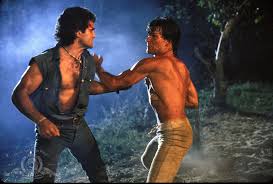
Road House (1989)

ROAD HOUSE

ROAD HOUSE (1989) Three-and-a-half stars
This is the Patrick Swayze (1952-2009) movie that ate all his other movies. More like ripped all the other movies’ throats out. We are talking about ROAD HOUSE, after all.

You can weep to GHOST, you can boogie to DIRTY DANCING, and you can kill Commies to RED DAWN, that’s fine and dandy, whatever floats your boat and tickles your fancy, but ROAD HOUSE is the ultimate Swayze viewing experience, at least for this magnificent bastard.

It is Swayze in Testosterone Hyperdrive, or it should have been titled OVER THE TOP rather than Sylvester Stallone’s epic about child custody, arm wrestling, and truck driving.

“Dalton lives like a loner, fights like a professional. And loves like there’s no tomorrow.”

“The dancing’s over. Now it gets dirty.”

“Dalton’s the best bouncer in the business. His nights are filled with fast action, hot music and beautiful women. It’s a dirty job, but somebody’s got to do it.”

Three taglines for ROAD HOUSE that only hit at the surface of the epic sleaze within the film.

Swayze plays Dalton, who’s not only the world’s greatest bouncer, he’s got a degree in philosophy from NYU. At one point, Dalton shares his general bouncer philosophy to his bouncer troops at the Double Deuce, the world’s roughest bar and the pride of the fictional Jasper, Missouri. (Bet the film’s producers did not know there’s a real Jasper, Missouri.)

“All you have to do is follow three simple rules. 1) Never underestimate your opponent. Expect the unexpected. 2) Take it outside. Never start anything inside the bar unless it’s absolutely necessary. And 3) Be nice.”

I enjoy hearing these rules — every single time — just like in GREMLINS when inventor Rand Peltzer tells his son about his new pet Mogwai, “First of all, keep him out of the light, he hates bright light, especially sunlight, it’ll kill him. Second, don’t give him any water, not even to drink. But the most important rule, the rule you can never forget, no matter how much he cries, no matter how much he begs, never feed him after midnight.”

I enjoy hearing both the rules in GREMLINS and ROAD HOUSE because I know that rules are meant to be broken in the movies. The rules — and a whole lot more, namely bones and plate glass windows — are definitely broken in ROAD HOUSE.

ROAD HOUSE is the most quotable Swayze movie by far.

“Pain don’t hurt.”

“Prepare to die.”

“Nobody ever wins a fight.”

“A polar bear fell on me.”

“You’re too stupid to have a good time.”

“Calling me ‘sir’ is like putting an elevator in an outhouse, it don’t belong.”

“Elvis! Play something with balls!”

“I thought you’d be bigger.”

“I’ll get all the sleep I need when I’m dead.”

“I sure ain’t gonna show you my dick.”

Three lines that you might want to pass on: “I used to fuck guys like you in prison.” “I heard you had balls big enough to come in a dump truck.” “Whaddaya say we get nipple to nipple?”

Sam Elliott strolls into Jasper as Wade Garrett, Dalton’s mentor and friend who rates second best bouncer in the world. Garrett’s salty language would not pass muster with Elliott’s ‘The Stranger’ in THE BIG LEBOWSKI — The Stranger asked The Dude at one point, “Do you have to use so many cuss words?” The Dude replied “What the fuck are you talking about?”

ROAD HOUSE is a Western cast in bar room terms all the way down the line, from the hero to the old mentor to the businessman with an offer for the hero to come in and calm down a rowdy scene to the super villain to the henchmen to the leading lady to the watering hole to a guy named Red. Kelly Lynch plays “Doc,” Dalton’s love interest, and ROAD HOUSE might have showed its only restraint in not choosing “Kitty” for the character’s name. Doc’s real name is the film’s big twist.

Guess we should have expected ROAD HOUSE from a director named Rowdy Herrington.

It was destined to be, especially since Herrington adopted the correct approach: “I saw it as a cartoon,” he said. “Broader than life. Brighter than life.”

Epic bar fights. Live music from a real band. A monster truck. Bouncer philosophy. Boobs. Obligatory Swayze butt shot. All that eminently quotable dialogue, although it would be hard saying any of it if we met arch henchman Jimmy’s fate. By the way, Jimmy’s wardrobe approved by Chuck Norris from INVASION U.S.A. and Ramon Revilla from THE KILLING OF SATAN.

In the film’s bravura climax, we encounter super villain Brad Wesley’s trophy room. True story: Recently visiting the Wonders of Wildlife National Museum in Springfield, Missouri, it called to mind Wesley’s trophy room.

Roger Ebert (1942-2013) found this late scene the key to unlocking the film’s guiding spirit: “His hunting trophies include not only the usual deer and elk and antelopes, but also orangutans, llamas and a matched set of tropical monkeys. This guy went hunting in the zoo.

“We are expected to believe that the sadist financed these hunting expeditions by shaking down the businessmen in a town that, on the visible evidence, contains a bar, a general store, a Ford dealership and two residences. ROAD HOUSE is the kind of movie that leaves reality so far behind that you have to accept it on its own terms.”

That’s right. It’s so ridiculous, so cartoonish, so over-the-top that it becomes highly enjoyable, just like COMMANDO and LONE WOLF McQUADE.

There’s a lot (not a whole lot, though) more that I have to say about ROAD HOUSE, but that can wait for another time down at the Double Deuce.

Don’t worry, it’s cooled down considerably since 1989.

Three favorite character actors in ROAD HOUSE: Sunshine Parker, John Doe (rock musician), and Terry Funk (professional wrestler).

Alligator (1980)

ALLIGATOR

ALLIGATOR (1980) Three stars
At the three-quarters mark of the 20th Century, beginning June 20, 1975, the JAWS phenomenon changed the game forever.

Since then, we’ve seen a deluge of killer shark pictures and Nature Attacks flicks, not to mention summer blockbuster after summer blockbuster.

Two of the best films in the JAWS mold are Joe Dante’s PIRANHA (Steven Spielberg himself endorsed PIRANHA) and Lewis Teague’s ALLIGATOR, both written by John Sayles.

Sayles’ surprisingly witty script for ALLIGATOR starts with the urban legend about what happens if you flush a pet alligator down the toilet. Of course, Ramon — our alligator — grows to gigantic proportions by feeing off discarded animal corpses spiked with growth hormones. Awesome sewer chow, no doubt, for a growing boy alligator.

We’ll go through a couple more examples of the film’s wit.

Ramon’s first victim, why he’s named Edward Norton. We all remember Ed Norton from “The Honeymooners” and his occupation. “Ol Ed Norton, reliable ol’ Ed Norton, working 17 years in the sewer. And now everything’s down the drain.” I believe Mr. Norton talked about them damn alligators in the sewer.

Late in the movie, graffiti on the sewer wall states “Harry Lime Lives.” Fans of the late show might remember Harry Lime’s fate in THE THIRD MAN. I wonder if Orson Welles ever caught this cinematic tribute before his 1985 death.

ALLIGATOR has a great cast, very distinguished for a B-movie indeed, and Ramon munches on some big names. This is all part of the fun, watching these actors chew the scenery before they’re chewed up by a giant alligator.

Dean Jagger (1903-91) won an Academy Award for Best Supporting Actor for his performance in TWELVE O’CLOCK HIGH (1949). ALLIGATOR marked Jagger’s last feature film; Jagger died in both his last two features, this one and GAME OF DEATH. What a way to go out!

Jack Carter (1922-2015) plays the weasel mayor who finds his reelection campaign deadly. Carter made his name being a comedian’s comedian, but he’s no laughing matter in ALLIGATOR. The Mayor certainly received no support from Ramon, though.

Sydney Lassick (1922-2003) proved to be one of those memorable character actors. You might remember him best from ONE FLEW OVER THE CUCKOO’S NEST; he played Cheswick, who tells Nurse Ratched, “Rules?! Piss on your fucking rules, Miss Ratched! I want you to know something right here and now, Miss Ratched! I’m no little kid! I ain’t no little kid!” We all can relate.

Henry Silva (who turned 90 in 2018) plays arrogant big game hunter Brock and we all know what happens to arrogant big game hunters in pictures like ALLIGATOR. Silva accumulated 138 acting credits from 1950 through 2001, and he could tell us about Frank Sinatra, Burt Reynolds, Chuck Norris, Steven Seagal, and Forrest Whitaker, not to mention Alfred Hitchcock, John Frankenheimer, and Jim Jarmusch.

Baby face Perry Lang — in his early 20s at the time — made 1941, ALLIGATOR, and THE BIG RED ONE within a year’s period.

Robert Forster and Robin Riker play our main protagonists, he a frazzled police detective with a troubled past and she a perky herpetologist who once was the proud owner of poor Ramon. Forster’s a legitimate good actor and that serves ALLIGATOR well.

Michael V. Gazzo (1923-95), another veteran character actor, plays the crusty but lovable police chief and you might remember Gazzo from THE GODFATHER PART II as Frankie Pentangeli. Gazzo received a nomination for Best Supporting Actor for his work in THE GODFATHER PART II.

I just wish they could have found a role for Keenan Wynn (1916-86), whose characters met their demise in both ORCA THE KILLER WHALE and PIRANHA.

ALLIGATOR proves to be a lot of fun.

Q: The Winged Serpent (1982)

Q

Q: THE WINGED SERPENT (1982) Three-and-a-half stars
I admit loud and proud a weakness for time travel, robots, monsters, and mad scientists.

Maybe weakness is the wrong choice of word. How about predilection?

Q: THE WINGED SERPENT definitely fits the bill for monsters, a grand homage to the great monster movies of the 1950s.

It’s directed, written, and produced by Larry Cohen (1941-2019) and it’s financed by Samuel Z. Arkoff (1918-2001) as the first release from Arkoff International Pictures.

Of course, Arkoff was involved with Q.

Arkoff’s producer credits include THE PHANTOM FROM 10,000 LEAGUES, IT CONQUERED THE WORLD, THE SHE-CREATURE, INVASION OF THE SAUCER MAN, THE AMAZING COLOSSAL MAN, HOW TO MAKE A MONSTER, and REPTILICUS.

Arkoff even provided a great quote in a conversation between the producer and critic Rex Reed (relayed by Roger Ebert).

Reed: “Sam! I just saw THE WINGED SERPENT! What a surprise! All that dreck — and right in the middle of it, a great Method performance by Michael Moriarty!”

Arkoff: “The dreck was my idea.”

That brings us to Michael Moriarty, whose performance elevates Q to another level.

He plays Jimmy Quinn (though he’s not the “Q” of the film’s title), a cheap dime store hood with aspirations of being a jazz pianist.

Quinn’s like Jeffrey Combs’ Herbert West in RE-ANIMATOR and Thomas Wilson’s Biff Tannen (and various historical offshoots) in the BACK TO THE FUTURE series.

In other words, he’s a lovable asshole or we love hating Jimmy Quinn.

Personally, I love what he does after his discovery of the Quetzalcoatl (the real source for the film’s title) responsible for several deaths.

A pair of hoods lean on Quinn after his part in a botched diamond heist and he leads them to the Chrysler Building, nesting ground of the Quetzalcoatl. The hoods don’t know that.

Quinn’s priceless reaction to the fate of the hoods: “Eat ‘em, eat ‘em! Crunch! Crunch!”

Then Quinn comes up with a plan, a ransom deal for New York City authorities: $1 million in cold, hard cash in exchange for divulging the nest location. “All my life I’ve been a nobody and right now I’ve got the chance of being somebody important,” Quinn said.

Seems like Quinn served as New York City’s preparation for the Ghostbusters, especially dealing with one Peter Venkman.

Guess we’ve covered a little bit of the plot.

If you’re not satisfied, though, I found this plot summary on Amazon: “Its name is Quetzalcoatl, a dragon-like Aztec god that is summoned to modern-day Manhattan by a mysterious cult. But just call it Q … because that is all you’ll be able to say before it tears you apart!”

Okay, that’s enough plot.

Moriarty headlines a very capable cast also including David Carradine, Richard Roundtree, and Candy Clark.

Carradine and Roundtree play NYPD detectives, who almost matter-of-factly react to a winged serpent and ritualistic Aztec murder.

Just another day on the beat.

That’s the beauty of a Larry Cohen film.

In the opening paragraph, I mentioned a taste for time travel, robots, monsters, and mad scientists. I should go back and put “stop-motion” in front of monsters, loving everything from Willis O’Brien’s pioneering work in KING KONG (1933) to Ray Harryhausen’s grand finale CLASH OF THE TITANS (1981).

Randall William Cook and David Allen worked on Q, a deliberate throwback to O’Brien and Harryhausen.

Between Moriarty’s performance and a stop-motion winged serpent, as well as Cohen’s work both writing and directing, Q rates as one of the great not-so-guilty pleasures.

Swamp Thing (1982)

SWAMP THING

SWAMP THING (1982) Three stars
This is the “green” movie I should have watched on St. Patrick’s Day.

Either that or perhaps any of the Incredible Hulk movies or the first SHREK.

Anything, just about anything, would have been preferred over LEPRECHAUN.

SWAMP THING rates as one of those indelible films that leave me with a goofy smile on my face and a warm glow in my heart, probably green colored in this particular case.

It’s been duly noted that filmmaker Wes Craven (1939-2015) earned an undergraduate degree in English and psychology from Wheaton College and a master’s in philosophy and writing from Johns Hopkins. He worked as English teacher before a four-decade film career predominantly associated with exploitation and horror.

Believe it or not, many of his films are informed by his educational, literary background.

Craven’s feature debut THE LAST HOUSE ON THE LEFT (1972) updated Ingmar Bergman’s THE VIRGIN SPRING (1960) for modern times in America; THE VIRGIN SPRING itself told a tale based on a 13th Century Swedish folk ballad incorporating rape, murder, and revenge.

Craven’s third film THE HILLS HAVE EYES (1977) took inspiration from 16th Century Scotland with Sawney Bean and His Cannibal Clan (45 members), responsible for the mass murder and cannibalization of over 1,000 people.

Even Craven’s arguably most famous film, A NIGHTMARE ON ELM STREET (1984), started after Craven read stories in the Los Angeles Times about how Southeast Asian refugees — who fled to the United States after the atrocities in Laos, Cambodia, and Vietnam — began experiencing terrifying nightmares and refused to sleep. Some of these men, ranging from age 19 to 57, even died in their sleep.

Based on a comic book, SWAMP THING, Craven’s fifth feature, was his first attempt to break away from the horror genre that would both be his blessing and his curse.

I suspect that one’s enjoyment of SWAMP THING depends on an individual’s level of sympathy for mad scientists, a megalomaniac and his nasty henchmen, a damsel-in-distress, secret formulas, mutations, comic book action, and Harry (FRIDAY THE 13TH) Manfredini’s relentless music that sounds echoes of his most famous work.

Busty actress Adrienne Barbeau proved to be at the peak of her film career at the time of SWAMP THING — it was the fifth picture in a six-picture run beginning with THE FOG (1980) and continuing with ESCAPE FROM NEW YORK, THE CANNONBALL RUN, THE THING (“Computer Voice”), and SWAMP THING before concluding later in 1982 with CREEPSHOW. She’s at her very best in SWAMP THING, and her very worst in CREEPSHOW.

Barbeau was married to filmmaker John Carpenter from 1979 to 1984, and half of those films listed in the above paragraph came from Carpenter in a flurry of films after HALLOWEEN.

Barbeau’s most famous talents are on display in the “international version” and the original DVD copies in America before viewers complained and had that “smut” recalled. Seriously, who would complain about Barbeau’s boobies, them magnificent mammaries? American DVD and Blu-ray issues since 2005 feature the American theatrical ‘PG’ version, and it would make America great again if we could have the “international version” of SWAMP THING.

Barbeau herself understands what makes SWAMP THING better than one more run-of-the-mill “creature feature.”

“When I read it, I fell in love with the screenplay,” Barbeau said of SWAMP THING. “It was whimsical, and charming, and lovely. I didn’t see it as a horror film. I guess I don’t see it as a horror film to this day, actually. It’s Beauty and the Beast — it’s more of a fantasy or a fairy tale, maybe, in my mind.”

I’ve long had admiration for Boris Karloff as Frankenstein’s Monster and Peter Weller as RoboCop. We can add stunt man and actor Dick Durock (1937-2009) as Swamp Thing to that list.

Like both Karloff and Weller, Durock creates great sympathy for Swamp Thing.

That human element — pieced together with Swamp Thing’s relationship with Alice Cable (Barbeau) — lifts SWAMP THING out of the swamp, if you will.

Just as when the Monster speaks in BRIDE OF FRANKENSTEIN, there’s poignancy when Swamp Thing says a line like “Much beauty in the swamp, if you only look.”

Swamp Thing and Cable have a better relationship than what the Monster and His Bride had in BRIDE OF FRANKENSTEIN. Cable gets far more screen time than the poor Bride, as well.

SWAMP THING has some of the same wit and same spirit as BRIDE OF FRANKENSTEIN.

I always say, “There’s much beauty in B-movies, if you only look.”

My Bloody Valentine (1981)

MY BLOODY VALENTINE

MY BLOODY VALENTINE (1981) Three stars
Several elements lift MY BLOODY VALENTINE — a 1981 Canadian production that became renowned for nine minutes of excised footage so it could receive a “R” from the Motion Picture Association of America — above the average mad slasher film.

1) Valentine Bluffs (“The Little Town with the Big Heart,” elevation 200, population 3735) feels like a real place, definitely more than Springwood, Ohio in A NIGHTMARE ON ELM STREET and any of the locations in the FRIDAY THE 13TH movies.

You can almost feel the characters’ excitement as they plan a Valentine’s Day dance for the first time in two decades, you can almost taste the Moosehead beer, you can almost sense their dread they’re stuck in this small town, and you can almost articulate word-for-word both their frustration and thankfulness for that damn mine where everybody, just about everybody, in town works for all their lives.

MY BLOODY VALENTINE just might be the only horror movie that evokes THE DEER HUNTER, through its mine, its miners, its cars, its bar, its beer drinking, its tough talking, and its romantic triangle.

In an interview with Terror Trap, director George Mihalka touched on the environment in MY BLOODY VALENTINE, at one point mentioning how the film’s screenwriter pictured it as “THE DEER HUNTER of horror films.”

“One of the things that both (screenwriter) John Beaird and I wanted to do was that we wanted to take it out of the suburban bungalow context,” Mihalka said. “We wanted to set this in some place where there is a slight hint of social consciousness. This was really the first film in that era where teenagers are actually talking about the fact that there’s no future left.

“There’s no jobs, there’s no future. Not a lot of hope. It was, in a strange way, the first of a Generation X mentality. I think that’s what may still resonate after all these years.”

Valentine Bluffs rates with Kingston Falls (GREMLINS) at the top of my list for horror towns.

MY BLOODY VALENTINE used Sydney Mines, Nova Scotia, for its location.

Their plants Sydney Steel (DISCO) and the Sydney Mines Steel (SCOTIA) helped produce 50 percent of Canada’s steel during World War I.

MY BLOODY VALENTINE filmed its mine scenes at Princess Colliery Mines, an operation from 1875 to 1975 that produced 30 million tons of coal.

Princess Colliery even had a famous disaster on December 6, 1938.

From the opening paragraph of Canadian Press staff writer Arthur Andrew, “A committee of miners and officials planned today to descend Princess Colliery and trace the death-dealing trail of a runaway ‘man-rake’ that killed 16 men yesterday. Their visit is the first step in an investigation seeking the reason the string of cars broke loose, spreading death and injury. … The evidence they gather, added to the testimony of the more than 200 men who survived the disaster, will be placed before an investigating commissioner. Hon. Michael Dwyer, minister of mines, will attend the probe into the worst accident in the last 21 years of coal mining in Cape Breton.”

2) MY BLOODY VALENTINE mines (pun intended) its holiday for all its worth.

Not only do we have Valentine Bluffs, we have a Valentine’s dance, we have red and white streamers all over the place, its killer has a future writing Hallmark cards … for psychos like this epic “ROSES ARE RED, VIOLETS ARE BLUE, ONE IS DEAD, AND SO ARE YOU!” (the killer underlines you three times for dramatic effect), and it makes brilliant use of a box of chocolates, only rather than candy hearts, well, think we should leave that a surprise for those who have never seen MY BLOODY VALENTINE. I’ve already said too much.

Paramount Pictures released MY BLOODY VALENTINE on February 11, 1981, and its profit proved to be considerably less than what FRIDAY THE 13TH produced for Paramount in 1980.

3) “The Miner” is one of the most iconographic killers, I mean, come on just take a gander at him on Google Images. Hell, better yet, go watch MY BLOODY VALENTINE.

He’s combination miner, Jason Voorhees, and Darth Vader.

4) These characters are years removed from HALLOWEEN, FRIDAY THE 13TH, and A NIGHTMARE ON ELM STREET: They’re adults.

Of course, that fact does not absolve them from doing any of the numbskull things horror movie characters often do at the most inopportune times for numbskull behavior.

5) A 25-year-old John McDermott sang “The Ballad of Harry Warden” over the closing credits and I remember being floored by this song upon first viewing MY BLOODY VALENTINE. I just could not believe it. Wow, it’s just about every bit as great as Bob Dylan’s “Knockin’ On Heaven’s Door” and it’s the closing song for a mad slasher movie.

A sampling of Paul Zaza’s lyrics: “Once upon a time, on a sad Valentine / In a place known as Henniger Mine / A legend began, every woman and man / Would always remember the time / And those who remain were never the same / You could see the fear in their eyes / Once every year, as the 14th draws near / There’s a hush all over the town / For the legend they say, on a Valentine’s Day / Is a curse that’ll live on and on / And no one will know, as the years come and go, of the horror from long time ago.”

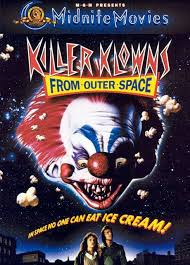
Killer Klowns from Outer Space (1988)

KILLER KLOWNS

KILLER KLOWNS FROM OUTER SPACE (1988) Three-and-a-half stars
Sociologists would undoubtedly have a field day unpacking why KILLER KLOWNS FROM OUTER SPACE retains cult classic status.

We can start at the first two words in the title and focus upon our seemingly eternal fascination with both killers and clowns.

Then, our nostalgia for 1980s kitsch.

I don’t know, that’s not why I dig KILLER KLOWNS FROM OUTER SPACE, because, to begin with, I don’t quite have the same obsession with killers and clowns that most Americans have or I don’t suffer from “coulrophobia,” the irrational fear of clowns.

I know several people who seriously consider 1980s mass entertainments THE GOONIES, DIRTY DANCING, FERRIS BUELLER’S DAY OFF, THE BREAKFAST CLUB, et cetera, not only their favorite movies, but they’ll go on record and proclaim their favorite “the greatest movie ever made.” Talk about a conversational cul-de-sac, it’s happened so many darn times over the years especially during college. I lost track of how many times I stood there in stone face silence (like Buster Keaton) while my brain pondered exactly how many films these other people have seen and why they’re stuck in 1987, for crying out loud.

I did not see KILLER KLOWNS FROM OUTER SPACE until many years later, though I always remembered that glorious title before I put the down payment on the DVD.

I love KILLER KLOWNS FROM OUTER SPACE because it’s a demented cartoon (the best kind of cartoon) that has ingeniousness to spare: “The Big Top” for the Killer Klowns’ spaceship; popcorn ray-guns; cotton candy cocoons that produce a dread end for dead humans; an invisible Clown car; shadow puppetry; killer pies; and the 18-foot tall Killer Klown leader known as “Jojo the Klownzilla,” a man-in-a-suit Godzilla parody or tribute.

KILLER KLOWNS FROM OUTER SPACE will remind some viewers of Steve McQueen’s debut motion picture, THE BLOB (1958).

You know, kids on lovers’ lane see what could be Halley’s Comet … no, hey, wait, that’s what a crusty old farmer named Gene Green (Royal Dano) mistakes “The Big Top” for when he sees the same unidentified flying object streaking across the sky in the opening sequence and boy, oh boy, that’s a dread mistake for Mean Gene and his poor, poor loyal dog Pooh Bear when they go investigate. Ol’ Man Green speaks a few great lines before his inevitable exit, “What in tarnation is going on?”

Straight out of THE BLOB, teenage sweethearts Mike Tobacco (Grant Cramer) and Debbie Stone (Suzanne Snyder) also investigate further and they go to the local authorities with their findings, centered on “The Big Top” and its inner workings. Our two local authorities, of course, are hesitant to believe these wacko teenagers and their whacked out stories of popcorn-shooting guns and cotton candy cocoons.

Damn kids and their elaborate pranks.

We do have a more sympathetic police officer in Dave Hansen (John Allen Nelson) and I seem to remember every other more sympathetic police officer travels by the name “Dave.” You just know you can have total faith in a guy named Dave.

Yes, at least one more sympathetic police officer did have that first name, “Lt. Dave” in THE BLOB, who patiently listened to and believed the cockamamie stories of Steve (McQueen) and Jane (Aneta Corsaut).

Just like THE BLOB, we have one policeman more sympathetic to the kiddos in KILLER KLOWNS FROM OUTER SPACE and then we have Curtis Mooney, who seems like a relative of Dean Vernon Wormer from NATIONAL LAMPOON’S ANIMAL HOUSE.

Of course, there’s a brilliant reason for that, both characters are played by the same actor.

The late John Vernon (1932-2005) has a fabulous start to his IMDb biography: “John Vernon was a prolific stage-trained Canadian character player who made a career out of convincingly playing crafty villains, morally-bankrupt officials and heartless authority figures in American films and television since the 1960s.”

He’s great in KILLER KLOWNS FROM OUTER SPACE, picking up right where he left off in ANIMAL HOUSE.

Maybe Wormer relocated to Crescent Cove and changed his name to Curtis Mooney.

Cramer plays a protagonist named “Mike Tobacco” and it took me a little bit to remember a character from “Charlie and the Chocolate Factory” and WILLY WONKA AND THE CHOCOLATE FACTORY named “Mike Teavee.” Are they distant relatives? While the TV obsessive Mike Teavee brought his obsession to another level in both the book and the 1971 film adaptation, we never see Mike Tobacco smoke tobacco in KILLER KLOWNS FROM OUTER SPACE, although we can be sure that Curtis Mooney believes that Mr. Tobacco’s smoking something stronger than tobacco when he descends upon the police station with that “killer clowns from outer space” story.

The Chiodo Bros. — Stephen, Charles, and Edward — are the auteurs behind KILLER KLOWNS FROM OUTER SPACE, siblings who specialize in clay models, creatures, stop motion, and animatronics. Their credits, in addition to the main film under discussion, include puppets and effects work for CRITTERS, ERNEST SCARED STUPID, and TEAM AMERICA: WORLD POLICE, as well as the Large Marge claymation scene from PEE-WEE’S BIG ADVENTURE.

They deserve a spot alongside such icons as Willis O’Brien and Ray Harryhausen.

On a certain level, KILLER KLOWNS FROM OUTER SPACE deals in a nostalgia for animation, horror, and science fiction entertainments of the past.

The IMDb lists numerous references, but the most important ones seem to be GODZILLA, INVASION OF THE BODY SNATCHERS, FORBIDDEN PLANET, PHANTASM, and ALIEN, as well as THE BLOB, of course, all of which seasoned viewers will be able to notice.

The film’s tagline captures the spirit of the enterprise: “In space, no one can eat ice cream.”

Godzilla vs. Hedorah (1971)

DAY 6, GODZILLA VS. THE SMOG MONSTER

GODZILLA VS. HEDORAH (1971) Three-and-a-half stars
Greg Kihn’s “The Breakup Song” posited that they don’t write ’em like that anymore.

Well, they don’t make movies like GODZILLA VS. HEDORAH (Toho Company title and version in 1971) or GODZILLA VS. THE SMOG MONSTER (American International title and version in 1972) or, for that matter, movies like INVASION OF THE BEE GIRLS and INFRA-MAN anymore. Where do you start with movies like that? Where do you end?

GODZILLA VS. THE SMOG MONSTER must be seen to be or not to be believed. It’s ridiculous, absolutely and sublimely ridiculous, in ways that only a truly great “bad” movie can be.

Honestly, though, I don’t think it’s bad at all and it’s definitely infinitely better than the 1998 American GODZILLA starring Matthew Broderick. I mean, come on, Roland Emmerich and Dean Devlin, you create a pair of characters based on Siskel & Ebert after their negative reviews of your previous movies and then you don’t have the testicular fortitude to kill them off. Wusses!

This is the 11th GODZILLA movie in the series and it honestly features just a little bit of everything.

No, seriously.

The IMDb plot summary: “From Earth’s pollution a new monster is spawned. Hedorah, the smog monster, destroys Japan and fights Godzilla while spewing his poisonous gas to further the damage.”

That only barely scratches the surface of GODZILLA VS. THE SMOG MONSTER. Even if the movie only revolved around that plot summary, I would be interested, but this flick goes the extra mile to entertain us.

Just yesterday I wrote about how I love it when a horror movie takes on more than just being a horror movie and gives us more.

That applies to Godzilla movies or any genre for that matter.

In this 11th Godzilla movie, we have a pro-environmental message replete with a song titled “Save the Earth,” we have a psychedelic freakout in a club with a tripping dude conjuring up partiers adorned with fish heads, we have weird animated interludes, we have little scientific lessons on nebulas and the like, we have a smog monster who looks more like a shit monster, and, last but definitely not least, a flying Godzilla, yes, a flying Godzilla using his atomic breath for jet propulsion. Was the similar scene in ROBOCOP 3 a tribute?

Those are simply the highlights.

Thankfully, the Save-the-Earth message doesn’t get too preachy or smug (it’s not ripe to be mocked by “South Park”) because of everything else surrounding it.

It’s a dark movie overall and genuinely scary in a few parts, because, let’s face it, none of us want to be killed by a shit monster.

Godzilla and Hedorah go 15 rounds in a heavyweight fight.

Godzilla vs. The Smog Monster could have been paired with Ali vs. Frazier, a creature feature before or after the boxing match.

The geniuses at American International ran GODZILLA VS. THE SMOG MONSTER together with FROGS. What a pair! Best pair since Marilyn Monroe, right?

I’ve long been fascinated by what movies are titled in country from country. We’ve already covered a pair of titles for the 11th Godzilla movie and here’s four more. How about HEDORAH, LA BURBUJA TOXICA (Spain) or HEDORAH, THE TOXIC BUBBLE.

GODZILLA CONTRA MONSTRUOS DEL SMOG (Mexico) or GODZILLA AGAINST MONSTERS OF SMOG.

FRANKENSTEIN’S BATTLE AGAINST THE DEVIL’S MONSTER or FRANKSTEINS KAMPF GEGEN DIE TEUFELMONSTER in German.

GODZILLA CONTRE LE MONSTRE DU BROUILLARD (French) or GODZILLA AGAINST THE MONSTER OF FOG.

That’s just a brief international title sampler.