Trog (1970)

TROG

TROG (1970) ***

Joan Crawford began her long cinematic career in 1925 as the double for Norma Shearer in LADY OF THE NIGHT.

She appeared in small roles in Erich von Stroheim’s THE MERRY WIDOW, King Vidor’s THE BIG PARADE, and Fred Niblo’s BEN-HUR: A TALE OF THE CHRIST and first made her fame in Tod Browning’s THE UNKNOWN, her 20th screen credit already by 1927.

Crawford survived the transition from silent to sound and she won the Academy Award for Best Actress for her performance in the 1945 film noir MILDRED PIERCE.

That brings us to her final screen appearance, TROG.

To the best of all knowledge, Crawford (1906-77) is the only Academy Award winner to star in a caveman movie and speak lines “Please, Trog, let me have the girl!” and “Music hath charms that soothes the savage beast.” Aben Kandel wrote the screenplay and Peter Bryan and John Gilling received credit for original story.

Granted, she’s also the only Academy Award winner to star in a Blue Öyster Cult song, a ditty inspired by the book and the film MOMMIE DEAREST written by Crawford’s far beyond estranged daughter Christina. The boys turned Joan Crawford into more of a monster than Godzilla. That part in the song where Mommie Dearest is calling for bad little Christina, it just doesn’t get much better than that in this oh so cruel bitch of a world. “Joan Crawford has risen from the grave,” indeed.

Back on point: I enjoyed TROG a good deal, and it’s one of those films that inspires the very best stories.

Film critic Pauline Kael (1919-2001) wrote, “Joan Crawford plays Stella Dallas with an ape instead of a baby girl. Some actors will do anything to be in movies: she probably would have played the ape.”

Herman Cohen (1925-2002), a producer whose credits include BELA LUGOSI MEETS A BROOKLYN GORILLA and I WAS A TEENAGE WEREWOLF, said that Crawford’s alcoholism raged during TROG and she had 100-proof vodka in her frosted Pepsi Cola glass. He added that Crawford brought four cases of the juice with her to England, because of its unavailability in Merrie Olde. (Speaking of Pepsi, Crawford, once married to the chairman of the board and CEO of Pepsi and then herself a board of the directors member, works in one brief moment of product placement during an early scene.)

Freddie Francis (1917-2007), a two-time Academy Award winner for Best Cinematography for SONS AND LOVERS and GLORY, said that he regretted directing TROG (which he called terrible) and that Crawford had so much trouble remembering her lines they had to resort to using “idiot cards” to get through her scenes.

Former English professional wrestler Joe Cornelius played the title character in TROG and he defended Crawford against those accusations in a 2015 interview with cult film director and fan John Waters after the British Film Institute retrospective of the film.

In the ring, they called Cornelius “The Dazzler.” From the Online World of Wrestling, “What a presence ‘The Dazzler’ made when he entered the ring, the wavy jet black hair, the dazzling smile, the eyebrows! Damn! He had it all, a personality as big as the Royal Albert Hall and ring savvy second to none, he was like a puppet master with strings fastened to the hearts of every member of the audience.”

Guess at this point we should discuss exactly what’s a Trog.

Trog is short for “troglodyte” or a person who lived in a cave, especially in prehistoric times. He’s proclaimed, in promotion of the film, as having the strength of 20 demons, so it makes perfect sense to have Cornelius play the role.

Crawford stars as Dr. Brockton, who of course represents science against those who just want to destroy the “monster.” She wants to reach and teach Mr. Trog. She wants to domesticate “The Missing Link,” half-man and half-ape with a costume borrowed from 2001. These domestication scenes are worth their weight in gold, especially the one when Trog learns how to play catch. “Good boy, Trog!”

Thankfully, for the sake of the movie and its cult following, Crawford does not condescend to her role. She plays it absolutely 100 percent straight and resolutely serious. In other words, Crawford plays it just like she did in MILDRED PIERCE. That makes TROG even funnier than if she just played it winking at the audience the entire time.

Michael Gough (1916-2011) opposes Brockton and Trog from his very first appearance. I doubt Gough used TROG in his audition for Tim Burton’s BATMAN, because his bad manners here as Sam Murdock do not mesh with Alfred Pennyworth, Bruce Wayne’s dedicated butler. We await the fate that waits for Mr. Murdock and it is well worth the wait.

During his attempted domestication, Trog freaks out both at the color red and more upbeat music.

That got me thinking: What if they played Trog the Troggs’ “Love is All Around” from 1967? Just forget about “Wild Thing.” Yes, the Troggs, an English rock band originally called the Troglodytes before the name was shortened, had a huge impact on future noise with their songs covered by Jimi Hendrix, the Buzzcocks, and Hüsker Dü.

Grand Theft Auto (1977)

GRAND THEFT AUTO

GRAND THEFT AUTO (1977) Three stars

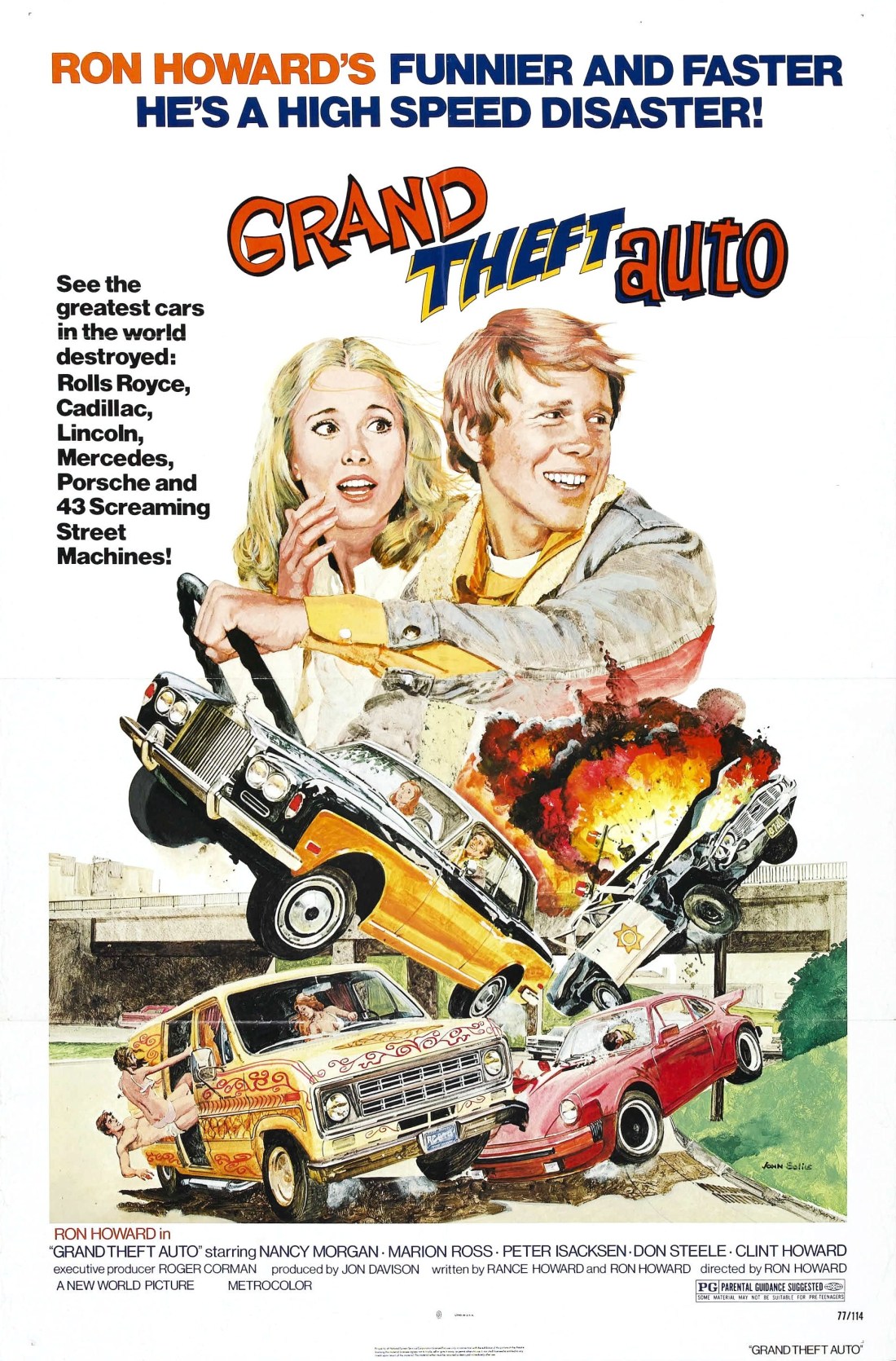
I just love the poster for GRAND THEFT AUTO, Ron Howard’s feature debut as director.

It advertises “See the greatest cars in the world destroyed: Rolls Royce, Cadillac, Lincoln, Mercedes, Porsche and 43 Screaming Street Machines.”

Sounds like my kind of picture.

RON HOWARD’S FUNNIER AND FASTER

HE’S A HIGH SPEED DISASTER!

A drawing of Nancy Morgan aghast and Howard with that All-American smile on his face and his left hand on the steering wheel. Below the young lovebirds are flames and crashes. Sure does resemble a drive-in movie from 1977.

Howard directed, starred in, and co-wrote this picture for New World, produced by Jon Davison and executive produced by Roger Corman. Howard kept some of GRAND THEFT AUTO in the family with father Rance a co-star and co-writer and brother Clint a co-star. It’s no small wonder that Howard earned a reputation for being one of the nicest guys in Hollywood.

Howard did not sell his soul to the Devil to get the picture made. No, instead, he made a deal with Mr. Corman. Howard agreed to star in EAT MY DUST! from 1976 if he could have a crack at directing. The rest is history and Howard’s directorial credits number 32, including Academy Award for Best Picture winner A BEAUTIFUL MIND. His other credits include NIGHT SHIFT, SPLASH, PARENTHOOD, FAR AND AWAY, THE PAPER, APOLLO 13, and FROST/NIXON.

Made for a reported $600,000 on down time for Howard from “Happy Days” (No. 1 show on TV in 1976-77 and No. 2 in 1977-78), GRAND THEFT AUTO tells a simple story.

Paula Powers (Morgan) loves her boyfriend Sam Freeman (Howard) and they want to get married, but her wealthy parents, especially her gubernatorial candidate father, oppose this pairing, taking Mr. Freeman for a gold digger. Paula’s parents want her to marry the wealthy Collins Hedgeworth (Paul Linke), who’s such a blasted tool he spends the movie in his jockey outfit. Paula steals her father’s Rolls Royce and Sam, and they plan to get married in Vegas. There ends up being a $25,000 reward for Paula and then a $25,000 price tag for Collins.

Seemingly all of California (and Nevada) pursues Paula and Sam, as well as Collins.

Collins alone goes through at least three cars in his first few minutes of screen time. What a schmuck! His overprotective mother, played by America’s Sweetheart and Howard’s TV mother Marion Ross, is the one responsible for the reward for Collins and it is one of the undeniable highlights of the movie to hear Marion Ross say “Piss off!” Even a preacher (Hoke Howell) goes after the money. Sleazy DJ Curly Q. Brown (Don Steele) eventually takes to the air in a whirlybird and he tells Mr. Freeman on the air, “Well, if you have it, I’m going to report it. Because every time you turn around and fart, it’s news.” The film especially picks up once Curly Q. Brown starts his play-by-play of the chase across California and Nevada.

The plot also includes a Helicopter vs. Rolls Royce showdown, a bridge blown up real good, and a Demolition Derby. The 1970s were the glory days for the car chase and GRAND THEFT AUTO belongs alongside DUEL, MAD MAX, CONVOY (both movie and song), SMOKEY AND THE BANDIT, THE FRENCH CONNECTION (chase scene), and several other pics.

Do Paula and Sam get married (and live happily ever after)? Well, I would never dream of revealing such an ending, although I told my wife after she asked me if they got married. I will compromise, though, and duly note GRAND THEFT AUTO saves its best demolition for last.

Bela Lugosi Meets a Brooklyn Gorilla (1952)

LUGOSI GORILLA 1953 OWENSBORO

BELA LUGOSI MEETS A BROOKLYN GORILLA (1952) Three stars

They don’t make bad movies like BELA LUGOSI MEETS A BROOKLYN GORILLA any more and that should bring sadness to genuine bad movie connoisseurs everywhere.

It was filmed in six days with a mighty mighty production budget of $12,000. (I have read other reports that have the film down for nine days and $50,000.)

William “One Shot” Beaudine (1892-1970) directed BELA LUGOSI MEETS A BROOKLYN GORILLA and his credits between film and TV amounted to a staggering 372 with his final theatrical features JESSE JAMES MEETS FRANKENSTEIN’S DAUGHTER and BILLY THE KID VS. DRACULA both released in 1966. Beaudine’s directorial career began in 1915, the year of D.W. Griffith’s landmark feature THE BIRTH OF A NATION; in fact, Beaudine assisted Griffith on both THE BIRTH OF A NATION and INTOLERANCE (1916).

Beaudine is not the only legendary Hollywood figure associated with BELA LUGOSI MEETS A BROOKLYN GORILLA.

We have, of course, Mr. Lugosi, no stranger to bad movies, especially in the later stages of his career. He always played a good game, though, and never failed in elevating anything that he was in. One of the all-time greats, Lugosi (1882-1956) even gave great performances in death in both the Kinks’ “Celluloid Heroes” (“Avoid stepping on Bela Lugosi / ‘Cause he’s liable to turn and bite”) and especially Bauhaus’ “Bela Lugosi’s Dead.” MEETS A BROOKLYN GORILLA does not represent peak Lugosi, of course, and it’s not even as good Lugosi as Ed Wood’s GLEN OR GLENDA and BRIDE OF THE MONSTER, but any Lugosi is still good Lugosi.

Martin Landau, who earned an Academy Award for portraying Lugosi in ED WOOD, said that he prepared for his role by watching BELA LUGOSI MEETS A BROOKLYN GORILLA three times (hopefully not in a row). Landau said the film was so bad that it made Ed Wood’s films seem like GONE WITH THE WIND by comparison. Now, there’s a pull quote for the ads: “Makes Ed Wood’s films seem like GONE WITH THE WIND.”

Lugosi made THE GORILLA in 1939 with the Ritz Brothers and Lionel Atwill and THE APE MAN in 1943, a film directed by Beaudine. All three ape films are public domain.

No, please wait, we have not even got to the best part yet. There’s nightclub duo Sammy Petrillo and Duke Mitchell, who play themselves in BELA LUGOSI MEETS A BROOKLYN GORILLA. They are really playing Jerry Lewis and Dean Martin, though, and you might be forgiven for mistaking Petrillo for Lewis and Mitchell for Martin if you missed the opening credits.

I raised my grade by at least one star once I found out that Martin and Lewis considered suing Petrillo and Mitchell for appropriating (misappropriating) their act for BELA LUGOSI MEETS A BROOKLYN GORILLA.

From a 1952 story by the United Press’ Aline Mosby, “The latest ‘Martin and Lewis’ are Duke Mitchell and Sammy Petrillo. They look, talk, laugh, and sing like Dean and Jerry, and they’re in the movies now, too. … Mitchell and Petrillo have the same haircuts, expressions, gestures and even ancestries of Martin, who’s Italian, and Lewis, who is Jewish.”

Mitchell and Petrillo insisted they did not see any resemblance. (Despite the film poster, “They look like Martin & Lewis … You’ll not know the difference … but they are really SAMMY PETRILLO DUKE MITCHELL.”)

After stating that Charlie Chaplin was the only original comic and everybody in show business is a combination of everybody else anyway, Petrillo added, “If it wasn’t for Minosha Skulnic, Harry Ritz and Gene Bayless, Jerry Lewis wouldn’t have an act. And that trick he does with his upper lip he got from Huntz Hall.”

“I’m a combination of Billy Daniels, Billy Eckstine and Sarah Vaughn,” Mitchell said. “Sometimes I get up to sing and I feel like Vaughn Monroe. Nothing’s original in show business. Who do you think Martin is? Crosby. Mel Torme’s like Sinatra, and he did all right.”

Mitchell and Petrillo only made BELA LUGOSI MEETS A BROOKLYN GORILLA and Martin and Lewis split in 1956 after 17 films together beginning with MY FRIEND IRMA (1949).

Mitchell died in 1981, Martin 1995, Petrillo 2009, and Lewis 2017.

BELA LUGOSI MEETS A BROOKLYN GORILLA is one of those movies where you can remember Leonard Maltin’s entire review, let’s see here, “BOMB. One of the all-time greats. Mitchell and Petrillo (the very poor man’s Martin and Lewis) are stranded on a jungle island, where Lugosi is conducting strange experiments. Proceed at your own risk.”

After positive reviews for THE TERROR OF TINY TOWN, KING KUNG FU, THE KILLING OF SATAN, and TROLL 2, I see no problem writing one for BELA LUGOSI MEETS A BROOKLYN GORILLA, although I have mentioned that it’s a bad movie several times. C.M.A., that’s all, folks.

Class of 1984 (1982)

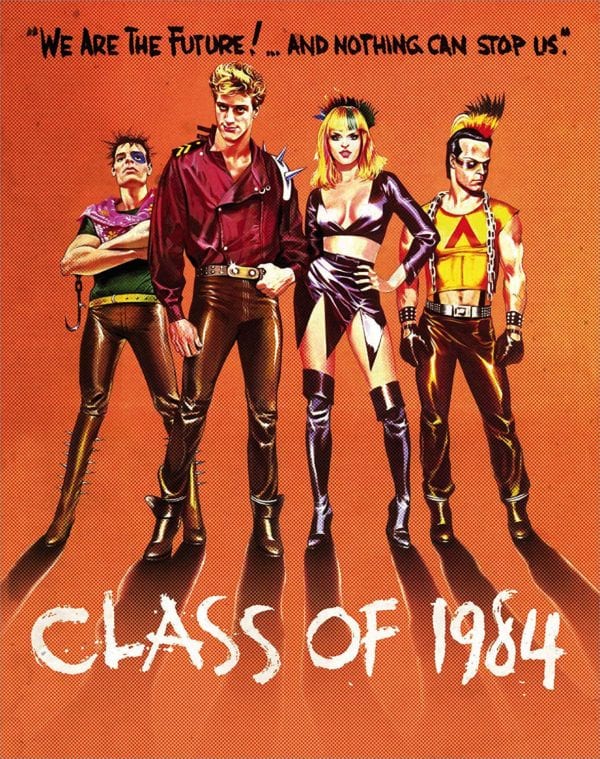
CLASS OF 1984

CLASS OF 1984 (1982) Three-and-a-half stars

Given its exploitation film content including gore, nudity, profanity, sex, and violence, CLASS OF 1984 will not be shown to new teachers or substitute teachers any school year soon.

Not that it should, but a little independent research never hurt anybody.

I don’t remember, though, if I first watched CLASS OF 1984 during or after my three years as substitute teacher in the late 00s. However, I do remember that it made a strong impact with its story of how an idealistic music teacher eventually gives into the dark side and murders his most unruly students at an inner city high school. It’s definitely the movie to see after DANGEROUS MINDS, LEAN ON ME, all that feel good uplifting claptrap.

Watching CLASS OF 1984 again in a decade since I substituted, it still brings on memories of the little punks who threatened violence, who said they would sue, who just ran their mouths incessantly, and who made getting through another day feel like an endurance contest from Hell. For every good student, it often seemed like there were two or three or twenty bad ones in every class. “I would love to punch you in the face,” one junior high student said. “Go ahead, give it your best shot,” the substitute teacher said. Thankfully, not every day substitute teaching was quite like that.

In that spirit, though, we return to our regularly scheduled review of CLASS OF 1984.

Be warned: This is a rough little movie, a nasty piece of work at times, but if you can make it through scenes like the biology teacher’s murdered rabbits and the rape of the music teacher’s wife, this 1982 update on the 1955 classic BLACKBOARD JUNGLE does have its merits.

The performances help lift this film above mere exploitation trash: Perry King as the music teacher, Roddy McDowall as the biology teacher, Timothy Van Patten as every teacher’s worst nightmare, and Michael J. Fox (in an early role) as one of the good students.

King makes for a likable protagonist and takes us from one end of the picture to the next. We are behind him every step of the way, and that’s critical during the film’s violent final act as enough has become more than enough for this music teacher. Those damn punks go too far, far enough for at least a couple exploitation films. Roger Ebert called the climax a cross between THE HUNCHBACK OF NOTRE DAME and BEYOND THE VALLEY OF THE DOLLS.

McDowall (1928-98) had a knack for supporting performances that almost steal a movie away from their nominal stars, and he displays that knack here in CLASS OF 1984, especially when he cracks and teaches his biology class by gunpoint. I bet you’ll remember how many chambers are in the human heart with a gun pointed at you, and I also bet that Richard Kiley (from BLACKBOARD JUNGLE) wishes he could have got a scene like that after the punks in his film had their way with his favorite jazz records. Damn kids, damn punks.

[Review resumed about two weeks later.]

To work properly, this genre requires a repugnant piece of work going up against the hero and Van Patten certainly provides that as teenage antagonist Peter Stegman. Audiences have been known to cheer his demise. Stegman’s personality profile on Villains Wiki, “A totally violent, sadistic, ruthless and mentally unstable teenager. He will hurt anyone who he thinks is threatening his authority over the school, or he will also kill them with no remorse or regrets.” In a different movie, Stegman’s piano-playing ability would have been exploited for a different kind of feel-good ending, not one where you feel good the bastard’s dead.

You can see why Fox became a superstar, even in a supporting performance.

CLASS OF 1984 director Mark L. Lester also directed TRUCK STOP WOMEN, WHITE HOUSE MADNESS, BOBBIE JO AND THE OUTLAW, GOLD OF THE AMAZON WOMEN, ROLLER BOOGIE, FIRESTARTER, and COMMANDO. Now, that’s some filmography and I’ll say that it’s close (real close) between CLASS OF 1984 and COMMANDO for his best work.

A movie like this needs a proper soundtrack.

Nearly two decades before AMERICAN GRAFFITI, BLACKBOARD JUNGLE made waves with its use of Bill Haley and the Comets’ “Rock Around the Clock.” What an opener!

Alice Cooper provides “I Am the Future” for CLASS OF 1984. Mr. Cooper has the ideal credentials for scoring a teenage rebellion pic: specifically “I’m Eighteen,” “School’s Out,” and “Teenage Lament ‘74” from his glory days. As far as mid-period solo Alice standards go, “I Am the Future” does not quite measure up against 1980’s “Clones” and 1983’s “I Love America,” but it still far surpasses Alice’s late 80s and early 90s hair metal period.

CLASS OF 1984 belongs to a branch of entertainment that includes such notables as not only BLACKBOARD JUNGLE but also BEYOND THE VALLEY OF THE DOLLS, OVER THE EDGE, ROCK ‘N’ ROLL HIGH SCHOOL, RIVER’S EDGE, and PUMP UP THE VOLUME, as well as the “Smells Like Teen Spirit” video.

The Thing with Two Heads (1972)

THE THING WITH TWO HEADS (1972) Three stars

Former NFL player Rosey Grier and 1946 Academy Award for Best Actor winner Ray Milland are the two heads. Let’s get that out of the way right from the start.

Top-billed Milland plays a brilliant scientist with terminal cancer who finds trial success with a two-headed gorilla (Rick Baker’s preparation for KING KONG). He comes up with a diabolical scheme to keep on living. Just like Spinal Tap lead singer David St. Hubbins once said, “It’s such a fine line between stupid, and clever.”

Second-billed Grier plays a convicted murderer on Death Row who has volunteered his body to medical science.

Doctors transplant Milland’s head onto Grier’s body, since both are running out of time. Maybe the wrong Grier, because just imagine Milland’s head, for example, on Pam Grier’s body. Now, that would be interesting. American International Pictures could have made it happen, at least for a sequel, but unfortunately it’s too late since Milland passed away in 1986.

You might not believe this, but Grier’s Jack Moss is an innocent man and Milland’s Maxwell Kirshner is an unapologetic racist. Try and imagine a TV show where they put Archie Bunker’s head on George Jefferson’s body.

Honestly, I don’t think THE THING WITH TWO HEADS takes off until it gets Milland and Grier out of the hospital and into the open after their transplant. That’s about the halfway point of the picture, when they kidnap black doctor Fred Williams (Don Marshall) and Moss and Kirshner both do their best negotiating to get the good doctor on their side. They both face challenges, in Moss being on Death Row and Kirshner being an unrepentant bigot. They both want the other head removed.

THE THING WITH TWO HEADS devotes several minutes to a chase scene with many police cars in hot pursuit of a “two-headed monster.” You really have not lived until you see this chase, especially after Grier and Milland commandeer a motor bike, make their way through a race course, and evade 14 crashing police cars en route to a safe haven. These policemen are incredibly incompetent: They cannot shoot, cannot drive, and cannot even close a trunk on their downtrodden squad cars. Yes, they do drive, but just look at their end results. Like a test reel for SMOKEY AND THE BANDIT and THE BLUES BROTHERS.

Milland plays basically the same character that he does in FROGS, another 1972 production from American International; FROGS came out on March 10 and THE THING WITH TWO HEADS on July 19. Milland sinks his teeth into the dialogue in both films and he gives off the feeling of an unhappy camper in both performances, but it works for his characters. Reportedly, Milland sweated so much during the production of FROGS, filmed in the Everglades, that his toupee fell off several times; additionally, he hated the production so much that he left it three days early.

Grier, meanwhile, has lived an interesting life to say the least and a starring role as one of the heads in THE THING WITH TWO HEADS barely scratches at the surface of that life, believe it or not. Grier played college football at Penn State and then professionally for the New York Giants and the Los Angeles Rams from 1955 through 1966. He served as a bodyguard for Robert Kennedy during the 1968 presidential campaign and it was Grier who subdued assassin Sirhan Sirhan. Grier hosted a TV show, enjoyed a recording career, became an ordained minister, spoke at the 1984 Republican National Convention, and entertained running for the Governor of California in 2018, lest we forget Grier’s 1973 book “Rosey Grier’s Needlepoint for Men.” He’s the last living member of the Rams’ “Fearsome Foursome,” a defensive line that included Deacon Jones (1938-2013) and Merlin Olsen (1940-2010).

Grier even gets to show off his singing ability just a little bit in the final moments of THE THING WITH TWO HEADS and let’s just say that, of course, the film ends on “Oh Happy Day.” It is just that kind of a movie.

NOTE: I would assign the film’s trailer four stars. It is 2 minutes, 21 seconds of greatness, especially with that dynamite opening line “It seemed like a good idea at the time,” which might just be exactly what many people have said after seeing THE THING WITH TWO HEADS.

King Kung Fu (1976)

KING KUNG FU (1976) Three stars

The Empire State Building, completed just a couple years earlier, played a key role in the 1933 classic KING KONG. At this very moment, we can picture Kong fighting off them darn airplanes from the highest spot in the modern world. Very few endings in movie history can even approach the final minutes in KING KONG. Remains awesome nearly 90 years later.

Meanwhile, our gorilla King Kung Fu takes shapely Pizza Hut waitress Rae Fay to the top of the Holiday Inn Plaza, the tallest building in Wichita at a majestic height of 262 feet, for the grand finale of KING KUNG FU. King Kung Fu battles a stop-motion helicopter piloted by a police captain with a bad John Wayne impersonation. Awesome, in a completely different way.

You win some, you lose some, and often times it seems like Kansas loses on the cultural front, while New York City wins and wins again and again and wins forever more.

Both the Empire State and the Holiday Inn are no longer their cities’ tallest buildings. Heck, the latter is not even the Holiday Inn any more, it’s the 250 Douglas Place Apartments (a.k.a. the Garvey Center). They both are doing quite well for themselves, however, with the Empire State Building in the news in late 2019 for $165 million renovation and being a top tourist destination.

The duo of producer Bob Walterscheid and director Lance D. Hayes started filming KING KUNG FU in 1974 and finished in 1976, but it took another 11 years for Walterscheid to wrangle up the necessary funds to complete the editing on this half-King Kong, half-Kung Fu spoof that has its tongue planted firmly within its cheek. Hell, maybe every cheek in Wichita.

I watched the Korean KING KONG rip-off A*P*E and KING KUNG FU within basically the same 24-hour period.

Objectively, both are “bad” movies, but there’s a world of difference in what both achieve.

A*P*E plays exactly like a cheap, cynical KING KONG rip-off and it’s quite telling that its most famous scene is of the title character flipping the bird.

KING KUNG FU, meanwhile, feels more like a labor of love, an affectionate tribute to King Kong and Kung Fu. Plus, it has this undeniable goofball charm as it tries every lowbrow gag, at least one per minute. Most fail, others succeed, but that’s part and parcel with any sense of humor. I laughed out loud a few times during KING KUNG FU and that’s definitely far more than what I can say for A*P*E.

I laughed at the “Simian Scope” gag at the beginning of KING KUNG FU. This is the first and last movie filmed in “Simian Scope.” We’ve had many variations on CinemaScope over the years: The Shaw Brothers’ “Shaw Scope” being my all-time favorite. Also worth seeking out: The Shaw Brothers released their own take on KING KONG in 1977, MIGHTY PEKING MAN.

I laughed at the John Wayne impersonation, which eradicates the whole “bad” judgment I wrote a few paragraphs back about that impersonation since I believe it was intended to be funny … and … (for a third time) I laughed. We could have used even more scenes with this character played by Tom Leahy, a favorite in the Wichita area for his many years of work in radio and television. Since we have a subordinate officer surnamed Pilgrim, well, you can already guess about half of the dialogue from Mr. Leahy as Captain J.W. Duke. Leahy died in 2010.

The plot: Two would-be reporters Bo (Billy Schwartz) and Herman (Tim McGill) hatch a master plan to free King Kung Fu, a great big gorilla from China whose goodwill tour of the United States stops in Wichita and the Sedgwick County Zoo. Of course, having seen KING KONG, Bo and Herman bait King Kung Fu with Rae Fay (not Fay Wray or Link Wray, for that matter). Sounds like Bo and Herman want to make a movie, one with a happy ending.

Unfortunately, the movie drags just a little bit in the middle section. Plain and simple, it takes way too long for King Kung Fu to be unleashed on Wichita. We get too many scenes with Bo and Herman and their slapstick shenanigans, as the filmmakers seem to have forgotten their own title. Granted, Bo and Herman are likeable oddballs, but they do push endurance levels to breaking point with their schtick in this middle section.

Because we want to see King Kung Fu wreak good-natured havoc on the Old Cowtown Museum, the Joyland Amusement Park (no longer in operation), and Lawrence-Dumont Stadium (demolished for a new facility that will host a new Triple-A franchise named The Wichita Wind Surge, beginning 2020). These scenes are worth their weight in gold.

Never mind Bo’s line, “… Me as the karater and him as the karatee.”

Or the genius in Washington who says, “As you can see, Wichita is located in the center of this great country of ours and it means quite simply we have him surrounded.” That look on his face when he says “It means quite simply we have him surrounded,” I mean, wow, if you watch it now it would be great preparation for the next electoral season.

Guess it should be mentioned King Kung Fu utters dialogue like “I gotta make like a banana and split.” I once told somebody, “Why don’t you make like Michael Jackson and just beat it!”

Believe it or not, KING KUNG FU received a ‘G’ rating. Not many movies are ‘G.’ The Washington Post ran “Rated ‘G’ — For Gone?” in 1992, because a ‘G’ rating became at some point a kiss of death just like X or NC-17 on the other extreme of taste. Disney animated movies survive a ‘G,’ no problem, but little else can break through the stigma associated with ‘G.’

This ‘G’ rating was not a mistake for KING KUNG FU, like, for example, it was for the 1968 Hammer film DRACULA HAS RISEN FROM THE GRAVE. There’s no blood in KING KUNG FU.

You might never look at Wichita quite the same way again after seeing KING KUNG FU.

Clash of the Titans (1981)


CLASH OF THE TITANS (1981) Three-and-a-half stars

Harryhausen vs. Harry Hamlin.

That’s what CLASH OF THE TITANS amounts to in the long run for this viewer.

Artist, designer, visual effects man, writer, and producer Ray Harryhausen (1920-2013) mastered the dying art of stop-motion animation. His credits include MIGHTY JOE YOUNG, THE 7TH VOYAGE OF SINBAD, JASON AND THE ARGONAUTS, ONE MILLION YEARS B.C., and CLASH OF THE TITANS, Harryhausen’s final production in which he goes out with a big bang.

Harryhausen is the real star of CLASH OF THE TITANS, and not Harry Hamlin or even big-name actors Laurence Olivier, Ursula Andress, Maggie Smith, Burgess Meredith, and Claire Bloom.

I like CLASH OF THE TITANS a lot because of all them stop-motion creations.

Let’s see, we have scorpions, the Stygian witches, Calibos and his vulture, a two-headed hound of Hell, the Kraken, the mechanical owl Bubo, and, of course, Medusa.

The Medusa sequence is the pièce de résistance of CLASH OF THE TITANS and responsible for at least three stars alone.

Harryhausen himself favored Medusa among his many creations.

The snake-haired Medusa, we all know that she’s deadly with arrows and she can turn a person to stone if you make contact with her eyes. Personally, I pretend that every salesperson in a shopping mall is Medusa and eye contact must be strictly avoided. Perseus (Hamlin) tricks Medusa with his reflection and he lops off her head. Then, our hero uses Medusa’s head to turn the formidable Kraken to stone.

A wide range of filmmakers have been inspired by Harryhausen’s work, including Steven Spielberg, Joe Dante, James Cameron, Tim Burton, Peter Jackson, and Sam Raimi.

In 2010, Academy Award winning animator Nick Park talked with the BBC about his three favorite Harryhausen moments. He finished up with Medusa from CLASH OF THE TITANS after picking two from JASON AND THE ARGONAUTS.

“It was so well done and frightening,” Park said. “It’s all the same technique but going to different heights of intricacy.

“I thought it was a combination of really good lighting and shadow. I do admire a lot of CGI, but there’s something not real about it.

“In the Medusa that Ray did it’s there and it’s grounded, there’s real light hitting real surfaces. Somehow your brain knows it’s not real with CGI.”

I’ll be honest, I am far more interested in Harryhausen’s creatures than the rather convoluted plot involving Perseus, Andromeda (Judi Bowker), Calibos, Cassiopeia, and the gods pulling all the strings.

That’s what I meant by starting this review “Harryhausen vs. Harry Hamlin.”

Most of CLASH OF THE TITANS plays like a soap opera, not helped out by pretty boy Hamlin and Bowker, who seem like they should be on “Days of Our Lives.”

Google is a wondrous invention: With just two magic words and one little click, I found the 1987 People article on Hamlin, “The Sexiest Man Alive” double issue no less, and the opening paragraph of “Last of the Great Romantics” just hooks me in against my better instincts.

“The name seems wrong for The Sexiest Man Alive, Harry is a name for an uncle, or a guy who asks you to the prom because his mother made him. Of course, Harold would be worse. So Harry it is. Harry Robinson Hamlin, to be precise … the Harry everyone’s just wild about.” (Personally, I prefer Harry Truman or Harry Potter, quite possibly since neither will ever be proclaimed “The Sexiest Man Alive.”)

The article comes back around for a swipe at CLASH OF THE TITANS.

“And there’s always the possibility of doing a remake of CLASH OF THE TITANS. ‘I brought my toga home,’ says Harry, raising hopes of another glimpse of those knees. He’s kidding, of course. Frivolous flicks are a thing of the past for The Sexiest Man Alive. Besides, says Harry, laughing, ‘I used the toga to wash my car.’”

Frivolous flicks a thing of the past for Hamlin? Hamlin’s career has included 105 episodes of “L.A. Law,” 21 of “Movie Stars,” 12 of “Veronica Mars,” eight apiece of “Army Wives” and “Shameless,” and 15 of “Mad Men,” as well as a plethora of TV movies and other shows.

Hamlin should count himself lucky to be associated with CLASH OF THE TITANS.

Because Harryhausen trumps Harry Hamlin every single time.

The Blob (1958)

THE BLOB 2

THE BLOB (1958) Four stars

Watching the original BLOB just the other day, once again it hit me how much THE BLOB seems to be influenced by the 1955 classic REBEL WITHOUT A CAUSE.

THE BLOB leads Steven McQueen and Aneta Corseaut respectively call to mind James Dean and Natalie Wood (McQueen even a few years older than Dean playing a high schooler), there’s a more friendly policeman in both films (Ray in REBEL WITHOUT A CAUSE, Dave in THE BLOB), and they both are iconographic time capsule films that appeal to all generations.

Plain and simple, THE BLOB is a goofy, ridiculously fun time at the movies.

It sets the tone with that glorious theme song over the opening credits — “Theme from the Blob” by the Five Blobs and it’s a real catchy little ditty written by Burt Bacharach and Mack David. It sure beats “Raindrops Keep Falling on My Head.”

“Beware of the Blob, it creeps

And leaps and glides and slides

Across the floor

Right through the door

And all around the wall

A splotch, a blotch

Be careful of the Blob.”

What’s the Blob? A modified weather balloon in early shots and colored silicone gel in later shots. From outer space.

It’s also been compared to cherry Jell-O.

THE BLOB was inspired by a real event that happened in  1950 Philadelphia. The Philadelphia Inquirer headline on Sept. 27, 1950: FLYING ‘SAUCER’ JUST DISSOLVES. Joe Keenan and John Collins, a pair of veteran police officers who probably both thought they had seen just about everything before the night in question, spotted a mysterious object falling from the sky, of course, just like in THE BLOB and KILLER KLOWNS FROM OUTER SPACE, for that matter. They pursued this mysterious object and eventually encountered a large mass which they described as “purple jelly.” Collins decided that he would reach out and touch the mysterious object … by that point, backup (two more officers) had arrived, so four policemen were taking on the case. Collins had much better luck than the old man at the beginning of both ’58 BLOB and ’88 BLOB. He survived. Within 30 minutes of the first sighting, this blob-like object disappeared. The police told their story to the local media the next day, and the rest is history.

Made for $240,000 (though numbers vary, as low as $110,000 has been reported), THE BLOB predates later George Romero horror films made in Pennsylvania.

THE BLOB filmed at Valley Forge Studios — destroyed by a fire in 1962 — and the towns of Phoenixville, Downingtown, Chester Springs, and Royersford. These locations give THE BLOB an unique flavor and I do enjoy how eventually young and old alike work together to defeat the monster.

Phoenixville (2018 estimated pop.: 16,957) features the historic Colonial Theatre, one of the town’s claims to fame. Since 2000, Phoenixville and the Colonial commemorate THE BLOB with the annual “Blobfest.” The 21st edition will be held July 10-12, 2020. Every year, of course, they reenact the famous run out from the Colonial when the title character attacks. In addition to THE BLOB, FORBIDDEN PLANET and TEENAGERS FROM OUTER SPACE will be featured in 2020.

(BTW, Phoenixville ranks in the top 10 in the U.S. in breweries per capita. Let’s see, there’s Root Down, Crowded Castle, Stable 12, Rebel Hill, Rec Room, Iron Hill, Sly Fox, Baba’s Brew, A Culture Factory, Stickman Brews, Tuned Up, Steel City, et cetera, on the map.)

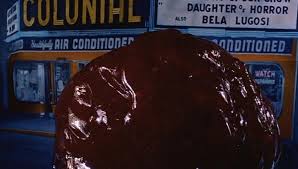
It just doesn’t get much better than when the title character attacks The Colonial during DAUGHTER OF HORROR, a real movie that’s the altered version of the 1955 movie DEMENTIA. The Kino Video DVD cover highlights three great reviews for DEMENTIA. Variety: “May be the strangest film ever offered for theatrical release.” Preston Sturges: “A work of art. It stirred my blood and purged my libido.” New York Censor Board: “Overflows with horror, hopelessness, sadism, violent acts of terror and outbursts of panic.”

Anyway, the Blob hates the cold. In that case, though, the Colonial must not have been too “Healthfully Air Conditioned,” because the Blob seems to thrive as it engorges the poor projectionist and heads into the auditorium.

Sometimes, during a bad bad bad movie at the multiplex, I’ve wanted the Blob to strike our screen and send us running.

Plan 9 from Outer Space (1959)


PLAN 9 FROM OUTER SPACE (1959) Four stars
Discourse around Ed Wood’s 1959 feature gives us two options: it’s either the worst movie ever made or it’s so bad that it’s actually good.

Having recently watched PLAN 9 twice, once near the 60th anniversary of the film’s initial release on July 22, I find that I disagree with both options, especially the first one.

It’s a great movie, because I traditionally equate personal enjoyment with greatness and I enjoy the living dead out of PLAN 9.

Wood’s films have been called “accidental avant-garde” or Wood didn’t know what he was doing and this sheer ineptitude created something arguably more bizarre. Wood’s films, like Ray Dennis Steckler’s THE INCREDIBLY STRANGE CREATURES WHO STOPPED LIVING AND BECAME MIXED-UP ZOMBIES and RAT PFINK A BOO BOO, exist in their own realm despite taking on many genres.

For example, in PLAN 9, we have horror, science fiction, action, adventure, and drama.

Sure, that seems like nothing special because a lot of movies yesterday and today and tomorrow mix and match genres, but just wait until you see PLAN 9.

What other movie would begin with a spiel from a psychic named “The Amazing Criswell” (1907-82) who became infamous for making “wildly inaccurate predictions.” (Aside from another Ed Wood film, of course.)

Criswell sets the tone for the rest of the movie right from the very start, “Greetings, my friend. We are all interested in the future, for that is where you and I are going to spend the rest of our lives. And remember my friend, future events such as these will affect you in the future. … My friend, can your heart stand the shocking facts about grave robbers from outer space?”

Wood had originally planned for GRAVE ROBBERS FROM OUTER SPACE to be his title, but financier J. Edward Reynolds, a devout Southern Baptist, found GRAVE ROBBERS offensive and Wood changed it to the title we all know and love. Wood and several cast members were even baptized at Reynolds’ church.

Taking into consideration the fascinating nature of the cast and Wood himself, you understand why Tim Burton’s fantastic ED WOOD focused so much time on PLAN 9.

— Criswell, given name Jeron Criswell King, became a fringe celebrity in Hollywood and he cut an entertaining figure at parties with his predictions. Criswell appeared on late night TV (he predicted 1966 on Johnny Carson), published his predictions in both magazines and newspapers, and wrote three books — “From Now to the Year 2000,” “Your Next Ten Years,” and “Forbidden Predictions” — and made a record titled “The Legendary Criswell Predicts Your Incredible Future” (which can be found online). Criswell’s friend and fellow PLAN 9 cast member Paul Marco released Criswell’s song “Someone Walked Over My Grave” after Criswell’s 1982 death, apparently because Criswell wanted it released that way.

— Finnish-American actress Maila Nurmi (1922-2008) became better known as “Vampira,” who hosted horror movies on her own series, “The Vampira Show,” from 1954-55 on KABC-TV in Los Angeles. Vampira is a combination of Morticia Addams, the Dragon Lady from “Terry and the Pirates,” and the evil queen from “Snow White.” Vampira sued horror movie host Elvira for $10 million for “infringing upon her trademark, public reputation and ability to market her lucrative character.” “The character was ripped off,” Vampira’s attorney Jan Goodman said. “Hopefully, my client will be fairly compensated and Cassandra Peterson will continue with her character and share the proceeds with my client.” The court ruled in favor of Elvira, “‘Likeness’ means actual representation of another person’s appearance, and not simply close resemblance.” Vampira played a silent role in PLAN 9 reportedly because she wanted absolutely nothing to do with the dialogue written by Wood.

— Hollywood legend Bela Lugosi (1882-1956) found his roles diminished greatly because his dependence on morphine and methadone for his sciatic neuritis became known by Hollywood producers. Lugosi and Wood struck up a friendship, and Wood cast Lugosi in GLEN OR GLENDA? and BRIDE OF THE MONSTER. Wood filmed Lugosi picking a flower in front of Tor Johnson’s home, which became Lugosi’s final work on film because the great actor died five months before production on PLAN 9 began. Lugosi’s absence obviously left a major hole in PLAN 9 and chiropractor Tom Mason stepped in for Lugosi in a way that predates the Bruce Lee subterfuge in GAME OF DEATH. It’s just as effective as GAME OF DEATH, as well, to get that out of the way. Mason stalks through his every scene in PLAN 9 with a cape over his face, a classic Lugosi gesture borrowed from his final performance as Dracula in ABBOTT AND COSTELLO MEET FRANKENSTEIN (1948). Legend has it that Lugosi was even buried in his cape.

— Swedish professional wrestler Tor Johnson (1902-71) appeared in 31 movie roles over nearly 30 years, mostly as a weightlifter or a strongman. Wood let the hulking Johnson speak in PLAN 9 and you will quickly realize why Johnson’s other roles were non-speaking. In fact, you might wish that he was mute like both Lugosi and Vampira in PLAN 9, but I find his dialogue as Inspector Daniel Clay strangely endearing, just like the movie itself, especially his line “I’m a big boy now, Johnny.” Johnson scared Groucho Marx on “You Bet Your Life” in 1954, where he weighed 387 pounds “soaking wet.” Groucho said, “With those measurements, you oughta be twice as attractive as Jayne Mansfield.” Johnson — played by fellow former professional wrestler George “The Animal” Steele in ED WOOD — also became a Halloween mask.

— Character actor Duke Moore (1913-76) had the distinction of his entire character actor career being spent in Ed Wood productions: CROSSROADS OF LAREDO, FINAL CURTAIN, NIGHT OF THE GHOULS, PLAN 9, THE SINISTER URGE, and TAKE IT OUT IN TRADE. In PLAN 9, he plays Lt. Harper, who’s not a very responsible gun owner. Lt. Harper touches his gun underneath his hat, holds it on top of his trench coat, and even points it at himself several times. According to Internet Movie Database trivia, Moore pointed the gun at himself deliberately to see if Wood would notice. Of course, Wood did not.

— Speaking of character actors, Lyle Talbot (1902-96) appeared in more than 150 films over a 56-year career. Talbot’s daughter Margaret wrote a book on her father called “The Entertainer: Movies, Magic and My Father’s 20th Century,” as Lyle worked in a carnival, as a hypnotist’s assistant, in theater, in the movies, and on TV. Lyle played Joe Randolph in 71 episodes of “The Adventures of Ozzie and Harriet” from 1956 to 1966. Lyle’s son, Stephen, played Gilbert on “Leave It to Beaver” (1957-63) and later became a journalist and documentarian. You will notice Lyle Talbot real quick in PLAN 9 because of the level of his performance.

— Dudley Manlove (1914-96, not Manlike, please, Auto Correct) has a voice that will make you think he’d be great in radio. Sure enough, looking up Manlove today, I discover that he worked on radio stations in Oakland and San Francisco. Manlove plays Commander Eros in PLAN 9.

— Independently wealthy, openly gay, and sex change seeking theatrical actor John “Bunny” Breckinridge (1903-96) made his only film appearance as “The Ruler” in PLAN 9.

Breckinridge’s obituary, “John ‘Bunny’ Breckinridge, an eccentric and troubled San Francisco millionaire who entertained grandly, served time in jail for vagrancy and was sued by his mother for lack of support, died Tuesday, November 5th, 1996 of heart failure in a Monterey nursing home. …

“Mr. Breckinridge, the great grandson of U.S. Vice President John Breckinridge and of Wells Fargo Bank founder Lloyd Tevis, was born in Paris. He spent time at Eton College and Oxford University in England and at the Atascadero State Hospital for the criminally insane.

“He was known for his flamboyant lifestyle, outrageous comments and penchant for perfume and costume jewelry. He performed in Shakespearean plays in England before coming to San Francisco in the late 1920s.

“He married the daughter of a French countess in 1927. The couple was divorced in 1929.

“‘I was a little bit wild when I was young, darling, but I lived my life grandly,’ he said.”

Bill Murray played Breckinridge in ED WOOD, so they’ve both got that going for them.

— Fumbling, bumbling, stumbling cop Kelton, played by Paul Marco (1927-2006), appeared in three Ed Wood productions and they form the “Kelton Trilogy” — BRIDE OF THE MONSTER, PLAN 9 FROM OUTER SPACE, and NIGHT OF THE GHOULS. Marco introduced Breckinridge to Wood, as the circle of friends around Wood expanded into his movies.

— Gregory Walcott (1928-2015) long regretted that he ever had anything to do with PLAN 9 FROM OUTER SPACE. From a 2000 Los Angeles Times article, “Drawbacks like this [Lugosi being dead] didn’t faze Ed Wood. He used a home movie of Lugosi and an impersonator. He used non-union crews and borrowed equipment. Walcott agreed as a favor, not even telling his agent, but regretted it instantly and for years thereafter. Virtually every reference guide labels PLAN 9 FROM OUTER SPACE the worst movie ever made.”

By the time (2000) that his old hometown of Wilson, North Carolina held a two-day Gregory Walcott Film Festival, Walcott (given name Bernard Mattox) had made peace with both Wood and PLAN 9.

“I didn’t want to be remembered for that,” Walcott said in the Times. “But it’s better to be remembered for something than for nothing, don’t you think?

“So I guess I owe Ed Wood an apology after all these years. Thanks, Ed.”

— Conrad Brooks (1931-2017), along with Walcott and Marco, appeared in Tim Burton’s ED WOOD and then, in his 80s, appeared in the 2015 PLAN 9 FROM OUTER SPACE remake directed by John Johnson and featuring such notables as Brian Krause, Camille Keaton, Mr. Lobo, and James “Angry Video Game Nerd” Rolfe.

Brooks, who played Patrolman Jamie in PLAN 9, was the last of the surviving Ed Wood actors.

— Wood (1924-78) unfortunately did not live to see the cult following that built up around PLAN 9 since 1980 when authors Harry and Michael Medved named it the “worst film ever made” in their book “The Golden Turkey Awards.” That pronouncement got the ball rolling.

Tim Burton’s rather feel good film only reinvigorated interest in both Wood and his filmography. ED WOOD treats PLAN 9 like a sacred text and jumps off the life story and filmography at that point. Wood’s later career included erotica, pornography, and even sexual education movies; Wood also wrote many pulp crime, horror, and sex novels.

ED WOOD (which undoubtedly cost more than all of the real Ed Wood’s films combined) also skips Wood’s alcoholism, but, hey, at least it does not skimp on his love of angora. (It’s also the most affectionate tribute from one director to another that I have ever seen, the film’s biggest strength.)

There’s even a Church of Ed Wood and if you go to www.edwood.org, you will have to click OK to “www.edwood.org says To answer your first question — yes, we’re serious!

“Woodism is a pop-culture-based religion created in 1996 by Reverend Steve Galindo. We follow the late cult director Edward D. Wood Jr., and we look to him as a savior. We at The Church of Ed Wood use Ed and his films to inject spirituality into those who get little fulfillment from more mainstream religions like Christianity. By looking at his films and his life, we learn to lead happy, positive lives. We strive for acceptance of others and of the self.”

I first encountered BRIDE OF THE MONSTER and PLAN 9 FROM OUTER SPACE around 12 years ago when Rob Zombie hosted “TCM Underground” on Turner Classic Movies, a show that I definitely miss since not having cable TV after the 2012 Election. I taped both movies, as well as Zombie’s bookend intros and outros for both, and that’s how I watched PLAN 9 twice recently.

I don’t write over 2,000 words on just any movie, so that only shows how much I love PLAN 9 FROM OUTER SPACE.

I love all the errors (boom mics visible, night-and-day day-and-night shifts during scenes), the cheesy special effects (love them flying saucers), the incongruous stock footage, the cast of goofball characters, the loopy dialogue, and, of course, Criswell’s narration.

BRIDE OF THE MONSTER (1955) Three stars; ED WOOD (1994) Four stars; PLAN 9 FROM OUTER SPACE (1959) Four stars

The Terror of Tiny Town (1938)

THE TERROR OF TINY TOWN

THE TERROR OF TINY TOWN (1938) Three-and-a-half stars

This is obviously the shortest Western ever made.

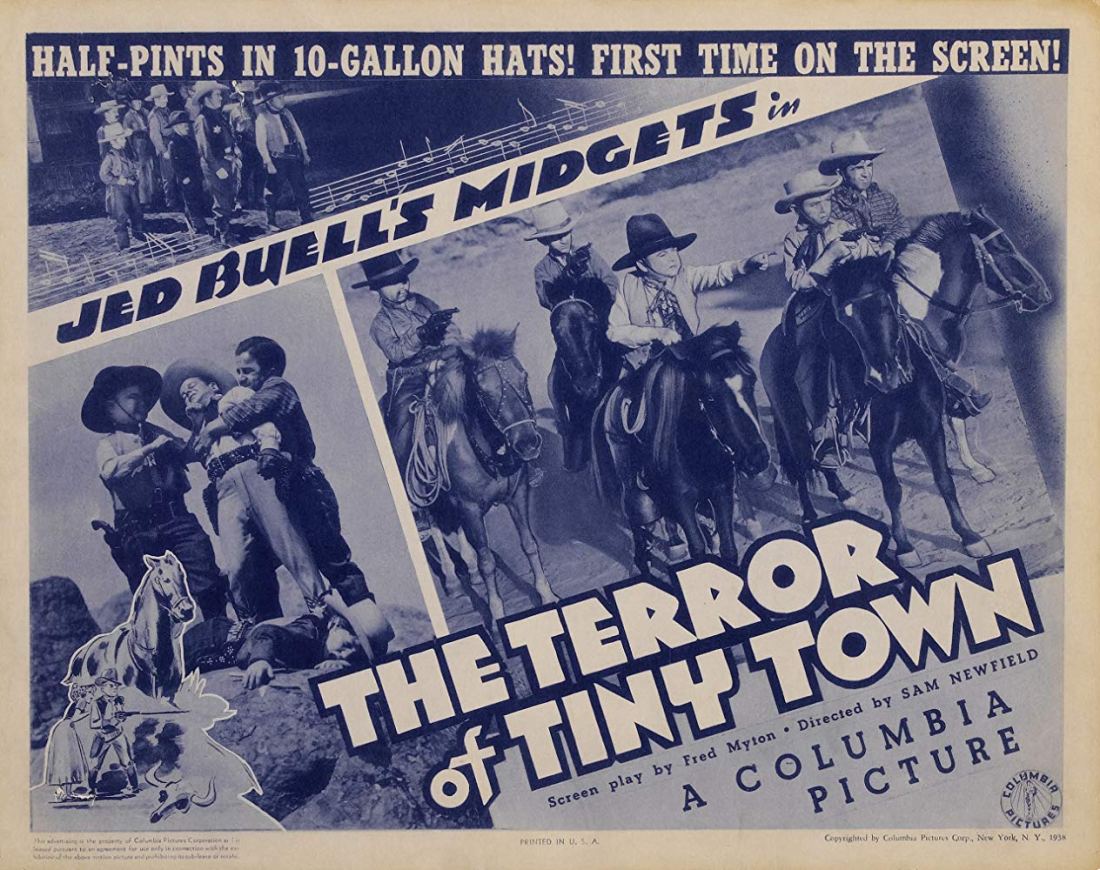
THE TERROR OF TINY TOWN owns the distinction of being the world’s only known Western musical starring midgets, hence the cheap wisecrack about it being the shortest Western ever made. We can be sure there’s many Westerns shorter than 62 minutes.

Exploitation film producer Jed Buell put out a casting call and he more or less put together the cast of the Munchkins before THE WIZARD OF OZ. We see just one non-vertically challenged cast member and that’s in the opening sequence.

Our announcer begins, “Ladies and gentlemen and children of all ages, we’re going to present for your approval a novelty picture with an all-midget cast, the first of its kind to ever be produced. I’m told that it has everything, that is everything that a Western should have.”

During this introduction, our hero Buck Lawson (Billy Curtis) and our villain Bat Haines (‘Little Billy’ Rhodes) just about shoot it out over who’s the star of the picture.

Buck Lawson, “I’m the hero. After this picture’s out, I’ll be the biggest cowboy star in Hollywood.”

Bat Haines, “I’m the villain. I’m the toughest hombre that ever lived, and I ain’t afraid o’ the biggest one o’ you. I’m the Terror of Tiny Town, and that’s the star part.”

Finally, the announcer, who could have been qualified to broker world peace or at least peace in the Middle East, gets Buck Lawson and Bat Haines to agree to let the motion picture play and prove who’s the star.

Judging by their subsequent careers, Curtis (1909-88) easily won.

You may remember him from his role as Mordecai in Clint Eastwood’s HIGH PLAINS DRIFTER.

Frankly, I was floored after looking up Curtis’ screen credits.

He appeared (mostly uncredited) in THE WIZARD OF OZ, MEET JOHN DOE, HELLZAPOPPIN’, SABOTEUR, BUCK PRIVATES COME HOME, LIMELIGHT, THE COURT JESTER, THE INCREDIBLE SHRINKING MAN, and PLANET OF THE APES, plus a multitude of TV shows. Apparently, Curtis hit on Judy Garland during the making of THE WIZARD OF OZ.

Curtis made his debut in THE TERROR OF TINY TOWN.

THE WIZARD OF OZ marked his third role and his first not in a Western. Curtis appeared in THREE TEXAS STEERS — a John Wayne picture — between TINY TOWN and OZ.

You can see why Curtis enjoyed the most successful career in TINY TOWN, because he gives the least stilted line readings.

If you watch THE TERROR OF TINY TOWN, please do not hunt me down if you hated all 62 minutes and then want to give me a piece of your mind because TINY TOWN sucked.

I’ll tell you a little secret right now: THE TERROR OF TINY TOWN, it’s not exactly a good movie and you can just ignore the three-and-a-half stars rating because these are not normal circumstances. I love it and enjoy it a great deal because it’s bad on an epic scale … it belongs in a special place in cinematic history alongside such infamous features as REEFER MADNESS and PLAN 9 FROM OUTER SPACE. I find all of them good for their own distinct reasons.

The announcer proved to be correct, in that THE TERROR OF TINY TOWN does have everything that a Western should have, at least plot wise. They filmed this basic plot a million times before TINY TOWN, I have no doubt. I mean, our villain pits two families against each other and the townspeople must organize to defeat “The Terror of Tiny Town,” and it all leads to an explosive final act. This basic plot was ancient many years before 1938.

Bottom line: THE TERROR OF TINY TOWN is a novelty picture, for sure, and I enjoy the novelty. If we’re being honest, every film exploits some form of novelty.

I find immense enjoyment from the sight gag of characters entering a saloon under the swinging doors, for example, and the ridiculous final showdown between hero and villain.

Unlike ZORRO THE GAY BLADE, TINY TOWN plays its Western musical story straight and does not beat us over the head with either its gags or its premise, at least after the credits and the announcer scene. It’s not a nudge-nudge wink-wink comedy like ZORRO THE GAY BLADE. It’s more funny than it might be otherwise because it’s played straight. The actors made no effort to be campy, but their stilted line readings help THE TERROR OF TINY TOWN achieve bad movie infamy.

Trivia: Jerry Maren (1920-2018) played one of the townspeople in THE TERROR OF TINY TOWN and he was the last surviving WIZARD OF OZ cast member and the last surviving Marx Brothers film cast member.