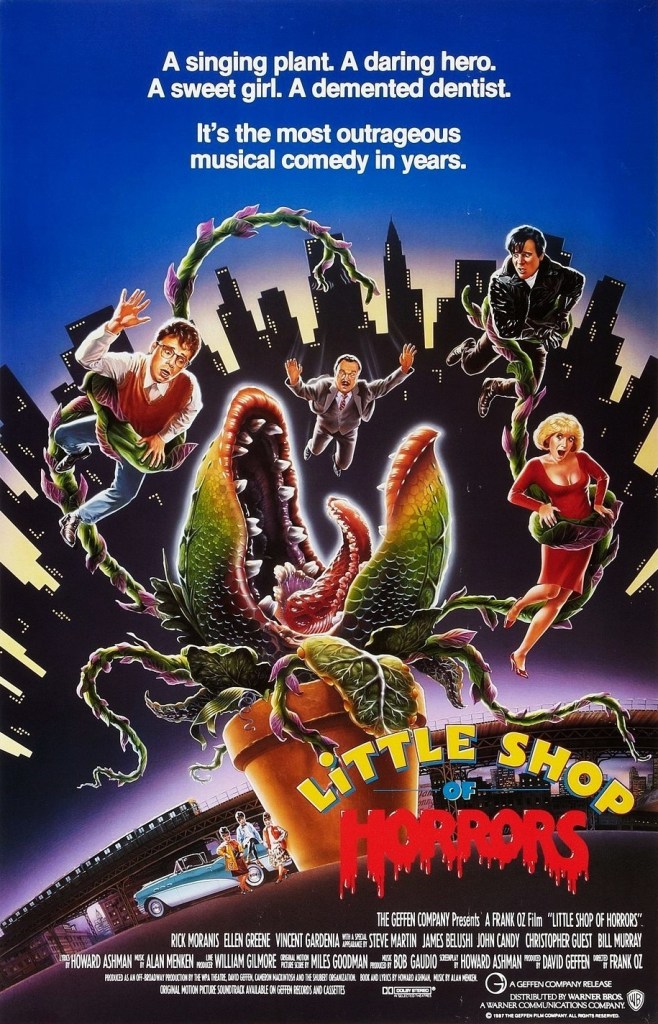
Little Shop of Horrors (1986)

LITTLE SHOP OF HORRORS (1986) ****
Little Shop of Horrors, based on the off-Broadway stage musical itself based on the 1960 Roger Corman cult film, is one of those movies that I like a little bit more every time I watch it.

I’ll just come right out and say it early on in this review: I’ll take Little Shop of Horrors over The Rocky Horror Picture Show every day of the week because the performances and characters, the science fiction and horror plot, the script, the direction, the musical production numbers, and the special effects are all far superior. Granted, to be fair, Little Shop of Horrors had more than 25 times the production budget of Rocky Horror.

I watched both films around the same time, in the late ’80s or early ’90s both on late-night local TV Saturday night movie programming. I also remember first coming across Wolfen and The Breakfast Club in this format. Anyway, I’ve always liked Little Shop of Horrors and never particularly cared for Rocky Horror, which I’ve come to like even less with every viewing so it’s Little Shop of Horrors inverted.

Rick Moranis stars as the meek, nerdy florist Seymour Krelborn. He means well but he’s extremely clumsy and pines after his beautiful coworker Audrey (Ellen Greene) who dates the abusive, sadistic, nitrous oxide fiend ’50s style greaser biker dentist Orin Scrivello (Steve Martin). Seymour’s perpetually chewed out by his boss Mr. Mushnik (Vincent Gardenia), the owner of Mushnik’s Flower Shop. Everything changes for Seymour, Audrey, and Mr. Mushnik when Seymour discovers Audrey II (voiced by Levi Stubbs, lead singer of the Four Tops), one mean green mother from outer space with an insatiable appetite and designs on taking over Planet Earth. Feeding Audrey II proves to be a nightmare for Seymour.

Moranis gives his definitive film performance, Greene returns to play Audrey from the stage production, Moranis and Greene make for a great movie couple and they’re very deserving of a happy ending, and Martin and Stubbs are both absolutely incredible in their villainous roles.

In fact, Martin and Stubbs both should have been nominated for Best Supporting Actor, but it’s understandable why they were not in a year with supporting actor winner Michael Caine for Hannah and Her Sisters and nominees Tom Berenger and Willem Dafoe for Platoon, Denholm Elliott for A Room with a View, and Dennis Hopper for Hoosiers.

Comedies, science fiction, and horror films very rarely earn nods from the Academy, a problem for Little Shop of Horrors when it encompasses all three genres.

It also became complicated when considering Stubbs (1936-2008) for a nomination, since he’s the voice of an animatronic puppet with 21 different principal puppeteers including Brian Henson. Stubbs’ authoritative, booming voice benefits the movie infinitely in both the dialogue scenes between Audrey II and poor Seymour and four musical numbers.

Audrey II’s Mean Green Mother from Outer Space, with lyrics by Howard Ashman and music by Alan Menken, received an Academy Award nomination for Best Original Song and lost to Berlin’s Take My Breath Away from Top Gun.

I’ve been known to say to pets both canine and feline Feed me, Seymour.

Crystal (Tichina Arnold), Ronette (Michelle Weeks), and Chiffon (Tisha Campbell), names borrowed from three girl groups contemporaneous with the original Little Shop of Horrors, provide a Greek chorus with sass and style.

Jim Belushi, John Candy, Christopher Guest, and Bill Murray show up in small roles.

Little Shop of Horrors originally retained the ending of the stage musical with Audrey and Seymour killed and giant Audrey II plants on a Godzilla-like rampage, but test audiences positively absolutely hated that Audrey and Seymour were killed and the original 23-minute ending became a rewritten and reshot happy ending that pushed the release date back to December 19, 1986.

I’ve only watched Little Shop of Horrors with the happy ending, and I must say that I’m more than happy with that.
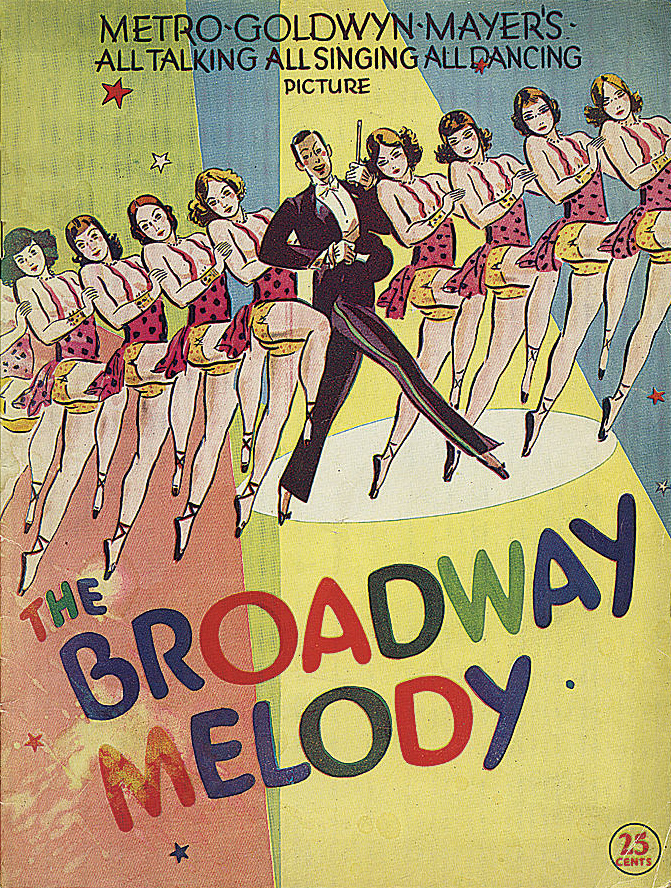
Broadway Melody, Cimarron Won Best Picture! So What, Because They Suck!

BROADWAY MELODY, CIMARRON WON BEST PICTURE! SO WHAT, BECAUSE THEY SUCK!
The Broadway Melody and Cimarron are horrible, terrible, horrible movies and the first two examples of how winning the Academy Award for Best Picture does not guarantee quality.

The Broadway Melody (1929) owns the distinction of being the first talking picture and the first musical to win Best Picture, thus it has a permanent place in cinematic history. Otherwise, though, The Broadway Melody makes me wonder how come the motion picture industry did not return to silent pictures, because the dialogue and the songs both stink up the screen every step of the way. (Apparently, MGM also released The Broadway Melody in a silent version.)

Likewise, Cimarron (1931) is the first Western to win Best Picture and it’s one of those movies, well, near the end of its 130-minute duration, I told my wife, “I feel like I’ve aged 40 years watching this movie.” In fact, I had to use hedge trimmers on my facial hair and step in the barber’s chair after Cimarron, and perhaps I should be thankful Cimarron only covered 1889 to 1929 and not a longer historical span. I might have been in deep trouble, at least six feet under, had the Howard Estabrook and Louis Sarecky screenplay and the 1929 Edna Ferber novel instead considered 50 or 60 years of Yancey and Sabra Cravat.

The first in a series of musicals for MGM, The Broadway Melody stars Charles King as Eddie Kearns and Anita Page and Bessie Love as sisters Queenie and Harriet ‘Hank’ Mahoney. See, what happens, Eddie and Hank have had a thing, but then he lays his eyes on a now grown up Queenie and boy oh boy, his eyes nearly pop out their head. Whee, Queenie lays off Eddie, sister loyalty, and lets New York high society playboy Jock Warriner (reference to studio mogul Jack Warner) play her. Eddie and Queenie realize they’re in love, Hank finally accepts it, and it all ends happily ever after with the closing line delivered by the character with a stutter. It was so good that I forgot it.

Charles King should have been renamed ‘Charles Sing’ because he sings much better than he acts and the scenes between Eddie and Hank (and Queenie) (and Jock) try and ultimately fail my test for strained melodrama. Yap! Yap! Yap! Yap! That’s right, one yap for every piece in the romantic square. Love and Page are easy on the eyes, especially Page, but difficult on the ears with all their hemming and hawing (more Page than Love) and perpetually melodramatic carrying on (more Love than Page). Either way, their dialogue scenes are destined for the mute button and subtitles.

I learned a lesson from Cimarron and it has nothing to do with Oklahoma’s state history before and after statehood on Nov. 16, 1907.

The Lesson: Do not start your movie with a land rush scene, because it’s highly unlikely that you will find something else to approach the excitement of that slambang opener.

After the intense thrills of the land rush, I must admit that I started paralleling Yancey Cravat’s restlessness and I desperately wanted to move to another movie, one that doesn’t even have to be a Best Picture winner, just as long as it can involve me from beginning to end and does not leave me contemplating how many years I have aged just watching it. That’s about the bare minimum I expect from a movie, any movie, and that isn’t asking for too much, now, is it?

The Magic of Lassie (1978)

THE MAGIC OF LASSIE

THE MAGIC OF LASSIE (1978) *

Nostalgia became a dominant cultural force in the 1970s, between AMERICAN GRAFFITI, “Happy Days,” ANIMAL HOUSE, ROCKY, STAR WARS, SUPERMAN, and THAT’S ENTERTAINMENT I and II.

Nostalgia also explains THE MAGIC OF LASSIE, in everything from everybody’s favorite cinematic collie to genial old timers James Stewart and Mickey Rooney to the songs by Richard M. and Robert B. Sherman and especially the values implied and directly stated by Lassie, Stewart, Rooney, and their songs.

The picture opens, for crying out loud, with All-American cinematic icon Jimmy Stewart singing “That Hometown Feeling.” I came up with a couple quick reactions: Thankfully, Stewart rarely ever sang during his long entertainment career; They are laying it on awful darn thick real quick in this pic. Of course, paraphrasing Bachman-Turner Overdrive, I hadn’t seen nothin’ yet. Is BTO on the soundtrack? No, but Stewart, Mickey Rooney, Debby Boone, and the Mike Curb Congregation are instead … hot diggity dog!

I just moaned and groaned about the Sherman Bros. songs in the 1972 animated SNOOPY, COME HOME, a picture about 10 or 50 or 100 times better than THE MAGIC OF LASSIE even with them darn songs.

In addition to songs that might cause somebody to wish for temporary hearing loss, THE MAGIC OF LASSIE relies heavily on a couple of my least favorite plot devices: A shady businessman leans on a property owner to sell his property (in this case a vineyard) and (mostly) comic villains ineptly chase our heroes.

In some real cutthroat business practices, Jamison takes Lassie away from kind old Grandpa Clovis Mitchell (Stewart) and his feisty grandchildren Kelly (Stephanie Zimbalist) and Chris (Michael Sharrett) and that horrible man makes it all the way to Colorado Springs with the prized bitch. Lassie runs away, headed for California. Chris runs away, headed for Colorado. Clovis takes off to look for Chris and Lassie. Clovis and Chris should be thankful, eternally grateful that Lassie’s the absolute smartest character in the entire movie, although maybe she wished she wasn’t so smart because her name would not have been in the title. Then again, wasn’t Lassie’s name always in the title of her entertainment packages?

It would take approximately 20 hours by automobile to get from Colorado Springs back to Sonoma (filming location of THE MAGIC OF LASSIE) and walking amounts to a trip lasting 414 hours. There are moments when THE MAGIC OF LASSIE feels like it lasts that long.

They really burden Lassie with some indignities during THE MAGIC OF LASSIE, all within that glorious ‘G’ rating. At least three name changes. A nasty addiction to banjo. Lassie rescues a cat from a burning building. That last one, why that’s just going way, way, way too far. I hope they paid her owners very handsomely.

Believe it or not, centerpiece song “When You’re Loved” (seen and heard in by my count two would-be feel good montages during the 100-minute cinematic endurance contest) received a nomination for Best Original Song at the 51st Academy Awards. I really can believe it, though, that “When You’re Loved” lost to Donna Summer’s “Last Dance” from THANK GOD IT’S FRIDAY.

By the end of THE MAGIC OF LASSIE (or TGIF, for that matter), though, all I was saying was “Thank God It’s Over.”

Let’s Dance! Let’s Sing! Let’s Nostalgia!: That’s Entertainment I, II, III

LET’S DANCE! LET’S SING! LET’S NOSTALGIA!: THAT’S ENTERTAINMENT I, II, III

I dutifully watched THAT’S ENTERTAINMENT, the 2-hour, 15-minute compilation of clips from MGM highlighting their hallowed “Golden Age of Musicals.” MGM, founded on April 17, 1924 by Louis B. Mayer and Marcus Loew, commemorated its 50th anniversary and then released THAT’S ENTERTAINMENT two months later commemorating it even more.

I have two immediate spoilsport thoughts, the first which originally occurred to me on June 22, 2004, watching the American Film Institute unveil the super bland “100 Years, 100 Songs.”

THAT’S ENTERTAINMENT brought it all back with a vengeance.

That night in 2004, I said aloud, “Are they going to put every single fucking song ever sung by Judy Garland on the list?” Ditto for Gene Kelly, Barbra Streisand, Julie Andrews, et cetera, who dominated the AFI list with their 20 or 25 songs seeming more like 80 or 100; Kelly and Garland, who passed away in 1969 at the age of 47, dominate THAT’S ENTERTAINMENT.

We get a double dose of heavy duty Judy in THAT’S ENTERTAINMENT, first through her Mickey (Rooney) and Judy “Hey gang, let’s put on a show” Era montage and then a tribute presented by her daughter Liza Minnelli, not long after CABARET. Garland also sings “You Made Me Love You” over a montage of Clark Gable that allows GONE WITH THE WIND (MGM’s most famous production) to be shoehorned into the song-and-dance ballyhoo.

Second spoilsport thought: Aside from THE WIZARD OF OZ and SINGIN’ IN THE RAIN, most of my favorite musicals are not from MGM. For example, Fred Astaire, who’s featured in THAT’S ENTERTAINMENT, did most of his best work at RKO — including TOP HAT and SWING TIME — in the 1930s paired with Ginger Rogers. Never mind alternative musicals like THE 5,000 FINGERS OF DR. T (Columbia and Stanley Kramer Productions) and ONE FROGGY EVENING and WHAT’S OPERA, DOC?, both famous Warner Bros. animated shorts.

What do I like about THAT’S ENTERTAINMENT?

Well, it’s always great seeing the usual suspects from THE WIZARD OF OZ and SINGIN’ IN THE RAIN no matter how many times I have seen them, especially Donald O’Connor’s showstopper “Make ‘Em Laugh.” Clark Gable singing “Puttin’ on the Ritz” from IDIOT’S DELIGHT. Jimmy Stewart’s jab at Robert “He tries his best” Montgomery. The Esther Williams montage. Somebody once said about Williams, “Dry, she ain’t much. Wet, she’s a star.” Madeline Kahn impersonating Marlene Dietrich in BLAZING SADDLES said, “It’s twue, it’s twue.”

We get more or less the same from PART 2, only we get token appearances from MGM employees Groucho Marx, Laurel and Hardy, Buster Keaton, and W.C. Fields and, of course, musical numbers that did not appear in PART I.

It would have been nice to see a musical number from the Marx Brothers or Laurel and Hardy or Fields, despite the fact they all did their best work somewhere else. I mean, would it have killed PART II director Gene Kelly to have aired Groucho’s “Lydia the Tattooed Lady” from AT THE CIRCUS … for example … instead of, I don’t know, one more variation on the song “That’s Entertainment” offered up by contemporaneous Astaire, contemporaneous Kelly together again and for the last time.

After watching PART II, I began hating Arthur Schwartz’s chestnut “That’s Entertainment” unlike ever before, although honestly I hardly ever gave it much thought until it was the (bludgeoning) recurring theme in a darn movie. They must have trotted it out 50 freaking times.

Eventually, to counterbalance the effects of cornball showbiz schmaltz, though, I started humming “That’s Entertainment” from the Jam. Let’s get all misty-eyed nostalgic over a song that starts “A police car and a screaming siren / A pneumatic drill and ripped up concrete / A baby wailing and stray dog howling / The screech of brakes and lamp light blinking.” I particularly love the second verse, “A smash of glass and the rumble of boots / An electric train and a ripped up phone booth / Paint splattered walls and the cry of a tomcat / Lights going out and a kick in the balls.”

I should just stop bitching and moaning and groaning about PART I and PART II of THAT’S ENTERTAINMENT, perhaps because life is short and also perhaps because I realize that I am not the target audience for these nostalgic entertainments. First and foremost, I was born in 1978 and my generation did not grow up on “classic” American musicals. In fact, a lot of us came to hate musicals in our teenage years, especially of the vintage celebrated endlessly by the THAT’S ENTERTAINMENT series. I have come to appreciate some of them corny old classics somewhat more in middle age, but I still prefer musical numbers from Monty Python, Mel Brooks, and “South Park” and I still grumble like nobody’s business at 21st Century schmaltz like FROZEN, MOANA, and THE GREATEST SHOWMAN, entertainment packages that give me fleas. I don’t even have to watch them to get fleas, because it seems like 90 percent of the people around me have memorized every single darn word of every single darn song and they don’t mind singing ‘em every single darn time they feel like singing in their darn glorious off-key melodramatic voice.

Recently, I conducted some independent research by watching MILLION DOLLAR MERMAID (a.k.a. THE ONE PIECE BATHING SUIT in the U.K.) from 1952 and starring Esther Williams, Victor Mature, and Walter Pidgeon. It was directed by Mervyn LeRoy, produced by Arthur Hornblow Jr., and replayed in at least one THAT’S ENTERTAINMENT. I watched it for Williams and the numbers choreographed by the legendary Busby Berkeley (who might be more fondly remembered today for being parodied in early 80s comedies CADDYSHACK and HISTORY OF THE WORLD). I enjoyed it and I realize that I probably would have enjoyed it for the same reasons at a younger age had I given it even half a chance. Now, that’s progress!

MGM returned to the vaults for a third time for THAT’S ENTERTAINMENT! III in 1994, only 18 years after PART II and 20 after the very first greatest hits-golden cinematic oldies compilation.

Anyway, who’d have ever thought that PART III tops both PART I and PART II and does it by including outtakes and unfinished numbers more than greatest hits and golden oldies.

We have Lena Horne’s “Ain’t It the Truth,” a sultry little number cut from CABIN IN THE SKY because a sexy black woman in a bathtub in 1943 would have spurred on a third American Revolution, yes, even in the middle of World War II.

We have two lip-sync takes on “Two-Faced Woman,” presented side-by-side, outtake Cyd Charisse from THE BAND WAGON and black face Joan Crawford from TORCH SONG (both dubbed by India Adams). Crawford’s scene made me think of Pauline Kael’s review of TROG, “Joan Crawford plays Stella Dallas with an ape instead of a baby girl. Some actors will do anything to be in movies: she probably would have played the ape.”

We have another Esther Williams montage and I must say that I am in favor of Esther Williams montages, especially ones that work in Tom and Jerry. Eat your hearts out, Frank and Gene, your movie (ANCHORS AWEIGH) only had Jerry dancing with Gene! In all honesty, the Esther Williams montages in PART I and PART III pushed me to seek out MILLION DOLLAR MERMAID and I have a feeling that I will be consuming Esther, Tom, and Jerry in DANGEROUS WHEN WET soon.

I also prefer PART III because it has much less of the elitist, self-congratulatory, self-important tone that marred the first two installments, as much as I enjoyed seeing all the “old” entertainers that have not been matched (let alone surpassed) since their heyday. PART III hints at the MGM that treated the cast of FREAKS like “freaks” and it at least delves beyond the surface glitz and glamour to the showbiz ugliness beneath.

That’s entertainment.

THAT’S ENTERTAINMENT PART I ***; PART II ***; PART III ****

Goin’ Coconuts (1978)

GOIN’ COCONUTS (1978) 1/2*

In the distant future, one of the great mysteries of human behavior will be why there were so many teen idols after, oh, let’s say, 1955. Imagine trying to explain Tiger Beat, Joey Lawrence, Jonathan Taylor Thomas, NSYNC and the Backstreet Boys, and Justin Bieber to future generations.

I can only hope that future rational beings will reach the conclusion that many people (mostly girls, but also boys with such beacons of humanity as Britney Spears, Paris Hilton, Kim Kardashian, et cetera ) in the late 20th and early 21st centuries obsessed about the shallow and the superficial and the stupid and such attributes as perfect hair, perfect teeth, and dimples. “He / She has got such a perfect body. He’s so cute. She’s so hot.” All that jive can just go fuck off.

I thought about this “teen idol” angle during and after GOIN’ COCONUTS, the motion picture debut and finale of former teen idols Donny and Marie Osmond. Since I watched it after SLITHIS, I just might have survived the worst two movies I have ever seen back-to-back; I am blanking on whether or not I ever watched BATTLEFIELD EARTH after LEONARD PART 6 or vice versa.

Anyway, I hated just about every second of GOIN’ COCONUTS. Hated every musical number. Hated every bit of perfunctory dialogue. Hated every single attempt at humor. Hated the jewelry caper story and every single plot development that we have seen before from a million different movies and TV shows. Hated seeing legendary movie villains being reduced to buffoons for comedic purposes that miserably failed. Hated it the longer it went on. I rejoiced at the first sight of the end credits and turned off the movie. I didn’t even care all that much about the Hawaiian scenery, just because we had to watch this stupid movie take place within it.

I felt especially bad for actors like Kenneth Mars, Ted Cassidy, Khigh Dhiegh, and Harold Sakata. But, hey, not that bad, since they got paid and had the opportunity to make a movie in Hawaii. That sounds great right about now. I could go for that, even a movie as shitty as GOIN’ COCONUTS.

The reason I felt bad for them was they had to play cosmically inept. Like, for example, Sakata’s Ito could not take out Donny Osmond, for crying out loud. The filmmakers made the dread mistake of costuming Sakata (1920-82) in the same hat that he wore in GOLDFINGER as super henchman Oddjob. Sure we all remember what Oddjob did with his hat in GOLDFINGER; let’s just say that he wears the hat throughout GOIN’ COCONUTS and that’s that. It’s so insulting to see a World War II veteran and an Olympic silver medalist in weightlifting (Sakata represented the United States in the 1948 Summer Olympics in London) reduced to playing the fool, thwarted at every churn of the plot by a couple teen idols and their perfect teeth.

Dhiegh (1910-91) played a key role in THE MANCHURIAN CANDIDATE as brainwashing expert Dr. Yen. Yes, THE MANCHURIAN CANDIDATE, one of the most intelligent movies ever made. Then, 16 years later, Dhiegh appeared in GOIN’ COCONUTS, which should have borrowed from THE WIZARD OF OZ its musical theme … “If I Only Had a Brain.” Again, it simply defies all credibility that Dhiegh’s character would be outsmarted by a pair of coconuts.

In GOIN’ COCONUTS, Mars (1935-2011) more or less gives us a variation on his characters from the Mel Brooks comedies THE PRODUCERS and YOUNG FRANKENSTEIN, only without the laughs.

Cassidy (1932-79) played Lurch on “The Addams Family” and would it have been too much to ask director Howard Morris (who played Ernest T. Bass on “The Andy Griffith Show”) and screenwriters William Marc Daniels and Raymond Harvey to include a gag where Cassidy’s Mickey answers the phone with “You rang.” Yes, of course, it would have been too much to ask. That’s silly to ask if you’ve survived GOIN’ COCONUTS.

It was a pathetic sight every time watching these villains shoot their guns at Donny and Marie. They should have been sent back to marksmanship class or had their diabolical henchmen licenses revoked.

Aside from the end credits, there was something else great about GOIN’ COCONUTS. Since it failed at the box office, Donny and Marie made only this one movie rather than a series of Donny and Marie spectaculars. They returned to their variety show where they belonged with their aw shucks gee whiz nature and perfect teeth intact.

Roller Boogie (1979)

ROLLER BOOGIE

ROLLER BOOGIE (1979) *1/2

Hot on the heels of reviewing THANK GOD IT’S FRIDAY, here’s another one where it’s a soundtrack in search of a movie.

Or, in other words, a gimmick in search of a movie. ROLLER BOOGIE belongs to a specific time and place of quickie exploitation flick: post-SATURDAY NIGHT FEVER boogie down and roller skating, hence that genius title.

ROLLER BOOGIE should have been a better film. I mean, director Mark L. Lester went on to make CLASS OF 1984 and COMMANDO, two films that go above-and-beyond in going over-the-top and that’s both films’ best virtue by far.

Not in ROLLER BOOGIE, though, which earns a ‘PG’ from the MPAA. It should have been ‘R.’

I’ll give one example.

Early on in the picture, we’re talking first few minutes here, our female lead Terry Barkley (Linda Blair) gets dressed and we sense there’s a missing nude scene, like they filmed one but left it on the cutting room floor. This early scene establishes the awkwardness that we sense around Blair’s character all movie.

We find Blair, who was in her late teens when she made ROLLER BOOGIE, in her transition period, between her breakout in THE EXORCIST (1973) and later exploitation films like CHAINED HEAT and SAVAGE STREETS. Maybe it’s because I watched ROLLER BOOGIE after her later films that I felt like the 1979 film teases us with possibilities that it ultimately did not want to pursue, undoubtedly for commercial reasons. The one song that should have been written for Blair: “I’m Not a Girl, Not Yet a Woman,” which was instead written for Britney Spears at the turn of the 21st Century. Rick James wrote “Cold Blooded” (title song for his 1983 album) about his relationship with Blair. “Cold Blooded” hit No. 40 on the Billboard Hot 100.

Upon further reflection, ROLLER BOOGIE does go above-and-beyond in recycling grand old cliches and stereotypes, pilfering from both the Mickey Rooney-Judy Garland “Let’s put on a show” movies of the late 1930s and early ‘40s and the Frankie Avalon-Annette Funicello BEACH PARTY movies of the early ‘60s in addition to SATURDAY NIGHT FEVER and the disco and roller skating fads more contemporaneous with ROLLER BOOGIE.

Like THANK GOD IT’S FRIDAY, ROLLER BOOGIE rattles off characters and scenes we have seen many times before.

Terry develops a romance with roller boogie master Bobby James (Jim Bray), who, get this, comes from another socioeconomic class than rich girl and musical genius Terry. Bray makes both his film debut and finale, basically playing a fictional version of himself … not all that well. He does skate convincingly, of course, and he does possess a great smile, but in any scene that requires any emotion whatsoever Bray absolutely falls flat on his face. Bray apparently had already earned 275 trophies for his skating before he made ROLLER BOOGIE. For his acting, though, Bray received “Dishonourable Mention” from the Stinkers Bad Movie Awards; Robby Benson won “Worst Actor” for WALK PROUD. Blair lost “Worst Actress” to Barbra Streisand in THE MAIN EVENT.

Then we have Franklin (Christopher S. Nelson), who’s this hopeless rich snob always lusting after Terry’s bod. We’ve seen this character archetype before, like Collins Hedgeworth (Paul Linke) in GRAND THEFT AUTO and Spaulding Smails (John F. Barmon Jr.) in CADDYSHACK. You remember Spaulding? He’s the snotty but spectacularly slobby grandson of Judge Smails (Ted Knight). In a classic scene, Spaulding wants a hamburger, no, a cheeseburger, a hot dog, and a milkshake … before Judge Smails sets the impetuous lad straight, “You’ll get nothing, and like it.” Well, there’s nothing that funny or worthwhile in ROLLER BOOGIE. Franklin’s scenes drag ROLLER BOOGIE down.

Cartoon gangsters lean on Jammer Delaney (Sean McClory), the owner of roller boogie rink Jammers. Nobody would ever believe this plot thread, but this here old Jammer, why he’s the last property owner holding out. Jammer’s sitting on a relative gold mine and he’s standing in the way of progress. We have seen this old cinematic war horse trotted out for everything ranging from BLACK BELT JONES (where property owner Scatman Crothers died from the weakest punch in cinematic history) to WHO’S THE MAN? Cartoon gangsters rarely ever bode well for a motion picture spread and they do not for ROLLER BOOGIE. I do not want to write another word on the plot.

Kimberly Beck’s next screen credit would be as final girl Trish Jarvis in 1984’s FRIDAY THE 13TH: THE FINAL CHAPTER. She famously said of the FRIDAY THE 13TH series: “I had never seen any of the FRIDAY films. And I didn’t want to see any of them. I still have never seen any of them. I just don’t like that kind of genre at all. And this was not even a B-movie, it was really just a C-movie.” Unfortunately, we do not have a quote from Beck detailing her experience playing Terry’s best friend Lana, who does really fill out her outfits rather nicely in ROLLER BOOGIE. She provides one of the fleeting pleasures of the movie. Sometimes, you take it wherever you can find it and ask questions never.

Thank God It’s Friday (1978)

THANK GOD IT'S FRIDAY

THANK GOD IT’S FRIDAY (1978) *1/2

Alternate title: PRAISE JESUS FOR STEREOTYPES.

Let’s enumerate them.

— The underage girls Frannie (Valerie Landsburg) and Jeannie (Terri Nunn) who sneak in.

— The awesome dancer Marv Gomez (Chick Vennera).

— The aspiring singer Nicole Sims who’s played by a superstar singer (Donna Summer).

— The fast-talking DJ Bobby Speed (Ray Vitte) who seemingly holds the fate of the world in his little hands, one record at a time.

— The straight married couple, Dave (Mark Lonow) and Sue (Andrea Howard), who are wanting to broaden their horizons. I believe they have the last name “Dullard.” Dave and Sue Dullard. Perfect.

— The swinging ladies man owner Tony (Jeff Goldblum) who makes a bet that he can conquer a married woman tonight. Sue Dullard, maybe?

— Two hopelessly polar opposite dates, Gus (Chuck Sacci) and Shirley (Hilary Beane), who have been set up by a computer dating service.

— Oh, there are more and more and more stereotypes in the cast, including Jennifer played by future star Debra Winger, but I’ll cut myself a little bit slack and cut this list very, very, very short.

— I should mention that it’s Friday night, of course, at the Zoo and the Commodores are slotted to play if Floyd (DeWayne Jessie) shows up with the instruments. I have a feeling that Floyd will let us down, but honestly, I believe that he flew the coop to go work on his scene in NATIONAL LAMPOON’S ANIMAL HOUSE (released two months after I LIKE SATURDAY MORE). You might remember Floyd as lead singer Otis Day of Otis Day and the Knights and their smash rendition of “Shout.” Floyd must fail at least long enough for Nicole to get her chance, though, because why else would Donna Summer be in the cast.

— Of course, the real stars of DEAR LORD IT’S DISCO are the songs: “After Dark” by Pattie Brooks, “Find My Way” and “It’s Serious” by Cameo, “Let’s Make a Deal” by G.C. Cameron & Syreeta, “Brickhouse” “Easy” and “Too Hot ta Trot” by the Commodores, “Romeo & Juliet” by Alec Constandinos, “You’re the Reason I Feel Like Dancing” by the 5th Dimension, “From Here to Eternity” by Giorgio Moroder, “Dance All Night” by Cuba Gooding, “Love Masterpiece” and “I’m Here Again” by Thelma Houston, “Disco Queen” and “Trapped in a Stairway” by Paul Jabara, “Do You Want the Real Thing” by D.C. LaRue, “Thank God It’s Friday” and “You Are the Most Precious Thing in My Life” by Love & Kisses, “I Wanna Dance” by Marathon, “Meco’s Theme” by Meco, “Floyd’s Theme” by Natural Juices, “Down to Lovetown” by the Originals, “Lovin, Livin’, and Givin’” by Diana Ross, “Sevilla Nights” by Santa Esmeralda, “Love to Love You Baby,” “With Your Love,” “Je T’aime (Moi Non Plus)” and “Last Dance” by Summer, “Take It to the Zoo” by Sunshine, “In Hollywood” and “I Am What I Am” by the Village People, and “Leatherman’s Theme” by Wright Brothers Flying Machine. This list should have been used to filibuster more than 40 years ago, but disco would seem to be outside the life experience of anybody in Congress then, now or tomorrow.

Nearly all those songs are from Casablanca Records, whose film division produced BLESS THE HIT SOUNDTRACK, and let’s just say the songs are far more memorable than any character. This is the case of a soundtrack in search of a movie.

Summer’s “Last Dance,” in fact, won Best Original Song at the 1979 Academy Awards, beating out “Hopelessly Devoted to You” from GREASE, “The Last Time I Felt Like This” from SAME TIME, NEXT YEAR, “Ready to Take a Chance Again” from FOUL PLAY, and “When You’re Loved” from THE MAGIC OF LASSIE. Not exactly the most inspired songs.

— It’s kinda sorta interesting to see Goldblum, Winger, and Nunn (future Berlin lead singer who earned an Academy Award for Best Original Song for “Take My Breath Away”) in the early stages of their careers, but really not all that interesting. A great title and a good soundtrack do not always make for a good movie. Exhibit A: THANK GOD IT’S FRIDAY.

Phantom of the Paradise (1974)

PHANTOM OF THE PARADISE

PHANTOM OF THE PARADISE (1974) **

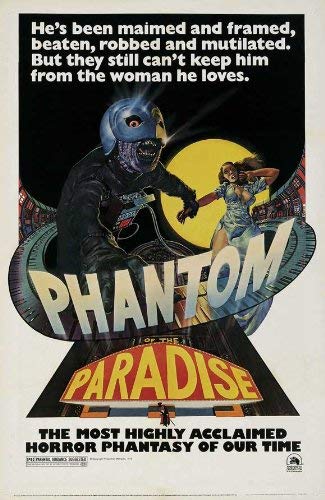
Brian De Palma’s PHANTOM OF THE PARADISE, a great big flop during its original release, is another cult film where I have to say, “I am glad you love this movie, but I don’t.” Big deal, it happens both ways on a regular basis.

It’s also one of those movies where I liked it less and less the more it was on, until I simply just wanted it to be over.

PHANTOM OF THE PARADISE gets called a “rock opera” and compared with THE ROCKY HORROR PICTURE SHOW, which came out about one year later.

Now, we’re getting to the heart of the problem. Both PHANTOM OF THE PARADISE and ROCKY HORROR are limp-wristed rock if they are in fact rock at all. Paul Williams, the songwriter and star of PHANTOM, he’s best known for writing Three Dog Night’s “An Old Fashioned Love Song,” the Carpenters’ “Rainy Days and Mondays,” Barbra Streisand’s “Evergreen” from A STAR IS BORN, and Kermit the Frog’s “Rainbow Connection” from THE MUPPET MOVIE. Not exactly the most rocking credentials.

Singer-songwriter and show tunes, with a little Sha Na Na and Meatloaf thrown in for extra measure, are not my idea of rock and that’s what PHANTOM and ROCKY HORROR offer listeners and viewers.

I already wrote a review comparing ROCKY HORROR against ROCK ‘N’ ROLL HIGH SCHOOL, a 1979 film that centers around the music of the Ramones.

This whole rock opera angle initiated my brilliantly engineered mind to recall Ken Russell’s TOMMY from 1975, another musical contemporaneous with both PHANTOM and ROCKY HORROR that’s far more deserving of being called a “rock opera.” That’s definitely true, because at one time The Who — the band responsible for the music for both the 1969 album and 1975 movie — owned the rights on “loudest rock band in the world.” They lived rock, long before they wrote a song like “Long Live Rock,” “Be it dead or alive.”

Russell, who’s every bit as good as De Palma at capturing wretched excess on celluloid, gives us non-singers Oliver Reed and Jack Nicholson, natural born entertainers Ann-Margret and Tina Turner, a Marilyn Monroe-themed cult led by “The Preacher” (Eric Clapton), and Elton John’s centerpiece “Pinball Wizard” number, taking advantage of a $5 million budget. Hell to the yes, I love me some pinball and Sir Elton’s melodramatic demise. Never mind what Ann-Margret does with champagne, beans, chocolates, and bubbles. What’s that Beach Boys line about excitation?

PHANTOM OF THE PARADISE (reportedly made for $1.3 million) takes on classic novels “Phantom of the Opera,” “The Picture of Dorian Gray,” and “Faust.” It also predates the Black Sabbath compilation album “We Sold Our Soul for Rock ‘N’ Roll.”

I prefer the 1925 silent PHANTOM OF THE OPERA because of Lon Chaney’s brilliant performance (his 1974 counterpart William Finley gives the best performance in the movie), the fact that melodrama works better in silent rather than sound films, and the fact that we do not hear the opera music. Yeah, that’s right, I do not particularly care for opera, rock or not. PHANTOM OF THE PARADISE does not rock enough.

I would have greatly preferred Robert Johnson’s music over Paul Williams’ tunes. Here I am and I can’t remember any of Williams’ songs from the film. Not a good sign.

I would not be surprised, though, to find out that Dario Argento cast Jessica Harper in SUSPIRIA (1977) because of her performance in PHANTOM OF THE PARADISE.

I’ll take SUSPIRIA.

TOMMY (1975) ***

TOMMY

Sextette (1978)

SEXTETTE

SEXTETTE (1978) ***

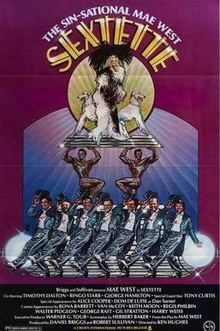
Mae West made her final theatrical film, SEXTETTE, in her mid-80s.

Please, just take a second and consider that statement.

How many people of any age, let alone somebody outside their golden years, have the chance to be the center of a Hollywood movie?

West, who made her first film NIGHT AFTER NIGHT in 1932 and then became a cinematic legend after SHE DONE HIM WRONG, I’M NO ANGEL, and BELLE OF THE NINETIES, had that chance more times than most people.

Your response to SEXTETTE will probably center upon how you feel about seeing West (1893-1980) performing the same act that made her fame and fortune … only 45 years older. Can you buy a woman her age being a sex symbol pursued by virtually every man in the movie? That’s the proverbial $64,000 question.

Granted, we’re not talking about just any woman, even an octogenarian. We’re talking about Mae West, a force of nature blessed with a splendid bosom and a splendid wit. But not in her advanced age, at least the splendid bosom part? Anyway, I think it’s more important whether or not you can believe the characters in the movie finding her sexy.

I believe West here as Marlo Manners, a world famous sex symbol and movie star who also does some important work for her country, repeats a line from Lady Lou in SHE DONE HIM WRONG, “Why don’t you come up some time and see me?”

Must be a slow news day in the world of SEXTETTE, because Marlo’s marriage to Sir Michael Barrington (Timothy Dalton), her sixth husband, seems to be all that’s covered. Regis Philbin’s coverage starts off the movie and then we have Gil Stratton and Dana, er, Rona Barrett. They all play themselves.

SEXTETTE is a tribute, albeit one that’s ridiculous, to Mae West.

There’s quite simply not any other film like it, then again there’s never been anybody quite like Mae West.

For example, West and Dalton sink their vocal chords into the Neil Sedaka and Howard Greenfield song made world famous by Captain & Tennille in 1975, “Love Will Keep Us Together.”

That comes after the infamous “Hooray for Hollywood” number and before the Jimmy Carter impersonator. You’ll never believe it until you see it yourself, but this Jimmy Carter rip-off eats peanuts. Crazy.

Ringo Starr and Keith Moon each make appearances, Starr a director and Moon a designer, and I wonder why they did not cast John Bonham and Charlie Watts. SEXTETTE came out a few months before Moon’s death in early September ‘78.

Alice Cooper sings a piano ballad in SEXTETTE in the same year that he played Uncle Sam, er, Father Sun in SGT. PEPPER’S LONELY HEARTS CLUB, a musical that gets my vote for one of the worst films of 1978 and one of the worst movies ever made. Cooper’s Father Son sings “Because” in SGT. PEPPER. Both Cooper songs from 1978 movies are worse than his “He’s Back (The Man Behind the Mask)” for 1986’s FRIDAY THE 13TH PART VI: JASON LIVES, believe it or not.

SGT. PEPPER brings us back to Mae West, who initially refused the four mop tops permission for her image to appear on the famous album cover, because, get this, she would never be part of any lonely hearts club.

Back to SEXTETTE.

Dom DeLuise (1933-2009) earns the most laughs in the picture, I mean he works hard for the money in SEXTETTE as he delays Marlo and Sir Michael consummating their marriage. Tony Curtis (1925-2010) tries on a Russian accent as one of Marlo’s five ex-husbands and I just want to point out that other Curtis films released in 1978 are THE MANITOU and THE BAD NEWS BEARS GO TO JAPAN. Could it be possible that SEXTETTE is the least ridiculous among those three movies?

George Raft (1901-80) recommended West for NIGHT AFTER NIGHT and plays himself in SEXTETTE, his penultimate film. Furthermore, West and Raft a couple two days apart in 1980 — West November 22 and Raft November 24.

I would be reticent, socially irresponsible even, not to mention that George Hamilton plays another ex-husband. Here’s a man who’s played Hank Williams, Evel Knievel, Dracula, and (later) Zorro, so I don’t think playing alongside Mae West intimidated him in the slightest. I bet he’s got some terrific stories.

NOTE: Crown International Pictures released SEXTETTE and Crown’s renowned for such films as THE BEAST OF YUCCA FLATS, THEY SAVED HITLER’S BRAIN, and ORGY OF THE DEAD, not to mention teenage sex comedies THE BEACH GIRLS, MY TUTOR, WEEKEND PASS, and TOMBOY.

Attack of the Killer Tomatoes (1978)

ATTACK OF THE KILLER TOMATOES

ATTACK OF THE KILLER TOMATOES (1978) Three stars

“In 1963, Alfred Hitchcock made a motion picture entitled THE BIRDS, a film which depicted a savage attack upon human beings by flocks of the winged creatures.

“People laughed.

“In the fall of 1975, 7 million black birds invaded the town of Hopkinsville, Kentucky, resisting the best efforts of mankind to dislodge them.

“No one is laughing now.”

— Introduction to ATTACK OF THE KILLER TOMATOES


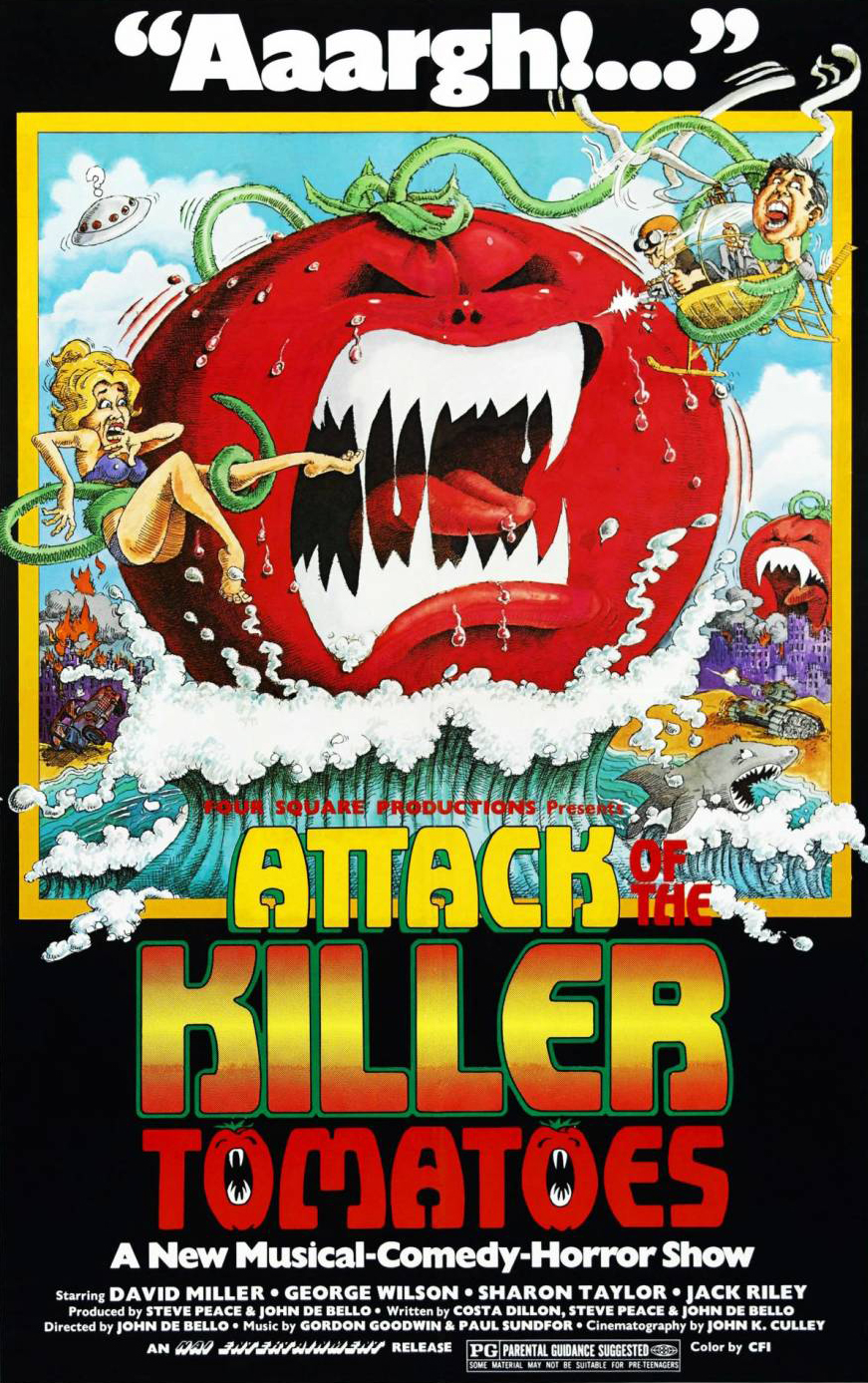
Watching ATTACK OF THE KILLER TOMATOES in full for the first time in possibly 30 years, it brought to mind KING KUNG FU.

Both are extremely low-budget labor-of-love parodies and tributes to both older and contemporaneous movies. Both have their dead spots and their high points. Both try many, many, many jokes. Both are filed under cult movies and “so bad they’re good.” Both love their filming locations, Wichita in KING KUNG FU and San Diego in KILLER TOMATOES. Both show people having a darn good time making a silly little movie. Both are so endearingly goofy that I end up forgiving all their various sins and transgressions and enjoying them.

Unlike KING KUNG FU, though, KILLER TOMATOES inspired three sequels — RETURN OF THE KILLER TOMATOES! (1988), KILLER TOMATOES STRIKE BACK! (1990), and KILLER TOMATOES EAT FRANCE! (1991) — plus an animated series and two video games.

Let me highlight what I liked (or loved) about KILLER TOMATOES.

— The songs are great. We have “Theme from Attack of the Killer Tomatoes,” “Puberty Love,” “The Mindmaker Song,” “Tomato Stomp,” and “Love Theme from Attack of the Killer Tomatoes.” I am sure that millions and millions proclaim GREASE the best musical from the film year 1978. No way! I say it’s KILLER TOMATOES all the way. I mean, both the opening and closing musical numbers are fantastic. “Theme” should have been a hit a la “The Blob” by The Five Blobs in 1958. “Love Theme” gives us better opera than YES, GIORGIO, Pavarotti’s feature film debut and farewell. I should have selected it to play at my wedding. “Puberty Love” kills the tomatoes. It’s that bad. Even badder. Just the sheet music for “Puberty Love” alone kills tomatoes smack dead in their tracks. Future Soundgarden and Pearl Jam drummer Matt Cameron sang “Puberty Love” around the tender age of 15. Maybe one day Pearl Jam will cover “Puberty Love.” It couldn’t be any worse than “Last Kiss.” By the way, you can’t throw tomatoes at the performers during “Puberty Love,” because all the tomatoes will be dead.

— KING KUNG FU combined King Kong and kung fu, according to a report from man on the spot Captain Obvious. KILLER TOMATOES affectionately kids monster movies, for example. Notice how the Japanese military always struggles against Godzilla. Well, in KILLER TOMATOES, the American military cannot lick our title characters. Rather, it takes playing a horrible little song named “Puberty Love” throughout San Diego Stadium. Tim Burton must have been taking notes before he made MARS ATTACKS!

— Fans of imported monster movies should have a great time with the character Dr. Nokitofa (credited to Paul Oya). KILLER TOMATOES purposely gave Dr. Nokitofa a bad dub, you know, one of those wildly inappropriate voices that just does not fit the character. I love it and I wish they gave his character more scenes with more lines. I busted a gut at his scene. When Dr. Nokitofa corrects somebody for calling tomatoes “vegetables,” he says “Technically sir, tomatoes are fags” … then his colleague Dr. Morrison says, “He means fruits.” Yes, there’s some bad taste humor in KILLER TOMATOES. Some of it works and some of it does not. Nature of the humor, so they say.

— There’s something absolutely brilliant about a character being chased by a “killer” tomato, relentlessly down the street, up the stairs, and through the hallway.

— I must admit to feeling grateful none of my newspaper bosses ever said that I have a great ass, like the editor (Ron Shapiro) tells Lois Fairchild (Sharon Taylor) in their first scene together.

— With a reporter named Lois, of course that affords KILLER TOMATOES an opportunity to kid SUPERMAN. KILLER TOMATOES came out a good two months before SUPERMAN, one of the most wildly anticipated releases in 1978.

— KILLER TOMATOES kids JAWS much more affectionately and successfully than GIANT SPIDER INVASION, A*P*E, THE HILLS HAVE EYES, and ORCA: THE KILLER WHALE, all of which took pot shots at Steven Spielberg’s game-changing summer blockbuster.

— I cannot have much of any ill will toward a film that works in a cameo for the San Diego Chicken (Ted Giannoulas) and thanks “Every Screwball in San Diego County,” that’s including Mr. Chicken, for the great crowd scene near the end of the picture.

— In conclusion, I thank director and co-writer John DeBello and fellow writers Costa Dillon and J. Stephen Peace (all three each took on even more roles) for their efforts in making a fun little movie.