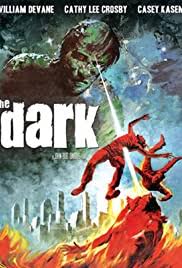
Be afraid, very afraid, not of the dark but of The Dark, a laughable thriller that only increases in being laughable until one of the most ridiculous conclusions in cinematic history.
See, I’m not afraid of sleeping in the dark, not afraid of being in a cemetery late at night, not afraid of being home alone in an old house, not afraid of admitting or being wrong, et cetera. In all honesty, though, I hated working alone late nights at the Neosho Daily News office and avoided it as much as possible, except Friday nights during football season. Once corporate killed the Sunday edition and made Tuesday our next paper, though, I started going home after the game, uploaded photos online, and wrote the gamer the next day.
Anyway, The Dark tells the story of a killer who strikes every night in the Los Angeles area and earns the cheap nickname ‘The Mangler.’ What’s a killer without a cheap nickname? This one is a nightmare for the police, because of his unusual strength, his seeming lack of any discernible pattern in his killing, his ability to leave no forensic evidence behind, and, predating Austin Powers, he shoots frickin’ laser beams from his frickin’ eyes. We eventually find out that he even grows stronger with every killing.
The killer and his laser beams look awesome on the poster for The Dark and I grade that promo artwork three-and-a-half stars. In the actual movie, though, the killer and his laser beams absolutely positively suck. These special effects alone impeded the advancement of all technology. When our killer unleashes his laser beams on several anonymous policemen in the grand finale, he clearly misses the mark but the policemen nonetheless take a mighty fall. In all seriousness, just thinking about these scenes now, I haven’t laughed this loudly since Richard Burton’s telekinesis in The Medusa Touch.
Just think all one had to do was light the killer on fire and BOOM! KABOOM! KABLOOEY! Just thinking about the killer’s demise now, I haven’t laughed so heavily since the paragraph before.
The Dark wastes a relatively distinguished cast — William Devane, Cathy Lee Crosby, Richard Jaeckel, and Keenan Wynn — and I find it ironic that fired director Tobe Hooper (replaced by John Cardos) later directed a flop horror film titled The Mangler.
Please remember, though, to be afraid, very afraid, of The Dark, especially since it’s possible that one’s head may explode from convulsive laughter.
THE PROWLER (1981) * Describe The Prowler in one word.
Excess.
Yes, indeed, director Joseph Zito goes for an excess of false alarms and jump scares. It seems like there’s a scene like that every couple minutes. I mean, for crying out loud, somebody (usually her policeman significant other) sneaks up on our main female protagonist alone at least five times. Keep in mind The Prowler (hopefully not confused with the 1951 Joseph Losey thriller) earned Zito the opportunity to direct Friday the 13th: The Final Chapter.
Tom Savini’s gore effects ran into considerably less interference than earlier 1981 slasher films My Bloody Valentine and Friday the 13th Part 2, both released in the immediate aftermath of John Lennon’s murder and the subsequent MPAA tougher stance against graphic violence. Savini’s effects are quite frankly almost too good for their own good, as the blood gushes like a geyser at regular intervals. I found them a little much, just as I did in Maniac, and I usually love Savini’s work, especially Dawn of the Dead and Day of the Dead.
In addition to all the false alarms and jump scares, The Prowler relies too much on cat-and-mouse or a ‘contrived action involving constant pursuit, near captures, and repeated escapes.’ The main female protagonist and her dashing cop significant other recall Nancy Drew and one of the Hardy Boys. At one point late in the picture, she even attempts the old hiding underneath the bed with a deranged, psychopathic killer nearby trick.
The Prowler begins with a 1945 newsreel and a ‘Dear John’ letter, before getting down to brass tacks with a double homicide in the distant past that will trigger a present-day murder spree. After the success of Halloween, this flashback style of storytelling to start the whole shebang in style became the vogue for slasher films. Let’s see, Friday the 13th, Prom Night, Terror Train, and The Burning all started up this way and Happy Birthday to Me and My Bloody Valentine were both not too far behind with tours of the past. The plots of The Prowler and My Bloody Valentine have striking parallels, especially the overall look of the killer.
The Prowler conceals the identity of the killer until nearly the end of the movie and that’s probably best … but, who are we kidding, since I found some or even most of the Prowler’s behavior laughable even before the unveiling that calls into question every murder in the past hour. Fortunately, though, we have only a brief unmasking and then our heroine unceremoniously shotgun blasts the Prowler’s head to smithereens. We are spared any big speech or further character motivation and the frenzied scenery chewing of, let’s say, Betsy Palmer late in Friday the 13th. Unfortunately, we are not spared yet another jump scare in the film’s last scene, as if Zito received a bonus for overloading the picture with jump scares. Jump scares are cheap, though, and eventually some audience members turn against any picture that abuses jump scares, false alarms, cat-and-mouse, flashbacks, and dream sequences or whatever combination of them.
Casting Farley Granger as Sheriff George Fraser proved to be a strike against The Prowler, because I flashed back on two of the greatest thrillers ever made, Rope and Strangers on a Train, directed by none other than the Master of Suspense, Alfred Hitchcock. All the marvels of modern cinematic technology like nudity, gore, and profanity galore cannot make up for the difference between Zito and Hitchcock or the difference between a hack and a master.
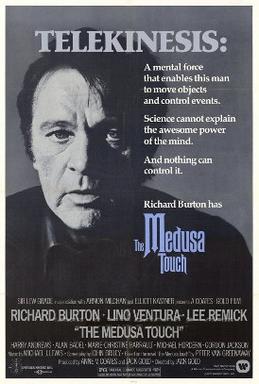
THE MEDUSA TOUCH (1978) *1/2 I could only empathize with Richard Burton’s character in The Medusa Touch in one way.
At some point during The Medusa Touch, I realized that I was seeing a cinematic disaster before my very eyes and I began staring right back at the screen especially when Burton’s John Morlar trotted out his telekinetic powers. Through my telecinematic eyes, I flashed back on Billy the Kid Vs. Dracula when the Old Count, played by veteran John Carradine, overacted with his eyes just like Burton did 12 years later. I laughed at both films more than I have at films that were aiming to make me laugh and failed.
Whether or not one appreciates The Medusa Touch boils down to how one feels about the film’s heavy flashback structure and the Burton lead performance.
I don’t know, personally speaking, I soured on the flashbacks by about the third time Lino Ventura’s French detective Monsieur Brunel encountered a character who recalled a past event, normally a disaster, involving John Morlar at various evolutionary stages in his telekinesis. We know, though, with dread certainty that whenever there’s a flashback, somebody’s going to die. Morlar’s parents, his wife and her lover, Morlar’s neighbor, Morlar’s enemies at school, et cetera. Of course, the deaths grow progressively in number and more sensational until Morlar crashes planes into buildings and reduces cathedrals to rubble.
As far as Burton’s performance, I never felt much of anything for John Morlar and that blame falls on the shoulders of the man who could be both one of the best and one of the worst actors in the world before his death in 1984. I feel even more admiration for Sissy Spacek’s work as the title character in Carrie, after watching Burton go down in flames in The Medusa Touch. Spacek creates such overwhelming empathy for her character that we get caught up in the predominantly teenybopper melodrama and we truly care about what happens to Carrie White. We don’t want to see any more misfortune befall this character, and we are on her side when the pigs’ blood flies late in the picture. Morlar could not even rouse me to a superficial hatred that immediately disappears at the end credits, and by all rights he should have. I just heard Burton mouthing dialogue and being guilty of worse overacting with his telekinesis.
Not only does Morlar have telekinesis, he’s apparently unstoppable. Nobody can kill him in this picture, though two main characters give it the old college try. Morlar takes a licking and keeps on ticking. Simply unbelievable. Morlar spends almost the entire movie in a hospital bed on life support and that helps explain why Burton gives his performance basically in flashback; it should be mentioned though Morlar’s brain occasionally causes the attached monitor to go schizoid. Nobody casts a star the stature of Burton and then have him bed ridden for the film’s duration.
Between telekinesis and invincibility, I found little to believe in during The Medusa Touch. I just wanted it to be over so I could quickly begin the healing process.
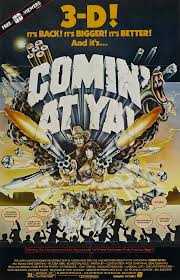
COMIN’ AT YA! (1981) *** Certain movie titles just don’t lie about their contents and intents.
For example, Comin’ at Ya (Bye-bye, exclamation point! You only get one, baby), because it keeps every object and every Spaghetti Western hallmark coming straight at us for 90 minutes. We get the objects because Comin’ at Ya inaugurated the resurgence of 3-D movies, a wave of exploitation that included such followers as Spacehunter: Adventures in the Forbidden Zone and The Man Who Wasn’t There, not to mention Friday the 13th Part III, Jaws 3-D, and Amityville 3-D.
I’ll try and not spoil all the fun by revealing every object thrown at the screen, but I will say that Comin’ at Ya absolutely loves arrows and works in a yo-yo showcase. Trust me on this one, you’ll go bats during Comin’ at Ya.
American actor, writer, producer, and director Tony Anthony, not the British Christian evangelist or the retired professional wrestler better known by his professional name Dirty White Boy, made a living in recycled Spaghetti Westerns like A Stranger in Town, The Stranger Returns, The Silent Stranger, Blindman, and Get Mean before writing the original story and starring in Comin’ at Ya. He certainly knows his way around a cowboy hat and a horse.
Veteran movie viewers will recognize just about every Spaghetti Western standard trotted out by Comin’ at Ya, especially its revenge revenge revenge plot, landscapes derived from Leone, music derived from Morricone, and mannerisms derived from Eastwood. Comin’ at Ya director Ferdinando Baldi and his writing team of Wolfe Lowenthal, Lloyd Battista, Gene Quintano, Anthony, Esteban Cuenca, and Ramon Plana also use clichés older than cinema or even dirt itself, like a dying old man who musters just enough life to give our hero critical informational bits and then dies from his wounds after muttering his remaining life, er, his final word. How many times have we seen that one? No, please, don’t tell me, it’s a rhetorical question.
It’s about time I get around to mentioning Comin’ at Ya shells out big doses of bad dubbing.
Between all the 3-D and Spaghetti Western brandishing and bludgeoning, mostly badly dubbed, one might think that’s more than enough to recommend a single movie. That’s wrong, though, because Comin’ at Ya features one of the most beautiful women in the world, Spanish actress and singer Victoria Abril, early in her career. Abril later starred in four Pedro Almodovar films and played the bisexual housewife in the acclaimed French sex farce French Twist.
I recommend Comin’ at Ya for any true connoisseur of clunky cinematic junk.
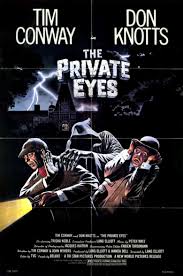
THE PRIVATE EYES (1980) *1/2 Eighty years of nostalgia account for the appeal of the comedy mystery THE PRIVATE EYES.
THE PRIVATE EYES spoofs Sherlock Holmes and Dr. Watson, who first appeared in the 1887 Arthur Conan Doyle novel “A Study in Scarlet” and made a comeback in the ’70s through such films as THE PRIVATE LIFE OF SHERLOCK HOLMES, THE ADVENTURE OF SHERLOCK HOLMES’ SMARTER BROTHER, THE SEVEN-PER-CENT SOLUTION, and MURDER BY DECREE, and it takes on a comedic style made famous by Abbott and Costello in such ’40s films as HOLD THAT GHOST and ABBOTT AND COSTELLO MEET FRANKENSTEIN.
Meanwhile, here we are more than 40 years out from the release of THE PRIVATE EYES, possibly feeling nostalgic for the comedic duo Don Knotts (1924-2006) and Tim Conway (1933-2019), who appeared together in a trifecta of Disney live-action pictures before THE PRIZE FIGHTER and THE PRIVATE EYES, both major successes for Roger Corman’s New World Productions. They last appeared together in a cameo for the bomb turkey CANNONBALL RUN II.
Knotts definitely carries more nostalgic heft than Conway, since I remember him from ‘The Andy Griffith Show,’ ‘Three’s Company,’ PLEASANTVILLE (playing a TV repairman, of course), and even a play in Kansas City when I was in college. Knotts’ Bernard ‘Barney’ Fife worked up my Grandma like no other fictional character and she reveled in his regularly scheduled comeuppance. I fondly remember giving her a hard time about it, saying that Knotts’ Fife made the show and that it went downhill after his departure. Strangely enough, I remember most fondly a TV spot pairing Fife’s antics with Right Said Fred’s ‘I’m Too Sexy.’ Wish that I could find that spot and crack up once again.
So, needless to say, I entered THE PRIVATE EYES with a generosity of good spirit and desire to laugh. I left 90 minutes later defeated by a really, really, really dumb, dumb, dumb mystery comedy and I have no real motivation to seek out the other Knotts and Conway cinematic pairings.
Knotts and Conway portray Inspector Winship and Dr. Tart, two bumbling fumbling stumbling American detectives who have somehow found themselves working for ‘The Yard.’ They bumble fumble stumble from their very first scene together all the way to the end and if you find that bumble fumble stumble worth a funny rumble the first time, you just might find it funny a hundred times. However, I did not find it funny the first or the last time or any darn time in-between.
THE PRIVATE EYES more accurately recalls a Scooby Doo episode. Hey, wouldn’t you know that Knotts appeared in cartoon form in the episodes ‘Guess Who’s Knott Coming to Dinner’ and ‘The Spooky Fog of Juneberry’ and Conway took on the Spirit of Fireball McPhan in ‘The Spirit Spooked Sports Show.’ I vaguely remember watching all three from childhood, but I still have no doubt they are each better than THE PRIVATE EYES.
Ironically, THE PRIVATE EYES has way too much plot for a dumb comedy.
HOLD THAT GHOST works much better than THE PRIVATE EYES because it has flights of fancy that deviate from its mystery plot like Costello’s dance scene with Joan Davis. Since they were all under the imperial offices of Universal Pictures, HOLD THAT GHOST makes room for musical numbers by Ted Lewis and His Orchestra and the Andrews Sisters. THE PRIVATE EYES, meanwhile, offers scenes like a gas station destroyed by Winship and Tart in a way that recalls IT’S A MAD, MAD, MAD, MAD WORLD, a very, very, very, very unfunny comedy. Let’s face it, Hollywood made less dumb comedies in 1941 than both 1963 and 1980.
Knotts and Conway remain likable throughout THE PRIVATE EYES, despite very rarely ever being funny. That said, Australian singer and actress Trisha Noble virtually steals the show out from underneath Knotts and Conway every time she appears as the alluring heiress Phyllis Morley. She’s very, ahem, ‘Oh LàLà,’ like a model for that magazine favored by 1955 Biff Tannen. I can honestly say that she alone boosts the overall rating for THE PRIVATE EYES by at least half a star.
My wife came home from work as I finished watching LET THE FIRE BURN and she thought I had came down with a cold.
No, as I later explained to her, I broke down in tears by the end of LET THE FIRE BURN, the archive footage only documentary recounting the decade-long conflict between back-to-nature and black liberation group MOVE and Philadelphia police and city officials that culminated in the police siege and aerial bombing of the MOVE house on May 13, 1985. Firefighters were on scene and let the subsequent fire burn for one hour, resulting in 11 deaths (including MOVE leader John Africa and five children), 61 destroyed homes, and more than 250 homeless people.
Only two people from inside 6221 Osage Avenue survived a day that also included water cannons and tear gas and 500 heavily-armed officers firing 10,000 rounds at the burning house. The lone adult survivor, Ramona Africa, was the only person from that day to serve any prison time, seven years for aggravated assault, riot, and conspiracy. No city officials were ever prosecuted for their actions that day, even after the MOVE Commission took aim at Mayor Wilson Goode, Managing Director Leo Brooks, Police Commissioner Gregore Sambor, and Fire Commissioner Wilson Richmond and held each of them responsible for their part in the “reckless,” “unconscionable” bombing. Sambor and Richmond were singled out for their “hasty, reckless, and irresponsible” decision to use fire as a tactical weapon. A grand jury concluded, “We do not exonerate the men responsible for this disaster. Rather than a vindication of those officials, this report should stand as a record of their morally reprehensible behavior.” Both Africa and Ward won civil cases against the city.
I especially lost it late in the film.
Philadelphia officer James Berghaier testifies before the MOVE Commission about how he rescued lone child survivor Birdie Africa, a.k.a. Michael Moses Ward, from a deep pool behind the incinerated MOVE house, braving water and downed power lines to bring the badly burned boy to safety. A title card then informs us that 17-year veteran Berghaier quit the force only months after his testimony due to post traumatic stress disorder … and that he received “nigger lover” harassment for his actions May 13.
Berghaier said in a October 1986 AP story, “I’m constantly reminded of the way that kid looked at me, but it’s not something other people can understand. It’s destroyed me. It never goes away. In order to survive as a policeman, you have to detach yourself from what you have to do, and I’ve never been able to do that.”
Another title card tells us Michael Moses Ward died at the age of 41 in 2012; Ward drowned in a cruise ship hot tub. He reunited with his biological father Andino, learned a lifestyle radically different from his childhood in the communal MOVE house, and eventually became a long-haul truck driver and a part-time barber in his adult years. Ward lost his mother in the fire.
Jason Osder makes an impressive and unorthodox directorial debut by eschewing traditional documentary form — no contemporaneous interviews, no talking heads, no reenactments, only archival footage with an occasional informational title card. LET THE FIRE BURN cuts between MOVE Commission testimony, news reports (mostly from May 13), Ward’s videotaped deposition, and police surveillance footage. It is a tremendous experience.
LET THE FIRE BURN does not let MOVE off the hook. They’re accused of abusing their child members and their black neighbors had an endless array of complaints against them. That’s why city officials worked on evicting them from 6221 Osage and gave their neighbors advance notice of the May 13 raid. MOVE leader John Africa also had the disconcerting habit of calling people — like the police commissioner — “motherfucker” over a loud speaker, something that will not always play well with others. On a surveillance tape played in LET THE FIRE BURN, one police officer can be heard saying that Africa won’t be calling the police commissioner “motherfucker” anymore.
The fact that Goode — the first black mayor in Philadelphia history — was mayor during the bombing and its aftermath makes the events even more complex and interesting. Renowned tough guy and former police commissioner Frank Rizzo (yes, the inspiration for one of the Jerky Boys) was mayor when strife between MOVE and Philadelphia police began and then exploded in 1978 with a confrontation that led to the death of police officer James Ramp and the beating of John Africa (officers can be seen on video beating Africa). Nine MOVE members were charged and convicted for murdering Ramp and received lengthy prison sentences; Delbert Orr Africa became the first member of the Move 9 to be released but he died at the age of 74 only months after his release in early 2020. All three officers were acquitted in the Africa beating; one of them, Terrence Mulvihill, in fact later played a part in the events of May 13.
Goode served as mayor until 1992, after he narrowly won re-election in 1987 against none other than Republican candidate Frank Rizzo; Rizzo lost the Democratic primary to Goode in 1983 and switched parties for the duration of his life. Goode then held a position in the U.S. Department of Education, became a minister and professor at private Christian university Eastern, and he’s currently the CEO of Amachi, a faith-based program geared toward mentoring the children of incarcerated parents. Goode recently called for the city of Philadelphia to issue a formal apology for the events of May 13, 1985.
I am grateful to have encountered this piece of history that’s come up again in recent months, but good luck finding a copy of a full LET THE FIRE BURN to watch online. I wanted to go back for another viewing and pin down some exact quotes, but alas, I could not find the version I just watched a few days before.
Both ignorance of and blatant disregard for the historical record have bothered me for a real long time (latter definitely more than former), and they seem to be practiced more and more from every conceivable angle.
Just a couple months ago, for example, protesters in Madison, Wisconsin, tore down, decapitated, and threw into a lake the statue of Norwegian-American abolitionist, journalist, anti-slavery activist (listed after abolitionist to push the point across more forcefully), politician, and Union soldier Hans Christian Heg, who died at the age of 33 from wounds he received during the Battle of Chickamauga on Sept. 20, 1863. Them protesters probably had absolutely no idea whatsoever this old dead white guy worked hard to and even died in the struggle to end slavery.
Recently, memes have made the rounds that Democrat Senators held the longest filibuster in history, 75 days, attempting to prevent the passage of the 1964 Civil Rights Act. That leaves out the part about the bipartisan effort — yes, both Republicans and Democrats working together, led by Democrats Hubert Humphrey and Mike Mansfield and Republicans Everett Dirksen and Thomas Kuchel — to end the filibuster and pass the bill ending segregation and prohibiting employment discrimination based on race, color, religion, sex, and national origin. Never mind the fact that a Democrat President (John F. Kennedy) proposed the legislation and his successor (Lyndon B. Johnson) signed it into law on July 2, 1964.
The Senate passed it with a vote of 73-27 (46 Democrats, 27 Republicans; 21 Democrats, 6 Republicans). The vast majority of “Nay” votes came from Southern Democrats — both senators from 10 states (Alabama, Arkansas, Florida, Georgia, Louisiana, Mississippi, North Carolina, South Carolina, Tennessee, and Virginia). Texas and West Virginia Democrats Ralph Yarborough and Jennings Randolph both voted for, while Texas Republican John Tower voted against it. West Virginia Democrat Robert Byrd, a nay vote, filibustered for 14 hours, 13 minutes.
In the final House vote, it passed 289-126 (153 Democrats, 136 Republicans; 91 Democrats, 35 Republicans) with a similar vast majority of “Nay” votes from Southern Democrats — including all eight representatives from Alabama, all four from Arkansas, all five from Mississippi, and all five from South Carolina. It is perhaps no coincidence that predominantly reps and senators from the former confederate states voted against every civil rights legislation that came down the pike for a good century.
For some reason, my brain has found these lyrics from Talking Heads’ “Crosseyed and Painless,” “Facts are simple and facts are straight / Facts are lazy and facts are late / Facts all come with points of view / Facts don’t do what I want them to / Facts just twist the truth around / Facts are living turned inside out / Facts are getting the best of them / Facts are nothing on the face of things / Facts don’t stain the furniture / Facts go out and slam the door / Facts are written all over your face / Facts continue to change their shape.” Of course, I’m still waiting. And the world moves on a woman’s hips, it swivels and bops, bounces and hops.
Like Jimi Hendrix, Janis Joplin, and Jim Morrison before and Tupac and Biggie after him, Kurt Cobain became a cottage industry after his death at the age of 27 in 1994. Nothing floods the market like a dead superstar.
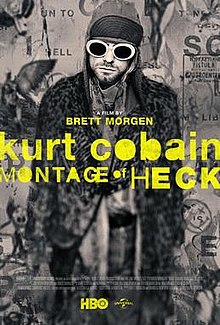
Just on the documentary front alone, we’ve had Nick Bloomfield’s 1998 investigative and speculative KURT & COURTNEY, A.J. Schnack’s 2006 KURT COBAIN: ABOUT A SON built around Cobain interviews for Michael Azerrad’s 1993 book “Come As You Are: The Story of Nirvana,” and then the 2015 double dose of SOAKED IN BLEACH and COBAIN: MONTAGE OF HECK, the former centered around private investigator Tom Grant and his digging into Cobain’s suicide and the latter officially approved by Cobain’s widow Courtney Love and their daughter Frances Bean Cobain. They made a real big deal about MONTAGE OF HECK being the first officially approved Cobain / Nirvana documentary, which automatically raises some red flags.
Throw in Gus Van Sant’s fictionalized LAST DAYS from 2005 and between all those cinematic incarnations and the Greatest Hits package (2002), the Journals (first released 2002), the three CD and one DVD box set (2004), the single-disc “Best of the Box” (2005), and various live albums released after his death beginning with MTV UNPLUGGED IN NEW YORK (Nov. 1, 1994) nearly six months after Cobain’s suicide, as well as all the celebrities from every walk of life fawning over seemingly every little thing Cobain, it’s easy to see why some of us experience Cobain fatigue or even why old fans sour on Cobain and Nirvana and ponder what they ever saw in their former heroes in the first place. Additionally, there are others who will tell you they hated Cobain and Nirvana during their brief heyday and that Cobain’s best move was blowing his brains out (a former co-worker actually said that during one musical discussion). We have more than enough room for each perspective and then some.
Through it all, though, I remain a Nirvana fan, mainly because I do my best to keep the legend at bay and just listen to the music. I turned 13 years old just three days before the release of Nirvana’s second album, NEVERMIND, so I definitely smelled teen spirit. That album, especially its first half, became so ingrained in my life during my teenage years that eventually I rarely ever played it, especially its first half, for quite some time. Only in the last year or so have I listened again to studio “Smells Like Teen Spirit,” “In Bloom,” “Come As You Are,” and “Lithium” on my own accord.
Anyway, that’s a long way of saying I watched MONTAGE OF HECK more than five years after its original release and subsequent hype and backlash. Movies about real people, especially artists, face at least one huge challenge: Do you focus on that person’s darker side or do you focus on the good times or do you try and find a middle ground between dark and light? Matters are compounded when the subject in question committed suicide at the age of 27 and titled songs “I Hate Myself and Want to Die.” Cobain’s often dark sense of humor should never be shortchanged and it’s not during MONTAGE OF HECK. We do see the darker side of Cobain throughout, especially in the second half of MONTAGE OF HECK, but the film also helps recall why Nirvana unexpectedly exploded into the stratosphere in late 1991 and early 1992. That said, I still do not and will probably never understand why Cobain became a generational spokesman, because like others before and after him, he did not want that responsibility and because this whole generational spokesman concept strikes me as being profoundly silly. Always remember, though, “It’s not what your celebrity (corporation) can do for you, it’s what you can do for your celebrity (corporation).”
MONTAGE OF HECK calls to mind Jeff Feuerzeig’s 2005 documentary THE DEVIL AND DANIEL JOHNSTON in a multitude of ways, through their deeply troubled protagonists who have a talent for writing songs, playing music, and drawing, their every moment seemingly captured on camera, and their animated interludes. Cobain himself appeared in THE DEVIL AND DANIEL JOHNSTON, wearing a “Hi, How Are You?” T-shirt alongside Red Hot Chili Peppers bassist and Nirvana trumpeter Flea at the 1992 MTV Music Awards.
MONTAGE OF HECK attempts to avoid the canned talking head format as much as possible — director Brett Morgen said the interviews from Bob Fosse’s Lenny Bruce screen biography LENNY influenced his style for MONTAGE OF HECK.
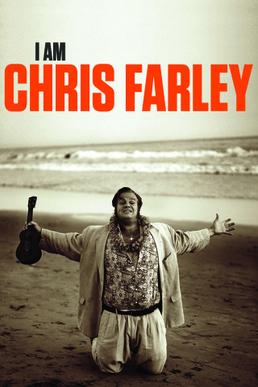
I AM CHRIS FARLEY, meanwhile, reinforces the idea that excess informed Chris Farley’s life and death at the age of 33 from an overdose in December 1997.
Farley enjoyed an excess of friends and loved ones, because fellow celebrities Christina Applegate, Tom Arnold, Dan Aykroyd, Bo Derek, Jon Lovitz, Lorne Michaels, Jay Mohr, Mike Myers, Bob Odenkirk, Bob Saget, Adam Sandler, and David Spade all share their Farley memories and anecdotes, in addition to excess in both overall lifestyle and comedic style.
I quickly realized once again that it was that very excess at the heart of Farley’s lead roles in TOMMY BOY, BLACK SHEEP, BEVERLY HILLS NINJA, and the posthumously released ALMOST HEROES. I watched BLACK SHEEP and BEVERLY HILLS NINJA and passed on the other two, because I thought BLACK SHEEP and BEVERLY HILLS NINJA relentlessly played one note for a good 90 minutes at a time — we shall call this note “Fat Man Takes a Really, Really Big Fall.” Seeing clips in I AM CHRIS FARLEY just brought it all back home again how much I disliked Farley’s films.
Also, during I AM CHRIS FARLEY, Aykroyd compared the comedic duo of Farley and Spade to Aykroyd and Belushi, Abbott and Costello, and Martin and Lewis. Wow. I mean, I did a double take when I first heard it and I just did another now writing it out. Farley and Spade paired for TOMMY BOY and BLACK SHEEP, while Abbott and Costello began working together in radio in 1935 and continued through radio, film, and TV into the mid-50s, highlighted by their legendary “Who’s on First?” routine. Abbott and Costello’s filmography doubled Farley and Spade in 1941 alone. Martin and Lewis made 16 films together — like Abbott and Costello, they worked in three entertainment mediums — from 1949 to 1956. Farley and Spade compared to Aykroyd and Belushi checks out, because of “Saturday Night Live” and two feature films.
On the other hand, I loved almost every Farley clip from “Saturday Night Live,” especially motivational speaker Matt Foley’s debut on May 8, 1993, because I can handle Farley’s excess better at five-minute sketch intervals than feature-length excess. I laughed at the Matt Foley sketch like I remember laughing at it 27 years earlier when it first aired. Spade and Applegate’s reactions and straining to remain in character when Foley unleashes “From what I understand, you’re not using your paper for writing, but for rolling doobies … you’ll be doing a lot of doobie rolling when you’re living in a van down by the river” make this sketch even funnier. Farley’s defining moment and one of the best on SNL.
By the way, you’ll discover the identity of the real-life Matt Foley during I AM CHRIS FARLEY. That’s one of the low-key highlights.
I AM CHRIS FARLEY balances toward light more than dark, but comments like Odenkirk’s “It’s just rare that a person has that much joy and brings that much happiness to everyone around him, but with Chris, there’s a limit to how wonderful it is to me and that limit is when you kill yourself with drugs and alcohol, you know, because that’s where it stops being so fucking magical” certainly get their point across.
Here’s another way to look at Cobain and Farley, “The light that burns twice as bright burns half as long.” In the case of a musician and a comedian who are preserved on record and celluloid, though, we have a chance to step into the light once more any time we so desire our personal favorite Nirvana album or “The Best of Chris Farley.” I believe that’s the best way to remember Cobain and Farley, as well as ourselves in the process.
COBAIN: MONTAGE OF HECK (2015) ****; I AM CHRIS FARLEY (2015) ***1/2
Nostalgia became a dominant cultural force in the 1970s, between AMERICAN GRAFFITI, “Happy Days,” ANIMAL HOUSE, ROCKY, STAR WARS, SUPERMAN, and THAT’S ENTERTAINMENT I and II.
Nostalgia also explains THE MAGIC OF LASSIE, in everything from everybody’s favorite cinematic collie to genial old timers James Stewart and Mickey Rooney to the songs by Richard M. and Robert B. Sherman and especially the values implied and directly stated by Lassie, Stewart, Rooney, and their songs.
The picture opens, for crying out loud, with All-American cinematic icon Jimmy Stewart singing “That Hometown Feeling.” I came up with a couple quick reactions: Thankfully, Stewart rarely ever sang during his long entertainment career; They are laying it on awful darn thick real quick in this pic. Of course, paraphrasing Bachman-Turner Overdrive, I hadn’t seen nothin’ yet. Is BTO on the soundtrack? No, but Stewart, Mickey Rooney, Debby Boone, and the Mike Curb Congregation are instead … hot diggity dog!
I just moaned and groaned about the Sherman Bros. songs in the 1972 animated SNOOPY, COME HOME, a picture about 10 or 50 or 100 times better than THE MAGIC OF LASSIE even with them darn songs.
In addition to songs that might cause somebody to wish for temporary hearing loss, THE MAGIC OF LASSIE relies heavily on a couple of my least favorite plot devices: A shady businessman leans on a property owner to sell his property (in this case a vineyard) and (mostly) comic villains ineptly chase our heroes.
In some real cutthroat business practices, Jamison takes Lassie away from kind old Grandpa Clovis Mitchell (Stewart) and his feisty grandchildren Kelly (Stephanie Zimbalist) and Chris (Michael Sharrett) and that horrible man makes it all the way to Colorado Springs with the prized bitch. Lassie runs away, headed for California. Chris runs away, headed for Colorado. Clovis takes off to look for Chris and Lassie. Clovis and Chris should be thankful, eternally grateful that Lassie’s the absolute smartest character in the entire movie, although maybe she wished she wasn’t so smart because her name would not have been in the title. Then again, wasn’t Lassie’s name always in the title of her entertainment packages?
It would take approximately 20 hours by automobile to get from Colorado Springs back to Sonoma (filming location of THE MAGIC OF LASSIE) and walking amounts to a trip lasting 414 hours. There are moments when THE MAGIC OF LASSIE feels like it lasts that long.
They really burden Lassie with some indignities during THE MAGIC OF LASSIE, all within that glorious ‘G’ rating. At least three name changes. A nasty addiction to banjo. Lassie rescues a cat from a burning building. That last one, why that’s just going way, way, way too far. I hope they paid her owners very handsomely.
Believe it or not, centerpiece song “When You’re Loved” (seen and heard in by my count two would-be feel good montages during the 100-minute cinematic endurance contest) received a nomination for Best Original Song at the 51st Academy Awards. I really can believe it, though, that “When You’re Loved” lost to Donna Summer’s “Last Dance” from THANK GOD IT’S FRIDAY.
By the end of THE MAGIC OF LASSIE (or TGIF, for that matter), though, all I was saying was “Thank God It’s Over.”
CHARLIE BROWN, HE’S NO CLOWN: SNOOPY, COME HOME & RACE FOR YOUR LIFE, CHARLIE BROWN
Charlie Brown and the “Peanuts” gang first appeared as “Li’l Folks” in 1947, debuted as “Peanuts” Oct. 2, 1950, and launched into Sunday papers on Jan. 6, 1952.
Multiple generations came to love Charles M. Schulz’s creation through TV specials, movies, merchandise, and newspapers.
I learned to read at no later than the age of 4 by perusing copies of my grandparents’ Pittsburg Morning Sun and I remember “Peanuts” being at or near the top of the comics page along with “Garfield.” Then, it was (in no particular order) “Blondie,” “Alley Oop,” “Beetle Bailey,” “Doonesbury,” “Family Circus,” and “Calvin and Hobbes.” Sure, I missed a strip or two in this nostalgic reverie.
I later wrote for the Morning Sun (considerably downsized from 2009 through 2014 with sadly more considerable downsizing to come) and I scrapbooked a few strips that particularly tickled my funny bone. You might not believe how much feedback we received about our comics page, but I have found that obituaries, comics, and sports form the backbone of a small town paper. I remember editors grumbling about how readers were still upset years later about what happened with the Sunday comics not being in color and not having their own little section … and I said that I am one of those readers mad about that, as well as the Sun dropping a Monday paper.
Anyway, we have to ask one of the five W’s: What makes “Peanuts” so unique in the first place and even still today?
First and foremost, indelible characters who resonate with readers and viewers. Just as a little exercise, let’s rattle some of them off and I bet that we don’t even need to cheat and consult Google or Wikipedia. Let’s see, we have Schulz’s alter ego Charlie Brown, of course, Linus and his security blanket, Schroeder and his toy piano, Lucy Van Pelt, Peppermint Patty, Marcy, little sister Sally Brown, Snoopy, Woodstock, and Pig-Pen (the Walking Dust Bowl). Over the years, I myself have called a child or two “Pig-Pen.”
Recently, one quarantine afternoon I decided to watch Charlie Brown cinematic adventures SNOOPY, COME HOME (1972) and RACE FOR YOUR LIFE, CHARLIE BROWN (1977) back-to-back.
SNOOPY, COME HOME took me by surprise with its emotional punch and I’d rate it even higher were it not for the presence of so many songs written by Richard M. and Robert B. Sherman that feel like padding to inflate SNOOPY, COME HOME to a running time of 80 minutes.
Snoopy receives a letter from his previous owner Lila, who’s sick in the hospital, and Snoopy and Woodstock set out upon a grand adventure to reach her. Charlie Brown and his friends face the possibility that Snoopy will return to his first owner and that whole plot development provides the emotional sucker punch right to the guts. I’ll admit to getting a little misty-eyed when the gang throws a farewell party for Snoopy.
Meanwhile, throughout his adventure, Snoopy encounters “No Dogs Allowed.” We are talking libraries, beaches, buses, seemingly everywhere our favorite little beagle turns. That’s no way to treat a star the caliber of Snoopy. These people must be somehow unaware of “Peanuts” and they must have never heard the songs “Snoopy vs. The Red Baron,” “The Return of the Red Baron,” and “Snoopy’s Christmas.” What kind of people are these?
After being driven away from the library, Snoopy picks fights against Van Pelt siblings Linus and Lucy, and we are suddenly in Laurel and Hardy territory with big laughs from violent slapstick (though not as violent as say the Three Stooges and still within the ‘G’ rating). Fans have taken Snoopy vs. Lucy and scored MORTAL KOMBAT and ROCKY to it.
Also, during his adventure, Snoopy encounters his worst nightmare, a little girl named Clara who has the unmitigated audacity to call him “Rex.” Snoopy and Woodstock barely make it out alive.
In the end, “No Dogs Allowed” benefits Charlie Brown, Snoopy, etc.
RACE FOR YOUR LIFE, CHARLIE BROWN proved to be a mere meager diversion after SNOOPY, COME HOME.
That’s right, RACE FOR YOUR LIFE is nothing more than a pleasant way to spend 77 minutes with characters that we like.
It does not have the dynamic emotional range of SNOOPY, COME HOME and the river rafting race does not rank with the use of baseball and football in CHARLIE BROWN’S ALL-STARS and numerous gags in strips and TV specials, respectively.
Upon further reflection, the special appeal of the Charlie Brown TV specials and SNOOPY, COME HOME is that adults have the ability to take away more from them than children, without ever feeling that we are being lectured or hearing a sermon. That’s ironic, given the relative absence of adults in “Peanuts.”
SNOOPY, COME HOME ***; RACE FOR YOUR LIFE, CHARLIE BROWN **1/2
LET’S DANCE! LET’S SING! LET’S NOSTALGIA!: THAT’S ENTERTAINMENT I, II, III
I dutifully watched THAT’S ENTERTAINMENT, the 2-hour, 15-minute compilation of clips from MGM highlighting their hallowed “Golden Age of Musicals.” MGM, founded on April 17, 1924 by Louis B. Mayer and Marcus Loew, commemorated its 50th anniversary and then released THAT’S ENTERTAINMENT two months later commemorating it even more.
I have two immediate spoilsport thoughts, the first which originally occurred to me on June 22, 2004, watching the American Film Institute unveil the super bland “100 Years, 100 Songs.”
THAT’S ENTERTAINMENT brought it all back with a vengeance.
That night in 2004, I said aloud, “Are they going to put every single fucking song ever sung by Judy Garland on the list?” Ditto for Gene Kelly, Barbra Streisand, Julie Andrews, et cetera, who dominated the AFI list with their 20 or 25 songs seeming more like 80 or 100; Kelly and Garland, who passed away in 1969 at the age of 47, dominate THAT’S ENTERTAINMENT.
We get a double dose of heavy duty Judy in THAT’S ENTERTAINMENT, first through her Mickey (Rooney) and Judy “Hey gang, let’s put on a show” Era montage and then a tribute presented by her daughter Liza Minnelli, not long after CABARET. Garland also sings “You Made Me Love You” over a montage of Clark Gable that allows GONE WITH THE WIND (MGM’s most famous production) to be shoehorned into the song-and-dance ballyhoo.
Second spoilsport thought: Aside from THE WIZARD OF OZ and SINGIN’ IN THE RAIN, most of my favorite musicals are not from MGM. For example, Fred Astaire, who’s featured in THAT’S ENTERTAINMENT, did most of his best work at RKO — including TOP HAT and SWING TIME — in the 1930s paired with Ginger Rogers. Never mind alternative musicals like THE 5,000 FINGERS OF DR. T (Columbia and Stanley Kramer Productions) and ONE FROGGY EVENING and WHAT’S OPERA, DOC?, both famous Warner Bros. animated shorts.
What do I like about THAT’S ENTERTAINMENT?
Well, it’s always great seeing the usual suspects from THE WIZARD OF OZ and SINGIN’ IN THE RAIN no matter how many times I have seen them, especially Donald O’Connor’s showstopper “Make ‘Em Laugh.” Clark Gable singing “Puttin’ on the Ritz” from IDIOT’S DELIGHT. Jimmy Stewart’s jab at Robert “He tries his best” Montgomery. The Esther Williams montage. Somebody once said about Williams, “Dry, she ain’t much. Wet, she’s a star.” Madeline Kahn impersonating Marlene Dietrich in BLAZING SADDLES said, “It’s twue, it’s twue.”
We get more or less the same from PART 2, only we get token appearances from MGM employees Groucho Marx, Laurel and Hardy, Buster Keaton, and W.C. Fields and, of course, musical numbers that did not appear in PART I.
It would have been nice to see a musical number from the Marx Brothers or Laurel and Hardy or Fields, despite the fact they all did their best work somewhere else. I mean, would it have killed PART II director Gene Kelly to have aired Groucho’s “Lydia the Tattooed Lady” from AT THE CIRCUS … for example … instead of, I don’t know, one more variation on the song “That’s Entertainment” offered up by contemporaneous Astaire, contemporaneous Kelly together again and for the last time.
After watching PART II, I began hating Arthur Schwartz’s chestnut “That’s Entertainment” unlike ever before, although honestly I hardly ever gave it much thought until it was the (bludgeoning) recurring theme in a darn movie. They must have trotted it out 50 freaking times.
Eventually, to counterbalance the effects of cornball showbiz schmaltz, though, I started humming “That’s Entertainment” from the Jam. Let’s get all misty-eyed nostalgic over a song that starts “A police car and a screaming siren / A pneumatic drill and ripped up concrete / A baby wailing and stray dog howling / The screech of brakes and lamp light blinking.” I particularly love the second verse, “A smash of glass and the rumble of boots / An electric train and a ripped up phone booth / Paint splattered walls and the cry of a tomcat / Lights going out and a kick in the balls.”
I should just stop bitching and moaning and groaning about PART I and PART II of THAT’S ENTERTAINMENT, perhaps because life is short and also perhaps because I realize that I am not the target audience for these nostalgic entertainments. First and foremost, I was born in 1978 and my generation did not grow up on “classic” American musicals. In fact, a lot of us came to hate musicals in our teenage years, especially of the vintage celebrated endlessly by the THAT’S ENTERTAINMENT series. I have come to appreciate some of them corny old classics somewhat more in middle age, but I still prefer musical numbers from Monty Python, Mel Brooks, and “South Park” and I still grumble like nobody’s business at 21st Century schmaltz like FROZEN, MOANA, and THE GREATEST SHOWMAN, entertainment packages that give me fleas. I don’t even have to watch them to get fleas, because it seems like 90 percent of the people around me have memorized every single darn word of every single darn song and they don’t mind singing ‘em every single darn time they feel like singing in their darn glorious off-key melodramatic voice.
Recently, I conducted some independent research by watching MILLION DOLLAR MERMAID (a.k.a. THE ONE PIECE BATHING SUIT in the U.K.) from 1952 and starring Esther Williams, Victor Mature, and Walter Pidgeon. It was directed by Mervyn LeRoy, produced by Arthur Hornblow Jr., and replayed in at least one THAT’S ENTERTAINMENT. I watched it for Williams and the numbers choreographed by the legendary Busby Berkeley (who might be more fondly remembered today for being parodied in early 80s comedies CADDYSHACK and HISTORY OF THE WORLD). I enjoyed it and I realize that I probably would have enjoyed it for the same reasons at a younger age had I given it even half a chance. Now, that’s progress!
MGM returned to the vaults for a third time for THAT’S ENTERTAINMENT! III in 1994, only 18 years after PART II and 20 after the very first greatest hits-golden cinematic oldies compilation.
Anyway, who’d have ever thought that PART III tops both PART I and PART II and does it by including outtakes and unfinished numbers more than greatest hits and golden oldies.
We have Lena Horne’s “Ain’t It the Truth,” a sultry little number cut from CABIN IN THE SKY because a sexy black woman in a bathtub in 1943 would have spurred on a third American Revolution, yes, even in the middle of World War II.
We have two lip-sync takes on “Two-Faced Woman,” presented side-by-side, outtake Cyd Charisse from THE BAND WAGON and black face Joan Crawford from TORCH SONG (both dubbed by India Adams). Crawford’s scene made me think of Pauline Kael’s review of TROG, “Joan Crawford plays Stella Dallas with an ape instead of a baby girl. Some actors will do anything to be in movies: she probably would have played the ape.”
We have another Esther Williams montage and I must say that I am in favor of Esther Williams montages, especially ones that work in Tom and Jerry. Eat your hearts out, Frank and Gene, your movie (ANCHORS AWEIGH) only had Jerry dancing with Gene! In all honesty, the Esther Williams montages in PART I and PART III pushed me to seek out MILLION DOLLAR MERMAID and I have a feeling that I will be consuming Esther, Tom, and Jerry in DANGEROUS WHEN WET soon.
I also prefer PART III because it has much less of the elitist, self-congratulatory, self-important tone that marred the first two installments, as much as I enjoyed seeing all the “old” entertainers that have not been matched (let alone surpassed) since their heyday. PART III hints at the MGM that treated the cast of FREAKS like “freaks” and it at least delves beyond the surface glitz and glamour to the showbiz ugliness beneath.
That’s entertainment.
THAT’S ENTERTAINMENT PART I ***; PART II ***; PART III ****






 Attack of the Killer Librarian