KINGDOM OF THE SPIDERS (1977) *** John ‘Bud’ Cardos’ Kingdom of the Spiders proved to be a pleasant surprise.
First, I remembered Cardos directed The Dark, one of the worst movies of 1979.
Second, I remembered the last time I saw Kingdom of the Spiders star William Shatner in a cowboy hat, yes, the absolutely ridiculous The Devil’s Rain, one of the worst movies of 1975.
Third, Kingdom of the Spiders starts out with the country number “Pleasant Verde Valley.”
Finally, Kingdom of the Spiders starts out slow, real slow, tipped off by No. 3.
Kingdom of the Spiders, though, kicks into high gear around the hour mark and it’s a whole lot of fun the final 35-40 minutes once the spiders attack Camp Verde, Arizona, and the tarantulas take complete control of the picture, hence being a pleasant surprise.
Kingdom of the Spiders borrows from such motion picture immortals as The Birds, Jaws, and Night of the Living Dead. That’s all part of the fun, when you enjoy something like Kingdom of the Spiders. Otherwise, it’s one more objection to a failure, like, for example, such bombs from the same era as The Giant Spider Invasion, Food of the Gods, and fellow 1977 release Empire of the Ants.
On the other hand, I have a weakness for Nature Attacks movies. There’s Frogs, starring killer amphibians, birds, insects, and reptiles, plus a crotchety old Ray Milland and a topless Sam Elliott. There’s Night of the Lepus, pairing a mutated killer rabbit infestation with a character actor infestation featuring Janet Leigh, Stuart Whitman, Rory Calhoun, and DeForest Kelley. There’s Squirm, where killer worms and a pair of redheads played by Don Scardino and the perky Patricia Pearcy wreak havoc on Fly Creek, Georgia, after one helluva storm. All of them are good fun and I’ve been known to call Frogs — great fun — better than The Godfather. Ditto for Godzilla vs. The Smog Monster.
Anyway, Kingdom of the Spiders works a thousand times more than The Giant Spider Invasion because it decides on real spiders — many spiders, how many exactly, how about 5,000, I mean that fact alone creates shivers down the spine — rather than a Volkswagen Beetle converted into a silly giant spider invasion. The Giant Spider Invasion doesn’t help itself when Alan Hale’s Sheriff exclaims, “You ever see the movie Jaws? It makes that shark look like a goldfish!” Giant mistake.
Also, the characters in Kingdom of the Spiders are far more likable than the ones in The Giant Spider Invasion. I mean, I eventually forgave Shatner for the cowboy hat — it’s better than the one he wore for The Devil’s Rain — and I even got over the fact that his character’s named “Rack Hansen.”
I remember an elementary school teacher calming the nerves of several pupils who were scared silly by a tarantula. She told us they’re harmless, they’re not poisonous anyway, they just look big and scary and very, very frightening indeed, and Kingdom of the Spiders brought me back 30 years to that moment in time. I’m just thankful our teacher did not show us Kingdom of the Spiders afterwards to counteract her moral lesson on tarantulas.
CREATURE FROM THE HAUNTED SEA (1961) * Lemme tell you about Jack from Creature from the Haunted Sea.
His real name is Happy Jack Monahan and he’s a crew member of crook Renzo Capetto, who has this real genius plan backfire on him miserably. Renzo wants to systematically eliminate his hapless crew and blame their deaths on a certain legendary sea monster, and that monster turns out to be real. Who could have guessed such a phenomenon? Anyway, Happy Jack’s played by Robert Bean and not by Jim Beam, which might improve Creature from the Haunted Sea.
This Happy Jack character, who probably once lived in the sand at the Isle of Man, imitates all form of animal life and it’s not a good sign for any sort of a good movie when Happy Jack lets out his inner yak. Happy Jack undoubtedly could have had a great future in “Farmer Says” toys, had he not been cast in Creature from the Haunted Sea.
That’s a roundabout way to get to the main point: Creature from the Haunted Sea ranks with the absolute dregs of the monster movie, down there buried at the bottom of the sea alongside Robot Monster and Slithis and APE, three other infamous monster movie titles featuring infamous movie monsters. You might feel sorry for this poor creature from the haunted sea and for all those associated with him, but mostly you’ll just laugh at him in that same way many people often do when they come across old movies and their antiquated special effects.
I am thankful, however, for Creature from the Haunted Sea, because its tedium afforded me the opportunity for an afternoon nap. I woke up and I felt like I didn’t miss a thing, not a beat; even if I did miss a thing, I would be grateful for it. That afternoon nap earned Creature from the Haunted Sea one-half star more than Slithis and APE, for example, I do believe.
I have not watched every Roger Corman monster movie, but Creature from the Haunted Sea is definitely the worst so far, leagues below Attack of the Crab Monsters from 1957 that’s for certain. Hell, Creature from the Haunted Sea is so bad that it makes The Wasp Woman look almost like Citizen Kane by comparison.
Charles B. Griffith (1930-2007), credited or not but more often credited, wrote screenplays for Corman spectaculars It Conquered the World, Attack of the Crab Monsters, A Bucket of Blood, and The Little Shop of Horrors, as well as later Corman productions Death Race 2000 and Eat My Dust. In other words, the man definitely had his better moments like Bucket of Blood and Little Shop of Horrors. Alas, Creature from the Haunted Sea is not one of them.
Rather, it’s a compendium of crap.
For example, Creature from the Haunted Sea gives us more voiceover narration than what’s necessary for any creature feature. I mean, for crying out loud, I bet there’s more voiceover in Creature from the Haunted Sea than in all the other films combined from 1961. Sure that’s why I fell asleep for a while. Airplane spoofed voiceover fantastically, although thankfully I did not meet the same fate as the characters on that infamous cinematic flight.
It doesn’t even matter that future Academy Award-winning screenwriter Robert Towne delivers this narration or that he’s credited for ‘Sparks Moran / Agent XK150 / Narrator.’
I have not talked much about the actual creature in Creature from the Haunted Sea and there’s a good reason for that. Yes, that’s right, the creature from the haunted sea just might be the worst movie monster I have ever seen, and please keep in mind I’ve seen Robot Monster.
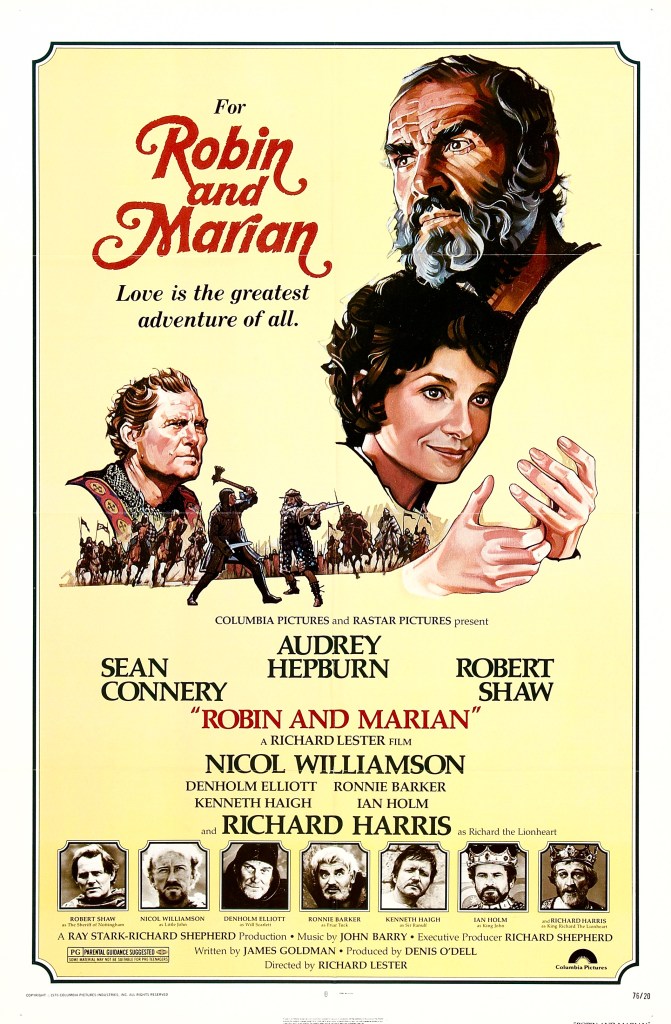
ROBIN AND MARIAN (1976) **** Richard Lester’s Robin and Marian definitely made a strong first impression.
I placed it on my top 10 films list for 1976, based on just viewing it a single time on cable TV many years ago.
Granted, Robin and Marian crossed my mind several times in recent months, especially after Robin and Marian star Sean Connery died last Halloween and then after I watched both the Disney (1973’s Robin Hood) and the Mel Brooks (1993’s Robin Hood: Men in Tights) takes on the legendary old warhorse. Disney and Brooks both left me feeling often unimpressed and ultimately supremely disappointed, for very different reasons, and I started thinking instead about superior Robin Hood films The Adventures of Robin Hood and Robin and Marian, both of which I first encountered during childhood or teenage years.
The Adventures of Robin Hood remains my favorite take on Robin Hood and I’ve watched it numerous times over the years. Of course, it helped that The Adventures of Robin Hood ranked among the select few titles Grandma Sisney had on VHS and I played it — along with Indiana Jones and the Temple of Doom and Fun in Acapulco — so many times before Grandma took over her TV for a day of game shows and soap operas. There’s always been something so indelible about Errol Flynn’s Robin Hood that I judge all others portraying Robin Hood against Flynn’s standard, Claude Rains and Basil Rathbone make incredibly satisfying villains, and Olivia de Havilland’s Maid Marian simply radiates a MOST BEAUTIFUL WOMAN IN THE WORLD AT THIS VERY MOMENT glow. Plus, it’s hard to forget the colors (and costumes) that argue for three-strip Technicolor superiority.
Robin and Marian left a mark for similar reasons — Connery and Audrey Hepburn both carry some of the same appeal as Flynn and de Havilland do in their iconic roles. Flynn was just a month shy of 29 years old when The Adventures of Robin Hood first came out in May 1938 and similarly, De Havilland was two months shy of a mere 22. However, Connery and Hepburn play older Robin Hood and older Maid Marian — please consider both Connery and Hepburn were in their mid-40s during Robin and Marian and each had a solid 15-20 years of stardom behind them. Connery and Flynn both have an undeniable robust humor and physicality (both men seemed tailor-made for James Bond, for example) and Hepburn could make claims on de Havilland’s radiant MBWITW glow several times during her career, from Roman Holiday and My Fair Lady to Robin and Marian.
Anyway, I finally watched Robin and Marian for a second time and it holds up as a great movie, right behind only The Adventures of Robin Hood in the Robin Hood cinematic pantheon.
Because of centering around middle age characters, Robin and Marian plays different notes and takes on a greater emotional range than any other Robin Hood film I have ever seen.
It’s definitely not the lusty adventure like The Adventures of Robin Hood. Sure, Robin and Marian has sword fights and scenic vistas and soaring music and horses and romantic clinches and every prerequisite of the genre, as well as King John, King Richard the Lionhearted, the Sheriff of Nottingham, Little John, Friar Tuck, Will Scarlett, and Sherwood Forest, but they’re all — both people and places, and every plot event — suffused with melancholy.
To be fair, though, Lester and Connery inject enough good humor and spirit into Robin and Marian to help it avoid being a more downbeat experience like the 1991 Robin Hood starring Kevin Costner. And the scenes between Connery and Hepburn are simply flat-out appealing, rooted in seeing two of the most attractive, most ebullient performers to ever grace the screen share time with each other (and us audience members).
It should also be mentioned that supporting players Nicol Williamson, Richard Harris, Denholm Elliott, and Ian Holm contribute to an absolute dynamite cast.
Didn’t we always ponder how it all turned out for Robin Hood, Maid Marian, the Sheriff, Little John, Friar Tuck, and Will Scarlett?
Lester’s film, with a screenplay written by James Goldman (writer of the play, film adaptation, and TV movie version of The Lion in Winter), answers those very questions, but do we viewers feel comfortable with the answers? Are we prepared to see Maid Marian as a nun because Robin Hood, off on his damn crusades and holy wars with Richard and Little John, didn’t write her for the last 20 years? We also found out that she attempted suicide. He’s back, though, and it’s obvious that Robin Hood and Maid Marian are destined to be together. They might initially hate it and initially fight it, she invariably more than he, but they are pulled together rather than apart.
All roads lead toward a final showdown between Robin Hood and the Sheriff (Robert Shaw). They fight like two worn-out, downtrodden men with many, many battles behind them and none ahead of them, who have resigned themselves to their final destiny. They fight because it’s their duty, or their almost perverse obligation to each other as hero and villain. They really don’t want to be fighting each other at this precise historical moment, it feels like, BUT THEY MUST FIGHT TO THE DEATH. There’s none of the joy in this fight that can be found in great film sword fights like the one, for example, between Robin Hood (Flynn) and the Sheriff (Rathbone) in The Adventures of Robin Hood. This final showdown, just like Robin and Marian overall, gives us something that’s different from any other purely adventure movie. All the main players have lived through considerable pain, considerable disappointment, and the film serves a reminder (from early on and throughout) there’s flesh-and-blood and real-life experience behind every legend, every song, every ode, every hymn, every myth.
Maid Marian gives Robin Hood (and us) some final words, “I love you. More than all you know. I love you more than children. More than fields I’ve planted with my hands. I love you more than morning prayers or peace or food to eat. I love you more than sunlight, more than flesh or joy or one more day. I love you more than God.”
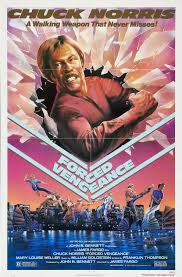
FORCED VENGEANCE (1982) **1/2 Slow motion’s absolutely vital to understanding the cinematic and TV work of the one and only Carlos Ray Norris.
Slow motion’s everywhere, in action movies, sporting events, movie musicals, etc. To the point that we don’t even realize how everywhere it’s become.
Over the decades, for example, slow motion became a customary tool in violent scenes, from Arthur Penn’s Bonnie and Clyde and Sam Peckinpah’s The Wild Bunch to The Matrix and beyond. Sometimes, I think Gee whiz, that’s awesome and very artfully done, but mostly I just think That’s super lame. I take off points for the obligatory and cheap use of slow motion.
Let’s see, off the top of my head, I deducted from The Lion King and Teen Wolf and Young Guns for their abuse of slow motion late in their motion picture spreads, while Kickboxer 2 flogs viewers with slow motion until it’s like receiving a slow motion roundhouse upside the head. For crying out loud, though, it’s slow motion, super slow even, and that gives us a greater chance to duck out of the way and to see all the cheap audience manipulation at play. I mean, I ducked the Kickboxer 2 roundhouse and found the Siskel & Ebert review playing alongside the movie inside my head esp. Ebert imitating the sounds of slow motion. It was more entertaining that way.
That brings us full roundhouse back to Norris, one of the foremost slow motion abusers.
A former co-worker said that his ears were ringing for a long time after he watched the Who play one of the Day on the Green concerts at Oakland-Alameda County Coliseum. He talked about being whacked upside the head by their incredible Wall of Noise. I soaked up this conversation.
“In 1976, the Who entered the Guinness Book of World Records for performing the loudest concert in history at the time during their concert at England’s Charlton Athletic Grounds with 76,000 watts at 120 decibels. This record would stand for nearly a decade.”
You can bet they used the Rock-o-meter from Rock ‘N’ Roll High School.
Anyway, now I will make the case for something that’s louder than any rock concert or sporting event, any plane taking flight, any hyena’s laugh, and any howler monkey.
For a couple months, I visited my Grandma for her bingo dominance Tuesday and Thursday. After the bingo hour, we’d return to her room and she’d turn her TV back on. Naturally, it would be Walker, Texas Ranger on Hallmark. Of course. At 3 every day, every single TV in the nursing home would simultaneously be turned on full volume and tuned in to Walker, Texas Ranger. That’d be probably close to 100 TVs. Yeah, we’ll go with 100 for the sake of hyperbole.
I’ve never in my life heard anything louder than 100 full blast TVs simultaneously reverberating Walker slow motion roundhouse kicks.
Guinness, book it.
I deducted a half-star from Forced Vengeance because it broke through my pain threshold for slow motion consumption early on during the final act leading toward a grand finale.
You have been forewarned.
Once again, though, a poster for a Norris spectacular earns four stars.
AN EYE FOR AN EYE (1981) *** An Eye for an Eye is one of the better Chuck Norris movies and that’s because it fits the bill for what helps define a better Chuck Norris movie — the quality of the supporting cast, something it has in common with Lone Wolf McQuade, Code of Silence, The Delta Force, and Silent Rage.
Let’s see, we have Christopher Lee, Richard Roundtree, Matt Clark, Mako, Maggie Cooper, Rosalind Chao, Professor Toru Tanaka, Stuart Pankin, Terry Kiser and Mel Novak, and they’re basically all good in their standard hero and villain roles.
Lee (1922-2015) enjoyed a truly marvelous career that intersected with Sherlock Holmes, Dracula, James Bond, Star Wars, Ichabod Crane, Kharis, Victor Frankenstein, Gandalf, and Hercules. Never mind acting alongside Slim Pickens and Toshiro Mifune in Steven Spielberg’s 1941. Often playing the villain, Lee had the ability to maximize his minimal screen time and An Eye for an Eye benefits from his presence.
Roundtree made his fame as the title character in Shaft and sequels Shaft’s Big Score and Shaft in Africa, and so I must admit to being somewhat amused that he’s played a cop so often throughout his career. It was both amusing and frustrating to watch his police superior character bust Norris’ chops. I told my wife during An Eye for an Eye, ‘At least he’s not killed by a winged serpent in this movie.’
Cooper plays Norris’ obligatory romantic interest and she gets a rare female nude scene in a Norris movie. Writing on Silent Rage, I noted that it was refreshing to see somebody’s chest other than Norris and I second that emotion after An Eye for an Eye.
Tanaka’s dossier begins, ‘Was an American professional wrestler, professional boxer, college football player, soldier, actor, and martial artist.’ What did the Professor earn his degree in? Judging by An Eye for an Eye and the vast majority of his filmography and his professions, it’s safe to say Tanaka earned a doctorate in pain. Like others in the An Eye for an Eye cast, he’s good at maximizing minimal screen time and in his case, minimal dialogue. Norris vs. Tanaka proved to be one of the film’s greatest highlights.
Before she went to sleep, I told my wife that Norris’ partner will be dead very shortly and it did not help the character’s survival odds being played by Terry Kiser, an actor best known for playing a corpse. Bernie from Weekend at Bernie’s and Weekend at Bernie’s II ring any bells? Yeah, I still argue that dead Bernie still shows more life than nominal leads Andrew McCarthy and Jonathan Silverman. For a man later hacked and whacked by Jason Voorhees, Kiser’s character died spectacularly in An Eye for an Eye — shot in the chest, crushed between not one but two cars, and caught on fire. His death haunts Norris’ Sean Kane during two flashback scenes.
An Eye for an Eye director Steve Carver died in January 2021 of complications from COVID-19 and he was 75. Carver also directed arguably Norris’ best picture, Lone Wolf McQuade, and the infamous 1974 Roger Corman / New World Productions films The Arena and Big Bad Mama. No doubt that Pam Grier and Angie Dickinson, as well as William Shatner, prepared Carver for Chuck Norris.
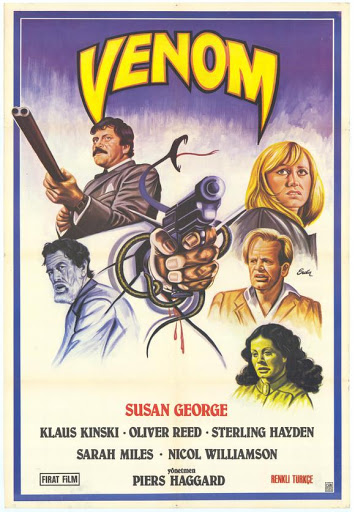
VENOM (1981) *** I just finished considering Silent Rage, a film that runs Chuck Norris, a Western, Animal House, mad scientists, and a madman killer made indestructible through a cinematic blender.
Thus, I feel safe in saying that Silent Rage prepared me for Venom, a British horror film that has a distinguished multinational cast, kidnapping and hostage negotiation, and only the world’s deadliest snake, the dreaded Black mamba from sub-Saharan Africa. The mamba gets a few closeups, more than Norma Desmond in Sunset Boulevard and Daffy Duck in Duck Amuck, and its own POV. Yeah, we’ll call it the Black Mamba Cam.
That distinguished cast includes kidnappers Klaus Kinski and Oliver Reed, Scotland Yard commander and lead negotiator Nicol Williamson, snake expert Sarah Miles, slinky (won’t call her slutty or a snake expert in her own right) nurse Susan George, and lovable crusty old grandfather Sterling Hayden.
Basically, Venom contains three movies within one — the kidnapping inside the house, the hostage negotiation and the behind-the-scenes police maneuvering on the outside, and the deadly snake on the loose. We’ve all seen kidnapping and hostage negotiation plenty before, on TV cop shows and in the movies, but very rarely do the kidnappers have to deal with the world’s deadliest snake. And Lord knows we’ve all seen a bad snake movie or two, like for example the 1972 disaster Stanley, which populated its killer snake scenario with thoroughly unpleasant and despicable characters, a somewhat heavy-handed environmental message, and some of the dopiest music ever heard by man this side of Jonathan Livingston Seagull.
Venom turned out to be a far more enjoyable motion picture experience than Stanley. For example, the scene in Venom where the boy picks up the mamba by mistake and unknowingly transports the world’s deadliest snake from one side of London to another brought to mind the classic sequence in Sabotage that ends in the death of a young boy named Stevie. The inevitable scenes late in the picture when the mamba strikes Reed and Kinski are both well worth their wait, and the mamba’s strike at George about 30 minutes into the picture lets us know that we’re in for a treat when Reed and Kinski do meet their demise.
Later that day, much later in the day to be precise, though, I watched Murders in the Zoo from 1933 and imagine my delightful little surprise when a mamba figured prominently in that older film’s plot. The gruesome hits in Murders in the Zoo just keep on coming down the home stretch, especially when a boa constrictor consumes the dastardly big-game hunter, bastardly zoologist, and insanely jealous husband played by Lionel Atwill.
Venom and Murders in the Zoo both find perfect ways to deal with snakes in the grass.
SIX WEEKS (1982) * My wife awoke in the middle of the night, it took her quite some time falling back asleep, and so naturally she joined me for about the last 30 minutes or so of Six Weeks. She asked me some basic journalistic questions like ‘What’s the little girl dying from?’ ‘I believe it’s leukemia.’ ‘No, it can’t be. It’s got to be something else. I don’t think she’d just suddenly die like that.’
At some point during our discussion, I said that actually this poor little girl has got the dread movie disease where the invariably dead-by-the-end-of-the-movie character becomes ever more beautiful and noble until her big death scene. Yes, the late film critic Roger Ebert named this affliction ‘Ali MacGraw Disease’ after the star of Love Story, the film based on the best-selling novel that one might say started it all way back in 1970.
Movies derived in way or another from Love Story invariably pour it on awful darn thick with the sentiment, until the movie in question becomes a real maudlin exercise. Six Weeks pulls out the stops more than most in this dubious category and that’s why I was utterly amazed that it did not feature a hot-air balloon scene like fellow maudlin tearjerkers Bobby Deerfield, Yes Giorgio, and Just the Way You Are. That’s about the only restraint practiced by Six Weeks.
Casting 101 pairs Dudley Moore (1935-2002) and Mary Tyler Moore (1936-2017), fresh off critical and commercial hot commodities Arthur and Ordinary People, respectively. Yes, wow, how far out, both actors have the same last name and they’re apparently not related. They don’t even have the same national origin. Anyway, like Walter Matthau and Jill Clayburgh in the turkey bomb First Monday in October, Moore and Moore do not share the slightest bit chemistry either, that’s for darn sure. Dudley plays a California politician who’s running for Congress, Mary’s a wealthy cosmetics heiress with the precocious 12-year-old daughter already discussed in the opening paragraph. Dudley’s hopelessly lost in an early scene, very late to a political fundraiser where he’s the featured speaker, and the 12-year-old gives him directions and a whole lot more. She wants Dudley to win his election and Moore² to hook up and become the ultimate happy family for her life’s remaining duration.
Katherine Healy plays the dying little girl and she’s a bit, what’s the word, insufferable. She’s one of those movie children with an unlimited supply of wannabe sharp dialogue and snappy comebacks. She’s dying, remember, and that makes her dialogue even worse and her fantasies ever more powerful. Yes, that’s right, she’s got six weeks left and she’s going to live out as many of her fantasies as possible within the production budget of a 107-minute feel good extravaganza.
Moore² and the little girl hit the bright lights of New York City because what better place to live out fantasies on the big screen and little Niki skates at The Rink at Rockefeller Center, takes on the lead in The Nutcracker, and rounds up Moore² for a smug little cutesy pie wedding ceremony that almost extracted wholesale vomit from the pit of my stomach. Not exactly in that order, though, because the wedding ceremony happens before the grandstanding grand finale ballet number. Niki performed her ballet number on center stage, I looked at my wrist like there’s a watch attached to it and said to my wife, ‘It’s about time for the little girl to die.’ Sure enough, that’s what happened in the very next scene.
I left out the part (until now, anyway) about Dudley’s family, his dutiful wife and teenage son. That’s OK, because they’re not that important and don’t stand in the way of the main body of the plot. Speaking of the plot, Six Weeks pushes and pulls so many emotional levers that it becomes one of the most shameful tearjerkers ever made. They finally resorted to yanking them emotions with pliers. Thankfully, I still resisted and this review signals my protest on aesthetic and emotional grounds.
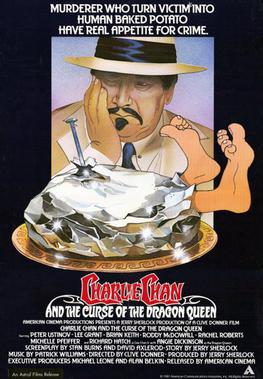
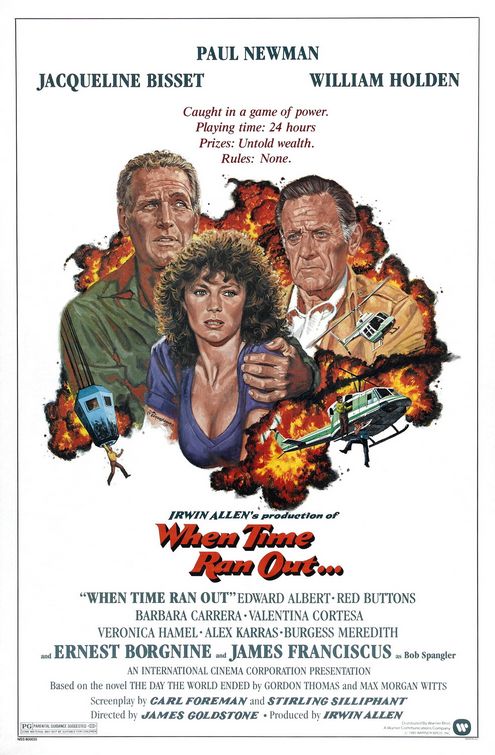
BOMB, BOMB, BOMB: PARTNERS, CHARLIE CHAN AND THE CURSE OF THE DRAGON QUEEN, WHEN TIME RAN OUT
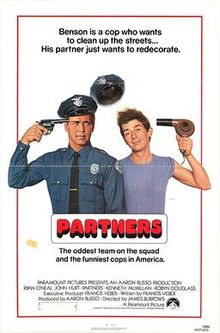
I could only make it through about 30 minutes of Partners and that’s more than enough for at least about 10 lifetimes, I’d say. I gave up on the picture for good around the fourth time star Ryan O’Neal uttered the epithet faggot. Yeah, Partners basically plays Cruising for laughs. Ha-ha, funny … about as funny as punching somebody’s mother in the face.
I consider Partners the absolute worst film from 1982, at least among the 70 or so films that I have seen thus far in my 42 years on this planet. It supplanted Amityville II: The Possession, a lovely little number incorporating blood, vomit, incest, matricide and patricide, fratricide and sororicide, and demonic possession. Never mind Inchon, a $46 million Korean War epic that bombed mightily at the box office with only a $5.2 million return. Never mind Halloween III: Season of the Witch, which features one of the least likable lead characters (Dr. Dan Challis) and lead performances (Tom Atkins) in recent memory. Believe it or not, Partners beats those other films in sheer unpleasantness.
Did longtime TV director James Burrows use Partners for his audition for Will and Grace? I seriously doubt it, because Partners is one of the nastiest pieces of work I have ever seen. Burrows has directed more than 1,000 TV episodes, including 237 Cheers and 75 Taxi and 32 Frasier. Thankfully, Burrows stuck with television after Partners.
Early in the picture, O’Neal asks his boss how he got stuck partnering up (literally) with gay records clerk Kerwin (John Hurt) to infiltrate and investigate a series of murders in the Los Angeles gay community. Anyway, Chief Wilkins (Kenneth McMillan) tells our matinee idol, “Because you’re a good cop, a real good cop. And because of your cute ass.” Maybe that’s how O’Neal himself got the gig. O’Neal certainly dressed up for the part, wearing a ridiculous tank top and then a leather garb in just the portion I watched before saying Roberto Duran on Partners.
— As I sit here before this keyboard and ponder my next direction, I consider how I endured all 95 minutes or so of Charlie Chan and the Curse of the Dragon Queen, another great big smelly turd from the early ’80s like the ones mentioned about three paragraphs up.
When folks express this incredible nostalgia for the ’80s, undoubtedly it’s not Charlie Chan or Partners or Inchon, for that matter, they’re nostalgic about, because they SUCK in the immortal words of Al from Caddyshack. Then again, if I have learned anything over the years writing about movies or music online, it’s that somewhere in this great big world there’s a cult following Howard the Duck or Halloween III, for example, and they just might flame you for not cherishing their cult object in the same way they do.
Charlie Chan asks us to believe Peter Ustinov (1921-2004), Richard Hatch (1945-2017), and Angie Dickerson as characters of Asian descent. Sure, I believe the Englishman Ustinov as fictional Belgian detective Hercule Poirot (a character he played six times, including features Death on the Nile, Evil Under the Sun, and Appointment with Death) and Roman emperor Nero in Quo Vadis, but I call it more of a stretch to consider him as Chan in 2020, nearly 40 years after the film was made. It’s even worse for both Hatch and Dickerson.
Charlie Chan features plenty of the broadest comedy and frenzied overacting by a rather distinguished cast that also includes Lee Grant, Brian Keith, Roddy McDowall, Rachel Roberts, and Michelle Pfeiffer early in her career. Hatch plays Chan’s fumbling bumbling stumbling grandson Lee Chan Jr. and I’ve watched so many films lately with fumbling stumbling bumbling would-be detectives that I now grumble and rumble when I see them on the screen. I’m thankful my Grandma never behaved like the one played by Grant in Charlie Chan. Keith’s police chief says ‘Goddamn’ about 50 times. McDowall and Roberts play Grant’s domestic helpers, Gillespie and Mrs. Dangers respectively, but they both provide little help to Charlie Chan since they are both in the grand tradition of melodramatic domestic help in the movies; Mrs. Dangers calls to mind Patsy Kelly’s frantic maid in The Gorilla. Pfeiffer could have dialed the perkiness down a notch or few and still have saved enough for the rest of her career. Nearly all of these characters are cringeworthy.
— When Time Ran Out came out Mar. 28, 1980 and it eventually fell about $16 million short of making its $20 million production budget back at the American box office.
Later that year, on July 2, Airplane parodied Airport specifically and disaster movies in general, and became one of the biggest hits of the summer and the entire calendar year.
The failure of When Time Ran Out and the success of Airplane signaled the end of the disaster movie, at least in the form that dominated the first half of the seventies with The Poseidon Adventure, Earthquake, and Towering Inferno and then dribbled out pure unadulterated dreck the final half of that decade like The Swarm, Beyond the Poseidon Adventure, and Meteor. Since I mentioned Meteor, I also have to mention Avalanche, which provided disaster footage recycled in Meteor as if being in one disaster of a disaster movie just simply was not enough.
Master of disaster Irwin Allen (1916-91) produced at least half the films mentioned in the paragraph right above this one and he even stepped in the director’s chair for the turkey bombs The Swarm and Beyond the Poseidon Adventure. Allen called on Rollercoaster director James Goldstone for When Time Ran Out, which features the required number of old time movie stars, hot commodities, and fledgling character actors. When Time Ran Out should have been called Take the Money and Run, though Woody Allen and Steve Miller already used it for a comedy (1969) and a hit song (1976).
We have William Holden (1918-81), Paul Newman (1925-2008), Jacqueline Bisset, Ernest Borgnine (1917-2012), James Franciscus (1934-91), Burgess Meredith (1907-97), Red Buttons (1919-2006), Barbara Carrera, Pat Morita (1932-2005), Veronica Hamel, Edward Albert (1951-2006), and Alex Karras (1935-2012), as well as a volcano, a tidal wave, etc.
Seemingly half of the cast takes part in a glorified soap opera before the molten lava really begins to flow and they have to repeat business from Beyond the Poseidon and seemingly every other disaster movie of the era. Here’s that glorified soap opera: Holden proposes to Bisset very early in the movie and she turns him down because she’s in love with Newman, who’s not the marrying kind and anyway he does not seem to much care for Bisset but maybe he’s just masking his true feelings toward her with standard male bluster. Franciscus is married to Hamel but he’s fooling around with half-brother Albert’s significant other Carrera. Just wait, it gets better, Albert does not know that he’s Franciscus’ half-brother … and Holden and Hamel are sleeping together. I think I just about nailed it down and you’re right if you’re thinking all that seems like too much plot for such a dimwitted movie.
You’re also right that I hated these characters and their miserable lives, and rooted for the volcano to wipe them all out.
Especially Franciscus, who takes chronic disbelief in the face of impending disaster to new lows in When Time Ran Out. Unfortunately, an incredibly shoddy special effect leads to an incredibly unsatisfying death for Franciscus’ character. We crave to see him bite the dust or eat molten lava in spectacular fashion, and what we get is just plain laughable.
Of course, just plain laughable describes about 99 percent of When Time Ran Out.
Believe it or not, costume designer Paul Zastupnevich earned an Academy Award nomination for Best Costume Design and went against winner Tess, The Elephant Man, My Brilliant Career, and Somewhere in Time, all of them period films where the look of the film itself becomes another important character.
Yeah, I hope the 1981 Oscar broadcast used a shot of Newman in his utterly ridiculous Urban Cowboy garb.
Zastupnevich received a nomination for the same award two years before for his edgy, state-of-the-art costume work on The Swarm, beekeeper outfits. The Agatha Christie Hercule Poirot period murder mystery Death on the Nile won the prize.
I hate to say it, but time ran out on this review because I don’t want to consider When Time Ran Out any longer than I already have.
Partners No stars; Charlie Chan and the Curse of the Dragon Queen 1/2*; When Time Ran Out *
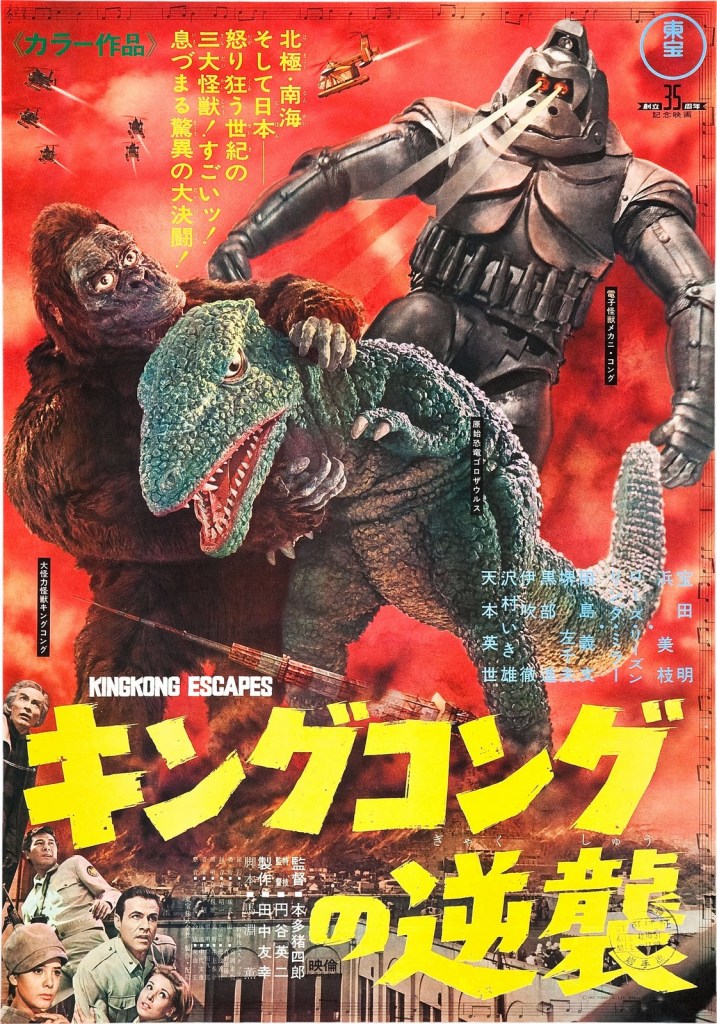
KING KONG ESCAPES (1967) **** I must be a sucker for movies like King Kong Escapes, but I just can’t help myself when it features so many awesome characters, plot details, and scenes.
Of course, we have the title character who’s obviously back from King Kong vs. Godzilla, one of Japan’s biggest Solid Gold hits of the early ’60s.
King Kong Escapes, a Toho Studios and Rankin/Bass Productions co-production, topped King Kong vs. Godzilla for me and I’d like to share how it did just that.
Not only do we have the iconic man-in-a-suit Kong, rather than the Willis O’Brien stop motion Kong from the immortal King Kong, the one that started it all, but we have Mechani-Kong, a giant robot double of Kong that first appeared in the 1966 animated TV series The King Kong Show (hence the Rankin/Bass involvement) and returned for live-action duty in King Kong Escapes.
King Kong Escapes also gives us Gorosaurus and a giant sea serpent, and Kong battles them near their home Mondo Island. See, Kong’s become obviously smitten with the lovely nurse Susan Watson (Linda Miller) and he’ll take on any beast to protect her. She holds sway on the big lug, and that naturally puts her life in danger from the bad guys. Kong saves her several times over the course of a 100-minute spectacular. All in a day’s work.
I believe it’s the human villains who put King Kong Escapes over into greatness for me — the evil mad scientist Dr. Who (not that Doctor Who) and the shady representative of an unknown Asian nation, Madame Piranha. She’s also called Madame X, but I’m sticking with Madame Piranha because I like that name better and she’s played by the pretty Mie Hama. 1967 proved to be a vintage year for Hama, who turned 24 that year and played Kissy Suzuki in the fifth James Bond film, You Only Live Twice. I believe Madame Piranha wins over Kissy Suzuki and ditto for their respective films. Madame Piranha, in fact, belongs right up there with Pussy Galore and Princess Dragon Mom.
Anyway, back to Dr. Who, played by the veteran character actor Hideyo Amamoto (1926-2003). He’s a cross between, I don’t know, Dracula (it’s the cape) and a Bond megalomaniac. He’s one of those characters that we absolutely love to hate and we savor his inevitable demise late in the picture. He’s so vain, so darn smart, so reckless, so persistent, so evil. Dr. Who created Mechani-Kong and when it fails him about 30 minutes into King Kong Escapes, Dr. Who captures first Kong and then Susan Watson, Commander Carl Nelson (Rhodes Reason), and Lt. Commander Jiro Nomura (Akira Takarada), Watson’s human interest. Needless to say, Kong and Mechani-Kong and Watson and gang escape from Dr. Who and his henchmen, which leads us to a battle royale atop Tokyo Tower.
I admit upfront that King Kong Escapes is silly, preposterous, and outright bloody ridiculous, in everything from its plot to its English dubbing, but it came as such a rejuvenation to my spirit after I watched The Gorilla, The Screaming Skull, The Robot vs. The Aztec Mummy, and The Curse of the Aztec Mummy earlier that same day, four exploitation films that if added together still did not provide as much entertainment value as King Kong Escapes.
When you have Bela Lugosi and Lionel Atwill in the cast, make them supporting players, and focus instead on the Ritz Brothers and Patsy Kelly, I call that a major failure.
The Gorilla, distributed by Twentieth Century-Fox and not surprisingly based on a stage play given the film’s limited sets and overall stagy feel, made that very choice. Lugosi earns more laughs than the execrable Ritz Brothers just by playing it straight. Yes, I found Al, Jimmy, and Harry execrable, as they fumbled bumbled and stumbled their way and I conversely grumbled my way through The Gorilla, a horror comedy that fails miserably at both genres. I read the Ritz Brothers walked away from The Gorilla because of the shoddy quality of the script and that’s never a good sign when the stars themselves grumble. They were right, though, because The Gorilla is shoddy, but the Ritz Brothers don’t get let off the hook. Not so fast.
The Ritz Brothers have been called a poor man’s Marx Brothers. No way, they’re not even good enough for that. Granted, to be fair, The Gorilla marked my first exposure to Al, Jimmy, and Harry, so maybe they did their best work elsewhere. Based on The Gorilla, though, I could not differentiate between Al, Jimmy, and Harry, who might as well be any Tom, Dick, and Harry off the street. They blended into one grating personality. I mean, Groucho, Harpo, and Chico created their own distinctive trademark comic personalities and they provided us a wealth of great comic material when they worked at their best (Horse Feathers, Duck Soup).
Laurel and Hardy did this horror comedy number much, much, much better in the 28-minute The Laurel-Hardy Murder Case from 1930. Watching The Gorilla, there’s one recurring gag involving a chair, a desk, a light, and disappearance that specifically makes it clear The Gorilla ripped off The Laurel-Hardy Murder Case, which parodies silent films The Cat and the Canary and The Bat. Paramount released a The Cat and the Canary remake starring Bob Hope and Paulette Goddard on Nov. 10, 1939, only about five-and-a-half months after The Gorilla.
We’ve all seen The Gorilla before, possibly many times before, through other movies, not only the fumbling bumbling stumbling detectives but also the maid who loves to shriek in just about every other scene, the wealthy uncle and the lovely young niece and her male friend and the inheritance plot, the butler who did not do it but who seems to show up at exactly the wrong time so he becomes an obvious suspect for the murders afoot, and both a killer named ‘The Gorilla’ and a real gorilla escaped from the local zoo on the loose and in the same house.
I believe that we talked about Lugosi and his great cinematic love for apes and gorillas back when I reviewed Bela Lugosi Meets a Brooklyn Gorilla. I gave that one three stars, but it actually has almost a full point lower average rating than The Gorilla on Internet Movie Database. Big whoop! I found Jerry Lewis and Dean Martin knockoffs Sammy Petrillo and Duke Mitchell a whole lot more endearing and funny than Al, Jimmy, and Harry Ritz, and Bela Lugosi Meets a Brooklyn Gorilla is not a snooze fest hopelessly dedicated to one set like The Gorilla.






 Attack of the Killer Librarian