Duel (1971)

duel

DUEL (1971) Three-and-a-half stars

24-year-old Steven Spielberg’s first feature film premiered November 13, 1971 on ABC.

Richard Matheson (1926-2013) wrote the script, based on his nightmarish experience on November 22, 1963 (the date of JFK’s assassination). A trucker tailgated Matheson on his return home following a golf match against friend and fellow writer Jerry Sohl. Matheson turned his experience into a short story that originally ran in Playboy.

Spielberg directed on a $450,000 budget and production ran 13 days, three days over schedule, and it played as the “ABC Movie of the Week” lasting 74 minutes. A later theatrical release covered nearly 90 minutes.

Spielberg wanted and got character actor Dennis Weaver (1924-2006). Of course, most of us know the Joplin-born actor for his work on TV series “Gunsmoke” and “McCloud,” but Spielberg admired Weaver for his work in Orson Welles’ TOUCH OF EVIL and in DUEL, Weaver’s character repeats a bit of verbal business from TOUCH OF EVIL. You got another think coming, indeed.

It’s a very basic premise at the center of DUEL: An unnamed truck driver stalks our protagonist David Mann (Weaver), a middle-aged salesman returning home from a business trip.

Mann passes the truck early on and that begins his 90-minute nightmare.

Oh sure, I bet you believe that driver sure as hell gets bent over being passed.

You might even say to yourself that it’s preposterous, but then again, in this day and rage, you might not.

I definitely believe that it’s not and I recall my own bizarre experience from November 2016.

“Driving home from work last night/this morning around 2 a.m., this car began following me from about the Highway 43/96 roundabout. It would creep up, then fall back and never pass despite multiple opportunities. There was no tailgating or attempt to run me off the road. A couple times, I looked back and the car swerved all over the place. At some point, I figured out it was definitely not a cop. That some point had already been reached when I turned on to Highway H toward Jasper, a destination 11 miles from Highway 43. I took a real slow, hesitant turn with a stop at the end and the creeper car behind me matched that slow, hesitant turn with a stop at the end. OK, it’s a creeper. We’re about halfway to Jasper when I turn into a random driveway. I sit in my car for a couple minutes, debating my next move. The car following me backs up a little bit and leaves me room to reverse and turn around. I see that it’s a dude driving the car. He’s alone. I back out, turn around, drive toward him, and engage him in what turned out to be one of the weirdest conversations I’ve ever known. But just like a character said to Inspector Harry Callahan in DIRTY HARRY, ‘I gots to know.’

“Anyway, I now know for sure what it’s like to have a conversation with someone orbiting Planet X. I could only understand bits and pieces of his stammered mutterings, something ‘bout him being from Wichita and then wanting to know if I wanted to make a contribution. No, sorry, I gave at the office.

“The Creepy Crawler: Thought we could talk for 10 minutes.

“Me: No, and we’ve already talked for 5.

“TCC: No, we haven’t.

“Me: It’s late and I just want to get home from working all night.

“(voice tails off quickly)

“TCC: So you don’t want to have a conversation?

“[I drive off into the sunset. No, wait, it’s 2 a.m. There’s no sunset. The sun rises in the opposite direction. Ah, hell, we’re not getting anywhere with this digression into stage direction.]

“Back on the road and that holy quest to make it home safe, I drove about 85 over those crazy little hills of Highway H until I reached Highway 43. No creeper. Very little active human life of any kind. Very few lights. I felt like saying, ‘It’s 30 miles to Arcadia, I’ve got a three-quarters full tank of gas, half a reporter’s notebook, it’s dark out and I am wearing a Star Wars T-shirt.’”

Watching it for the first time in full the other day, DUEL brought on a flashback to that 2016 incident and I certainly felt all the sympathy in the world for the plight of David Mann.

DUEL represented a test run for JAWS, Spielberg’s third feature. Both productions often masterfully exploit our fear of the unknown, but I’ll say that DUEL scares me more than JAWS because I drive a whole helluva lot more than I swim in the ocean.

The Big Boss (1971)

day 50, the big boss

THE BIG BOSS (1971) Two stars
Glad that I didn’t watch THE BIG BOSS (a.k.a. FISTS OF FURY) first among Bruce Lee films; ENTER THE DRAGON, RETURN OF THE DRAGON, and FIST OF FURY (a.k.a. THE CHINESE CONNECTION) each came before and that’s a groovy thing because I could definitely understand what the furor over Lee is about.

First time I watched THE BIG BOSS, I did not know what quite to make of it, other than I didn’t like it very much. I thought, let me get this straight, this is Lee’s first martial arts feature and his character has sworn an oath of nonviolence. Ridiculous. Absolutely ridiculous. I know, I know, they wanted a dramatic build-up to the inevitable moment when that nonviolence goes straight out the damn window and Hell (in the form of Lee) breaks loose. That’s just not how it works, though, for me and I have always found the moments leading up to the later fight scenes a genuine snoozer. Cue to the good parts, please. I’ve watched it several times and I’ve never been able to connect with it like many others have.

Lee’s character taking a pledge to nonviolence, why that’s about the equivalent of strapping a piano on Fred Astaire’s back during one of his musicals or it’s like making a great singer play a mute character for half the movie. This is not quite as frustrating as the script for JAWS 2 that delayed the inevitable for Sheriff Brody to go and kill the damn shark with some truly idiotic plot gyrations … but it’s close, real close. How many characters have to die before it’s set right?

No offense to Lee, but he was no Gandhi or Martin Luther King.

I don’t care what anybody says, but we go to a Lee movie for the fight scenes and there’s just not enough of them in THE BIG BOSS (nearly 120 minutes in length) for it to qualify as one of Lee’s better efforts. It’s a grade above GAME OF DEATH or at least the bastardized posthumous version conjured up by Robert Clouse of what could have been Lee’s masterpiece had the man been able to complete it.

There’s still moments, though, in THE BIG BOSS when you realize what’s so special about Lee. He’s truly one of a kind, even in dreck. This flick made Lee famous throughout Asia, and it became the highest-grossing film of all-time in Hong Kong in 1971, beating out THE SOUND OF MUSIC and TORA! TORA! TORA! That’s all because of Lee, who commands the screen like only a select few have in motion picture history.

Like GAME OF DEATH and its fight scenes late in that movie, viewers have to wade through a lot of crap just to get to the high points; we’re knee deep. There’s a 4-5 minute fight sequence in the ice factory in THE BIG BOSS that gets at the heart of Lee’s appeal, though Lee memorably made his own criticism of his own movies in ENTER THE DRAGON, “Why doesn’t somebody pull out a .45 and, bang, settle it?”

Of course, that would not be within the basic spirit of a martial arts picture. The genre exists as an alternative to the Western and it’s based on a lot of the same themes, such as integrity and honor, as what was once the quintessential American movie genre. Martial artists, though, use their fists and feet rather than guns.

The graphic violence, though, in THE BIG BOSS belongs more to a Spaghetti Western than anything directed by John Ford or Anthony Mann.

THE BIG BOSS is a poorly made exploitation film that features one great aspect (two if you count that poster; all Lee’s films have incredible posters) and reportedly director Lo Wei (1918-96) was more interested in the racetracks than the film. Wei’s known for launching both Lee and Jackie Chan, directing Lee in THE BIG BOSS and FIST OF FURY and Chan in NEW FIST OF FURY. Wei can be seen in FIST OF FURY as the police inspector Lo.

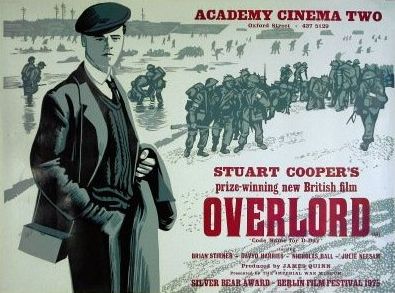
Overlord (1975)

day 73, overlord

OVERLORD (1975) Four stars
American director Stuart Cooper did something very interesting for his fourth film, 1975’s OVERLORD.

Cooper integrated archival footage of British training missions and the D-Day Invasion (a.k.a. Operation Overlord) into a fictional film about a young man’s journey from call up to the grave. Cooper and his very talented cinematographer John Alcott (he won the Academy Award for Best Cinematography for his work on Stanley Kubrick’s BARRY LYNDON, another 1975 film) did their best to make a consistent look so one could not tell any difference between the archival footage and the fictional story.

The Imperial War Museum granted Cooper access to its vaults and that’s where he found all that historical footage. Cooper had originally planned to make a documentary on the Overlord Embroidery, which commemorates scenes from wartime photos housed by the Imperial War Museum. Sandra Lawrence designed it and the Royal School of Needlework provided the handiwork.

Cooper told The Guardian in 2008, “I spent approximately 3,000 hours in that dark cell between 1971 and 1975, briefly interrupted by a couple of other projects. It was during the archival research that I developed the idea of a dramatised feature film about an English soldier who sees his first action on D-Day, interweaving the archive footage to expand and tell the story. …

“A major concern for my cinematographer, John Alcott, was how to match the texture of the archive footage. In an unprecented move, the museum granted us access to the original nitrate negatives. The quality of the original nitrate negatives was pristine. After Alcott examined them, we decided to film OVERLORD on period lenses. Alcott scoured England and found two sets of 1936 and 1938 German Goetz and Schneider lenses. Alcott then applied a lighting style in keeping with the war photography, seamlessly blending the archive and dramatised story. Seventy percent of the film is live action, which was completed in 10 days of filming.”

OVERLORD, though it won the Silver Bear at the 25th Berlin International Film Festival, seemed to have fallen through the cracks of history for many, many years.

Cooper again in The Guardian, “In spite of OVERLORD’s festival success, it never gained distribution in the U.S., which I suspect hurt its chances of being properly remembered. It may also have been because it was made during the tail end of the Vietnam War, as well as being a black-and-white film with a very British story. The only airing the film received in the U.S. was on Jerry Harvey’s Z Channel in 1982, a forerunner to U.S. cable stations. Twenty-two years later, Xan Cassavetes, John Cassavetes’ daughter, included several clips of OVERLORD in her 2004 documentary, Z CHANNEL: A MAGNIFICENT OBSESSION. As a result, OVERLORD was invited to the Telluride Film Festival, where it was a surprise success. Shortly afterwards, it was belatedly picked up for U.S. distribution.”

Better late than never, for sure.

I found out about the film from Roger Ebert’s 4-star review in 2006.

Ebert first wrote about the film at Telluride in 2004, “The most remarkable discovery at this year’s Telluride is OVERLORD, an elegiac 1975 film that follows the journey of one young British soldier to the beaches of Normandy. … Unlike SAVING PRIVATE RYAN and other dramatizations based on D-Day, OVERLORD is an intimate film, one that focuses closely on Tom Beddoes (Brian Stirner), who enters the British army, goes through basic training and is one of the first ashore on D-Day. Beddoes is not a macho hero but a quiet, nice boy, who worries about his cocker spaniel and takes along ‘David Copperfield’ when he goes off to war.”

Christopher Hudson’s screenplay built scenes based on diaries and letters from real servicemen, again providing something unique from the average war film.

Unique is definitely one word for OVERLORD.

You sometimes feel like you’re watching a real young man’s life, as if Tom Beddoes had been a real person and had been followed around by a documentary film crew who managed to conceal themselves from the real people being filmed.

That’s a different feeling than just about every other fictional war movie.

Of course, OVERLORD includes all the standard issue scenes: Tom’s call up, his basic training, his meeting a young woman whom he falls in love with (she’s called “The Girl” in the credits), his journey overseas, and finally his death on D-Day.

OVERLORD reminds us that clichés have their roots in things commonly happening to people.

Who knows how many Tom Beddoes there have been and will be throughout the pages of history.

I drift back to the following lyrics from the Clash’s “The Call Up,” “There is a rose that I want to live for / Although, God knows, I may not have met her / There is a dance an’ I should be with her / There is a town unlike any other.”

Jaws (1975)

day 23, jaws

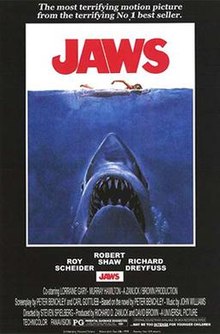
JAWS (1975) Three-and-a-half stars
Steven Spielberg’s JAWS wanted to do for sharks what Alfred Hitchcock’s PSYCHO did for showers 15 years earlier.

Like PSYCHO, JAWS became a game-changing motion picture and it’s been analyzed, overanalyzed, parodied, and satirized, and it spawned many clones and rip-offs with just about every animal turned into a relentless killer.

It’s known as the first summer blockbuster film (released on June 20, 1975), I mean it even says so in the Guinness Book of World Records, “Not only did people queue up around the block to see the movie, it became the first film to earn $100 million at the box office.”

Before 1975, summers were traditionally reserved for dumping insignificant fluff.

Based on Peter Benchley’s best-selling novel, JAWS tells a pulp story: a great white shark terrorizes Amity Island, a summer resort community, and transplanted city policeman Sheriff Brody (Roy Scheider) wants to close off the beaches but he runs into much resistance from Mayor Larry Vaughn (Murray Hamilton), who of course fears the loss of tourist revenue more than he does a great white shark. Eventually, though, Brody, along with preppy Ichthyologist Matt Hooper (Richard Dreyfuss) and grizzled old man of the sea Quint (Robert Shaw), attempts to hunt down and kill the great white aboard Quint’s ship, the Orca.

The film and the novel are different in several fundamental ways: Hooper and Brody’s wife do not have an affair in the film; Mayor Vaughn’s squeezed by the mafia in the novel and not simply local business interests; newspaper man Harry Meadows plays a bigger role in the novel; Quint’s made a survivor of the World War II USS Indianapolis; Hooper escapes death in the film; Quint dies by drowning in the novel; in the film, Brody kills the shark by shooting a compressed air tank inside the creature’s jaws, of course.

Spielberg said that he rooted for the shark the first time he read Benchley’s novel because he found the human characters unlikeable.

Normally, books are credited for having stronger characterizations than their screen adaptations.

That’s not the case with JAWS.

In fact, none of the subsequent JAWS films could match the characterizations of Brody, Hooper, and Quint and performances by Scheider, Dreyfuss, and Shaw. We have three indelible characters who stay within our hearts and minds just as much as the image of the great white shark.

Scheider and Dreyfuss appeared to have great chemistry together, just like there seemed to be real tension between Dreyfuss and Shaw.

Universal had Scheider bent over a barrel after he dropped out two weeks before filming started on THE DEER HUNTER, due to “creative differences,” and so they forced Scheider into starring in JAWS 2. Scheider’s performance in JAWS 2 suggests a very, very unhappy person and his conflicts with director Jeannot Szwarc must have only contributed to Scheider’s apparent misery.

Dreyfuss passed on JAWS 2 because Spielberg did not direct it; they made CLOSE ENCOUNTERS OF THE THIRD KIND together instead. Of course, there were obvious difficulties in Quint returning for JAWS 2.

JAWS 2 gives us a bunch of teeny boppers and repeats the basic plot of the first movie, JAWS 3-D sinks even more into a morass of mediocrity (how bad must you be to be disowned by the next JAWS film), and JAWS THE REVENGE, well, it gives us the first shark movie designed for geriatric consumption. To be honest, JAWS THE REVENGE defies the suspension of disbelief beyond belief and becomes one of the worst bad movies ever made.

Necessity became the mother of invention for JAWS, because of the numerous technical difficulties with the mechanical shark that became known as Bruce, named after Spielberg’s lawyer, or alternately “the great white turd.” Spielberg wanted to show the shark a lot sooner, but instead the film took on more Val Lewton proportions than the average horror movie. JAWS relies heavily on John Williams’ famous musical score to substitute for the shark.

The JAWS sequels utilized the mechanical shark far more often and much earlier on, honestly to their detriment. Less is more and more is less.

I always love it when horror movies take on more than just being a horror movie. At times, especially when our three protagonists are stuck on that damn boat together, JAWS becomes grand adventure and an unexpected comedy.

The Up Series (1964- )

250px-the_up_series_dvd

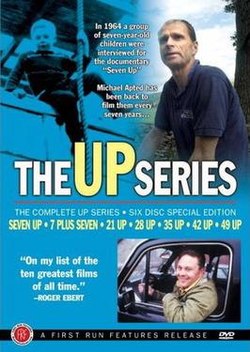
THE UP SERIES (1964- ) Four stars

In his early 20s, researcher and future director Michael Apted picked 14 7-year-old British boys and girls — Bruce Balden, Jackie Bassett, Symon Basterfield, Andrew Brackfield, John Brisby, Peter Davies, Susan Davis, Charles Furneaux, Nicholas Hitchon, Neil Hughes, Lynn Johnson, Paul Kligerman, Suzanne Lusk, and Tony Walker — from either the upper class or working class to participate in a documentary for Granada Television called “Seven Up!”

That was 1964 and the guiding theory behind the documentary was that each child’s social class determined their future or “Give me a child until he is seven and I will give you the man.”

Beginning in 1971 with 7 PLUS SEVEN, Apted (serving as director) has tracked down the original participants and made another film, every seven years. We catch up with them and their lives. We see and hear them at every seven-year interval. We can expect 63 UP in 2019.

Over the course of time, just one participant willingly dropped out completely, Charles Furneaux, who quit after 21 UP (1977). In an irony, Furneaux became a documentarian himself. Three others have missed a combined six installments.

In May 2013, Lynn Johnson became the first participant to die. A librarian, St. Saviour’s School in London honored Johnson with a refurbished library and the plaque read “St. Saviour’s School Library in honour of Lynn Johnson … who was passionate about reading.” Johnson had been the Chair of Governors at the school for 25 years.

Of course, it’s not been easy for the participants.

Nicholas Hitchon touched on this in a 2012 interview with The Independent.

“It’s always very disturbing,” Hitchon said. “It’s the fact that they don’t show you the way you want to be shown — but that’s not the main thing. They ask you some really disturbing questions. They stick a camera under your nose and ask — ‘Why did you choose your wife?’ — and then it’s shown to gazillions of people. I’ve learnt that the stupider the thing I say, the more likely it is to get in. You’re asked to discuss every intimate part of your life. You feel like you’re just a specimen pinned on the board. It’s totally dehumanising.”

Hitchon said that his relationship has been strained with Apted over the years, especially after his portrayal in 28 UP. By that point in his life, he moved to the United States.

“Anyone who knows me knows that I don’t hang out at malls,” Hitchon said. “But [Apted] took me to one and filmed in front of a lot of girls’ punk clothing and said, ‘Nick came to the US for a salary of £30,000.’ Some people in England changed their mind about me as a result, thinking what a jerk he’s become. That was really upsetting.”

Hitchon has participated in each film, concluding “It’s wonderful that someone had this new idea and I feel very privileged to have been part of it — but it’s come at a big cost.”

Hitchon, the farm kid of the bunch, became a nuclear physicist. “Well, if you’ve seen the film, I was furious because at 7 I was just answering questions. But by the time I was 13, I did not like the way they’d portrayed me. It was clear that they were portraying me as a bumpkin. And, I mean, you know, I was mad.” Hitchon said that before he played a game called ’Not My Job’ for NPR.

School teacher (and later lawyer) Peter Davies dropped out for three installments after remarks he made about the Margaret Thatcher government in 28 UP. We did not see him again until 56 UP (2012).

“I pulled out because of the reaction to my participation in the weeks after 28 UP, particularly from the tabloid press,” Davies said in the Telegraph. “They decided they were going to portray me as the angry young Red in Thatcher’s England. I think I was articulating at the time what a lot of young people of my age were thinking. I was absolutely taken aback, genuinely shocked, at the level of malice and ill will directed toward me. Until you’ve experienced it yourself, you can’t begin to appreciate how it feels.”

Davies returned to the series to promote his band The Good Intentions.

In an academic journal, Apted responded to complaints made about the series.

“The UP films are clearly the one project I’ve done that has stayed around the longest and had the most impact,” Apted wrote. “Yet, it’s also the hardest to define and to nail down. Its power is that it means all things to all people. Everybody who has the patience to watch it finds something in it: a character, an event, a thought, a moment that they can relate to. People project themselves onto it and it becomes very personal to the viewer.”

He’s right.

As I started watching the films (they can be discovered online), I found myself flashing back on my own life at 7, 14, 21, 28, and 35, and made some mental notes on my evolution. I remembered home movies from Christmas 1987 and Thanksgiving 1988, as well as numerous neighborhood basketball games from 1997 through 2000. Always thought it was great to have all that documented.

7 years old (1985): first grader at Arma Elementary School. I can remember every single teacher that I had from K through certainly 8. That year, it was Ms. Golob. For some reason, I recall missing recess due to illness and honing up on all 50 states and their capitals (Montpelier, Vermont, baby!), as well as remembering every United States president in order. Nerd alert!

14 years old (1992): eighth grader at Northeast Junior High. Awkward, very awkward time in my life, as ridiculously big glasses and braces dealt a double whammy of even more awkwardness during a time with raging hormones already taking a toll. Some folks look back on their teenage years as the best years of their lives. To hell with that, for many, many reasons. It took years to work through adolescent awkwardness.

21 years old (1999): final semester at Fort Scott Community College. I remember every time walking up to a bar for a drink and every single damn server not believing that I was 21 years old. In fact, every single time, I heard something like “You look 14 years old.” Damn, baby face! Hell, even several years later, while a substitute teacher at alma mater Fort Scott High, I walked first onto a school bus transporting us to the bowling alley and the bus driver was shocked, absolutely shocked that I was the teacher. She thought I was a student.

28 years old (2006): Eight days after my birthday, I wrecked and rolled over. Bye-bye, Enterprise! That day, I planned on attending a job fair at my alma mater Pittsburg State. About halfway to Pittsburg, I said to hell with all that jazz because at that point in my life, I did not want another damn rejection. After graduating with a master’s degree in 2005, I must have endured a few hundred applications and interviews before returning to college and embarking on my current path.

35 years old (2013): At this point, as sports writer at the Morning Sun, I started working 60-70 hours a week, a rate of work that culminated with a 156-hour time sheet in May 2014. Yeah, that’s right, 76 overtime hours. (That’s a long story. I’d rather talk about something else.) At least, I get to love what I love to do and that’s what keeps me going. Back in sixth grade, I wrote that I wanted to be a sports writer when I grow up. You were right, you crazy bastard.

And now for something completely different: I love, absolutely love it every time characters in the UP films say “row” (rhymes with cow).

The Big Red One (1980)

day 72, the big red one

THE BIG RED ONE (1980) Four stars
When I think of the dumb things college students love to say, I drift back to the History in Film & Fiction class that I took back in 2005 at Pittsburg State.

Boy oh boy, all those undergrads sure did say the dumbest things. (A graduate student like myself would never.)

Like, for example, after we consumed SAVING PRIVATE RYAN around Veterans’ Day.

Were these normally cynical and reserved undergrads all of a sudden turned into Steven Spielberg’s press agents?

Sounded like it.

I mean, for crying out loud, I don’t remember any of those bastards liking the other films we considered that semester or liking at least enough to break on through that cool, detached undergrad reserve.

Several classmates said “SAVING PRIVATE RYAN is the greatest war movie ever made.” One even said, “It’s the only war movie to ever truly care about its characters.” All said with that gleeful, pretentious undergrad enthusiasm.

The first opinion makes you wonder how many war movies they have seen. Probably not that many, either then or now for that matter. Anyway, just say that it’s your favorite and not make that great leap to being an asshole by saying “the greatest.”

The second one makes you wonder how that undergrad history major knew how Spielberg felt about his characters and how that was somehow purer of heart than all the other makers of countless war movies.

For example, makes you wonder how director William Wyler, a World War II veteran, felt about the three veteran characters returning home in THE BEST YEARS OF OUR LIVES (1946). Man, oh man, betcha he must have disliked them characters and didn’t care a single lick about them and their plight. Sure, sure, sure, Wyler just did it for the money and the heaps of critical praise, unlike Mr. Spielberg.

We needed a Walter Sobchak in our class that day and he could have pretended the undergrads were all named Donny, especially when they were getting just a wee bit too grandiose in their statements.

“SAVING PRIVATE RYAN is the greatest war movie ever made. …”

“Shut the fuck up, Donny.”

“It’s the only war movie to ever truly care about its characters. …”

“Forget it, Donny, you’re out of your element.”

“SAVING PRIVATE RYAN is the greatest war movie ever made. …”

Jeffrey Lebowski speaks up, “Yeah, well, you know, that’s just, like, your opinion, man.”

I am sure that Spielberg would not be guilty of such ridiculous statements as his many unabashed admirers in that Film & Fiction class.

For example, Spielberg and George Lucas grabbed the character name “Short Round” for INDIANA JONES AND THE TEMPLE OF DOOM from director Samuel Fuller’s Korean War film THE STEEL HELMET.

You can be sure Spielberg watched Fuller’s World War II epic THE BIG RED ONE before taking on SAVING PRIVATE RYAN.

Fuller (1912-97) was truly an one-of-a-kind dynamo who lived one helluva life. A screenwriter, a novelist, a reporter, a combat veteran, a World War II survivor, a director, an actor, an inspiration to many. He directed some of the best movies you could ever have the chance to see (I would start with WHITE DOG) and THE BIG RED ONE lives and breathes Fuller.

From his 1980 Cannes Film Festival interview with Roger Ebert, where there’s an audience of a German TV crew and they ask him if THE BIG RED ONE was pro-war or anti-war, Fuller said, “Pro or anti, what the hell difference does it make to the guy who gets his ass shot off? The movie is very simple. It’s a series of combat experiences, and the times of waiting in between. Lee Marvin plays a carpenter of death. The sergeants of this world have been dealing death to young men for 10,000 years. He’s a symbol of all those years and all those sergeants, no matter what their names were or what they called their rank in other languages. That’s why he has no name in the movie.

“The movie deals with death in a way that might be unfamiliar to people who know nothing of war except what they learned in war movies. I believe that fear doesn’t delay death, and so it is fruitless. A guy is hit. So, he’s hit. That’s that. I don’t cry because that guy over there got hit. I cry because I’m gonna get hit next. All that phony heroism is a bunch of baloney when they’re shooting at you. But you have to be honest with a corpse, and that is the emotion that the movie shows rubbing off on four young men.

“I wanted to do the story of a survivor, because all war stories are told by survivors. Pro- or anti-war, that’s immaterial, because in any war picture, you’re going to allegedly feel anti-war because they make a character sympathetic and then the character gets shot, and so you say, ‘How tragic.’ What baloney. Why should I be against war because some kid gets hit while he’s reading a letter from Mom? I don’t think I’ve seen any war movie where you get to know the characters and one of them isn’t killed. It’s a cliche.

“But to the guy who’s killed, try telling him about heroism and courage. Get him to listen after he’s dead. Even World War II, with all its idealism, basically there was a lot of hypocrisy. …”

I could read a Fuller interview all day.

Fuller served in the 1st Infantry Division or “The Big Red One” and he received the Silver Star, Bronze Star, and Purple Heart during his service. THE BIG RED ONE’s based on his experiences with Robert Carradine’s Pvt. Zab as Fuller’s alter ego. Fuller sold a gangster novel that he wrote during his military service and in the movie, just like in real life, he finds out that his novel’s been published when he spots a soldier reading it.

Fuller, in his interview with Ebert, said that Carradine’s character is not nearly as vicious as Fuller was in real life.

Zab’s the narrator in THE BIG RED ONE and I just love his narration, both the words themselves (apparently written by Jim McBride) and Carradine’s delivery.

A couple examples: “The Bangalore Torpedo was 50′ long and packed with 85 pounds of TNT and you assembled it along the way. By hand. I’d love to meet the asshole who invented it.”

Example No. 2: “These Sicilian women cooked us a terrific meal. It’s too bad they were all over 50. We were more horny than we were hungry.”

Those are words you could find yourself saying.

Our four privates are Zab, Griff (Mark Hamill), Vinci (Bobby DiCicco), and Johnson (Kelly Ward), and they all do bang-up jobs. It’s especially nice seeing Hamill in a live-action role outside Luke Skywalker.

In the long run, though, THE BIG RED ONE belongs to Lee Marvin as The Sergeant.

You could just say that Marvin was born to play this role.

He’s one gruff son-of-a-bitch and he’s lovable because of it.

Marvin’s delivery and Fuller’s dialogue are a match made in heaven.

Check out this conversation and try and imagine Marvin saying it as The Sergeant.

Griff: I can’t murder anybody.

The Sergeant: We don’t murder; we kill.

Griff: It’s the same thing.

The Sergeant: The hell it is, Griff. You don’t murder animals; you kill ’em.

THE BIG RED ONE marked Fuller’s return to directing after 11 years, with THE SHARK from 1969 his previous credited film, and it was to be his grand epic.

Fuller originally submitted a 4-hour cut and then a 2-hour cut, and both were rejected, of course, by the studio.

The studio reedited the film and tacked on the narration, but still in any form, THE BIG RED ONE packs a wallop and it’s one of the best war movies out there.

Five Deadly Venoms (1978)

day 47, five deadly venoms

FIVE DEADLY VENOMS (1978) Three-and-a-half stars
Years ago, I finally tracked down (i.e. bought) a subtitled copy of FIVE DEADLY VENOMS and it made all the difference in the world after having extreme technical difficulties watching a dubbed copy the week before the subtitled version, failing twice to make it through because of the haphazard dub job.

The plot in a nutshell: A wise old martial arts master, on his death bed, gives his latest young martial arts pupil a dying wish to go track down some wayward pupils who have done “evil” with the master’s teachings, the “Five Deadly Venoms” that provide our lovely and oh so poetic title, and redeem the master and his martial arts philosophy and teachings forever.

Like DRUNKEN MASTER, FIVE DEADLY VENOMS provides us with multiple idiosyncratic martial artists, fighting styles, and personalities: The Centipede, The Snake, The Scorpion, The Gecko (lizard), and The Toad. The young pupil combines all five styles, although he’s not as potent as the older pupils because he only knows a little about each style.

The old man describes their styles in some detail on his deathbed. Honestly, this scene gets us hyped for the movie ahead, filled with great expectations.

Each fighter and fighting style have their own distinct strengths and weaknesses, some more apparent than others.

The Centipede: Based on speed and quickness. Fastest of the fast.

The Snake: Based on agility and flexibility. This flexibility makes for mad defensive skills and the pinpoint ability to attack the opponents’ weak spots.

The Scorpion: Based on acrobatic kicks or “the sting.” The style resembles the scorpion pincer in the hand techniques of the artist.

The Lizard: Nimble, quick footwork, also described on the FAQs at the IMDb as “Spider-Man with a black belt” because of The Lizard’s mastery of walls.

The Toad: Based on power and resilience. Once mastered, this style lends itself to becoming immune to physical harm. Well, we’ll all see how well that stands up in FIVE DEADLY VENOMS.

These fascinating artists and styles are placed inside an old-fashioned movie plot involving an old man’s treasure, imperial politics, and secret identities. We also have the age-old themes of redemption and revenge that seem to be at the core of the genre.

The different artists each wear masks that prominently feature their animal at the top of the mask.

Of course, you might find FIVE DEADLY VENOMS silly, very silly indeed, almost by default with this genre. I’ve always found that “silliness” in martial arts entertainments to be one of their most endearing features. Your mileage may vary.

Granted, THE FIVE DEADLY VENOMS takes itself seriously. It’s not attempting to be a comedy in any way shape or form.

There’s several twists and turns in the plot and we have to figure out the alignment of the “Five Deadly Venoms.”

We know that certain fighters will be more deadly than the others. To the film’s credit, I couldn’t guess it straight out. We align ourselves with the young pupil early on and follow him on his journey through such deadly waters.

Just a cut below DRUNKEN MASTER and THE 36TH CHAMBER OF SHAOLIN, two fabulous martial arts entertainments from 1978, THE FIVE DEADLY VENOMS nonetheless proves itself a damn good time at the movies and another iconic entry in the Shaw Brothers’ filmography. (Another martial arts film referenced by multiple hip-hop artists over the years, as well as Quentin Tarantino. It was also the inspiration for a series of Sprite commercials in the late 1990s.)

Please seek out the subtitled version. The dubbing proved deadliest venom in the English dubbed version. It took effect almost immediately.

Psycho (1960)

day 22, psycho

PSYCHO (1960) Four stars
Oh, to get into any one of the seven DeLorean DMC-12s used in BACK TO THE FUTURE and rev that sonuvabitch up to 88.8 MPH with the date set for June 16, 1960, the release date for Alfred Hitchcock’s PSYCHO.

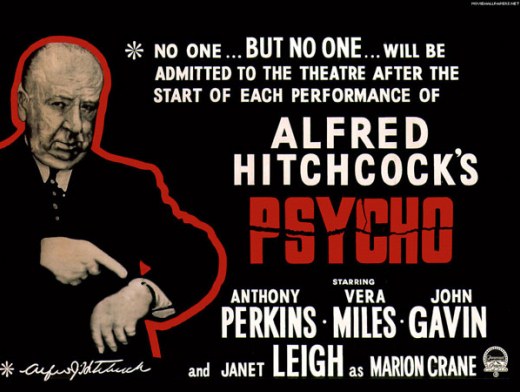
I’d go find the nearest theatre where it’s playing and put down the 69 cents. Of course, I would be sure to arrive early and hang around the lobby if necessary since Hitchcock made sure theaters enforced a strict “no late admission” policy.

Hitchcock even wrote a beautiful note, “Surely you do not have your meat course after your dessert at dinner. You will therefore understand why we are so insistent that you enjoy PSYCHO from start to finish, exactly as we intended that it be served.

“We won’t allow you to cheat yourself. Every theatre manager, everywhere, has been instructed to admit no one after the start of each performance of PSYCHO. We said no one — not even the manager’s brother, the President of the United States or the Queen of England (God bless her).

“To help you cooperate with this extraordinary policy, we are listing the starting times below. Treasure them with your life — or better yet, read them and act accordingly.”

Gotta love that Hitchcock and his ripped, twisted sense of humor.

Anyway, I would go back in time to see PSYCHO just to observe others’ reactions to it, to see their shock, to see their absolute terror at certain moments. They would not have possibly known all the surprises in store for them, while viewers for the last nearly 60 years have not had the benefit of watching PSYCHO with a clean slate. Since its release, PSYCHO has been analyzed, overanalyzed, parodied, satirized, and its famous shower scene long ago replaced the Odessa Steps sequence from BATTLESHIP POTEMKIN (1925) as the most fetishized scene in movie history.

Every time I watch PSYCHO, I am gobsmacked by just how audacious Hitchcock and gang were in making it. Start the movie with a love affair in a seedy hotel? Check. Show the heroine in her bra multiple times? Check. Kill off the heroine played by a big movie star halfway through the film? Check. Start out with the theft of $40,000 and more or less drop it after the death of the heroine? Check.

That’s just the tip of the iceberg.

Of course, none of that might seem the least bit audacious in 2018, but please keep in mind the Motion Picture Production Code dominated Hollywood movies from the early 1930s through 1968. PSYCHO helped chip away at that damn archaic code.

Everybody knows the plot by now. Marion Crane (Janet Leigh) steals $40,000 from her employer’s client and she’s on the lam hoping to get together with her lover Sam (Sam Loomis, played by John Gavin). We hear the voices that are inside her head (her mind and by extension our minds are obsessed with the money) and Hitchcock once again proved he’s the Master of Suspense by making a policeman’s stop and Marion’s drive in the pouring rain as tension-filled as any of the death scenes. With the rain beating down on her poor, weary windshield wipers, a conscience-stricken Marion stops at the famous Bates Motel with its 12 cabins and 12 vacancies.

There we meet proprietor Norman Bates (Anthony Perkins), a fictional character in Robert Bloch’s novel and Hitchcock’s film with roots in the real-life Wisconsin murderer and grave robber Ed Gein (an inspiration for THE TEXAS CHAINSAW MASSACRE’s Leatherface). Gein, for example, loved to make wastebaskets from human skin. Unlike later slasher movie super villains Michael Myers and Jason Voorhees, Norman speaks and he does not wear a mask. This makes Norman Bates far more fascinating than any of the slasher film madmen descended from PSYCHO.

Norman loves taxidermy and he’s got mother issues.

Otherwise, he seems like a good, old-fashioned All-American boy.

Oh, what happens to Marion? Let’s just say that in real life, Leigh stopped taking showers for years, preferring a bath after the fate of her character in PSYCHO.

Sam teams up with Marion’s sister Lila Crane (Vera Miles) and they try and track down Marion. Of course, all roads lead them and poor, poor Detective Arbogast (Martin Balsam) to Bates Motel and Norman Bates and his dear old mother.

In arguably his most audacious move, Hitchcock substituted protagonists from Marion Crane to Norman Bates. Perkins gives one of the great performances, one that will be discussed and cherished for centuries. He walks away with the movie.

The HALLOWEEN sequels continued to add more and more back story to the detriment of Michael Myers. Near the end of PSYCHO, Hitchcock gives us a phony baloney psychiatrist (Simon Oakland) and his phony baloney explanation for Norman Bates, but it’s taken to such an extreme that it plays like a parody. We could have done without this sequence, though, unlike the rest of the movie.

Early on in this review, I shared a note from Hitchcock. Now we go full circle.

A woman complained to Hitchcock that the PSYCHO shower scene had such a deleterious effect on her daughter that the young girl refused to shower.

Hitchcock replied, “Then Madam I suggest you have her dry cleaned.”

Clan of the White Lotus (1980)

DAY 45, CLAN OF THE WHITE LOTUS.jpg

CLAN OF THE WHITE LOTUS (1980) Three-and-a-half stars
The Shaw Brothers (Runme and Run Run Shaw) rapidly became my favorite old school movie factory producers, following hot on the trails of the spectacles of the incomparable INFRA-MAN and THE 36TH CHAMBER OF SHAOLIN with CLAN OF THE WHITE LOTUS, a 1980 effort directed by Lo Lieh.

Like Sam Elliott’s rustic narrator said to the Dude in THE BIG LEBOWSKI, “I like your style.”

I get all giddy when I see and hear the Shaw Brothers fanfare before their every movie.

CLAN OF THE WHITE LOTUS quickly dispenses with its standard issue martial arts plot and focuses on exciting fight sequences centered on choreographed punches and kicks that play like violent ballet or Fred Astaire and Gene Kelly meets Bruce Lee.

Gordon Liu made his fame in THE 36TH CHAMBER OF SHAOLIN and stars here as our bald protagonist with the wicked cool handle. In THE 36TH CHAMBER, it was San Te (pronounced like the jolly fat guy from the North Pole) and in WHITE LOTUS, it’s Hong Wen-Ting but the subtitles tell us it’s “Hung Man Ting.”

Anyway, Liu plays the hot-tempered fiery young martial artist who faces many unbelievable hardships through the first couple acts before finally triumphing over every obstacle and the resident evil antagonist holding our main man back during the first couple acts through his sheer dedication, hard work, and martial arts talent.

As we discussed at some length in THE 36TH CHAMBER review, Liu is a genuine movie star and holds the camera and our attention and rooting interest.

Director Lo Lieh doubles as the resident evil antagonist Priest White Lotus and he’s virtually untouchable in the first two reels and he undoubtedly could take on an entire cast of doubles and extras just with his glorious white beard alone.

Tarantino fans will immediately recognize White Lotus.

CLAN OF THE WHITE LOTUS depends on a durable storytelling formula (underdog triumphs over evil) and, like DRUNKEN MASTER and THE 36TH CHAMBER OF SHAOLIN, WHITE LOTUS puts enough quirky twists and turns on the formula without diluting its very purity and making it unrecognizable from its basic elements.

For example, CLAN OF THE WHITE LOTUS co-stars needles, a martial artist getting in touch with his feminine side and martial arts style, a child, and pressure points. I believe I’ll skip more generic action movies and stick to films like CLAN OF THE WHITE LOTUS.

I mean, just look at a poster that hypes “Deadly Needle Kung-Fu Against the Invincible Armor of White Lotus.”

I would certainly have bought tickets for that extravaganza.

Alternate titles: HONG WENDING SAN PO BAI LIAN JIAO and FISTS OF THE WHITE LOTUS.

The Adventures of Ichabod and Mr. Toad (1949)

DAY 21, THE ADVENTURES OF ICHABOD AND MR. TOAD.jpeg

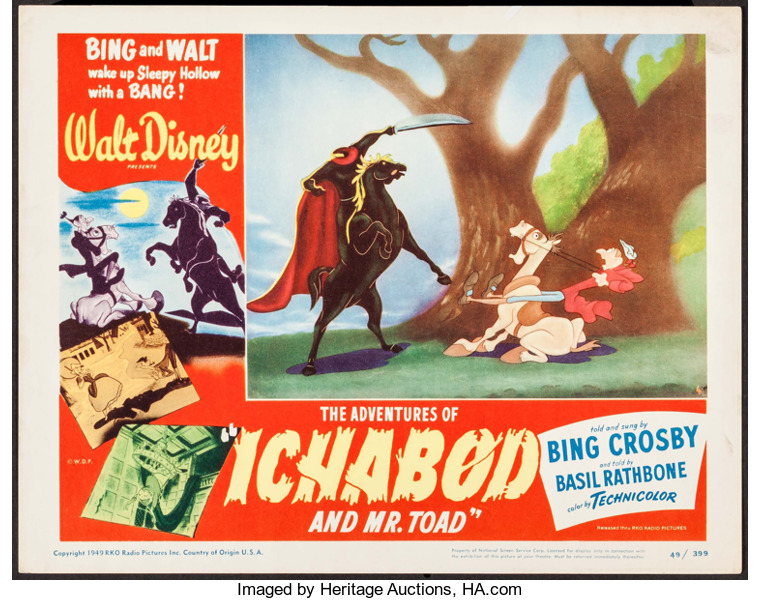
THE ADVENTURES OF ICHABOD AND MR. TOAD (1949) Three-and-a-half stars

Walt Disney favored package films after the release of BAMBI (1942) and released about one every year to close out the 1940s.

THE ADVENTURES OF ICHABOD AND MR. TOAD runs at 68 minutes, split at just the right length between the opening Mr. Toad segment based on “The Wind in the Willows” by Kenneth Grahame and the closing Ichabod Crane segment based on “The Legend of Sleepy Hollow” by Washington Irving. We have narration duties split between Basil Rathbone (MR. TOAD) and Bing Crosby (ICHABOD), plus Crosby handles voice duties for both Ichabod Crane and Brom Bones and sings a few songs. Crosby sings “The Headless Horseman” tale Brom Bones tells at the campfire that sticks in Ichabod Crane’s imagination on that famous long ride home.

Since we’re on a month of horror movie reviews, I will be focusing on the ICHABOD segment for the purpose of these few hundred words.

I must have first read “The Legend of Sleepy Hollow” in eighth grade and it’s long been one of my favorite stories. It’s compulsively readable (an engrossing yarn as the publicists said in 1820) and I’m looking around for that damn Irving anthology I bought several years ago. It must be hiding, of course, probably somewhere right around that Edgar Allen Poe anthology that could squish a spider the size of a Buick.

Just take a prose sample:

“As Ichabod approached this fearful tree, he began to whistle; he thought his whistle was answered: it was but a blast sweeping sharply through the dry branches,” Irving wrote. “As he approached a little nearer, he thought he saw something white, hanging in the midst of the tree: he paused and ceased whistling; but on looking more narrowly, perceived that it was a place where the tree had been scathed by lightning, and the white wood laid bare. Suddenly he heard a groan—his teeth chattered, and his knees smote against the saddle: it was but the rubbing of one huge bough upon another, as they were swayed about by the breeze. He passed the tree in safety, but new perils lay before him.

“About two hundred yards from the tree, a small brook crossed the road, and ran into a marshy and thickly wooded glen, known by the name of Wiley’s Swamp. On that side of the road where the brook entered the wood, a group of oaks and chestnuts, matted thick with wild grape vines, threw a cavernous gloom over it. To pass this bridge was the severest trial. It was at this identical spot that the unfortunate Andre was captured, and under the covert of those chestnuts and vines were the sturdy yeoman concealed who surprised him. This has ever since been considered a haunted stream, and fearful are the feelings of the schoolboy who has to pass it alone after dark.”

As much as I like the Johnny Depp and Tim Burton SLEEPY HOLLOW (1999), it only appropriates the title and a few character names from Irving’s short story. It’s laughable when you read “Based on ‘The Legend of Sleepy Hollow’ by Washington Irving” in the credits, because Ichabod Crane’s transformed into a horror movie hero who’s rather normal even by Burton and Depp standards and he’s no longer a gold digger like in Irving’s story, where Ichabod schemes after Katrina Van Tassel more for her money than her looks and personality. Ichabod becomes the standard issue lovable movie eccentric and he’s also a constable and not a schoolteacher. Of course, that plays into a murder mystery that manufactures more twists than a year’s worth of production at a pretzel factory.

I have to stifle laughter at this very instant after reading the Wikipedia entry for the 1999 version, which starts “SLEEPY HOLLOW is a 1999 American gothic supernatural horror film directed by Tim Burton. It is a film adaptation loosely based on Washington Irving’s 1820 short story ‘The Legend of Sleepy Hollow.’”

How loosely? Very loosely. Maybe as loosely as the Demi Moore version of SCARLET LETTER.

Burton’s film seems more heavily influenced by Hammer Films (none other than Christopher Lee plays a small role) than the original story, which plays on legends, superstitions, and Ichabod’s overactive imagination for its horrors. SLEEPY HOLLOW makes one feel that it’s merely exploiting the Washington Irving name and literary reputation to give class to what would otherwise be another gory horror movie with a rather convoluted plot.

Take away the slapstick and Crosby’s songs about Ichabod and Katrina, the Walt Disney version sticks closer to the spirit and letter of Washington Irving and the final dozen minutes of ICHABOD AND MR. TOAD are a vivid reminder of Disney films’ ability to scare audiences in classics like SNOW WHITE, PINOCCHIO, and BAMBI.

Ultimately, though, with the Burton film, I accept it for what it is rather than what it is not. Cue to “Seinfeld” and “Not that there’s anything wrong with that.” It does have a lot of virtues and I’ve enjoyed it every time seeing it since that first time in a theater in late 1999. Hey, that reminds me, I need to grab my VHS copy and put the damn thing on.