Road House (1989)

ROAD HOUSE

ROAD HOUSE (1989) Three-and-a-half stars
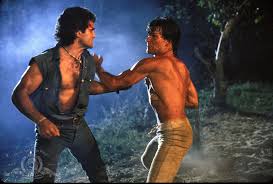
This is the Patrick Swayze (1952-2009) movie that ate all his other movies. More like ripped all the other movies’ throats out. We are talking about ROAD HOUSE, after all.

You can weep to GHOST, you can boogie to DIRTY DANCING, and you can kill Commies to RED DAWN, that’s fine and dandy, whatever floats your boat and tickles your fancy, but ROAD HOUSE is the ultimate Swayze viewing experience, at least for this magnificent bastard.

It is Swayze in Testosterone Hyperdrive, or it should have been titled OVER THE TOP rather than Sylvester Stallone’s epic about child custody, arm wrestling, and truck driving.

“Dalton lives like a loner, fights like a professional. And loves like there’s no tomorrow.”

“The dancing’s over. Now it gets dirty.”

“Dalton’s the best bouncer in the business. His nights are filled with fast action, hot music and beautiful women. It’s a dirty job, but somebody’s got to do it.”

Three taglines for ROAD HOUSE that only hit at the surface of the epic sleaze within the film.

Swayze plays Dalton, who’s not only the world’s greatest bouncer, he’s got a degree in philosophy from NYU. At one point, Dalton shares his general bouncer philosophy to his bouncer troops at the Double Deuce, the world’s roughest bar and the pride of the fictional Jasper, Missouri. (Bet the film’s producers did not know there’s a real Jasper, Missouri.)

“All you have to do is follow three simple rules. 1) Never underestimate your opponent. Expect the unexpected. 2) Take it outside. Never start anything inside the bar unless it’s absolutely necessary. And 3) Be nice.”

I enjoy hearing these rules — every single time — just like in GREMLINS when inventor Rand Peltzer tells his son about his new pet Mogwai, “First of all, keep him out of the light, he hates bright light, especially sunlight, it’ll kill him. Second, don’t give him any water, not even to drink. But the most important rule, the rule you can never forget, no matter how much he cries, no matter how much he begs, never feed him after midnight.”

I enjoy hearing both the rules in GREMLINS and ROAD HOUSE because I know that rules are meant to be broken in the movies. The rules — and a whole lot more, namely bones and plate glass windows — are definitely broken in ROAD HOUSE.

ROAD HOUSE is the most quotable Swayze movie by far.

“Pain don’t hurt.”

“Prepare to die.”

“Nobody ever wins a fight.”

“A polar bear fell on me.”

“You’re too stupid to have a good time.”

“Calling me ‘sir’ is like putting an elevator in an outhouse, it don’t belong.”

“Elvis! Play something with balls!”

“I thought you’d be bigger.”

“I’ll get all the sleep I need when I’m dead.”

“I sure ain’t gonna show you my dick.”

Three lines that you might want to pass on: “I used to fuck guys like you in prison.” “I heard you had balls big enough to come in a dump truck.” “Whaddaya say we get nipple to nipple?”

Sam Elliott strolls into Jasper as Wade Garrett, Dalton’s mentor and friend who rates second best bouncer in the world. Garrett’s salty language would not pass muster with Elliott’s ‘The Stranger’ in THE BIG LEBOWSKI — The Stranger asked The Dude at one point, “Do you have to use so many cuss words?” The Dude replied “What the fuck are you talking about?”

ROAD HOUSE is a Western cast in bar room terms all the way down the line, from the hero to the old mentor to the businessman with an offer for the hero to come in and calm down a rowdy scene to the super villain to the henchmen to the leading lady to the watering hole to a guy named Red. Kelly Lynch plays “Doc,” Dalton’s love interest, and ROAD HOUSE might have showed its only restraint in not choosing “Kitty” for the character’s name. Doc’s real name is the film’s big twist.

Guess we should have expected ROAD HOUSE from a director named Rowdy Herrington.

It was destined to be, especially since Herrington adopted the correct approach: “I saw it as a cartoon,” he said. “Broader than life. Brighter than life.”

Epic bar fights. Live music from a real band. A monster truck. Bouncer philosophy. Boobs. Obligatory Swayze butt shot. All that eminently quotable dialogue, although it would be hard saying any of it if we met arch henchman Jimmy’s fate. By the way, Jimmy’s wardrobe approved by Chuck Norris from INVASION U.S.A. and Ramon Revilla from THE KILLING OF SATAN.

In the film’s bravura climax, we encounter super villain Brad Wesley’s trophy room. True story: Recently visiting the Wonders of Wildlife National Museum in Springfield, Missouri, it called to mind Wesley’s trophy room.

Roger Ebert (1942-2013) found this late scene the key to unlocking the film’s guiding spirit: “His hunting trophies include not only the usual deer and elk and antelopes, but also orangutans, llamas and a matched set of tropical monkeys. This guy went hunting in the zoo.

“We are expected to believe that the sadist financed these hunting expeditions by shaking down the businessmen in a town that, on the visible evidence, contains a bar, a general store, a Ford dealership and two residences. ROAD HOUSE is the kind of movie that leaves reality so far behind that you have to accept it on its own terms.”

That’s right. It’s so ridiculous, so cartoonish, so over-the-top that it becomes highly enjoyable, just like COMMANDO and LONE WOLF McQUADE.

There’s a lot (not a whole lot, though) more that I have to say about ROAD HOUSE, but that can wait for another time down at the Double Deuce.

Don’t worry, it’s cooled down considerably since 1989.

Three favorite character actors in ROAD HOUSE: Sunshine Parker, John Doe (rock musician), and Terry Funk (professional wrestler).

Miles Ahead (2016)

MILES AHEAD

MILES AHEAD (2016) Three-and-a-half stars
Jazz trumpeter, composer, and band leader Miles Davis (1926-91) made some of the best albums of all-time: KIND OF BLUE, SKETCHES OF SPAIN, and IN A SILENT WAY among them.

He’s listed for 51 studio albums, 36 live albums, 35 compilation albums, 17 box sets, four soundtrack albums, 57 singles, and three remix albums in a solo career that lasted over 40 years.

MILES AHEAD (also the title of a 1957 album) works as a meditation on Davis’ public image and Samuel L. Jackson’s favorite word.

Actor, director, and writer Don Cheadle, who stars as Davis, has not fashioned a traditional screen biography and I am very thankful for that. I mean, I gave that genre up for good after the double whammy of RAY (2004) and WALK THE LINE (2005) nearly 15 years ago. I don’t think an old-fashioned screen biography could possibly contain Davis, anyway, just like it failed with Johnny Cash; Kris Kristofferson captured Cash better than a two-hour motion picture with these lyrics, “He’s a poet, he’s a picker / He’s a prophet, he’s a pusher / He’s a pilgrim and a preacher, and a problem when he’s stoned / He’s a walkin’ contradiction, partly truth and partly fiction.”

A Rolling Stone article titled “The Two Sides of Miles Davis” begins, “There was never one Miles Davis. Depending on whom you ask, there may have been as many as five. But those would be the jazz fans, those who charted his every artistic move. They’re right. The composer/trumpeter blew through styles with a restless energy unlike any other 20th century musician. But for our purposes, let’s step back from Davis’ stylistic devices and creations and look at the two fundamental Miles Davises: the public and the private.”

The article goes on to discuss Davis’ 1989 autobiography.

It definitely seems that Cheadle and gang read “Miles Davis: An Autobiography,” with detailed notes from Davis’ vocabulary.

Here’s a few samples:

“Anybody can play. The note is only 20 percent. The attitude of the motherfucker who plays it is 80 percent.”

“I remember one time — it might have been a couple times — at the Fillmore East in 1970, I was opening for this sorry-ass cat named Steve Miller. Steve Miller didn’t have his shit going for him, so I’m pissed because I got to open for this non-playing motherfucker just because he had one or two sorry-ass records out. So I would come late and he would have to go on first and then we got there we smoked the motherfucking place, everybody dug it.”

“We were all up in that shit like a muthafucka. It’s cleaner than a broke dick dog.”

“You can tell whether a person plays or not by the way he carries the instrument, whether it means something to him or not. Then the way they talk and act. If they act too hip, you know they can’t play shit.”

Davis would probably tell me to go eat a dead dog’s dick for using the word “jazz” to categorize his music at the start of this review. He rants about that early on during MILES AHEAD.

“I don’t like that word ‘jazz.’ Don’t … don’t call it ‘jazz,’ man. That’s some made-up word. Trying to box somebody in. Don’t call my music ‘jazz.’ It’s social music.”

There’s no effort to soften or sugarcoat or make Davis more palatable for the masses in MILES AHEAD, unlike both RAY and WALK THE LINE.

That’s probably why Cheadle, unlike Jamie Foxx in RAY and Joaquin Phoenix in WALK THE LINE, did not get showered during awards season.

We do hear Davis’ music throughout MILES AHEAD — notably “So What” from KIND OF BLUE, “Solea” from SKETCHES OF SPAIN, “Seven Steps to Heaven” from SEVEN STEPS TO HEAVEN, “Frelon Brun (Brown Hornet)” from FILLES DE KILIMANJARO, and “Black Satin” from ON THE CORNER.

Just incredible music.

You wouldn’t have been able to tell that to Davis. Bless him.

Enjoy this excerpt from Nick Kent’s “Lightening Up with the Prince of Darkness”:

“It’s (music’s) never been better!” Davis said. “Damn right! Are there drawbacks? None whatsoever! Hell, some damn critic’ — the word is spat out — ‘might disagree, but, you see, he don’t know! All this shit about me bein’ better in the old days … music bein’ better. That’s reactionary thinking from motherfuckers who weren’t even there. The old days … shit!”

That’s something that Davis could have easily said during MILES AHEAD.

Cheadle’s film bounces back between Davis’ hiatus period and his relationship and subsequent decade-long marriage (1958-68) with his first wife Frances Taylor (1929-2018).

Several articles have called MILES AHEAD’s factual accuracy into question.

More importantly, though, MILES AHEAD captures the spirit of Miles Davis accurately.

Q: The Winged Serpent (1982)

Q

Q: THE WINGED SERPENT (1982) Three-and-a-half stars
I admit loud and proud a weakness for time travel, robots, monsters, and mad scientists.

Maybe weakness is the wrong choice of word. How about predilection?

Q: THE WINGED SERPENT definitely fits the bill for monsters, a grand homage to the great monster movies of the 1950s.

It’s directed, written, and produced by Larry Cohen (1941-2019) and it’s financed by Samuel Z. Arkoff (1918-2001) as the first release from Arkoff International Pictures.

Of course, Arkoff was involved with Q.

Arkoff’s producer credits include THE PHANTOM FROM 10,000 LEAGUES, IT CONQUERED THE WORLD, THE SHE-CREATURE, INVASION OF THE SAUCER MAN, THE AMAZING COLOSSAL MAN, HOW TO MAKE A MONSTER, and REPTILICUS.

Arkoff even provided a great quote in a conversation between the producer and critic Rex Reed (relayed by Roger Ebert).

Reed: “Sam! I just saw THE WINGED SERPENT! What a surprise! All that dreck — and right in the middle of it, a great Method performance by Michael Moriarty!”

Arkoff: “The dreck was my idea.”

That brings us to Michael Moriarty, whose performance elevates Q to another level.

He plays Jimmy Quinn (though he’s not the “Q” of the film’s title), a cheap dime store hood with aspirations of being a jazz pianist.

Quinn’s like Jeffrey Combs’ Herbert West in RE-ANIMATOR and Thomas Wilson’s Biff Tannen (and various historical offshoots) in the BACK TO THE FUTURE series.

In other words, he’s a lovable asshole or we love hating Jimmy Quinn.

Personally, I love what he does after his discovery of the Quetzalcoatl (the real source for the film’s title) responsible for several deaths.

A pair of hoods lean on Quinn after his part in a botched diamond heist and he leads them to the Chrysler Building, nesting ground of the Quetzalcoatl. The hoods don’t know that.

Quinn’s priceless reaction to the fate of the hoods: “Eat ‘em, eat ‘em! Crunch! Crunch!”

Then Quinn comes up with a plan, a ransom deal for New York City authorities: $1 million in cold, hard cash in exchange for divulging the nest location. “All my life I’ve been a nobody and right now I’ve got the chance of being somebody important,” Quinn said.

Seems like Quinn served as New York City’s preparation for the Ghostbusters, especially dealing with one Peter Venkman.

Guess we’ve covered a little bit of the plot.

If you’re not satisfied, though, I found this plot summary on Amazon: “Its name is Quetzalcoatl, a dragon-like Aztec god that is summoned to modern-day Manhattan by a mysterious cult. But just call it Q … because that is all you’ll be able to say before it tears you apart!”

Okay, that’s enough plot.

Moriarty headlines a very capable cast also including David Carradine, Richard Roundtree, and Candy Clark.

Carradine and Roundtree play NYPD detectives, who almost matter-of-factly react to a winged serpent and ritualistic Aztec murder.

Just another day on the beat.

That’s the beauty of a Larry Cohen film.

In the opening paragraph, I mentioned a taste for time travel, robots, monsters, and mad scientists. I should go back and put “stop-motion” in front of monsters, loving everything from Willis O’Brien’s pioneering work in KING KONG (1933) to Ray Harryhausen’s grand finale CLASH OF THE TITANS (1981).

Randall William Cook and David Allen worked on Q, a deliberate throwback to O’Brien and Harryhausen.

Between Moriarty’s performance and a stop-motion winged serpent, as well as Cohen’s work both writing and directing, Q rates as one of the great not-so-guilty pleasures.

Swamp Thing (1982)

SWAMP THING

SWAMP THING (1982) Three stars
This is the “green” movie I should have watched on St. Patrick’s Day.

Either that or perhaps any of the Incredible Hulk movies or the first SHREK.

Anything, just about anything, would have been preferred over LEPRECHAUN.

SWAMP THING rates as one of those indelible films that leave me with a goofy smile on my face and a warm glow in my heart, probably green colored in this particular case.

It’s been duly noted that filmmaker Wes Craven (1939-2015) earned an undergraduate degree in English and psychology from Wheaton College and a master’s in philosophy and writing from Johns Hopkins. He worked as English teacher before a four-decade film career predominantly associated with exploitation and horror.

Believe it or not, many of his films are informed by his educational, literary background.

Craven’s feature debut THE LAST HOUSE ON THE LEFT (1972) updated Ingmar Bergman’s THE VIRGIN SPRING (1960) for modern times in America; THE VIRGIN SPRING itself told a tale based on a 13th Century Swedish folk ballad incorporating rape, murder, and revenge.

Craven’s third film THE HILLS HAVE EYES (1977) took inspiration from 16th Century Scotland with Sawney Bean and His Cannibal Clan (45 members), responsible for the mass murder and cannibalization of over 1,000 people.

Even Craven’s arguably most famous film, A NIGHTMARE ON ELM STREET (1984), started after Craven read stories in the Los Angeles Times about how Southeast Asian refugees — who fled to the United States after the atrocities in Laos, Cambodia, and Vietnam — began experiencing terrifying nightmares and refused to sleep. Some of these men, ranging from age 19 to 57, even died in their sleep.

Based on a comic book, SWAMP THING, Craven’s fifth feature, was his first attempt to break away from the horror genre that would both be his blessing and his curse.

I suspect that one’s enjoyment of SWAMP THING depends on an individual’s level of sympathy for mad scientists, a megalomaniac and his nasty henchmen, a damsel-in-distress, secret formulas, mutations, comic book action, and Harry (FRIDAY THE 13TH) Manfredini’s relentless music that sounds echoes of his most famous work.

Busty actress Adrienne Barbeau proved to be at the peak of her film career at the time of SWAMP THING — it was the fifth picture in a six-picture run beginning with THE FOG (1980) and continuing with ESCAPE FROM NEW YORK, THE CANNONBALL RUN, THE THING (“Computer Voice”), and SWAMP THING before concluding later in 1982 with CREEPSHOW. She’s at her very best in SWAMP THING, and her very worst in CREEPSHOW.

Barbeau was married to filmmaker John Carpenter from 1979 to 1984, and half of those films listed in the above paragraph came from Carpenter in a flurry of films after HALLOWEEN.

Barbeau’s most famous talents are on display in the “international version” and the original DVD copies in America before viewers complained and had that “smut” recalled. Seriously, who would complain about Barbeau’s boobies, them magnificent mammaries? American DVD and Blu-ray issues since 2005 feature the American theatrical ‘PG’ version, and it would make America great again if we could have the “international version” of SWAMP THING.

Barbeau herself understands what makes SWAMP THING better than one more run-of-the-mill “creature feature.”

“When I read it, I fell in love with the screenplay,” Barbeau said of SWAMP THING. “It was whimsical, and charming, and lovely. I didn’t see it as a horror film. I guess I don’t see it as a horror film to this day, actually. It’s Beauty and the Beast — it’s more of a fantasy or a fairy tale, maybe, in my mind.”

I’ve long had admiration for Boris Karloff as Frankenstein’s Monster and Peter Weller as RoboCop. We can add stunt man and actor Dick Durock (1937-2009) as Swamp Thing to that list.

Like both Karloff and Weller, Durock creates great sympathy for Swamp Thing.

That human element — pieced together with Swamp Thing’s relationship with Alice Cable (Barbeau) — lifts SWAMP THING out of the swamp, if you will.

Just as when the Monster speaks in BRIDE OF FRANKENSTEIN, there’s poignancy when Swamp Thing says a line like “Much beauty in the swamp, if you only look.”

Swamp Thing and Cable have a better relationship than what the Monster and His Bride had in BRIDE OF FRANKENSTEIN. Cable gets far more screen time than the poor Bride, as well.

SWAMP THING has some of the same wit and same spirit as BRIDE OF FRANKENSTEIN.

I always say, “There’s much beauty in B-movies, if you only look.”

My Bloody Valentine (1981)

MY BLOODY VALENTINE

MY BLOODY VALENTINE (1981) Three stars
Several elements lift MY BLOODY VALENTINE — a 1981 Canadian production that became renowned for nine minutes of excised footage so it could receive a “R” from the Motion Picture Association of America — above the average mad slasher film.

1) Valentine Bluffs (“The Little Town with the Big Heart,” elevation 200, population 3735) feels like a real place, definitely more than Springwood, Ohio in A NIGHTMARE ON ELM STREET and any of the locations in the FRIDAY THE 13TH movies.

You can almost feel the characters’ excitement as they plan a Valentine’s Day dance for the first time in two decades, you can almost taste the Moosehead beer, you can almost sense their dread they’re stuck in this small town, and you can almost articulate word-for-word both their frustration and thankfulness for that damn mine where everybody, just about everybody, in town works for all their lives.

MY BLOODY VALENTINE just might be the only horror movie that evokes THE DEER HUNTER, through its mine, its miners, its cars, its bar, its beer drinking, its tough talking, and its romantic triangle.

In an interview with Terror Trap, director George Mihalka touched on the environment in MY BLOODY VALENTINE, at one point mentioning how the film’s screenwriter pictured it as “THE DEER HUNTER of horror films.”

“One of the things that both (screenwriter) John Beaird and I wanted to do was that we wanted to take it out of the suburban bungalow context,” Mihalka said. “We wanted to set this in some place where there is a slight hint of social consciousness. This was really the first film in that era where teenagers are actually talking about the fact that there’s no future left.

“There’s no jobs, there’s no future. Not a lot of hope. It was, in a strange way, the first of a Generation X mentality. I think that’s what may still resonate after all these years.”

Valentine Bluffs rates with Kingston Falls (GREMLINS) at the top of my list for horror towns.

MY BLOODY VALENTINE used Sydney Mines, Nova Scotia, for its location.

Their plants Sydney Steel (DISCO) and the Sydney Mines Steel (SCOTIA) helped produce 50 percent of Canada’s steel during World War I.

MY BLOODY VALENTINE filmed its mine scenes at Princess Colliery Mines, an operation from 1875 to 1975 that produced 30 million tons of coal.

Princess Colliery even had a famous disaster on December 6, 1938.

From the opening paragraph of Canadian Press staff writer Arthur Andrew, “A committee of miners and officials planned today to descend Princess Colliery and trace the death-dealing trail of a runaway ‘man-rake’ that killed 16 men yesterday. Their visit is the first step in an investigation seeking the reason the string of cars broke loose, spreading death and injury. … The evidence they gather, added to the testimony of the more than 200 men who survived the disaster, will be placed before an investigating commissioner. Hon. Michael Dwyer, minister of mines, will attend the probe into the worst accident in the last 21 years of coal mining in Cape Breton.”

2) MY BLOODY VALENTINE mines (pun intended) its holiday for all its worth.

Not only do we have Valentine Bluffs, we have a Valentine’s dance, we have red and white streamers all over the place, its killer has a future writing Hallmark cards … for psychos like this epic “ROSES ARE RED, VIOLETS ARE BLUE, ONE IS DEAD, AND SO ARE YOU!” (the killer underlines you three times for dramatic effect), and it makes brilliant use of a box of chocolates, only rather than candy hearts, well, think we should leave that a surprise for those who have never seen MY BLOODY VALENTINE. I’ve already said too much.

Paramount Pictures released MY BLOODY VALENTINE on February 11, 1981, and its profit proved to be considerably less than what FRIDAY THE 13TH produced for Paramount in 1980.

3) “The Miner” is one of the most iconographic killers, I mean, come on just take a gander at him on Google Images. Hell, better yet, go watch MY BLOODY VALENTINE.

He’s combination miner, Jason Voorhees, and Darth Vader.

4) These characters are years removed from HALLOWEEN, FRIDAY THE 13TH, and A NIGHTMARE ON ELM STREET: They’re adults.

Of course, that fact does not absolve them from doing any of the numbskull things horror movie characters often do at the most inopportune times for numbskull behavior.

5) A 25-year-old John McDermott sang “The Ballad of Harry Warden” over the closing credits and I remember being floored by this song upon first viewing MY BLOODY VALENTINE. I just could not believe it. Wow, it’s just about every bit as great as Bob Dylan’s “Knockin’ On Heaven’s Door” and it’s the closing song for a mad slasher movie.

A sampling of Paul Zaza’s lyrics: “Once upon a time, on a sad Valentine / In a place known as Henniger Mine / A legend began, every woman and man / Would always remember the time / And those who remain were never the same / You could see the fear in their eyes / Once every year, as the 14th draws near / There’s a hush all over the town / For the legend they say, on a Valentine’s Day / Is a curse that’ll live on and on / And no one will know, as the years come and go, of the horror from long time ago.”

They Live (1988)

THEY LIVE

THEY LIVE (1988) Three-and-a-half stars
Back in October 2018, I started writing movie reviews again and sharing them on Facebook so that we could have something else to read other than one more political diatribe or one more unfunny meme taking cheap shots at entire groups of people.

Months later, I will go against the grain and consider THEY LIVE, both an anti-yuppie, anti-Reagan satire and a kick ass 1980s action and science fiction thriller from director John Carpenter.

THEY LIVE came out November 4, 1988 and made $4.8 million during its opening weekend, earning one-third of its box office take.

Four days after THEY LIVE’s opening day, tough-talking and hard-hitting Texan conservative George H.W. Bush crushed soft and elitist Massachusetts liberal Michael Dukakis in the U.S. Presidential Election.

(Though, of course, Bush was born in Massachusetts, attended Yale, and belonged to Skull and Bones, a secret society at Yale, he was not one of the elite to his fervent supporters. Bush’s son, George W. Bush, later riffed on similar associations with Texas and Massachusetts in 2004 against John Kerry. I mean, don’t you know that Massachusetts is the exclusive domain of the most “pussy liberals” and “T is for Tough” just like “T is for Texas.” You can have the utmost faith in a Texan against terrorism.)

Bush could have used THEY LIVE’s most famous one-liner for his campaign slogan, “I have come here to chew bubblegum and kick ass … and I’m all out of bubblegum.”

In the long run, that might have worked out better for Bush — given his popularity after “Operation Nifty Package” and “Operation Desert Storm” — than “Read my lips: no new taxes,” a mantra written by Peggy Noonan for the 1988 Republican National Convention.

Likewise, THEY LIVE would have worked better for Dukakis than a tank, a photo op the Bush campaign used against Dukakis in a memorable 30-second ad with dramatic narration and subtitles, “He opposed new aircraft carriers. He opposed anti-satellite weapons. He opposed four missile systems, including the Pershing Two Missile deployment. Dukakis opposed the Stealth Bomber and a ground emergency warning system against nuclear attack. He even criticized our rescue mission to Grenada and our strike on Libya. And now he wants to be our Commander-in-Chief. America can’t afford that risk.”

“America can’t afford that risk” pops up on a screen mostly filled with the ridiculous image of a smiling Dukakis in that darn tank, topped off by that even more ridiculous name-tagged helmet “Mike Dukakis.” Dukakis looks like an absolute fool, an absolute tool, even worse than “strategic guest star” Eddie Murphy in BEST DEFENSE. Who would vote for this clown?

The Democrats would have been so much cooler if they had been able to latch on to THEY LIVE for the 1988 presidential campaign.

No, as we all know, they failed.

Just imagine an ad with Dukakis sitting at home watching the Republican National Convention and he puts on the THEY LIVE shades, revealing all the Republicans to be aliens. Their real agenda also shows up on screen: CONSUME — OBEY — SUBMIT — WATCH TV — BUY — MARRY REPRODUCE — DO NOT QUESTION AUTHORITY — NO THOUGHT — WORK 8 HOURS. (This would also work against the Democrats.)

I bet nobody can remember any negative campaign ad against Bush in the 1988 Election … but we all remember Willie Horton and “Revolving Door” against Dukakis painting him in broad ideological strokes. Again, leftist = wimp, conservative = tough guy.

It worked and still works.

I mean, where would Donald Trump be without such macho, tough guy associations?

You can just chuck any claims on “family values” and “Moral Majority” right out the window.

“I moved on her, and I failed. I’ll admit it.

“I did try and fuck her. She was married.

“And I moved on her very heavily. In fact, I took her out furniture shopping. She wanted to get some furniture. I said, ‘I’ll show you where they have some nice furniture.’ I took her out furniture — I moved on her like a bitch. But I couldn’t get there. And she was married. Then all of a sudden I see her, she’s now got the big phony tits and everything. She’s totally changed her look. …

“I better use some Tic Tacs just in case I start kissing her. You know I’m automatically attracted to beautiful — I just start kissing them. It’s like a magnet. Just kiss. I don’t even wait. And when you’re a star, they let you do it. You can do anything. Grab ‘em by the pussy. You can do anything.”

Now there’s a campaign slogan for your average Republican or Democrat candidate in an Election coming soon to a screen near you — I CAN DO ANYTHING.

(For the record, I think Trump, Bill Clinton, Hillary Clinton, Spike Lee, Ted Nugent, Rush Limbaugh, and Alec Baldwin are flip sides of the same coin.)

So THEY LIVE mixes liberal and radical ideology with, let’s face it, conservative ass kicking or “Rambo Meets The Sandinistas.”

THEY LIVE’s poster: “You see them on the street. You watch them on TV. You might even vote for one this fall. You think they’re people just like you. You’re wrong. Dead wrong.”

Carpenter, under the name “Frank Armitage,” adapted Ray Nelson’s 1963 short story “Eight O’Clock in the Morning.” Nelson and Philip K. Dick were friends and even co-conspirators on the 1967 alien invasion novel “The Ganymede Takeover.”

On the eve of the 2012 Election, Carpenter talked with “Entertainment Weekly,” “Well, THEY LIVE was a primal scream against Reaganism of the ‘80s. And the ‘80s never went away. They’re still with us. That’s what makes THEY LIVE look so fresh — it’s a document of greed and insanity. It’s about life in the United States then and now. If anything, things have gotten worse.”

In the same interview, Carpenter touched on why aliens should be evil and why professional wrestler — which should be synonymous with “professional actor” — Roddy Piper (1954-2015) landed the gig of the protagonist John Nada.

“First of all, I was a wrestling fan when I was young. Even when I figured out what wrestling was, I was still a fan. To me, Roddy just had a weathered face and looked like he’d been working all his life. He wasn’t a Hollywood star. He had some scars on his face and I thought he would be convincing walking into town with a backpack on his back looking for work. I’d met Roddy at Wrestlemania 3 in Pontiac, Michigan. He was a great heel.”

Piper works his way around one-liners every bit as effectively as both Clint Eastwood and Arnold Schwarzenegger.

Not only the epic “bubblegum,” but also “Either put on these glasses or start eating that trash can,” “It looks like you dipped your face in the cheese dip back in 1957,” “That’s like pouring perfume on a pig,” and “Life’s a bitch, and she’s in heat.”

Piper was one of the all-time great wrestling trash talkers and that served him (and us) well in THEY LIVE.

Keith David plays the character Frank Armitage and we remember David from PLATOON, where he proved a nice counterpoint to Charlie Sheen’s green protagonist, especially in the first part of the film.

For example, in this dialogue, “Shit. You gotta be rich in the first place to think like that. Everybody know the poor are always being fucked over by the rich. Always have, always will.”

Piper and David have one of the memorable fights in THEY LIVE. “South Park” later paid tribute with a Timmy and Jimmy brawl.

Piper and David slug it out for a good six minutes — just because Dada wants Frank to put on the shades and Frank demurs — and in a 2015 article, Vulture starts out, “The fight lasts for six minutes and purportedly serves no purpose; its incomprehensible duration is the joke, and in lieu of a punch line, Carpenter gives us punches.”

Wrong, in that it serves no purpose.

For one, it’s a showcase for the professional wrestler.

Secondly, Piper and David wanted a real brawl, according to info found on IMDb, only faking hits to the face and groin. Apparently, the duo rehearsed their fisticuffs for three weeks. Their final brawl impressed Carpenter so much that he left every single bit of it in the film. The plans had originally been for a 20-second fight.

Finally, viewers have read it as a metaphor for working class people fighting each other rather than fighting their real enemies and that we are wasting our precious time in that fight amongst ourselves.

Six minutes in a movie could symbolize a lifetime in reality.

Killer Klowns from Outer Space (1988)

KILLER KLOWNS

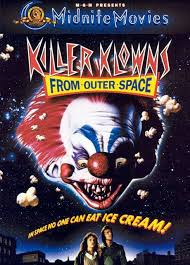
KILLER KLOWNS FROM OUTER SPACE (1988) Three-and-a-half stars
Sociologists would undoubtedly have a field day unpacking why KILLER KLOWNS FROM OUTER SPACE retains cult classic status.

We can start at the first two words in the title and focus upon our seemingly eternal fascination with both killers and clowns.

Then, our nostalgia for 1980s kitsch.

I don’t know, that’s not why I dig KILLER KLOWNS FROM OUTER SPACE, because, to begin with, I don’t quite have the same obsession with killers and clowns that most Americans have or I don’t suffer from “coulrophobia,” the irrational fear of clowns.

I know several people who seriously consider 1980s mass entertainments THE GOONIES, DIRTY DANCING, FERRIS BUELLER’S DAY OFF, THE BREAKFAST CLUB, et cetera, not only their favorite movies, but they’ll go on record and proclaim their favorite “the greatest movie ever made.” Talk about a conversational cul-de-sac, it’s happened so many darn times over the years especially during college. I lost track of how many times I stood there in stone face silence (like Buster Keaton) while my brain pondered exactly how many films these other people have seen and why they’re stuck in 1987, for crying out loud.

I did not see KILLER KLOWNS FROM OUTER SPACE until many years later, though I always remembered that glorious title before I put the down payment on the DVD.

I love KILLER KLOWNS FROM OUTER SPACE because it’s a demented cartoon (the best kind of cartoon) that has ingeniousness to spare: “The Big Top” for the Killer Klowns’ spaceship; popcorn ray-guns; cotton candy cocoons that produce a dread end for dead humans; an invisible Clown car; shadow puppetry; killer pies; and the 18-foot tall Killer Klown leader known as “Jojo the Klownzilla,” a man-in-a-suit Godzilla parody or tribute.

KILLER KLOWNS FROM OUTER SPACE will remind some viewers of Steve McQueen’s debut motion picture, THE BLOB (1958).

You know, kids on lovers’ lane see what could be Halley’s Comet … no, hey, wait, that’s what a crusty old farmer named Gene Green (Royal Dano) mistakes “The Big Top” for when he sees the same unidentified flying object streaking across the sky in the opening sequence and boy, oh boy, that’s a dread mistake for Mean Gene and his poor, poor loyal dog Pooh Bear when they go investigate. Ol’ Man Green speaks a few great lines before his inevitable exit, “What in tarnation is going on?”

Straight out of THE BLOB, teenage sweethearts Mike Tobacco (Grant Cramer) and Debbie Stone (Suzanne Snyder) also investigate further and they go to the local authorities with their findings, centered on “The Big Top” and its inner workings. Our two local authorities, of course, are hesitant to believe these wacko teenagers and their whacked out stories of popcorn-shooting guns and cotton candy cocoons.

Damn kids and their elaborate pranks.

We do have a more sympathetic police officer in Dave Hansen (John Allen Nelson) and I seem to remember every other more sympathetic police officer travels by the name “Dave.” You just know you can have total faith in a guy named Dave.

Yes, at least one more sympathetic police officer did have that first name, “Lt. Dave” in THE BLOB, who patiently listened to and believed the cockamamie stories of Steve (McQueen) and Jane (Aneta Corsaut).

Just like THE BLOB, we have one policeman more sympathetic to the kiddos in KILLER KLOWNS FROM OUTER SPACE and then we have Curtis Mooney, who seems like a relative of Dean Vernon Wormer from NATIONAL LAMPOON’S ANIMAL HOUSE.

Of course, there’s a brilliant reason for that, both characters are played by the same actor.

The late John Vernon (1932-2005) has a fabulous start to his IMDb biography: “John Vernon was a prolific stage-trained Canadian character player who made a career out of convincingly playing crafty villains, morally-bankrupt officials and heartless authority figures in American films and television since the 1960s.”

He’s great in KILLER KLOWNS FROM OUTER SPACE, picking up right where he left off in ANIMAL HOUSE.

Maybe Wormer relocated to Crescent Cove and changed his name to Curtis Mooney.

Cramer plays a protagonist named “Mike Tobacco” and it took me a little bit to remember a character from “Charlie and the Chocolate Factory” and WILLY WONKA AND THE CHOCOLATE FACTORY named “Mike Teavee.” Are they distant relatives? While the TV obsessive Mike Teavee brought his obsession to another level in both the book and the 1971 film adaptation, we never see Mike Tobacco smoke tobacco in KILLER KLOWNS FROM OUTER SPACE, although we can be sure that Curtis Mooney believes that Mr. Tobacco’s smoking something stronger than tobacco when he descends upon the police station with that “killer clowns from outer space” story.

The Chiodo Bros. — Stephen, Charles, and Edward — are the auteurs behind KILLER KLOWNS FROM OUTER SPACE, siblings who specialize in clay models, creatures, stop motion, and animatronics. Their credits, in addition to the main film under discussion, include puppets and effects work for CRITTERS, ERNEST SCARED STUPID, and TEAM AMERICA: WORLD POLICE, as well as the Large Marge claymation scene from PEE-WEE’S BIG ADVENTURE.

They deserve a spot alongside such icons as Willis O’Brien and Ray Harryhausen.

On a certain level, KILLER KLOWNS FROM OUTER SPACE deals in a nostalgia for animation, horror, and science fiction entertainments of the past.

The IMDb lists numerous references, but the most important ones seem to be GODZILLA, INVASION OF THE BODY SNATCHERS, FORBIDDEN PLANET, PHANTASM, and ALIEN, as well as THE BLOB, of course, all of which seasoned viewers will be able to notice.

The film’s tagline captures the spirit of the enterprise: “In space, no one can eat ice cream.”

Victory (1981)

VICTORY

VICTORY (1981) Three stars
It’s hard to believe that any movie directed by the late John Huston (1906-87) and starring Michael Caine and Sylvester Stallone could possibly be a “buried treasure,” but that’s definitely the case for 1981’s VICTORY in North America or ESCAPE TO VICTORY in international markets.

Huston, born in Nevada, Missouri, to actor Walter and sports editor Rhea (who gave up her career after her son was born), debuted with THE MALTESE FALCON in 1941 and his distinguished directorial career included THE TREASURE OF THE SIERRA MADRE, THE ASPHALT JUNGLE, THE RED BADGE OF COURAGE, THE AFRICAN QUEEN, BEAT THE DEVIL, THE MISFITS, FAT CITY, THE MAN WHO WOULD BE KING, WISE BLOOD, ANNIE, UNDER THE VOLCANO, PRIZZI’S HONOR, and his final movie, THE DEAD, in 1987.

Huston directed four more films after VICTORY.

Huston previously directed Caine in THE MAN WHO WOULD BE KING (1975) and Caine’s an actor who has persevered through many a bad movie during his nearly seven-decade career, including such epic disasters as THE SWARM, BEYOND THE POSEIDON ADVENTURE, BLAME IT ON RIO, and JAWS: THE REVENGE. (Caine did not accept his Academy Award for Best Supporting Actor for HANNAH AND HER SISTERS in person because he was making JAWS: THE REVENGE, a role for which he famously stated, “I have never seen it, but by all accounts it is terrible. However, I have seen the house that it built, and it is terrific.” Honestly, Caine gave a better performance in the 1984 Madness song “Michael Caine.”)

Stallone has mostly struggled outside the ROCKY and RAMBO franchises.

If you’ve seen THE GREAT ESCAPE, THE LONGEST YARD, and ROCKY, for example, then you’ve basically seen VICTORY, a movie built along similar lines except for it substitutes fútbol for football (THE LONGEST YARD) and boxing (ROCKY). It leads up to both a big game and the great escape from Nazis in the grand finale, and it features several training sequences as this ragtag group of war prisoners takes on the German national team in a propaganda soccer match.

Although VICTORY is a very predictable movie, it’s a rousing crowd pleaser just like THE GREAT ESCAPE, THE LONGEST YARD, and ROCKY before it.

You do feel good watching it.

Normally, action movies with an international cast (like VICTORY) bite the big one. Not here and it’s not your average international action spectacular cast.

Here, we have soccer players Pele from Brazil, Bobby Moore, Russell Osman, and Mike Summerbee from England, Osvaldo Ardiles from Argentina, Paul Van Himst from Belgium, Kazimierz Deyna from Poland, Co Prins from Holland, John Wark from Scotland, Soren Linsted from  Denmark, Halivar Thoresen from Norway, and Kevin O’Callaghan from Ireland.

That’s just the Allied team.

Caine and Stallone play soccer in the movie, although we can be thankful Caine used a double, professional football player Kevin Beattie. Paul Cooper’s credited for being Stallone’s double, although Stallone insisted on his own work during the big match.

Stallone initially blew off training from England’s World Cup winning goalkeeper Gordon Banks. In a 2015 interview, Pele talked about Stallone and the movie.

“When I got the first script I was a goalkeeper and Stallone was a forward,” Pele said. “I said, ‘Listen, I can’t play as a goalkeeper.’ When we started training for the film, we saw Stallone knew nothing about football. We teased him because he didn’t even know how to kick a ball. Michael Caine was my teacher. He’d call me over and say, ‘Pele, you must be more patient — this is a film, not reality.’ He was fantastic.”

Stallone dislocated a shoulder and broke his ribs a couple times during filming.

Ardiles said of the 47-year-old Caine and his physical and soccer abilities, “Awful, and he couldn’t even run 20 yards.”

Acting wise, though, Caine blows Stallone right off the screen in VICTORY and gets us more from the beginning to the end of the picture than his American counterpart.

Stallone’s not very good in VICTORY.

Apparently, Stallone antagonized cast and crew by eating by himself and flying off to either London or Paris every weekend on his private jet.

Also, Stallone reportedly insisted that he end the film on the note of a game-winning goal. “A game-winning goal from a goalkeeper?” Ridiculous.

That’s why the match ends on a penalty kick where, you guessed it, Stallone makes the save that saves the day.

In “Booked! The Gospel According to our Football Heroes” by John Smith and Dan Treifer, Wark talked about the film with much praise for Caine and the opposite for Stallone.

“Stallone was nowhere near as sociable. He and his entourage, which comprised several minders, were even booked into a different hotel.”

Wark touched on Stallone and a prisoner shower scene in the movie, “We spotted that Stallone preferred to wear a pair of mini briefs and all these years later I still can’t help wondering what ‘Rocky’ wanted to keep hidden from us.”

In the same book, it’s said by Pele that Stallone refused to allow anybody else to sit in his chair on the set and by Ardiles that it took Stallone at least 17 takes before he could make the save on the penalty kick.

You can bet the film’s writers took it all hard.

Yabo Yablonsky, one of two screenwriters and one of three credited for the story, apparently hated the revisions so much that he contemplated taking his own life upon seeing the finished project.

Stallone later made OVER THE TOP, that 1987 epic combining arm wrestling, child custody, and truck driving.

That brings us to a story involving Stallone and professional footballer Beattie.

Beattie told the East Anglian Daily Times in 2008, “We had finished for the day and I was at the bar with Russell Osman and John Wark and we were winding each other up. Somehow we started chatting about arm wrestling and there was a lot of laughing and joking.

“I was just sitting there and Stallone came over and asked if I’d like to give him an arm wrestle. I said, ‘By all means, no problem.’

“He had muscles on his muscles but I don’t remember him being that tall. I just thought I’d give it a go — I’d always been quite strong. Anyway, I ended up beating him and I don’t think he talked to me again for the rest of the film!

“Stallone got a bit of a shock but it’s a good claim to fame. I guess I was naturally strong. I used to carry the bags of coal for my dad and when I was at the gym at Portman Road, I was one of the only ones who could lift all the weights.”

I’d prefer footage of Beattie and Stallone arm wrestling in a bar over all of OVER THE TOP.

That’s because I take my arm wrestling without child custody and truck driving.

The Big Lebowski (1998)

THE BIG LEBOWSKI

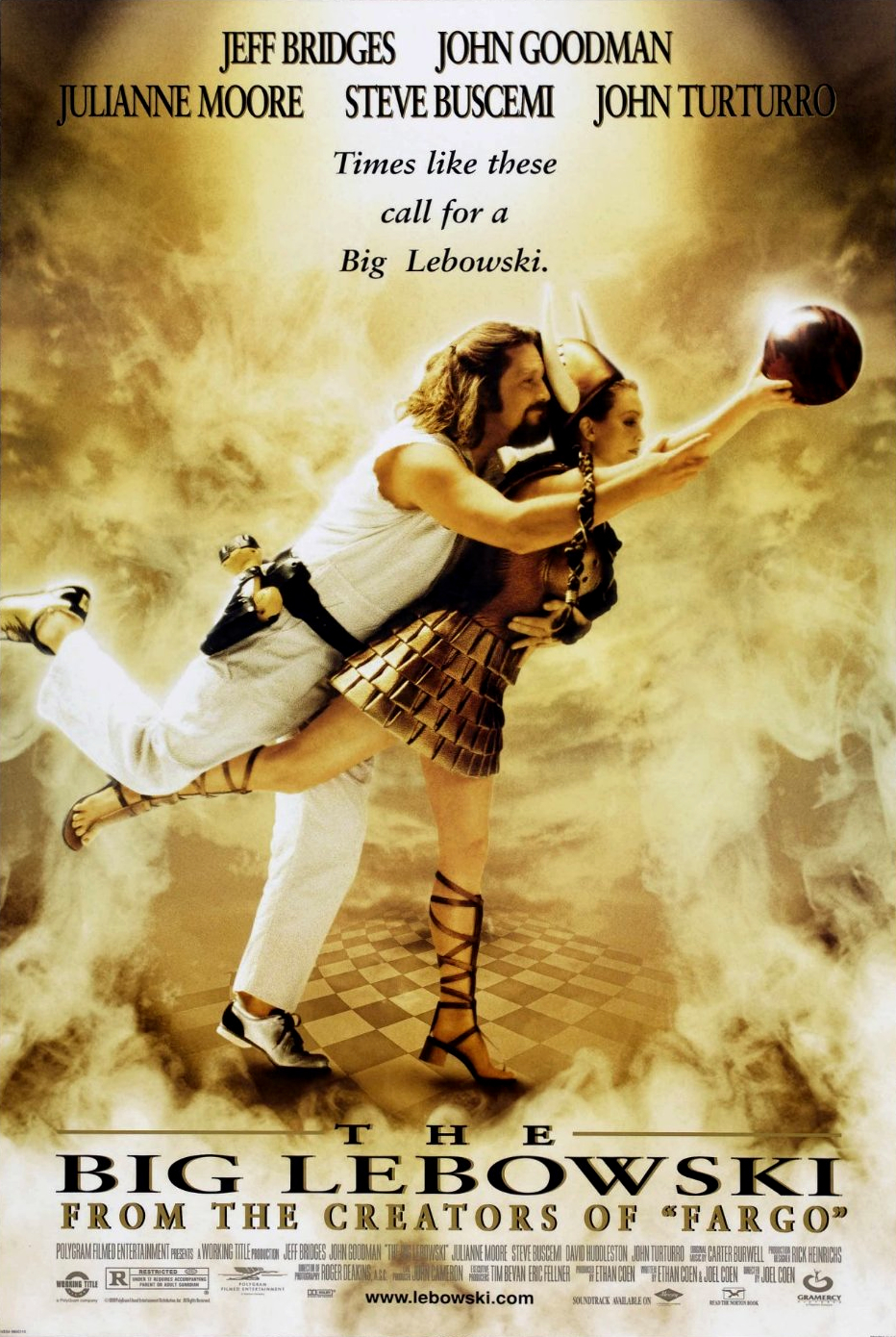
THE BIG LEBOWSKI (1998) Four stars
The Coen Brothers’ THE BIG LEBOWSKI starts with a brilliant idea: Why not take a blissed out former 1960s radical who loves his White Russians and his bowling with his two best mates and place him right smack dab in the heart of a labyrinthine plot straight from THE BIG SLEEP.

You might remember Howard Hawks’ 1946 classic, starring Humphrey Bogart and Lauren Bacall. That’s the one where writer Raymond Chandler famously said of the identity of the murderer of the Sternwoods’ chauffeur, “I don’t know.” Apparently, neither did Hawks or any of the various writers — William Faulkner, Leigh Brackett, Jules Furthman, and Phiip Epstein — involved with the screen adaptation of Chandler’s 1939 novel.

How does Jeffrey “The Dude” Lebowski react to such a convoluted plot?

I believe he explains it as such, “This is a very complicated case. You know, a lotta ins, lotta outs, lotta what-have-you’s. And, uh, lotta strands to keep in my head, man. Lotta strands in old Duder’s head. Luckily I’m adhering to a pretty strict, uh, drug regimen to keep my mind, you know, limber.”

Main characters “The Dude” and Walter Sobchack are known to be inspired by a couple Hollywood eccentrics: Jeff Dowd and John Milius.

Dowd was a member of the Seattle Liberation Front, a radical anti-Vietnam War protest group that became known as the Seattle Seven. Lebowski mentions this fact in THE BIG LEBOWSKI.

Dowd then became a producer’s representative, a consulting producer, creative consultant, post-production consultant, producer, and executive producer. Those are some of his credits.

Ethan and Joel Coen first met Dowd around the time of their feature debut BLOOD SIMPLE.

I remember coming across him in the writings of Roger Ebert, for example a story from the 1999 Toronto Film Festival called “Dude Keeps Building a Rep.”

It starts out with Dowd telling Ebert that he’s got to see a movie called GOAT ON FIRE & SMILING FISH. Ebert’s in the press office at the Toronto Film Festival, only out of his hotel room four minutes before Dowd could find the critic. Dowd hands Ebert two Xeroxed sheets stapled together promoting GOAT ON FIRE & SMILING FISH.

Ebert wrote, “The Dude’s name is Jeff Dowd. He is tall and large and has a lot of unruly curly hair and a big mustache. If you saw the Coen Brothers movie THE BIG LEBOWSKI, Jeff Bridges was playing a character based on him, although the Dude is a great deal more abstentious than the Bridges character. If he were not, the movie would have been called THE LATE LEBOWSKI. The Coens and Dowd go back a long way, to 1984, when he was telling me, ‘You gotta see this one. It’s called BLOOD SIMPLE. These are the Coen Brothers.’”

Dowd “repped” THE BLACK STALLION, CHARIOTS OF FIRE, HOOSIERS, THE STUNT MAN, and THE BLAIR WITCH PROJECT, just like he did GOAT ON FIRE & SMILING FISH.

Dowd to Ebert, “Just so people see them. I’d walk up and down the lines for hit movies, handing out brochures for what we were showing. The way I figure it is, who goes to movies? People who go to movies, that’s who. They may or may not read Premiere magazine. They may or may not watch TV. But they go to movies. So if Warner Bros. spends $40 million to promote a movie and they’re standing in line to see it, why not tell them about my movie?

“A lot of the movies, they’re not what they seem to be. You take THE BLACK STALLION. The studio said it would never appeal to children because the first 18 minutes were without dialogue. I hold a test screening. A little girl, 5 years old, is in front of me. She tells her mommy she has to pee. She gets up and stands on the aisle, still watching the screen, and she stands there for the next 10 minutes. Her knees are knocking together, she has to pee so bad, but she can’t stop watching. The whole history of THE BLACK STALLION was changed, right then and there.”

The St. Louis-born Milius’ writing credits include JEREMIAH JOHNSON, MAGNUM FORCE, APOCALYPSE NOW, 1941, and CLEAR AND PRESENT DANGER. He both wrote and directed THE WIND AND THE LION, BIG WEDNESDAY, CONAN THE BARBARIAN, and RED DAWN. He’s not directed anything since 1997.

Milius says that Hollywood blacklisted him for his conservative beliefs.

He’s the disreputable one of the Film Brat Generation, whose friends and colleagues include Steven Spielberg, George Lucas, Francis Ford Coppola, and Brian DePalma.

A 2017 Indie Film Hustle story comes with the tagline “John Milius: The Craziest Director in Hollywood?”

“He’s a really funny guy, a really good storyteller,” Ethan Coen said of Milius in a book on THE BIG LEBOWSKI. “He was never actually in the military, although he wears a lot of military paraphernalia. He’s a gun enthusiast and survivalist type. Whenever we saw him, he’d invite us out to his house to look at his guns — although we never took him up on it.”

You can hear Milius’ storytelling abilities on commentaries for APOCALYPSE NOW, 1941, and CONAN THE BARBARIAN, for example.

Milius contributed Robert Shaw’s famous U.S.S. Indianapolis speech in JAWS (uncredited), some of Dirty Harry’s best lines, and all that stuff about surfing in APOCALYPSE NOW.

It helps that John Goodman, like Milius, is a native of the St. Louis area.

Bridges and Goodman have been two of the best actors working in the movies.

They’re probably as close to a guarantee of quality as anybody you can name.

“The Dude” and Walter are likely the characters they will be most associated with all their lives.

There’s lots of inspired madness throughout THE BIG LEBOWSKI.

Like the trippy production number called “Gutterballs,” combining bowling and Busby Berkeley, all scored by Kenny Rogers and the New Edition’s “Just Dropped In (To See What Condition My Condition Was In),” Rogers’ first Top 10 hit.

Like the German nihilists who have a band and album that are parodies of / homages to Kraftwerk, with the band name Autobahn and the album cover that’s similar to THE MAN-MACHINE.

Like utilizing gems like Bob Dylan’s “The Man in Me” and Captain Beefheart’s “Her Eyes Are A Blue Million Miles.”

Like Mr. Lebowski’s rant about the Eagles. Reportedly, Allen Klein (1931-2009) wanted $150,000 for usage of the Rolling Stones’ “Dead Flowers,” but he waived that licensing fee because he so loved the scene where “The Dude” hates on the Eagles. You’re not the only one, Mr. Klein.

THE BIG LEBOWSKI joins TWILIGHT ZONE: THE MOVIE and AN AMERICAN WEREWOLF IN LONDON for some of the best utilization of Creedence Clearwater Revival in a moving picture.

Coupled with BOOGIE NIGHTS (1997), THE BIG LEBOWSKI helped start my love affair with Julianne Moore, which continued over many, many years in everything from THE END OF THE AFFAIR to CHLOE.

Character actors Steve Buscemi, John Turturro, Ben Gazzara, David Huddleston, and Philip Seymour Hoffman all lend their abilities to the menagerie.

Never mind Sam Elliott’s voiceover narration.

I vividly remember coming across THE BIG LEBOWSKI when it came on Showtime in the late 1990s. I played the VHS dub I had for several friends and it became one of our favorite movies.

I’ve seen it many, many, many times over the years. It’s my favorite Coen Brothers movie, certainly far ahead of the overrated FARGO and NO COUNTRY FOR OLD MEN.

An old friend would seemingly only want to play THE BIG LEBOWSKI, FEAR AND LOATHING IN LAS VEGAS, and THE CROW, although he would also play the hell out of CITY LIGHTS, BLADE RUNNER, and SOME LIKE IT HOT as well, for that matter.

It’s been a while since I’ve watched it and I just might have to change that very, very soon.

Patton (1970)

DAY 79, PATTON

PATTON (1970) Four stars
That darn cat Patton has been wanting me to get around to writing this review all month.

He’s especially been frustrated with his humanoid friend the last couple days. “Will you stop writing about sports long enough to sit down and write on PATTON? Will you do it for me?” He’s been asking such tough questions the last couple days.

I told him, “I worked a 13-hour day Saturday and wrote up over 4,200 words for Tuesday’s paper. I covered a few games in person and I’m dog tired. Then, I stayed up all night Sunday formatting everything into the system and posting it online.”

Patton the Cat did not want to hear such excuses. He said, “Don’t be a candy ass, suck it up Buttercup, and write me a few hundred words on PATTON. It’s where I got my name, you know, of course.” He knows how to bust a fellow’s balls, that’s for sure, that darn cat.

Just in a dirty look, one which he normally directs at the dog.

Alright, I’ll get you that darn review. Sure thing, boss, and I’ll give it everything I got just for you because I know you’ll come over and check out Facebook.

Fortunately, I’ve watched PATTON quite a few times over the years. Many years ago, I would slide the VHS into the player and just sit back and relax for nearly 3 hours. I did that on a regular basis. Sometimes, I would fall to sleep and take a little nap.

On a certain level, I’m a sucker for epics like BRIDGE ON THE RIVER KWAI, LAWRENCE OF ARABIA, THE TEN COMMANDMENTS, and even ones of more recent vintage like THE PATRIOT and THE LORD OF THE RINGS trilogy, for example. There’s just something innately appealing about the form itself. Like a baseball game, you can just lose yourself inside an epic for three hours at a time.

PATTON wisely starts out with a speech based on George S. Patton’s rabble-rouser to the Third Army. Of course, we see an abbreviated and less profane version, but it’s an effective curtain raiser that gets at the heart of the character and how we find this contradictory, larger-than-life character so fascinating despite any objections we might have to this man of war.

“Now, I want you to remember that no bastard ever won a war by dying for his country. He won it by making the other poor dumb bastard die for his country.

“Men, all this stuff you’ve heard about America not wanting to fight, wanting to stay out of the war, is a lot of horse dung. Americans, traditionally, love to fight. All real Americans love the sting of battle.

“When you were kids, you all admired the champion marble shooter, the fastest runner, the big league ball players, the toughest boxers. Americans love a winner and will not tolerate a loser. Americans play to win all the time. Now, I wouldn’t give a hoot in hell for a man who lost and laughed. That’s why Americans have never lost and will never lose a war. Because the very thought of losing is hateful to Americans.

“Now, an army is a team. It lives, eats, sleeps, fights as a team. This individuality stuff is a bunch of crap. The bilious bastards who wrote that stuff about individuality for the Saturday Evening Post don’t know anything more about real battle than they do about fornicating.

“Now, we have the finest food and equipment, the best spirit, and the best men in the world. You know, by God, I actually pity those poor bastards we’re going up against. By God, I do. We’re not just going to shoot the bastards. We’re going to cut out their living guts and use them to grease the treads of our tanks. We’re going to murder those lousy Hun bastards by the bushel.

“Now, some of you boys, I know, are wondering whether or not you’ll chicken-out under fire. Don’t worry about it. I can assure you that you will all do your duty. The Nazis are the enemy. Wade into them. Spill their blood. Shoot them in the belly. When you put your hand into a bunch of goo that a moment before was your best friend’s face, you’ll know what to do.

“Now there’s another thing I want you to remember. I don’t want to get any messages saying that we are holding our position. We’re not holding anything. Let the Hun do that. We are advancing constantly and we’re not interested in holding onto anything — except the enemy. We’re going to hold onto him by the nose, and we’re gonna kick him in the ass. We’re gonna kick the hell out of him all the time, and we’re gonna go through him like crap through a goose!

“Now, there’s one thing that you men will be able to say when you get back home, and you may thank God for it. Thirty years from now when you’re sitting around your fireside with your grandson on your knee, and he asks you, “What did you do in the great World War II?” — you won’t have to say, “Well, I shoveled shit in Louisiana.”

“Alright now you sons-of-bitches, you know how I feel. Oh, I will be proud to lead you wonderful guys into battle anytime, anywhere. That’s all.”

That speech definitely sets the mood for the rest of the picture, and George C. Scott commands the screen.

Francis Ford Coppola and Edmund H. North’s screenplay effectively plays both sides of the street and director Franklin J. Schaffner (PLANET OF THE APES) helmed a film that can appeal to both hawks and doves, a divide that was especially sharp in 1970 America.

(Or you can simultaneously or alternately be attracted to and repulsed by Patton and PATTON.)

Historical movies undoubtedly say more about the era when they are made, rather than whatever era in time they are depicting.

For example, three events from a turbulent April-May 1970 are tied together.

PATTON premiered on April 2.

Richard Nixon announced the invasion of Cambodia on national TV on April 30.

The Kent State shootings happened on May 4 after four days of protest by college students against invading Cambodia.

PATTON was Nixon’s favorite movie.

Philip D. Beidler wrote “Just Like in the Movies: Richard Nixon and Patton,” which appeared in “The Georgia Review” in the fall of 1995.

Beidler’s opening paragraph: “I began this examination of the strange and often dreadful reciprocity between American life and American entertainment—a commemorative essay, one might call it, in several meanings of that term—by adducing two parallel narratives, both essentially factual and both spanning roughly the same period twenty-five years ago. Each began in early April 1970 and ended slightly more than a month later, after the US Army invasion of Cambodia and the killing of four students by Ohio National Guardsmen at Kent State University. The first involves a US president and his obsession with a war movie. The second involves a US Army lieutenant and his experiences in a war being conducted at that time by that president. The president was Richard Nixon. The war movie was PATTON. The army lieutenant was me. The war, of course, was Vietnam.”

I am unable to read past the first page of Biedler’s essay because I do not have a JSTOR account.

Nixon, of course, instantly identified with PATTON and Patton, because I am sure Nixon was aware that he’s one of those people who many folks loved to hate, just like Patton. We have little doubt that PATTON inspired Nixon to get on with Cambodia.

Nixon’s official response to Kent State: “We think we’ve done a rather good job here in Washington in that respect. As you know, we handled the two demonstrations, Oct. 15 and Nov. 15 of last year, without any significant casualties. That took a lot of doing, because there were some rough people who were involved. A few were rough. Most of them were very peaceful.

“I would hope that the experience that we have had in that respect could be shared by the National Guards, which of course are not under Federal control but under state control. … I do know that when you have a situation with a crowd throwing rocks and the National Guard is called in, that there is always a chance that it will escalate into the kind of tragedy that happened at Kent State. … I saw the pictures of those four youngsters in the Evening Star the day after that tragedy. I vowed then that we were going to find methods that would be more effective to deal with these problems of violence, methods that would deal with those who would use force and violence and endanger others, but at the same time would not take the lives of innocent people.”

Kent State inspired Neil Young to write “Ohio” and it was released in June 1970, “Tin soldiers and Nixon coming / We’re finally on our own / This summer I hear the drumming / Four dead in Ohio” and “Gotta get down to it / Soldiers are cutting us down / Should have been done long ago / What if you knew her / And found her dead on the ground / How can you run when you know?”

Young on the song in the liner notes to 1977’s DECADE, “It’s still hard to believe I had to write this song. It’s ironic that I capitalized on the death of these American students. Probably the biggest lesson ever learned at an American place of learning. My best CSNY cut. Recorded totally live in Los Angeles. David Crosby cried after this take.”

And the sad saga pushed Jerry Casale, then a Kent State student, into forming Devo and using “De-evolution” (a.k.a. backward human evolution) as the conceptual framework of the band. Jeffrey Miller and Allison Krause, two of the four killed on May 4, were Casale’s friends.

“Until then I was a hippie,” Casale said in a 2005 interview. “I thought that the world is essentially good. If people were evil, there was justice … and that the law mattered. All of those silly naïve things. I saw the depths of the horrors and lies and the evil. The paper that evening, the Akron Beacon Journal, said that students were running around armed and that officers had been hurt. So deputy sheriffs went out and deputized citizens. They drove around with shotguns and there was martial law for 10 days. 7 p.m. curfew. It was open season on the students. We lived in fear. Helicopters surrounding the city with hourly rotating runs out to the West Side and back downtown. All first amendment rights are suspended at the instant the governor gives the order. All of the class-action suits by the parents of the slain students were all dismissed out of court, because once the governor announced martial law, they had no right to assemble.”