Karloff Meets Lugosi Meets Poe: The Black Cat, The Raven

KARLOFF MEETS LUGOSI MEETS POE: THE BLACK CAT, THE RAVEN
Boris Karloff (1887-1969) and Bela Lugosi (1882-1956) endure as two icons of horror and their best movies remain essential to a greater understanding of the horror genre long after their death.

Karloff and Lugosi starred in many classic films. Dracula. Frankenstein. Island of Lost Souls. The Mummy. White Zombie. Old Dark House. Murders in the Rue Morgue. The Mask of Fu Manchu. Chandu the Magician. The Bride of Frankenstein. Mark of the Vampire. The Black Room. The Man They Could Not Hang. The Wolf Man. Frankenstein Meets the Wolf Man. The Return of the Vampire. House of Frankenstein. Isle of the Dead. Bedlam. Abbott and Costello Meet Frankenstein. Targets.

That list grows once the several films they made together are considered: The Black Cat, The Raven, The Invisible Ray, Son of Frankenstein, Black Friday (not a classic), You’ll Find Out (not seen this one), and The Body Snatcher.

The Black Cat and The Raven, generally paired together in greatest hits packages, are the films where Karloff and Lugosi are most evenly matched on screen. They’re both immortal movie classics based on that mere fact alone; Lugosi nearly walks away with Son of Frankenstein as Ygor, while it’s sad to see how much of a nonentity part Lugosi received in The Body Snatcher, especially when compared against Karloff’s meaty role as John Gray and perhaps his best performance.

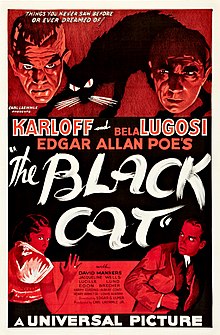
Young American lovers on their honeymoon in Hungary, a train ride beginning and ending the picture, a dark and rainy night, a road accident, an old dark house, an enigmatic doctor, a Satan worshipping priest, a story suggested by the work of Edgar Allan Poe with story and direction from Edgar G. Ulmer, and The Black Cat flies past in about 65 minutes, like a lot of the early horror classics.

Of course, there’s Karloff credited merely as Karloff, David Manners as one of the young American lovers, and Karloff and Lugosi find themselves at each other’s throat by the end of the picture.

Like the Frankenstein pictures and the Mary Shelley source material, The Black Cat departs almost entirely from Poe’s short story originally published in The Saturday Evening Post on August 19, 1843. I am okay with that, because Ulmer has a style all his own like James Whale in Frankenstein and The Bride of Frankenstein and The Black Cat pairs two movie legends for the first time.

The Raven gets done faster than even The Black Cat at 61 minutes, credits both Karloff and Lugosi with their surnames alone, and it has a lot of the same elements as The Black Cat.

Lugosi plays arguably his most diabolical and evil character in Dr. Richard Vollin, the archetype for the brilliant but troubled surgeon who has this, let’s say, morbid obsession with instruments of torture. He’s not your average doctor, obviously. Lugosi chews through the scenery, especially in the final reel, and relishes lines like Death is my talisman, I like torture, I tear torture out of myself by torturing you, and Poe, you are avenged!

Yes, he’s also obsessed with Edgar Allan Poe. The Pit and the Pendulum even makes a cameo appearance!

The Raven tilts more toward being Lugosi’s show because Karloff doesn’t even show up for his first scene until 17 minutes into the picture.

Karloff is great though, of course, and brings a certain poignancy to the tortured murderer on the run Edmond Bateman, who just wants the doctor to fix his ugly face.

EB: I’m saying, Doc, maybe because I look ugly … maybe if a man looks ugly, he does ugly things.

DRV: You are saying something profound.

Naturally, Vollin makes Bateman’s face even uglier and enlists him in a diabolical scheme.

The rest of the cast doesn’t measure up against Lugosi and Karloff, especially Irene Ware as the screaming socialite Jean Thatcher, but it doesn’t really matter because Lugosi and Karloff are so damn great.

I heartily recommend The Black Cat and The Raven, both Poe and Universal.

The Black Cat (1934) ****; The Raven (1935) ****


Silent Night, Deadly Night (1984)

SILENT NIGHT, DEADLY NIGHT (1984) No stars
It should be stated right away that I found Silent Night, Deadly Night, the legendary killer Santa Claus picture, to be a shocking experience, though not anywhere near the same reason it created a firestorm of controversy in 1984 and 1985.

Silent Night, Deadly Night is a shockingly bad motion picture, so poorly acted, written, directed, and executed that it becomes laughable without being funny.

If you Google why is Silent Night, Deadly Night controversial, you’ll receive Most protests were generated by the feeling that the depiction of a killer in a Santa Claus suit would traumatize children and undermine their traditional trust in Santa Claus.

Poppycock!

Silent Night, Deadly Night is one of the worst horror movies ever made, but it didn’t traumatize this 44-year-old man or undermine his traditional trust in motion pictures, even low-budget exploitation films.

It must be said that Little Billy, definitely not the same one in the Who song, faces enough childhood trauma in the opening minutes of Silent Night, Deadly Night for a lifetime of bad movies. It should be played at dentist offices everywhere, and not only around Christmas.

He’s told by his otherwise catatonic Grandpa that Santa punishes all those who are naughty, he watches his parents get slaughtered by a killer dressed as Santa, he’s orphaned and introduced to the hateful Mother Superior, and he’s given a lethal mullet.

Little Billy was the fattest kid in his class / Always the last in line / All the other little kids would laugh at him / Said he’d die before his time / Ha ha ha ha / Ha ha ha ha / Little Billy didn’t mind / Most of the kids smoked cigarettes / Just to prove that they were cool / The teacher didn’t know about the children’s games / And Billy always followed the rules / Ha ha ha ha / Ha ha ha ha / Little Billy didn’t mind / Billy was big on the outside / But there’s an even bigger inside / Ten million cigarettes burning every day / And Billy’s doing fine.

The Billy in Silent Night, Deadly Night finally snaps from all that overacting. I mean, seriously, they start in with that shit from the first scene and never let up. Grandpa, Mother Superior, Billy’s boss at the toy store, on down the line, they all played it for the back row.

Now Billy and his classmates are middle-aged / With children of their own / Their smoking games are reality now / And cancer’s seed is sown / Ha ha ha ha / Ha ha ha ha / Little Billy didn’t mind / Most of them smoke maybe 40 a day / A habit Billy doesn’t share / One by one they’re passing away / Leaving orphans to Billy’s care / Ha ha ha ha / Ha ha ha ha / Ha ha ha ha / Little Billy doesn’t mind / Ha ha ha ha / Ha ha ha ha / Little Billy’s doing fine.

Little Billy could have punched out Mike Tyson. When he punches out Santa at the orphanage, you’d think maybe somebody could have introduced Little Billy to Cus D’Amato. Granted, it’s a long, long, long way from Utah to New York and a more uplifting boxing picture would not generate all that controversy and curiosity like a killer dressed up like Santa Claus.

Did you ever see the faces of children? They get so excited / Waking up on Christmas morning hours before the winter sun has ignited / They believe in dreams and all they mean, including heaven’s generosity / Peeping round the door to see what parcels are for free in curiosity.

We patiently wait for Billy to snap throughout Silent Night, Deadly Night, because isn’t that why we’re watching this tripe in the first place?

When he finally does snap and starts the slaughter, it’s every bit as bad and maybe even worse than what came before, believe it or not. This movie does not stop in the pursuit of just plain awful scenes.

Surrounding by his friends he sits / So silently and unaware of everything / Playing Poxy Pinball / Picks his nose and smiles and pokes his tongue at everything / I believe in love but how can men / Who’ve never seen light be enlightened? / Only if he’s cured will his spirits future level ever heighten.

Silent Night, Deadly Night lays it on thick with gratuitous nudity and sexual assault. It’s a very, very, very naughty movie!

Tara Buckman plays Billy’s mother and you might remember her or at least her cleavage from The Cannonball Run, where her and her race partner Adrienne Barbeau brandish their copious amounts of cleavage whenever they’re stopped by law enforcement. She’s not particularly convincing in her role as mother and her bad acting, as well as her sexual assault / death scene, set an early tone for Silent Night, Deadly Night.

Robert Brian Wilson made his motion picture debut as 18-year-old Billy and it easily could have been his only performance because he’s not very good in Silent Night, Deadly Night. Needless to say, for an IMDb biography that starts handsome and muscular actor, Wilson moved on to appearing in a number of soap operas and TV shows.

All of the actors are on the level of a bad soap opera, and the project feels like Amateur Night all the way.

The director Charles E. Sellier Jr. (1943-2011) produced The Life and Times of Grizzly Adams, In Search of Noah’s Ark, The Lincoln Conspiracy, Beyond and Back, The Bermuda Triangle, In Search of Historic Jesus, Hangar 18, Earthbound, The Boogens, and The President Must Die before Silent Night, Deadly Night.

Sellier Jr.’s mini-bio on IMDb starts something like this: Sellier skillfully pioneered market testing and ‘four-walling’ – renting a theater to show his films, thereby enabling him to keep all the profits for himself – garnered him the distinction of having more pictures in the top 50 independent grossers than any other independent producer in the 1970s.

In other words, he was a skilled con artist.

Silent Night, Deadly Night is a big con, and the people responsible for it all knew exactly what they were doing when they marketed the picture with TV spots like the one that intones The most talked-about film of the decade … the movie that shocked America, outraged Hollywood, and frightened the government … the movie that they tried to ban … you’ve read about it, heard about it, and now you can see it in all its terrifying aura.

Their first TV spot played on the killer Santa angle — Santa with an ax, Santa with a gun — and capped it with the tagline You’ve made it through Halloween, now try and survive Christmas! Also, he knows when you’ve been naughty!

Were Silent Night, Deadly Night not so bloody inept it could be a terrifying experience.

Rather, it’s just terrible, and I am thankful for a running time under 90 minutes because any longer I might not have survived Christmas.

Jaws in 3D (1975 / 2022)

JAWS IN 3D (1975 / 2022) ****
When I first read the announcement Jaws 3D would be released to theaters in early September 2022, I mistook it for the Jaws 3-D from 1983 and I thought why in the bloody hell anybody would unleash that bloody awful movie once again … Just when you thought it was safe to go back in a movie theater … because there couldn’t be that much interest really in a third-rate Jaws movie.

I watched Jaws for the first time on the big screen in June 2020, sitting between my wife Lynn on the left and my mom on the right. We ate lunch beforehand at a place called Sharky’s Pub and Grub, and they might even have a Jaws poster. Just when you thought it was safe to go into a restaurant. My stepdaughter Emily and her friend watched E.T.

Jaws is another one of those movies that I would stop and watch every time I would come across it on cable TV, whether it played on TBS or TNT or part of a Jaws marathon 4th of July weekend on one of the premium channels.

Anyway, I decided to watch Jaws in 3D on Saturday, Sept. 3, which just happened to be National Cinema Day. $3 tickets for every showing, every showtime, every format. I had never seen the multiplex so busy; the theater had all hands on deck, and apparently 8.1 million people attended theaters across the nation on that day. Despite not being the biggest 3D fan, I thought why not bloody Jaws, of course a movie not originally in 3D, at that relatively budget price. There was a decent-sized crowd for this 47-year-old blockbuster pioneer, and they remained mostly quiet except for a couple of the most famous shock moments.

I thought it was a great experience, not only because I got to keep the glasses.

I long considered Jaws a very good movie, an ideal one to watch on cable TV when you just want to laze around and watch a movie, but after the last two times I’ve seen it in a movie theater, Jaws has dramatically increased in stature. It’s a great movie.

First and foremost, I appreciate Roy Scheider as Police Chief Martin Brody, Robert Shaw as Quint, and Richard Dreyfuss as Matt Hooper more every single time I watch Jaws.

Three great characters, three great performances, and they are something the other three Jaws films obviously lack. Scheider returns as Brody for Jaws 2, but it’s not the same.

George Burns (The Sunshine Boys) beat out Brad Dourif (One Flew Over the Cuckoo’s Nest), Burgess Meredith (The Day of the Locust), Chris Sarandon (Dog Day Afternoon), and Jack Warden (Shampoo) for Best Supporting Actor at the 1976 Academy Awards, but none of them approach Shaw’s work in Jaws.

Shaw makes an unlikable character likable by not even trying to be likable, and we feel his death scene more than just about any other in movie history. It is truly a horrifying moment, and despite the fact that I’ve watched Jaws 50, 75, 100, however many times, I still don’t want to see Quint lose his grip and slide right into the mouth of that great white shark.

Recently, I mentioned the incredible chemistry between Fred Ward and Kevin Bacon in Tremors. Scheider and Dreyfuss have a similar chemistry as Brody and Hooper, and I’m glad Jaws made Hooper infinitely more likable, excised Hooper’s extramarital affair with Brody’s wife, and let him survive along with Brody in the movie.

Shaw and Dreyfuss are great together, especially when they’re landing jabs and throwing shade at each other.

At one point in Jaws, Hooper describes the shark, and he could just as well be talking about Jaws itself and its capacity to make thrills, What we are dealing with here is a perfect engine, an eating (thrill) machine. It’s really a miracle of evolution. All this machine does is swim and eat and make little sharks (thrills), and that’s all.

Of course, that’s not all with Jaws, a truly scary classic that also generates lots of laughter and lots of emotion.

Tremors (1990)

TREMORS (1990) ****
The title Tremors immediately conjures up such science fiction and monster movie touchstones from a long-gone era as Tarantula and Them!

Matter of fact, though it does not approach the suspense in Them, Tremors belongs filed right alongside the classic horror films of the ’30s and the science fiction films of the ’50s from predominantly Universal Studios.

Tremors also calls to mind The Birds, Jaws, and Night of the Living Dead at various times, obviously, but director Ron Underwood and screenwriters Brent Maddock and S. S. Wilson provide us with a talented ensemble cast playing quirky and likable characters, as well as interesting and intelligent monsters, nifty special effects that bring the monsters to life, and the ability to balance horror and humor, that Tremors becomes a minor classic with a fresh and funky vibe all its own.

Kevin Bacon and Fred Ward star as Val (short for Valentine) and Earl, two repairmen in the small town of Perfection, Nevada. Can you really call Perfection a small town when it’s Population 14 and Elevation 2135? Anyway, Bacon and Ward have incredible chemistry in Tremors and they’re every bit as good as Danny Glover and Mel Gibson in Lethal Weapon, for example. Their characters and their performances are stronger than what can be found within the average monster movie, and they form a strong human core at the epicenter of Tremors. We like these two characters a great deal and make an investment in their fate.

Finn Wilson is also quite good as seismology student (and potential Kevin Bacon romantic interest) Rhonda LeBeck. She’s not some dumdum, thankfully, and she fits right in alongside Val and Earl because she’s feisty and intelligent and resourceful and likable.

Supporting cast members Michael Gross, best known beforehand for playing Michael J. Fox’s dad on Family Ties, and Reba McEntire nearly steal the show as survivalist and prepper husband and wife Burt and Heather Gummer. Their scene in the basement when they do battle against one of the monsters earned a spot in the annals of unforgettable movie scenes next to the final scene in Road House.

Burt Gummer’s Gun Wall has, as matter of fact, its own fan page with the weapons listed: William and Moore 8 gauge, Heckler & Koch HK91, Colt AR-15 Sporter II, Remington 870, Winchester 1200 Defender, Winchester Model 1894, Winchester Model 70, Steyr-Mannlicher SSG-PII Rifle, Micro Uzi, Colt Single Action Army, Smith & Wesson Model 19, Beretta 92FS Inox, SIG-Sauer P226, Ruger Redhawk, Magnum Research Inc. Mark I Desert Eagle, M8 Flare Pistol, M1911A1, Walther P38, Luger P08, TT-33, Browning Hi-Power, Walther PPK, .600 Nitro Express, Browning Auto-5, Norinco Type 54, Ruger Mini-14, Uzi, Nambu Type-14, Ruger Mk1, Browning Hi Power, SIG-Sauer P228, .38 Derringer, Webley Mk1, S&W Model 66 3-inch barrel, S&W Model 66 4-inch barrel, S&W Model 686 5-inch barrel, Chinese SKS, Factory stock blued Ruger Mini-14, Auto Ordnance M1 Carbine with metal heat shroud, Mil-Spec M1 Carbine, M1 Carbine in aftermarket unfolding stock, and Ruger Mini-14 with Choate folding stock.

Okay, yeah, anyway, I’m glad that somebody went to such great lengths to keep organized stock of an inventory that could be considered a Dirty Harry dream come true.

There’s one super irritating, annoying character in Tremors — prankster Melvin Plug (Bobby Jacoby), a smug little teenage punk who never becomes a kill count statistic much to everybody’s chagrin who’s ever watched Tremors. He’s only a small blemish on the film, because we do get a certain satisfaction when Burt tells Melvin I wouldn’t give you a gun if it were World War 3 and eventually gives him a gun without bullets.

Tremors still comes equipped with such an inherent appeal in part because it’s one of those movies I would always sit and watch if I came across it on cable TV. I don’t know how many times I’ve watched it over the years, but I know it’s a lot and Tremors fits this definition of romp — a light fast-paced narrative, dramatic, or musical work usually in a comic mood.

Any way you define it, though, it’s a fun 96 minutes and I do know that, after writing this review, I do want to watch it once again.

Prey (2022)

PREY (2022) ***1/2
Even if you do not care for Prey, the latest entry and one of the best entries in the often-lackluster Predator series, you have to admit they cooked up one hell of a great idea for a new Predator movie: Have the action take place in the Northern Great Plains in North America in 1719 with Comanche warriors and French trappers up against the first Predator alien to arrive on Earth.

I’ll come straight to the main point: Prey left me gobsmacked because it far exceeded my feeble expectations for the fifth (or seventh) installment of not exactly my favorite series.

Prey approaches the 1987 original in overall quality, and I never thought I would ever say that because of the track record of the series other than Predator.

There were other significant areas that created trepidation before I sat down and watched Prey on August 15.

I watched The Predator, the previous installment, and wrote a two-star review of it back in 2018 which I closed out with At the end of the day, The Predator is not a bad movie, nor a good one, and I doubt that I’ll be able to remember it for too much longer. I’ll say that I’ve killed two hours of my life in worse fashion many times before and hopefully not as many times after. I was right, because I had to go back and read the review to even remember it.

Prey bypassed theaters and began streaming on Hulu in August 2022.

Prey received several enthusiastic reviews, and I seem to remember one or two or maybe a few voices saying that it’s even better than Predator.

Also, unfortunately I could not avoid garbage discourse like Prey is the most woke blockbuster in Hollywood and woke trash and Prey woke garbage. I don’t know, at this point in time, I bypass any writing or any opinion or any discourse that revolves around calling something and somebody woke. You lost me at woke, a word that has been overused to death in recent times and which I see as intellectual laziness.

A simple Google search returns 5,420,000 results for ‘prey woke.’

Oh, for crying out loud, I liked Prey because it hearkened back to Predator in some ways, staked out plenty territory for itself different than any other Predator film before it, and I don’t think it had one damn thing to do with racial and social justice.

Personally, I would love to see future Predator installments that give us samurai, ninjas, cowboys, bounty hunters, assassins, secret agents, saboteurs, and historic rather than contemporary soldiers.

The Comanche warriors and French trappers were so much more interesting than what passed for characters in The Predator, for example.

Prey worked because it had a strong central premise successfully executed more than not with a main character that we can give a damn about from beginning to end.

Twenty-five-year-old Amber Midthunder is the single best reason to recommend Prey.

I had never seen this actress before or at least I had thought so, but then again, I am not exactly a person who keeps up with the latest, greatest movies and shows.

Looking over her acting credits, Midthunder played Vernon Teller in Hell or High Water, a crime movie from 2016 directed by David Mackenzie and starring Chris Pine, Ben Foster, and Jeff Bridges that I love. I thought about it a little more, and I think I can remember Midthunder from that movie. Hell or High Water could be even more interesting on a revisit, given that I would be specifically looking out for one Midthunder.

Midthunder recently hit a little back at Prey haters.

I think a lot of people thought our movie would be some super woke, F-the-patriarchy kind of a story, and that’s not what it’s about at all. It’s not a girl defying what men say she can and can’t do. It’s literally an individual who feels called to something and the people who know her don’t think that is her calling. That is so much more personal and, I think, as the character, harder to deal with anything.

People don’t know a lot about native history. Period. So they don’t know what kind of warriors we were. There are people who don’t even know that there are different tribes or languages. So already that’s coming from a place of ignorance. Then you look at it and go, ‘Oh no, man. Comanche were really, really great warriors. They were known for being some of the fiercest warriors of all. And they did have female-warrior society, so there were women that fought and hunted. So yeah, I think you look at that and you just [tell yourself], ‘Alright, whatever, people are always going to say stuff.’ I’m proud of what we did.

Midthunder’s Naru works in the fine tradition of an underdog protagonist whose progress makes for compelling, emotionally involving entertainment for 100 minutes.

Right around the same time Prey came out the formal apology from the Academy of Motion Picture Arts and Sciences to Native American activist and actor Sacheen Littlefeather for her mistreatment at the 1973 Academy Awards ceremony became public.

Hello. My name is Sacheen Littlefeather. I’m Apache and I am president of the National Native American Affirmative Image Committee. I’m representing Marlon Brando this evening and he has asked me to tell you in a very long speech, which I cannot share with you presently because of time but I will be glad to share with the press afterwards, that he very regretfully cannot accept this very generous award. And the reasons for this being are the treatment of American Indians today by the film industry and on television in movie reruns, and also with recent happenings at Wounded Knee. I beg at this time that I have not intruded upon this evening and that we will in the future, our hearts and our understandings will meet with love and generosity. Thank you on behalf of Marlon Brando.

Littlefeather passed away Oct. 2, 2022, at the age of 75.

Space Jam: A New Legacy (2021)

SPACE JAM: A NEW LEGACY (2021) *
I am not exactly sure why I decided to watch Space Jam: A New Legacy on a Saturday afternoon, following hot on the heels of the Disney live-action films Midnight Madness and Condorman.

I mean, I am not the biggest fan of the original Space Jam from 1996, basically a feature-length advertisement for the greatness of Michael Jordan with Looney Tunes and Bill Murray and Wayne Knight and everybody else guest stars or glorified cameos. Never thought it was all that great even back during the height of the Chicago Bulls — Space Jam came out Nov. 15, 1996, just a few months after the Bulls put together a 72-10 regular season and won an NBA title — and it has aged worse. Of course, it seems to have a major cult following, but then again, so does Howard the Duck.

Also, I have never been much of a LeBron James fan, since his arrival upon the scene in 2002. I’ve never cared for his style of play, his flopping and floundering about like he’s been shot when selling a foul despite the fact that he’s easily the size of an NFL tight end and bigger than most NBA players, his celebratory antics, his aping Michael Jordan from the shoes, money, and the uniform number to the chalk toss and now his very own Space Jam movie, his ring chasing and team hopping, and his outright hijacking of ESPN for the last two decades. He’s arguably been even more omnipresent in our lives than Jordan, one of the most famous people in the world during his glory days in the ’90s, given the social media factor.

For example, I liked and shared one LeBron traveling GIF, and the Facebook algorithms just won’t show me any mercy in the two or three years since. LeBron this, LeBron that, just because I thought it was funny to see LeBron travel across the desert with basketball in hand. Now, I have to see a brilliant quote like this one, I don’t give a fuck what nobody think. I’m him. I get shit for making the right play. Four motherfuckers on me. Motherfucker wide open right here. We are a team and I trust them. Why wouldn’t I have thrown it to them? I don’t care about the results. What?

Anyway.

You guessed it, Space Jam: A New Legacy is a $150 million and 1-hour, 55-minute advertisement for the greatness of LeBron James.

You can even play a drinking game with A New Legacy: Take a swig of the sauce every time you hear King James. It’s a lot safer than drinking every time they say Carol Anne in Poltergeist III or Cheech and Chong utter Hey, man in Up in Smoke.

I found very little to like in A New Legacy. A lot of the movie felt like watching a mash up of the plots from Hook and Space Jam. Also, the Looney Tunes more or less serve LeBron James and his greatness, aside from very fleeting isolated moments that don’t add up to any of the Looney Tunes shorts like Duck Amuck or The Great Piggy Bank Robbery or Porky in Wackyland or You Ought to Be in Pictures or any number of the brilliant shorts of the ’40s and ’50s.

Wile E. Coyote proves though he could be ideal halftime entertainment.

I absolutely hated what they did with all the Warner Brothers intellectual properties: Turn them into fans in The Big Game that closes out the picture. I mean, seriously, do you take King Kong or Pennywise for a basketball fan? I don’t see Pennywise cheering for anything. Come on, man. I didn’t catch Dirty Harry or Rick Deckard or Stanley Kowalski or Jack Torrance or Pazuzu in the crowd, but I sincerely hope that doesn’t mean we’ll see them in Space Jam 3.

I must admit to rooting for the villains, or the goons, during A New Legacy and found the greatest entertainment when they dunked on LeBron real good in the first half.

Of course, I understood the second half would take a dramatic turn and give us a great big happy ending for LeBron and his celluloid family. Wasn’t it cast in stone?

I just hope that LeBron (and his legion of fans) do not try and count his victory in A New Legacy toward his NBA titles.

Midnight Madness (1980)

MIDNIGHT MADNESS (1980) 1/2*
Midnight Madness is a teenybopper It’s a Mad, Mad, Mad, Mad World and I wrote of the latter picture ‘I laughed more during Inherit the Wind,’ ‘Because of its length, It’s a Mad, Mad, Mad, Mad World (dumb, dumb, dumb, dumb title) earns my vote for worst comedy ever made,’ and ‘I did not laugh once for more than three hours. That’s a record.’

Had I seen it at the time of the original review, I would have stated ‘I laughed more during Judgement at Nuremberg.’

I, however, did not laugh more during Midnight Madness, which I thought I would rate higher than It’s a Mad, Mad, Mad, Mad World (much prefer James Brown’s It’s a Man’s Man’s Man’s World) because it’s shorter by a hour but Midnight Madness got so incredibly dumb in the final act that I could not in clear conscience give it any more than half a star.

Letterboxd plot summary for It’s a Mad, Mad, Mad, Mad World: ‘A group of strangers come across a man dying after a car crash who proceeds to tell them about the $350,000 he buried in California. What follows is the madcap adventures of those strangers as each attempts to claim the prize for himself.’

Letterboxd plot summary for Midnight Madness: ‘A genius grad student organizes an all-night treasure hunt in which five rival teams composed of colorful oddballs furiously match wits with one another while trying to locate and decipher various cryptic clues planted ingeniously around Los Angeles.’

Laugh summary for a disgruntled viewer in the middle of nowhere, er, middle America: None.

Basically, I just do not like this comedic style, where a bunch of rumbling bumbling stumbling fumbling idiots fall all over themselves for two (or three) hours in the broadest possible acting imaginable (mugging) and this is supposed to be funny, entertaining, satirical.

Midnight Madness also belongs in this bizarre cinematic nether region between a G-rated Disney live-action movie and an R-rated National Lampoon’s Animal House.

Walt Disney Productions released Midnight Madness and it’s quite obvious, despite the studio not appearing in the credits and despite no Dean Jones, no Tim Conway, no Don Knotts, no Sandy Duncan, no Bette Davis, no Ray Milland, and no Keenan Wynn in the cast.

It has enough, more than enough, zany slapstick action for 10 Disney live-action pictures.

We get five different teams of colorful oddballs or rather, 21 young professional actors mugging through stereotypes like the fat twins, the beer-loving jocks, the debate nerds, the feminists, the Latino who never speaks, the older and younger brother, etc. There’s even a character named ‘Barf,’ preceding Spaceballs and Pizza the Hutt’s infamous line Barf … Puke … Whatever! Stephen Furst plays Harold – Blue Team Leader in a way that amplifies his Flounder from Animal House and crosses him with Mark Metcalf’s detestable Douglas C. Neidermeyer.

Midnight Madness certainly delivers the fat jokes at rapid intervals.

Anyway, well before the end of this dreary mess of a motion picture, all the characters are reduced to becoming overacting jerks like they’re all descended from Dick Shawn’s Sylvester.

The plot summary mentioned something or other about matching wits.

That’s more like half-wits, if you ask the spirit of Moe, Larry, and Curly.

Speaking of them, I’ll stick with Men in Black, Punch Drunks, and Hoi Polloi.

Jaws 2 (1978)

JAWS 2 (1978) **1/2
I feel like I owe both Jaws 2 overall and specifically the killer great white shark in Jaws 2 a big apology.

Not a great big apology, though, but let’s go back in time.

When I reviewed Jaws 2 back in 2019, I gave the film two and the killer great white shark three stars, the former rating averaged from the shark’s three stars and the human characters’ one star. I wrote that review based on memory from having seen it so, so, so many times over the years, rather than a fresh viewing.

After revisiting Jaws 2 for the first time in several years, I have bumped the shark to three-and-a-half and the human characters to one-and-a-half, averaging out to two-and-a-half stars.

I still think Jaws 2 has the same fundamental strengths and weaknesses, though I found the strengths a little bit stronger and the weaknesses a little bit less weak this latest watch.

The great white shark in Jaws 2, plain and simple, it’s one bad mother- (Shut your mouth!) But I’m talking ’bout Bruce Two! (Then we can dig it!)

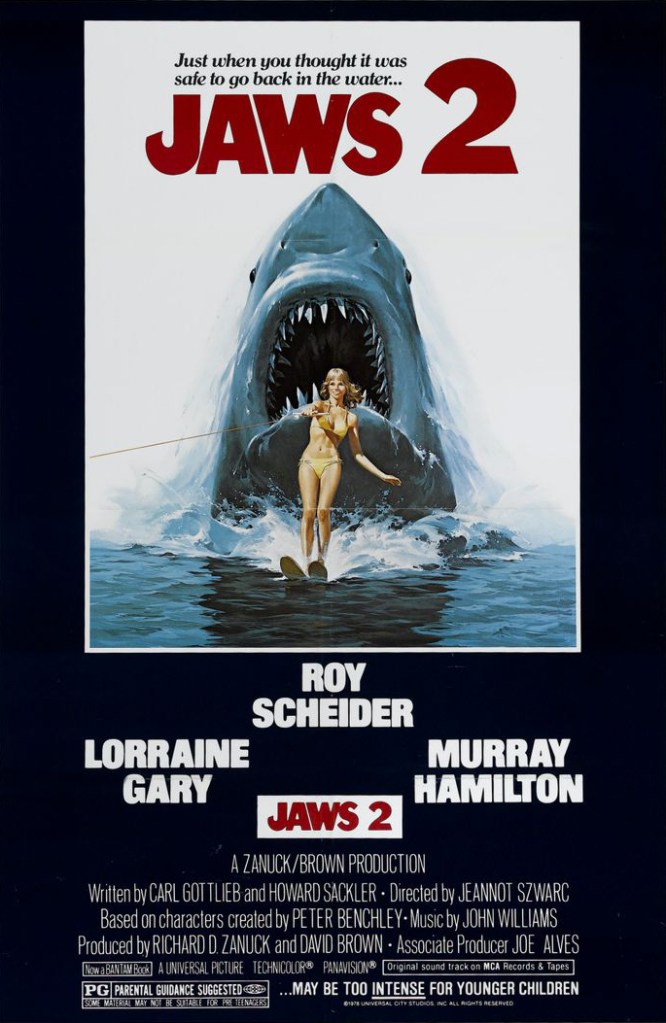
Though a major step down from the original in just about every conceivable way, Jaws 2 still made a strong killing financially because it had a hard sell advertising campaign centered around the immortal tagline Just when you thought it was safe to go back in the water; because, just as Yogurt said in Spaceballs, Merchandising, merchandising, where the real money from the movie is made; and because, let’s face it, people wanted more shark and more shark attacks.

Jaws obviously did not satisfy the public demand for shark attacks captured on celluloid.

Released nearly three years later to the day, Jaws 2 serves up a shark attack every 10-15 minutes, just so we’re not completely bored stiff by a plot that rehashes one of the worst elements of the original Jaws and substitutes adult characters for a steady procession of teeny boppers who together do not make up for Quint and Hooper.

Jaws 2 introduces a syndrome … called none other than the Jaws 2 Syndrome.

That’s where a sequel takes the worst or one of the worst plot elements of the original film and does it again, only even worse, usually a lot worse.

We remember the infuriating mayor and the infuriating small town businesspeople and their infuriating desire to keep the beaches open in Jaws.

They’re even more infuriating in Jaws 2, set four years after the events of the first movie, especially in the form of the super sleazy town official and all-purpose wheeler dealer Len Peterson (Joseph Mascolo). Peterson only compounds our dislike of this character with his obvious lusting after Sheriff Brody’s wife Ellen (Lorraine Gary).

We’re not even rewarded with a death scene for Peterson, because, generally speaking, business interests and power brokers survive Jaws films.

Presented with photographic evidence of a shark, Peterson and his cronies on the town council dismiss it as seaweed, mud, something on the lens and they fire Sheriff Brody (Roy Scheider) not long after his public meltdown on a crowded beach.

We all know too well that Sheriff Brody and the killer shark are destined for a final showdown, so it is very frustrating (and infuriating, once again) to see Sheriff Brody put through the proverbial ringer in the middle section of Jaws 2.

Scheider did not want to have anything to do with Jaws 2 whatsoever and reports have it the human star of the movie thought he would be overshadowed by the shark. He’s right, exactly right, because the shark and the shark attacks absolutely steal the show. The shark is the greatest character in Jaws 2, despite Scheider’s best efforts as Sheriff Brody.

Jaws gives us five great characters in Sheriff Brody, Hooper (Richard Dreyfuss), Quint (Robert Shaw), Mayor Vaughn (Murray Hamilton), and the shark.

Brody and Vaughn return in Jaws 2, but they are overshadowed by the shark, Hooper did not return, and Quint certainly did not return after that ending in Jaws.

Instead, we have a bunch of nattering (or screaming) teenagers, who are still better characters than any in Jaws 3 and Jaws: The Revenge.

The Lonely Lady

THE LONELY LADY (1983) 1/2*
The Lonely Lady is one of the all-time great stinker movies, 91 minutes of unpleasant characters in unsavory relationships with unbelievably bad actors speaking dialogue that should have never been uttered or ever written in the first place.

Like the (believe it or not) even more awful, killer Santa picture Silent Night, Deadly Night, The Lonely Lady potentially takes the heat off viewers by undercutting a procession of controversial scenes with unintentional humor. I could see hooting and howling in derisive laughter at the performances and the dialogue throughout Silent Night, Deadly Night and The Lonely Lady.

I found myself appalled more than anything else throughout The Lonely Lady, so I was basically too appalled to laugh.

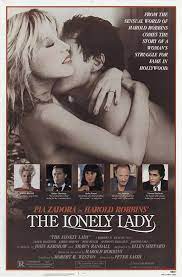
The Lonely Lady especially lays it on thick whenever the title character — aspiring young screenwriter Jerilee Randall, played by the immortal Pia Zadora, though she’s never lonely — expresses her outrage at her perpetual exploitation by Hollywood writers, directors, actors, and producers, every one of them sexist pigs who just nonstop use and abuse her.

At the same time, however, the camera lingers on this exploitation from the rape by garden hose early on in the picture to some of the least sexy movie sex ever captured on celluloid.

On top of all that, Zadora’s real-life husband, Israeli multimillionaire industrialist Meshulam Riklis, funded Butterfly and The Lonely Lady with both pictures starring none other than Zadora. Legend has it that Riklis bought a Golden Globe award for his wife and her performance in Butterfly.

Zadora beat out Elizabeth McGovern and Howard E. Rollins Jr. in Ragtime, Kathleen Turner in Body Heat, Rachel Ward in Sharky’s Machine, and Craig Wasson in Four Friends, all five better-received performances in better-received films.

It remains inconceivable that Zadora — who made her motion picture debut in the 1964 cult film Santa Claus Conquers the Martians — won that award on her own merits.

Riklis was more than 30 years older than Zadora, and that’s not any different than the age gap between Jerilee and her much older husband, veteran Hollywood hack screenwriter Walter Thornton (Lloyd Bochner), in The Lonely Lady.

All those factors combine to make Jerilee’s speech at the Academy Awards — highlighted by that risible line I don’t suppose I’m the only one who’s had to fuck her way to the top! — the absolute worst scene in a movie populated by predominantly bad scenes.

Most of them involve Jerilee sleeping her way through some of the ugliest men imaginable.

Let’s take a look at one more scene that epitomizes The Lonely Lady.

Jerilee and Walter argue outside their Beverly Hills home, near the swimming pool seen first in one of the film’s most appalling scenes.

Jerilee: Walter? Walter, come to bed.
Walter: Haven’t you had enough wine? Go sleep it off.
J: If you’ll come with me.
[W turns away.]
J: I’m trying to say sorry.
W: With a head full of drink!
J: We don’t have to make love.
W: Thank you.
J: We could talk. We need to talk.
W: Why didn’t you go off with Dacosta? He would’ve enjoyed it.
[W picks up the garden hose that raped J earlier in the film.]
W: Or is this more your kick?

That’s even worse than the argument between Kathryn Harrold and Luciano Pavarotti in Yes, Giorgio that culminated in the infamous line I don’t want to be watered on by Fini.

That garden hose, in fact, might have once belonged to Fini.

The Lonely Lady flopped so badly that, thankfully, Hollywood never adapted one of Harold Robbins’ trashy novels again.

Now, I call that a happy ending.

Dead of Night (1945)

DEAD OF NIGHT (1945) ****
Back in 2005, I needed three credits to complete a master’s degree in history (lifetime underachievement) and I finished a three-week 120-hour internship that summer at the National Archives in Kansas City, Missouri.

Anyway, they let me loose on their free account on some genealogical site as reward for good behavior and a day-and-a-half later I came back with Sisney family history dating back to 1776.

On February 27, 1776, a few months before the Declaration of Independence, Steven Sisney fought at and was captured and imprisoned during the Battle of Moores Creek Bridge near Wilmington, North Carolina. Sisney was one of about 1600 loyalist-siding Highland Scots who marched from Cross Creek, North Carolina, toward the coast behind British Colonel Donald McLeod. The loyalists lost, the patriots received a morale boost, and North Carolina became the first colony to vote for independence, beating the official declaration by a couple months easy.

Every once in a while, I think about Steven Sisney and his loyalty to the British since I favor the Beatles and the Stones and the Who and the Kinks and Black Sabbath and Led Zeppelin and the Clash and the Sex Pistols and the Buzzcocks and Radiohead and Pink Floyd and Peter Cushing and Christopher Lee and Sherlock Holmes and James Bond and Alec Guinness and Cary Grant and Ben Kingsley and Ian McKellen and Glenda Jackson and Hammer and Hitchcock and Monty Python and Lord of the Rings and Harry Potter and on and so on and on some more again.

If nothing else, the 1945 horror anthology film Dead of Night made me think about Steven Sisney, the epic 1989 David Hackett Fischer history book Albion’s Seed: Four British Folkways in America (never forget the saga of the poor one-eyed servant George Spencer in New Haven, who was hanged for bestiality after a sow birthed a deformed pig with one eye and the two witnesses required for conviction were the deformed piglet and Spencer’s recanted confession), the late Pittsburg State history professor Judith Shaw (1931-2013) who taught many British History courses over the decades, and how much of an impact Dead of Night had on Richard Attenborough’s Magic.

Horror anthologies generally offer a mixed bag of success and failure.

Of course, Ray Davies outlined it in Celluloid Heroes, Success walks hand-in-hand with failure along Hollywood Boulevard. I always think about Twilight Zone: The Movie from 1983 to illustrate the mixed bag qualities of just about every anthology we’ve ever been expected to consume. The segments directed by John Landis and Steven Spielberg suck, the ones from Joe Dante and George Miller are dynamite, and the prologue and epilogue push the overall package into positive review terrain.

In Dead of Night, Alberto Cavalcanti directed Christmas Party and The Ventriloquist’s Dummy, Charles Crichton directed Golfing Story, Robert Hamer directed The Haunted Mirror, and Basil Dearden directed Hearse Driver and Linking Narrative.

It all starts when architect Walter Craig (Mervyn Johns) tells host and potential client Eliot Foley (Roland Culver) and his guests at country estate Pilgrim’s Farm that he’s seen them all in a recurring dream. Craig feels like he’s been at Pilgrim’s Farm before and every guest rings a bell to him despite never having met any of them before. Each person (host and guests alike) rattles off a supernatural tale, inspired by Craig’s revelations. Craig wants to leave because he doesn’t want his dream to come true and the guests do their best to make him stay.

The Haunted Mirror and The Ventriloquist’s Dummy are especially brilliant and Golfing Story reminds one that Ealing Studios later brought us Kind Hearts and Coronets, The Lavender Hill Mob, and The Ladykillers, all of which feature a dark comedy that seems to have started with Hitchcock. Hamer directed Kind Hearts and Coronets and Crichton directed The Lavender Hill Mob (and later on in his career A Fish Called Wanda).

Basil Radford (1897-1952) and Naunton Wayne (1901-70) appear together in Dead of Night, but not as their characters Charters and Caldicott. Charters and Caldicott began in Hitchcock’s 1938 classic The Lady Vanishes and then the acting duo appeared together in a series of films from 1940 through 1949, including three more times playing Charters and Caldicott. They are very funny, both individually and collectively, in Dead of Night. They don’t seem particularly gay in Dead of Night.

During The Haunted Mirror, guest Joan Cortland (Googie Withers) relays to us what happened after she gifted an antique mirror to her future husband Peter (Ralph Michael). Peter sees another room in the mirror’s reflection, does not see Joan in the mirror when she confronts him, and for a spell he sees the room as normal. Joan finds out the history of the mirror and the wealthy man who owned it after she visits the antique shop from which she purchased the mirror. This wealthy man was crippled in a riding accident, then he grew so insanely jealous of his wife that he strangled her and he finally slit his own throat in front of the mirror. When Joan returns home, Peter accuses her of having an affair and then he attempts to strangle her. Joan smashes the mirror in sheer desperation and breaks the spell.

In The Ventriloquist’s Dummy, the absolute most effective segment, resident rational explanation seeker Dr. Van Straaten (Frederick Valk) tells us about the case of ventriloquist Maxwell Frere (Michael Redgrave) and his dummy Hugo Fitch. Maxwell develops a dual personality with Hugo becoming the dominant part. Poor, poor, poor Sylvester Kee (Hartley Power), who happens to catch and be impressed by the act.

In the long run, I was much impressed by Dead of Night and I recommend it to anyone.