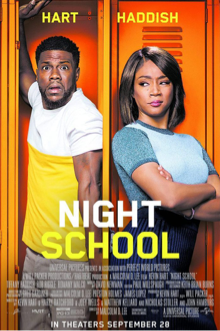
Night School (2018)

NIGHT SCHOOL

NIGHT SCHOOL (2018) One star

I know that I am probably not the target audience for director Malcolm D. Lee’s comedy starring Kevin Hart, who also served as one of the six writers and producers on NIGHT SCHOOL.

I know that, but I am still hard pressed to come up with a single (even fleeting) moment I laughed at during a movie listed at 111 minutes.

I struggled through NIGHT SCHOOL, but I must report there were those around me who laughed their heads off at regular intervals. They made up the difference for my stone face. (Previously, I had this experience at THE HANGOVER, STEP BROTHERS, and TED, though far more pronounced for those comedies since I watched them in a crowded multiplex.)

Perusing through Hart’s credits, I found one movie over the last 18 years that I watched before experiencing NIGHT SCHOOL, just one movie and not exactly a good one at that, SCARY MOVIE 3. I might have watched SUPERHERO MOVIE, but it’s not exactly coming back to me now with any clarity. I am glad that I have missed just about every one of his movies.

In NIGHT SCHOOL, Hart plays a high school dropout named Teddy who’s forced to attend night school at his alma mater to pursue a GED. It is far more complicated than that, of course, especially since he’s not been honest with his far more successful fiance about a single thing. Yes, he’s a hustler. I know, I know, it’s a shocker.

I especially found any of the restaurant scenes in NIGHT SCHOOL difficult to watch, because they involve a pubic hair custody battle, incessant mugging and melodrama especially by Hart, racism accusations that will remind one of bad scenes from BEVERLY HILLS COP and RUSH HOUR 2 involving Eddie Murphy and Chris Tucker, and I just can’t take that sentence and paragraph any longer though I will be leaving behind crucial plot points.

The classroom scenes are really not any better, since the night school students and authority figures combine to form a modern-day comedic variation on a platoon in a World War II movie. There are would-be identification figures for everybody in NIGHT SCHOOL.

We have the harpy teacher with an inspirational heart of gold (Tiffany Haddish), the high school principal (Taran Killam) whom our protagonist embarrassed back in high school who’s prone to fits of mugging for the camera more pronounced than the rest of the cast, the working class laborer (Rob Riggle) who has literally broken his back and wants to get into management, the harried housewife (Mary Lynn Rajskub) with a great big lummox for a husband, the former waiter (Al Madrigal) who dreams of being like Justin Bieber or Justin Timberlake, the woke conspiracy theorist (Romany Malco), the young woman (Anne Winters) from a wealthy family, and the convict (Fat Joe) beamed into a standard plot through Skype.

Hart, Haddish, and Killam in particular are guilty of overplaying everything, bludgeoning us with every single joke until the film gets all gooey and sentimental in the final reel and takes its plot oh so seriously. This cast acts like each audience member suffers from a learning disability (or hearing loss).

I absolutely hate it when comedies go for cheap gag after cheap gag for most of their running time and then get all serious and borderline preachy at the end, like they want both their NATIONAL LAMPOON’S ANIMAL HOUSE and their ABC Afterschool Special. I wanted to gag when Teddy began his meandering feel good speech at graduation.

Austin Chronicle reviewer Marc Savlov incorporated both the Hindenburg and John Hughes’ THE BREAKFAST CLUB into his opening sentence. That’s good and true, because NIGHT SCHOOL indeed leaves me saying “Oh, the Humanity!”

The Delta Force (1986)

THE DELTA FORCE

THE DELTA FORCE (1986) Three stars

Watching THE DELTA FORCE for the first time in 30 years, it surprised me in three ways.

First, it accumulates a running time of 2 hours, 5 minutes.

Second, the heavy action does not kick in until about 1 hour, 15 minutes in.

Third, it’s more thoughtful than expected, given that it is a Golan-Globus production starring Chuck Norris and featuring a cast of many highlighted by hostages Martin Balsam, Joey Bishop, Lainie Kazan, George Kennedy, and Shelley Winters, actors who initially suggest the movie would quickly become AIRPORT ‘86.

About that running time, let’s see here, RAMBO: FIRST BLOOD PART II and COMMANDO, both from 1985, clock in at approximately 96 and 92 minutes, respectively. Then again, Norris’ previous cinematic crusade against terrorism, INVASION U.S.A., lasts 110 minutes.

Once the action does kick in, it kicks in real good in THE DELTA FORCE and it especially delivers the goods with shit blown up real good just like an old school action movie should. Of course, I hope the demolition experts were paid real good.

The action truly begins with a chase: Major Scott McCoy (Norris) and his Delta Force colleague are pursued by Lebanese terrorists through Beirut and one terrorist vehicle crashes into a poor defenseless fruit cart and melons fly everywhere. Ah, yes, this is one of the better fruit cart scenes in history because they used both slow motion and big melons. I say the bigger the melons, the better the fruit cart scene.

I have argued the best Chuck Norris movies are the ones with the best supporting casts and THE DELTA FORCE definitely upholds that argument. Other cast members include Robert Forster, Hanna Schygulla (it’s a long way from Rainer Werner Fassbinder melodramas to Chuck Norris action spectaculars), Susan Strasberg, Bo Svenson, and Robert Vaughn. The great Lee Marvin (1924-87) also plays a key role in his final movie performance. Of course, Marvin brings his association with THE DIRTY DOZEN.

This is Norris’ best supporting cast, though I still rate THE DELTA FORCE slightly below LONE WOLF MCQUADE and CODE OF SILENCE overall.

Palestine born Menahem Golan (1929-2014) wrote, produced, and directed the film, which takes an undeniable pro-Israeli, pro-Jewish position. Golan served in the Israeli Air Force as a young man, long before he and his younger cousin and business partner Yoram Globus attempted to conquer the international film market.

Call me a fool and slap me silly, but it seems that Golan paid a lot more attention and dedicated more craft to THE DELTA FORCE than the average run-of-the-mill Cannon production, like, for example, Norris’ other 1986 film, FIREWALKER. Granted, J. Lee Thompson directed that one, but it’s doubtful that Golan would have evinced any passion in a watered down third-rate Indiana Jones retread like he did for THE DELTA FORCE.

THE DELTA FORCE ripped its plot from the real-life hijacking of Trans World Airlines Flight 847 on June 14, 1985. There’s a real-life Delta Force who have engaged in Operation Eagle Claw, Operation Enduring Freedom, the Iraq War, Operation Inherent Resolve, and Operation Kayla Mueller, among many other specialized missions incorporating counter-terrorism, hostage rescue, and direct action.

THE DELTA FORCE began production in July 1985 and filming in September 1985. The shoot lasted until early November. The filming took place in predominantly Israel. THE DELTA FORCE opened February 14, 1986, 245 days after the hijacking.

We have about the same number of passengers and crew members in the movie as in real life, the same number of terrorists behind the hijacking, a purser based on flight service manager Uli Derickson, the singling out of the Jewish passengers and the Navy divers and the eventual murder of one of them, and a similar flight pattern.

In real life, though, diplomats brought about the release of the hostages, not the Delta Force. Of course, that’s not what anybody wants to see in an action movie. I mean, you don’t cast Chuck Norris and Lee Marvin for that.

THE DELTA FORCE can be a wish fulfillment fantasy particularly for those who feel the United States perpetually takes a soft position on international terrorism and that we should go right into the heart of the Middle East and “Kill all the A-rabs” once and forever. Never mind that all our prior and ongoing efforts in the Middle East have seemingly only compounded matters and created more terrorists. One just might be left to conclude the War on Terrorism will never end, just like the War on Drugs.

The Arab characters in THE DELTA FORCE, terrorists one and all, earned their place in Jack G. Shaheen’s book “Reel Bad Arabs: How Hollywood Vilifies a People.” Vincent Canby of the New York Times wrote, “[DELTA FORCE] will be the 1986 film all others will have to beat for sheer, unashamed, hilariously vulgar vaingloriousness.”

Subaru customized a motorcycle just for Norris’ late picture heroics. Gene Siskel wrote in his one-star review for the Chicago Tribune, “The action in Beirut is more appropriate for a bad James Bond film than for a subject that has been all too real lately. Norris gets off shooting rocket launchers from his specially built motorcycle, and we sit there stunned at the movie industry’s ability to make money off of any tragedy.”

Israeli filmmaker Rafi Bukai said that he hated films like THE DELTA FORCE because they do not show Arabs as human beings.

Veteran character actor Robert Forster (1941-2019) plays the main terrorist Abdul Rafai. Forster was born in Rochester, New York, to parents of Italian, English, and Irish descent. His father trained elephants for the Ringling Bros. and Barnum & Bailey Circus. File this casting alongside John Wayne as Genghis Khan in the 1956 THE CONQUEROR. Along this same line, how many ethnicities and nationalities have character actors like Alfred Molina and Armand Assante played over the years?

I give THE DELTA FORCE a positive review because I enjoy it as a big, dumb, and even stupid action movie and it is an effective time capsule piece with Golan-Globus, Cannon Films, Chuck Norris, Lee Marvin, and all those older character actors. Not because it is a sobering, thoughtful, and balanced consideration of Middle East politics and international terrorism. Thankfully, I have read several books just like that on those subjects.

Porky’s (1981)

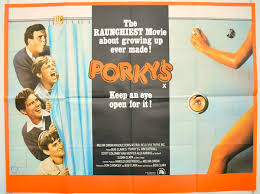
PORKY'S

PORKY’S (1981) Three stars

“Nobody ever went broke underestimating the intelligence of the American public,” H.L. Mencken famously said.

Mencken said that long before the success of PORKY’S, PORKY’S II: THE NEXT DAY, and PORKY’S REVENGE!, comedies which combined for over $200 million in box office and rental returns. Mencken died in 1956.

PORKY’S earned the vast majority of that $200 million and it came from out of seemingly nowhere to place fifth at the American box office in 1982, behind only breakaway winner E.T., ROCKY III, ON GOLDEN POND, and AN OFFICER AND A GENTLEMAN. PORKY’S sat on top of the American box office from late March through early May and it was dethroned by Arnold Schwarzenegger and CONAN THE BARBARIAN.

Unlike those other films, however, critics absolutely detested PORKY’S and aligned it with FRIDAY THE 13TH and THE CANNONBALL RUN in an unholy trinity of films that would no doubt lead to the downfall of Western Civilization. PORKY’S exhibits more than most how a film can be hated by critics and loved by the masses.

The success of the first PORKY’S spawned a whole slew of teenage sex comedies, often nostalgic and especially set in either the 1950s or 1960s.

I claimed a copy of PORKY’S as one of my first VHS purchases in my late teenage years and it quickly became a favorite movie of my rowdy group of friends. We loved it, as well as NATIONAL LAMPOON’S ANIMAL HOUSE, CADDYSHACK, KINGPIN, and THE BIG LEBOWSKI.

Every time I watch PORKY’S, I find a few big laughs and that’s why I am giving the film a passing grade. As far as the sequels are concerned, they are dreadful and deserve their horrible reputation. I remember seeing all of them in heavily edited form on “USA Up All Night,” before catching up with them all on video or pay TV.

Of course, our seven high school horn balls in PORKY’S are all played by older actors: Dan Monahan turned 26 in 1981, Mark Herrier 27, Wyatt Knight 26, Roger Wilson 25, Cyril O’Reilly 23, Tony Ganios 22, and Scott Colomby 29. That’s not anything new for a Hollywood film. For example, in GREASE, another highly successful nostalgia piece, John Travolta was 23 when he made it and Olivia Newton-John was 28 almost 29, Stockard Channing 33, Jeff Conaway 27, Barry Pearl 27, and Michael Tucci 31 when they were playing high school students.

Speaking of GREASE, one could describe PORKY’S as GREASE with T&A and rednecks instead of PG and greasers and without musical numbers.

PORKY’S includes sex jokes, condom jokes, sex jokes, size jokes, sex jokes, nude jokes, sex jokes, penis jokes, sex jokes, virgin jokes, sex jokes, and fat jokes, especially at the expense of villains Porky (Chuck Mitchell, a 6-foot-3, nearly 400-pound man) and Ms. Beulah Balbricker (Nancy Parsons).

Porky is a real vile piece of work, a saloon and brothel owner who is the most powerful man in his county. Every public official seems to be related to Mr. Wallace, namely his brother Sheriff Wallace (former NFL great Alex Karras). Mitchell wraps his best redneck goon around such dialogue as “I was givin’ the old place an enema and this pile of shit come floatin’ up to the surface” and “Where are these five little virgins who think they reached manhood? You wanna tangle ass with me? Come up here, you sawed-off punk! I’ll educate ya! I’ll wrap this right around your damn neck!” It is to Mitchell’s credit that he creates such a nasty character that we do root for his comeuppance in the final reel.

Balbricker embodies the worst killjoy or she’s basically portrayed as the Carrie Nation of the teenage sex comedy. Less successful, though, much less successful. After all, Carrie Nation (1846-1911) said things like “I felt invincible. My strength was that of a giant. God was certainly standing by me. I smashed five saloons with rocks before I ever took a hatchet” and “I want all hellions to quit puffing that hell fume in God’s clean air.” Balbricker (also called “Ball-breaker” and “King Kong” by other characters) develops an obsession with one character’s penis. Please can we call it a tallywhacker? Penis is so personal. Parsons, like Mitchell, gives a very good performance, one that rates with John Vernon in ANIMAL HOUSE.

Kim Cattrall must have used her work here as Miss Honeywell (“Lassie”) during her audition for “Sex and the City.” It definitely beats MANNEQUIN.

Writer and director Bob Clark (1939-2007) has a very interesting story and filmography, since his credits include the 1974 proto-slasher BLACK CHRISTMAS, the beloved A CHRISTMAS STORY, and the first two PORKY’S films, as well as even more diverse entries like MURDER BY DECREE, TRIBUTE, RHINESTONE, TURK 182!, LOOSE CANNONS, and BABY GENIUSES.

His entry in “Take One’s Essential Guide to Canadian Film” from 2001 : “Clark turned down bids to play pro football to complete a drama major at the University of Miami. With the success of his low-budget horror classic CHILDREN SHOULDN’T PLAY WITH DEAD THINGS, Clark moved to Montreal in 1973 and came to dominate Canadian commercial filmmaking for a decade. He followed CHILDREN with BLACK CHRISTMAS, a box-office hit starring Margot Kidder, and then, from 1978 to 1981, he directed MURDER BY DECREE, TRIBUTE, and PORKY’S – three of the most successful films produced in the tax-shelter era. Sad to say, the sophomoric PORKY’S remains the Canadian box-office champ. Clark returned to the United States in 1984; his career, like his locale, has gone south since.”

I read that Clark gathered the material for PORKY’S over a 15-year period, combining stories from other males of his generation with his own experiences. Every Hollywood studio passed on PORKY’S and it was produced by the Canadian company Astral Bellevue Pathe and Melvin Simon Productions (Mr. Simon, who died in 2009 at the age of 82, developed Mall of America, co-owned the Indiana Pacers along with his brother Herbert, and produced films including PORKY’S, THE STUNT MAN, and ZORRO, THE GAY BLADE), but 20th Century Fox picked up the U.S. distribution and a slick marketing campaign, combined with strong word-of-mouth, produced a monster hit on a $4 million budget.

Clark passionately defended the film amid the constant cries of misogyny and racism.

Those critics are missing that Wendy, played by Kaki Hunter, is often the sunniest presence and that Clark set his film in the Deep South in 1954. One character does overcome his initial anti-Semitism and becomes friends with a Jewish classmate.

THE NEXT DAY seems to address both criticisms, though, with one thoughtful dialogue scene between Wendy and main horn ball Pee-Wee (Monahan) and then adds a fanatical reverend, hypocritical politicians, a Native American, and the Ku Klux Klan to the mix. All the latter material simply does not mesh with the juvenile sex comedy.

Clark did not return to direct REVENGE and director James Komack and screenwriter Ziggy Steinberg wanted the third installment to return to the pure sex farce of the first movie. All the actors simply look too long in the tooth to be partaking in such adolescent shenanigans. I mean, for crying out loud, Colomby was nearly in his mid-30s by the point they made this third PORKY’S film; he graduated from Beverly Hills High School in 1970. Bottom line: I laughed not a single time at PORKY’S REVENGE, maybe once at NEXT DAY.


PORKY’S II: THE NEXT DAY (1983) One star; PORKY’S REVENGE! (1985) No stars

Hanover Street (1979)

HANOVER STREET

HANOVER STREET (1979) One star

In a review of the Michael Bay cinematic bomb PEARL HARBOR, “one of the most insulting, most cloying excuses for mass entertainment ever made” I called that one, I mentioned HANOVER STREET and called it both possibly Harrison Ford’s worst movie and a weeper from Hell.

HANOVER STREET establishes a basic plot scenario that worked much better in films contemporaneous with World War II, films like WATERLOO BRIDGE, CASABLANCA, THE CLOCK, and BRIEF ENCOUNTER. Outside that immediate context, though, a film had better be very good because otherwise it will not get away with a period romance. In fact, played badly, we just might laugh it right off the screen. That’s what I did, for example, to survive PEARL HARBOR.

We have all seen HANOVER STREET many times before, even before seeing the film for the first time. Peter Hyams both directed and wrote HANOVER STREET, so he definitely has nobody but himself to blame for such ridiculous tripe.

David (Ford), American pilot.

Margaret (Lesley-Anne Down), English nurse.

She’s married.

He’s not.

Instant love / lust.

They start a love affair in the midst of a London blown up real good.

She keeps her husband a secret from her new lover.

He’s assigned to escort a British secret agent into France.

They’re shot down behind enemy lines.

David discovers that secret agent, you guessed it, is Margaret’s husband, Paul (Christopher Plummer).

David and Paul must work together to survive.

Enough is enough, because I think anybody with an IQ of at least 100 can finish the rest of the synopsis of HANOVER STREET.

With the staggering success of both ROCKY and STAR WARS in back-to-back years (1976 and 1977), both good old-fashioned popular entertainments, Hollywood began churning out light, feel good, escapist pictures by the dozens. It especially became even more pronounced in 1979 (and beyond), since 1978 releases GREASE, HEAVEN CAN WAIT, and SUPERMAN proved to be major hits in the ROCKY and STAR WARS mold.

Just take a look at the poster for HANOVER STREET.

The words at the top: LOVE HASN’T BEEN LIKE THIS SINCE 1943.

Below that an illustration of Harrison Ford and Lesley-Anne Down looking each other passionately in the eyes, foreshadowing or merely shadowing a key scene in the movie.

More text (hype): “It was a time of courage and honor – of passion and sacrifice. This is the story of two people swept up in that time – who met – and fell in love.”

There’s also a map and two planes on the poster.

Ford worked so effectively as both Han Solo and Indiana Jones in eight films partly because he found a way to work in humor that counterbalanced all the cornball surrounding him. There’s also that priceless scene in THE EMPIRE STRIKES BACK when Princess Leia (Carrie Fisher) tells Han that she loves him and he merely says, “I know.”

In HANOVER STREET, Ford stumbles his way though dialogue like “Think of me when you drink tea,” “I love you enough to let you go, which is more than I’ve ever felt about anyone in my life,” and “You’ve got to go to him, and I’ve got to turn and walk away.” To be fair, everybody stumbles in HANOVER STREET and there’s no counterbalance to cornball.

Christopher Plummer legendarily disliked working on THE SOUND OF MUSIC (he called it “The Sound of Mucus”) and he said this about his co-star, “Working with Julie Andrews is like getting hit over the head with a valentine.” (Plummer and Andrews have remained friends.)

I just wonder what Plummer has to say about HANOVER STREET.

The Swarm (1978)

THE SWARM

THE SWARM (1978) One-half star

Many comedies wish they could make me laugh as hard as I do at the ridiculous disclaimer at the end of the 1978 Irwin Allen film THE SWARM: “The African killer bee portrayed in this film bears absolutely no relationship to the industrious hard-working American honey bee to which we are indebted for pollinating vital crops that feed our nation.”

Were the folks at Warner Bros. seriously afraid of alienating the American honey bee?

I’ve read that the American Bee Association considered suing Allen for defaming the honey bee … and that must be why we ended up with that jive disclaimer right before the end credits. But, honestly, why stop there? The director, writer, and actor guilds should have sued Allen for defaming their respective trades, because this has to be the worst use ever of a $21 million production budget (reports vary on the $), seven Academy Award winning actors (Michael Caine, Olivia de Havilland, Ben Johnson, Jose Ferrer, Patty Duke, Lee Grant, and Henry Fonda, but none of them earned for this movie), and 800,000 bees with their stingers removed.

I’ll never forget THE SWARM because it’s not easy forgetting one of the worst movies ever made. I caught it (not all of it, though) for the first time in either late 1997 or early 1998, home alone late afternoon during my freshman year of college. I returned from class and found this disaster pic flipping channels. It was somewhere in the middle and I watched the rest. The lousy special effects, the cornball everything (premise, plot, dialogue, acting, title), and that darn disclaimer stuck with me. …

I’ve caught up with THE SWARM a couple more times or I’ve watched it at an interval of once every 10 years. It still rates about the exact same as the first time watching it, though, but I guess I have watched it a couple more times after the first as a honest reminder of what a bad movie’s truly like.

Guess we should give a lot of blame for THE SWARM to Allen (1916-91). The Master of Disaster produced THE POSEIDON ADVENTURE, THE TOWERING INFERNO, THE SWARM, BEYOND THE POSEIDON ADVENTURE, and WHEN TIME RAN OUT, the last three of which helped kill off the disaster films that were so popular in the 1970s. THE SWARM earned $7.7 million, BEYOND THE POSEIDON $2.1 million, and WHEN TIME RAN OUT $3.8 million.

Allen also directed THE SWARM and BEYOND THE POSEIDON. In THE SWARM, he kills two genres in one movie, combining disaster with the killer animal genre that became a dominant exploitation staple after the incredible success of Steven Spielberg’s JAWS in 1975.

It was David Hannum, not P.T. Barnum, who came up with the legendary quote, “There’s a sucker born every minute.” Should have been Irwin Allen, though, because his films really take us for suckers one and all. Fortunately, we are better (smarter) than that.

Stirling Silliphant (1918-96) wrote the screenplay for THE SWARM and he wrote both of Allen’s biggest hits, THE POSEIDON and TOWERING INFERNO. He also won an Academy Award for his screenplay for Best Picture winner IN THE HEAT OF THE NIGHT. (Silliphant’s erratic credits include VILLAGE OF THE DAMNED, SHAFT IN AFRICA, and OVER THE TOP.)

Unfortunately, his work on THE SWARM will go down in infamy.

Helicopter pilot: “Oh my God! Bees! Bees! Millions of bees … (later on) Bees! Millions of bees!” Of course, it does not help matters that the bees sometimes look more like painted-on black dots.

There’s some dynamite exchanges in THE SWARM. I’ll highlight just one.

Dr. Crane (Caine): Are you endowing these bees with human motives? Like saving their fellow bees from captivity, or seeking revenge on Mankind?

General Slater (Richard Widmark): I always credit my enemy, no matter what he may be, with equal intelligence.

“No matter what he may bee,” maybe they should have stripped Silliphant of his Academy Award for writing that one.

There’s more howlers in THE SWARM: “Houston on fire. Will history blame me, or the bees?”; “I know people look at me and think that I’m just the man behind the aspirin counter, but inside I love you”; “They’re more virulent than the Australian Brown-Box Jellyfish”; “By tomorrow there will be no more Africans … at least not in the Houston sector.” This dialogue indicts inself.

THE SWARM is one time where calling a film a train wreck is literal.

A train wreck, by the way, that kills Olivia de Havilland, Ben Johnson, and Fred MacMurray, two of the film’s seven Academy Award winning actors. Johnson (1918-96) fared better later as the conductor in the horror film TERROR TRAIN. I really did not want to mention that de Havilland, Johnson, and MacMurray form a romantic triangle in THE SWARM. Let’s just get past that and move on immediately, unlike the movie.

Having such an all-star cast, by the way, backfires miserably for THE SWARM, because I start thinking about movies like ZULU (Caine), THE ADVENTURES OF ROBIN HOOD (de Havilland), THE LAST PICTURE SHOW (Johnson), DOUBLE INDEMNITY (MacMurray), THE MIRACLE WORKER (Duke), and ONCE UPON A TIME IN THE WEST (Fonda), for example, rather than what I am supposed to be watching.

Some of the stars have smaller roles than others. Yeah, and I almost forgot about Richard Widmark, Richard Chamberlain, and Slim Pickens, though I mentioned the always skeptical, always boneheaded General Slater played by Widmark. How could I forget though about Mr. Pickens? According to Cinemorgue Wiki, Pickens died cinematic deaths in THE LAST COMMAND, A THUNDER OF DRUMS, DR. STRANGELOVE, MAJOR DUNDEE, ROUGH NIGHT IN JERICHO, PAT GARRETT & BILLY THE KID, BEYOND THE POSEIDON, THE BLACK HOLE, and THE HOWLING. They missed an opportunity in not killing Pickens in THE SWARM. I mean, his death scenes in DR. STRANGELOVE and PAT GARRETT & BILLY THE KID are legendary.

I am rambling, just like THE SWARM itself.

When you watch THE SWARM, please try and keep in mind that Paul Zastupnevich received a nomination for the Academy Award for Best Costume Design. Unbelievable, just unbelievable, like THE SWARM.

Park Row (1952)

PARK ROW (1952) Four stars

I finally watched for the first time PARK ROW, Samuel Fuller’s self-financed labor of love and love letter to newspapers, newspapermen, and the revolutionary concept of a free press.

Of course, Fuller produced his love letter decades before many newspapers became downsized, outsourced, strip-mined, gutted, and homogenized into bland soggy vanilla wafer cookie cutter clone drone carbon copies of all the other papers owned by the same media company. Fewer days printed, earlier and earlier deadlines, fewer pages (less content) because of declining ad revenue and increased printing costs, more delivery issues, and price increases at every level all factor into a worse product, more unhappy customers, and ultimately fewer subscribers, as well as fewer employees, in a vicious cycle. Less (newspaper) for more (money) will not cut it.

That once family-owned small town newspaper … once the beacon, pride and joy, and watchdog of a community (and possibly region) and once housed inside a buzzing building populated by wordsmiths and word slingers, photographers, editors of various persuasions, proof readers and fact checkers, pressmen, inserters, and many others in a diverse work environment … has been reduced over time to a skeleton crew of employees who hear the grief for the sad state of a formerly great paper. They hear the grief because the power players are hundreds if not thousands of miles away. Good luck reaching them.

Not that journalism majors and college paper staff members are forewarned a million times before their graduation about newspapers being a dying industry. It’s not a natural death, though, and it’s both maddening and saddening for the lover of the printed word to see what’s happening to so many papers.

PARK ROW inspired thoughts, reactions, and reflections by the bushel.

  • People with a vision and the character and personality necessary to carry it out have been replaced by number-crunching, bean-counting, penny-pinching, character- and personality-deficient, machine-like men and women in many decision-making positions in the newspaper industry. Just like protagonist Phineas Mitchell (Gene Evans) says in PARK ROW, “The press is good or evil according to the character of those who direct it.”
  • Remember that classic line from John Ford’s 1962 western THE MAN WHO SHOT LIBERTY VALANCE? Something like “This is the West, sir. When the legend becomes fact, print the legend.” That’s just what we shall do with PARK ROW, written, directed, produced, and financed by Fuller. That’s right, Fuller himself put up every dollar spent on PARK ROW: $200,000 since the other $1,000 of his life’s savings went toward cigars and vodka.
  • Fuller (1912-97) became a copy boy at the age of 12 for the New York Evening Journal and a crime reporter for the New York Evening Graphic at 17. He quit his newspaper gig three years later and hitchhiked the U.S.A. with the occasional freelance job. In 1934, Fuller took a temp crime reporter job for the San Francisco Chronicle and then editorial writer for the San Diego Sun. Fuller returned to New York in 1935 and published his first novel, “Burn, Baby, Burn.” Fuller wrote more novels and branched out into screenplays for Hollywood, including one from 1938 with a catchy title, GANGS OF NEW YORK, directed by James Cruze and starring Charles Bickford and Ann Dvorak. Fuller enlisted for the U.S. Army the day after Pearl Harbor and he served in the 26th Regiment, Third Battalion, Company K or the Big Red One for the rest of the war (his experiences inspired his 1980 movie THE BIG RED ONE). Two screenplays were filmed and his mystery novel “The Dark Page” was printed during World War II with Fuller overseas. Back stateside, Fuller directed his first film, I SHOT JESSE JAMES, in 1949 and his 26 films are informed by his background in newspapers and novels.
  • Fuller’s older brother Ving (1903-65) provided the editorial cartoons for PARK ROW. Ving worked as a newspaper cartoonist, among other gigs including animation and gag writing, and his best known work is the mad scientist comic strip “Doc Syke” from 1944 to 1960.
  • PARK ROW starts with a scroll through the names of the 1,772 daily newspapers in the United States circa 1952. Bold letters proclaim “ONE OF THEM IS THE PAPER YOU READ.” A few seconds later, “ALL OF THEM ARE THE STARS OF THIS STORY.” About one minute in, “DEDICATED TO AMERICAN JOURNALISM,” with “AMERICAN JOURNALISM” in much bigger letters just like a front page headline for a major news story. That sure as all get-out beats what we see and hear today, you know, all that “evil liberal media” and “fake news” hyperbole. Why, just a couple years ago Walmart sold online, through a third party seller, T-shirts featuring “Rope. Tree. Journalist.” Below that, “Some Assembly Required.” Walmart pulled the shirts after a complaint from the Radio Television Digital News Association.
  • As of 2016, the number of daily papers in the United States had dropped to 1,286.
  • After that scroll and a brief Samuel Fuller Productions fanfare, PARK ROW gives us voice-over narration, “This is Johannes Gutenberg, who invented movable type 500 years ago and printed the first Bible. Recognized as the father of modern printing, Gutenberg stands on Park Row, the most famous newspaper street in the world, where giants of journalism mixed blood and ink to make history across the front page of America. Our story takes place in the lusty days of the Golden 80s [1880s] when Park Row was the birth place and graveyard of great headlines, the street of America’s first world famous journalist, a printer’s devil who helped draft the Declaration of Independence and was one of its signers, Benjamin Franklin, patron saint of Park Row … and it is the street of Phineas Mitchell.” I’m already reeled in less than three minutes into the picture.
  • By the way, newspapers chose their location on Park Row because of the proximity to City Hall and the police department.
  • PARK ROW belongs right up there with CITIZEN KANE on the list of my favorite newspaper movies. I found myself inspired by Fuller’s depiction of media wars in 1886, of a small rogue newspaper started by an editor (Mitchell) warring against the very newspaper that fired him because he questioned their moral scruples. The Star’s cutthroat heiress publisher Charity Hackett (Mary Welch) does everything in her power to destroy the start-up Globe, a ragtag team put together on the spot in a saloon right after Mitchell’s firing and that succeeds through initiative and ingenuity, of course much to the chagrin of Hackett.
  • For example, The Globe prints its first edition on butchers’ paper.
  • Mitchell and Hackett, though, are strongly attracted to each other. The film’s poster shows them kissing with the caption “she had blood in her veins … he had ink … and guts.” Other hype on the poster: “Street of rogues … reporters … and romance!” and “The picture with the page one punch!”
  • PARK ROW wins for the best use of a Benjamin Franklin statue in a motion picture. Now, maybe, just maybe, I’ll go back and look at “The Autobiography of Benjamin Franklin,” although I prefer “The Autobiography of Malcolm X.” Both are on the nearby shelf.
  • I have a bias favoring newspapers, because, for one, I learned how to read from one. I love the reaction people have when I tell them I learned to read by the age of 4. Grandpa sat me on his lap and read me the paper. I picked it up from there and have been a passionate newspaper reader ever since.

Big (1988)

BIG (1988) Three-and-a-half stars

Twelve-year-old Joshua Baskin (David Moscow) cannot gain admittance on a roller coaster ride because he’s not tall enough, so the embarrassed young man finds a Zoltar Speaks machine and it grants his wish that he were big. Overnight, Joshua Baskin becomes 30 years old and he’s played by Tom Hanks for basically the rest of the movie.

BIG is by far the best of the body switch movies that were all the rave during the Reagan administration. Anybody sentient during that era can surely remember a body switch pic or two. Let’s see, we had OH! HEAVENLY DOG from 1980, whose July 11 release date predates Reagan and which gives us Chevy Chase trapped inside Benji … Chase provides voice-over for Benji in a rather dull murder mystery. Then, there’s LIKE FATHER LIKE SON from 1987 pairing Dudley Moore and Kirk Cameron, who just scream father and son, in one of the worst movies of all-time had it not come out during the same year as such cinematic landmarks as THE GARBAGE PAIL KIDS MOVIE, LEONARD PART 6, JAWS THE REVENGE, MANNEQUIN, and TEEN WOLF TOO. Never mind, it’s still one of the worst movies of all-time.

BIG streamlined and more or less perfected the body switch, because we stick with one character (Joshua Baskin) the whole time and there’s less of a suspension of disbelief required for the movie to work. For example, in LIKE FATHER LIKE SON, we have to picture Dudley Moore inside Kirk Cameron and vice-versa (pun and reference to another body switch movie intended), but it’s almost impossible since their speaking voices remain the same. Movies like LIKE FATHER LIKE SON are why the late Roger Ebert coined the phrase “The Idiot Plot.”

Hanks gives a strong performance, especially in conveying the whole child trapped inside a grown man’s body through body language, facial gestures, boyish enthusiasm, wide-eyed reactions. He works his predicament for laughs, for pathos, for drama, and there’s a compelling sequence during his first “big” day when he’s staying at this seedy New York City hotel and he’s scared by the real world. Hanks broke away from his poor man’s Bill Murray for the first time in his career and established his own niche that would culminate in playing Forrest Gump.

Elizabeth Perkins is just terrific in BIG and I don’t think she’s ever been either better or more beautiful than as Susan. Perkins matches Hanks every step of the way during their complicated romance and please go back and watch her during the farewell scene with Baskin. She kisses him on the forehead and strokes behind his ear, in a tender and more motherly fashion. She makes the scene work, as Hanks reverts back to Moscow as Baskin.

Robert Loggia (1930-2015) and John Heard (1946-2017) were two of the best character actors during their respective careers.

Loggia plays against type here as MacMillan, the owner of a toy company who takes a major liking to the way Baskin looks at toys; phooey to marketing reports, Baskin and MacMillan test toys the old-fashioned way by going straight to the biggest toy store. They pair together for a toy piano duet and create one of the most iconic movie scenes of the late 80s. It’s known quite simply as the “Big Piano Scene.”

There was often an edge to Heard during his performances and he taps into that edge a great deal in BIG. Heard creates a real jerk.

Penny Marshall became a name director after BIG and she and Hanks reunited for A LEAGUE OF THEIR OWN. Anne Spielberg and Gary Ross wrote the script and Barry Sonnenfeld worked as cinematographer; Ross later directed PLEASANTVILLE and Sonnenfeld’s directorial credits include GET SHORTY and MEN IN BLACK.

There seems to be a certain nostalgia for BIG, just like at times it seems like that’s all true for anything (the good and the bad, and the ugly) from the 80s.

How far can that nostalgia go? Well, there’s the Nostalgic Zoltar Speaks machine for sale on the Zoltar site. One machine comes equipped with a $10,500 price tag and that’s not counting any customization like a wireless microphone to talk through Zoltar ($425 without remote control, $520 with), breathing movement for Zoltar ($625), motion activated attract ($75), custom fortune cards, custom audio messages, and traveling case ($1,500 plastic, $650 wood).

If you do buy that Nostalgic Zoltar Speaks machine for a major chunk of change, do you dare make a wish, “I wish I were big.” I say you better for that level of investment.


Monty Python’s The Meaning of Life (1983)

MONTY PYTHON’S THE MEANING OF LIFE (1983) Three stars

There’s a DVD bundle called “A Little Something to Offend Everybody” and it pairs Mel Brooks’ HISTORY OF THE WORLD PART I and MONTY PYTHON’S THE MEANING OF LIFE.

That’s fitting, because both films definitely fit that bill. For example, both have centerpiece musical numbers that flaunt their potential for controversy: “The Inquisition” in HISTORY OF THE WORLD and “Every Sperm is Sacred” in THE MEANING OF LIFE. Both films go highbrow, middlebrow, lowbrow, below the brow, and even more below the brow. Scatological and sexual jokes abound and Brooks and the Python troupe use just about every trick in the book for their assault on delicate sensibilities and community standards, and they especially indulge their willingness to go over the top in almost every single moment.

It seems like the Monty Python gang (Graham Chapman, John Cleese, Terry Gilliam, Eric Idle, Terry Jones, Michael Palin) made THE MEANING OF LIFE as a reaction to the intense controversy around LIFE OF BRIAN. “If you thought that was bad, well, you ain’t seen nothing yet,” that’s what it seems like they’re saying for all 90 minutes of THE MEANING OF LIFE.

I can hear some of you asking, though, do you get the meaning of life from the movie? Just think about the ridiculousness of that question.

Lady Presenter: Uh, try and be nice to people, avoid eating fat, read a good book every now and then, get some walking in, and try and live together in peace and harmony with people of all creeds and nations. …

The lady presenter (actually Palin in one of his almost 20 roles in the movie) then gets at the crux of the movie as she continues her speech: “And, finally, here are some completely gratuitous pictures of penises to annoy the censors and to hopefully spark some sort of controversy, which, it seems, is the only way, these days, to get the jaded, video-sated public off their fucking arses and back in the sodding cinema. Family entertainment? Bollocks. What they want is filth: people doing things to each other with chainsaws during Tupperware parties, babysitters being stabbed with knitting needles by gay presidential candidates, vigilante groups strangling chickens, armed bands of theatre critics exterminating mutant goats.”

If people truly want “filth,” THE MEANING OF LIFE delivers the goods.

The feature’s second sketch “The Third World” highlights a Catholic working class father (Palin) from Yorkshire, his wife (Jones), and their 63 children. He comes home and informs his family that he’s out of work because the local mill shut down, they are destitute, and that he must sell all 63 children for scientific experiments. He says, “Blame the Catholic Church for not letting me wear one of those little rubber things.”

The father eventually breaks into “Every Sperm is Sacred,” with the memorable chorus “Every sperm is sacred / Every sperm is great / If a sperm is wasted / God gets quite irate.” It turns into a production number straight out of an elaborate musical nominated for a multitude of awards, with even the children getting in on the act before they hit the streets.

The children obviously knew not what they were singing about at the time. Palin felt uncomfortable with one particular line and he originally delivered it “sock” in front of the children before “cock” was later dubbed in.

Beyond “Every Sperm is Sacred,” there’s “Penis Song” (I remember somebody once sang this crowd pleaser at karaoke) and “Christmas in Heaven.”

Quentin Tarantino said the Mr. Creosote sequence makes him nauseous and that says all there needs to be said about the explosive sequence.

I am not or have ever been offended by any of the content in THE MEANING OF LIFE. I think it’s an uneven grab bag of comedy, with hilarious bits, merely funny bits, and other bits where I admire the bits on an intellectual level but I do not laugh. That’s a bit too much of the word bit, but obviously THE MEANING OF LIFE deserves excess verbiage. It’s not as good (funny) as AND NOW FOR SOMETHING COMPLETELY DIFFERENT, THE HOLY GRAIL, and LIFE OF BRIAN.

Before THE MEANING OF LIFE officially starts, we get a bonus 17-minute pirate movie from Gilliam. The elderly British accountants of Crimson Permanent Assurance are fed up with corporate efficiency and they are not gonna take it anymore after the big corporation sacks one of the accountants. Their building turns into a pirate ship with filing cabinets for cannons, ceiling fans for broadswords, and paper spindles for short swords, and they attack The Very Big Corporation of America.

There were several pirate movies during the 1980s and I vote THE CRIMSON PERMANENT ASSURANCE one of the best, right alongside CASTLE IN THE SKY and THE PRINCESS BRIDE.


THE CRIMSON PERMANENT ASSURANCE (1983) Three-and-a-half stars

Bill & Ted’s Bogus Journey (1991)

BILL & TED’S BOGUS JOURNEY (1991) ***1/2

A great supporting character can elevate a movie.

Take, for example, the Grim Reaper from BILL & TED’S BOGUS JOURNEY. I mean, it’s not every day that a supposedly lowbrow comedy puts a novel spin on a character and plot thread from Ingmar Bergman’s THE SEVENTH SEAL.

In that one, you might remember a medieval knight (Max von Sydow) plays a game of chess against a personification of Death (Bengt Ekerot) to prolong his life. The mere image of the knight and Death playing chess by the sea had become one of the most revered in movie history by the time BOGUS JOURNEY director Peter Hewitt, writers Chris Matheson and Ed Solomon, and Grim Reaper player William Sadler, as well as co-stars Keanu Reeves and Alex Winter, got their grubby little mitts on it.

In BOGUS JOURNEY, our two most excellent dudes Bill S. Preston Esquire (Winter) and Ted “Theodore” Logan (Reeves) find themselves in a most hellish predicament. They are killed by evil robot Bill & Teds, called the Evil Robot Usses by our poetic lead characters, and wind up in Hell. What else would happen to a pair of heavy metal fans? Bill & Ted, who quickly discover their album covers lied to them, man, are greeted by Granny Preston, an evil Easter Bunny, Colonel Oats, and eternal boot camp, a plight highlighted by infinity push-ups and verbal abuse, in their own personal Hell. Colonel Oats tells Bill & Ted they are silky boys and silk comes from the butts of Chinese worms.

Back to the Grim Reaper. “How’s it hanging, Death?” asks Ted.

Bill & Ted play The Reaper dude in a series of games, including Battleship, Clue, and Twister, because Death is a sore loser and Bill & Ted must win two out of three or was that three out of five. Nah, believe it’s best five out of seven. The Reaper finally relents, “I will take you back.”

Bill & Ted are the first to ever beat The Reaper, and before that the first to melvin him. “Ted, don’t fear the reaper.” Cue them celestial cowbells.

I love just about everything about the Grim Reaper in BOGUS JOURNEY and he contributes to BOGUS JOURNEY being a step up from EXCELLENT ADVENTURE.

Sadler should have been at least nominated for Best Supporting Actor for his performance here. No, instead, the Academy of Motion Picture Arts and Sciences saw fit to nominate Harvey Keitel and Ben Kingsley from BUGSY, Michael Lerner from BARTON FINK, Tommy Lee Jones from JFK, and winner Jack Palance from CITY SLICKERS. Keitel and Kingsley should have faced off against Sadler in a best-of-seven to see if we could get one less nomination for BUGSY. Colonel Oats would certainly have approved of Palance’s victory with his celebratory one-armed push-ups.

EXCELLENT ADVENTURE takes on time travel, historical figures, and historical fiction. Bill & Ted need to earn an A+ on their final report in history … and the future of the human race hangs in the balance. Literally, because in a mere 700 years in the future, humanity exists in an utopia built around the music of the Wyld Stallions, Bill & Ted’s most excellent rock band.

BOGUS JOURNEY adds depictions of the afterlife, Heaven, and Hell to the mix, and it gives us good and evil robot Bill & Teds in addition to living and dead Bill & Teds. Winter and Reeves compete with Michael J. Fox and Thomas F. Wilson for most permutations in a time travel comedy. Peter Sellers and Tony Randall would have been proud of all of them.

Additionally, the universe’s most brilliant scientific genius uses a single word vocabulary and that’s his name, Station. Station builds the “good robot usses” or “Station’s creations.”

I should not forget Joss Ackland as arch villain Chuck DeNomolos, who programs the evil robots to kill the good Bill & Ted because he hates their ideas and their insipid music. Don’t feel too bad for Chuck, because he gets a shot with Missy. Doesn’t just about everybody?

In the end, though, remember “You might be a king or a street sweeper, but sooner or later you dance with the reaper.”

That and, of course, “Be excellent to each other.”

Hunger (1974)

HUNGER (1974) Four stars

Over a span of many decades, there have been several great dinner scenes in the movies.

The Wedding Feast in FREAKS, the cannibal family dinner in TEXAS CHAINSAW MASSACRE, and that famous plate throwing in AMERICAN BEAUTY are three that spring quickly to mind.

Oh, of course, there’s Mr. Creosote from MONTY PYTHON’S THE MEANING OF LIFE and Peter Greenaway’s THE COOK, THE THIEF, HIS WIFE & HER LOVER. (Perhaps, on the next episode, I’ll cover great diner scenes in the movies, everything from DINER to SUPERMAN II and SUDDEN IMPACT.)

In that Mr. Creosote spirit, we now turn our attention toward Peter Foldes’ historic computer animated short from 1974. We use historic not because of the appetite of the main character but historic works here because HUNGER broke ground in using computer animation. Please keep in perspective it was some two decades before TOY STORY and it took Foldes and his National Research Council’s Division of Radio and Engineering’s Data Systems Group well over a year to make this nearly 12-minute film.

This is essentially a silent film, with no dialogue, no narration, not even intertitles. Just instrumental music and images.

That makes HUNGER all the more effective as a cautionary tale about greed and gluttony in contemporary society. It does not get preachy because of the lack of words or tiresome because of the length of a short. The animation holds our interest and it also gives Foldes no limits (except for the limits of his own imagination) in showing this greed and gluttony. Images rapidly dissolve and their perpetually changing nature points out some striking differences.

In HUNGER, our main character evolves from a skinny office worker into a monster.

A couple minutes in, our main character grabs a bite from the delicatessen before dinner and then he goes through a pig, two fish, everything else on the menu, and the dinner table itself before he takes home the waitress who served him. He sits back down to eat and repeats his business from the restaurant in the privacy of his own home. He really likes swine and then he starts developing a multitude of mouths on his body, as well as more hands to fill all those hungry mouths. Of course, he grows bigger and bigger and even bigger, until finally he’s mobbed by a hungry horde of emaciated figures.

This short came out roughly a decade before the Ethiopian famine of 1983 through 1985 that claimed 1.2 million lives and brought images of starving children to living rooms around the world. How many of us now adults remember from our childhood when our parents, confronted by a plate with food left uneaten, usually something not favored by a child, scolded us by reminding us there’s starving children in Africa. Since it’s approximately 13,000 km between Kansas and Ethiopia, sadly I did not let this scolding affect me in the slightest and I wasted all that food. I’m still a stubborn, picky eater.

Both the images of starving children and the main character in HUNGER stick with me, though, and I am not alone in that respect.

HUNGER earned a nomination for the 1974 Academy Award for Best Animated Short Film and it competed against THE FAMILY THAT DWELT APART, VOYAGE TO NEXT, WINNIE THE POOH AND TIGGER TOO, and the winner CLOSED MONDAYS (co-directed by Will Vinton). It won a jury prize at Cannes in 1974, the Norman McLaren Award and the Silver Hugo at the 1974 Chicago International Film Festival, and the Best Animation Film at the 1975 British Academy of Film & Television Awards (BAFTA), according to its National Film Board of Canada bio.


FIVE MORE HIGHLY RECOMMENDED ANIMATED SHORT FILMS

  1. A CHRISTMAS CAROL (1971, Richard Williams)
  2. THE DOT AND THE LINE: A ROMANCE IN LOWER MATHEMATICS (1965, Chuck Jones)
  3. THE FLY (1980, Ferenc Rofusz)
  4. THE OLD MILL (1937, Wilfred Jackson)
  5. THUMB SNATCHERS FROM THE MOON COCOON (2012, Bradley Schaffer)

NOTE: All five shorts, as well as HUNGER, can be found through online sources.