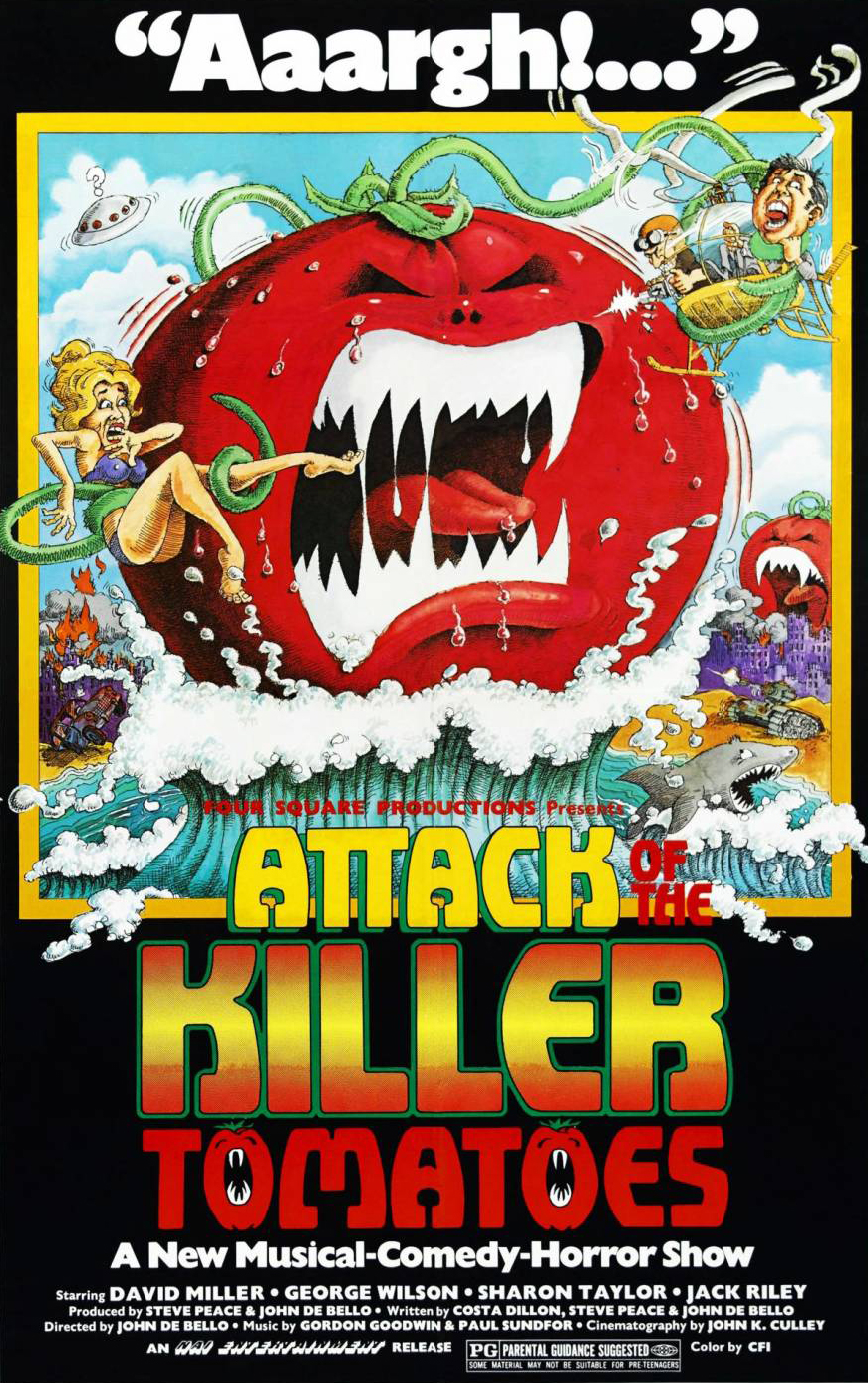
Attack of the Killer Tomatoes (1978)

ATTACK OF THE KILLER TOMATOES

ATTACK OF THE KILLER TOMATOES (1978) Three stars

“In 1963, Alfred Hitchcock made a motion picture entitled THE BIRDS, a film which depicted a savage attack upon human beings by flocks of the winged creatures.

“People laughed.

“In the fall of 1975, 7 million black birds invaded the town of Hopkinsville, Kentucky, resisting the best efforts of mankind to dislodge them.

“No one is laughing now.”

— Introduction to ATTACK OF THE KILLER TOMATOES


Watching ATTACK OF THE KILLER TOMATOES in full for the first time in possibly 30 years, it brought to mind KING KUNG FU.

Both are extremely low-budget labor-of-love parodies and tributes to both older and contemporaneous movies. Both have their dead spots and their high points. Both try many, many, many jokes. Both are filed under cult movies and “so bad they’re good.” Both love their filming locations, Wichita in KING KUNG FU and San Diego in KILLER TOMATOES. Both show people having a darn good time making a silly little movie. Both are so endearingly goofy that I end up forgiving all their various sins and transgressions and enjoying them.

Unlike KING KUNG FU, though, KILLER TOMATOES inspired three sequels — RETURN OF THE KILLER TOMATOES! (1988), KILLER TOMATOES STRIKE BACK! (1990), and KILLER TOMATOES EAT FRANCE! (1991) — plus an animated series and two video games.

Let me highlight what I liked (or loved) about KILLER TOMATOES.

— The songs are great. We have “Theme from Attack of the Killer Tomatoes,” “Puberty Love,” “The Mindmaker Song,” “Tomato Stomp,” and “Love Theme from Attack of the Killer Tomatoes.” I am sure that millions and millions proclaim GREASE the best musical from the film year 1978. No way! I say it’s KILLER TOMATOES all the way. I mean, both the opening and closing musical numbers are fantastic. “Theme” should have been a hit a la “The Blob” by The Five Blobs in 1958. “Love Theme” gives us better opera than YES, GIORGIO, Pavarotti’s feature film debut and farewell. I should have selected it to play at my wedding. “Puberty Love” kills the tomatoes. It’s that bad. Even badder. Just the sheet music for “Puberty Love” alone kills tomatoes smack dead in their tracks. Future Soundgarden and Pearl Jam drummer Matt Cameron sang “Puberty Love” around the tender age of 15. Maybe one day Pearl Jam will cover “Puberty Love.” It couldn’t be any worse than “Last Kiss.” By the way, you can’t throw tomatoes at the performers during “Puberty Love,” because all the tomatoes will be dead.

— KING KUNG FU combined King Kong and kung fu, according to a report from man on the spot Captain Obvious. KILLER TOMATOES affectionately kids monster movies, for example. Notice how the Japanese military always struggles against Godzilla. Well, in KILLER TOMATOES, the American military cannot lick our title characters. Rather, it takes playing a horrible little song named “Puberty Love” throughout San Diego Stadium. Tim Burton must have been taking notes before he made MARS ATTACKS!

— Fans of imported monster movies should have a great time with the character Dr. Nokitofa (credited to Paul Oya). KILLER TOMATOES purposely gave Dr. Nokitofa a bad dub, you know, one of those wildly inappropriate voices that just does not fit the character. I love it and I wish they gave his character more scenes with more lines. I busted a gut at his scene. When Dr. Nokitofa corrects somebody for calling tomatoes “vegetables,” he says “Technically sir, tomatoes are fags” … then his colleague Dr. Morrison says, “He means fruits.” Yes, there’s some bad taste humor in KILLER TOMATOES. Some of it works and some of it does not. Nature of the humor, so they say.

— There’s something absolutely brilliant about a character being chased by a “killer” tomato, relentlessly down the street, up the stairs, and through the hallway.

— I must admit to feeling grateful none of my newspaper bosses ever said that I have a great ass, like the editor (Ron Shapiro) tells Lois Fairchild (Sharon Taylor) in their first scene together.

— With a reporter named Lois, of course that affords KILLER TOMATOES an opportunity to kid SUPERMAN. KILLER TOMATOES came out a good two months before SUPERMAN, one of the most wildly anticipated releases in 1978.

— KILLER TOMATOES kids JAWS much more affectionately and successfully than GIANT SPIDER INVASION, A*P*E, THE HILLS HAVE EYES, and ORCA: THE KILLER WHALE, all of which took pot shots at Steven Spielberg’s game-changing summer blockbuster.

— I cannot have much of any ill will toward a film that works in a cameo for the San Diego Chicken (Ted Giannoulas) and thanks “Every Screwball in San Diego County,” that’s including Mr. Chicken, for the great crowd scene near the end of the picture.

— In conclusion, I thank director and co-writer John DeBello and fellow writers Costa Dillon and J. Stephen Peace (all three each took on even more roles) for their efforts in making a fun little movie.
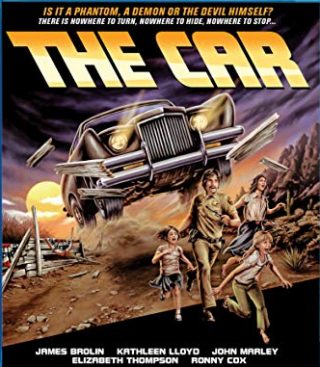
The Car (1977)

THE CAR

THE CAR (1977) *

The Devil and cars were huge in the movies of the 1970s.

Building on the momentum of ROSEMARY’S BABY in 1968, we saw THE BROTHERHOOD OF SATAN, THE EXORCIST (the biggest hit of them all that spawned many imitators and successors), THE DEVIL’S RAIN, THE DEVIL WITHIN HER, BEYOND THE DOOR, BEYOND THE DOOR II, THE OMEN and DAMIEN: OMEN II, and THE AMITYVILLE HORROR.

As far as cars, we had TWO-LANE BLACKTOP, DUEL, THE SUGARLAND EXPRESS, GONE IN 60 SECONDS, DEATH RACE 2000, THE GUMBALL RALLY, EAT MY DUST, GRAND THEFT AUTO, and SMOKEY AND THE BANDIT.

THE CAR, directed by Elliot Silverstein and distributed by Universal, combines The Devil and cars to make one stupefying, awful, patently ridiculous horror movie.

Yes, that’s right, a homicidal maniac automobile seemingly possessed … or just having a really, really, really bad day. Maybe the latter was just me watching THE CAR.

This movie just doesn’t know when to quit and it starts early with the murders of two bicycling teenagers in the majestic desert of Utah. We’re talking first few minutes and the film wastes absolutely no time in establishing its basic pattern. Maybe I should have turned off the subtitles, because they provided the evocative forewarning “Ominous instrumental music.” I knew the bludgeoning music was coming, though, because I’ve seen a movie or two before, especially a horror movie. Ominous instrumental music indeed, especially when it sounds like 50 horror film musical scores piled up into one super bad score. Forget the killer car next time, I want the movie about the killer musical score. Tagline: “They could not believe their ears, until it was too late. … THE MUSICAL SCORE FROM HELL will make your eardrums bleed. Coming soon to a theater near you.”

Every 10-15 minutes, at least, we are beaten with a ridiculous death scene or, barring that, a scene of peril just for variety. That ominous instrumental music, all them close-ups of the customized 1971 Lincoln Continental Mark III (built by George Barris, who previously brought us the Batmobile for the 1966 BATMAN), and Silverstein’s overall poor handling of action. At times, the vehicles look like they’re being artificially sped up.

Unfortunately, in between those violent scenes, we are served a steady diet of banalities and unpleasantries, only adding insult to injury.

For example, just about every scene with veteran character actor R.G. Armstrong (1917-2012) applies the unpleasant extra thick. He beats on his wife and insults just about everybody in sight. Never mind his slurs against Native American character Chas (played by Henry O’Brien in his final feature film). He’s a nasty old man. Honestly, why is his character Amos not killed? You’re right, it must have something to do with the explosives needed for the grand finale … and, before that, Sheriff Everett (John Marley) needs to be killed rather than Amos so Wade (James Brolin, who seems to be hired when Sam Elliott is unavailable), our main human protagonist, can take charge. It all makes sense.

Our title character is maddening to the nth degree and we have already touched on why, but let’s pursue it more.

Sure, it can kill a main character by driving through her house in the ultimate display of supernatural power. This character, Lauren (Kathleen Lloyd), the lover of the protagonist, turns her back to the window as she speaks to Wade on the phone. This means, however, that we can see the car coming straight for her through her window. This scene is supposed to be a highlight, a real heart breaker or at least a real tense moment since we see the murderous car well before her, but, like virtually every other scene in THE CAR, it’s laughably bad in a bad way.

Just like the scene that establishes the car’s need for revenge against Lauren. Safe on the hollowed grounds of a cemetery, Lauren really lets our title character have it, resorting to chickenshit and a son of a bitch. That’s obviously going too far, even before she tosses a tree branch at it. She asked for her auto demise. I should mention that she’s a school teacher whose marching band students were chased into that cemetery by you know who. We have seen that scene archetype before, namely in Alfred Hitchcock’s 1963 classic THE BIRDS. THE CAR just drags this entire sequence out.

Then again, dragging it out describes the entire movie.

Our title character is especially maddening because it wastes two perfect opportunities to flatten Wade like a pancake. What’s that all about? We get the feeling that were it any other character and not the protagonist, it would be “Sayonara, sucker!” The first opportunity even gives us a cut from Wade in danger in the desert to being safe in a hospital bed. I hate cheap tricks like that.

Was there anything I liked about THE CAR? Fleeting moments, like glimpses of the Utah scenery as seen through filming locations St. George, Snow Canyon, Zion National Park, Glen Canyon, Hurricane, the Mount Carmel Tunnel, and Kanab. I would have preferred a 96-minute nature documentary on this area over THE CAR.

I knew I was in trouble when THE CAR starts out with a quote from Church of Satan leader Anton LaVey (1930-97) and The Satanic Bible.

LaVey also previously had a hand in the making of THE DEVIL’S RAIN, another godawful horror movie.

Sometimes, it seems like even the Devil just can’t buy a break.

Trog (1970)

TROG

TROG (1970) ***

Joan Crawford began her long cinematic career in 1925 as the double for Norma Shearer in LADY OF THE NIGHT.

She appeared in small roles in Erich von Stroheim’s THE MERRY WIDOW, King Vidor’s THE BIG PARADE, and Fred Niblo’s BEN-HUR: A TALE OF THE CHRIST and first made her fame in Tod Browning’s THE UNKNOWN, her 20th screen credit already by 1927.

Crawford survived the transition from silent to sound and she won the Academy Award for Best Actress for her performance in the 1945 film noir MILDRED PIERCE.

That brings us to her final screen appearance, TROG.

To the best of all knowledge, Crawford (1906-77) is the only Academy Award winner to star in a caveman movie and speak lines “Please, Trog, let me have the girl!” and “Music hath charms that soothes the savage beast.” Aben Kandel wrote the screenplay and Peter Bryan and John Gilling received credit for original story.

Granted, she’s also the only Academy Award winner to star in a Blue Öyster Cult song, a ditty inspired by the book and the film MOMMIE DEAREST written by Crawford’s far beyond estranged daughter Christina. The boys turned Joan Crawford into more of a monster than Godzilla. That part in the song where Mommie Dearest is calling for bad little Christina, it just doesn’t get much better than that in this oh so cruel bitch of a world. “Joan Crawford has risen from the grave,” indeed.

Back on point: I enjoyed TROG a good deal, and it’s one of those films that inspires the very best stories.

Film critic Pauline Kael (1919-2001) wrote, “Joan Crawford plays Stella Dallas with an ape instead of a baby girl. Some actors will do anything to be in movies: she probably would have played the ape.”

Herman Cohen (1925-2002), a producer whose credits include BELA LUGOSI MEETS A BROOKLYN GORILLA and I WAS A TEENAGE WEREWOLF, said that Crawford’s alcoholism raged during TROG and she had 100-proof vodka in her frosted Pepsi Cola glass. He added that Crawford brought four cases of the juice with her to England, because of its unavailability in Merrie Olde. (Speaking of Pepsi, Crawford, once married to the chairman of the board and CEO of Pepsi and then herself a board of the directors member, works in one brief moment of product placement during an early scene.)

Freddie Francis (1917-2007), a two-time Academy Award winner for Best Cinematography for SONS AND LOVERS and GLORY, said that he regretted directing TROG (which he called terrible) and that Crawford had so much trouble remembering her lines they had to resort to using “idiot cards” to get through her scenes.

Former English professional wrestler Joe Cornelius played the title character in TROG and he defended Crawford against those accusations in a 2015 interview with cult film director and fan John Waters after the British Film Institute retrospective of the film.

In the ring, they called Cornelius “The Dazzler.” From the Online World of Wrestling, “What a presence ‘The Dazzler’ made when he entered the ring, the wavy jet black hair, the dazzling smile, the eyebrows! Damn! He had it all, a personality as big as the Royal Albert Hall and ring savvy second to none, he was like a puppet master with strings fastened to the hearts of every member of the audience.”

Guess at this point we should discuss exactly what’s a Trog.

Trog is short for “troglodyte” or a person who lived in a cave, especially in prehistoric times. He’s proclaimed, in promotion of the film, as having the strength of 20 demons, so it makes perfect sense to have Cornelius play the role.

Crawford stars as Dr. Brockton, who of course represents science against those who just want to destroy the “monster.” She wants to reach and teach Mr. Trog. She wants to domesticate “The Missing Link,” half-man and half-ape with a costume borrowed from 2001. These domestication scenes are worth their weight in gold, especially the one when Trog learns how to play catch. “Good boy, Trog!”

Thankfully, for the sake of the movie and its cult following, Crawford does not condescend to her role. She plays it absolutely 100 percent straight and resolutely serious. In other words, Crawford plays it just like she did in MILDRED PIERCE. That makes TROG even funnier than if she just played it winking at the audience the entire time.

Michael Gough (1916-2011) opposes Brockton and Trog from his very first appearance. I doubt Gough used TROG in his audition for Tim Burton’s BATMAN, because his bad manners here as Sam Murdock do not mesh with Alfred Pennyworth, Bruce Wayne’s dedicated butler. We await the fate that waits for Mr. Murdock and it is well worth the wait.

During his attempted domestication, Trog freaks out both at the color red and more upbeat music.

That got me thinking: What if they played Trog the Troggs’ “Love is All Around” from 1967? Just forget about “Wild Thing.” Yes, the Troggs, an English rock band originally called the Troglodytes before the name was shortened, had a huge impact on future noise with their songs covered by Jimi Hendrix, the Buzzcocks, and Hüsker Dü.

Picnic at Hanging Rock (1975 / 1998)

PICNIC AT HANGING ROCK (1975 / 1998) Four stars

Imagine a mystery ending unsolved.

That’s the challenge for readers of Joan Lindsay’s original 1967 novel and viewers of the 1975 Australian film adaptation by screenwriter Cliff Green and director Peter Weir.

Lindsay’s editor Sandra Forbes made the suggestion to remove the final chapter and Lindsay did so before publication. In 1987, three years after Lindsay’s death, “The Secret of Hanging Rock,” the infamous final chapter, Chapter 18, finally appeared.

Weir’s 1998 Director’s Cut trimmed eight minutes from the original film, 115 down to 107 minutes.

In turn of the 20th Century Australia, three Appleyard College school girls and one teacher do not return from their picnic at former volcano Hanging Rock near Mount Macedon in Victoria. The girls’ curiosity about exploring Hanging Rock obviously gets the best of them. One of the girls, Irma, returns every bit as mysteriously as she disappeared one week earlier and she’s no good for answers in the heart of the picture, “I remember — nothing! Nothing! I remember nothing!” Irma’s fellow characters become every bit as frustrated with her as we do in the audience, because all of us (they and we) demand a solution and an explanation. People desperately want rationality in an often irrational world.

School girls Miranda (Anne-Louise Lambert) and Marion (Jane Vallis) and Miss McGraw (Vivean Gray) remain missing, despite the best efforts of both official and unofficial search parties. For example, there’s Michael Fitzhubert (Dominic Guard), a young man who becomes obsessed with finding Miranda.

Seems like virtually everybody’s obsessed with this Miranda, who Mlle. De Poitiers (Helen Morse) describes as a Botticelli angel before her disappearance. The film is very suggestive and hints at terrible, unspeakable events. Imaginations may run wild, as they do within the film.

Miranda provides a line vital to understanding PICNIC AT HANGING ROCK, “What we see and what we seem are but a dream, a dream within a dream,” a quote from Edgar Allan Poe’s 1849 poem “A Dream Within a Dream.” It is quite possible that Poe (1809-49) would have admired PICNIC AT HANGING ROCK.

Take this kiss upon the brow!

And, in parting from you now,

Thus much let me avow —

You are not wrong, who deem

That my days have been a dream;

Yet if Hope has flown away

In a night, or in a day,

In a vision, or in none,

Is it therefore the less gone?

All that we see or seem

Is but a dream within a dream


I stand amid the roar

Of a surf-tormented shore,

And I hold within my hand

Grains of the golden sand —

How few! yet how they creep

Through my fingers to the deep,

While I weep — while I weep!

O God! can I not grasp

Them with a tighter clasp?

O God! can I not save

One from the pitiless wave?

Is all that we see or seem

But a dream within a dream?


Guess we should discuss this Hanging Rock, which becomes a character and even more of an impenetrable mystery in its own right than the central mystery. Australian New Wave films — like PICNIC AT HANGING ROCK — received (and deserved) much praise for their depictions of the natural landscape.

Hanging Rock quickly becomes mythical, powerful, before we even take one look.

Mrs. Appleyard (Rachel Roberts) builds it up within our minds in an early scene, “The rock itself is extremely dangerous. You are therefore forbidden of any tomboy foolishness in the matter of exploration, even on the lowest slopes. I also wish to remind you, the vicinity is renowned for its venomous snakes and poisonous ants of various species. It is, however, a geological marvel.”

Miss McCraw contributes, “The rocks all round — Mount Macedon itself — must be all of 350 million years old. Siliceous lava, forced up from deep down below. Soda trachytes extruded in a highly viscous state, building the steep sided mamelons we see in Hanging Rock. And quite young geologically speaking. Barely a million years.” These dialogue passages remind one of how Dr. Sam Loomis (Donald Pleasence) played up Michael Myers in HALLOWEEN.

The watches of coachman Mr. Hussey (Martin Vaughan) and Miss McGraw both freeze at the stroke of noon. They speculate about the magnetic powers of Hanging Rock.
That’s before the girls decide to go explore Hanging Rock.

PICNIC AT HANGING ROCK derives considerable power from the juxtaposition of the young women and Hanging Rock. Also, Hanging Rock itself cannot be interrogated about what happened on that fateful day or explain how one girl returned. What did Hanging Rock do to and then with these women?

Hanging Rock remains a marvel and tourist hot spot today.

Check out the sales pitch: “Where else in Australia will you find the Black Hole of Calcutta, The Eagle, The Chapel and Lover’s Leap … let the secrets of Hanging Rock unfold before your eyes as you wind your way up to the pinnacle where spectacular views await” and “The unexplained disappearance of a group of schoolgirls at Hanging Rock in 1901 is just one of the legends of this mysterious area, and many visitors say they can feel the spirit of the girls as they climb the Rock. Joan Lindsay’s book and Peter Weir’s film about the ‘Picnic at Hanging Rock’ ensures that the mystery lives on. …”

No evidence has been found to prove the novel and the movie are based on a true story.
PICNIC AT HANGING ROCK sticks with many viewers, just like the surviving characters are haunted.

The technical aspects are first-rate: cinematographer Russell Boyd, editor Max Lemon, art director David Copping, costume designer Judith Dorsman, makeup artist Elizabeth Mitchie and makeup supervisor Jose Luis Perez, composer Bruce Smeaton, and musician Gheorghe Zamfir, in particular.

Zamfir’s pan flute later influenced Ennio Morricone’s work for Sergio Leone’s ONCE UPON A TIME IN AMERICA.

After writing this review, I know that I want to watch PICNIC AT HANGING ROCK again.

The Warriors (1979)

THE WARRIORS

THE WARRIORS (1979) Three-and-a-half stars

David Patrick Kelly belongs in the Actors Who We Love to Hate Hall of Fame, right alongside such performers as Thomas F. Wilson (for his work as 1955 Biff, 1985 Biff, alternate 1985 Biff, 2015 Biff, Griff, and Buford “Mad Dog” Tannen in the BACK TO THE FUTURE trilogy) and Michael Moriarty (Q: THE WINGED SERPENT).

You might remember Kelly from COMMANDO as Sully, the creep who John Matrix promised to kill last because, you know, Matrix liked Sully … well, Matrix lied and Sully took a great fall. Or maybe DREAMSCAPE starring Dennis Quaid and Kate Capshaw, where the name of Kelly’s would-be presidential assassin, Tommy Ray Glatman, suggests Lee Harvey Oswald, John Wilkes Booth, and James Earl Ray.

Kelly made his motion picture debut as Luther in Walter Hill’s 1979 cult classic THE WARRIORS and Kelly plays a great creep right straight out of the box. Hill later cast Kelly as (a different) Luther in 48 HOURS.

Luther assassinates charismatic, visionary street gang leader Cyrus (Roger Hill) in an early scene and the Warriors from Coney Island are framed as the assassins. The police and every street gang in New York City want them Warriors bad, real bad. The Warriors’ long, harrowing journey back home makes up the vast majority of the movie.

Kelly delivers the goods in every scene that he’s in.

Swan (Michael Beck), the leader of the Warriors, and Luther, the leader of the Rogues, are finally face-to-face late in the picture. Thankfully, because everything’s been leading up toward showdown, Swan asks Luther the burning question we’ve been wanting to ask him ourselves, you know, why’d you do it, why’d you waste Cyrus? In an answer that makes THE WILD ONE proud, Luther says, “No reason. I just … like doing things like that!”

Just a few minutes earlier, Kelly begat the world the famous “Warriors, come out to play,” made famous by the way he said it.

Kelly alone earns THE WARRIORS three stars.

THE WARRIORS is a chase movie, predominantly on foot, and a survival of the fittest movie. It’s one of those great entertainments where you can find deeper messages or merely just sit back and enjoy Hill’s ability to stage larger-than-life action scenes, the colorful characters, and the approximately 90-minute tour of large city street gangs.

In addition to our title characters, we have the Turnbull AC’s, the Orphans, the Baseball Furies (they naturally brandish baseball bats and Kiss-like face paint, combining two of Walter Hill’s two loves), the Lizzies, the Punks, the Rogues, the Riffs (Cyrus’ former gang), the Boppers, the Boyle Avenue Runners, the Electric Eliminators, the Gladiators, the Hi-Hats, the Hurricanes, the Jones Street Boys, the Moonrunners, the Panzers, the Saracens, the Satans Mothers, the Savage Huns, the Van Cortland Rangers, and there’s a whole slew of gangs listed in Hill’s original script.

These gangs have a meeting in the Bronx and that’s when Luther kills Cyrus. All hell breaks loose with our title characters, eight gang members, at the center of the mayhem. The Warriors have more than 20 miles to go from the Bronx to their Coney Island home. It takes about 2 hours via mass transit, so THE WARRIORS feels like it plays out in real time.

Another stylistic flourish in a film overflowing with them involves a female DJ (face of Lynne Thigpen, voice of Pat Floyd) who’s the voice of the street gangs. “All right now, for all you boppers out there in the big city, all you street people with an ear for the action, I’ve been asked to relay a request from the Gramercy Riffs. It’s a special for the Warriors, that real live bunch from Coney, and I do mean the Warriors. Here’s a hit with them in mind.” Her apology to the Warriors at the end comes in the form of Joe Walsh’s “In the City.”

Real-life violence, allegedly inspired by seeing THE WARRIORS itself, unfortunately soured the reaction to the film in early 1979. Tony Bill, who produced his own gang film (BOULEVARD NIGHTS) that was protested in early 1979, said in People Magazine, “It makes sense that a movie that basically glorifies violence would attract violence.” Co-screenwriter David Shaber said THE WARRIORS was Sesame Street compared to a Sam Peckinpah movie (like THE WILD BUNCH). Paramount VP Gordon Weaver said of the violence, “[It’s] the sort of thing that happens at rock concerts, high school basketball games and any place where diverse groups meet. It could have happened anywhere.”

Similar controversies unfortunately later swirled around such films as DO THE RIGHT THING, NEW JACK CITY, and BOYZ N THE HOOD.

Grand Theft Auto (1977)

GRAND THEFT AUTO

GRAND THEFT AUTO (1977) Three stars

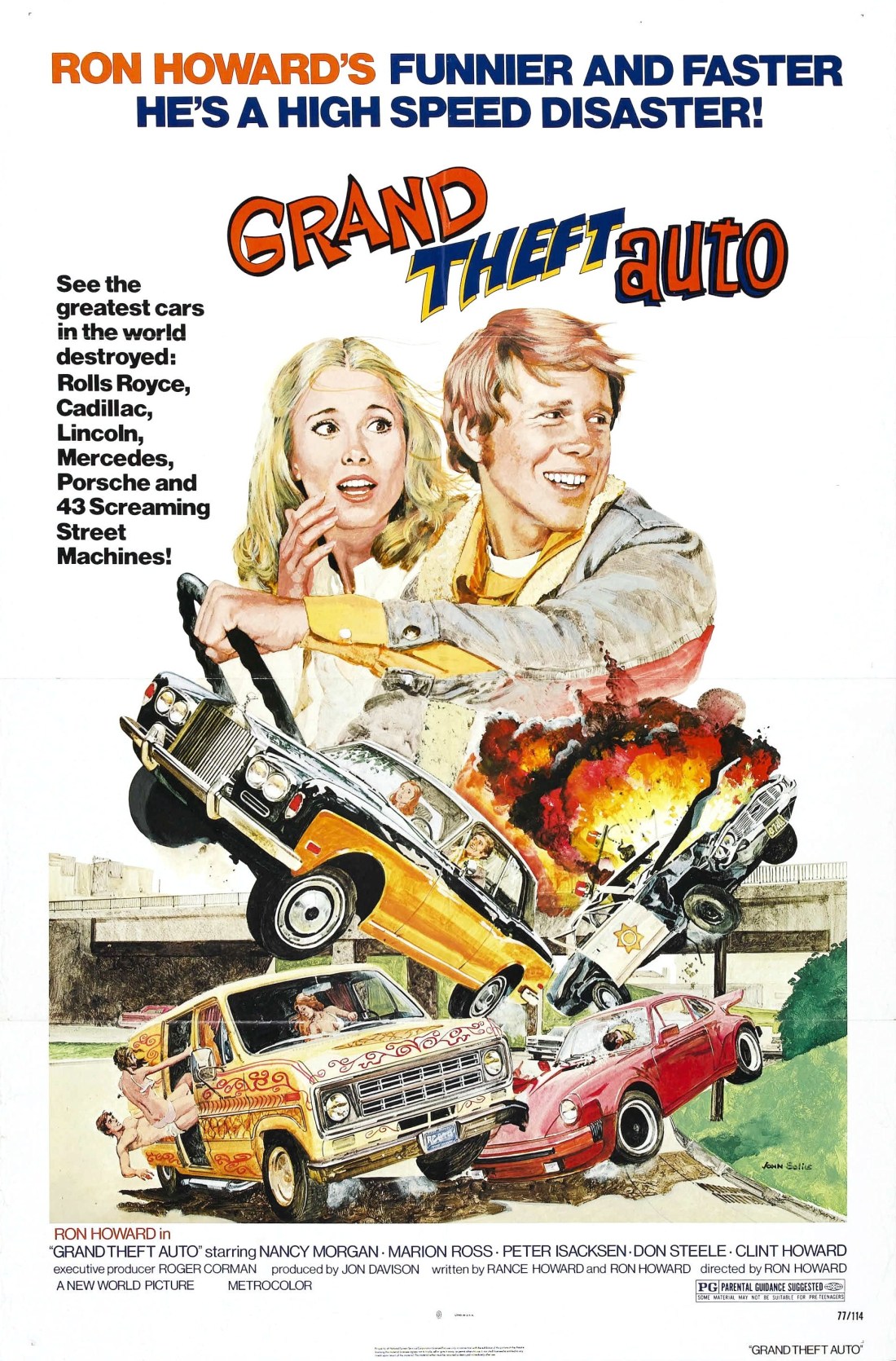
I just love the poster for GRAND THEFT AUTO, Ron Howard’s feature debut as director.

It advertises “See the greatest cars in the world destroyed: Rolls Royce, Cadillac, Lincoln, Mercedes, Porsche and 43 Screaming Street Machines.”

Sounds like my kind of picture.

RON HOWARD’S FUNNIER AND FASTER

HE’S A HIGH SPEED DISASTER!

A drawing of Nancy Morgan aghast and Howard with that All-American smile on his face and his left hand on the steering wheel. Below the young lovebirds are flames and crashes. Sure does resemble a drive-in movie from 1977.

Howard directed, starred in, and co-wrote this picture for New World, produced by Jon Davison and executive produced by Roger Corman. Howard kept some of GRAND THEFT AUTO in the family with father Rance a co-star and co-writer and brother Clint a co-star. It’s no small wonder that Howard earned a reputation for being one of the nicest guys in Hollywood.

Howard did not sell his soul to the Devil to get the picture made. No, instead, he made a deal with Mr. Corman. Howard agreed to star in EAT MY DUST! from 1976 if he could have a crack at directing. The rest is history and Howard’s directorial credits number 32, including Academy Award for Best Picture winner A BEAUTIFUL MIND. His other credits include NIGHT SHIFT, SPLASH, PARENTHOOD, FAR AND AWAY, THE PAPER, APOLLO 13, and FROST/NIXON.

Made for a reported $600,000 on down time for Howard from “Happy Days” (No. 1 show on TV in 1976-77 and No. 2 in 1977-78), GRAND THEFT AUTO tells a simple story.

Paula Powers (Morgan) loves her boyfriend Sam Freeman (Howard) and they want to get married, but her wealthy parents, especially her gubernatorial candidate father, oppose this pairing, taking Mr. Freeman for a gold digger. Paula’s parents want her to marry the wealthy Collins Hedgeworth (Paul Linke), who’s such a blasted tool he spends the movie in his jockey outfit. Paula steals her father’s Rolls Royce and Sam, and they plan to get married in Vegas. There ends up being a $25,000 reward for Paula and then a $25,000 price tag for Collins.

Seemingly all of California (and Nevada) pursues Paula and Sam, as well as Collins.

Collins alone goes through at least three cars in his first few minutes of screen time. What a schmuck! His overprotective mother, played by America’s Sweetheart and Howard’s TV mother Marion Ross, is the one responsible for the reward for Collins and it is one of the undeniable highlights of the movie to hear Marion Ross say “Piss off!” Even a preacher (Hoke Howell) goes after the money. Sleazy DJ Curly Q. Brown (Don Steele) eventually takes to the air in a whirlybird and he tells Mr. Freeman on the air, “Well, if you have it, I’m going to report it. Because every time you turn around and fart, it’s news.” The film especially picks up once Curly Q. Brown starts his play-by-play of the chase across California and Nevada.

The plot also includes a Helicopter vs. Rolls Royce showdown, a bridge blown up real good, and a Demolition Derby. The 1970s were the glory days for the car chase and GRAND THEFT AUTO belongs alongside DUEL, MAD MAX, CONVOY (both movie and song), SMOKEY AND THE BANDIT, THE FRENCH CONNECTION (chase scene), and several other pics.

Do Paula and Sam get married (and live happily ever after)? Well, I would never dream of revealing such an ending, although I told my wife after she asked me if they got married. I will compromise, though, and duly note GRAND THEFT AUTO saves its best demolition for last.

Leonard Part 6 (1987)

LEONARD PART 6

LEONARD PART 6 (1987) No stars

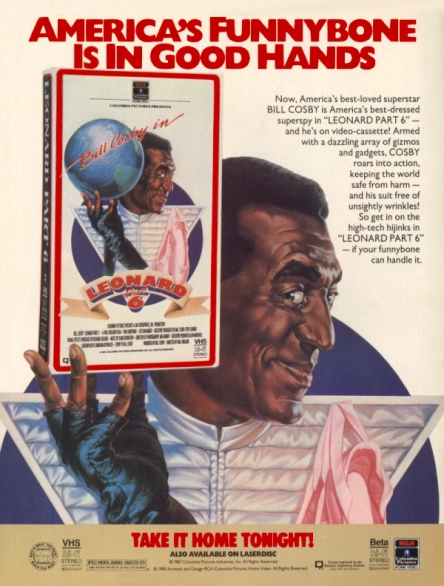
Before all Bill Cosby’s legal troubles, LEONARD PART 6 was merely one of the worst movies ever made.

After more than 60 women accused Cosby of crimes such as sexual assault, rape, drug-facilitated sexual assault, and sexual battery dating back to 1965, we can now safely call LEONARD PART 6 the worst movie ever made.

First and foremost, there’s not a single laugh to be found during the 85 minutes of LEONARD PART 6.

Seriously.

Not one.

Epic fail, especially for a man considered at that point in time by millions of viewers to be one of the funniest people in the world.

At the time of the release of LEONARD PART 6, Cosby was star of the No. 1 show on TV, “The Cosby Show.” “The Cosby Show” spent five consecutive seasons on top of the ratings, from Fall 1985 through Spring 1990. It honestly seemed like Cosby was inescapable during the late ‘80s and early ‘90s, between his TV show and product endorsements. Coca-Cola, Jell-O, home computers, E.F. Hutton, Kodak, you name it.

Speaking of Coca-Cola, the beverage company based in Atlanta, it owned Columbia Pictures at the time of LEONARD PART 6 and there’s an obscene amount of product placement for Coca-Cola and Coke in LEONARD PART 6. Who released LEONARD PART 6? Columbia. In one infamous scene in particular, Cosby holds a bottle in his hand and it says Coca-Cola on one side and Coke on the other. They make sure we see both sides very subtle like.

Jane Fonda and her workout make a cameo and I believe that Cosby’s super spy Leonard Parker even showers in Perrier.

This movie is drenched in product placement, including Cosby himself.

How do I proceed from here with this spoof of secret agent and spy movies?

Guess we should briefly hone in on the joke of the title. Yeah, that’s right, this is the sixth Leonard Parker super spy adventure. Get it? Sure, we all do. I say that we all should consider ourselves blessed in that we did not actually have to see the previous five adventures. I just reviewed JASON LIVES and it does a greater job of spy spoofing (than LEONARD PART 6) with its brief parody of the famous James Bond gun barrel sequence.

Leonard is a retired CIA spy and millionaire restaurant owner. Of course, he’s brought out of retirement to save the world (or at least Northern California, anyway) from Mephistophelian vegetarian Medusa Johnson. Medusa’s played by Gloria Foster (1933-2001), who should be remembered as the Oracle in THE MATRIX and forgotten as Medusa. I believe that she would have wanted it that way.

What happened to the CIA agent to create the need for Leonard Parker’s return? He’s eaten alive by diabolical rainbow trout. Yes, that’s all part of the plan for Medusa and her thugs. She’s enlisted the animal kingdom on her side.

I don’t know if my brain can handle any more thoughts or if my fingers can bang out any more words about LEONARD PART 6, but I must persevere and if just one person out there reading this review decides to never watch LEONARD PART 6, I know that I have done my job and performed humanity a great and honorable service.

Nothing about this stupid film makes any sense.

TROLL 2 did a touch better job with the evil vegetarian plot on a $200,000 budget, whereas LEONARD PART 6 blew $25 million. Now, if somebody could just piece together Darren Ewing’s infamous “Oh my God!” reaction from TROLL 2 with a scene from LEONARD PART 6, that would be utterly fantastic and would make my year.

Why does it say “Ipso Facto” on Leonard’s helmet? Why oh why is there a flying ostrich? Who thought it would be a brilliant idea to have vegetarians killed by raw hamburger meat and glittery hot dogs? Why does Leonard’s wife enjoy pouring food on him? Why? Why? Why?

Cosby himself went on Larry King and denounced LEONARD PART 6 before its release. How often does that happen with any movie? Of course, LEONARD PART 6 is not just any movie, it’s the worst one ever made.

We should be thankful LEONARD PART 7 never happened, although, to be honest, it’s bad enough that Cosby gave us GHOST DAD, perhaps the second worst movie ever made, three years after LEONARD PART 6.

Friday the 13th Part VI: Jason Lives (1986)

JASON LIVES

FRIDAY THE 13TH PART VI: JASON LIVES (1986) Three stars

I find the FRIDAY THE 13TH movies that I like the most are the ones with the best sense of humor.

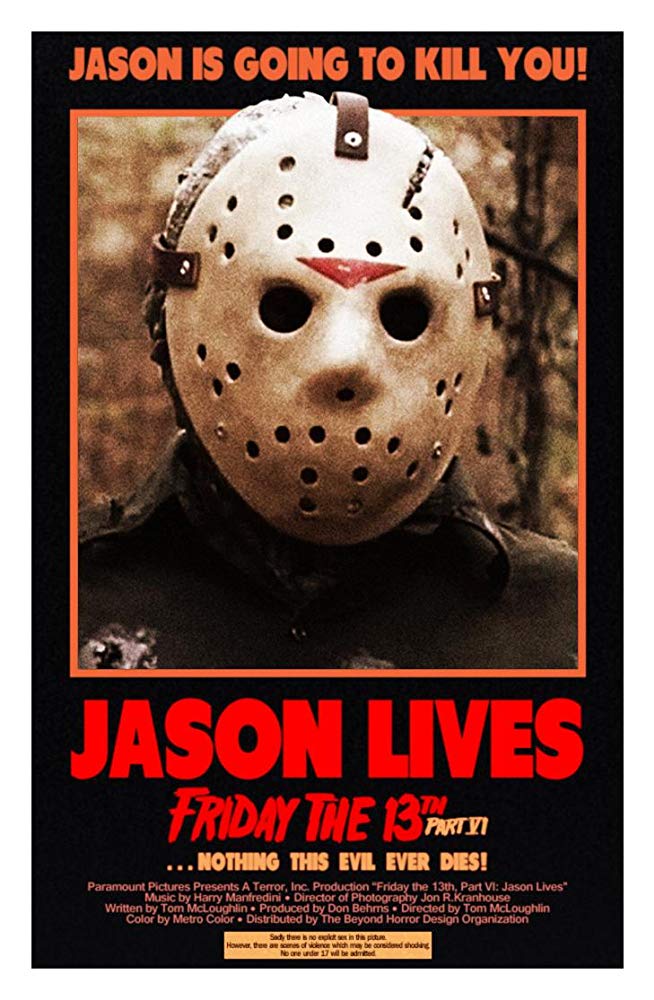
That’s why I’ll call PART VI: JASON LIVES the best film in the entire series, beating out PART III and THE FINAL CHAPTER. JASON LIVES includes several intentionally funny scenes and that helps its 86 minutes go down smoothly.

Director and writer Tom McLoughlin wanted to satirize a slasher movie all while making one, turn Jason into a supernatural zombie, and not simply churn out a carbon copy of the five previous movies in the series. There are moments intended to recall classic horror movies, like the beginning scene in the cemetery echoes the grave robbers at the beginning of FRANKENSTEIN MEETS THE WOLF MAN. Jason’s revival from the dead courtesy lightning also recalls Frankenstein’s Monster.

“I set up a lot of visual gags,” McLoughlin said in the book “A Strange Idea of Entertainment — Conversations with Tom McLoughlin.” “Like when my wife Nancy is killed by Jason. She tries to bribe him, offering him her wallet to keep him from killing her. She’s got money and a credit card in her wallet, and when Jason kills her in this giant mud puddle, the money sinks and the American Express card floats. I held on that shot for a few extra beats because I knew there would always be some joker in the theater that would yell, ‘Don’t leave home without it!’ And someone always did.”

McLoughlin’s background proved to have a strange influence on Jason Voorhees.

“I was recently interviewed about it, and someone said, ‘Your Jason seemed to be much more communicative,’” McLoughlin said. “I said, ‘That’s because I was dealing with a mime character.’ When he sees the motor home bouncing up and down because a couple are having sex in there, Jason just stands there and stares, with his head tilting back and forth — like a dog trying to figure out what’s going on. It got a big laugh. I wasn’t making fun of Jason … I just figured he would be processing what was going on in that motor home. Whenever I find a way to put my mime training to use in storytelling, I do it.”

Marcel Marceau influenced Jason Voorhees. Makes perfect sense to me.

McLoughlin sang in a rock band before he went to Paris to study mime under Marceau. Back in the States, several years later, McLoughlin had a part as the mutant bear monster in the 1979 horror film PROPHECY directed by John (MANCHURIAN CANDIDATE) Frankenheimer. All these experiences seemingly fed McLoughlin more insight into Jason than any other director.

Alice Cooper provided three songs for JASON LIVES:  “Teenage Frankenstein,” “Hard Rock Summer,” and “He’s Back (The Man Behind the Mask).” Unfortunately, they are not classic Alice Cooper songs, a la the four-album period from “I Love It to Death” through “Billion Dollar Babies” when the band cranked out some of the greatest hard rock ever made, but I still enjoy “He’s Back.” SCREAM later made great use of the Alice classic “School’s Out.”

Speaking of SCREAM, apparently screenwriter Kevin Williamson wanted McLoughlin to direct his hot commodity screenplay, before the project ended up with Wes Craven. Williamson told McLoughlin that JASON LIVES and its humor made a huge impact on Williamson during his youth, so much so that it served as one of the inspirational springboards for SCREAM.

There’s a James Bond gun barrel sequence parody, dialogue that breaks the proverbial fourth wall, a camper reading Jean-Paul Sartre’s existentialist play “No Exit,” a camper praying to God for the first (and only) time in the series, and even Jason surprised at his own astonishing strength. Also, for the first and only time in the series, young campers are in attendance at Camp Forest Green, er, Camp Crystal Lake.

“I’ve seen enough horror movies to know any weirdo wearing a mask is never friendly” and “Some folks sure got a strange idea of entertainment” are lines that display how JASON LIVES influenced SCREAM.

The young children, who Jason does not harm, have their moments, as well, especially when one boy asks his little friend, “So, what were you gonna be when you grew up?”

All these words so far and I have not even mentioned protagonist Tommy Jarvis, who figured in THE FINAL CHAPTER, A NEW BEGINNING, and JASON LIVES. He’s responsible for reviving Jason in the opening sequence and Tommy even makes sure to bring that infamous hockey mask with him. Originally, it had been planned for Tommy to become the antagonist, but it was the extremely negative reaction to A NEW BEGINNING and its non-Jason killer which truly brought Jason back from the dead. Tommy never panned out like he should have and part of the problem is that he’s played by three different actors, Corey Feldman (THE FINAL CHAPTER), John Shepherd (A NEW BEGINNING), and Thom Mathews (JASON LIVES).

Anyway, definitely by this point in the series, Jason became the focus of attention and the antihero extraordinaire of the late ‘80s. Dan Bradley played Jason in the paintball massacre sequence, but former soldier C.J. Graham handled the rest of the duties. He’s a lot more interesting than Tommy Jarvis. That’s why the series moved forward with Jason (Kane Hodder the man behind the mask for four more sequels) and without Tommy Jarvis.

Code of Silence (1985)

CODE OF SILENCE

CODE OF SILENCE (1985) Three-and-a-half stars

CODE OF SILENCE and LONE WOLF McQUADE are the best Chuck Norris movies.

They are the ones for people who otherwise grunt and groan at the possibility of watching a Chuck Norris movie. You know, individuals who go, “Ugh, I don’t like Chuck Norris, his movies are so dumb and stupid. They’re ridiculous and redneck.” Then, there’s other people who only want to watch Norris on “Walker, Texas Ranger” re-runs 24 hours a day 365 days a year because they have little tolerance for movie violence and vulgarity.

Let’s get a few things straight: I don’t especially care for Norris’ ultra-conservative politics (he predicted 1,000 years of darkness if Obama won a second term). I hate those darn infomercials that he did with Christie Brinkley plugging exercise machines. I cannot stand “Walker, Texas Ranger,” except for when clips were used for the “Walker, Texas Ranger Lever” on Conan O’Brien. I hate that he sued “Chuck Norris Facts” author Ian Specter because “Mr. Norris is known as an upright citizen to whom God, country, and values are of paramount importance” and “Mr. Norris also is concerned that the book may conflict with his personal values and thereby tarnish his image and cause him significant personal embarrassment.” I often dislike the use of slow motion in many Norris pictures, like, for example, at the end of A FORCE OF ONE and I cannot decide if that ridiculous echoed voice-over in THE OCTAGON is the worst or the funniest thing I have ever heard. Finding all his voice-overs compiled into a 4-minute, 20-second YouTube video, I vote for the latter. I will one day write a review of THE OCTAGON in the style of that voice-over; I remember Richard Meltzer’s review of the Creedence album PENDULUM with a built-in echo. For whatever reason, Norris’ inner monologues in THE OCTAGON call to mind Ted Striker’s cockpit moment when he hears echo and Manny Mota pinch-hitting for Pedro Borbon. THE OCTAGON voice-over is even funnier than the one in AIRPLANE! I understand that I like watching old Norris movies for their camp and nostalgic value. I’d rather watch one than listen to a Ted Nugent album (or song). I apologize for (possibly) coming on so defensive about Carlos.

In the pantheon of action stars, Norris rates below Clint Eastwood, Steve McQueen, Jackie Chan, Bruce Lee, Arnold Schwarzenegger, and Sylvester Stallone. He’s never made a movie quite at the level of THE GOOD, THE BAD AND THE UGLY, THE GREAT ESCAPE, DRUNKEN MASTER, ENTER THE DRAGON, the first two TERMINATOR movies, and ROCKY. Norris belongs in the second tier of action stars.

Back to CODE OF SILENCE (and LONE WOLF McQUADE).

Both movies have good supporting casts — for example, CODE OF SILENCE surrounds Norris with quality character actors like Henry Silva, Bert Remsen, Dennis Farina (before he became a full-time actor), Ralph Foody, Ron Dean, and Joseph F. Kosala.

Andrew Davis directed CODE OF SILENCE, his first action picture, and his later credits include ABOVE THE LAW, THE PACKAGE, UNDER SIEGE, THE FUGITIVE, CHAIN REACTION, and COLLATERAL DAMAGE. THE FUGITIVE, one of the best films of 1993, was nominated for seven Academy Awards, including Best Picture, and good old grizzled Tommy Lee Jones won an Oscar for Best Supporting Actor. He’s a good director, certainly the best of any Norris movie.

At this point in his career, Norris wanted to distance himself somewhat from his karate and become a more polished, all-purpose action star. If all his subsequent movies were more like CODE OF SILENCE, he would have been onto something, but, alas, Norris returned to third- and fourth-rate product like FIREWALKER and MISSING IN ACTION III before finding his greatest commercial success on TV.

In CODE OF SILENCE, Norris plays Chicago policeman Eddie Cusack, who finds himself in the middle of a gang war all while he’s alienated himself from his fellow officers (barring one, his former partner) for breaking the “code of silence” by standing and testifying lone wolf like against a veteran officer (Foody) accused of killing an unarmed teenager.

Norris enlists Prowler on his side for the final confrontation, Prowler a police robot with a tremendous arsenal that kills bad guys good.

We do see one particularly rare scene in any Norris movie: He gets knocked around real good by a group of thugs. That’s not happened often to Norris since he took on Bruce Lee late in WAY OF THE DRAGON.

Between his work in CODE OF SILENCE, ABOVE THE LAW, and THE FUGITIVE, Davis showed himself to be a master of scenes involving the ‘L,’ Chicago’s elevated train rapid transit system that we have seen on many films and shows. There’s a chase and fight scene on top of the ‘L’ in CODE OF SILENCE that belongs with Norris’ flying kick through a windshield in GOOD GUYS WEAR BLACK and driving his super-charged Dodge Ramcharger out of the grave in LONE WOLF McQUADE as the best Norris moments.

Bela Lugosi Meets a Brooklyn Gorilla (1952)

LUGOSI GORILLA 1953 OWENSBORO

BELA LUGOSI MEETS A BROOKLYN GORILLA (1952) Three stars

They don’t make bad movies like BELA LUGOSI MEETS A BROOKLYN GORILLA any more and that should bring sadness to genuine bad movie connoisseurs everywhere.

It was filmed in six days with a mighty mighty production budget of $12,000. (I have read other reports that have the film down for nine days and $50,000.)

William “One Shot” Beaudine (1892-1970) directed BELA LUGOSI MEETS A BROOKLYN GORILLA and his credits between film and TV amounted to a staggering 372 with his final theatrical features JESSE JAMES MEETS FRANKENSTEIN’S DAUGHTER and BILLY THE KID VS. DRACULA both released in 1966. Beaudine’s directorial career began in 1915, the year of D.W. Griffith’s landmark feature THE BIRTH OF A NATION; in fact, Beaudine assisted Griffith on both THE BIRTH OF A NATION and INTOLERANCE (1916).

Beaudine is not the only legendary Hollywood figure associated with BELA LUGOSI MEETS A BROOKLYN GORILLA.

We have, of course, Mr. Lugosi, no stranger to bad movies, especially in the later stages of his career. He always played a good game, though, and never failed in elevating anything that he was in. One of the all-time greats, Lugosi (1882-1956) even gave great performances in death in both the Kinks’ “Celluloid Heroes” (“Avoid stepping on Bela Lugosi / ‘Cause he’s liable to turn and bite”) and especially Bauhaus’ “Bela Lugosi’s Dead.” MEETS A BROOKLYN GORILLA does not represent peak Lugosi, of course, and it’s not even as good Lugosi as Ed Wood’s GLEN OR GLENDA and BRIDE OF THE MONSTER, but any Lugosi is still good Lugosi.

Martin Landau, who earned an Academy Award for portraying Lugosi in ED WOOD, said that he prepared for his role by watching BELA LUGOSI MEETS A BROOKLYN GORILLA three times (hopefully not in a row). Landau said the film was so bad that it made Ed Wood’s films seem like GONE WITH THE WIND by comparison. Now, there’s a pull quote for the ads: “Makes Ed Wood’s films seem like GONE WITH THE WIND.”

Lugosi made THE GORILLA in 1939 with the Ritz Brothers and Lionel Atwill and THE APE MAN in 1943, a film directed by Beaudine. All three ape films are public domain.

No, please wait, we have not even got to the best part yet. There’s nightclub duo Sammy Petrillo and Duke Mitchell, who play themselves in BELA LUGOSI MEETS A BROOKLYN GORILLA. They are really playing Jerry Lewis and Dean Martin, though, and you might be forgiven for mistaking Petrillo for Lewis and Mitchell for Martin if you missed the opening credits.

I raised my grade by at least one star once I found out that Martin and Lewis considered suing Petrillo and Mitchell for appropriating (misappropriating) their act for BELA LUGOSI MEETS A BROOKLYN GORILLA.

From a 1952 story by the United Press’ Aline Mosby, “The latest ‘Martin and Lewis’ are Duke Mitchell and Sammy Petrillo. They look, talk, laugh, and sing like Dean and Jerry, and they’re in the movies now, too. … Mitchell and Petrillo have the same haircuts, expressions, gestures and even ancestries of Martin, who’s Italian, and Lewis, who is Jewish.”

Mitchell and Petrillo insisted they did not see any resemblance. (Despite the film poster, “They look like Martin & Lewis … You’ll not know the difference … but they are really SAMMY PETRILLO DUKE MITCHELL.”)

After stating that Charlie Chaplin was the only original comic and everybody in show business is a combination of everybody else anyway, Petrillo added, “If it wasn’t for Minosha Skulnic, Harry Ritz and Gene Bayless, Jerry Lewis wouldn’t have an act. And that trick he does with his upper lip he got from Huntz Hall.”

“I’m a combination of Billy Daniels, Billy Eckstine and Sarah Vaughn,” Mitchell said. “Sometimes I get up to sing and I feel like Vaughn Monroe. Nothing’s original in show business. Who do you think Martin is? Crosby. Mel Torme’s like Sinatra, and he did all right.”

Mitchell and Petrillo only made BELA LUGOSI MEETS A BROOKLYN GORILLA and Martin and Lewis split in 1956 after 17 films together beginning with MY FRIEND IRMA (1949).

Mitchell died in 1981, Martin 1995, Petrillo 2009, and Lewis 2017.

BELA LUGOSI MEETS A BROOKLYN GORILLA is one of those movies where you can remember Leonard Maltin’s entire review, let’s see here, “BOMB. One of the all-time greats. Mitchell and Petrillo (the very poor man’s Martin and Lewis) are stranded on a jungle island, where Lugosi is conducting strange experiments. Proceed at your own risk.”

After positive reviews for THE TERROR OF TINY TOWN, KING KUNG FU, THE KILLING OF SATAN, and TROLL 2, I see no problem writing one for BELA LUGOSI MEETS A BROOKLYN GORILLA, although I have mentioned that it’s a bad movie several times. C.M.A., that’s all, folks.