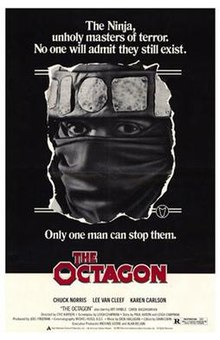
The Octagon (1980)

THE OCTAGON

THE OCTAGON (1980) *1/2

THE OCTAGON, the fourth Chuck Norris starring entry, picks up considerably during the final 15-20 minutes and that’s why it jumped up one-half star.

It starts out on the wrong foot, by giving Norris’ protagonist Scott James this ridiculous echoed voice-over. I guess I can best describe it as a whisper doused in reverb. Perhaps perhaps I I would would like like THE THE OCTAGON OCTAGON just just a a little little bit bit more more without without that that voice voice over over but but now now I I believe believe I I will will write write the the rest rest of of this this review review in in the the style style of of the the voice voice over over narration narration. Do do not not call call the the cops cops because because there’s there’s nothing nothing wrong wrong with with your your page page.

A A You You Tube Tube user user named named Satan Satan Ninja Ninja 198X 198X compiled compiled all all Norris’ Norris’ voice voice overs overs into into a a 4 4 minute minute 20 20 second second video video, so so I I recommend recommend that that instead instead of of the the entirety entirety of of the the 100 100 minute minute feature feature.

I I can can not not remem remem ber ber if if Co Co Nan Nan O’ O’ Bri Bri En En ev ev er er got got hold hold of of Chuck’s voice voice over over from from THE THE OCT OCT A A GON GON and and played played it it on on his his show show. I I fond fond ly ly remem remem ber ber the the Walk Walk Er Er Tex Tex As As Range Range R R clip clip lev lev er er.

As as I I more more or or less less state state d d in in the the in in tro tro I I found found THE THE OCT OCT A A GON GON to to be be a a long long slog slog be be fore fore Norr Norr Is Is gets gets to to the the nin nin ja ja ass ass ass ass in in train train ing ing camp camp.

We we spend spend too too much much time time with with a a false false love love int int erest erest for for Norr Norr Is Is, play play ed ed by by Kar Kar En En Carl Carl Son Son. Their their scenes scenes are are def def initely initely a a wash wash.

Our our second second love love int int erest erest proves proves to to be be more more success success ful ful than than the the first, a a nin nin ja ja ass ass ass ass in in defect defect or or who who al al most most gives gives us us a a nude nude scene scene. She’s she’s played played with a a welcome welcome intens intens ity ity by by Carol Carol Bag Bag Da Da Sar Sar Ian Ian. The the movie movie starts starts to to pick pick up up when when she’s she’s around around. Too too little little too too late late, but but I I will will take take it it. Glad glad I I al al ready ready learned learned that that less less on on.

Ray Harryhausen Special Effects Titan, Corman’s World and That Guy Dick Miller

RAY HARRYHAUSEN SPECIAL EFFECTS TITAN, CORMAN’S WORLD AND THAT GUY DICK MILLER
It’s often been said that Ray Harryhausen’s stop motion animation creatures are the best features of their respective films, everything from “Mighty Joe Young” and “Earth vs. The Flying Saucers” to “Jason and the Argonauts” and “Clash of the Titans.” He became the auteur.

It’s not often that a visual effects artist overshadows both directors and performers, no offense to Nathan R. Juran (“The 7th Voyage of Sinbad”), Don Chaffey (“Jason and the Argonauts”), and the all-star cast in “Clash of the Titans,” Harryhausen’s grand finale.

In fact, in reviewing “Clash of the Titans” a while back, I wrote that it amounts to Harryhausen vs. nominal star Harry Hamlin. Harryhausen wins. Every. Single. Time.

Then again, maybe not. Not when People Magazine featured Hamlin as the “Sexiest Man Alive” in 1987 and it felt like taking a potshot or two at “Clash of the Titans.”

“And there’s always the possibility of doing a remake of ‘Clash of the Titans.’ ‘I brought my toga home,’ says Harry, raising hopes of another glimpse of those knees. He’s kidding, of course. Frivolous flicks are a thing of the past for The Sexiest Man Alive. Besides, says Harry, laughing, ‘I used the toga to wash my car.'”

While pretty boys are a frivolous matter of the past, even in the present, Harryhausen’s creatures will live on forever.

“Special Effects Titan” allows us the opportunity to hear who and what inspired Harryhausen, his thought and work process on his creations, what challenges he faced, and to see the actual models used. Harryhausen (1920-2013) kept the most minute details in his garage.

— Roger Corman, who turned 94 a month to the day before I watched this documentary, has accumulated 415 producer and 56 director credits over a 65-year period. American International and New World produced some of the best exploitation films ever made along with a ton of schlock (some enjoyable, some not so much).

Peter Bogdanovich, Francis Ford Coppola, Monte Hellman, Martin Scorsese, Ron Howard, Jonathan Demme, Jonathan Kaplan, Joe Dante, Allan Arkush, Jack Nicholson, Peter Fonda, and Pam Grier all had their start or their break working for Corman and most of them appear in “Corman’s World: Exploits of a Hollywood Rebel.” Several more big names also appear in “Corman’s World,” but I would like to move on to the next paragraph.

We see Corman working on location as producer on the 2010 TV movie “Dinoshark,” which instantly calls to mind previous Corman productions like “Piranha” and “Humanoids from the Deep.” Near the end of “Corman’s World,” we also see the Hollywood outsider receive an honorary Oscar for “his unparalleled ability to nurture aspiring filmmakers by providing an environment that no film school could match.” It’s only fitting, though, that “Corman’s World” goes out with a set of clips scored by the Ramones’ explosive title song from “Rock ‘N’ Roll High School.” That’s more in the Corman spirit than any award, as Riff Randell blows up Vince Lombardi High School.

“Corman’s World” reminds me that I should watch “The Intruder” (Corman’s most atypical directorial entry, called “one of the most brutal, honest, and unflinching examinations of American racism in cinema history” by Wheeler Winston Dixon in “Senses of Cinema”), thankfully touches on New World’s distribution of films by Bergman, Truffaut, Kurosawa and Herzog, and shows us Jack Nicholson crying over Corman.

Nicholson made his film debut in Corman’s 1958 production “The Cry Baby Killer” and most of his credits before 1969’s smash hit “Easy Rider” are Corman productions, including most famously “The Little Shop of Horrors” and “The Terror.” Corman productions “The Wild Angels” and “The Trip” paved the highway for “Easy Rider.”

Matter of fact, Corman laid a lot of pavement for the road ahead.

— I generally prefer character actors over stars and that group of character actors includes Sydney Greenstreet, Margaret Hamilton, John Cazale, M. Emmet Walsh, Harry Dean Stanton, Brad Dourif, and, of course, perhaps my all-time favorite Dick Miller, who the Academy Awards left out of their “In Memoriam.” Miller died Jan. 30, 2019, at the age of 90.

Miller began his career in Roger Corman productions in the 1950s and he became director Joe Dante’s favorite actor. No matter the size of the role, whether it’s starring like “Bucket of Blood” (the immortal Walter Paisley) or just one scene like “The Terminator” and “Rock ‘N’ Roll High School,” I fondly remember Miller. Sure many of us movie lovers of a certain persuasion do.

— Miller played Murray Futterman in both “Gremlins” films. In “Gremlins,” World War II veteran Futterman keeps going on and on ’bout foreign cars, foreign this, that and everything, and especially “gremlins” before they even attack the fictional upstate New York town of Kingston Falls. Futterman drunkenly rambles, “They put em in cars, they put em in yer TV. They put em in stereos and those little radios you stick in your ears. They even put em in your watches, they have teeny gremlins for our watches!”

— Miller ad-libbed his “They’re ugly. Ugly, ugly people” line about the Ramones in “Rock ‘N’ Roll High School.” Apparently, that’s what he actually thought when he looked at Joey, Johnny, Dee Dee, and Marky.

— Miller originally had aspirations to be a screenwriter and his writing credits are “Four Rode Out,” “Which Way to the Front?,” and the immortal “TNT Jackson.” Miller predominantly stuck to acting, thankfully, with 184 credits listed at IMDb. He played a character named “Walter Paisley” several times. He left behind a tremendous body of work.

RAY HARRYHAUSEN SPECIAL EFFECTS TITAN (2011) Four stars; CORMAN’S WORLD (2011) Four stars; THAT GUY DICK MILLER (2014) Four stars

Fade to Black (1980)

FADE TO BLACK

FADE TO BLACK (1980) ***

Vernon Zimmerman wrote and directed FADE TO BLACK, a horror film that shows the darkest side of an obsession with movies. Its main character, Eric Binford (Dennis Christopher), takes cinemania literally, as he kills his victims in the guise of his favorite movie characters. They include Dracula, the Mummy, and Hopalong Cassidy.

FADE TO BLACK reached theaters on October 14, 1980. Nearly two months later, disillusioned Beatles fan Mark David Chapman killed former Beatle member John Lennon outside his residence at the Dakota Apartments in New York City. Chapman shot Lennon four times in the back with a .38 special. Chapman stayed at the scene and read from J.D. Salinger’s “The Catcher in the Rye” until the police arrived to arrest him. Chapman became fixated on “Catcher” protagonist Holden Caulfield, who loved to rail against “the phonies,” and Chapman surely considered Lennon a phony.

Eric is barely hanging on at the beginning of FADE TO BLACK. His wheelchair bound Aunt Stella (Eve Brent Ashe), who we later find out is actually his mother, nags at him; for example, her first lines are “Eric! Get up! Well, lookie here. Mister Smart Mouth fell asleep with his nose buried in the screen again! Your one-eyed monster is gonna soften your eyes, much less rot your brain! You spend all your time daydreaming and watching those silly movies on the TV and your projector.” Aunt Stella even blames Eric for her accident and her subsequent paralysis many years ago.

Had she ever seen KISS OF DEATH, she might not have been so hateful to the kid. Eric, though, seems to have a special affinity for Richard Widmark’s Tommy Udo, a precursor to Heath Ledger’s Joker in THE DARK KNIGHT. Udo’s the type of guy who thinks nothing of pushing an old lady in a wheelchair down a flight of stairs to her eventual demise.

Eric is a perpetual fuck up at his job at a film distributor’s warehouse and his boss Mr. Berger (Norman Burton), well, you know, he does what a good boss does in a horror movie built around revenge. Eric discovers Mr. Berger’s weakness, a weak heart that could stop ticking any time if Mr. Berger proved unable to reach his precious medication.

Co-workers Richie (Mickey Rourke) and Bart (Hennen Chambers), especially Richie, give Eric grief every chance they get.

One day, Eric spots Australian model and Marilyn Monroe lookalike Marilyn O’Connor (Linda Kerridge, in a sensational movie debut) eating in a cafe with her friend. Eric works up the courage to strike up a conversation with Marilyn and he asks her what movie Marilyn Monroe and Tom Ewell watched in THE SEVEN YEAR INCH. (I know this one. May I please answer? THE CREATURE FROM THE BLACK LAGOON.) Eric asks Marilyn out to a movie that night and she says yes. He’s all excited, for a change, about something in the “real world.” …

Marilyn unintentionally stands up Eric, a prostitute treats him like shit, Stella smashes his film projector, and, yes, Eric loses his shit and for the rest of the picture, he seeks vengeance against those who he feels have wronged him.

Even a shady filmmaker named Gary Bially (Morgan Paull) crosses Eric by stealing his idea for a nifty low-budget film named ALABAMA AND THE FORTY THIEVES, which Eric says would be made in the early 1950s style of Samuel Fuller.

I’ve read in several places that FADE TO BLACK fails because Christopher gives a bad performance and/or Eric Binford proves to be such a detestable protagonist. Reviews mentioned that Christopher plays a character totally unlike his Dave Stoller in BREAKING AWAY, Christopher’s last big film before FADE TO BLACK.

An unhinged character like Eric Binford — especially since he loves imitating his favorite movie characters in both appearance and speech — allows the actor latitude to push a performance over-the-top and Christopher definitely pushes those limits for even somebody (like me, for example) who admires his performance in FADE TO BLACK.

I give Christopher a tremendous amount of slack after his breakout performance in BREAKING AWAY; he created one of the more lovable characters in cinematic history and I’ll always be grateful to Christopher for that.

Reviewers, though, apparently forgot Dave Stoller’s obsession with bicycling and everything Italian. Did they not remember “cutter” Dave pretending to be Italian exchange student Enrico Gimondi to impress and then date a cute Indiana University co-ed? Dave even renamed poor Jake the Cat “Fellini.”

Eric and Dave are not as different as reviewers have suggested. Eric just lived a tougher life right from the start and he was definitely not blessed with great friends and family like Dave Stoller. We could get into the whole “Nature vs. Nurture” discussion and when’s the last time a horror movie spurred on that.

What I especially liked about FADE TO BLACK is that it follows Eric’s descent into madness all the way to its inevitable conclusion — especially inevitable since Eric becomes Cody Jarrett from WHITE HEAT — and then it finishes in such a flourish atop legendary movie palace Grauman’s Chinese Theatre to make WHITE HEAT director Raoul Walsh and star Jimmy Cagney proud. “Made it Ma! Top of the world!”

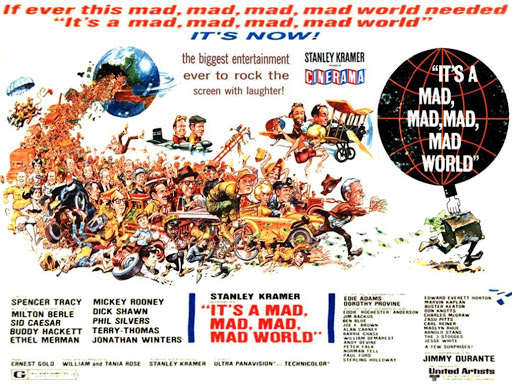
It’s a Mad, Mad, Mad, Mad World (1963)

MAD MAD MAD MAD WORLD

IT’S A MAD, MAD, MAD, MAD WORLD (1963) 1/2*

Let’s start this review with a bold statement and prediction: IT’S A MAD, MAD, MAD, MAD WORLD is the worst comedy I have ever seen and it will remain that way for all my life, even if I would be blessed to reach 100 years old.

Fact: I did not laugh once during the 3-hour, 19-minute duration of IT’S A MAD, MAD, MAD, MAD WORLD.

I consider it a lock on being the worst comedy I will ever see because of that length. Sure, I can go 90 or 95 or even 100 minutes not laughing at some dumb or aggressively stupid comedy, no problem, but 189 minutes proved to be a new personal record for remaining in a state of stone cold silence during a comedy. I only broke that silence to express disbelief with a grunt or a sigh. To be honest these intermittent sighs were deep enough to fill the Grand Canyon.

Yes, I almost forgot LEONARD PART 6 (believe me, how I tried forgetting), which I gave no stars and called “the worst movie ever made.” That’s right, it passes comedy straight into being bad enough to encompass all genres.

Why the half-star for a repetitive, repetitive, repetitive, repetitive comedy? Because I liked looking at the cast members during any fleeting moments when they were quiet. Once they resumed talking, well, shit, IT’S A MAD, MAD, MAD, MAD WORLD turned back into unfunny shit on a stick. Yeah, I felt like IT’S A MAD, MAD, MAD, MAD WORLD beat me over the head with unfunny shit on a stick for roughly a quarter of a quarantine day. I will do my best to utilize past tense during this review because I have no intent to ever watch IT’S A MAD, MAD, MAD, MAD WORLD ever, ever, ever, ever again.

I should rephrase one portion of the paragraph immediately above. Very, very, very, very rarely do any of the characters merely talk during IT’S A MAD, MAD, MAD, MAD WORLD. Just imagine a crowded room populated by people who feel compelled to compete with each other for who can be the loudest (and most obnoxious) person in the world, forget the room. And then being trapped inside that room for over three hours describes this movie in a nutshell. Perhaps it would be too much to add real cars to the room. Nah, instead, we’ll have a movie theater size TV in the room playing a loop of car chases at full volume intensity.

Here’s a main character who speaks in a voice resembling that of a normal person: Emeline-Marcus Finch (Dorothy Provine), whose character seems like the movie loaned her from a library amidst the chaos in this loud, loud, loud, loud movie. They no doubt used the Frances Howard Goldwyn – Hollywood Regional Branch Library, only a three-minute walk from the Walk of Fame.

The film establishes a basic tone early on, when five of the characters stand around and squabble over their potential take of the stolen $350,000 hidden under the ‘Big W’ in the Santa Rosita State Park. Yes, IT’S A MAD, MAD, MAD, MAD WORLD is basically one long argument over money interrupted by chases, overacting, mugging, pitfalls and pratfalls, dancing, overacting, cameo appearances, police chatter, overacting, an intermission, pitfalls and pratfalls, plane crashes, explosions, and (for old times’ sake) overacting.

Just take a look at some of the cast: Spencer Tracy, Milton Berle, Sid Caesar, Buddy Hackett, Ethel Merman, Mickey Rooney, Dick Shawn, Phil Silvers, Terry-Thomas, Jonathan Winters, Jim Backus, William Demarest, Jimmy Durante, Peter Falk, Jack Benny, Joe E. Brown, Norman Fell, Stan Freberg, Leo Gorcey, Edward Everett Horton, Buster Keaton, Don Knotts, Jerry Lewis, ZaSu Pitts, Carl Reiner, Arnold Stang, and the Three Stooges, with more than half of them in minute roles. What a sad, sad, sad, sad waste of talent!

Among the main characters, it’s easy to pick my least favorite: Mrs. Marcus, played by Merman. She’s awful from the start and remains awful for the entire length of the picture. IT’S A MAD, MAD, MAD, MAD WORLD partisans argue that she’s a character that people love to hate. I, however, am not one of those people, because I only hate this character. Thankfully, Merman closed out her career with a hilarious cameo in AIRPLANE!

Gordon Gekko told us “Greed is good” during WALL STREET. Meanwhile, nearly 25 years earlier, IT’S A MAD, MAD, MAD, MAD WORLD told us “Greed is bad, mkay?”

One more zinger before closing time: I laughed more during Stanley Kramer’s INHERIT THE WIND than I did IT’S A MAD, MAD, MAD, MAD WORLD. (If I ever watch Kramer’s JUDGMENT AT NUREMBERG, I’ll be sure to revise this final paragraph and gag.)

The Wasp Woman (1959)

THE WASP WOMAN (1959) **

Seems like only yesterday — time’s such an elusive concept during quarantine — that I highlighted the deceptive print ads and posters for THE GIANT CLAW.

Today, we return to that beat with Roger Corman’s 1959 wasploitation “non-classic” THE WASP WOMAN — do not fear, it’s not another movie about yet another “White Anglo-Saxon Protestant” woman. Instead, in this one, our protagonist takes, no, abuses an experimental potion made from the royal jelly of wasps that can apparently reverse the aging progress. Unfortunate side effect that even more unfortunately only kicks in during the film’s last 20 minutes: It turns her into the title character or “A BEAUTIFUL WOMAN BY DAY — A LUSTING QUEEN WASP BY NIGHT.”

Anyway, the poster for THE WASP WOMAN, it lies. Oh, how it lies. The poster “Wasp Woman” has a woman’s head and a wasp’s body. In the film, it’s flipped and she resembles a distant cousin of the title character in the much, much better THE FLY from 1958.

THE WASP WOMAN itself could make one feel appreciably older, rather than younger, because it’s extremely dull for the first hour.

We have a crusty old scientist named Zinthrop (Michael Mark). He’s not fun in any traditional mad scientist way … and, then, he’s ran over by a car and subsequently bed ridden for most of the rest of the picture … of course, his accident happened before he could warn our protagonist Janice Starlin (Susan Cabot) of some of the unfortunate side effects found in the other non-human test subjects. He redeems himself in the final act. Actually, no, he does not.

Believe it or not, most of this movie takes place in an office building, the location for the monster movie of your dreams. On top of a dull scientist, we have multiple cosmetic company staff meetings, just exactly what the viewers want during a movie called THE WASP WOMAN. Less wasp woman, more staff meetings, bingo! This movie should have been titled CLUELESS in roughly all 6,500 languages of the world.

By the way, I do believe the film shows bees rather than wasps, most notably in both the opening and closing title screens. I might be wrong, but I don’t want to be stung for being wrong. Please, have mercy on me, I’ve been stung bad enough watching THE WASP WOMAN, which definitely pales against ATTACK OF THE CRAB MONSTERS in the Roger Corman monster movie filmography.

In 1993, TNT’s MonsterVision featured THE WASP WOMAN alongside THE GIANT CLAW, THE CYCLOPS, CREATURE WITH THE ATOM BRAIN, FROM HELL IT CAME, VALLEY OF THE DRAGONS, and THE WEREWOLF during a bad movie marathon called “A Christmas Nightmare.” THE WASP WOMAN played between THE CYCLOPS and CREATURE WITH THE ATOM BRAIN.

At that point in my life, I did not watch “MonsterVision”; I started watching it only during the Joe Bob years. I would love to go back in time to the early ‘90s and talk my teenage self into watching (and taping) “MonsterVision,” so I could have all them old tapes to watch at this critical junction in time. Also, I am sure that I would have already converted them from VHS to DVD. Preservation of the species of bad movies is an imperative.

The Giant Claw (1957)

THE GIANT CLAW (1957) ***

Funny how none of the alternate titles for THE GIANT CLAW, a low-budget monster movie from director Fred Sears and producer Sam Katzman, are BATTLESHIP or FLYING BATTLESHIP or BIG AS A BATTLESHIP, because that’s how multiple characters — especially our protagonist, electronics engineer Mitch MacAfee (Jeff Morrow) — describe “The Giant Claw” for at least the first 30 minutes.

Of course, the Giant Claw looks absolutely nothing like a battleship. Mitch himself says at one point to his lady friend’s expression of disbelief, “I said it looked like a battleship, not that it was a battleship.” Yeah, sure, whatever, best never mind.

I love how most of the movie’s promotional goods avoid revealing the Giant Claw’s face, because that act would have undoubtedly scared off potential customers or attracted only those with a taste for absolutely ridiculous movies. At least, that way — not depicting the monster honestly in cinematic propaganda — it took precisely 27 minutes before audiences had the laughter of a lifetime caused by a movie monster. This is one of those movies where I would love to get in a time machine and head for the nearest theater (or drive-in) playing THE GIANT CLAW when it opened in June 1957. How did initial audiences react to it? Did they hoot and holler and howl derisively? Did they flee in total disbelief at the latest Sam Katzman motion picture monstrosity? Did they seek a refund to absolutely no avail? Did they write their Congressmen to complain?

One poster proclaims, “Winged Monster from 17,000,000 B.C.!” “Big as a Battleship!” “Flies 4 Times The Speed of Sound!” “Atomic Weapons Can’t Hurt It!” There’s a drawing of a bird — wings, body, and talons but no face — destroying a plane and a skyscraper. Could that be the Empire State Building? All pictorial renderings of the bird are basically the same — wings, body, and talons, as well as destruction, but no face — and that’s deceptive advertising in a nutshell. (Only those who got to watch the trailer got the real dope on THE GIANT CLAW.)

The producers originally planned to get stop-motion animation titan Ray Harryhausen (MIGHTY JOE YOUNG, JASON AND THE ARGONAUTS, CLASH OF THE TITANS) to create the monster, but he proved to be too much budget and so they outsourced the bird to a model maker in Mexico City. Reportedly, Katzman spent $50 on the puppet that became known as the Giant Claw. Fifty dollars well spent, for sure, and way to go, Uncle Sam.

The film’s posters and the characters themselves fail to accurately describe the giant bird mass murderer in THE GIANT CLAW. To be fair to the actors, they had no idea during filming what the Giant Claw would look like and were left to their own imagination. The characters, though, are made to look like blithering idiots because there’s a vast disconnect between their words and “The Giant Claw” itself, beginning with the battleship description. The filmmakers especially hung out lead actor Morrow to dry, because he gives a legitimately good performance. Legend has it that Morrow ducked out of the theater in embarrassment and got drunk at home after the audience laughed at the Giant Claw’s first appearance. It apparently only took once for Morrow.

Guess that I should try myself to describe the head of the Giant Claw puppet. Extremely long neck, big teeth, flaring nostrils, bulging eyes, and a Mohawk that should be the envy of any buzzard or punk rock singer.

Over the course of the plot, we discover this killer giant bird is actually an alien avian who has come to Earth to lay eggs and wreak destruction and terror on poor, poor humanity. We learn even more, but I will leave that explanatory exposition out of this review for all those individuals who have not seen THE GIANT CLAW before. Trust me, it gets even better as the film attempts to explain the Giant Claw more and more with dialogue passages that could inspire bouts of hysterical laughter. I believe the Mayo Clinic calls it “Pseudobulbar affect.”

Bottom line: This alien avian was sabotaged by a chintzy movie producer named Sam Katzman (1901-73) and both “The Giant Claw” and THE GIANT CLAW will live in infamy as one of the great bad movie monsters and one of the great bad movies, respectively. During my first viewing, I enjoyed THE GIANT CLAW more than many so-called “good” movies.

I have one particular favorite scene in THE GIANT CLAW.

It is reminiscent of the scene in Q: THE WINGED SERPENT (produced by Samuel Z. Arkoff) when lovable hateful creep Jimmy Quinn (Michael Moriarty) leads two hoods leaning on him to the Quetzalcoatl in the Chrysler Building. We hear the Big Q take a couple bites out of crime and Quinn absolutely revels in their demise, “Eat ‘em, eat ‘em! Crunch! Crunch!” I love to hate Quinn even more after that scene.

Anyway, when the Giant Claw chomps on a pair of parachuting passengers, I said out loud, “Crunch! Crunch!” Please keep in mind that in quarantine, no one can hear you scream.

Sleepaway Camp (1983)

SLEEPAWAY CAMP

SLEEPAWAY CAMP (1983) Two stars

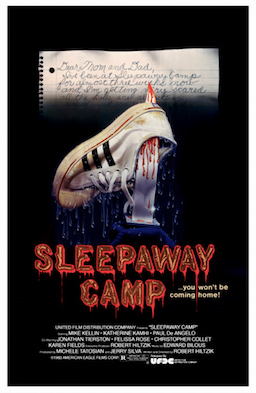
This is one of those instances where I can remember seeing the poster long before the attached movie.

Undoubtedly like most of the jaded youth of my generation, I first saw the poster for SLEEPAWAY CAMP back in the late 1980s. It’s the one that stayed with me the most over the decades.

It has the dominant image of a dripping wet shoe being stabbed all the way through by a bloodied knife. Above, there’s a letter from a camper, “Dear Mom and Dad, I’ve been at Sleepaway Camp for almost three weeks now and I’m getting very scared. …” Right below the hand holding the knife are the title dripping blood from its bold type and the tag “You won’t be coming home!”

Now, hours after watching SLEEPAWAY CAMP for the first time, it’s just as unforgettable as the poster.

To a great degree, SLEEPAWAY CAMP chucks our traditional notions of what constitutes a “good” or a “bad” movie right out the fucking window. It’s more of an experience, an event, a rite of passage, something where you can ask friends and family if they have ever seen it. If they have or haven’t, dynamite conversation will follow either way. For sure, though, it would make a great watch party — of course, following proper social distancing protocol at this point in history.

Here’s a few notes on the experience:

— Melodrama is defined as such, “A sensational dramatic piece with exaggerated characters and exciting events intended to appeal to the emotions.” Addendum: See SLEEPAWAY CAMP. Early on, after the obligatory flashback to traumatic events of the past, Desiree Gould’s Aunt Martha establishes the basic tone for the rest of the movie: Campy with overacting possible. Yes, SLEEPAWAY CAMP goes over-the-top, gleefully, merrily, in every scene, including the end credits.

— Being bat shit crazy for 84 minutes has been SLEEPAWAY CAMP’s meal ticket to cult movie immortality. Because, let’s face it, it’s not as well-made technically as similar low-budget precursors BLACK CHRISTMAS, ALICE SWEET ALICE, and HALLOWEEN. Not even remotely close.

— SLEEPAWAY CAMP uses a musical score that also functions as bludgeoning device and melodrama amplifier. I just checked for any injuries after being whacked upside the head at regular intervals by Edward Bilous’ sledgehammer score. I survived without a single bump — amazing, I know. Anyway, I looked up this Bilous fellow. IMDb linked me to edwardbilous.com and a Bilous quote from the Wall Street Journal, “Artists today need a new set of skills to be able to tell the unique story of their generation.” He’s the founding director for the Center for Innovation in the Arts and the artistic director for Beyond the Machine, A Festival of Electro-Acoustic and Interdisciplinary Art at Juilliard. He joined the Juilliard faculty in 1984.

— “Weird Al” Yankovic’s “Nature Trail to Hell” sounds like a spin on FRIDAY THE 13TH PART III and SLEEPAWAY CAMP. “Coming this Christmas to a theater near you / The most horrifying film to hit the screen / There’s a homicidal maniac who finds a cub scout troop / And he hacks up two or three in every scene / Please don’t reveal the secret ending to your friends / Don’t spoil the big surprise / You won’t believe your eyes when you see. …” and “See severed heads that almost fall right in your lap / See that bloody hatchet coming right at you / No, you’ll never see hideous effects like these again / ‘Till we bring you ‘Nature Trail to Hell Part 2.’” File “Nature Trail to Hell” alongside such “Weird Al” epics as “The Biggest Ball of Twine in Minnesota,” “Albuquerque,” “Trapped in the Drive-Thru,” and “Jackson Park Express.”

— In his final performance, veteran actor Mike Kellin (1922-83) surpasses Gould in scenery chewing. He chews scenery to such a degree that he could chew through every picture’s scenery within an entire multiplex. Kellin plays Camp Arawak owner Mel Kostic, who keeps downplaying everything until about the 50th dead body. At least it feels that way anyway. He’s one of those characters who becomes creepier and more detestable over the course of the movie, especially when he lines up dinner with a camp counselor in her late teens and assaults one of the main characters who he mistakenly believes to be the killer. Mel loses his shit late in the picture, and it’s not pretty.

— By this point in the review, I should have already discussed the plot. Eight years after a tragic boating accident near Camp Arawak, Aunt Martha sends her niece Angela (Felissa Rose) to camp with Ricky (Jonathan Tiersten), Angela’s cousin and Martha’s son who’s a veteran camper. Mean girls Judy (Karen Fields) and Meg (Katherine Kamhi), as well as a group of their male counterparts both teenage and prepubescent, are relentlessly cruel and nasty toward Angela and Ricky, especially the initially painfully shy and quiet Angela. Ricky’s friend Paul (Christopher Collet) takes a shining to Angela and he’s able to break her silence. Over time, however, the picture develops a dread pattern: Every character who’s cruel and nasty to Angela or Ricky bites the dust in spectacular fashion. Yes, just like everything else in the picture, including the crop-tops and short-shorts, the murder set pieces are over-the-top.

— At this relative late point in the slasher film craze, a mere five years since HALLOWEEN, films in the genre needed a major selling point and SLEEPAWAY CAMP includes one of those (awesome but infuriating) endings that redefines the reality of every scene that came before, just like FRIDAY THE 13TH and HAPPY BIRTHDAY TO ME. This beyond bizarre ending is the first and foremost reason we still talk about SLEEPAWAY CAMP all these years later.

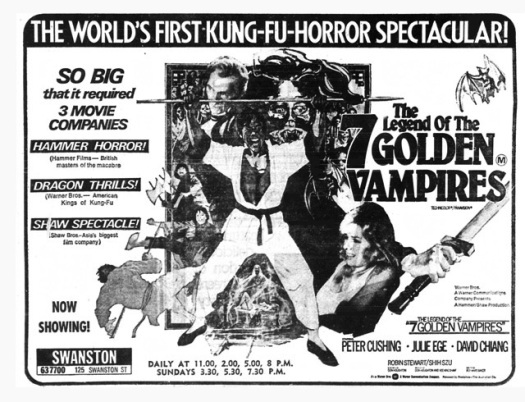
The Legend of the 7 Golden Vampires (1974)

THE LEGEND OF THE 7 GOLDEN VAMPIRES

THE LEGEND OF THE 7 GOLDEN VAMPIRES (1974) ***

It was really only a matter of time before Hammer, the British masters of the macabre, and the Shaw Brothers, the Hong Kong masters of martial arts, would combine forces and make the world’s first martial arts vampire movie spectacular. An exploitation movie fan’s wet dream come true, in other words.

They created THE LEGEND OF THE 7 GOLDEN VAMPIRES in 1974, not the greatest vampire or martial arts movie ever made, of course, but still an enjoyable romp for those who have a hankering for (in no particular order, except for the last item) vampire hunting, neck biting, blood letting, boiling blood, severed hands, throat slitting, stabbings through the heart, vampires turning to dust, fake bats, fake castles, sword fights, martial arts combat between warriors and vampires & their minions, archery, breasts, romance, and one ridiculous, anticlimactic ending. Three stars, check it out.

Christopher Lee first played Dracula for Hammer in 1958 and he returned for PRINCE OF DARKNESS (1966), DRACULA HAS RISEN FROM THE GRAVE (1968), TASTE THE BLOOD OF DRACULA (1970), SCARS OF DRACULA (1970), DRACULA 1972 (1972), and THE SATANIC RITES OF DRACULA (1973). Lee’s animosity toward the series increased over time and he finally refused to participate in THE LEGEND OF THE 7 GOLDEN VAMPIRES after seven times as the Count. Lee read the script and said “No deal.”

That’s a bummer, especially since John Forbes-Robinson makes for a horrible Dracula. How horrible? They dubbed him with David de Keyser and Dracula only appears in a few minutes at the beginning and end of the picture. In the opening scene, Dracula kills a Chinese monk and takes on his form. (Reportedly, Forbes-Robinson was furious about being dubbed. Hey, it’s not the first time in history. A few years after GOLDEN VAMPIRES, SATURN 3 director Stanley Donen felt dissatisfied with Harvey Keitel’s Brooklyn accent and since Mr. Keitel refused participation in post-production, Donen dubbed over Keitel with a British actor using a Mid-Atlantic accent.)

Granted, we do have Peter Cushing for the fifth time as Professor Van Helsing. Who else would handle the plot exposition through dialogue scenes? How about that plot? Van Helsing, on a lecture stop in China, agrees to help seven siblings (six men, one woman) take back their ancestral mountain village that’s been taken over by seven “golden” vampires (including Dracula trapped in another body) and their living dead minions. Then again, I already described the plot in 44 words in the second paragraph.

THE LEGEND OF THE 7 GOLDEN VAMPIRES can stand with any of the goofiest Shaw Brothers spectaculars and it ranks among the best of the Hammer Dracula films.

Alice, Sweet Alice (1976)

ALICE, SWEET ALICE (1976) ***

They really tried hard with ALICE, SWEET ALICE, the horror film that’s best known for being Brooke Shields’ film debut.

It appeared in November 1976 at the Chicago International Film Festival, where it competed against such films as ALLEGRO NON TROPPO, GREY GARDENS, SMALL CHANGE, THE DEVIL’S PLAYGROUND, and Best Feature winner KINGS OF THE ROAD.

It received theatrical release (and mostly negative reviews) in 1977, 1978, and 1981. Viewers might have seen it as either ALICE, SWEET ALICE or COMMUNION (the original title) or HOLY TERROR depending on when they watched it.

The promotional forces especially played on the Brooke Shields angle in ‘78 and ‘81.

One of the ‘78 ALICE, SWEET ALICE ads proclaimed at its top, “PRETTY BABY Brooke Shields, America’s New Star,” a reference to Shields being in Louis Malle’s contemporaneous PRETTY BABY.

Three years later, the film returned as HOLY TERROR with a hard sell promotional campaign again built around exploiting Shields’ notoriety from her Calvin Klein advertisements and her film projects like THE BLUE LAGOON. Shields put up a fight, though, because she had more clout and ENDLESS SUMMER coming down the pike; “Brooke was concerned that film goers could only be disappointed if led into the theater with the promise that the film was of recent vintage or that she had a central part in it,” said her attorney. See, the original HOLY TERROR ads used a photo of Shields circa ‘81 rather than one of her from the film that was made during a different administration. Those naughty ad men, they did a bad, bad thing.

Roger Ebert made the advertising campaign for HOLY TERROR his “Dog of the Week.” “The ads promise that it stars Brooke Shields,” Ebert said. “That’s where the trouble begins, because HOLY TERROR was first released five years ago under the title of COMMUNION and then it was released three years ago as ALICE, SWEET ALICE. Now, when this movie was originally shot, Brooke Shields was a little girl, only 10 years old, and as Calvin Klein can tell you, she’s not 10 years old anymore. Shields has a supporting role in the movie as an apparently demented little girl and it’s an effective thriller alright, but how many title changes is it going to go through in an attempt to cash in on Brooke Shields’ recent popularity?” Gene Siskel replied, “Maybe they ought to try GONE WITH THE WIND.”

Truth in advertising: Shields, listed 10th in the cast in the end credits, appears in the picture for about the first 10 minutes. For those of us who think she’s one of the worst mainstream actresses ever committed to celluloid, that’s a major blessing in disguise. She’s not a demented little girl, though, but the first murder victim. Attending her first communion, her character Karen gets killed real good before she can receive it, strangled to death and then incinerated by a masked figure in a costume that should make one think back to the superior thriller DON’T LOOK NOW. Only this raincoat is yellow rather than red like DON’T LOOK NOW.

Deceptive promotional campaigns are not anything new. They’ve happened before and they will happen again. It happens all the time, and not only (but especially) during election years.

For example, John Travolta made his debut (briefly) in the ridiculous 1975 thriller THE DEVIL’S RAIN, which features Ernest Borghine, Eddie Albert, Ida Lupino, Tom Skerritt, William Shatner, and Keenan Wynn in the cast, as well as the special participation of Anton LaVey, high priest of the Church of Satan. Anyway, in the original 1975 ads, not a mention of Travolta. Instead, we have mug shots of “Satan on Earth” (Borghine), “Devil Destroyer” (Albert), “Demon Sacrifice” (Lupino), “Tortured Soul” (Shatner), and “Faceless Follower” (Wynn) right above the claim “Absolutely the most incredible ending of any motion picture ever!”

Preying on Travolta’s success in SATURDAY NIGHT FEVER and GREASE, THE DEVIL’S RAIN made a comeback. Siskel named it a “Dog of the Week” the same week in 1978 his colleague Ebert picked that awful monster movie SLITHIS. “My dog this week is a four-year old film named THE DEVIL’S RAIN that’s suddenly come back to a lot of theaters advertised as starring John Travolta,” Siskel said. “Well, that’s a complete lie. THE DEVIL’S RAIN stars Ernest Borghine as a Devil’s helper trying to hang on to some lost souls. Travolta is on screen for less than a minute, this was his first film. He had only one line of dialogue in it. Most of the time, he has red and green wax melting all over his face. Looks like he fell asleep on a pizza. … Beware of films you’ve never heard of promising big stars. One reason you’ve never heard of them, they’re lousy.”

These promotional campaigns definitely backfired in the case of ALICE, SWEET ALICE, because it’s a good little thriller often compared with the works of Alfred Hitchcock and called a prototype of the slasher film. That should have been more than enough to sell the film.

ALICE, SWEET ALICE involves a series of murders in 1961 in Paterson, New Jersey, around a church and an apartment building. Our title character, a 12-year-old girl played by a 18- or 19-year-old Paula Sheppard, becomes the first suspect and she’s sent to a psychiatric institution for evaluation. She was always mean to her little sister and besides, she’s just plain “weird.” Their parents are divorced and they live with their mother Catherine (Linda Miller) and attend St. Michael’s Parish Girls’ School. We also have the girls’ father Dom (Niles McMaster) and their aunt (Jane Lowry), Father Tom (Rudolph Willrich), his housekeeper Mrs. Tredoni (Mildred Clinton), the creepy obese landlord (Alphonso DeNoble), and assorted policemen and minor characters. Dom leaves behind his new wife to more or less become a detective on behalf of his oldest daughter, and that leads to his demise in a scene that echoes Donald Sutherland’s death at the end of DON’T LOOK NOW.

ALICE, SWEET ALICE reminds one of not only DON’T LOOK NOW, but also any number of giallos or Italian thrillers because of the anti-Catholic themes, dark humor, and familial dysfunction. Lucio Fulci’s DON’T TORTURE A DUCKLING and Dario Argento’s PROFONDO ROSSO quickly come to mind. Of course, all these films have their roots in Hitchcock.

Director, producer, and co-writer Alfred Sole, who shared the screenplay with Rosemary Ritvo, reveals the real killer around the two-thirds mark and that’s a departure from the modus operandi of the thriller.

ALICE, SWEET ALICE stands up long after the promotional campaign has become a faded memory. Anyway, I’ll still call it Brooke Shields’ best movie.

Goin’ Coconuts (1978)

GOIN’ COCONUTS (1978) 1/2*

In the distant future, one of the great mysteries of human behavior will be why there were so many teen idols after, oh, let’s say, 1955. Imagine trying to explain Tiger Beat, Joey Lawrence, Jonathan Taylor Thomas, NSYNC and the Backstreet Boys, and Justin Bieber to future generations.

I can only hope that future rational beings will reach the conclusion that many people (mostly girls, but also boys with such beacons of humanity as Britney Spears, Paris Hilton, Kim Kardashian, et cetera ) in the late 20th and early 21st centuries obsessed about the shallow and the superficial and the stupid and such attributes as perfect hair, perfect teeth, and dimples. “He / She has got such a perfect body. He’s so cute. She’s so hot.” All that jive can just go fuck off.

I thought about this “teen idol” angle during and after GOIN’ COCONUTS, the motion picture debut and finale of former teen idols Donny and Marie Osmond. Since I watched it after SLITHIS, I just might have survived the worst two movies I have ever seen back-to-back; I am blanking on whether or not I ever watched BATTLEFIELD EARTH after LEONARD PART 6 or vice versa.

Anyway, I hated just about every second of GOIN’ COCONUTS. Hated every musical number. Hated every bit of perfunctory dialogue. Hated every single attempt at humor. Hated the jewelry caper story and every single plot development that we have seen before from a million different movies and TV shows. Hated seeing legendary movie villains being reduced to buffoons for comedic purposes that miserably failed. Hated it the longer it went on. I rejoiced at the first sight of the end credits and turned off the movie. I didn’t even care all that much about the Hawaiian scenery, just because we had to watch this stupid movie take place within it.

I felt especially bad for actors like Kenneth Mars, Ted Cassidy, Khigh Dhiegh, and Harold Sakata. But, hey, not that bad, since they got paid and had the opportunity to make a movie in Hawaii. That sounds great right about now. I could go for that, even a movie as shitty as GOIN’ COCONUTS.

The reason I felt bad for them was they had to play cosmically inept. Like, for example, Sakata’s Ito could not take out Donny Osmond, for crying out loud. The filmmakers made the dread mistake of costuming Sakata (1920-82) in the same hat that he wore in GOLDFINGER as super henchman Oddjob. Sure we all remember what Oddjob did with his hat in GOLDFINGER; let’s just say that he wears the hat throughout GOIN’ COCONUTS and that’s that. It’s so insulting to see a World War II veteran and an Olympic silver medalist in weightlifting (Sakata represented the United States in the 1948 Summer Olympics in London) reduced to playing the fool, thwarted at every churn of the plot by a couple teen idols and their perfect teeth.

Dhiegh (1910-91) played a key role in THE MANCHURIAN CANDIDATE as brainwashing expert Dr. Yen. Yes, THE MANCHURIAN CANDIDATE, one of the most intelligent movies ever made. Then, 16 years later, Dhiegh appeared in GOIN’ COCONUTS, which should have borrowed from THE WIZARD OF OZ its musical theme … “If I Only Had a Brain.” Again, it simply defies all credibility that Dhiegh’s character would be outsmarted by a pair of coconuts.

In GOIN’ COCONUTS, Mars (1935-2011) more or less gives us a variation on his characters from the Mel Brooks comedies THE PRODUCERS and YOUNG FRANKENSTEIN, only without the laughs.

Cassidy (1932-79) played Lurch on “The Addams Family” and would it have been too much to ask director Howard Morris (who played Ernest T. Bass on “The Andy Griffith Show”) and screenwriters William Marc Daniels and Raymond Harvey to include a gag where Cassidy’s Mickey answers the phone with “You rang.” Yes, of course, it would have been too much to ask. That’s silly to ask if you’ve survived GOIN’ COCONUTS.

It was a pathetic sight every time watching these villains shoot their guns at Donny and Marie. They should have been sent back to marksmanship class or had their diabolical henchmen licenses revoked.

Aside from the end credits, there was something else great about GOIN’ COCONUTS. Since it failed at the box office, Donny and Marie made only this one movie rather than a series of Donny and Marie spectaculars. They returned to their variety show where they belonged with their aw shucks gee whiz nature and perfect teeth intact.