
Fiend Without a Face (1958)

FIEND WITHOUT A FACE

FIEND WITHOUT A FACE (1958) ****

The 1958 British independent horror production FIEND WITHOUT A FACE contains everything this science fiction and horror fiend wants from a film of that era: a square but likeable hero (Marshall Thompson), a shapely heroine (Kim Parker), a mad scientist (Kynaston Reeves), townspeople who blame everything on the wrong people, atomic fallout, and horrible, terrifying stop motion animation monsters (created by the special effects team of Flo Nordhoff and Karl-Ludwig Ruppel) that are loads of fun.

It also has an evocative title.

The final 20 minutes or so of FIEND WITHOUT A FACE are phenomenal and push this film into the stratosphere.

The fiends of the title are floating killer brains who started as one brain materialized from the thoughts of Professor R.E. Walgate, a man who specializes in telekinesis. The nearby airbase’s nuclear power radar experiments have dire consequences and the original fiend escapes from Walgate’s lab and wreaks murder and mayhem on the surrounding community. The fiends replicate themselves through attacks on humans (looting their brains and spinal cords) and they remain invisible until the final 20 or so minutes after they crank up the nuclear power to DANGER! They must be stopped!

These fiends are one helluva brainstorm, literally. They have antennae and tentacles, and one can see their influence on later creature features creatures. (The ALIEN films leap to mind. George Romero must have watched at least the last 20 minutes of FIEND WITHOUT A FACE before he made the first NIGHT OF THE LIVING DEAD.)

When the fiends are shot in the brain (love that concept), they naturally gush out this great-looking brain glop and I honestly wish these death scenes lasted another 20 minutes. They are so much fun, and it’s just as great when our hero breaks out an axe. The fiends (love that word) finally turn into goo after our hero blows up their great power source real good.

When the fiends are in their invisible stage, we hear slurping sounds when they strike their victims’ brains and spinal cords. Awesome, totally awesome, because it’s not happening to us, of course.

Credited director Arthur Crabtree (reports have it that star Thompson worked on the film himself after Crabtree walked off the picture because directing sci-fi proved to be too much for his fragile little mind) and his team did a fantastic job with the fiends when they’re invisible or visible. FIEND WITHOUT A FACE pulls off the nifty little trick of building up high audience expectations toward a great final act, then it delivers the goods and maybe even exceeds expectations during that final act.

Believe it or not, FIEND WITHOUT A FACE apparently caused quite a storm of controversy when it was first released in early July 1958. The British Board of Film Censors demanded cuts be made before it would be certified for release and the picture still received an ‘X.’ It’s lucky to not have met the same fate as banned-for-many-years pictures like BATTLESHIP POTEMKIN (1926-54), FREAKS (1932-63), and ISLAND OF LOST SOULS (1932-58), for example.

Legend even has it that British Parliament discussed why the censors allowed FIEND WITHOUT A FACE to be released.

Over time, I’ve come to realize that I love 1950s horror and sci-fi: THE DAY THE EARTH STOOD STILL, THE THING FROM ANOTHER WORLD, HOUSE OF WAX, GODZILLA, THEM!, CREATURE FROM THE BLACK LAGOON, INVASION OF THE BODY SNATCHERS, THE INCREDIBLE SHRINKING MAN, ATTACK OF THE CRAB MONSTERS, FIEND, THE H-MAN, THE BLOB, THE FLY, HORROR OF DRACULA, PLAN 9 FROM OUTER SPACE, BUCKET OF BLOOD, and THE KILLER SHREWS all have made personal top 10 lists for their respective years and the decade also featured at least five of Hitchcock’s best works (STRANGERS ON A TRAIN, REAR WINDOW, THE WRONG MAN, VERTIGO, NORTH BY NORTHWEST) and other films that are horrifying in their own distinct ways, like film noir KISS ME DEADLY and war film FIRES ON THE PLAIN.
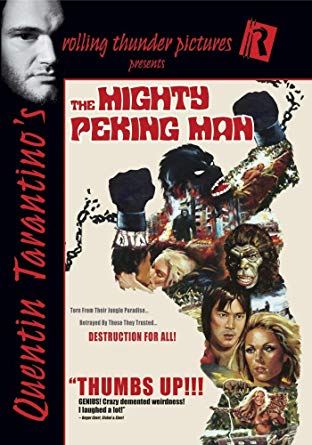
The Mighty Peking Man (1977)

THE MIGHTY PEKING MAN

THE MIGHTY PEKING MAN (1977) ***

The Shaw Brothers (Runme 1901-85 and Run Run 1907-2014) have rarely ever let me down and they provided some of the greatest entertainments of all-time, like THE ONE-ARMED SWORDSMAN, FIVE FINGERS OF DEATH, INFRA-MAN, THE 36TH CHAMBER OF SHAOLIN, and CLAN OF THE WHITE LOTUS.

The Shaw Brothers did not (and still do not, in death) cheat us.

For example, in THE MIGHTY PEKING MAN, their 1977 spin on King Kong, Mighty Joe Young, and Tarzan (not to mention Godzilla) that’s not quite peak but still good Shaw Brothers, we don’t have to wait very long whatsoever to see the title character. No, life is short, time is precious, so director Ho Meng-hua gives us our first monster encounter in the first minute of screen time. Okay, to be exact, it’s 1:45 into the movie, but that still beats most every other entry in this distinguished genre.

That establishes a tone for a very generous entertainment package. Find a copy and buy it for somebody, and it’s the gift that keeps on giving.

THE MIGHTY PEKING MAN not only provides a sympathetic monster in the grand tradition, but also (in no particular order) a plucky explorer hero (Danny Lee) who’s been betrayed by his lover with his playboy brother so he’s drowning his sorrows in booze when he’s recruited for a jungle mission, a scantily-clad leading lady (Evelyne Kraft, a regular Swedish Fay Wray) who’s grown up with the animals in the jungle after her parents died in a plane crash (she’s been raised by the Mighty Peking Man, in fact), an earthquake, elephants, tigers and leopards (oh my!), a fight between a leopard and a snake, quicksand, vine swinging, flashbacks to key moments in both the hero’s and the leading lady’s life, callous and shady businessmen, heartless authority figures, mucho destruction of miniatures galore, and a grand finale that boggles the mind even after everything that came before.

My favorite scene, however, begins around the 33-minute mark.

It involves the Semi-Obligatory Lyrical Interlude, a term made famous by the late Roger Ebert. Here’s the definition from Ebert: “Scene in which soft focus and slow motion are used while a would-be hit song is performed on the sound track and the lovers run through a pastoral setting. Common from the mid-1960s to the mid-1970s; replaced in 1980s with the Semi-Obligatory Music Video.”

The Simon and Garfunkel songs in THE GRADUATE epitomize the Semi-OLI.

The one in THE MIGHTY PEKING MAN rates below Louis Armstrong singing “We Have All the Time in the World” over George Lazenby and Diane Rigg in ON HER MAJESTY’S SECRET SERVICE and the foreboding use of Roberta Flack’s “The First Time Ever I Saw Your Face” in Clint Eastwood’s PLAY MISTY FOR ME. Ebert himself said Eastwood filmed the first Semi-OLI that works.

In THE MIGHTY PEKING MAN, our hero and leading lady embrace and lock lips for the first time (watch her eyes after this first kiss) and they unleash the awesomely banal love song “Could It Be I’m in Love, Maybe.”

This is one helluva old-fashioned love song and one helluva Semi-OLI.

I mean, I believe it’s the only Semi-OLI in the history of motion pictures to incorporate a leopard.

Not only that, but the leading lady seems more interested in the leopard than our poor, poor hero. You really sympathize for this guy even more after this scene.

Let’s get back to those lyrics for a second here.

“The love you gave me then showed me a thing or two / I guess I saw it in your eyes / And the look of love upon your face is too hard to disguise / Maybe just a smile will say [cannot make out, even after watching this scene 500 times] / Could it be I’m in love (Maybe? Baby?)” (To hell with it, I already chose “Maybe.” Why does life have to be so difficult?)

“I can’t begin to say what makes me feel like this / I never knew what love could do / But if this is love, it’s here to stay / [Don’t want to make this part out] / So all I have to hear is I’ll give it all to you.”

There’s more lyrics, but we all catch the drift and there’s not any need to drown in banality.

It all totals about 3:30 of pure junk food cinema bliss.

I definitely love it because it’s so utterly ridiculous.

Then again, utterly ridiculous describes THE MIGHTY PEKING MAN.

I should end this review with a consideration of the ending of THE MIGHTY PEKING MAN. Just imagine the ending of KING KONG times 10 times 10.

Night of the Lepus (1972)

NIGHT OF THE LEPUS (1972) Three stars

Janet Leigh (1927-2004) famously said that she never took another shower after her iconic scene in PSYCHO.

Wonder what she said after her performance in William F. Claxton’s NIGHT OF THE LEPUS.

Reportedly, Leigh said “I’ve forgotten as much as I could about that picture.”

Well, Claxton ain’t quite Hitchcock and NIGHT OF THE LEPUS ain’t quite PSYCHO, but this 1972 picture certainly deserves a far better reputation. Like PLAN 9 FROM OUTER SPACE, it’s simply just too darn entertaining to be anywhere near the “worst movie ever made.”

After all, it’s not every day that you see a bad movie featuring Leigh, Stuart Whitman, Rory Calhoun (1922-99), DeForest Kelley (1920-99), Paul Fix (1901-83), and a cast of all-star killer rabbits. They’re playing it straight and not condescending to the material. Give them at least that much credit.

The single biggest gripe against NIGHT OF THE LEPUS: The killer rabbits are not scary. I don’t know if there’s ever been a single review of NIGHT OF THE LEPUS that’s gone without making a major note about the premise itself and then the botched execution of that bad idea.

Claxton and crew obviously worked very hard to make the homicidal rabbits more imposing and terrifying. They constructed miniature sets for regular-sized rabbits to run wild through, filmed them from angles conducive to making the rabbits appear larger-than-life, and cooked up very convincing guttural noises for our furry friends when they’re in full-on beast mode. Basically, our title characters look like they’re running wild on the set of a Western filmed in the back lots of Arizona … and I believe that’s exactly what happened.

Maybe one day they’ll cross NIGHT OF THE LEPUS with THE TERROR OF TINY TOWN.

As far as rabbits not being scary, I do believe these complainers have not encountered that dynamite rabbit from MONTY PYTHON AND THE HOLY GRAIL and Ted “Theodore” Logan’s brush with the Easter Bunny from Hell in BILL AND TED’S BOGUS JOURNEY.

Rabbits can be scary. In theory, anything could be scary, if done right.

Honestly, I don’t know if I could handle a truly scary killer rabbit picture.

The producers did their best to obscure the nature of the killers in promoting NIGHT OF THE LEPUS, apparently booking on the fact that millions did not know the Latin word for rabbit.

They believed that people would not waste their time and money on a killer rabbit picture.

Idiom: “A fool and his money are soon parted.”

Well, here we are at least 47 years after the release of NIGHT OF THE LEPUS and I received a DVD copy of the film for an early Christmas present. It’s a gift that’s already kept on giving.

On first re-watch, I enjoyed NIGHT OF THE LEPUS all over again and I actually enjoyed it more at the age of 41 being able to see all its flaws more clearly than when I first watched the film in late prepubescence. I enjoyed all the melodramatic efforts to make the rabbits scary (especially the bloody aftermath of rabbits on the rampage scenes), all the scientific mumbo-jumbo, all the scenes of the rabbits on their attack route (Pamplona with rabbits and no people), all the blatantly obvious set-ups for blatantly obvious payoffs, the ridiculous final plan to exterminate the rabbits and restore natural order, and I especially loved watching the all-star cast diligently keep a straight face through all the silliness and earn their paychecks.

It’s still a notch below such contemporaneous classics as FROGS, GODZILLA VS. THE SMOG MONSTER, and INVASION OF THE BEE GIRLS.

The Thing with Two Heads (1972)

THE THING WITH TWO HEADS (1972) Three stars

Former NFL player Rosey Grier and 1946 Academy Award for Best Actor winner Ray Milland are the two heads. Let’s get that out of the way right from the start.

Top-billed Milland plays a brilliant scientist with terminal cancer who finds trial success with a two-headed gorilla (Rick Baker’s preparation for KING KONG). He comes up with a diabolical scheme to keep on living. Just like Spinal Tap lead singer David St. Hubbins once said, “It’s such a fine line between stupid, and clever.”

Second-billed Grier plays a convicted murderer on Death Row who has volunteered his body to medical science.

Doctors transplant Milland’s head onto Grier’s body, since both are running out of time. Maybe the wrong Grier, because just imagine Milland’s head, for example, on Pam Grier’s body. Now, that would be interesting. American International Pictures could have made it happen, at least for a sequel, but unfortunately it’s too late since Milland passed away in 1986.

You might not believe this, but Grier’s Jack Moss is an innocent man and Milland’s Maxwell Kirshner is an unapologetic racist. Try and imagine a TV show where they put Archie Bunker’s head on George Jefferson’s body.

Honestly, I don’t think THE THING WITH TWO HEADS takes off until it gets Milland and Grier out of the hospital and into the open after their transplant. That’s about the halfway point of the picture, when they kidnap black doctor Fred Williams (Don Marshall) and Moss and Kirshner both do their best negotiating to get the good doctor on their side. They both face challenges, in Moss being on Death Row and Kirshner being an unrepentant bigot. They both want the other head removed.

THE THING WITH TWO HEADS devotes several minutes to a chase scene with many police cars in hot pursuit of a “two-headed monster.” You really have not lived until you see this chase, especially after Grier and Milland commandeer a motor bike, make their way through a race course, and evade 14 crashing police cars en route to a safe haven. These policemen are incredibly incompetent: They cannot shoot, cannot drive, and cannot even close a trunk on their downtrodden squad cars. Yes, they do drive, but just look at their end results. Like a test reel for SMOKEY AND THE BANDIT and THE BLUES BROTHERS.

Milland plays basically the same character that he does in FROGS, another 1972 production from American International; FROGS came out on March 10 and THE THING WITH TWO HEADS on July 19. Milland sinks his teeth into the dialogue in both films and he gives off the feeling of an unhappy camper in both performances, but it works for his characters. Reportedly, Milland sweated so much during the production of FROGS, filmed in the Everglades, that his toupee fell off several times; additionally, he hated the production so much that he left it three days early.

Grier, meanwhile, has lived an interesting life to say the least and a starring role as one of the heads in THE THING WITH TWO HEADS barely scratches at the surface of that life, believe it or not. Grier played college football at Penn State and then professionally for the New York Giants and the Los Angeles Rams from 1955 through 1966. He served as a bodyguard for Robert Kennedy during the 1968 presidential campaign and it was Grier who subdued assassin Sirhan Sirhan. Grier hosted a TV show, enjoyed a recording career, became an ordained minister, spoke at the 1984 Republican National Convention, and entertained running for the Governor of California in 2018, lest we forget Grier’s 1973 book “Rosey Grier’s Needlepoint for Men.” He’s the last living member of the Rams’ “Fearsome Foursome,” a defensive line that included Deacon Jones (1938-2013) and Merlin Olsen (1940-2010).

Grier even gets to show off his singing ability just a little bit in the final moments of THE THING WITH TWO HEADS and let’s just say that, of course, the film ends on “Oh Happy Day.” It is just that kind of a movie.

NOTE: I would assign the film’s trailer four stars. It is 2 minutes, 21 seconds of greatness, especially with that dynamite opening line “It seemed like a good idea at the time,” which might just be exactly what many people have said after seeing THE THING WITH TWO HEADS.

King Kung Fu (1976)

KING KUNG FU (1976) Three stars

The Empire State Building, completed just a couple years earlier, played a key role in the 1933 classic KING KONG. At this very moment, we can picture Kong fighting off them darn airplanes from the highest spot in the modern world. Very few endings in movie history can even approach the final minutes in KING KONG. Remains awesome nearly 90 years later.

Meanwhile, our gorilla King Kung Fu takes shapely Pizza Hut waitress Rae Fay to the top of the Holiday Inn Plaza, the tallest building in Wichita at a majestic height of 262 feet, for the grand finale of KING KUNG FU. King Kung Fu battles a stop-motion helicopter piloted by a police captain with a bad John Wayne impersonation. Awesome, in a completely different way.

You win some, you lose some, and often times it seems like Kansas loses on the cultural front, while New York City wins and wins again and again and wins forever more.

Both the Empire State and the Holiday Inn are no longer their cities’ tallest buildings. Heck, the latter is not even the Holiday Inn any more, it’s the 250 Douglas Place Apartments (a.k.a. the Garvey Center). They both are doing quite well for themselves, however, with the Empire State Building in the news in late 2019 for $165 million renovation and being a top tourist destination.

The duo of producer Bob Walterscheid and director Lance D. Hayes started filming KING KUNG FU in 1974 and finished in 1976, but it took another 11 years for Walterscheid to wrangle up the necessary funds to complete the editing on this half-King Kong, half-Kung Fu spoof that has its tongue planted firmly within its cheek. Hell, maybe every cheek in Wichita.

I watched the Korean KING KONG rip-off A*P*E and KING KUNG FU within basically the same 24-hour period.

Objectively, both are “bad” movies, but there’s a world of difference in what both achieve.

A*P*E plays exactly like a cheap, cynical KING KONG rip-off and it’s quite telling that its most famous scene is of the title character flipping the bird.

KING KUNG FU, meanwhile, feels more like a labor of love, an affectionate tribute to King Kong and Kung Fu. Plus, it has this undeniable goofball charm as it tries every lowbrow gag, at least one per minute. Most fail, others succeed, but that’s part and parcel with any sense of humor. I laughed out loud a few times during KING KUNG FU and that’s definitely far more than what I can say for A*P*E.

I laughed at the “Simian Scope” gag at the beginning of KING KUNG FU. This is the first and last movie filmed in “Simian Scope.” We’ve had many variations on CinemaScope over the years: The Shaw Brothers’ “Shaw Scope” being my all-time favorite. Also worth seeking out: The Shaw Brothers released their own take on KING KONG in 1977, MIGHTY PEKING MAN.

I laughed at the John Wayne impersonation, which eradicates the whole “bad” judgment I wrote a few paragraphs back about that impersonation since I believe it was intended to be funny … and … (for a third time) I laughed. We could have used even more scenes with this character played by Tom Leahy, a favorite in the Wichita area for his many years of work in radio and television. Since we have a subordinate officer surnamed Pilgrim, well, you can already guess about half of the dialogue from Mr. Leahy as Captain J.W. Duke. Leahy died in 2010.

The plot: Two would-be reporters Bo (Billy Schwartz) and Herman (Tim McGill) hatch a master plan to free King Kung Fu, a great big gorilla from China whose goodwill tour of the United States stops in Wichita and the Sedgwick County Zoo. Of course, having seen KING KONG, Bo and Herman bait King Kung Fu with Rae Fay (not Fay Wray or Link Wray, for that matter). Sounds like Bo and Herman want to make a movie, one with a happy ending.

Unfortunately, the movie drags just a little bit in the middle section. Plain and simple, it takes way too long for King Kung Fu to be unleashed on Wichita. We get too many scenes with Bo and Herman and their slapstick shenanigans, as the filmmakers seem to have forgotten their own title. Granted, Bo and Herman are likeable oddballs, but they do push endurance levels to breaking point with their schtick in this middle section.

Because we want to see King Kung Fu wreak good-natured havoc on the Old Cowtown Museum, the Joyland Amusement Park (no longer in operation), and Lawrence-Dumont Stadium (demolished for a new facility that will host a new Triple-A franchise named The Wichita Wind Surge, beginning 2020). These scenes are worth their weight in gold.

Never mind Bo’s line, “… Me as the karater and him as the karatee.”

Or the genius in Washington who says, “As you can see, Wichita is located in the center of this great country of ours and it means quite simply we have him surrounded.” That look on his face when he says “It means quite simply we have him surrounded,” I mean, wow, if you watch it now it would be great preparation for the next electoral season.

Guess it should be mentioned King Kung Fu utters dialogue like “I gotta make like a banana and split.” I once told somebody, “Why don’t you make like Michael Jackson and just beat it!”

Believe it or not, KING KUNG FU received a ‘G’ rating. Not many movies are ‘G.’ The Washington Post ran “Rated ‘G’ — For Gone?” in 1992, because a ‘G’ rating became at some point a kiss of death just like X or NC-17 on the other extreme of taste. Disney animated movies survive a ‘G,’ no problem, but little else can break through the stigma associated with ‘G.’

This ‘G’ rating was not a mistake for KING KUNG FU, like, for example, it was for the 1968 Hammer film DRACULA HAS RISEN FROM THE GRAVE. There’s no blood in KING KUNG FU.

You might never look at Wichita quite the same way again after seeing KING KUNG FU.

A*P*E (1976)

A*P*E (1976) One-half star

Finally, now I can mark this one off the bucket list.

I have wanted to watch A*P*E ever since I bought an used copy of John Wilson’s “The Official Razzie Movie Guide” more than 12 years ago. The infamous shot of the man-in-a-suit ape flying the middle finger graces the front cover of the book and of course, I surrendered the hardly-earned on that beautiful book. Wilson wrote of the ape suit, “(It) looks more like your grandmother’s lamb’s wool coat collar than an actual simian.”

On December 2, 2019, a date that will live in Internet infamy, I watched A*P*E and it was even worse than I thought possible, believe it or not. Not sure why it even received a half-star.

This joint South Korean and American production cost an incredible $23,000, including a reported $1,200 for miniatures, and they filmed this 87-minute craptacular in a mere 14 days. Please keep in mind that Robert Rodriguez made EL MARIACHI for $7,000, so I am not knocking A*P*E because of its budget.

It was a quickie exploitation picture designed to cash in on the much hyped KING KONG released in late 1976. A*P*E originally announced itself as THE NEW KING KONG, but RKO filed a $1.5 million suit against Kukje Movies, the Lee Ming Film Co., and Worldwide Entertainment, the producers of A*P*E. They changed the title to APE (we are no longer stylizing a title of a movie with very, very, very little style) and added the tag “Not to be confused with KING KONG.”

APE (a.k.a. “Attacking Primate monstEr”) is so bad that it makes KING KONG ‘76 look much, much, much better.

Let’s start taking down APE flaw by flaw.

Prerequisite screen ingenue Marilyn Baker (Joanna Kerns) and reporter Tom Rose (Rod Arrants) suck face through a lot of APE. I mean, get a room, for crying out loud. When they’re not sucking face, their mouths are utilized for uttering mushy-mouthed dialogue so bad that we prefer them sucking face.

There’s a scene where Miss Baker screams for what feels like an eternity. She probably screams more during this scene than Fay Wray, Jessica Lange, and Naomi Watts did in all their scenes combined in their respective KONG movies.

Between Miss Baker’s screams and two Korean children laughing for another eternity, I was blessed to not have a pencil nearby, because it’s quite possible that I would have grabbed it and jabbed both my eardrums until I could no longer hear.

I love how when they’re evacuating South Korean cities, the voice over the loud speakers speaks English. Guess that’s how imperialism works and this cheap KING KONG rip-off was the cinematic wing.

I shall regroup here and move away from imperialism. They filmed APE in 3-D and even if we did not know that coming in, we could figure it out for ourselves very quickly considering all the objects coming at us, including arrows, boulders, and that infamous middle finger.

The title character not only looks like a shoddy rug, but it is very distracting when he changes in size from scene-to-scene. He’s supposed to be 36 feet tall, but we don’t believe it for a single fleeting second.

In an early scene, the ape kills a shark, just another jab at JAWS. APE joins a club that includes GIANT SPIDER INVASION, THE HILLS HAVE EYES, and ORCA THE KILLER WHALE.

APE arrived in theaters in October ‘76, beating KING KONG by two months. That’s the only thing APE had on KING KONG.

Clash of the Titans (1981)


CLASH OF THE TITANS (1981) Three-and-a-half stars

Harryhausen vs. Harry Hamlin.

That’s what CLASH OF THE TITANS amounts to in the long run for this viewer.

Artist, designer, visual effects man, writer, and producer Ray Harryhausen (1920-2013) mastered the dying art of stop-motion animation. His credits include MIGHTY JOE YOUNG, THE 7TH VOYAGE OF SINBAD, JASON AND THE ARGONAUTS, ONE MILLION YEARS B.C., and CLASH OF THE TITANS, Harryhausen’s final production in which he goes out with a big bang.

Harryhausen is the real star of CLASH OF THE TITANS, and not Harry Hamlin or even big-name actors Laurence Olivier, Ursula Andress, Maggie Smith, Burgess Meredith, and Claire Bloom.

I like CLASH OF THE TITANS a lot because of all them stop-motion creations.

Let’s see, we have scorpions, the Stygian witches, Calibos and his vulture, a two-headed hound of Hell, the Kraken, the mechanical owl Bubo, and, of course, Medusa.

The Medusa sequence is the pièce de résistance of CLASH OF THE TITANS and responsible for at least three stars alone.

Harryhausen himself favored Medusa among his many creations.

The snake-haired Medusa, we all know that she’s deadly with arrows and she can turn a person to stone if you make contact with her eyes. Personally, I pretend that every salesperson in a shopping mall is Medusa and eye contact must be strictly avoided. Perseus (Hamlin) tricks Medusa with his reflection and he lops off her head. Then, our hero uses Medusa’s head to turn the formidable Kraken to stone.

A wide range of filmmakers have been inspired by Harryhausen’s work, including Steven Spielberg, Joe Dante, James Cameron, Tim Burton, Peter Jackson, and Sam Raimi.

In 2010, Academy Award winning animator Nick Park talked with the BBC about his three favorite Harryhausen moments. He finished up with Medusa from CLASH OF THE TITANS after picking two from JASON AND THE ARGONAUTS.

“It was so well done and frightening,” Park said. “It’s all the same technique but going to different heights of intricacy.

“I thought it was a combination of really good lighting and shadow. I do admire a lot of CGI, but there’s something not real about it.

“In the Medusa that Ray did it’s there and it’s grounded, there’s real light hitting real surfaces. Somehow your brain knows it’s not real with CGI.”

I’ll be honest, I am far more interested in Harryhausen’s creatures than the rather convoluted plot involving Perseus, Andromeda (Judi Bowker), Calibos, Cassiopeia, and the gods pulling all the strings.

That’s what I meant by starting this review “Harryhausen vs. Harry Hamlin.”

Most of CLASH OF THE TITANS plays like a soap opera, not helped out by pretty boy Hamlin and Bowker, who seem like they should be on “Days of Our Lives.”

Google is a wondrous invention: With just two magic words and one little click, I found the 1987 People article on Hamlin, “The Sexiest Man Alive” double issue no less, and the opening paragraph of “Last of the Great Romantics” just hooks me in against my better instincts.

“The name seems wrong for The Sexiest Man Alive, Harry is a name for an uncle, or a guy who asks you to the prom because his mother made him. Of course, Harold would be worse. So Harry it is. Harry Robinson Hamlin, to be precise … the Harry everyone’s just wild about.” (Personally, I prefer Harry Truman or Harry Potter, quite possibly since neither will ever be proclaimed “The Sexiest Man Alive.”)

The article comes back around for a swipe at CLASH OF THE TITANS.

“And there’s always the possibility of doing a remake of CLASH OF THE TITANS. ‘I brought my toga home,’ says Harry, raising hopes of another glimpse of those knees. He’s kidding, of course. Frivolous flicks are a thing of the past for The Sexiest Man Alive. Besides, says Harry, laughing, ‘I used the toga to wash my car.’”

Frivolous flicks a thing of the past for Hamlin? Hamlin’s career has included 105 episodes of “L.A. Law,” 21 of “Movie Stars,” 12 of “Veronica Mars,” eight apiece of “Army Wives” and “Shameless,” and 15 of “Mad Men,” as well as a plethora of TV movies and other shows.

Hamlin should count himself lucky to be associated with CLASH OF THE TITANS.

Because Harryhausen trumps Harry Hamlin every single time.

King Kong vs. Godzilla (1963)

KING KONG VS. GODZILLA

KING KONG VS. GODZILLA (1963) Three stars

The Japanese champion Godzilla had last appeared in GODZILLA RAIDS AGAIN in 1955 or in the American version GIGANTIS, THE FIRE MONSTER in 1959.

The American champion King Kong (guess we claim the big lug, though we kidnapped him from Skull Island and brought him to the Big Apple) had last appeared in SON OF KONG in 1933. Yes, they rushed out a sequel nine months after the seminal KING KONG.

With a title like KING KONG VS. GODZILLA, maybe we can take a guess at the content of the third GODZILLA and third KING KONG film. Three is the magic number, right? At least it was in Japan, where its success at the box office inspired Toho to continue the Godzilla series.

Both monsters appear in color for the first time.

Like a lot of Jackie Chan films, the Godzilla films appeared in radically different forms when they invaded America after their original release.

It started with the very first GODZILLA in 1954, released two years later in America as GODZILLA, KING OF THE MONSTERS. This new version excised 16 minutes of footage from the original, mainly the political, social, and anti-nuclear themes so vital to the Japanese version. Remember that GODZILLA came out less than a decade after Hiroshima and Nagasaki. The American producers sponsored new footage and inserted American journalist Steve Martin (Raymond Burr), used mostly in flashbacks and voice-over narration. Japanese-American actors and look-alikes had to be used to attempt to make it seem like Martin had been in the original film. Martin speaks into a tape recorder, “George, here in Tokyo, time has been turned back two million years. This is my report as it happens. The prehistoric monster the Japanese call ‘Godzilla’ has just walked out of Tokyo Bay. He’s as tall as a 30-story building.”

In America, KING KONG VS. GODZILLA follows that KING OF THE MONSTERS format, as we get a series of talking head scenes before we finally get down to the heavy-duty monster battle royal in the let’s say last half. Several years ago, I wrote a negative review of KING KONG VS. GODZILLA because I wanted to yell at United Nations reporter Eric Carter to shut his big fat trap and just let the title characters fight. On the latest watch or two, after purchasing a VHS copy (GoodTimes big box, no less, with a blurb from Leonard Maltin, “Above average special effects”) recently, I enjoyed the film a lot more than I had before.

Now, I think of the Eric Carter and the blah, blah, blah gang as the wrestling commentators on a big pay-per-view hyping up Hulk Hogan vs. Andre the Giant, for example. King Kong vs. Godzilla and Hulk Hogan vs. Andre the Giant have equal stature in my estimation.

I just love monsters fighting and the Godzilla films delivered that for nearly a 15-year period beginning with KING KONG VS. GODZILLA and continuing through Ghidorah, Mothra, Rodan, Ebirah, the Smog Monster, Gigan, Megalon, and Mechagodzilla. Technically, it started with GODZILLA RAIDS AGAIN when Godzilla fought Anguirus … or when Kong battled a T-Rex in the original KONG.

What was the genesis of KING KONG VS. GODZILLA?

Stop motion animator pioneer Willis O’Brien (1886-1962), who did the work for both KONG films, created a story outline where Kong battled Frankenstein’s Monster. O’Brien gave the outline to producer John Beck to develop a project, but Beck took the project instead to Toho behind O’Brien’s back. The rest is history, including Frankenstein’s Monster.

Some of us are probably thinking right about now that it does not seem like a fair fight between Kong and Godzilla. Over the years, Godzilla’s size has varied greatly from 164 feet tall in 1954 to 492 feet tall 60 years later. Kong, meanwhile, stands at 24 feet at his highest height in 1933. KING KONG VS. GODZILLA makes Kong 147 feet tall.

Machine gun fire topples Kong from the Empire State Building, while Godzilla seems virtually indestructible despite the best efforts of the military. Well, let’s just say that lightning gives Kong incredible powers; later in the Godzilla series, lightning would have the same effect on Godzilla. Maybe one day we’ll have a film combining Frankenstein’s Monster, Godzilla, King Kong, and Jason Voorhees, and we’ll call it LIGHTNING STRIKES.

A legend grew up around KING KONG VS. GODZILLA that Kong won in the American version and Godzilla won in the Japanese version. That’s not true. I mean, for crying out loud, Kong gets top billing in the title.

Godzilla vs. Hedorah (1971)

DAY 6, GODZILLA VS. THE SMOG MONSTER

GODZILLA VS. HEDORAH (1971) Three-and-a-half stars
Greg Kihn’s “The Breakup Song” posited that they don’t write ’em like that anymore.

Well, they don’t make movies like GODZILLA VS. HEDORAH (Toho Company title and version in 1971) or GODZILLA VS. THE SMOG MONSTER (American International title and version in 1972) or, for that matter, movies like INVASION OF THE BEE GIRLS and INFRA-MAN anymore. Where do you start with movies like that? Where do you end?

GODZILLA VS. THE SMOG MONSTER must be seen to be or not to be believed. It’s ridiculous, absolutely and sublimely ridiculous, in ways that only a truly great “bad” movie can be.

Honestly, though, I don’t think it’s bad at all and it’s definitely infinitely better than the 1998 American GODZILLA starring Matthew Broderick. I mean, come on, Roland Emmerich and Dean Devlin, you create a pair of characters based on Siskel & Ebert after their negative reviews of your previous movies and then you don’t have the testicular fortitude to kill them off. Wusses!

This is the 11th GODZILLA movie in the series and it honestly features just a little bit of everything.

No, seriously.

The IMDb plot summary: “From Earth’s pollution a new monster is spawned. Hedorah, the smog monster, destroys Japan and fights Godzilla while spewing his poisonous gas to further the damage.”

That only barely scratches the surface of GODZILLA VS. THE SMOG MONSTER. Even if the movie only revolved around that plot summary, I would be interested, but this flick goes the extra mile to entertain us.

Just yesterday I wrote about how I love it when a horror movie takes on more than just being a horror movie and gives us more.

That applies to Godzilla movies or any genre for that matter.

In this 11th Godzilla movie, we have a pro-environmental message replete with a song titled “Save the Earth,” we have a psychedelic freakout in a club with a tripping dude conjuring up partiers adorned with fish heads, we have weird animated interludes, we have little scientific lessons on nebulas and the like, we have a smog monster who looks more like a shit monster, and, last but definitely not least, a flying Godzilla, yes, a flying Godzilla using his atomic breath for jet propulsion. Was the similar scene in ROBOCOP 3 a tribute?

Those are simply the highlights.

Thankfully, the Save-the-Earth message doesn’t get too preachy or smug (it’s not ripe to be mocked by “South Park”) because of everything else surrounding it.

It’s a dark movie overall and genuinely scary in a few parts, because, let’s face it, none of us want to be killed by a shit monster.

Godzilla and Hedorah go 15 rounds in a heavyweight fight.

Godzilla vs. The Smog Monster could have been paired with Ali vs. Frazier, a creature feature before or after the boxing match.

The geniuses at American International ran GODZILLA VS. THE SMOG MONSTER together with FROGS. What a pair! Best pair since Marilyn Monroe, right?

I’ve long been fascinated by what movies are titled in country from country. We’ve already covered a pair of titles for the 11th Godzilla movie and here’s four more. How about HEDORAH, LA BURBUJA TOXICA (Spain) or HEDORAH, THE TOXIC BUBBLE.

GODZILLA CONTRA MONSTRUOS DEL SMOG (Mexico) or GODZILLA AGAINST MONSTERS OF SMOG.

FRANKENSTEIN’S BATTLE AGAINST THE DEVIL’S MONSTER or FRANKSTEINS KAMPF GEGEN DIE TEUFELMONSTER in German.

GODZILLA CONTRE LE MONSTRE DU BROUILLARD (French) or GODZILLA AGAINST THE MONSTER OF FOG.

That’s just a brief international title sampler.