The Manitou (1978)

THE MANITOU (1978) *1/2
California is going to hell.

— Donald J. Trump on Twitter

Obviously, President Trump — a big movie fan, the biggest movie fan ever — forgot The Manitou from 1978, because then he would have known California, at least one San Francisco hospital, had already gone straight to Hell for one absolutely positively bloody ridiculous 103-minute horror movie.

The Manitou just might help explain what’s happening today in California and many other places, for that matter. Yes, that’s right, it’s another possession movie.

Tony Curtis plays a phony baloney psychic seen in movies upon occasion (normally bad movies) — one of them who reads Tarot cards to little old ladies and other suckers — and his former flame discovers a growth on the back of her neck. The foremost tumor expert calls it “malignant.” It’s definitely malignant, alright, it’s the reborn spirit of the most powerful 400-year-old medicine man on his fifth reincarnation. You think you’re having a bad day or a bad time, just wait until you see what happens to poor Karen Tandy (Susan Strasberg) in The Manitou.

This is yet another one of those movies where I am thankful every actor maintained a straight face reciting all their dialogue. To be honest, though, I want to learn their secret. The Manitou combines doctor talk, psychic talk, spiritual talk, and Indian talk into one concoction that’s overloaded and overheated with jive, like, for example, we all — even us White people — have a Manitou and that we includes all our possessions. I cannot help myself when I laugh at such dialogue like “Gichi Manitou? Harry, you don’t call Gichi Manitou. He …” and (in response) “Oh, yeah, well he’s going to get a person-to-person call from me … collect!”

The Manitou somewhat redeems itself with a spectacular psychedelic light show late in the picture. It comes in about 90-95 minutes to be a tad bit more precise and that display earned the picture a half-star bump in overall rating. By the way, I almost rescinded that half-star boost after The Manitou hits us with the following statement:

Fact: Tokyo, Japan, 1969.

A fifteen-year-old boy developed what doctors thought was a tumor in his chest. The larger it grew, the more uncharacteristic it appeared. Eventually, it proved to be a human fetus.

After 100 minutes of The Manitou, about the last thing in the world we needed was any claim to factual basis.

The Manitou is so bad that I hope it will not be reborn in 400 years, when it would be ever more powerful and worse.

Orgy of the Dead (1965)

ORGY OF THE DEAD (1965) ****
Officially, Stephen C. Apostolof (1928-2005) is the director of Orgy of the Dead, but it bears so many of the trademarks of its screenwriter, Edward D. Wood Jr., that it could play as the back end of a doubleheader with the immortal Plan 9 from Outer Space directed by Wood.

Loopy dialogue? Check. How about “Torture, torture! It pleasures me!” “A pussycat is born to be whipped.” “If I am not pleased with tonight’s entertainment, I shall banish their souls to everlasting damnation!” “Q: Is it some kind of college initiation? A: It’s an initiation alright, but not to any college as you or I know it!”

Criswell as narrator? Check. On top of being the narrator, Criswell stars as The Emperor, giving him more screen time than Plan 9 and he’s the source of most of the quotes in the above paragraph. Yeah, anyway, here’s the epic narration to open the film in true Wood (and Criswell) style, “I am Criswell. For years, I have told the almost unbelievable, related the unreal, and showed it to be more than a fact. Now I tell a tale of the threshold people, so astounding that some of you may faint. This is a story of those in the twilight time. Once human, now monsters, in a void between the living and the dead. Monsters to be pitied, monsters to be despised. A night with the ghouls, the ghouls reborn from the innermost depths of the world.”

Questionable acting? Check. Continuity errors galore? Check. Shoddy visual effects stemming from a micro budget? Check.

Unlike Plan 9 though, Orgy of the Dead features about one dozen bizarre topless dance sequences and that ultimately gives it the edge over Plan 9.

I love a film where the nominal protagonists have the only proper names. Of course, one of them answers to Bob and he’s a writer looking for inspiration. Boy, does he ever find it. Otherwise, in addition to The Emperor, we have The Black Ghoul and the bevy of dancers, Hawaiian Dance, Skeleton Dance, Indian Dance, Slave Dance, Street Walker Dance, Cat Dance, Fluff Dance, Mexican Dance, and Zombie Dance (great Cramps song). That’s all the plot synopsis necessary.

Orgy of the Dead, though, also leaves plenty enough room for poorly costumed Mummy and Wolfman as imperial henchmen. Pat Barrington essays a double role as Bob’s lady friend Shirley and the Gold Girl. The Gold Girl calls to mind Shirley Eaton’s infamous golden paint demise in the 1964 Bond film Goldfinger. At first, I thought they were saving the good girl’s nudity for last, like the bodaciously buxom good girl Debra Blee in the 1982 sex comedy The Beach Girls, but that’s not true in Orgy of the Dead since Barrington also played the Gold Girl.

Even the taglines for Orgy of the Dead (Titty Dance of the Dead describes the film more accurately) are incredible, especially “Are you heterosexual?” and “In Gorgeous ASTRAVISION and Shocking SEXICOLOR!” Shocking sexy color, indeed.

Blackenstein (1973)

BLACKENSTEIN (1973) No stars
Blackenstein just might possibly be the worst horror movie I have ever seen and off the top of my head, that means it competes alongside such turkey bombs as Jaws: The Revenge, Monster a Go-Go, and Robot Monster. Now, that would be one way to do a horror movie marathon.

Poor Eddie. Dude lost both arms and both legs in Vietnam and he’s bullied in a Veterans Hospital near the beginning of Blackenstein over ice cream. He does have the love of the lovely Dr. Winifred Walker, who hooks Eddie up with the brilliant surgeon and DNA researcher Dr. Stein. Dr. Stein can attach new limbs to Eddie and he’ll be walking just like you and I in no time says this preeminent doctor. Not so fast, my fiend, not with Dr. Stein’s dastardly assistant Malcomb around.

This super creep Malcomb falls instantly in love, well he calls it love anyway, with Dr. Winifred, and by the way, the actor who plays Malcomb (Roosevelt Jackson) gives one of the most subtle performances ever. He does not foreshadow any upcoming plot developments by staring a hole right through Dr. Winifred the first half-dozen scenes they share. That’s why I called him super creep just a couple moments ago, because he’s super creepy.

Malcomb declares his lust, er, love for Dr. Winifred, Dr. Winifred tells Malcomb no because she loves Eddie, Malcomb becomes all spurned and switches Eddie’s DNA with that of a caveman, and Eddie becomes, you guessed it, the title character. That’s when Blackenstein really takes a dive for the dumpster, as it departs from soap opera to horrible horror with soul music interludes that quite frankly belong in another movie.

Blackenstein first wanted to cash in on the coattails of the 1972 hit Blacula and I have read that American International, one of the best exploitation film outlets, chose Scream Blacula Scream over Blackenstein. Gene Siskel reviewed Blackenstein in 1975, when distributors tried passing it off as Black Frankenstein with their fervent Malcomb-like desire to siphon off the success of the Mel Brooks satire / affectionate tribute Young Frankenstein. Siskel managed to be extremely generous when he rated Blackenstein one-half star.

Blackenstein, in short, has got no soul and that’s why it failed then and fails now or any moment in time. Not only does it have no soul, which is certainly bad enough, it’s got no joy of filmmaking like Edward R. Wood’s Plan 9 from Outer Space and Ray Dennis Steckler’s The Incredibly Strange Creatures Who Stopped Living and Became Mixed-Up Zombies, both of which are somehow considered worse than Blackenstein. The director of Blackenstein should be glad we cannot remember his name without an Internet search party.

What’s Good for the Goose May Not Be Good for the Gander

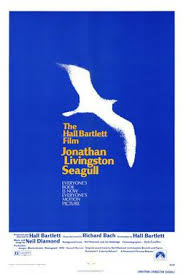
WHAT’S GOOD FOR THE GOOSE MAY NOT BE GOOD FOR THE GANDER: JONATHAN LIVINGSTON SEAGULL & MILLION DOLLAR DUCK

Jonathan Livingston Seagull felt like the cinematic equivalent of a bird pooping on you for 99 long, long, long minutes. How long? It felt twice as long as watching Shoah.

By the way, what did that bird spray on its way? A whole load of New Age gobbledygook that gobsmacked me right in the kisser. I’ll stand with the flock of seagulls in this case, thank you very much, and put Jonathan Livingston Seagull on blast for being one festering piece of poo.

The nature photography and some level of admiration for exactly how they filmed it earn Jonathan Livingston Seagull one star, and that’s definitely more than our next specimen. However, I hate Neil Diamond’s songs and the birds’ outer-inner monologues, and I desperately wish Jonathan Livingston Seagull was a silent movie. Maybe I should have watched it muted. My bad.

For example, there’s six-and-a-half minutes of a Diamond concoction named “Be.” Maybe just maybe it will replace “Sweet Caroline” as the Great American Sing-a-Long. This sports writer can only hope after 10 years of hearing “Sweet Caroline” at every single baseball game. I’ll have endless admiration for a crowd that could make something timeless from lyrics the likes of “Be / As a page that aches for words / Which speaks on a theme that’s timeless / While the Sun God will make for your day / Sing / As a song in search of a voice that is silent / And the one God will make for your way.”

Early on in Jonathan Livingston Seagull, it tricked me into thinking I might be stumbling into a remake of the Alfred Hitchcock classic The Birds. Oh, how I wish it were true. Guess I can wish in one hand and have bird shit in the other.

Now, we come to Million Dollar Duck, a Walt Disney Studios production from 1971 that must have created a commotion back then, namely the sound of Uncle Walt rolling over in his grave at the abysmal quality of what might quite possibly be “one of the most profoundly stupid movies I’ve ever seen.” Roger Ebert and Gene Siskel agreed, because I quoted Ebert and now I will mention that Siskel walked out on Million Dollar Duck.

For the record, I endured about one hour and I stopped watching Million Dollar Duck right around the point when they brought out a photo of Richard Nixon and the stereotype of a Japanese diplomat carried over from World War II propaganda. At that point, I told Million Dollar Duck to go straight to The Devil and Max Devlin.

Sandy Duncan’s Katie Dooley has a beat on being the single dumbest character in cinematic history, and yes, that’s including any dumb character played by Pauly Shore or Adam Sandler and Lloyd and Harry from Dumb and Dumber, for crying out loud. You wonder how Katie Dooley and her brilliant husband Professor Albert Dooley (Dean Jones) ever created a child, let alone one of those precious, er, precocious Disney brood, er, children that could kill Damien with kindness.

The other dumb characters are not far behind, who are all dumber than the title character who earns the title, you guessed it, by laying golden eggs. Million Dollar Duck certainly laid an egg, all right, definitely not golden.

Once upon a time, my Grandma told me the story of how a bird found my Grandpa’s bald head in their back yard one day and how the bird started pecking away on that bald head. Actually, she told me that story a few times over the years and I must admit that I thought about it and pictured my poor Grandpa being pecked by that bird during both Jonathan Livingston Seagull and Million Dollar Duck. Finally, though, I cannot hate Jonathan Livingston Seagull and Million Dollar Baby too much because they helped me think about my grandparents and I have settled on the thought that one day I will tell my grandchildren about that one fateful night I watched Jonathan Livingston Seagull and Million Dollar Duck back-to-back and how I lived to tell the tale.

The Dark (1979)

THE DARK (1979) *

Be afraid, very afraid, not of the dark but of The Dark, a laughable thriller that only increases in being laughable until one of the most ridiculous conclusions in cinematic history.

See, I’m not afraid of sleeping in the dark, not afraid of being in a cemetery late at night, not afraid of being home alone in an old house, not afraid of admitting or being wrong, et cetera. In all honesty, though, I hated working alone late nights at the Neosho Daily News office and avoided it as much as possible, except Friday nights during football season. Once corporate killed the Sunday edition and made Tuesday our next paper, though, I started going home after the game, uploaded photos online, and wrote the gamer the next day.

Anyway, The Dark tells the story of a killer who strikes every night in the Los Angeles area and earns the cheap nickname ‘The Mangler.’ What’s a killer without a cheap nickname? This one is a nightmare for the police, because of his unusual strength, his seeming lack of any discernible pattern in his killing, his ability to leave no forensic evidence behind, and, predating Austin Powers, he shoots frickin’ laser beams from his frickin’ eyes. We eventually find out that he even grows stronger with every killing.

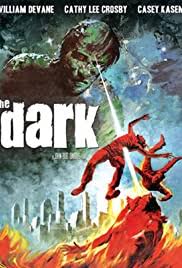
The killer and his laser beams look awesome on the poster for The Dark and I grade that promo artwork three-and-a-half stars. In the actual movie, though, the killer and his laser beams absolutely positively suck. These special effects alone impeded the advancement of all technology. When our killer unleashes his laser beams on several anonymous policemen in the grand finale, he clearly misses the mark but the policemen nonetheless take a mighty fall. In all seriousness, just thinking about these scenes now, I haven’t laughed this loudly since Richard Burton’s telekinesis in The Medusa Touch.

Just think all one had to do was light the killer on fire and BOOM! KABOOM! KABLOOEY! Just thinking about the killer’s demise now, I haven’t laughed so heavily since the paragraph before.

The Dark wastes a relatively distinguished cast — William Devane, Cathy Lee Crosby, Richard Jaeckel, and Keenan Wynn — and I find it ironic that fired director Tobe Hooper (replaced by John Cardos) later directed a flop horror film titled The Mangler.

Please remember, though, to be afraid, very afraid, of The Dark, especially since it’s possible that one’s head may explode from convulsive laughter.

Couple Bombs from ’81: The Legend of the Lone Ranger, First Monday in October

COUPLE BOMBS FROM ‘81: THE LEGEND OF THE LONE RANGER, FIRST MONDAY IN OCTOBER

THE LEGEND OF THE LONE RANGER fails miserably at capturing any of the magic of the 1978 blockbuster SUPERMAN, its obvious cinematic inspiration.

Not even one speck.

Like SUPERMAN, LONE RANGER gives us a mythic origin story for an old cultural hero and then unfurls a new grand adventure featuring our updated hero and other updated characters. Sounds like a great time at the movies, but where did LONE RANGER go so absolutely incredibly stupendously wrong?

First stumbling block first, we have screen neophyte Klinton Spilsbury, who more or less remains a screen neophyte after LONE RANGER. That’s because Spilsbury botched his opportunity so badly that producers dubbed him with James Keach in post-production. Spilsbury quickly became a punchline upon the release of the film. For example, Gene Siskel remarked in his review that Spilsbury playing the Lone Ranger would make for a fine trivia question in the 1990s. I am straining to remember if Spilsbury appeared in “Trivial Pursuit” or perhaps on “Jeopardy” as the answer to who played the Lone Ranger in THE LEGEND OF THE LONE RANGER. If producers dub in another actor’s voice, how much of a performance did the dubbed out actor really give? Nevertheless, Spilsbury joined the ranks of infinitely superior actor Harvey Keitel, whose trademark Brooklyn accent did not make the final cut of SATURN 3. Sorry, Mr. Keitel.

Spilsbury definitely proved to be no Christopher Reeve, whose performance as both mild-mannered reporter for a great metropolitan newspaper Clark Kent and Kal-El, a.k.a. Superman, a.k.a. The Man of Steel, contributed a great deal to what made SUPERMAN and SUPERMAN II successful super-budget entertainments that connected with a mass audience on a personal level. Reeve said that he found inspiration from Cary Grant’s performance in BRINGING UP BABY and SUPERMAN and SUPERMAN II indeed at times resemble screwball romantic comedies. (Gene Hackman, Ned Beatty, and gang unfortunately suggest the campy villains from the 1960s Batman TV show, almost upsetting that precarious balance ‘tween humor and seriousness. Terence Stamp, Jack O’Halloran, and Sarah Douglas make better villains in SUPERMAN II.)

LONE RANGER lacks a lighter, humorous touch to counterbalance its mythology attempts. It is so somber that it becomes ponderous and then dreary before it finally springs into action, despite the efforts of Merle Haggard in the Waylon Jennings “Dukes of Hazzard” balladeer role. Obituarists skipped this chapter in Haggard’s career out of respect for the man when he died in 2016.

Finally springs into action is an understatement in the case of LONE RANGER.

LONE RANGER takes approximately 70 minutes to get the title character into costume and to play the William Tell Overture on the soundtrack, and we’re talking about a movie clocked at 98 minutes. William A. Fraker (director), Walter Coblenz (producer), Martin Starger (executive producer), and the writing team of Ivan Goff, Ben Roberts, William Roberts, Michael Kane, and Gerald B. Derloshon discovered a new level of stupidity.

Complete epic failure amounts to the only legend created by THE LEGEND OF THE LONE RANGER.

FIRST MONDAY IN OCTOBER also has its roots in old movies, though it may not be as obvious as LONE RANGER.

FIRST MONDAY wanted to be like one of those movies pairing Spencer Tracy and Katharine Hepburn — WOMAN OF THE YEAR, KEEPER OF THE FLAME, WITHOUT LOVE, SEA OF GRASS, STATE OF THE UNION, ADAM’S RIB, PAT AND MIKE, DESK SET, and GUESS WHO’S COMING TO DINNER.

Those movies succeeded in part because of the chemistry between Tracy and Hepburn and our enjoyment from watching them interact.

FIRST MONDAY fails in large part because Walter Matthau and Jill Clayburgh do not spark that Tracy-Hepburn chemistry and they are both miscast in their roles. FIRST MONDAY should be renamed “The Bickersons Go to the Supreme Court.”

Matthau stars as veteran Associate Justice Dan Snow and Clayburgh draws freshly appointed Associate Justice Ruth Loomis. All we need to know about them boils down to cranky old white ultra-liberal male (Snow) and feisty liberated white ultra-conservative female (Loomis) babble and battle but nonetheless develop affection toward each other.

Matthau gives the standard Matthau performance and it simply does not suit his character. Melvyn Douglas and Henry Fonda played this character on stage and they were both much better fits than Matthau.

Clayburgh made her fame as the quintessential liberated woman in AN UNMARRIED WOMAN and so it is jarring to see her play a rigid conservative. Also, she’s too young for her character. Jean Arthur, Jane Alexander (a few years older than Clayburgh), and Eva Marie Saint played the role on stage.

Paramount originally planned to release FIRST MONDAY in early 1982, but after President Ronald Reagan nominated Sandra Day O’Connor to the Supreme Court on July 7, 1981, Paramount rushed FIRST MONDAY forward to release in late August, one month before the Senate confirmed O’Connor’s appointment.

It is possible that FIRST MONDAY benefited commercially from publicity attendant with O’Connor’s historic appointment. FIRST MONDAY earned nearly $13 million in returns. In the long run, though, so what?

Upon first perusal of British director Ronald Neame’s film credits, one sees two disaster films, THE POSEIDON ADVENTURE and METEOR. After watching FIRST MONDAY, I count three disaster films directed by Neame.

I reviewed two bombs from ‘81 because Hollywood still recycles, rehashes, regurgitates, recapitulates, and remakes old movies, old plays, old TV shows relentlessly.

The Wasp Woman (1959)

THE WASP WOMAN (1959) **

Seems like only yesterday — time’s such an elusive concept during quarantine — that I highlighted the deceptive print ads and posters for THE GIANT CLAW.

Today, we return to that beat with Roger Corman’s 1959 wasploitation “non-classic” THE WASP WOMAN — do not fear, it’s not another movie about yet another “White Anglo-Saxon Protestant” woman. Instead, in this one, our protagonist takes, no, abuses an experimental potion made from the royal jelly of wasps that can apparently reverse the aging progress. Unfortunate side effect that even more unfortunately only kicks in during the film’s last 20 minutes: It turns her into the title character or “A BEAUTIFUL WOMAN BY DAY — A LUSTING QUEEN WASP BY NIGHT.”

Anyway, the poster for THE WASP WOMAN, it lies. Oh, how it lies. The poster “Wasp Woman” has a woman’s head and a wasp’s body. In the film, it’s flipped and she resembles a distant cousin of the title character in the much, much better THE FLY from 1958.

THE WASP WOMAN itself could make one feel appreciably older, rather than younger, because it’s extremely dull for the first hour.

We have a crusty old scientist named Zinthrop (Michael Mark). He’s not fun in any traditional mad scientist way … and, then, he’s ran over by a car and subsequently bed ridden for most of the rest of the picture … of course, his accident happened before he could warn our protagonist Janice Starlin (Susan Cabot) of some of the unfortunate side effects found in the other non-human test subjects. He redeems himself in the final act. Actually, no, he does not.

Believe it or not, most of this movie takes place in an office building, the location for the monster movie of your dreams. On top of a dull scientist, we have multiple cosmetic company staff meetings, just exactly what the viewers want during a movie called THE WASP WOMAN. Less wasp woman, more staff meetings, bingo! This movie should have been titled CLUELESS in roughly all 6,500 languages of the world.

By the way, I do believe the film shows bees rather than wasps, most notably in both the opening and closing title screens. I might be wrong, but I don’t want to be stung for being wrong. Please, have mercy on me, I’ve been stung bad enough watching THE WASP WOMAN, which definitely pales against ATTACK OF THE CRAB MONSTERS in the Roger Corman monster movie filmography.

In 1993, TNT’s MonsterVision featured THE WASP WOMAN alongside THE GIANT CLAW, THE CYCLOPS, CREATURE WITH THE ATOM BRAIN, FROM HELL IT CAME, VALLEY OF THE DRAGONS, and THE WEREWOLF during a bad movie marathon called “A Christmas Nightmare.” THE WASP WOMAN played between THE CYCLOPS and CREATURE WITH THE ATOM BRAIN.

At that point in my life, I did not watch “MonsterVision”; I started watching it only during the Joe Bob years. I would love to go back in time to the early ‘90s and talk my teenage self into watching (and taping) “MonsterVision,” so I could have all them old tapes to watch at this critical junction in time. Also, I am sure that I would have already converted them from VHS to DVD. Preservation of the species of bad movies is an imperative.

The Giant Claw (1957)

THE GIANT CLAW (1957) ***

Funny how none of the alternate titles for THE GIANT CLAW, a low-budget monster movie from director Fred Sears and producer Sam Katzman, are BATTLESHIP or FLYING BATTLESHIP or BIG AS A BATTLESHIP, because that’s how multiple characters — especially our protagonist, electronics engineer Mitch MacAfee (Jeff Morrow) — describe “The Giant Claw” for at least the first 30 minutes.

Of course, the Giant Claw looks absolutely nothing like a battleship. Mitch himself says at one point to his lady friend’s expression of disbelief, “I said it looked like a battleship, not that it was a battleship.” Yeah, sure, whatever, best never mind.

I love how most of the movie’s promotional goods avoid revealing the Giant Claw’s face, because that act would have undoubtedly scared off potential customers or attracted only those with a taste for absolutely ridiculous movies. At least, that way — not depicting the monster honestly in cinematic propaganda — it took precisely 27 minutes before audiences had the laughter of a lifetime caused by a movie monster. This is one of those movies where I would love to get in a time machine and head for the nearest theater (or drive-in) playing THE GIANT CLAW when it opened in June 1957. How did initial audiences react to it? Did they hoot and holler and howl derisively? Did they flee in total disbelief at the latest Sam Katzman motion picture monstrosity? Did they seek a refund to absolutely no avail? Did they write their Congressmen to complain?

One poster proclaims, “Winged Monster from 17,000,000 B.C.!” “Big as a Battleship!” “Flies 4 Times The Speed of Sound!” “Atomic Weapons Can’t Hurt It!” There’s a drawing of a bird — wings, body, and talons but no face — destroying a plane and a skyscraper. Could that be the Empire State Building? All pictorial renderings of the bird are basically the same — wings, body, and talons, as well as destruction, but no face — and that’s deceptive advertising in a nutshell. (Only those who got to watch the trailer got the real dope on THE GIANT CLAW.)

The producers originally planned to get stop-motion animation titan Ray Harryhausen (MIGHTY JOE YOUNG, JASON AND THE ARGONAUTS, CLASH OF THE TITANS) to create the monster, but he proved to be too much budget and so they outsourced the bird to a model maker in Mexico City. Reportedly, Katzman spent $50 on the puppet that became known as the Giant Claw. Fifty dollars well spent, for sure, and way to go, Uncle Sam.

The film’s posters and the characters themselves fail to accurately describe the giant bird mass murderer in THE GIANT CLAW. To be fair to the actors, they had no idea during filming what the Giant Claw would look like and were left to their own imagination. The characters, though, are made to look like blithering idiots because there’s a vast disconnect between their words and “The Giant Claw” itself, beginning with the battleship description. The filmmakers especially hung out lead actor Morrow to dry, because he gives a legitimately good performance. Legend has it that Morrow ducked out of the theater in embarrassment and got drunk at home after the audience laughed at the Giant Claw’s first appearance. It apparently only took once for Morrow.

Guess that I should try myself to describe the head of the Giant Claw puppet. Extremely long neck, big teeth, flaring nostrils, bulging eyes, and a Mohawk that should be the envy of any buzzard or punk rock singer.

Over the course of the plot, we discover this killer giant bird is actually an alien avian who has come to Earth to lay eggs and wreak destruction and terror on poor, poor humanity. We learn even more, but I will leave that explanatory exposition out of this review for all those individuals who have not seen THE GIANT CLAW before. Trust me, it gets even better as the film attempts to explain the Giant Claw more and more with dialogue passages that could inspire bouts of hysterical laughter. I believe the Mayo Clinic calls it “Pseudobulbar affect.”

Bottom line: This alien avian was sabotaged by a chintzy movie producer named Sam Katzman (1901-73) and both “The Giant Claw” and THE GIANT CLAW will live in infamy as one of the great bad movie monsters and one of the great bad movies, respectively. During my first viewing, I enjoyed THE GIANT CLAW more than many so-called “good” movies.

I have one particular favorite scene in THE GIANT CLAW.

It is reminiscent of the scene in Q: THE WINGED SERPENT (produced by Samuel Z. Arkoff) when lovable hateful creep Jimmy Quinn (Michael Moriarty) leads two hoods leaning on him to the Quetzalcoatl in the Chrysler Building. We hear the Big Q take a couple bites out of crime and Quinn absolutely revels in their demise, “Eat ‘em, eat ‘em! Crunch! Crunch!” I love to hate Quinn even more after that scene.

Anyway, when the Giant Claw chomps on a pair of parachuting passengers, I said out loud, “Crunch! Crunch!” Please keep in mind that in quarantine, no one can hear you scream.

Slithis (1978)

SLITHIS (1978) 1/2*

SLITHIS is one of the worst movies ever made, I feel safe in saying that, and it did for radioactive mutant monsters what A*P*E did for giant apes.

Maybe I would feel a little better after watching it had I received a “Slithis Survival Kit” like viewers did back in 1978 when this cinematic plague called SLITHIS was unleashed on theaters and drive-ins.

I read about this survival kit in Roger Ebert’s review and I found images of the four-page document through the magic of the Internets.

WARNING!

SLITHIS A CREATURE SPAWNED FROM THE WASTE OF A NUCLEAR ENERGY PLANT … WANTS YOU TO SURVIVE.

FOLLOW THESE INSTRUCTIONS!

  1. REMOVE PICTURE OF SLITHIS BY CUTTING ALONG THE DOTTED LINE.
  2. KEEP PICTURE OF SLITHIS ON YOUR PERSON AT ALL TIMES.
  3. AT NIGHT, WHEN SLEEPING, PLACE PICTURE OF SLITHIS UNDER PILLOW.
  4. JOIN THE SLITHIS FAN CLUB … HE WILL REMEMBER YOU WHEN HE STALKS YOUR NEIGHBORHOOD.

SLITHIS FAN CLUB

FOR MY PERSONAL SAFETY AND SURVIVAL PLEASE SIGN ME UP FOR THE SLITHIS FAN CLUB … I SOLEMNLY SWEAR TO UPHOLD THE FOLLOWING RULES AND REGULATIONS.

  • TO HELP ESTABLISH THAT SLITHIS IS A VICTIM OF OUR SOCIETY.
  • TO PROMOTE A BETTER UNDERSTANDING OF THE SLITHIS AND THE ENVIRONMENTAL CONDITIONS THAT CREATED IT.
  • TO ASSURE OTHERS THAT WITH THE SURVIVAL KIT THEY NEED NOT FEAR THE SLITHIS.

NAME

ADDRESS

CITY STATE ZIP

PLEASE SEND ME MY FREE PHOTO OF THE SLITHIS AND MY OFFICIAL MEMBERSHIP CARD.

(SEE BACK OF CARD FOR FURTHER INFORMATION)

NOTICE

PLEASE DEPOSIT THIS PORTION OF THE OFFICIAL SURVIVAL KIT IN MEMBERSHIP BOX LOCATED IN THE LOBBY OR CONCESSION STAND OF THIS THEATRE … YOU MAY PICK UP YOUR FREE PHOTO AND MEMBERSHIP CARD 3 WEEKS FROM NOW AT THIS THEATRE … or enclose 25¢ FOR POSTAGE & HANDLING AND MAIL TO

SLITHIS FAN CLUB

SUITE 200

1024 WALNUT ST.

DES MOINES, IOWA 50309

That’s absolutely patently ridiculous and far better than the movie itself. I wish I had thought about the Slithis Fan Club when our family vacation stopped in Des Moines.

I am being perfectly blunt with you when I warn you that coffee or any strong stimulant (s) would be a better survival kit for SLITHIS. How about taking a drink every time a character says “Slithis”? No, wait, never mind, alcohol’s a depressant and SLITHIS has been known to create depression within its viewers for at least a few hours. Viewers in 1978 were reportedly incredibly slow in returning home, since they just sat inside their cars unable to move and they were even unable to speak for hours. Hundreds even thousands of people sat in their cars in silence. It took a long time to process SLITHIS.

Because SLITHIS is deadly dull. Deadly dull. It is quite possible that SLITHIS wiped out an entire population of drive-in denizens through its sheer dullness.

After all, dullness is one of the worst possible sins that a monster movie can commit and SLITHIS commits that sin in spades. Its 85 minutes surpass watching GONE WITH THE WIND or the final act of RETURN OF THE KING.

The dialogue is banal, no, wait, it is so beyond banal that we need to invent a new word for the dialogue in SLITHIS.

I know that Warner Bros. plans to unleash GODZILLA VS. KONG on the world at some point during 2020, but I hope that some quick-buck smooth operator can beat that release into theaters with SLITHIS VS. A*P*E. Given the beating that humanity’s taken so far in the first three months of the 20th year of the 21st Century, SLITHIS VS. A*P*E seems only fitting.

Schlock (1973)

SCHLOCK

SCHLOCK (1973) ***

Schlock (/SHläk/): cheap or inferior goods or material; trash.

For quite some time as I watched it, I could not make heads or tails out of John Landis’ 1973 extremely low-budget feature film debut SCHLOCK.

I mean, I understood that it’s a good old-fashioned spoof of good old-fashioned monster movies, sure, from the moment I read a plot synopsis and that its title speaks louder than a thousand words, you bet, but it kept veering between tones. Our title character (played by none other than Landis himself) seemed menacing and imposing one moment and then funny the very next. He’s the missing link and “The Banana Monster” and the poster promises “A love stronger than KING KONG.”

There was one sequence though in particular that changed my tune about SCHLOCK.

Schlock (blanking on his full name right now) watches DINOSAURUS! from 1960 and THE BLOB from 1958 in a movie theater, both classics directed by Irvin S. Yeaworth and produced by SCHLOCK producer Jack H. Harris. We see choice scenes from both films, like a dinosaur fight and that classic moment in THE BLOB when its title character attacks first the projectionist and then the patrons to rudely interrupt the showing of DAUGHTER OF HORROR (renamed from DEMENTIA). Showing THE BLOB also provided Landis an opportunity to work Steven, er, Steve McQueen into his little $60,000 movie.

Not only that, but Schlock learns about vending machines and cleans out a candy counter. Bet he loved them jujubes with his sharp teeth. I love what Schlock does when this incredibly tall man sits in the seat one row in front of him. If only life could be that way. Then again, proper authorities cannot handle Schlock.

At the point Schlock went movie watching, I learned to stop worrying and like (not love) SCHLOCK.

Landis’ love for SEE YOU NEXT WEDNESDAY starts out early in his directorial career, by promoting it with “First, BIRTH OF A NATION! Then, GONE WITH THE WIND! 2001: A SPACE ODYSSEY! LOVE STORY! SEE YOU NEXT WEDNESDAY! And now … SCHLOCK!” A line spoken in 2001 turned into a running gag throughout most Landis films and even the music video for Michael Jackson’s “Thriller.”

So many low-budget movies have a great back story.

Landis and crew, including makeup artist Rick Baker early in his career, made SCHLOCK during 12 days in the summer of 1971, but it was not released until 1973. Johnny Carson found out about the film and he booked Landis on “The Tonight Show.” With this spotlight opportunity, Landis showed clips from SCHLOCK, which helped the first-time director find a distributor in Jack H. Harris Enterprises. Harris put up $10,000 if Landis put 10 minutes of running time on SCHLOCK.

I enjoyed SCHLOCK every bit as much as the Joan Crawford classic TROG (1970) and the similarly low-budget KING KUNG FU (1976).

Of course, I did not forget, but I will see you next Wednesday.