Kingdom of the Spiders (1977)

KINGDOM OF THE SPIDERS (1977) ***
John ‘Bud’ Cardos’ Kingdom of the Spiders proved to be a pleasant surprise.

First, I remembered Cardos directed The Dark, one of the worst movies of 1979.

Second, I remembered the last time I saw Kingdom of the Spiders star William Shatner in a cowboy hat, yes, the absolutely ridiculous The Devil’s Rain, one of the worst movies of 1975.

Third, Kingdom of the Spiders starts out with the country number “Pleasant Verde Valley.”

Finally, Kingdom of the Spiders starts out slow, real slow, tipped off by No. 3.

Kingdom of the Spiders, though, kicks into high gear around the hour mark and it’s a whole lot of fun the final 35-40 minutes once the spiders attack Camp Verde, Arizona, and the tarantulas take complete control of the picture, hence being a pleasant surprise.

Kingdom of the Spiders borrows from such motion picture immortals as The Birds, Jaws, and Night of the Living Dead. That’s all part of the fun, when you enjoy something like Kingdom of the Spiders. Otherwise, it’s one more objection to a failure, like, for example, such bombs from the same era as The Giant Spider Invasion, Food of the Gods, and fellow 1977 release Empire of the Ants.

On the other hand, I have a weakness for Nature Attacks movies. There’s Frogs, starring killer amphibians, birds, insects, and reptiles, plus a crotchety old Ray Milland and a topless Sam Elliott. There’s Night of the Lepus, pairing a mutated killer rabbit infestation with a character actor infestation featuring Janet Leigh, Stuart Whitman, Rory Calhoun, and DeForest Kelley. There’s Squirm, where killer worms and a pair of redheads played by Don Scardino and the perky Patricia Pearcy wreak havoc on Fly Creek, Georgia, after one helluva storm. All of them are good fun and I’ve been known to call Frogs — great fun — better than The Godfather. Ditto for Godzilla vs. The Smog Monster.

Anyway, Kingdom of the Spiders works a thousand times more than The Giant Spider Invasion because it decides on real spiders — many spiders, how many exactly, how about 5,000, I mean that fact alone creates shivers down the spine — rather than a Volkswagen Beetle converted into a silly giant spider invasion. The Giant Spider Invasion doesn’t help itself when Alan Hale’s Sheriff exclaims, “You ever see the movie Jaws? It makes that shark look like a goldfish!” Giant mistake.

Also, the characters in Kingdom of the Spiders are far more likable than the ones in The Giant Spider Invasion. I mean, I eventually forgave Shatner for the cowboy hat — it’s better than the one he wore for The Devil’s Rain — and I even got over the fact that his character’s named “Rack Hansen.”

I remember an elementary school teacher calming the nerves of several pupils who were scared silly by a tarantula. She told us they’re harmless, they’re not poisonous anyway, they just look big and scary and very, very frightening indeed, and Kingdom of the Spiders brought me back 30 years to that moment in time. I’m just thankful our teacher did not show us Kingdom of the Spiders afterwards to counteract her moral lesson on tarantulas.

Creature from the Haunted Sea (1961)

CREATURE FROM THE HAUNTED SEA (1961) *
Lemme tell you about Jack from Creature from the Haunted Sea.

His real name is Happy Jack Monahan and he’s a crew member of crook Renzo Capetto, who has this real genius plan backfire on him miserably. Renzo wants to systematically eliminate his hapless crew and blame their deaths on a certain legendary sea monster, and that monster turns out to be real. Who could have guessed such a phenomenon? Anyway, Happy Jack’s played by Robert Bean and not by Jim Beam, which might improve Creature from the Haunted Sea.

This Happy Jack character, who probably once lived in the sand at the Isle of Man, imitates all form of animal life and it’s not a good sign for any sort of a good movie when Happy Jack lets out his inner yak. Happy Jack undoubtedly could have had a great future in “Farmer Says” toys, had he not been cast in Creature from the Haunted Sea.

That’s a roundabout way to get to the main point: Creature from the Haunted Sea ranks with the absolute dregs of the monster movie, down there buried at the bottom of the sea alongside Robot Monster and Slithis and APE, three other infamous monster movie titles featuring infamous movie monsters. You might feel sorry for this poor creature from the haunted sea and for all those associated with him, but mostly you’ll just laugh at him in that same way many people often do when they come across old movies and their antiquated special effects.

I am thankful, however, for Creature from the Haunted Sea, because its tedium afforded me the opportunity for an afternoon nap. I woke up and I felt like I didn’t miss a thing, not a beat; even if I did miss a thing, I would be grateful for it. That afternoon nap earned Creature from the Haunted Sea one-half star more than Slithis and APE, for example, I do believe.

I have not watched every Roger Corman monster movie, but Creature from the Haunted Sea is definitely the worst so far, leagues below Attack of the Crab Monsters from 1957 that’s for certain. Hell, Creature from the Haunted Sea is so bad that it makes The Wasp Woman look almost like Citizen Kane by comparison.

Charles B. Griffith (1930-2007), credited or not but more often credited, wrote screenplays for Corman spectaculars It Conquered the World, Attack of the Crab Monsters, A Bucket of Blood, and The Little Shop of Horrors, as well as later Corman productions Death Race 2000 and Eat My Dust. In other words, the man definitely had his better moments like Bucket of Blood and Little Shop of Horrors. Alas, Creature from the Haunted Sea is not one of them.

Rather, it’s a compendium of crap.

For example, Creature from the Haunted Sea gives us more voiceover narration than what’s necessary for any creature feature. I mean, for crying out loud, I bet there’s more voiceover in Creature from the Haunted Sea than in all the other films combined from 1961. Sure that’s why I fell asleep for a while. Airplane spoofed voiceover fantastically, although thankfully I did not meet the same fate as the characters on that infamous cinematic flight.

It doesn’t even matter that future Academy Award-winning screenwriter Robert Towne delivers this narration or that he’s credited for ‘Sparks Moran / Agent XK150 / Narrator.’

I have not talked much about the actual creature in Creature from the Haunted Sea and there’s a good reason for that. Yes, that’s right, the creature from the haunted sea just might be the worst movie monster I have ever seen, and please keep in mind I’ve seen Robot Monster.

Venom (1981)

VENOM (1981) ***
I just finished considering Silent Rage, a film that runs Chuck Norris, a Western, Animal House, mad scientists, and a madman killer made indestructible through a cinematic blender.

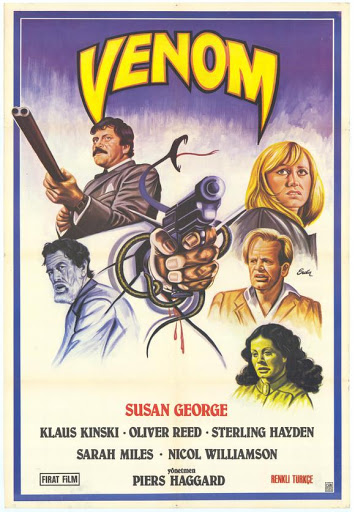
Thus, I feel safe in saying that Silent Rage prepared me for Venom, a British horror film that has a distinguished multinational cast, kidnapping and hostage negotiation, and only the world’s deadliest snake, the dreaded Black mamba from sub-Saharan Africa. The mamba gets a few closeups, more than Norma Desmond in Sunset Boulevard and Daffy Duck in Duck Amuck, and its own POV. Yeah, we’ll call it the Black Mamba Cam.

That distinguished cast includes kidnappers Klaus Kinski and Oliver Reed, Scotland Yard commander and lead negotiator Nicol Williamson, snake expert Sarah Miles, slinky (won’t call her slutty or a snake expert in her own right) nurse Susan George, and lovable crusty old grandfather Sterling Hayden.

Basically, Venom contains three movies within one — the kidnapping inside the house, the hostage negotiation and the behind-the-scenes police maneuvering on the outside, and the deadly snake on the loose. We’ve all seen kidnapping and hostage negotiation plenty before, on TV cop shows and in the movies, but very rarely do the kidnappers have to deal with the world’s deadliest snake. And Lord knows we’ve all seen a bad snake movie or two, like for example the 1972 disaster Stanley, which populated its killer snake scenario with thoroughly unpleasant and despicable characters, a somewhat heavy-handed environmental message, and some of the dopiest music ever heard by man this side of Jonathan Livingston Seagull.

Venom turned out to be a far more enjoyable motion picture experience than Stanley. For example, the scene in Venom where the boy picks up the mamba by mistake and unknowingly transports the world’s deadliest snake from one side of London to another brought to mind the classic sequence in Sabotage that ends in the death of a young boy named Stevie. The inevitable scenes late in the picture when the mamba strikes Reed and Kinski are both well worth their wait, and the mamba’s strike at George about 30 minutes into the picture lets us know that we’re in for a treat when Reed and Kinski do meet their demise.

Later that day, much later in the day to be precise, though, I watched Murders in the Zoo from 1933 and imagine my delightful little surprise when a mamba figured prominently in that older film’s plot. The gruesome hits in Murders in the Zoo just keep on coming down the home stretch, especially when a boa constrictor consumes the dastardly big-game hunter, bastardly zoologist, and insanely jealous husband played by Lionel Atwill.

Venom and Murders in the Zoo both find perfect ways to deal with snakes in the grass.

King Kong Escapes (1967)

KING KONG ESCAPES (1967) ****
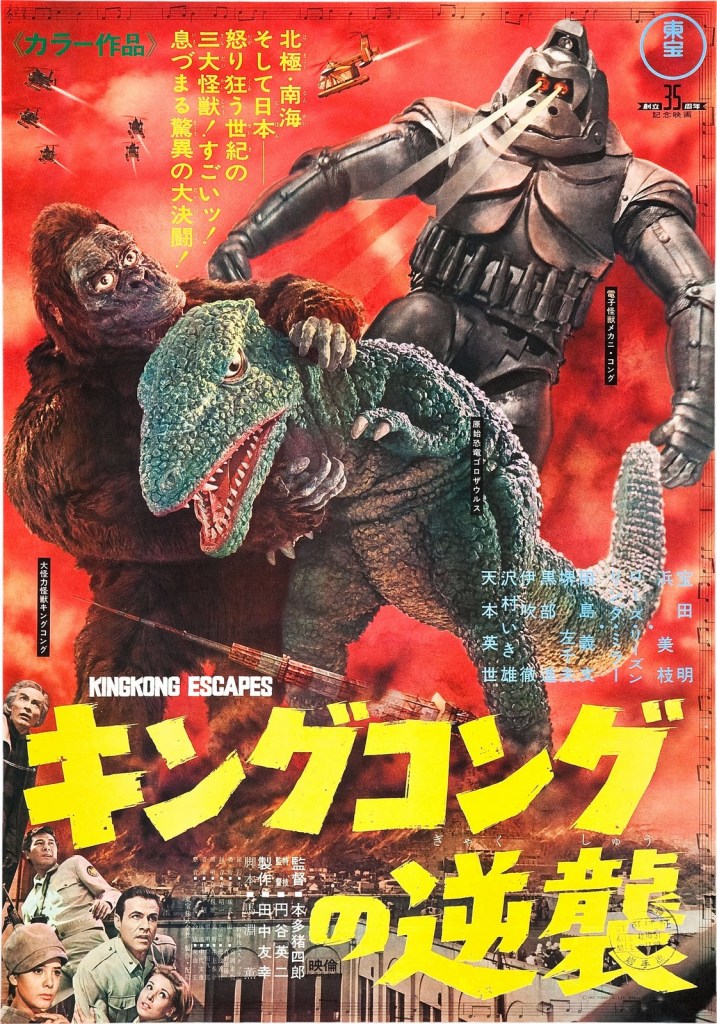
I must be a sucker for movies like King Kong Escapes, but I just can’t help myself when it features so many awesome characters, plot details, and scenes.

Of course, we have the title character who’s obviously back from King Kong vs. Godzilla, one of Japan’s biggest Solid Gold hits of the early ’60s.

King Kong Escapes, a Toho Studios and Rankin/Bass Productions co-production, topped King Kong vs. Godzilla for me and I’d like to share how it did just that.

Not only do we have the iconic man-in-a-suit Kong, rather than the Willis O’Brien stop motion Kong from the immortal King Kong, the one that started it all, but we have Mechani-Kong, a giant robot double of Kong that first appeared in the 1966 animated TV series The King Kong Show (hence the Rankin/Bass involvement) and returned for live-action duty in King Kong Escapes.

King Kong Escapes also gives us Gorosaurus and a giant sea serpent, and Kong battles them near their home Mondo Island. See, Kong’s become obviously smitten with the lovely nurse Susan Watson (Linda Miller) and he’ll take on any beast to protect her. She holds sway on the big lug, and that naturally puts her life in danger from the bad guys. Kong saves her several times over the course of a 100-minute spectacular. All in a day’s work.

I believe it’s the human villains who put King Kong Escapes over into greatness for me — the evil mad scientist Dr. Who (not that Doctor Who) and the shady representative of an unknown Asian nation, Madame Piranha. She’s also called Madame X, but I’m sticking with Madame Piranha because I like that name better and she’s played by the pretty Mie Hama. 1967 proved to be a vintage year for Hama, who turned 24 that year and played Kissy Suzuki in the fifth James Bond film, You Only Live Twice. I believe Madame Piranha wins over Kissy Suzuki and ditto for their respective films. Madame Piranha, in fact, belongs right up there with Pussy Galore and Princess Dragon Mom.

Anyway, back to Dr. Who, played by the veteran character actor Hideyo Amamoto (1926-2003). He’s a cross between, I don’t know, Dracula (it’s the cape) and a Bond megalomaniac. He’s one of those characters that we absolutely love to hate and we savor his inevitable demise late in the picture. He’s so vain, so darn smart, so reckless, so persistent, so evil. Dr. Who created Mechani-Kong and when it fails him about 30 minutes into King Kong Escapes, Dr. Who captures first Kong and then Susan Watson, Commander Carl Nelson (Rhodes Reason), and Lt. Commander Jiro Nomura (Akira Takarada), Watson’s human interest. Needless to say, Kong and Mechani-Kong and Watson and gang escape from Dr. Who and his henchmen, which leads us to a battle royale atop Tokyo Tower.

I admit upfront that King Kong Escapes is silly, preposterous, and outright bloody ridiculous, in everything from its plot to its English dubbing, but it came as such a rejuvenation to my spirit after I watched The Gorilla, The Screaming Skull, The Robot vs. The Aztec Mummy, and The Curse of the Aztec Mummy earlier that same day, four exploitation films that if added together still did not provide as much entertainment value as King Kong Escapes.

The Creature Walks Among Us (1956)

THE CREATURE WALKS AMONG US (1956) **1/2
I should have already learned my lesson.

I bitch about the yucky suck face between scientists John Agar and the lovely Lori Nelson through most of the second half of Revenge of the Creature, so it only serves me right that I got immediately served with the miserably married couple played by Jeff Morrow and Leigh Snowden in The Creature Walks Among Us, the third and final entry in the Creature series released by Universal Studios. Morrow and Snowden are truly a downer and their scenes drag The Creature Walks Among Us down a notch or two from being a perfectly enjoyable creature feature.

All three Creature features benefit heavily from their underwater photography and Walks Among Us works best when the action takes place underwater. Above water, especially when Morrow and Snowden provide us another unpleasant scene together, it’s not so hot. Watching Revenge and Walks Among Us in close proximity, it’s obvious just how much influence these earlier films had upon the later Jaws series also produced by Universal. Jaws 3 borrowed major plot developments from Revenge, for crying out loud.

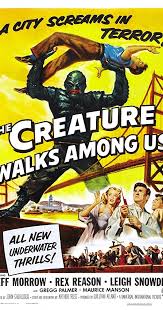
In a fundamental way, though, Walks Among Us cheats us. It doesn’t really live up to any part of that title until the very end of the picture, when the title character escapes from captivity. I certainly don’t remember a city screaming in terror and the poster incorporates the Golden Gate Bridge into its promotional campaign. Good job, marketing department. Sure, we see the Golden Gate, kinda sorta obligatory for any film shot for any length in San Francisco, but I don’t recall any character being held up above the Golden Gate by our title character, sure to be thrown to his death. Now, that would be an impressive scene.

I feel like I must make amends in this review for cheating Ricou Browning (born 1930) in the Revenge review. He’s the man in the creature suit in the underwater scenes. In Walks Among Us, Don Megowan plays the Gill Man on land. In Revenge, it was Tom Hennesy. In Creature, it was Ben Chapman. I believe it’s a testament to the quality of Browning’s work in the underwater scenes that he filled the creature suit in all three movies.

Strangely enough, I felt a certain sadness during Walks Among Us, alternating with a sense of overall wonderment toward the Universal Classic Monsters series. Walks Among Us ended a stretch where I watched 16 classic horror films, from 1935’s Werewolf of London to 1956’s The Creature Walks Among Us, for the first time, having already watched Universal’s true classics like The Bride of Frankenstein and The Wolf Man several times before. Because I even sometimes enjoy watching a bad movie, like The Invisible Woman, this stretch greatly satisfied both the historian and the horror movie fan living inside me.

Top 12 Universal Classic Monster Movies
1. The Bride of Frankenstein (1935)
2. Frankenstein (1931)
3. The Wolf Man (1941)
4. Son of Frankenstein (1939)
5. Creature from the Black Lagoon (1954)
6. The Invisible Man (1933)
7. The Phantom of the Opera (1925)
8. The Mummy (1932)
9. Dracula’s Daughter (1936)
10. Dracula (Spanish version) (1931)
11. Dracula (English version) (1931)
12. Abbott and Costello Meet Frankenstein (1948)

Abbott and Costello Meet the Mummy (1955)

ABBOTT AND COSTELLO MEET THE MUMMY (1955) Two stars
Bud Abbott (1897-1974) and Lou Costello (1906-59) enjoyed a phenomenal run for Universal Studios from 1941’s Buck Privates through 1955’s Abbott and Costello Meet the Mummy.

They made lots of pictures that made lots and lots of money and they met lots and lots of interesting people (and monsters) in their pictures.

Their career meeting people for Universal took off with the 1948 hit Abbott and Costello Meet Frankenstein, a title which sells Larry Talbot / The Wolf Man (Lon Chaney Jr.), Dracula (Bela Lugosi), and even for one gag the Invisible Man (Vincent Price) short. After that, let’s see, Abbott and Costello meet the Killer, Boris Karloff (not the killer), the Invisible Man (not Vincent Price), Captain Kidd, Dr. Jekyll and Mr. Hyde, the Keystone Kops, and the Mummy. We should pause right here and mention Abbott and Costello visited Jack and his beanstalk, Africa, Mexico, and Mars.

I wanted to like Abbott and Costello Meet the Mummy.


I wanted to laugh at Abbott and Costello Meet the Mummy.

I had a mixed reaction instead.

I liked it without laughing at it once.

Since it’s a comedy and I didn’t laugh even once, I guess I don’t really like it.

I call it a forced smile picture more than anything else, where I see the joke, understand the joke, and finally smile with a sense of resignation.

Maybe I have seen too many Abbott and Costello films in close proximity during quarantine, not to mention imitation Abbott and Costello Don Knotts and Tim Conway in The Private Eyes, but I failed to laugh at humor frequently predicated on Costello fumbling bumbling stumbling into or through someone or something, being terrified beyond the capacity for rational thought or a coherent sentence, and then most often failing to make the skeptical Abbott believe him. I swear, Abbott and Costello must play their favorite routine about 100 times during Meet the Mummy.

Abbott and Costello only call each other by name throughout Meet the Mummy. During the final credits, they’re listed playing Pete Patterson and Freddie Franklin, respectively. That’s about the high point of the humor in Meet the Mummy.

Of all the Universal classic monsters, I must admit that I like the Mummy series the least, namely the four pictures Universal rattled off like machine gun fire in the 1940s — The Mummy’s Hand, The Mummy’s Tomb, The Mummy’s Ghost, and The Mummy’s Curse. I like Hand alright, find Tomb elevated by Lon Chaney Jr.’s debut as Kharis, and Ghost and Curse have already blended into monotonous goo in my brain after seeing them back-to-back recently. Don’t even get me started on the Indiana Jones wannabe Brendan Fraser CGI monstrosities and I blissfully missed Tom Cruise’s so-called abomination completely.

Chaney Jr. proved to be the most menacing Mummy on screen, and he’s not in Meet the Mummy. It could be any other guy wrapped in gauze and affecting a lumbering pace. Yeah, it’s a guy named Eddie Parker. Oh, sure, probably a nice guy, but still no Chaney Jr. They call the Mummy ‘Claris’ — not Kharis — anyway in Meet the Mummy.

Meet Frankenstein and Meet the Invisible Man worked because the actors portraying the monsters played it straight rather than knowing they were in a comedy. It’s similar to the acting in Airplane, Top Secret, and The Naked Gun, in that it never received the credit it deserved.

As for Abbott and Costello, there’s always Hold That Ghost, Meet Frankenstein, Meet the Invisible Man, and “Who’s on First.”

Revenge of the Creature (1955)

REVENGE OF THE CREATURE (1955) **1/2
Once upon a time, Universal Studios took more time between sequels: The Bride of Frankenstein four years after Frankenstein, Dracula’s Daughter five after Dracula, The Invisible Man Returns seven after The Invisible Man, and The Mummy’s Hand eight after The Mummy.

Universal threw all that right out the window during the 1940s and churned out four Mummy, three Invisible Man, four Frankenstein, two Dracula, and five Wolf Man pictures, although the studio mashed just about every monster it had for bashes like House of Frankenstein, House of Dracula, and Abbott and Costello Meet Frankenstein so my numbers might be a slight bit inaccurate.

Creature from the Black Lagoon premiered Feb. 12, 1954, and it became a box office success. Of course, that meant two sequels, Revenge of the Creature in 1955 and The Creature Walks Among Us in 1956, and the latter sequel closed out a 31-film run of horror movies for Universal that began with 1925’s The Phantom of the Opera and continued through Dracula, Frankenstein’s Monster, The Mummy, The Invisible Man, and The Wolf Man.

Revenge of the Creature will seem awful familiar to first time viewers, and not only because it’s a sequel to a legendary horror film. No, when I watched it for the first time, I thought about how much fellow Universal production Jaws 3 (1983) ripped off from Revenge. Both movies were made in 3-D and the later sequel borrowed and updated several plot elements from the earlier one, mainly a monster on the loose in an amusement park.

Revenge proves to be far more enjoyable and memorable than Jaws 3.

Clint Eastwood’s motion picture career had to start somewhere, and that somewhere happens to be Revenge. His one scene occurs somewhere about 10 minutes in. He plays college lab assistant Jennings, intended comic relief. Back to the Future Part III (another Universal sequel) worked in a nod to both Revenge and Tarantula, Eastwood’s second appearance in an Universal creature feature / monster movie from 1955 directed by Jack Arnold. Eastwood plays the jet squadron leader in Tarantula, and Mr. Eastwood helps blow up the title character real good in a preview of his future action hero glory. I recommend Tarantula over Revenge of the Creature, but they do make a suitable double feature, sharing not only Arnold (and Eastwood) but producer William Alland, actors John Agar and Nestor Paiva, and Henry Mancini stock music.

At this point, I should mention that protagonists Professor Clete Ferguson (Agar) and Helen Dobson (Lori Nelson) spend most of the second half of Revenge locked in suck face embrace. Holy cow, why didn’t they just get a room … or a romantic comedy or something. I have not seen two love birds like Clete and Helen since Rod Arrants’ Tom Rose and Joanna Kerns’ Marilyn Baker in the 1976 anti-classic Ape. In all honesty, I wanted The Gill Man to come in and break up Clete and Helen sooner rather than later … and it just doesn’t happen soon enough.

I certainly don’t believe that Agar and Nelson are improvements from previous leads Richard Carlson and Julie Adams, and I don’t recall Creature bludgeoning us over the head with their romance. Revenge shows that our horny Gill Man does not discriminate in the hair color of leading ladies, loving and lusting after both brunette (Adams) and blonde (Nelson). How progressive! Nelson naturally spends a lot of her screen time scantily clad, in swimsuit and even her lingerie in one scene much to the delight of the Gill Man and likely millions of teenage boys of all ages in 1955. Here we are 65 years later and I’m not complaining, just merely stating actual factual information.

Yeah, anyway, Revenge takes its sweet time in getting to the good parts again once it gets the Gill Man into captivity and for that very reason, it ranks below not only Creature from the Black Lagoon and Tarantula but also The Incredible Shrinking Man, the 1957 science fiction classic from Universal directed by Arnold.

Revenge possesses some of the same virtues as Creature, especially sensational underwater photography, and it’s nice they at least brought Nestor Paiva’s enjoyable Lucas character back for the sequel without killing him off in his early appearance. I am looking forward to watching The Creature Walks Among Us and finishing the Universal Classic Monsters series.

Werewolf of London (1935)

WEREWOLF OF LONDON (1935) ***
Werewolf of London — Hollywood’s first werewolf picture — must be one of the most overlooked horror films in the history of overlooked horror films, for obvious reasons.

During the 1930s, Universal Studios released Werewolf of London among the following group of horror films: Dracula, Dracula (Spanish version), Frankenstein, The Mummy, The Invisible Man, The Bride of Frankenstein, Dracula’s Daughter, and Son of Frankenstein, over half of them landmark productions that spawned multiple imitations and sequels. Werewolf of London came out nearly a month after The Bride of Frankenstein in the spring of 1935 and The Bride of Frankenstein became a big hit and developed a reputation for being a sequel that arguably betters the original.

Late in 1941, Universal’s second werewolf film appeared, The Wolf Man, and it quickly became the quintessential werewolf film, leaving Werewolf of London behind in the dustbins of cinematic history. Lon Chaney Jr. joined his late father Lon Chaney (Phantom of the Opera), Boris Karloff (Frankenstein), and Bela Lugosi (Dracula) in becoming a horror movie icon just from a single performance. Chaney Jr. revisited Larry Talbot / The Wolf Man in Frankenstein Meets the Wolf Man, The House of Frankenstein, House of Dracula, and Abbott and Costello Meets Frankenstein, and he displayed his versatility by portraying Dracula, Frankenstein’s Monster, and the Mummy.

In addition to Chaney Jr., The Wolf Man cast includes Claude Rains and Ralph Bellamy and many horror films love it for its mood and first-rate atmosphere.

By contrast, Werewolf of London stars veteran character actor Henry Hull and that’s unfortunately not a name that rolls off the tongue like, say, Lon Chaney Jr. Warren Zevon name checked both Chaneys in “Werewolves of London” — Well, I saw Lon Chaney walking with the Queen / Doing the Werewolves of London / I saw Lon Chaney Jr. walking with the Queen / Doing the Werewolves of London / I saw a werewolf drinking a piña colada at Trader Vic’s / And his hair was perfect — but, alas, no direct mention of Hull.

Werewolf of London definitely holds its most value as curiosity (and conversational) piece and not only for its place as the most overlooked film within the Universal canon and for its overall historical standing. After all, when’s the last time any protagonist in a film counted botany for their career or a horror film started with a prologue in Tibet. It also holds considerable fascination comparing and contrasting Jack Pierce’s makeup work between Werewolf of London and The Wolf Man, as well as how this earlier film handled the essential transformation scenes. The werewolf seems to have inspired Eddie Munster, so Werewolf of London does have that going for it.

Godzilla: King of the Monsters (2019)


GODZILLA: KING OF THE MONSTERS (2019) ***
The latest Godzilla: King of the Monsters inspires mixed feelings.

On the one hand, Warner Bros. pumped an estimated $170-200 million into King of the Monsters (likely more spent on this one Godzilla picture than all the Toho Studios productions combined) and cast a diverse, multinational group of actors and actresses, Kyle Chandler, Vera Farmiga, Millie Bobby Brown, Bradley Whitford, Sally Hawkins, Charles Dance, Thomas Middleditch, Aisha Hinds, O’Shea Jackson Jr., David Straithaim, Ken Watanabe, and Zhang Ziyi. Perhaps, most importantly for them, they are not dubbed, badly dubbed.

On the other, King of the Monsters spends way too much time in banter and disputes between scientists, military men, etc., and it’s still cliché dialogue no matter what if read by an Oscar winner or not. When the monsters Godzilla, King Ghidorah, Mothra, and Rodan do fight, it’s somehow not enough and I wanted King of the Monsters to give us a good old Royal Monster Mash Rumble right out in the middle of the streets in broad daylight, for crying out loud. Watching King of the Monsters for a second time, I felt tempted to begin chanting “No rain! No rain! No rain!” but I doubted there were any Woodstock or Live Rust fans aside from me in the house, so I restrained myself and thought better to save it for this review.

Honestly, I definitely miss all the bizarre little touches Toho sprinkled throughout their Godzilla films, especially the 1954-75 Showa Era. For example, it took a little time to wrap my warped little mind around seeing Mothra without her representatives from Infant Island, two tiny twin fairies who speak for and accompany Mothra and sing “Mothra’s Song,” “Mothra oh Mothra / If we were to call for help / Over time, over sea, like a wave / You’d come / Like a guardian angel / Mothra oh Mothra.” To be fair, King of the Monsters references the twins through twin scientist characters Ilene and Ling Chen (played by Ziyi) and we do get an instrumental version of “Mothra’s Song” late in the picture.

King of the Monsters could have used a lighter touch.

I liked the first Warner Bros. Godzilla more than King of the Monsters and I have no doubt Godzilla 2014 benefited more from the novelty of being a serious Godzilla film, which took so many of us by surprise because that’s not what we expected from an American Godzilla film after the disastrous 1998 production brought to us kind folks by TriStar Pictures and the creative partnership — writer and director Roland Emmerich and writer and producer Dean Devlin — who previously dumped Stargate and Independence Day on humanity.

Regardless, I am looking forward to Godzilla vs. Kong whenever that moment will come.

Son of Godzilla (1967)

SON OF GODZILLA (1967) **
I made a terrible mistake.

Not in watching Son of Godzilla, the eighth film in the Godzilla series, per se, but watching it through the most available version online.

Characters begin speaking in dubbed English, of course only the best for us American monster movie aficionados, for a few seconds before a foreign language (presumably Russian) overlays the English. We get two bad dub jobs for the price of one, sure yeah whatever never mind.

I was desperate, though, and needed to watch Son of Godzilla to complete the entire 15-film Godzilla series Japan’s hallowed Toho Studios produced from 1954 to 1975. I sucked it up, buttercup, who cares about the bloody dialogue in a Godzilla movie anyway for crying out loud, and mission accomplished. Yes, I always save the worst for last.

Son of Godzilla marks the beginning of a period of several pictures when Toho made Godzilla a kinder, gentler monster. Like Arnold Schwarzenegger, as Godzilla became a bigger star, a monster if you will, the big guy preferred not playing a villain and so Son of Godzilla and 1969’s All Monsters Attack (a.k.a. Godzilla’s Revenge) are the equivalent of later Schwarzenegger pictures like Kindergarten Cop and Jingle All the Way. Not sure that Schwarzenegger ever made his Godzilla vs. Hedorah (a.k.a. Godzilla vs. The Smog Monster) and that’s a bummer.

The suits at Toho have made Godzilla and the men inside the suit do some awkward bull over a nearly 70-year period, but seeing the big guy try and relate to his adopted son Minilla during Son of Godzilla and All Monsters Attack just might take the cake. Godzilla rescues Minilla from a trio of Kamacuras or a mutated mantis species found on Sollgel Island, and is it in poor taste to say that I wish Minilla had been eaten by the mantis. Minilla’s just so darn cute that it took a great deal of restraint to not puke all over my relatively new laptop.

W.C. Fields died eight years before Godzilla’s screen birth, but we can be sure the famously curmudgeonly performer would have found some choice words for Son of Godzilla and All Monsters Attack, easily the worst of the 15 Showa Era films.

I believe Fields said, “I like children, if they’re properly cooked.”