A Force of One (1979)

A FORCE OF ONE

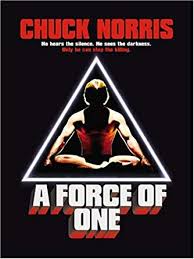
A FORCE OF ONE (1979) Two-and-a-half stars
We should all thank Steve McQueen (1930-80) for the acting career of Chuck Norris, because it was McQueen who encouraged Norris to get into acting.

After all, without Norris’ acting career would there ever have been “Chuck Norris Facts?” Or the lever on “Conan?”

So, thank you, Steve McQueen.

McQueen also had some important advice for Norris after GOOD GUYS WEAR BLACK (1978).

“They said I was the worst thing in 50 years,” Norris said in a 1983 New York Times article. “Well, I wasn’t good, but my feelings were hurt. I said, ‘I’m not trying to be Dustin Hoffman; I just want to project a strong positive hero image on the screen.’ I went to Steve, and he said, ‘In GOOD GUYS, you talk too much. Too much dialogue. Let the character actors lay out the plot. Then, when there’s something important to say, you say it, and people will listen. Anyway, you’ll get better as an actor. You should have seen me in THE BLOB.’”

McQueen seemed to be onto something regarding the quality of Norris movies, because Norris’ best pictures LONE WOLF McQUADE and CODE OF SILENCE both rely on strong casts around Norris: David Carradine, Barbera Carrera, Leon Isaac Kennedy, Robert Beltran, L.Q. Jones, Dana Kimmell, R.G. Armstrong, Sharon Farrell, and William Sanderson (LONE WOLF); Henry Silva, Bert Remsen, Molly Hagan, Dennis Farina, Mike Genovese, and Ralph Foody (CODE OF SILENCE).

A FORCE OF ONE, alas, features a decent supporting cast around Norris — Jennifer O’Neill (she actually receives top billing), Clu Gulager, Ron O’Neal, and Charles Cyphers — and they handle the awfully generic material rather well. We should be grateful for a good supporting cast because. …

I mean, how many times have we seen this plot filmed on TV or even in the movies? We’ve all been here many, many, many times before, sitting through cops, drugs, cop killers, drug lords, et cetera.

Screenwriter Ernest Tidyman’s credits include SHAFT, THE FRENCH CONNECTION, and HIGH PLAINS DRIFTER, heavy duty action credentials.

Tidyman (1928-84), however, was not impressed by A FORCE OF ONE, called it his least successful effort, and said that he only wrote the script to buy his mother a house.

I understand Tidyman’s disappointment with his script.

That said, I enjoyed most of A FORCE OF ONE because it combines a standard issue cops and criminals plot acted out by a good cast with martial arts and a “very subtle” anti-drug message that plays like one of those infamous 1980s TV commercials, only featuring roundhouse kicks.

Wish they would have showed A FORCE OF ONE in D.A.R.E.

Oops, never mind, since all us kiddos are supposed to resist violence.

A FORCE OF ONE loses points and a positive review because of two negative elements.

Dick Halligan’s music hits the viewer like a roundhouse upside the head. I would love to make a joke here referencing either “blood,” “sweat,” or “tears” because Halligan founded the jazz-rock band Blood, Sweat & Tears and played in that group from 1967 through 1972. I just don’t have it today.

All plot roads lead to a final karate showdown between Norris and the main heavy. This is what we wait for all 80 minutes.

Unfortunately, the final karate showdown quickly devolves into slow motion and distorted / echoed vocal effects, plus Halligan’s music returns with a vengeance.
Black Belt Jones (1974)

DAY 54, BLACK BELT JONES

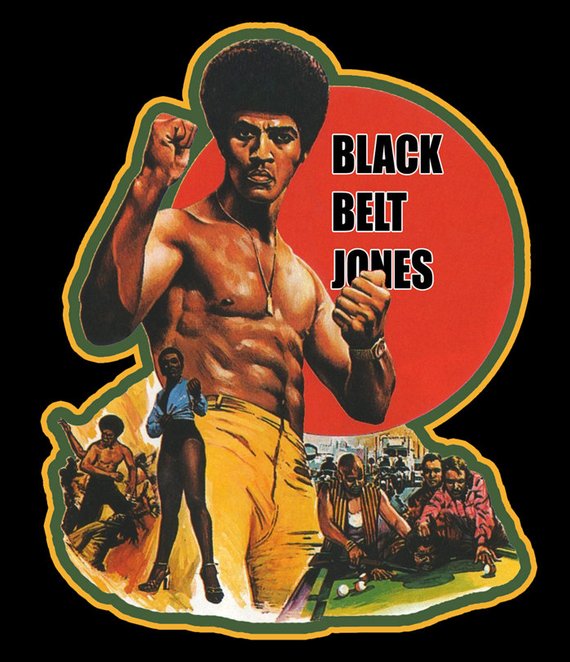
BLACK BELT JONES (1974) One star
Jim Kelly (he of the “unorthodox” martial arts style in ENTER THE DRAGON) and Gloria Hendry (she played a role in LIVE AND LET DIE) are the stars of BLACK BELT JONES, a blaxploitation karate film half-ENTER THE DRAGON and half-SHAFT.

Their best scene involves a half-seduction, half-fight on a beach, replete with one liners, back flips, and explicit musical score, as well as one bystander’s acoustic guitar smashed and busted balloons. Finally, we have a continuation of this scene with first Kelly and Hendry in tight embrace and then holding hands on the beach until we get a morning after scene before we’re ready for the film’s heaviest action.

I did not believe a second of BLACK BELT JONES. I believed more in ENTER THE DRAGON and DRUNKEN MASTER, even if just for the length of the movie. The plot of BLACK BELT JONES defines standard issue yet its details are disgustingly inappropriate.

Sometimes the punches and kicks appear not to have actually hit their mark. Sometimes the villains are outrageously incompetent. We get a lot of those high flying slow motion sequences with deafening sound and vocal effects like grunts and groans and taped ping pong paddles struck against Naugahyde sofas. Any time any character raises their fists and feet during this film they make loud noises. This movie should have been called ATTACK OF THE SOUND EFFECTS. Granted, I realize that this complaint likely could apply to virtually every “old school” martial arts film, but I only make this complaint because BLACK BELT JONES fails on so many levels.

You should observe Scatman Crothers’ death scene. Yes, Scatman Crothers, a great character actor like Slim Pickens and Bradford Dillman. Ah, Scatman Crothers, a nice black man with a great big smile. You may remember him from ONE FLEW OVER THE CUCKOO’S NEST, THE SHINING (axed by Jack Torrance), and TWILIGHT ZONE: THE MOVIE. I’m trying to forget he was in ZAPPED!

In this film, Scatman plays a property owner whose property lies on the mother lode of a great big real estate development project. He’s the last property owner denying progress — here it’s a karate school rather than roller boogie rink (ROLLER BOOGIE) or barbershop (WHO’S THE MAN?).

Anyway, local heavies lean heavily on Scatman’s character, Wesley “Papa” Byrd, and he dies from the weakest punch in history. Not just cinematic history, but the history of history. To honor this man, the coroner listed cause of death as heart attack rather than “weakest punch in history.”

Back to the real plot of BLACK BELT JONES.

There’s one (several, I get confused) of those patented karate movie moments where a hero’s slow motion kick dispatches a goon through a distant plate glass window garnering the goon some frequent flier miles.

There’s a lot of windows broken during BLACK BELT JONES, by the way.

Just once I’d love a hero to remain in slow motion while a goon stays in normal speed and moves out of the path of destruction so the hero flies straight out the damn window, still in slow motion of course.

In the second paragraph, we mentioned the film’s heaviest action. Here it is: an obligatory car chase, some gun shots, and the great big final karate showdown involving lots and lots and lots of bubbles (it’s a long story) with no showerhead and rubber ducky in sight. This is obviously the cleanest fight scene in film history.

After the sordid content that came before in BLACK BELT JONES, I can understand the urge to come out clean.

The Legend of Drunken Master (2000)

DAY 53, THE LEGEND OF DRUNKEN MASTER

THE LEGEND OF DRUNKEN MASTER (2000) Three-and-a-half stars
Once upon a time, there was a commonly held belief that Jackie Chan and his movies would never succeed in America.

Chan’s first two attempts to capture the American market both failed, 1980’s THE BIG BRAWL (Robert Clouse) and 1985’s THE PROTECTOR (James Glickenhaus).

Clouse (ENTER THE DRAGON, BLACK BELT JONES, GAME OF DEATH) and Glickenhaus (THE EXTERMINATOR, THE SOLDIER, SHAKEDOWN) did not see eye-to-eye with Chan and vice-versa, as Chan felt more confined to the generic American style of movie violence rather than his own more idiosyncratic style during both films. Chan even released his own edit of THE PROTECTOR.

Glickenhaus once said in an interview, “Well, you know that’s still the most successful Jackie Chan movie internationally and always will be because the American audience, the mainstream audience, will never sit still for Jackie’s style of action.”

Wrong, and wrong again.

In 1995, in the third attempt on cornering the American market, New Line Cinema (Freddy Krueger’s studio) finally succeeded with an English dubbed, shortened RUMBLE IN THE BRONX (17 minutes of cuts from the Hong Kong version, two additional scenes filmed for the international market). On a budget of $8.5 million, RUMBLE IN THE BRONX earned $40 million in America, then we saw the deluge of Jackie Chan pictures.

There were SUPER COP, JACKIE CHAN’S FIRST STRIKE, and MR. NICE GUY, for example, leading up to RUSH HOUR in late 1998.

Ah, yes, RUSH HOUR, one of my memorable multiplex experiences because of the way good fortune smiled down on me. Two friends and I went out for pizza and a movie, originally intended to be Adam Sandler’s THE WATERBOY. Already at that point in life, I had tired of Sandler movies after finding so very little of interest or laughter in BILLY MADISON and HAPPY GILMORE; I liked Sandler on “Saturday Night Live,” for what it’s worth. After devouring our large order of cheesesticks, we headed to the Pittsburg Cinema 8 and discovered that THE WATERBOY sold out. Bummer, man, but at least not for me. We discussed it over and finally decided that we take a chance on RUSH HOUR rather than have driven to Pittsburg for virtually nothing.

This was my first exposure to Jackie Chan and I liked it. I liked RUSH HOUR for Chan far more than motormouth Chris Tucker. Of course, it’s a formula picture, “the buddy cop” picture that somehow had survived debacles like A COP AND A HALF (1993), remember that one with Norman D. Golden II and Burt Reynolds. Chan had been successfully integrating comedy and martial arts in his movies for years, and so he was right at home in RUSH HOUR with both elements. Chan and Tucker played well off each other and so naturally, they made two more RUSH HOUR films each less successful than the one before it.

At the turn of the 21st Century, a friend and I watched THE LEGEND OF DRUNKEN MASTER at the Joplin 14.

Around this time, I had discovered the first DRUNKEN MASTER on video and had purchased a couple Chan films on video.

In other words, I became a fan, a big fan.

THE LEGEND OF DRUNKEN MASTER, dubbed into English and re-edited for the American market, is the sequel to the 1978 film that helped make Chan a star. It was originally released in 1994 as DRUNKEN MASTER 2.

I don’t enjoy it nearly as much as the first DRUNKEN MASTER, a film that’s highly reminiscent of both ROCKY and ANIMAL HOUSE, as well as Bruce Lee, but the sequel definitely finishes on an incredibly high note with a rousing fight scene apparently directed by Chan himself.

This fight scene pits Chan against his personal bodyguard Ken Lo, a member of the famous Jackie Chan Stunt Team, the group of martial artists and stuntmen that worked alongside Chan on his movies.

Kinetic would be one word for this fight scene. Epic another. Fiery one more. “Do not try it at home” overkill.

Chan and Lo move so fast and are so fleet of foot and fist that it’s downright amazing, a ballet with kicks and punches.

It’s also funny in the way that Chan and his “drunken boxing” can be.

It makes use of the props that are in the scene’s immediate environment, a Chan trademark that originates from his affinity for silent movie comedians Charlie Chaplin, Buster Keaton, and Harold Lloyd.

Just a couple days ago, we looked at WAY OF THE DRAGON and that featured the epic fight scene between Lee and Chuck Norris. We could pair that scene with Chan and Lo.

After THE BIG BRAWL and before THE PROTECTOR, Chan took supporting roles in two CANNONBALL RUN films directed by Hollywood stuntman turned filmmaker Hal Needham and featuring a cast of thousands headlined by Needham’s friend, Burt Reynolds. Hong Kong production company Golden Harvest produced both CANNONBALL RUN films. The great thing that came from CANNONBALL RUN was that Needham’s tradition of a bloopers reel during the end credits inspired Chan to do the same for his future films. Both CANNONBALL RUN films, thanks to Chan’s popularity, were big in Japan.

Fist of Fury (1972)

day522cfistoffury

FIST OF FURY (1972) Three-and-a-half stars
I started the month with Bruce Lee’s ENTER THE DRAGON and now I review a fifth Bruce Lee action spectacular, FIST OF FURY, originally called THE CHINESE CONNECTION for many, many years after its 1972 release in America.

FIST OF FURY ranks second in the Lee pantheon and for me it’s the most emotionally resonant of his pictures. ENTER THE DRAGON succeeds more as spectacle, a slambang entertainment, than anything else.

I’ve always responded to the story of Lee’s Chan Zhen in FIST OF FURY, a young man who stands against the Japanese antagonists who belittle their Chinese neighbors in Shanghai at every turn and Chan Zhen also seeks justice for those responsible for his master Huo Yuanja’s death. The other Lee films’ stories do not grip me quite like this one.

This was Lee’s second film, coming hot on the heels of THE BIG BOSS. It’s a far more successful film than its precursor, and it does away with any silly notion or pretense of nonviolence, when we all know that it would never last. I don’t think that withholding strategy worked whatsoever in THE BIG BOSS. I mean, come on, we just want to see Lee fight and waiting half the damn film made no damn sense. That would be like a Gene Kelly musical where he did not dance until the final scene.

FIST OF FURY gives us a couple nifty villains, although not quite as nifty as WAY OF THE DRAGON and ENTER THE DRAGON.

Former professional baseball player Riki Hashimoto portrays Suzuki, the master of the Hongkou dojo that presents so many problems for Chan Zhen and Huo Yuanja.

Hashimoto played for the Mainichi Orions (now the Chiba Lotte Marines) in the 1950s before an injury forced his early retirement. Hashimoto turned to acting and he had 25 credits from 1960 to 1985; FIST OF FURY was his third-to-last acting credit. Hashimoto died in 2017 at the age of 83, of lung cancer.

FIST OF FURY introduces a secondary villain, Suzuki’s translator played by Paul Wei. Yes, another movie where a translator’s rendered redundant by the fact all the characters are dubbed into English. Anyway, Wei returned in WAY OF THE DRAGON for a similar role. He’s an oily bastard in both movies, a weasel of the highest order basically. He’s called “Interpreter Wu” in FIST OF FURY and “Ho” in WAY OF THE DRAGON. Wei died in 1989.

So we have a story that grips us, a martial arts dynamo and all-around charismatic movie star in the lead role, and villains that we love to hate.

Sounds like a good movie.

Okay, now back to the titles. Until 2005, FIST OF FURY was mistakenly called THE CHINESE CONNECTION in America. See, they originally meant to title THE BIG BOSS as THE CHINESE CONNECTION and FIST OF FURY as, well, FIST OF FURY. They wanted to exploit William Friedkin’s THE FRENCH CONNECTION, a big critical and commercial success (and the first R-rated movie to win the Academy Award for Best Picture) that featured drug smuggling, just like THE BIG BOSS. For many years, however, we had the wrong titles.

Guess you could say though, in the case of FIST OF FURY, a good action movie under another name is a good action movie all the same.

On the eve of Thanksgiving, I’d like to say thanks for Lee (1940-73) and the work that he left behind. It’s still inspiring after all these years.

NOTE: This review was part of a series of reviews in November 2018.

Way of the Dragon (1972)

day 51, way of the dragon

WAY OF THE DRAGON (1972) Three stars
Foreign movies have always faced challenges in America. Always have, most likely always will.

I can remember selecting PAN’S LABYRINTH at the video store and the concerned clerk attempted warning me that it had subtitles.

I was at first amused and then quickly frustrated by this warning, and mumbled back “OK” in a way that communicates far more than just two letters.

Next time I hear something like that, I’ll pipe back, “I can read” and “Well, I hope so, I’m not that fluent in … ”

Some people just have an irrational fear of subtitles, apparently they are the chopsticks of cinema. Come on, suck it up buttercup and don’t be a candy ass, reading won’t kill you.

Another memorable foreign movie experience was CROUCHING TIGER, HIDDEN DRAGON at the Pittsburg 8 Cinema, where two airheads kept snickering throughout the picture and they accounted for more laughter than I heard that year during so-called comedies THE LADIES MAN and NEXT FRIDAY. I laughed most that year at DRACULA 2000, followed by THE SKULLS and ROMEO MUST DIE, although I have been informed that I should not have been laughing.

The challenges faced by foreign movies always come to mind every time I watch Bruce Lee’s WAY OF THE DRAGON, titled RETURN OF THE DRAGON in America because it was released after ENTER OF THE DRAGON. Lee’s movies, by the way, often had title issues.

I always hate it when characters are supposed to be speaking different languages (in WAY OF THE DRAGON, I am betting on Chinese, Italian, and English) and there’s obviously a translator in a scene. Instead, they’re all dubbed awkwardly into English and the translator merely repeats what’s already been said just moments ago. Scenes are (needlessly) rendered redundant.

This situation happened years ago during a version of Jean-Luc Godard’s CONTEMPT that played on Turner Classic Movies, where I was only left with contempt for the English dub. Apparently, only the French received a multilingual (French, English, Italian, and German) release while the American and Italian releases were dubbed entirely into their respective languages. Still a great movie, but the French version would have been superior because I’d rather have multiple languages all subtitled rather than everybody reduced to one dubbed language.

Thankfully, for WAY OF THE DRAGON, it’s a martial arts picture and Bruce Lee’s dynamism cannot be lost in translation.

Howard Hawks once called a good movie “three good scenes and no bad scenes,” and the director of SCARFACE, BRINGING UP BABY, and THE BIG SLEEP would know.

WAY OF THE DRAGON has the three good scenes down pat. Unfortunately, it’s got a few bad scenes, largely because of the dodgy dubbing, but we’ll cover two great scenes in this space.

WAY OF THE DRAGON features arguably the best cinematic display of Lee’s nunchakus, as he takes on a whole gang of buffoonish henchmen.

Lee was introduced to the weapon by Dan Inosanto, who battled against Lee with nunchakus in one of the best scenes in GAME OF DEATH.

Legend has it Lee played ping pong and lit cigarettes with nunchakus. Apparently, the part about ping pong, that’s false. The video was just a promotional spot with digital trickery and a Lee look-alike highlighting the shenanigans, a promo by the way for the Nokia N96 Limited Edition Bruce Lee cell phone that was produced in 2008. Doesn’t sound any more nefarious than any of the other Lee exploitation after his 1973 death.

The crime boss in WAY OF THE DRAGON hires American karate champion Colt and the legendary Chuck Norris makes his motion picture debut.

Lee’s Tang Lung and Colt have one of the great movie fights at the Colosseum and it’s quite possibly the best fight the Colosseum’s seen for at least a few hundred years, a 10-minute spectacle that never gets old to watch.

Indelible images like Norris’ chest hair (enough for a bear skin rug), that damn cute little cat (it gets more close-ups than Norma Desmond and Daffy Duck combined), and Lee’s touching gesture of final respect toward his worthy opponent after an epic battle make it more than just another fight.

Norris makes for a great villain, but it’s unfortunately a vein that he never tapped again, preferring to play square heroes.

Norris fans and fact hunters might deny the existence of WAY OF THE DRAGON. I found some alternative “facts” on the Internets.

Q: Why are there more Chuck Norris Jokes than Bruce Lee?

A: Because Bruce Lee is no joke.

FACT: Monsters look under the bed for Chuck Norris. Chuck Norris checks his closet and looks under the bed in fear of Bruce Lee.

FACT (using John Goodman’s piece-pulling Walter from THE BIG LEBOWSKI in the meme): “Am I the only one around here that thinks Bruce Lee is way more badass than Chuck Norris?”

Q: Want to know Chuck Norris fact?!

A: I (Bruce Lee smiling in the meme) kicked his ass.

The Big Boss (1971)

day 50, the big boss

THE BIG BOSS (1971) Two stars
Glad that I didn’t watch THE BIG BOSS (a.k.a. FISTS OF FURY) first among Bruce Lee films; ENTER THE DRAGON, RETURN OF THE DRAGON, and FIST OF FURY (a.k.a. THE CHINESE CONNECTION) each came before and that’s a groovy thing because I could definitely understand what the furor over Lee is about.

First time I watched THE BIG BOSS, I did not know what quite to make of it, other than I didn’t like it very much. I thought, let me get this straight, this is Lee’s first martial arts feature and his character has sworn an oath of nonviolence. Ridiculous. Absolutely ridiculous. I know, I know, they wanted a dramatic build-up to the inevitable moment when that nonviolence goes straight out the damn window and Hell (in the form of Lee) breaks loose. That’s just not how it works, though, for me and I have always found the moments leading up to the later fight scenes a genuine snoozer. Cue to the good parts, please. I’ve watched it several times and I’ve never been able to connect with it like many others have.

Lee’s character taking a pledge to nonviolence, why that’s about the equivalent of strapping a piano on Fred Astaire’s back during one of his musicals or it’s like making a great singer play a mute character for half the movie. This is not quite as frustrating as the script for JAWS 2 that delayed the inevitable for Sheriff Brody to go and kill the damn shark with some truly idiotic plot gyrations … but it’s close, real close. How many characters have to die before it’s set right?

No offense to Lee, but he was no Gandhi or Martin Luther King.

I don’t care what anybody says, but we go to a Lee movie for the fight scenes and there’s just not enough of them in THE BIG BOSS (nearly 120 minutes in length) for it to qualify as one of Lee’s better efforts. It’s a grade above GAME OF DEATH or at least the bastardized posthumous version conjured up by Robert Clouse of what could have been Lee’s masterpiece had the man been able to complete it.

There’s still moments, though, in THE BIG BOSS when you realize what’s so special about Lee. He’s truly one of a kind, even in dreck. This flick made Lee famous throughout Asia, and it became the highest-grossing film of all-time in Hong Kong in 1971, beating out THE SOUND OF MUSIC and TORA! TORA! TORA! That’s all because of Lee, who commands the screen like only a select few have in motion picture history.

Like GAME OF DEATH and its fight scenes late in that movie, viewers have to wade through a lot of crap just to get to the high points; we’re knee deep. There’s a 4-5 minute fight sequence in the ice factory in THE BIG BOSS that gets at the heart of Lee’s appeal, though Lee memorably made his own criticism of his own movies in ENTER THE DRAGON, “Why doesn’t somebody pull out a .45 and, bang, settle it?”

Of course, that would not be within the basic spirit of a martial arts picture. The genre exists as an alternative to the Western and it’s based on a lot of the same themes, such as integrity and honor, as what was once the quintessential American movie genre. Martial artists, though, use their fists and feet rather than guns.

The graphic violence, though, in THE BIG BOSS belongs more to a Spaghetti Western than anything directed by John Ford or Anthony Mann.

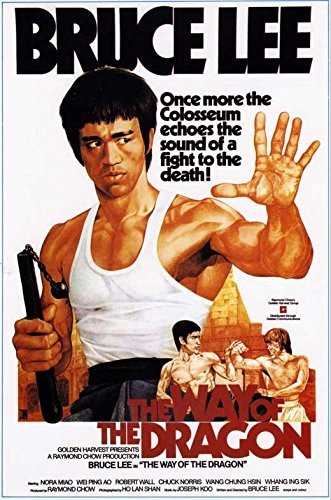
THE BIG BOSS is a poorly made exploitation film that features one great aspect (two if you count that poster; all Lee’s films have incredible posters) and reportedly director Lo Wei (1918-96) was more interested in the racetracks than the film. Wei’s known for launching both Lee and Jackie Chan, directing Lee in THE BIG BOSS and FIST OF FURY and Chan in NEW FIST OF FURY. Wei can be seen in FIST OF FURY as the police inspector Lo.

Five Deadly Venoms (1978)

day 47, five deadly venoms

FIVE DEADLY VENOMS (1978) Three-and-a-half stars
Years ago, I finally tracked down (i.e. bought) a subtitled copy of FIVE DEADLY VENOMS and it made all the difference in the world after having extreme technical difficulties watching a dubbed copy the week before the subtitled version, failing twice to make it through because of the haphazard dub job.

The plot in a nutshell: A wise old martial arts master, on his death bed, gives his latest young martial arts pupil a dying wish to go track down some wayward pupils who have done “evil” with the master’s teachings, the “Five Deadly Venoms” that provide our lovely and oh so poetic title, and redeem the master and his martial arts philosophy and teachings forever.

Like DRUNKEN MASTER, FIVE DEADLY VENOMS provides us with multiple idiosyncratic martial artists, fighting styles, and personalities: The Centipede, The Snake, The Scorpion, The Gecko (lizard), and The Toad. The young pupil combines all five styles, although he’s not as potent as the older pupils because he only knows a little about each style.

The old man describes their styles in some detail on his deathbed. Honestly, this scene gets us hyped for the movie ahead, filled with great expectations.

Each fighter and fighting style have their own distinct strengths and weaknesses, some more apparent than others.

The Centipede: Based on speed and quickness. Fastest of the fast.

The Snake: Based on agility and flexibility. This flexibility makes for mad defensive skills and the pinpoint ability to attack the opponents’ weak spots.

The Scorpion: Based on acrobatic kicks or “the sting.” The style resembles the scorpion pincer in the hand techniques of the artist.

The Lizard: Nimble, quick footwork, also described on the FAQs at the IMDb as “Spider-Man with a black belt” because of The Lizard’s mastery of walls.

The Toad: Based on power and resilience. Once mastered, this style lends itself to becoming immune to physical harm. Well, we’ll all see how well that stands up in FIVE DEADLY VENOMS.

These fascinating artists and styles are placed inside an old-fashioned movie plot involving an old man’s treasure, imperial politics, and secret identities. We also have the age-old themes of redemption and revenge that seem to be at the core of the genre.

The different artists each wear masks that prominently feature their animal at the top of the mask.

Of course, you might find FIVE DEADLY VENOMS silly, very silly indeed, almost by default with this genre. I’ve always found that “silliness” in martial arts entertainments to be one of their most endearing features. Your mileage may vary.

Granted, THE FIVE DEADLY VENOMS takes itself seriously. It’s not attempting to be a comedy in any way shape or form.

There’s several twists and turns in the plot and we have to figure out the alignment of the “Five Deadly Venoms.”

We know that certain fighters will be more deadly than the others. To the film’s credit, I couldn’t guess it straight out. We align ourselves with the young pupil early on and follow him on his journey through such deadly waters.

Just a cut below DRUNKEN MASTER and THE 36TH CHAMBER OF SHAOLIN, two fabulous martial arts entertainments from 1978, THE FIVE DEADLY VENOMS nonetheless proves itself a damn good time at the movies and another iconic entry in the Shaw Brothers’ filmography. (Another martial arts film referenced by multiple hip-hop artists over the years, as well as Quentin Tarantino. It was also the inspiration for a series of Sprite commercials in the late 1990s.)

Please seek out the subtitled version. The dubbing proved deadliest venom in the English dubbed version. It took effect almost immediately.

Clan of the White Lotus (1980)

DAY 45, CLAN OF THE WHITE LOTUS.jpg

CLAN OF THE WHITE LOTUS (1980) Three-and-a-half stars
The Shaw Brothers (Runme and Run Run Shaw) rapidly became my favorite old school movie factory producers, following hot on the trails of the spectacles of the incomparable INFRA-MAN and THE 36TH CHAMBER OF SHAOLIN with CLAN OF THE WHITE LOTUS, a 1980 effort directed by Lo Lieh.

Like Sam Elliott’s rustic narrator said to the Dude in THE BIG LEBOWSKI, “I like your style.”

I get all giddy when I see and hear the Shaw Brothers fanfare before their every movie.

CLAN OF THE WHITE LOTUS quickly dispenses with its standard issue martial arts plot and focuses on exciting fight sequences centered on choreographed punches and kicks that play like violent ballet or Fred Astaire and Gene Kelly meets Bruce Lee.

Gordon Liu made his fame in THE 36TH CHAMBER OF SHAOLIN and stars here as our bald protagonist with the wicked cool handle. In THE 36TH CHAMBER, it was San Te (pronounced like the jolly fat guy from the North Pole) and in WHITE LOTUS, it’s Hong Wen-Ting but the subtitles tell us it’s “Hung Man Ting.”

Anyway, Liu plays the hot-tempered fiery young martial artist who faces many unbelievable hardships through the first couple acts before finally triumphing over every obstacle and the resident evil antagonist holding our main man back during the first couple acts through his sheer dedication, hard work, and martial arts talent.

As we discussed at some length in THE 36TH CHAMBER review, Liu is a genuine movie star and holds the camera and our attention and rooting interest.

Director Lo Lieh doubles as the resident evil antagonist Priest White Lotus and he’s virtually untouchable in the first two reels and he undoubtedly could take on an entire cast of doubles and extras just with his glorious white beard alone.

Tarantino fans will immediately recognize White Lotus.

CLAN OF THE WHITE LOTUS depends on a durable storytelling formula (underdog triumphs over evil) and, like DRUNKEN MASTER and THE 36TH CHAMBER OF SHAOLIN, WHITE LOTUS puts enough quirky twists and turns on the formula without diluting its very purity and making it unrecognizable from its basic elements.

For example, CLAN OF THE WHITE LOTUS co-stars needles, a martial artist getting in touch with his feminine side and martial arts style, a child, and pressure points. I believe I’ll skip more generic action movies and stick to films like CLAN OF THE WHITE LOTUS.

I mean, just look at a poster that hypes “Deadly Needle Kung-Fu Against the Invincible Armor of White Lotus.”

I would certainly have bought tickets for that extravaganza.

Alternate titles: HONG WENDING SAN PO BAI LIAN JIAO and FISTS OF THE WHITE LOTUS.

Game of Death (1978)

day 44, game of death

GAME OF DEATH (1978) One-and-a-half stars
After Bruce Lee’s death in 1973, a new genre of exploitation films came into existence, “Bruceploitation.”

Actors in this genre included Bruce Li, Bronson Lee (combining two action stars), Bruce Lai, Bruce Le, Bruce Lei, Bruce Lie, Bruce Liang, Saro Lee, Bruce Ly, Bruce Thai, Bruce K.L. Lea, Brute Lee, Myron Bruce Lee, Lee Bruce, and Dragon Lee, while Jackie Chan was touted as the next Bruce Lee until he found his own groove with SNAKE IN THE EAGLE’S SHADOW and DRUNKEN MASTER (both 1978).

“Bruceploitation” films often included some variant of “Enter,” “Fist,” “Fury,” “Dragon,” and “New” in their titles. BRUCE LEE FIGHTS BACK FROM THE GRAVE, that’s my favorite title and VHS cover art.

The films were nearly all garbage.

That leads us to GAME OF DEATH.

Lee started filming GAME OF DEATH after WAY OF THE DRAGON and he finished a few dazzling fight sequences, including the most famous one against NBA superstar Kareem Abdul-Jabbar, a matchup pitting the 5-foot-7 Lee and 7-2 Abdul-Jabbar. GAME OF DEATH had all the makings of Lee’s masterwork.

Alas, it never came to be.

Lee stopped filming GAME OF DEATH to go make ENTER THE DRAGON, the film that helped break martial arts films in the international market.

Unfortunately, Lee died on July 20, shortly before the release of ENTER THE DRAGON, and he never completed GAME OF DEATH.

A few years later, director Robert Clouse built a theatrical version of GAME OF DEATH around Lee’s three fight scenes (totaling 11 minutes), with all sorts of subterfuge used to “cover” for the fact Lee died and left a major hole in the production. Clouse, under the pseudonym Jan Spears with Raymond Chow, concocted an entirely different plot leading up to the fights and changed Lee’s character from “Hai Tien” to “Billy Lo.” Amazingly enough, two former Academy Award winners found their way into the cast, Dean Jagger (in his penultimate theatrical film) and Gig Young (in his final film).

This insulting subterfuge includes multiple Lee stand-ins who hide behind shades for the majority of the movie, stock footage beginning with Lee’s fight scene from WAY OF THE DRAGON against Chuck Norris, a superimposed towel over stock footage, a cardboard cutout, cuts to “fake” Bruce from “real” Bruce, and finally footage from Lee’s actual funeral.

You can differentiate stock footage from the body of the movie, because of its grainy quality.

Abdul-Jabbar even refused to participate in the reshoot and so they filled the “Hakim” part with somebody who does not even closely resemble the basketball star.

In other words, none of it’s well done.

Not that it should have been done at all.

Heart of the Matter: The 11 minutes of the real Lee are the only reason GAME OF DEATH gets more than one star for a rating and these scenes are the only reasons for watching. Lee deserved better, a lot better, than a cynical slapdash exploitation film like the first 80 minutes directed by Clouse.

In those 11 minutes, however, we remember what a dynamo Lee truly was, a marvel of modern man. Just dazzling.

Thankfully, after technological advances, viewers can skip all the bullshit and cue up the good parts, as Phil Hartman’s Telly Savalas said (about different movies, lol, but yeah, we don’t have time to fast-forward).

Still, it’s tempting to speculate what could have been.

They could have taken all of Lee’s completed footage and built around it with interviews from Lee himself, Norris, Abdul-Jabbar, Robert Wall, Steve McQueen, James Coburn, et cetera. Or just used only the completed footage.

Nearly anything would have been superior to what they did for the first 80 minutes in GAME OF DEATH.

Bloodsport (1988)

day 43, bloodsport

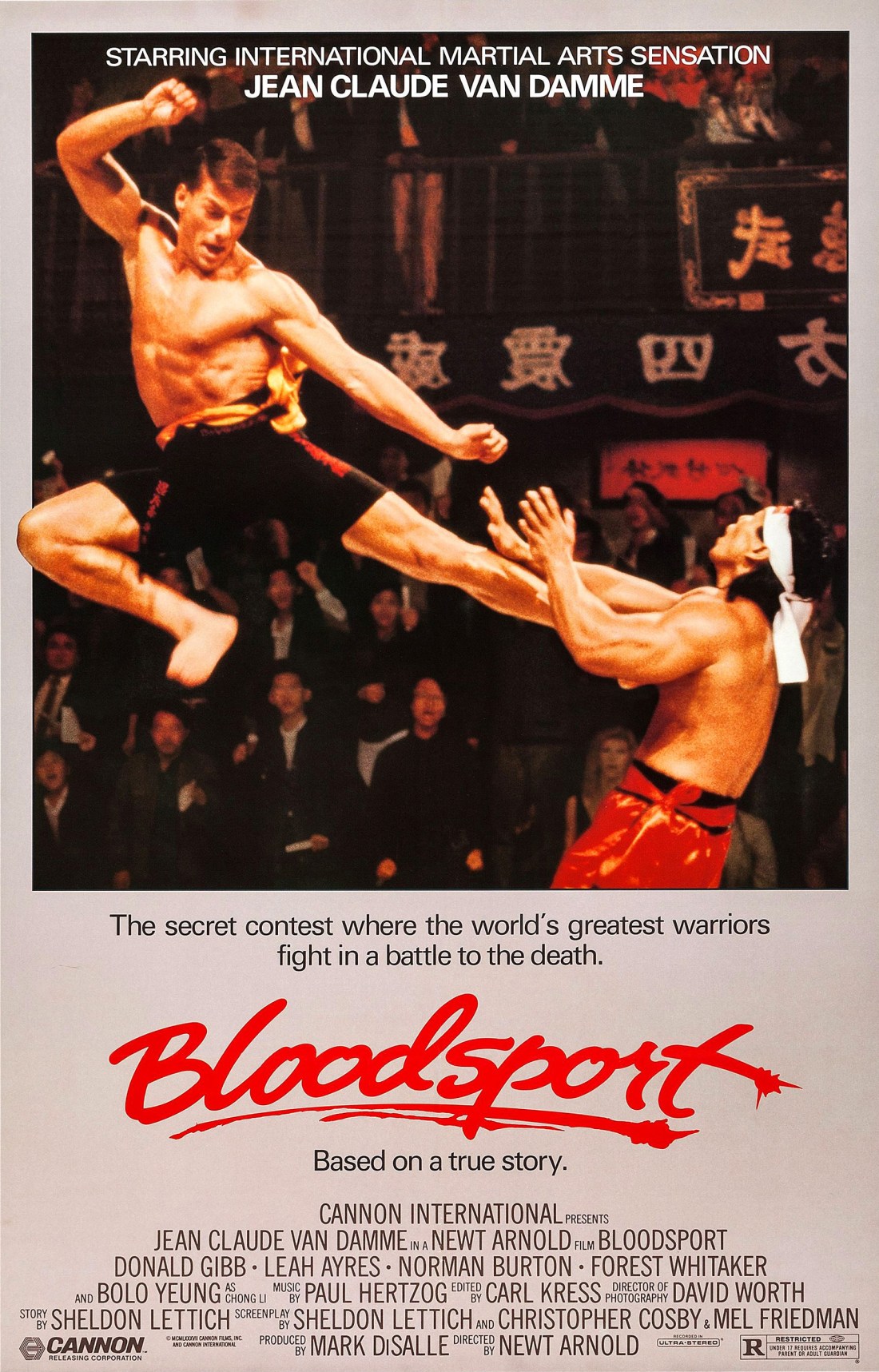
BLOODSPORT (1988) Three stars
RZA said that he’s probably watched THE 36TH CHAMBER OF SHAOLIN 300 times.

I have probably watched Jean-Claude Van Damme’s feature debut BLOODSPORT a good 100 times.

I can just remember being a young lad watching it every single damn time it played on cable television.

Yeah, every single time.

Idly clicking on that remote control day after day, depressed by all them channels and nothing to watch, then here came BLOODSPORT like an oasis in the sub-Sahara of Midwestern small town cable TV.

BLOODSPORT, you saved me from watching SHE’S OUT OF CONTROL again because there’s “nothing to do and nowhere to go.”

Van Damme played an important part in my adolescence. For a while, I was a raving JCVD fan, watching as many of his cheesy action flicks as possible. To be sure, JCVD had many, many fans during the late 1980s and throughout the 1990s, where his performing the splits at least once every flick became nearly as ubiquitous as Keanu Reeves saying “Whoa!” in all his films. All we needed was Van Damme splits followed by a Reeves “Whoa!” Life would have been perfect.

Eventually, though, I had to face the facts that Van Damme’s movies were not all that good.

Yeah, you’re right, I’m still mad about being ripped off by his 1997 pairing with Dennis Rodman, DOUBLE TEAM, and Rodman’s acting made a basketball fan pine away for the acting of his Chicago Bulls teammate Michael Jordan, who struggled considerably playing himself in SPACE JAM. That’s bad.

I felt ripped off by DOUBLE TEAM and somebody else rented it.

Oh dear Lord, I even forgot Mickey Rourke was in DOUBLE TEAM.

Roger Ebert started his review, “DOUBLE TEAM is one of the most preposterous action films ever made.”

That comes with the territory for Van Damme movies and it’s just amazing what cocaine will do.

Anyway, here we are back at BLOODSPORT, Van Damme’s magnum opus.

Under normal circumstances, it’s not a good movie, but like TEEN WOLF and OVER THE TOP, for example, I enjoy it particularly because it’s not good and it stockpiles cliches like rogue nations do atomic weapons. I like BLOODSPORT more than both TEEN WOLF and OVER THE TOP, though.

Let’s go through a brief cliche checklist for BLOODSPORT:

— Illegal martial arts tournament in Hong Kong.

— Our hero (Van Damme) who wants to go to honor his sensei, who trained our hero as if he was his own son.

— Our hero who must go absent without leave because his Army superiors balk at his participation in the martial arts tournament.

— The Army send a couple buffoons to chase our hero around Hong Kong. Bet they skip this film during a Forest Whitaker career retrospective.

— Our hero’s arch enemy (Bolo Yeung) in the illegal martial arts tournament who effectively creates a mood of menace until he finally opens his mouth to speak.

— Our hero’s new best friend (Donald Gibb), a loud-mouthed, cartoonish American who must take a fall to give the hero the revenge angle in the final match.

— Our hero’s obligatory love interest (Leah Ayres), who’s a reporter that wants access to the illegal martial arts tournament. She’s just appalled, terrified by the violence and, of course, wants the hero to not participate.

— How could I forget the loud, loud, loud rock music that’s used because the movie’s producers couldn’t afford Survivor.

Here it’s “Fight to Survive” by Stan Bush, a jaunty little rock number I remembered simply as “Kumite!,” the name of the illegal martial arts tournament the song chants until it’s hopelessly attached to your cerebrum.

Yes, that Stan Bush, who gave the world “The Touch” from TRANSFORMERS THE MOVIE, later covered by Dirk Diggler in BOOGIE NIGHTS during his cocaine wannabe rock star days.

In 1986, Bush’s “The Touch” and “Weird Al” Yankovic’s “Dare to Be Stupid” (Al’s Devo style parody) split a single. Epic. Surely, it was released on Epic Records. (How ironic that YouTube cued up “Dare to Be Stupid” right after rocking out to “The Touch.”)

Think I like “Fight to Survive” more than “The Touch.”

— There’s a child actor playing the young Frank Dux (later played by Van Damme) in BLOODSPORT and he’s an astonishingly bad actor. He’s named Pierre Rafini and his only credit listed on IMDb is “Young Frank.” Awesome.

Honestly, that’s not a huge liability, since he’s only in a small portion of the film, not like for example David Mendenhall in OVER THE TOP and Norman D. Golden II in COP AND A HALF, who mugged so heavily during their performances that I look for my wallet after every viewing of their respective films.

— Slow motion. Lots and lots of slow motion. Maybe the whole movie should have been made in slow motion and we’d have a GONE WITH THE WIND-length martial arts epic.

— “Based on a true story,” about as true as “The Amityville Horror.”

Credit: “This motion picture is based upon true events in the life of Frank W. Bux. From 1975 to 1980 Frank W. Dux fought 329 matches. He retired undefeated as the World Heavy Weight Full Contact Kumite Champion. … (yada yada yada not in credits yada yada yada).”

BLOODSPORT screenwriter Sheldon Lettich touched on Dux in an interview found on Asian Movie Pulse, “Frank told me a lot of a tall tales, most of which turned out to be bullshit. … There was one guy who he introduced me to, named Richard Bender, who claimed to have actually been at the Kumite event and who swore everything Frank told me was true. A few years later this guy had a falling out with Frank, and confessed to me that everything he told me about the Kumite was a lie; Frank had coached him in what to say. … Nearly everyone knew he (Dux) was just a delusional day-dreamer and a big bullshitter.”

Dux served as the fight choreographer for BLOODSPORT.

— Van Damme made such waves in the motion picture industry that he received a Razzie nomination for “Worst New Star” and his competition included Don the Talking Horse from HOT TO TROT, Tami Erin from THE NEW ADVENTURES OF PIPPI LONGSTOCKING, Robby Rosa from SALSA, and the winner Ronald McDonald from MAC AND ME.

Lettich received a Worst Screenplay nomination for his work with Sylvester Stallone for RAMBO III. Both lost to COCKTAIL and its screenplay by Heywood Gould.

— Cannon released BLOODSPORT and all I can say about that is “Electric Boogaloo.”