The Human Tornado (1976)

THE HUMAN TORNADO (1976) **1/2
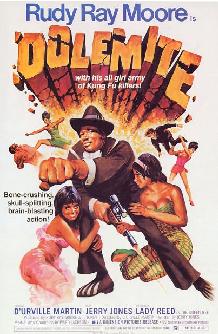
I have mixed feelings about this sequel to Dolemite
Sometimes it sucks and sometimes it is outta sight
Rudy Ray Moore returns as our title character and he’s fine
He’s truly one of a kind and his bluntness will blow yo’ mind
He’s grown on me since he made a terrible first impression
Both Dolemite and The Human Tornado a better expression
He’s not what earns The Human Tornado a mixed review
I promise that I like Dolemite and Rudy Ray, I really do!
It’s that rat soup eating motherfucker redneck racist sheriff piece of shit
He drags the movie into the mud and his every scene’s just like a cesspit
Character’s named Sheriff Beatty, played by J.D. Baron in his film debut
Somebody should have kung fu kicked him to death, but they never do
His all-out redneck assault often brings The Human Tornado to a halt
Not sure if that’s writer Jerry Jones or director Cliff Roquemore’s fault
Enough about that, how ’bout “Glorya De Lani” as Hurricane Annie
Her glorious breasts distract from Rudy Ray Moore’s big fat fanny
She contributes her fair share to some of the best nudity in screen history
I’d trade her nude for every redneck sheriff scene and it’s sure no mystery
Glorious Gloria Delaney and her breasts returned as Peaches in Penitentiary
What else can be said but yes, God bless the breasts of the Twentieth Century
Dolemite seeks out the sleazy crime boss’ sex pot wife and their sex wrecks the set
Nympho gives Dolemite the info he wants so many times none of us will ever forget
Dolemite takes out anonymous henchmen in a flurry of speeded up kung fu kicks
The Human Tornado truly has everything, a gay blade and a guy with karate sticks
We can’t neglect Ernie Hudson early in his career or Lady Reed and Lord Java in the cast
Funky music, funky hair, miles of nudity, loads of vulgarity, mostly a blast from the past

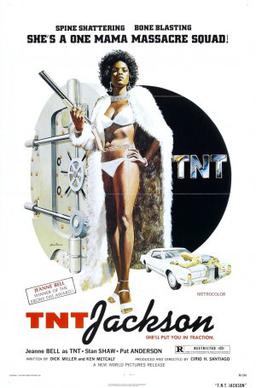
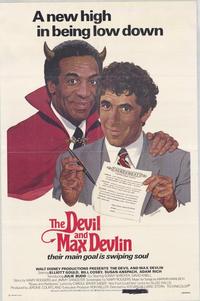
We Had Ourselves a Real Good Time: Blacula, Dolemite, TNT Jackson, The Devil and Max Devlin

WE HAD OURSELVES A REAL GOOD TIME: BLACULA, DOLEMITE, TNT JACKSON, THE DEVIL AND MAX DEVLIN
Max Schreck, Bela Lugosi, Carlos Villarias, Lon Chaney Jr., John Carradine, Christopher Lee, Klaus Kinski, George Hamilton, Frank Langella, Gary Oldman, and Leslie Nielsen.

That’s a lot of bared fangs, deadly stares, and spectacular deaths over the decades.

Fair warning: Best get outta here with that Tom Cruise, Gerard Butler, Robert Pattinson bull.

Blacula star William Marshall deserves his rightful place among the best screen vampires. For example, he’s definitely better than, oh, let’s say, Carradine, who played Dracula in House of Frankenstein, House of Dracula, and Billy the Kid vs. Dracula and often looked like somebody had squeezed some fresh lemon juice in his eyes. A few months after Marshall debuted as Black Dracula, Lee appeared in his sixth Dracula film — cleverly titled Dracula A.D. 1972 — and Lee’s spiraling lack of enthusiasm for the role that made him famous bites you right smack dab in the neck.

With his booming voice, commanding screen presence, and legitimate acting chops, Marshall (1924-2003) owns Blacula and makes it infinitely better than some cruddy hunk of cinematic junk like Blackenstein. He brings an unexpected dignity to what might otherwise have been a throwaway film.

Rating: Three stars.

— I enjoyed Dolemite a whole lot more than Disco Godfather, my first Rudy Ray Moore experience, and not only because I’m now calling the former picture Boom Mic Motherfucker.

Disco Godfather lost me by about the millionth or maybe it was by the billionth time Moore (1927-2008) exclaimed Put your weight on it, a slogan that needless to say would not be adopted or adapted by 1980 U.S. Presidential candidates Jimmy Carter, Ronald Reagan, and John B. Anderson. Despite the fact that it tried cultivating a social conscience, Disco Godfather needed some weight put on it, because it was the cinematic equivalent of an anorexic crackhead.

Moore has been called The Godfather of Rap and both Dolemite and the character himself almost instantly serve notice why. Jailbird Dolemite’s first lines are Oh, shit. What the hell does that rat-soup-eatin’ motherfucker want with me? One could play a reasonable drinking game with how many times Dolemite utters motherfucker in the movie, because it’s not every time Cheech & Chong say Man in Up in Smoke (reportedly 285 times) or everybody says Carol Anne in Poltergeist III (121). You won’t get wasted, best shit you ever tasted, from Dolemite. You’ll probably feel pretty good and the alcohol will help laughter.

The plot: Dolemite gets released from prison and fights the criminals and corrupt police officers who sent our favorite cinematic pimp up the river in the first place. Really, though, Dolemite is about the profanity, fight scenes, female (we’ll forget about the male) nudity, and complete utter ridiculousness, all of it done over-the-top. Never mind that it’s a time capsule into Bicentennial-Era America filed right alongside Dog Day Afternoon.

To be honest, though, I was distracted from the plot and everything else by the unpaid co-star Boom Mic Visible, who’s absolutely the funniest motherfucker in Dolemite. According to IMDb, The boom mic is visible in many shots of original Xenon VHS to DVD transfer from the 1980s. The film was originally transferred without the proper ratio ‘gate’ of 1:85.1, revealing more of the top and bottom of the frame than the film makers originally intended. The 2016 Vinegar Syndrome Bluray release was re-transferred from an archive print of the film, at the proper ratio, so the boom mics are hidden in many shots. The Bluray release also includes a ‘boom mic’ version of the new transfer, intentionally revealing the boom mics for comic effect.

Now we know.

The actor John Kerry (not that John Kerry) played Detective Mitchell in Dolemite and it’s a missed opportunity that nobody ever asked 2008 U.S. Presidential Candidate John Kerry about his experiences making Dolemite, what Rudy Ray Moore was really like, etc. That’s a real shame.

Rating: Three stars.

TNT Jackson is definitely not a good movie, but I am still feeling a certain lingering affection for it that other (better) movies wish they could make me feel for them.

What else could be said about some of the worst martial arts sequences ever committed to celluloid, from the very first fists and feet of fury scene all the way to the grand finale. Would you believe punches and kicks that do not connect but still inflict damage? Would you believe the heroine could punch right through the villain? Well, prepare yourself for TNT Jackson.

TNT Jackson falls short of the standard established by similar pictures Coffy and Cleopatra Jones, because, let’s face it, TNT Jackson star Jeannie Bell falls below Pam Grier and Tamara Dobson, respectively. Sure, former playmate and bunny Bell looks absolutely stunning with her great hair, great face, and great body, but she can’t act her way out of a paper bag and we don’t really believe that she could fight her way out of one if she wasn’t the star of the movie. Miss Jackson and her inevitable white chick nemesis (Pat Anderson) wage what’s possibly the worst cat fight ever in the history of the movies. It’s a doozy, and that describes the vast majority of the 72-minute TNT Jackson. Yes, that’s right, 72 minutes, a genuine throwback.

The late, great character actor Dick Miller (1928-2019) earned a screenwriting credit on TNT Jackson, but apparently producer Roger Corman had it rewritten by Ken Metcalfe, who plays the sleazy sub-villain Sid in TNT. Miller does not appear in TNT Jackson.

It’s amazing TNT Jackson romantic lead and main villain Stan Shaw did not get The Sensational, Smooth, Suave, Sophisticated, Stunning Stan Shaw for his screen credit, but maybe just maybe that’s because he overplays his smooth, suave, sophisticated ways so much that we’re tired of his jive real quick. Heck, even Shaw’s afro overplays it throughout TNT Jackson. I’ve not seen this much overacting by hair since, oh, let’s see, Chu Chu and the Philly Flash or maybe I’m mixing up Carol Burnett’s decorative head cover (wait, that’s just part of her costume) with her maracas.

Basically, I can’t hate too much on TNT Jackson like I do Chu Chu (more like Poo Poo and the Poopy Gas), since director Cirio H. Santiago remade TNT a few years later as Firecracker and substituted (white) Jillian Kesner for Bell in the title role. Both movies have similar plot elements, namely infamous topless fights, and Metcalfe in a similar role, but Firecracker does it better.

After watching TNT Jackson, I could not help but gravitate toward AC/DC’s song and the chorus ‘Cause I’m T.N.T., I’m dynamite / T.N.T., and I’ll win the fight / T.N.T., I’m a power load / T.N.T., watch me explode. Bonus points for TNT Jackson, ones that keep it from a two-star rating.

The best version of TNT Jackson is the two-minute promotional trailer put together by Joe Dante and Allan Arkush for New World Pictures circa 1974 or 1975. The voice-over narration takes it to greatness: TNT Jackson, Black Bombshell with a Short Fuse! This Hit Lady’s Charm Will Break Both Your Arms! She’s a One-Mama Massacre Squad! TNT’s Mad and That’s Real Bad! With That Dynamite Bod She’s a Jet Black Hit Squad! A Super Soul Sister and a Bad News Brother Under Cover and Out to Blast a Killer Army That’s Poisoning the People with Deadly China White! You Best Pay the Fine or She’ll Shatter Your Spine! Black Chinatown, Where Flesh is Cheap and Life is Cheaper! TNT Jackson, She’ll Put You in Traction!

Rating: Two-and-a-half stars. Trailer: Four stars.

— Before The Devil and Max Devlin, it had no doubt been a long time since Walt Disney Studios depicted Hell in one of their films.

For example, Hell’s Bells from 1929 and Pluto’s Judgement Day from 1935 leap first to mind, two animated shorts that might blow people’s minds who normally associate animation with cute-and-cuddly innocuous fare at this late point in history.

To be fair to the older films, which are both far superior to the main film currently under consideration, feature length The Devil and Max Devlin doesn’t spend a lot of time in Hell.

Well, actually, according to some former President, right, aren’t California and Hell the same?

I wonder, given the subject matter and the presence of Bill Cosby in one of the starring roles, if The Devil and Max Devlin will go or has already gone the way of the controversial, divisive Song of the South — suppressed for seeming eternity by the folks at Disney. I found them both in the dark, dank recesses of the Internet and I hope that I won’t go to jail or Hell for either cultural sin.

Anyway, I like the locations (especially Hell) and I like the high concepts behind The Devil and Max Devlin like a slumlord trying to save his soul by giving the bad guys three unsullied souls and it turned out to be perfect casting to have Cosby in the role of the Devil’s helper, but the movie gets so bogged down in plot details that it evolves into a real slog and we just want more than anything else in the world at the moment for the movie to finally be over. At least, if nothing else, that’s how The Devil and Max Devlin made me feel watching it.

Rating: Two-and-a-half stars.

An Eye for an Eye (1981)

AN EYE FOR AN EYE (1981) ***
An Eye for an Eye is one of the better Chuck Norris movies and that’s because it fits the bill for what helps define a better Chuck Norris movie — the quality of the supporting cast, something it has in common with Lone Wolf McQuade, Code of Silence, The Delta Force, and Silent Rage.

Let’s see, we have Christopher Lee, Richard Roundtree, Matt Clark, Mako, Maggie Cooper, Rosalind Chao, Professor Toru Tanaka, Stuart Pankin, Terry Kiser and Mel Novak, and they’re basically all good in their standard hero and villain roles.

Lee (1922-2015) enjoyed a truly marvelous career that intersected with Sherlock Holmes, Dracula, James Bond, Star Wars, Ichabod Crane, Kharis, Victor Frankenstein, Gandalf, and Hercules. Never mind acting alongside Slim Pickens and Toshiro Mifune in Steven Spielberg’s 1941. Often playing the villain, Lee had the ability to maximize his minimal screen time and An Eye for an Eye benefits from his presence.

Roundtree made his fame as the title character in Shaft and sequels Shaft’s Big Score and Shaft in Africa, and so I must admit to being somewhat amused that he’s played a cop so often throughout his career. It was both amusing and frustrating to watch his police superior character bust Norris’ chops. I told my wife during An Eye for an Eye, ‘At least he’s not killed by a winged serpent in this movie.’

Cooper plays Norris’ obligatory romantic interest and she gets a rare female nude scene in a Norris movie. Writing on Silent Rage, I noted that it was refreshing to see somebody’s chest other than Norris and I second that emotion after An Eye for an Eye.

Tanaka’s dossier begins, ‘Was an American professional wrestler, professional boxer, college football player, soldier, actor, and martial artist.’ What did the Professor earn his degree in? Judging by An Eye for an Eye and the vast majority of his filmography and his professions, it’s safe to say Tanaka earned a doctorate in pain. Like others in the An Eye for an Eye cast, he’s good at maximizing minimal screen time and in his case, minimal dialogue. Norris vs. Tanaka proved to be one of the film’s greatest highlights.

Before she went to sleep, I told my wife that Norris’ partner will be dead very shortly and it did not help the character’s survival odds being played by Terry Kiser, an actor best known for playing a corpse. Bernie from Weekend at Bernie’s and Weekend at Bernie’s II ring any bells? Yeah, I still argue that dead Bernie still shows more life than nominal leads Andrew McCarthy and Jonathan Silverman. For a man later hacked and whacked by Jason Voorhees, Kiser’s character died spectacularly in An Eye for an Eye — shot in the chest, crushed between not one but two cars, and caught on fire. His death haunts Norris’ Sean Kane during two flashback scenes.

An Eye for an Eye director Steve Carver died in January 2021 of complications from COVID-19 and he was 75. Carver also directed arguably Norris’ best picture, Lone Wolf McQuade, and the infamous 1974 Roger Corman / New World Productions films The Arena and Big Bad Mama. No doubt that Pam Grier and Angie Dickinson, as well as William Shatner, prepared Carver for Chuck Norris.

Silent Rage (1982)

SILENT RAGE (1982) ***
Michael Miller’s 1982 feature Silent Rage combines several American movie hallmarks into one barely coherent package: Chuck Norris, a small Texas town (never sleepy when Norris plays Sheriff), a madman killer, mad scientists, shots borrowed straight from John Carpenter’s Halloween, two love scenes, Stephen Furst basically playing his character from Animal House again, bar fights, roundhouse kicks, biker gangs, breasts (inc. Norris but not Furst), and a schizophrenic musical score, not in any particular order.

We also have at least five wildly different acting styles for the price of one. We’ve already covered Norris and Furst, then there’s Ron Silver and he’s playing it straight in easily the best dramatic acting that one can find in anything starring Chuck Norris. Silver plays the voice of reason and let’s do the right thing scientist, whereas his colleagues played by Steven Keats and William Finley are variants on Universal horror archetypes updated for a new generation. Keats, of course, wants to push science further than any one ever before even when it’s not prudent and Finley, best known for his roles in Brian De Palma and Tobe Hooper films Phantom of the Paradise and Eaten Alive, occupies the middle ground between Silver and Keats. Brian Libby’s madman killer continues in the proud screen tradition of Frankenstein’s Monster and Michael Myers, especially after our mad scientists flat out turn him posthumously into an indestructible killing machine whose stalking does all the talking. I wanted Dr. Loomis to show up and say THIS ISN’T A MAN. Bummer that it didn’t happen.

Norris battles the mad killer and later the virtually indestructible mad killer in the opening and concluding scenes. Otherwise, he alternates between mentoring and supporting unsure and unsteady rookie cop Furst, rekindling his romance with a former lover played by Toni Kalem, and questioning Silver and Keats. For Norris fans, apparently the scariest parts of Silent Rage involved Kalem’s bare breasts and Norris favoring jazz music because our favorite roundhouse specialist returned to only love scenes between men for the rest of his career, barring his rolling around in the mud with the sultry Barbara Carrera in the 1983 Walker, Texas Ranger precursor Lone Wolf McQuade. I for one like Silent Rage because it’s nice to see more chests on display than just Chuck’s for a change.

Silent Rage unfortunately drags at two main points. The death of Silver’s wife literally feels like it takes forever, like one of the filler killings in a Friday the 13th sequel. Ditto for the bar fight, which are drags both in real life and in the movies. A couple moments in this otherwise humdrum bar fight sequence redeem it, just barely though. If you’ve seen Silent Rage, you know exactly what I mean.

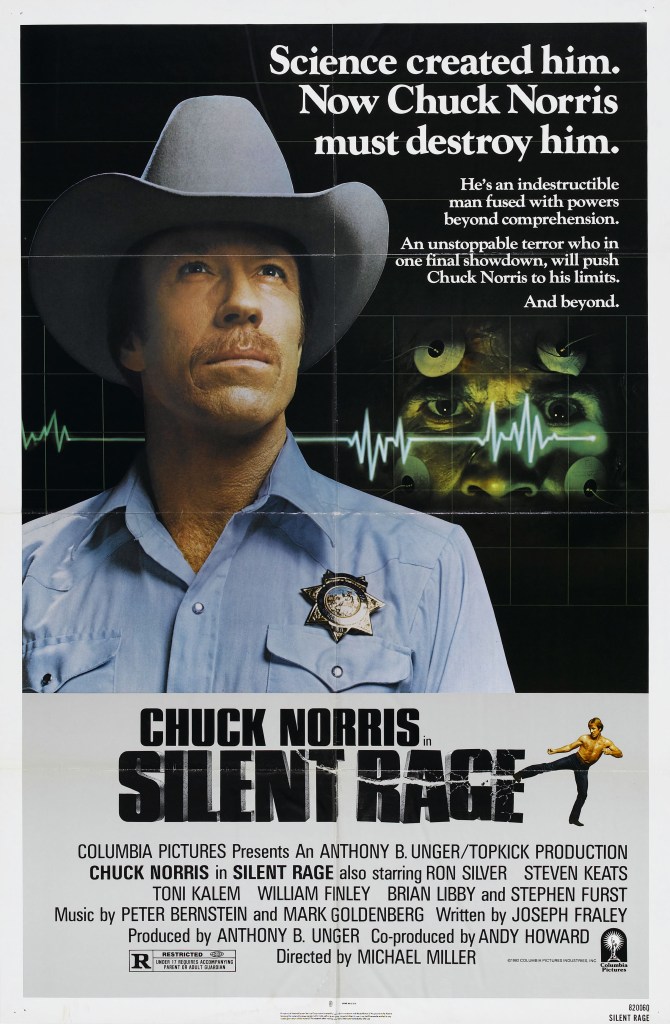
The poster for Silent Rage rates with Breaker! Breaker as the best Norris film poster. There’s really no arguing with a mini-Norris roundhouse cracking the movie’s title and the promotional hype Science created him. Now Chuck Norris must destroy him. He’s an indestructible man fused with powers beyond comprehension. An unstoppable terror who in one final showdown, will push Chuck Norris to his limits. And beyond.

Once upon a review, I believe I wrote that I wanted to see Chuck Norris vs. Jason Voorhees and Silent Rage is the closest that I will ever get to seeing that dream come true.

Ninja Rap: Enter the Ninja, Revenge of the Ninja

NINJA RAP: ENTER THE NINJA, REVENGE OF THE NINJA

An instant word search on ninja returns this definition, “A ninja or shinobi was a covert agent or mercenary in feudal Japan. The functions of a ninja included espionage, deception, and surprise attacks. Their covert methods of waging irregular warfare were deemed dishonorable and beneath the honor of the samurai.” Buh.

It goes without saying but we’ll say it anyway that ninja survived a gratuitous Vanilla Ice rap number and mass flatulence, er, mass gas in a kiddie picture.

There’s also “A person who excels in a particular skill or activity. ‘The courses vary — you don’t have to be a computer ninja to apply.’”

I contribute: “An iconic action movie bad ass character archetype epitomized by the legendary ‘Ninja Trilogy’ from Cannon Films, ENTER THE NINJA (1981), REVENGE OF THE NINJA (1983), and NINJA III: THE DOMINATION (1984).”

I’ve already discussed NINJA III at some length — any movie that combines ENTER THE NINJA, THE EXORCIST, and FLASHDANCE must have something brilliant up her sleeve — and only very recently caught up with ENTER THE NINJA and REVENGE OF THE NINJA on the same night.

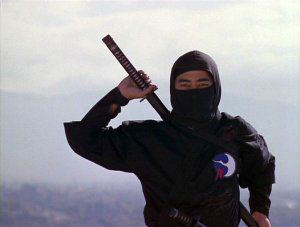
Of course, any definition of “ninja” would be greatly served by a picture of Japanese martial artist Sho Kosugi. In fact, this review would be vastly improved just by the mere insertion of a picture of The Man, The Myth, The Legend. A picture speaks louder than a thousand words … regardless, it’s not like any action movie hero worth their celluloid ever spoke a thousand words.

SHO KOSUGI

I’ve made it through most of the collected film works of Eastwood, Bruce Lee, Jackie Chan, Norris, Stallone, Schwarzenegger, et cetera, and now I am grateful for the opportunity to delve into Kosugi’s filmography. It’s a safe bet that I will eventually seek out PRAY FOR DEATH, DEATHS OF THE NINJA, and RAGE OF HONOR because they’re great titles and have great cover art in addition to starring Mr. Kosugi.

I’ll start with REVENGE OF THE NINJA, the second and best overall installment of the so-called ‘Ninja Trilogy.’ Kosugi takes on a starring role after playing second (or third or fourth) fiddle in ENTER THE NINJA, behind at least Franco Nero, Susan George, and Christopher George. The Kosugi parts are arguably the best parts of ENTER, so REVENGE serves up a full course of Kosugi with hors d’oeuvres, wine (or beer or liquor), and dessert included.

The nominal plot: “After his family is killed in Japan by ninjas, Cho and his son Kane come to America to start a new life. He opens a doll shop but is unwittingly importing heroin in the dolls. When he finds out that his friend has betrayed him, Cho must prepare for the ultimate battle he has ever been involved in.”

The actual plot: ACTION! PLENTY OF ACTION! We’re talking serious hardcore ninja action here. I’m no expert on ninja weaponry, but I do believe that REVENGE (as did ENTER before and THE DOMINATION after it) employs the ninjato, the katana, nunchaku, blowgun, shuriken, crossbow, and many, many more weapons of mass dismemberment. Gore hounds have a lot of howling to do over the ‘Ninja Trilogy.’

REVENGE prevails over ENTER because it spends more time focused on the actual plot than the nominal plot.

We have not only two fierce ninja warriors, Kosugi’s hero Cho Osaki opposed by the dastardly bastard Braden (Arthur Roberts), but we also have two, er, 1 1/2 Kosugis in this picture, since Sho’s real-life son Kane Kosugi plays Cho’s son Kane. We say 1/2 because Kane was around 9 years old when he made his memorable motion picture debut in REVENGE. He’s not one of those insufferable movie brats who mugs so heavily that I check my wallet after their every scene. He’s not David Mendenhall in OVER THE TOP, for example. Yes, he’s basically a miniaturized Sho Kosugi.

Both REVENGE and THE DOMINATION ultimately win over ENTER because they’re more entertaining and off-the-wall in that classic crazy Cannon way.

Nero, of course, makes for an effective action hero in a more traditional sense and I find his filmography very fascinating, from playing the title character in the 1966 Spaghetti Western DJANGO and Lancelot in the lavish 3-hour 1967 American musical CAMELOT (singing voice by Gene Merlino) to roles in Quentin Tarantino’s DJANGO UNCHAINED (naturally) and JOHN WICK: CHAPTER 2. Nero plays a character named “Cole” in ENTER and that has seemed to be one of the more common given names for both action movies and soap operas; Roger Ebert’s Little Movie Glossary includes The Cole Rule: “No movie made since 1977 containing a character with the first name ‘Cole’ has been any good.”

I commented during ENTER that it marked the first time I had seen English actress Susan George (STRAW DOGS) in a movie without her getting naked.

Christopher George almost walks away with the picture as the nefarious businessman Charles Venarius. He’s so bad that he’s good because George savors every single line. It is indelible fun hearing George deliver “This is 20th Century Manila, not feudal Japan.”

Kosugi appeared in all three NINJA films, as three different characters, and ultimately it is his screen presence that makes all three such enjoyable and memorable experiences.

Kickboxer 2 (1991)

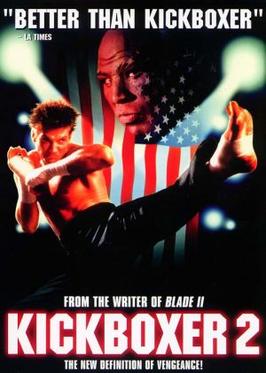
KICKBOXER 2

KICKBOXER 2 (1991) *1/2

En route to the cinematic crapper, Albert Pyun’s KICKBOXER 2 abuses two of the worst cinematic devices: slow motion and an offscreen death.

On their review program, Gene Siskel and Roger Ebert pointed out how much Pyun and the picture relied on slow motion during the fight scenes. Ebert claimed they used slow motion for every single moment of every single fight scene in the movie, including for the voices of the announcer and the referee, but that the sound effects guy must not have got the same memo because all the punches and kicks sounded like they were in regular motion. Siskel accused Ebert of eating spiked popcorn. Bottom line: If only KICKBOXER 2 had been half as entertaining as the Siskel & Ebert review.

Let’s take the fight that’s right smack dab in the middle of the picture, between our principled, reluctant-to-fight hero David Sloan’s former protege Brian “The Hammer” Wagner (Vince Murdocco) and the super villainous Tong Po (Michel Qissi) who’s back from KICKBOXER: THE MOTION PICTURE (not its real title). Brian Wagner dies in the ring from a series of brutal slow motion kicks and punches and other blows to the body. Coming that slow, he should have seen it coming and got out of the way. No, no, no, of course not, Brian Wagner wanted to die. Okay, maybe not wanted to die per se, but he was destined to die in that post-Apollo Creed ROCKY IV way. Anyway, we knew he was going to die from early in the picture, when his worried mother told David Sloan (Sasha Mitchell) that she’s afraid for her son and made Mr. Sloan promise to look after him. Brian Wagner further sealed his cinematic doom by walking away from David Sloan and cursing him on the way to greener pastures, by taking the easy fights and that cheap nickname, by allowing himself to be pumped full of steroids, and finally by his defiant overconfidence and his blatant refusal to surrender to his opponent. Yes, yes, he deserved to die.

The final buildup to Wagner’s death hits us over the head with a slow-moving sledge hammer. Not only are Tong Po and Brian Wagner in super duper excruciating slow motion, but Wagner’s poor mother and David Sloan are both moving like that in the crowd … in a cinematic technique derived especially from the later ROCKY pictures, you know when Clubber Lang and Ivan Drago are beating the brain stuffing out of Rocky (or Apollo Creed) and Rocky’s corner men or even his poor, poor wife Adrian are laboriously freaking out but ultimately helpless in the face of slow motion annihilation. I am so, so glad this overdone cinematic technique eventually faded away.

Offscreen deaths are usually cheap and sometimes, they’re even worse. For example, Hicks and Newt at the beginning of ALIEN 3. That one left millions reeling and they’re still talking about it today flabbergasted and frustrated.

In KICKBOXER 2, we are informed that Tong Po killed both David Sloan’s older brothers, including KICKBOXER protagonist Kurt Sloane (Jean-Claude Van Damme), after the events of the first movie and before the events of the second one. And to think Kurt avenged his paralyzed older brother Eric Sloane (played by former world kickboxing champion Dennis Alexio) against Tong Po for the big thrilling conclusion of KICKBOXER.

Yes, that’s right, Sloan and Sloane, that’s what really confused this unfrozen caveman writer. Sloan’s older brothers each have an ‘e’ on the end of their surname. Fascinating. Let’s see here: Van Damme speaks with a thick Franco-Belgian accent, while Sasha Mitchell, why he’s just a poor man’s Keanu Reeves. Bizarre family that must really get around. Ironically enough, though, Mitchell has been called both a poor man’s Keanu and a poor man’s Jean-Claude. Mitchell’s not without a slight charm, however, and he’s definitely not the biggest problem in KICKBOXER 2. The film’s biggest problem is that we’ve seen it all done before … and better numerous times.

KICKBOXER 2 lacks the off-the-wall qualities of a Shaw Brothers spectacular or a truly batty WTF exploitation picture like NINJA III: THE DOMINATION and SAMURAI COP, as well as the genuine pathos of ROCKY and THE KARATE KID. It is neither truly good enough nor bad enough to be any good.

The Octagon (1980)

THE OCTAGON

THE OCTAGON (1980) *1/2

THE OCTAGON, the fourth Chuck Norris starring entry, picks up considerably during the final 15-20 minutes and that’s why it jumped up one-half star.

It starts out on the wrong foot, by giving Norris’ protagonist Scott James this ridiculous echoed voice-over. I guess I can best describe it as a whisper doused in reverb. Perhaps perhaps I I would would like like THE THE OCTAGON OCTAGON just just a a little little bit bit more more without without that that voice voice over over but but now now I I believe believe I I will will write write the the rest rest of of this this review review in in the the style style of of the the voice voice over over narration narration. Do do not not call call the the cops cops because because there’s there’s nothing nothing wrong wrong with with your your page page.

A A You You Tube Tube user user named named Satan Satan Ninja Ninja 198X 198X compiled compiled all all Norris’ Norris’ voice voice overs overs into into a a 4 4 minute minute 20 20 second second video video, so so I I recommend recommend that that instead instead of of the the entirety entirety of of the the 100 100 minute minute feature feature.

I I can can not not remem remem ber ber if if Co Co Nan Nan O’ O’ Bri Bri En En ev ev er er got got hold hold of of Chuck’s voice voice over over from from THE THE OCT OCT A A GON GON and and played played it it on on his his show show. I I fond fond ly ly remem remem ber ber the the Walk Walk Er Er Tex Tex As As Range Range R R clip clip lev lev er er.

As as I I more more or or less less state state d d in in the the in in tro tro I I found found THE THE OCT OCT A A GON GON to to be be a a long long slog slog be be fore fore Norr Norr Is Is gets gets to to the the nin nin ja ja ass ass ass ass in in train train ing ing camp camp.

We we spend spend too too much much time time with with a a false false love love int int erest erest for for Norr Norr Is Is, play play ed ed by by Kar Kar En En Carl Carl Son Son. Their their scenes scenes are are def def initely initely a a wash wash.

Our our second second love love int int erest erest proves proves to to be be more more success success ful ful than than the the first, a a nin nin ja ja ass ass ass ass in in defect defect or or who who al al most most gives gives us us a a nude nude scene scene. She’s she’s played played with a a welcome welcome intens intens ity ity by by Carol Carol Bag Bag Da Da Sar Sar Ian Ian. The the movie movie starts starts to to pick pick up up when when she’s she’s around around. Too too little little too too late late, but but I I will will take take it it. Glad glad I I al al ready ready learned learned that that less less on on.

The Legend of the 7 Golden Vampires (1974)

THE LEGEND OF THE 7 GOLDEN VAMPIRES

THE LEGEND OF THE 7 GOLDEN VAMPIRES (1974) ***

It was really only a matter of time before Hammer, the British masters of the macabre, and the Shaw Brothers, the Hong Kong masters of martial arts, would combine forces and make the world’s first martial arts vampire movie spectacular. An exploitation movie fan’s wet dream come true, in other words.

They created THE LEGEND OF THE 7 GOLDEN VAMPIRES in 1974, not the greatest vampire or martial arts movie ever made, of course, but still an enjoyable romp for those who have a hankering for (in no particular order, except for the last item) vampire hunting, neck biting, blood letting, boiling blood, severed hands, throat slitting, stabbings through the heart, vampires turning to dust, fake bats, fake castles, sword fights, martial arts combat between warriors and vampires & their minions, archery, breasts, romance, and one ridiculous, anticlimactic ending. Three stars, check it out.

Christopher Lee first played Dracula for Hammer in 1958 and he returned for PRINCE OF DARKNESS (1966), DRACULA HAS RISEN FROM THE GRAVE (1968), TASTE THE BLOOD OF DRACULA (1970), SCARS OF DRACULA (1970), DRACULA 1972 (1972), and THE SATANIC RITES OF DRACULA (1973). Lee’s animosity toward the series increased over time and he finally refused to participate in THE LEGEND OF THE 7 GOLDEN VAMPIRES after seven times as the Count. Lee read the script and said “No deal.”

That’s a bummer, especially since John Forbes-Robinson makes for a horrible Dracula. How horrible? They dubbed him with David de Keyser and Dracula only appears in a few minutes at the beginning and end of the picture. In the opening scene, Dracula kills a Chinese monk and takes on his form. (Reportedly, Forbes-Robinson was furious about being dubbed. Hey, it’s not the first time in history. A few years after GOLDEN VAMPIRES, SATURN 3 director Stanley Donen felt dissatisfied with Harvey Keitel’s Brooklyn accent and since Mr. Keitel refused participation in post-production, Donen dubbed over Keitel with a British actor using a Mid-Atlantic accent.)

Granted, we do have Peter Cushing for the fifth time as Professor Van Helsing. Who else would handle the plot exposition through dialogue scenes? How about that plot? Van Helsing, on a lecture stop in China, agrees to help seven siblings (six men, one woman) take back their ancestral mountain village that’s been taken over by seven “golden” vampires (including Dracula trapped in another body) and their living dead minions. Then again, I already described the plot in 44 words in the second paragraph.

THE LEGEND OF THE 7 GOLDEN VAMPIRES can stand with any of the goofiest Shaw Brothers spectaculars and it ranks among the best of the Hammer Dracula films.

The Last Dragon (1985)

THE LAST DRAGON

THE LAST DRAGON (1985) Three stars

Gene Siskel included THE LAST DRAGON among his “Guilty Pleasures” in a 1987 “Siskel & Ebert” show and he gave it one of his funniest reviews, highlighted by “I’m a sucker for glowing fingers. Roger, I see glowing fingers in a movie, I tend to like the movie. … Just one finger (in E.T.), that’s how much I like it. In this one, you get 20. Two men, Roger, 20. Can you imagine the ads? ‘20 times the entertainment value of E.T.’” Siskel gave it three-and-a-half stars in his 1985 print review.

Roger Ebert gave it a mixed negative review and two-and-a-half stars, “THE LAST DRAGON turns into a funny, high-energy combination of karate, romance, rock music and sensational special effects. It’s so entertaining that I could almost recommend it … if it weren’t for an idiotic subplot about a gangster and his girlfriend, a diversion that brings the movie to a dead halt every eight or nine minutes. … They’ve been borrowed from a hundred other movies, they say things that have been said a hundred other times, and they walk around draining the movie of its vitality. They’re tired old cliches getting in the way of the natural energy of Taimak, Vanity and the Shogun character.”

I find myself occupying the middle ground between Siskel and Ebert. They both agreed on the strengths and the weaknesses of THE LAST DRAGON, but Siskel found the strengths to be stronger and Ebert the weaknesses to be weaker. LAST DRAGON co-stars Taimak, Vanity, and Julius J. Carry III are the strengths and Chris Murney as comic gangster Eddie Arkadian and Faith Prince as his aspiring singer girlfriend Angela Viracco are the weaknesses.

Taimak (full name Taimak Guarriello) stars as Leroy Green, who’s inspired by the works of Bruce Lee to such a degree that he’s called “Bruce Leroy.” He’s in pursuit of “The Glow,” referenced memorably by Siskel — see, only a true martial arts master can exhibit “The Glow” over his entire body and that’s Leroy’s No. 1 goal. Scenes like “Don’t think, feel! It’s like a finger pointing away to the moon. Do not concentrate on the finger or you will miss all of the heavenly glory” from ENTER THE DRAGON undoubtedly warmed the heart of Mr. Leroy … and possibly Motown mogul Berry Gordy, whose Motown Productions sponsored THE LAST DRAGON.

He’s opposed by Sho’nuff (Carry III), a.k.a. “The Shogun of Harlem,” who sees Leroy in his way for ultimate martial arts mastery. Sho’nuff interrupts a showing of the sacred text ENTER THE DRAGON in an urban theater and he throws down the gauntlet, “Well well, well. If it ain’t the serious, elusive Leroy Green. I’ve been waiting a long time for this, Leroy. I am sick of hearing these bullshit Superman stories about the — Wassah! — legendary Bruce Leroy catching bullets with his teeth. Catches bullets with his teeth? Nigga please.” Leroy counters with two platitudes that he might have gleaned from the “Kung Fu” TV show, then Sho’nuff throws it down again, “See, now it is mumbo jumbo like that, and skinny little lizards like you thinkin’ they the last dragon that gives kung fu a bad name. Get up, Leroy, I got somethin’ real fo’ yo’ ass in these hands.” Carry III (1952-2008) undoubtedly prepared for his role as Sho’nuff by playing in both DISCO GODFATHER, his debut feature, and THE FISH THAT SAVED PITTSBURGH.

All roads lead to a final showdown between Leroy and Sho’nuff when, sure enough, they both have “The Glow.” Leroy, though, finally exhibits true martial arts mastery.

Bruce Leroy also becomes the protector of television personality Laura Charles (Vanity) against them comic gangsters. She tells Leroy, “I thought that maybe it would be a great idea if I got myself a bodyguard. You know, like someone to guard my body? What girl could do worse than to have her own real life kung fu master?”

THE LAST DRAGON is a lot of fun, especially for viewers who are fans of martial arts spectaculars, particularly Bruce Lee. During the 1985 episode they reviewed THE LAST DRAGON, Siskel and Ebert lamented the lack of quality martial arts entertainment in a special “X-ray segment.” They singled out three “better” martial arts films that predated THE LAST DRAGON: ENTER THE DRAGON, THE OCTAGON starring Chuck Norris, and THE KARATE KID, the surprise blockbuster from 1984. I felt bad for Siskel and Ebert, because it seemed like they missed a great many great martial arts films like DRUNKEN MASTER and THE 36TH CHAMBER OF SHAOLIN, for example, and instead they made several “Dogs of the Week” (their picks for worst movie each episode until September ‘82) from seeing obviously inferior martial arts imports with lousy prints and horrific dubbing. It would be difficult for anybody not to form a negative opinion about martial arts films from seeing only the mass-produced bargain-basement rip-offs that almost immediately came in the wake of Bruce Lee’s death in 1973.

Thankfully, through ventures like the Dragon Dynasty, we can see classics like THE 36TH CHAMBER, KING BOXER (a.k.a. FIVE FINGERS OF DEATH), THE ONE-ARMED SWORDSMAN, FIST OF LEGEND, MAD MONKEY KUNG FU, FIVE DEADLY VENOMS, and EIGHT DIAGRAM POLE FIGHTER in quality prints and not dubbed in dodgy English. Films like these have provided me a ridiculous amount of enjoyment over the years.

King Kung Fu (1976)

KING KUNG FU (1976) Three stars

The Empire State Building, completed just a couple years earlier, played a key role in the 1933 classic KING KONG. At this very moment, we can picture Kong fighting off them darn airplanes from the highest spot in the modern world. Very few endings in movie history can even approach the final minutes in KING KONG. Remains awesome nearly 90 years later.

Meanwhile, our gorilla King Kung Fu takes shapely Pizza Hut waitress Rae Fay to the top of the Holiday Inn Plaza, the tallest building in Wichita at a majestic height of 262 feet, for the grand finale of KING KUNG FU. King Kung Fu battles a stop-motion helicopter piloted by a police captain with a bad John Wayne impersonation. Awesome, in a completely different way.

You win some, you lose some, and often times it seems like Kansas loses on the cultural front, while New York City wins and wins again and again and wins forever more.

Both the Empire State and the Holiday Inn are no longer their cities’ tallest buildings. Heck, the latter is not even the Holiday Inn any more, it’s the 250 Douglas Place Apartments (a.k.a. the Garvey Center). They both are doing quite well for themselves, however, with the Empire State Building in the news in late 2019 for $165 million renovation and being a top tourist destination.

The duo of producer Bob Walterscheid and director Lance D. Hayes started filming KING KUNG FU in 1974 and finished in 1976, but it took another 11 years for Walterscheid to wrangle up the necessary funds to complete the editing on this half-King Kong, half-Kung Fu spoof that has its tongue planted firmly within its cheek. Hell, maybe every cheek in Wichita.

I watched the Korean KING KONG rip-off A*P*E and KING KUNG FU within basically the same 24-hour period.

Objectively, both are “bad” movies, but there’s a world of difference in what both achieve.

A*P*E plays exactly like a cheap, cynical KING KONG rip-off and it’s quite telling that its most famous scene is of the title character flipping the bird.

KING KUNG FU, meanwhile, feels more like a labor of love, an affectionate tribute to King Kong and Kung Fu. Plus, it has this undeniable goofball charm as it tries every lowbrow gag, at least one per minute. Most fail, others succeed, but that’s part and parcel with any sense of humor. I laughed out loud a few times during KING KUNG FU and that’s definitely far more than what I can say for A*P*E.

I laughed at the “Simian Scope” gag at the beginning of KING KUNG FU. This is the first and last movie filmed in “Simian Scope.” We’ve had many variations on CinemaScope over the years: The Shaw Brothers’ “Shaw Scope” being my all-time favorite. Also worth seeking out: The Shaw Brothers released their own take on KING KONG in 1977, MIGHTY PEKING MAN.

I laughed at the John Wayne impersonation, which eradicates the whole “bad” judgment I wrote a few paragraphs back about that impersonation since I believe it was intended to be funny … and … (for a third time) I laughed. We could have used even more scenes with this character played by Tom Leahy, a favorite in the Wichita area for his many years of work in radio and television. Since we have a subordinate officer surnamed Pilgrim, well, you can already guess about half of the dialogue from Mr. Leahy as Captain J.W. Duke. Leahy died in 2010.

The plot: Two would-be reporters Bo (Billy Schwartz) and Herman (Tim McGill) hatch a master plan to free King Kung Fu, a great big gorilla from China whose goodwill tour of the United States stops in Wichita and the Sedgwick County Zoo. Of course, having seen KING KONG, Bo and Herman bait King Kung Fu with Rae Fay (not Fay Wray or Link Wray, for that matter). Sounds like Bo and Herman want to make a movie, one with a happy ending.

Unfortunately, the movie drags just a little bit in the middle section. Plain and simple, it takes way too long for King Kung Fu to be unleashed on Wichita. We get too many scenes with Bo and Herman and their slapstick shenanigans, as the filmmakers seem to have forgotten their own title. Granted, Bo and Herman are likeable oddballs, but they do push endurance levels to breaking point with their schtick in this middle section.

Because we want to see King Kung Fu wreak good-natured havoc on the Old Cowtown Museum, the Joyland Amusement Park (no longer in operation), and Lawrence-Dumont Stadium (demolished for a new facility that will host a new Triple-A franchise named The Wichita Wind Surge, beginning 2020). These scenes are worth their weight in gold.

Never mind Bo’s line, “… Me as the karater and him as the karatee.”

Or the genius in Washington who says, “As you can see, Wichita is located in the center of this great country of ours and it means quite simply we have him surrounded.” That look on his face when he says “It means quite simply we have him surrounded,” I mean, wow, if you watch it now it would be great preparation for the next electoral season.

Guess it should be mentioned King Kung Fu utters dialogue like “I gotta make like a banana and split.” I once told somebody, “Why don’t you make like Michael Jackson and just beat it!”

Believe it or not, KING KUNG FU received a ‘G’ rating. Not many movies are ‘G.’ The Washington Post ran “Rated ‘G’ — For Gone?” in 1992, because a ‘G’ rating became at some point a kiss of death just like X or NC-17 on the other extreme of taste. Disney animated movies survive a ‘G,’ no problem, but little else can break through the stigma associated with ‘G.’

This ‘G’ rating was not a mistake for KING KUNG FU, like, for example, it was for the 1968 Hammer film DRACULA HAS RISEN FROM THE GRAVE. There’s no blood in KING KUNG FU.

You might never look at Wichita quite the same way again after seeing KING KUNG FU.