
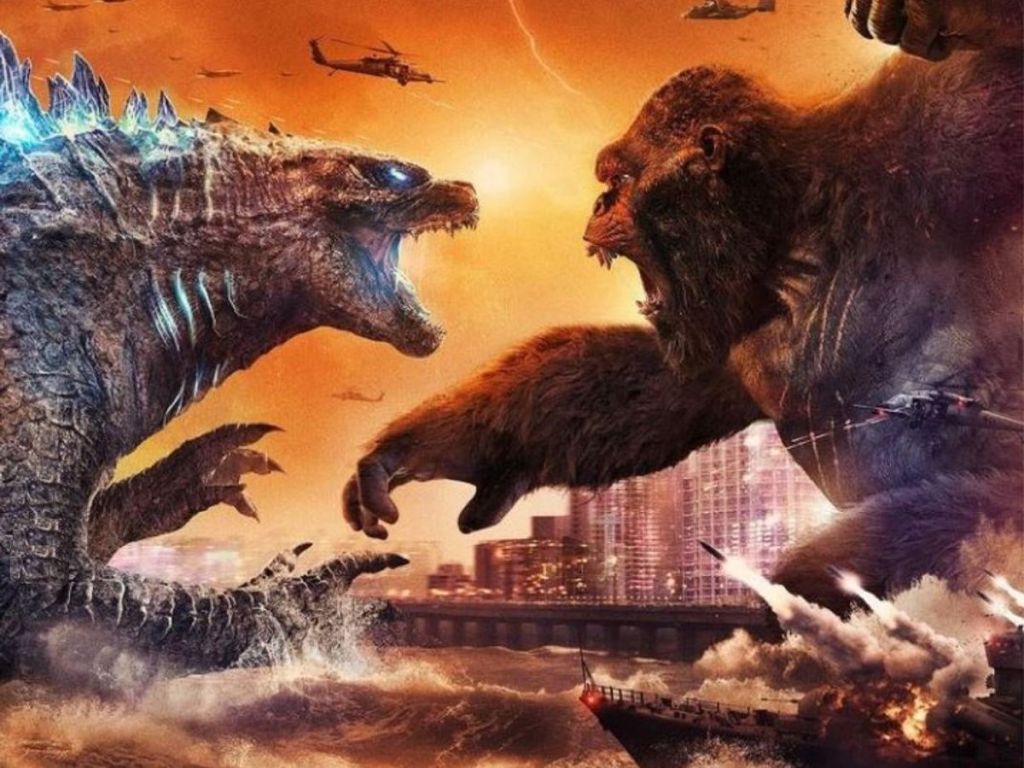
Godzilla vs. Kong (2021)

GODZILLA VS. KONG (2021) ****
Adam Wingard’s Godzilla vs. Kong got it (mostly) right, especially compared with its immediate predecessor Godzilla: King of the Monsters, and that’s because the film wisely spends more time with protagonist Kong and antagonist Godzilla than its banal human characters and their petty dramas and squabbles and simply functional dialogue.

Also, unlike both Godzilla 2014 and King of the Monsters, we get monster fights shot in broad daylight or neon light. All the monsters and their incredible mayhem are clearly visible, and it makes a huge difference from the disappointing King of the Monsters. Thus, it seems that Wingard and Warner Brothers must have caught wind of the complaints about King of the Monsters, that we didn’t see Godzilla and King Ghidorah and Mothra enough and instead we had to squirm our way through too many family drama scenes involving father Kyle Chandler, mother Vera Farmiga, and daughter Millie Bobby Brown just to get to the monsters. Chandler and Brown return for Godzilla vs. Kong, Farmiga does not for an obvious reason from the end of King of the Monsters, and they’re sidelined for Godzilla and Kong, the nominal stars of the movie, just like they should. We have plenty of new human characters in Godzilla vs. Kong, as well, and they’re not all that important, not as important as Mechagodzilla anyway. Monsters rule Godzilla vs. Kong.

In other words, Godzilla vs. Kong gave me a damn good time at the movies.

I’ve read and heard complaints that Godzilla vs. Kong features too many ridiculous and just plain inexplicable plot elements and developments. What? No way! That’s what I wanted more from Godzilla ’14 and King of the Monsters, to just be silly and ridiculous occasionally and display a lighter touch, esp. King of the Monsters.

The best Godzilla movies work for different reasons: The original 1954 classic has a darker, somber tone unlike any other Godzilla and introduces one of the great movie monsters; Godzilla vs. Hedorah (1971) and Godzilla vs. King Ghidorah (1991) are off-the-wall and so far off-the-wall they could be in another house; Godzilla ’14 gave us a serious Godzilla movie with legitimate actors and it took many of us by surprise, especially with memories of the previous American Godzilla picture.

I’ve watched most all of the 36 Godzilla films — 32 from Japan’s Toho Studios, four from America — and I currently recommend 28 of them, except for Godzilla vs. Gigan (a close miss), All Monsters Attack and Son of Godzilla, and the 1998 Godzilla, the absolute bottom-of-the-barrel cinematic dregs from Roland Emmerich and Dean Devlin that should have been fed to the Smog Monster.

We’ve had many fewer Kong movies over the years, but I’ve loved most of them. The 1933 original remains one of my touchstone movie experiences and it’s something that I am compelled to put on every once in a while just to be dazzled and amazed all over again. I’ll enthusiastically or vehemently defend the 1976 and 2005 remakes, the 1933 sequel could have been so much greater had it not been rushed into release during the same calendar year as the original film, I’ve not seen King Kong Lives from 1986, and I enjoyed Kong: Skull Island more than King of the Monsters, though go figure I gave them both the same three-star rating. Okay, okay, Skull Island edges closer to three-and-a-half and King of the Monsters two-and-a-half, but who needs all that nuance. Apparently, there’s 12 films overall in the King Kong franchise, including the Toho productions King Kong vs. Godzilla and King Kong Escapes. I love King Kong Escapes for most of the reasons I love Godzilla vs. Hedorah and Godzilla vs. King Ghidorah, and they’re all gloriously ridiculous and preposterous. Quite frankly, I wouldn’t have it any other way.

What better space than here and better time than now to put in a word for Marv Newland’s 1969 classic animated short Bambi Meets Godzilla and King Kong knockoff films King Kung Fu and the Shaw Brothers’ The Mighty Peking Man, the former the only monster movie filmed in Wichita, Kansas, and the latter comes to us from dudes known for The One-Armed Swordsman and Five Fingers of Death though they also brought us The Super Inframan and Hammer co-production The Legend of the 7 Golden Vampires. We’re still giving the middle finger to A*P*E and I would be remiss to not mention The Most Dangerous Game from 1932 that was filmed on some of the same sets as King Kong and includes King Kong stars Fay Wray and Robert Armstrong in a dangerous adventure saga on an island and Mighty Joe Young from 1949 with the same creative team as King Kong — Merian C. Cooper and Ernest B. Schoedsack — as well as Armstrong, splendid work from The Lost World and King Kong special effects pioneer Willis O’Brien (assisted by Ray Harryhausen), and a surprisingly touching and involving friendship at the heart of the picture.

The original King Kong vs. Godzilla needed upgraded because, let’s face it, its success or failure hinges on whether or not viewers embrace or reject the cheesy special effects, the preposterous plot, the horrific dubbing (at least in the American version). On first viewing, I rejected King Kong vs. Godzilla yet I’ve warmed to it just a little bit more every time on subsequent viewings. I watched it as the start of a mini-marathon the night before seeing Godzilla vs. Kong in theaters and it remained good, solid fun. Still, though, it’s not some masterpiece that should never be remade and remodeled, like, for example, Psycho (oops, Gus Van Sant didn’t get that memo) and 2001.

I appreciate the nods that Godzilla vs. Kong makes to King Kong vs. Godzilla and King Kong Escapes (I hope a future installment makes room for Mechani-Kong), as well as other elements seen before during Pacific Rim and Tron. Guess what? I have enjoyed Pacific Rim and Tron, films which their critics have dismissed for being cheesy, as well and Godzilla vs. Kong joins their ranks.

— BONUS: I read three reviews of Godzilla vs. Kong before seeing the movie. Two of them reminded me that Emmerich and Devlin inserted characters based on Roger Ebert and Gene Siskel in their Godzilla, but they didn’t have the guts or the nuts to have Mayor Ebert and Gene stomped out by their bad CGI monster.

You don’t even have to read the full review by Armond White to feel like saying Lighten up, Francis. On Apr. 2, White proclaimed Godzilla vs. Kong to be the Shiny Dud of the Week, because it (in White’s words) cheapens the moviegoing habit thru mindless spectacle and shameless formula. Several hours later, White shared his review again and hyped it, If you have a mind, Godzilla vs. Kong is not the movie for you. Ah, it’s mindless entertainment, I see, but, hey wait, my prefrontal and limbic regions of the neocortex, particularly the orbitofrontal region of the prefrontal cortex, anterior cingulate cortex, and the insular cortex, especially object to White’s review.

Web-based film critic James Berardinelli finished his review, I wonder how my eight-year-old self would have reacted to Godzilla vs. Kong. There was a time when I gobbled up anything with monsters, irrespective of the quality of special effects. I didn’t care about the level of destruction and took it as a necessity that the movie would sometimes become bogged down by focusing on underdeveloped humans and their silly concerns. I suspect I might have loved this film in all its overproduced glory. But what works for an eight-year-old doesn’t always work for someone who has evolved to expect more.

Personally, the 42-year-old me is ecstatic the 38-year-old director Wingard and the screenwriting team of 41-year-old Eric Pearson and presumably-40ish-year-old Max Borenstein decided to focus more on Kong and Godzilla and less on inane humans. They could have gone even further. I’d love a Jurassic Park movie, for example, to feature only dinosaurs and prehistoric life — no banal or venal human beings to muddle and bungle it all up — and this ideal dinosaur movie would be made in the style of Luis Bunuel’s The Phantom of Liberty and Richard Linklater’s Slacker.

I find myself closer to Matt Zoller Seitz’s rave on RogerEbert.com, which had me at Godzilla vs. Kong is a crowd-pleasing, smash-’em-up monster flick and a straight-up action picture par excellence. It is a fairy tale and a science-fiction exploration film, a Western, a pro wrestling extravaganza, a conspiracy thriller, a Frankenstein movie, a heartwarming drama about animals and their human pals, and, in spots, a voluptuously wacky spectacle that plays as if the creation sequence in The Tree of Life had been subcontracted to the makers of Yellow Submarine.

Yeah, Godzilla vs. Kong got it about 90 percent right.
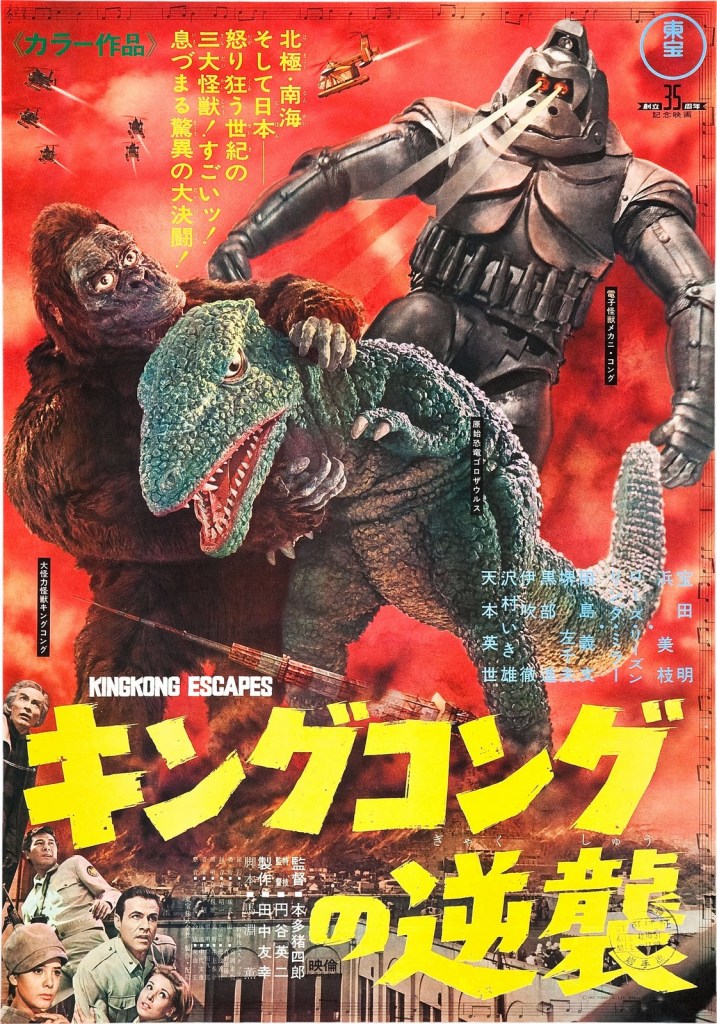
King Kong Escapes (1967)

KING KONG ESCAPES (1967) ****
I must be a sucker for movies like King Kong Escapes, but I just can’t help myself when it features so many awesome characters, plot details, and scenes.

Of course, we have the title character who’s obviously back from King Kong vs. Godzilla, one of Japan’s biggest Solid Gold hits of the early ’60s.

King Kong Escapes, a Toho Studios and Rankin/Bass Productions co-production, topped King Kong vs. Godzilla for me and I’d like to share how it did just that.

Not only do we have the iconic man-in-a-suit Kong, rather than the Willis O’Brien stop motion Kong from the immortal King Kong, the one that started it all, but we have Mechani-Kong, a giant robot double of Kong that first appeared in the 1966 animated TV series The King Kong Show (hence the Rankin/Bass involvement) and returned for live-action duty in King Kong Escapes.

King Kong Escapes also gives us Gorosaurus and a giant sea serpent, and Kong battles them near their home Mondo Island. See, Kong’s become obviously smitten with the lovely nurse Susan Watson (Linda Miller) and he’ll take on any beast to protect her. She holds sway on the big lug, and that naturally puts her life in danger from the bad guys. Kong saves her several times over the course of a 100-minute spectacular. All in a day’s work.

I believe it’s the human villains who put King Kong Escapes over into greatness for me — the evil mad scientist Dr. Who (not that Doctor Who) and the shady representative of an unknown Asian nation, Madame Piranha. She’s also called Madame X, but I’m sticking with Madame Piranha because I like that name better and she’s played by the pretty Mie Hama. 1967 proved to be a vintage year for Hama, who turned 24 that year and played Kissy Suzuki in the fifth James Bond film, You Only Live Twice. I believe Madame Piranha wins over Kissy Suzuki and ditto for their respective films. Madame Piranha, in fact, belongs right up there with Pussy Galore and Princess Dragon Mom.

Anyway, back to Dr. Who, played by the veteran character actor Hideyo Amamoto (1926-2003). He’s a cross between, I don’t know, Dracula (it’s the cape) and a Bond megalomaniac. He’s one of those characters that we absolutely love to hate and we savor his inevitable demise late in the picture. He’s so vain, so darn smart, so reckless, so persistent, so evil. Dr. Who created Mechani-Kong and when it fails him about 30 minutes into King Kong Escapes, Dr. Who captures first Kong and then Susan Watson, Commander Carl Nelson (Rhodes Reason), and Lt. Commander Jiro Nomura (Akira Takarada), Watson’s human interest. Needless to say, Kong and Mechani-Kong and Watson and gang escape from Dr. Who and his henchmen, which leads us to a battle royale atop Tokyo Tower.

I admit upfront that King Kong Escapes is silly, preposterous, and outright bloody ridiculous, in everything from its plot to its English dubbing, but it came as such a rejuvenation to my spirit after I watched The Gorilla, The Screaming Skull, The Robot vs. The Aztec Mummy, and The Curse of the Aztec Mummy earlier that same day, four exploitation films that if added together still did not provide as much entertainment value as King Kong Escapes.

Schlock (1973)

SCHLOCK

SCHLOCK (1973) ***

Schlock (/SHläk/): cheap or inferior goods or material; trash.

For quite some time as I watched it, I could not make heads or tails out of John Landis’ 1973 extremely low-budget feature film debut SCHLOCK.

I mean, I understood that it’s a good old-fashioned spoof of good old-fashioned monster movies, sure, from the moment I read a plot synopsis and that its title speaks louder than a thousand words, you bet, but it kept veering between tones. Our title character (played by none other than Landis himself) seemed menacing and imposing one moment and then funny the very next. He’s the missing link and “The Banana Monster” and the poster promises “A love stronger than KING KONG.”

There was one sequence though in particular that changed my tune about SCHLOCK.

Schlock (blanking on his full name right now) watches DINOSAURUS! from 1960 and THE BLOB from 1958 in a movie theater, both classics directed by Irvin S. Yeaworth and produced by SCHLOCK producer Jack H. Harris. We see choice scenes from both films, like a dinosaur fight and that classic moment in THE BLOB when its title character attacks first the projectionist and then the patrons to rudely interrupt the showing of DAUGHTER OF HORROR (renamed from DEMENTIA). Showing THE BLOB also provided Landis an opportunity to work Steven, er, Steve McQueen into his little $60,000 movie.

Not only that, but Schlock learns about vending machines and cleans out a candy counter. Bet he loved them jujubes with his sharp teeth. I love what Schlock does when this incredibly tall man sits in the seat one row in front of him. If only life could be that way. Then again, proper authorities cannot handle Schlock.

At the point Schlock went movie watching, I learned to stop worrying and like (not love) SCHLOCK.

Landis’ love for SEE YOU NEXT WEDNESDAY starts out early in his directorial career, by promoting it with “First, BIRTH OF A NATION! Then, GONE WITH THE WIND! 2001: A SPACE ODYSSEY! LOVE STORY! SEE YOU NEXT WEDNESDAY! And now … SCHLOCK!” A line spoken in 2001 turned into a running gag throughout most Landis films and even the music video for Michael Jackson’s “Thriller.”

So many low-budget movies have a great back story.

Landis and crew, including makeup artist Rick Baker early in his career, made SCHLOCK during 12 days in the summer of 1971, but it was not released until 1973. Johnny Carson found out about the film and he booked Landis on “The Tonight Show.” With this spotlight opportunity, Landis showed clips from SCHLOCK, which helped the first-time director find a distributor in Jack H. Harris Enterprises. Harris put up $10,000 if Landis put 10 minutes of running time on SCHLOCK.

I enjoyed SCHLOCK every bit as much as the Joan Crawford classic TROG (1970) and the similarly low-budget KING KUNG FU (1976).

Of course, I did not forget, but I will see you next Wednesday.

King Kung Fu (1976)

KING KUNG FU (1976) Three stars

The Empire State Building, completed just a couple years earlier, played a key role in the 1933 classic KING KONG. At this very moment, we can picture Kong fighting off them darn airplanes from the highest spot in the modern world. Very few endings in movie history can even approach the final minutes in KING KONG. Remains awesome nearly 90 years later.

Meanwhile, our gorilla King Kung Fu takes shapely Pizza Hut waitress Rae Fay to the top of the Holiday Inn Plaza, the tallest building in Wichita at a majestic height of 262 feet, for the grand finale of KING KUNG FU. King Kung Fu battles a stop-motion helicopter piloted by a police captain with a bad John Wayne impersonation. Awesome, in a completely different way.

You win some, you lose some, and often times it seems like Kansas loses on the cultural front, while New York City wins and wins again and again and wins forever more.

Both the Empire State and the Holiday Inn are no longer their cities’ tallest buildings. Heck, the latter is not even the Holiday Inn any more, it’s the 250 Douglas Place Apartments (a.k.a. the Garvey Center). They both are doing quite well for themselves, however, with the Empire State Building in the news in late 2019 for $165 million renovation and being a top tourist destination.

The duo of producer Bob Walterscheid and director Lance D. Hayes started filming KING KUNG FU in 1974 and finished in 1976, but it took another 11 years for Walterscheid to wrangle up the necessary funds to complete the editing on this half-King Kong, half-Kung Fu spoof that has its tongue planted firmly within its cheek. Hell, maybe every cheek in Wichita.

I watched the Korean KING KONG rip-off A*P*E and KING KUNG FU within basically the same 24-hour period.

Objectively, both are “bad” movies, but there’s a world of difference in what both achieve.

A*P*E plays exactly like a cheap, cynical KING KONG rip-off and it’s quite telling that its most famous scene is of the title character flipping the bird.

KING KUNG FU, meanwhile, feels more like a labor of love, an affectionate tribute to King Kong and Kung Fu. Plus, it has this undeniable goofball charm as it tries every lowbrow gag, at least one per minute. Most fail, others succeed, but that’s part and parcel with any sense of humor. I laughed out loud a few times during KING KUNG FU and that’s definitely far more than what I can say for A*P*E.

I laughed at the “Simian Scope” gag at the beginning of KING KUNG FU. This is the first and last movie filmed in “Simian Scope.” We’ve had many variations on CinemaScope over the years: The Shaw Brothers’ “Shaw Scope” being my all-time favorite. Also worth seeking out: The Shaw Brothers released their own take on KING KONG in 1977, MIGHTY PEKING MAN.

I laughed at the John Wayne impersonation, which eradicates the whole “bad” judgment I wrote a few paragraphs back about that impersonation since I believe it was intended to be funny … and … (for a third time) I laughed. We could have used even more scenes with this character played by Tom Leahy, a favorite in the Wichita area for his many years of work in radio and television. Since we have a subordinate officer surnamed Pilgrim, well, you can already guess about half of the dialogue from Mr. Leahy as Captain J.W. Duke. Leahy died in 2010.

The plot: Two would-be reporters Bo (Billy Schwartz) and Herman (Tim McGill) hatch a master plan to free King Kung Fu, a great big gorilla from China whose goodwill tour of the United States stops in Wichita and the Sedgwick County Zoo. Of course, having seen KING KONG, Bo and Herman bait King Kung Fu with Rae Fay (not Fay Wray or Link Wray, for that matter). Sounds like Bo and Herman want to make a movie, one with a happy ending.

Unfortunately, the movie drags just a little bit in the middle section. Plain and simple, it takes way too long for King Kung Fu to be unleashed on Wichita. We get too many scenes with Bo and Herman and their slapstick shenanigans, as the filmmakers seem to have forgotten their own title. Granted, Bo and Herman are likeable oddballs, but they do push endurance levels to breaking point with their schtick in this middle section.

Because we want to see King Kung Fu wreak good-natured havoc on the Old Cowtown Museum, the Joyland Amusement Park (no longer in operation), and Lawrence-Dumont Stadium (demolished for a new facility that will host a new Triple-A franchise named The Wichita Wind Surge, beginning 2020). These scenes are worth their weight in gold.

Never mind Bo’s line, “… Me as the karater and him as the karatee.”

Or the genius in Washington who says, “As you can see, Wichita is located in the center of this great country of ours and it means quite simply we have him surrounded.” That look on his face when he says “It means quite simply we have him surrounded,” I mean, wow, if you watch it now it would be great preparation for the next electoral season.

Guess it should be mentioned King Kung Fu utters dialogue like “I gotta make like a banana and split.” I once told somebody, “Why don’t you make like Michael Jackson and just beat it!”

Believe it or not, KING KUNG FU received a ‘G’ rating. Not many movies are ‘G.’ The Washington Post ran “Rated ‘G’ — For Gone?” in 1992, because a ‘G’ rating became at some point a kiss of death just like X or NC-17 on the other extreme of taste. Disney animated movies survive a ‘G,’ no problem, but little else can break through the stigma associated with ‘G.’

This ‘G’ rating was not a mistake for KING KUNG FU, like, for example, it was for the 1968 Hammer film DRACULA HAS RISEN FROM THE GRAVE. There’s no blood in KING KUNG FU.

You might never look at Wichita quite the same way again after seeing KING KUNG FU.

A*P*E (1976)

A*P*E (1976) One-half star

Finally, now I can mark this one off the bucket list.

I have wanted to watch A*P*E ever since I bought an used copy of John Wilson’s “The Official Razzie Movie Guide” more than 12 years ago. The infamous shot of the man-in-a-suit ape flying the middle finger graces the front cover of the book and of course, I surrendered the hardly-earned on that beautiful book. Wilson wrote of the ape suit, “(It) looks more like your grandmother’s lamb’s wool coat collar than an actual simian.”

On December 2, 2019, a date that will live in Internet infamy, I watched A*P*E and it was even worse than I thought possible, believe it or not. Not sure why it even received a half-star.

This joint South Korean and American production cost an incredible $23,000, including a reported $1,200 for miniatures, and they filmed this 87-minute craptacular in a mere 14 days. Please keep in mind that Robert Rodriguez made EL MARIACHI for $7,000, so I am not knocking A*P*E because of its budget.

It was a quickie exploitation picture designed to cash in on the much hyped KING KONG released in late 1976. A*P*E originally announced itself as THE NEW KING KONG, but RKO filed a $1.5 million suit against Kukje Movies, the Lee Ming Film Co., and Worldwide Entertainment, the producers of A*P*E. They changed the title to APE (we are no longer stylizing a title of a movie with very, very, very little style) and added the tag “Not to be confused with KING KONG.”

APE (a.k.a. “Attacking Primate monstEr”) is so bad that it makes KING KONG ‘76 look much, much, much better.

Let’s start taking down APE flaw by flaw.

Prerequisite screen ingenue Marilyn Baker (Joanna Kerns) and reporter Tom Rose (Rod Arrants) suck face through a lot of APE. I mean, get a room, for crying out loud. When they’re not sucking face, their mouths are utilized for uttering mushy-mouthed dialogue so bad that we prefer them sucking face.

There’s a scene where Miss Baker screams for what feels like an eternity. She probably screams more during this scene than Fay Wray, Jessica Lange, and Naomi Watts did in all their scenes combined in their respective KONG movies.

Between Miss Baker’s screams and two Korean children laughing for another eternity, I was blessed to not have a pencil nearby, because it’s quite possible that I would have grabbed it and jabbed both my eardrums until I could no longer hear.

I love how when they’re evacuating South Korean cities, the voice over the loud speakers speaks English. Guess that’s how imperialism works and this cheap KING KONG rip-off was the cinematic wing.

I shall regroup here and move away from imperialism. They filmed APE in 3-D and even if we did not know that coming in, we could figure it out for ourselves very quickly considering all the objects coming at us, including arrows, boulders, and that infamous middle finger.

The title character not only looks like a shoddy rug, but it is very distracting when he changes in size from scene-to-scene. He’s supposed to be 36 feet tall, but we don’t believe it for a single fleeting second.

In an early scene, the ape kills a shark, just another jab at JAWS. APE joins a club that includes GIANT SPIDER INVASION, THE HILLS HAVE EYES, and ORCA THE KILLER WHALE.

APE arrived in theaters in October ‘76, beating KING KONG by two months. That’s the only thing APE had on KING KONG.

King Kong vs. Godzilla (1963)

KING KONG VS. GODZILLA

KING KONG VS. GODZILLA (1963) Three stars

The Japanese champion Godzilla had last appeared in GODZILLA RAIDS AGAIN in 1955 or in the American version GIGANTIS, THE FIRE MONSTER in 1959.

The American champion King Kong (guess we claim the big lug, though we kidnapped him from Skull Island and brought him to the Big Apple) had last appeared in SON OF KONG in 1933. Yes, they rushed out a sequel nine months after the seminal KING KONG.

With a title like KING KONG VS. GODZILLA, maybe we can take a guess at the content of the third GODZILLA and third KING KONG film. Three is the magic number, right? At least it was in Japan, where its success at the box office inspired Toho to continue the Godzilla series.

Both monsters appear in color for the first time.

Like a lot of Jackie Chan films, the Godzilla films appeared in radically different forms when they invaded America after their original release.

It started with the very first GODZILLA in 1954, released two years later in America as GODZILLA, KING OF THE MONSTERS. This new version excised 16 minutes of footage from the original, mainly the political, social, and anti-nuclear themes so vital to the Japanese version. Remember that GODZILLA came out less than a decade after Hiroshima and Nagasaki. The American producers sponsored new footage and inserted American journalist Steve Martin (Raymond Burr), used mostly in flashbacks and voice-over narration. Japanese-American actors and look-alikes had to be used to attempt to make it seem like Martin had been in the original film. Martin speaks into a tape recorder, “George, here in Tokyo, time has been turned back two million years. This is my report as it happens. The prehistoric monster the Japanese call ‘Godzilla’ has just walked out of Tokyo Bay. He’s as tall as a 30-story building.”

In America, KING KONG VS. GODZILLA follows that KING OF THE MONSTERS format, as we get a series of talking head scenes before we finally get down to the heavy-duty monster battle royal in the let’s say last half. Several years ago, I wrote a negative review of KING KONG VS. GODZILLA because I wanted to yell at United Nations reporter Eric Carter to shut his big fat trap and just let the title characters fight. On the latest watch or two, after purchasing a VHS copy (GoodTimes big box, no less, with a blurb from Leonard Maltin, “Above average special effects”) recently, I enjoyed the film a lot more than I had before.

Now, I think of the Eric Carter and the blah, blah, blah gang as the wrestling commentators on a big pay-per-view hyping up Hulk Hogan vs. Andre the Giant, for example. King Kong vs. Godzilla and Hulk Hogan vs. Andre the Giant have equal stature in my estimation.

I just love monsters fighting and the Godzilla films delivered that for nearly a 15-year period beginning with KING KONG VS. GODZILLA and continuing through Ghidorah, Mothra, Rodan, Ebirah, the Smog Monster, Gigan, Megalon, and Mechagodzilla. Technically, it started with GODZILLA RAIDS AGAIN when Godzilla fought Anguirus … or when Kong battled a T-Rex in the original KONG.

What was the genesis of KING KONG VS. GODZILLA?

Stop motion animator pioneer Willis O’Brien (1886-1962), who did the work for both KONG films, created a story outline where Kong battled Frankenstein’s Monster. O’Brien gave the outline to producer John Beck to develop a project, but Beck took the project instead to Toho behind O’Brien’s back. The rest is history, including Frankenstein’s Monster.

Some of us are probably thinking right about now that it does not seem like a fair fight between Kong and Godzilla. Over the years, Godzilla’s size has varied greatly from 164 feet tall in 1954 to 492 feet tall 60 years later. Kong, meanwhile, stands at 24 feet at his highest height in 1933. KING KONG VS. GODZILLA makes Kong 147 feet tall.

Machine gun fire topples Kong from the Empire State Building, while Godzilla seems virtually indestructible despite the best efforts of the military. Well, let’s just say that lightning gives Kong incredible powers; later in the Godzilla series, lightning would have the same effect on Godzilla. Maybe one day we’ll have a film combining Frankenstein’s Monster, Godzilla, King Kong, and Jason Voorhees, and we’ll call it LIGHTNING STRIKES.

A legend grew up around KING KONG VS. GODZILLA that Kong won in the American version and Godzilla won in the Japanese version. That’s not true. I mean, for crying out loud, Kong gets top billing in the title.

King Kong (1976)

KING KONG 1976

KING KONG (1976) Three-and-a-half stars
Of course this 1976 KING KONG cannot hold a candle to the 1933 version, one of the all-time screen classics.

If and when you and I can get past that fact, admittedly not an easy hurdle, the 1976 version stands out for being a great entertainment.

Jeff Bridges and Jessica Lange are improvements over Bruce Cabot and Fay Wray, respectively, in the male and female leads and Charles Grodin’s not far below what Robert Armstrong did in a similar role.

Of course, you can immediately tell when this movie was made by all the contemporaneous dialogue (especially from Lange) and Grodin plays an executive with Petrox Corporation, a fictional American oil company referencing the “pet rock” phenomenon. This KONG is more bound to 1976 than the original is to 1933.

Beset with production issues of a wide variety, including a complicated legal battle between Paramount, Universal, RKO, and the Cooper estate before filming even started (at one point, both Paramount and Universal had KONG projects lined up), and a first-time leading lady, as well as practical effects that often look more dated than what Willis O’Brien accomplished in 1933, KONG 1976 still works on a basic level.

It is fun.

The stories around the film, though, are more interesting than the finished product and help explain why the hype for the film took on epic proportions before its December 17 premiere.

Italian producer Dino DeLaurentiis (1919-2010) had the Carl Denham quotes in real life: “No one cry when JAWS die,” he said in Time. “But when the monkey die, people gonna cry. Intellectuals gonna love Kong. Even film buffs who love the first Kong gonna love ours.”

Or how about this one about Barbra Streisand told by Roger Ebert: “It’s-a no good, have two monsters in one movie.”

Unfortunately, when Meryl Streep auditioned for the Jessica Lange part, Dino said to his son in Italian that she was “too ugly” for the role; Streep understood Italian and replied in Italian to Dino, “I’m sorry I’m not beautiful enough to be in KING KONG.” We are printing legends, and that only seems appropriate for KING KONG.

Dino talked more smack about JAWS with ORCA THE KILLER WHALE (1977).

Gotta love Dino, whose mouth bit off more than his productions could chew.

Rather than Universal’s competing KONG movie (not released until Peter Jackson’s remake in 2005), the public first received A*P*E, an American / South Korean co-production with its Grade Z special effects, an early appearance for future TV mother Joanna (“Growing Pains”) Kerns, and an infamous shot where the ape uses the middle finger to show his disgust with the helicopters shooting at him.

Either that or he’s just showing his disgust at being trapped in that damn gorilla suit in a shitty movie.

A*P*E would later be topped, in the KING KONG ripoff department, by the Shaw Brothers’ MIGHTY PEKING MAN, the best of the King Kong ripoffs.

There’s also KING KUNG FU from 1976, where a gorilla trained in martial arts wreaks havoc on Wichita, Kansas. Financial constraints forced the makers into not being able to finish their film until 1987.

A*P*E invaded movie screens in October 1976, beating DeLaurentiis’ KONG by a good two months. MIGHTY PEKING MAN came out April 10, 1977, and Quentin Tarantino’s Rolling Thunder Pictures re-released the film on April 23, 1999.

Carlo Rambaldi, Glen Robinson, and Frank Van der Veer won a Special Achievement Award from the Academy of Motion Picture Arts and Sciences for the visual effects in KING KONG, believe it or not.

Legendary make-up artist Rick Baker played Kong, or he’s the man in the ape suit. The original plan had been for KONG ’76 to feature a 40-foot high mechanical ape, but that mechanical monster worked even less than Bruce the Shark in JAWS. JAWS director Steven Spielberg worked around the frequent mechanical failure to make an even better film than if the mechanical shark had been fully operational.

That’s not exactly the case with KONG ’76, partially because musical cues would not be a proper substitute for an ape like John Williams’ musical score proved to be for the shark or even Harry Manfredini’s score for the psycho killer in FRIDAY THE 13TH.

In other words, you have to see the ape.

“KING KONG offered the one chance to do a really perfect gorilla suit,” Baker said. “With the money and the time, it could have been outstanding. Unfortunately, it wasn’t. There were compromises and enforced deadlines.”

Let’s face it, KONG director John Guillermin, he’s no Spielberg.

At the same time, though, I give KONG ’76 and JAWS both three-and-a-half stars. Why?

A) Because life (and my brain) work in mysterious ways.

B) Because star ratings are basically arbitrary.

C) Because both films tap into the same primordial appeal and work as great entertainments for a couple hours each.