The Car (1977)

THE CAR

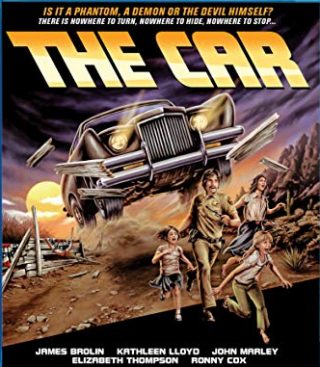
THE CAR (1977) *

The Devil and cars were huge in the movies of the 1970s.

Building on the momentum of ROSEMARY’S BABY in 1968, we saw THE BROTHERHOOD OF SATAN, THE EXORCIST (the biggest hit of them all that spawned many imitators and successors), THE DEVIL’S RAIN, THE DEVIL WITHIN HER, BEYOND THE DOOR, BEYOND THE DOOR II, THE OMEN and DAMIEN: OMEN II, and THE AMITYVILLE HORROR.

As far as cars, we had TWO-LANE BLACKTOP, DUEL, THE SUGARLAND EXPRESS, GONE IN 60 SECONDS, DEATH RACE 2000, THE GUMBALL RALLY, EAT MY DUST, GRAND THEFT AUTO, and SMOKEY AND THE BANDIT.

THE CAR, directed by Elliot Silverstein and distributed by Universal, combines The Devil and cars to make one stupefying, awful, patently ridiculous horror movie.

Yes, that’s right, a homicidal maniac automobile seemingly possessed … or just having a really, really, really bad day. Maybe the latter was just me watching THE CAR.

This movie just doesn’t know when to quit and it starts early with the murders of two bicycling teenagers in the majestic desert of Utah. We’re talking first few minutes and the film wastes absolutely no time in establishing its basic pattern. Maybe I should have turned off the subtitles, because they provided the evocative forewarning “Ominous instrumental music.” I knew the bludgeoning music was coming, though, because I’ve seen a movie or two before, especially a horror movie. Ominous instrumental music indeed, especially when it sounds like 50 horror film musical scores piled up into one super bad score. Forget the killer car next time, I want the movie about the killer musical score. Tagline: “They could not believe their ears, until it was too late. … THE MUSICAL SCORE FROM HELL will make your eardrums bleed. Coming soon to a theater near you.”

Every 10-15 minutes, at least, we are beaten with a ridiculous death scene or, barring that, a scene of peril just for variety. That ominous instrumental music, all them close-ups of the customized 1971 Lincoln Continental Mark III (built by George Barris, who previously brought us the Batmobile for the 1966 BATMAN), and Silverstein’s overall poor handling of action. At times, the vehicles look like they’re being artificially sped up.

Unfortunately, in between those violent scenes, we are served a steady diet of banalities and unpleasantries, only adding insult to injury.

For example, just about every scene with veteran character actor R.G. Armstrong (1917-2012) applies the unpleasant extra thick. He beats on his wife and insults just about everybody in sight. Never mind his slurs against Native American character Chas (played by Henry O’Brien in his final feature film). He’s a nasty old man. Honestly, why is his character Amos not killed? You’re right, it must have something to do with the explosives needed for the grand finale … and, before that, Sheriff Everett (John Marley) needs to be killed rather than Amos so Wade (James Brolin, who seems to be hired when Sam Elliott is unavailable), our main human protagonist, can take charge. It all makes sense.

Our title character is maddening to the nth degree and we have already touched on why, but let’s pursue it more.

Sure, it can kill a main character by driving through her house in the ultimate display of supernatural power. This character, Lauren (Kathleen Lloyd), the lover of the protagonist, turns her back to the window as she speaks to Wade on the phone. This means, however, that we can see the car coming straight for her through her window. This scene is supposed to be a highlight, a real heart breaker or at least a real tense moment since we see the murderous car well before her, but, like virtually every other scene in THE CAR, it’s laughably bad in a bad way.

Just like the scene that establishes the car’s need for revenge against Lauren. Safe on the hollowed grounds of a cemetery, Lauren really lets our title character have it, resorting to chickenshit and a son of a bitch. That’s obviously going too far, even before she tosses a tree branch at it. She asked for her auto demise. I should mention that she’s a school teacher whose marching band students were chased into that cemetery by you know who. We have seen that scene archetype before, namely in Alfred Hitchcock’s 1963 classic THE BIRDS. THE CAR just drags this entire sequence out.

Then again, dragging it out describes the entire movie.

Our title character is especially maddening because it wastes two perfect opportunities to flatten Wade like a pancake. What’s that all about? We get the feeling that were it any other character and not the protagonist, it would be “Sayonara, sucker!” The first opportunity even gives us a cut from Wade in danger in the desert to being safe in a hospital bed. I hate cheap tricks like that.

Was there anything I liked about THE CAR? Fleeting moments, like glimpses of the Utah scenery as seen through filming locations St. George, Snow Canyon, Zion National Park, Glen Canyon, Hurricane, the Mount Carmel Tunnel, and Kanab. I would have preferred a 96-minute nature documentary on this area over THE CAR.

I knew I was in trouble when THE CAR starts out with a quote from Church of Satan leader Anton LaVey (1930-97) and The Satanic Bible.

LaVey also previously had a hand in the making of THE DEVIL’S RAIN, another godawful horror movie.

Sometimes, it seems like even the Devil just can’t buy a break.

Trog (1970)

TROG

TROG (1970) ***

Joan Crawford began her long cinematic career in 1925 as the double for Norma Shearer in LADY OF THE NIGHT.

She appeared in small roles in Erich von Stroheim’s THE MERRY WIDOW, King Vidor’s THE BIG PARADE, and Fred Niblo’s BEN-HUR: A TALE OF THE CHRIST and first made her fame in Tod Browning’s THE UNKNOWN, her 20th screen credit already by 1927.

Crawford survived the transition from silent to sound and she won the Academy Award for Best Actress for her performance in the 1945 film noir MILDRED PIERCE.

That brings us to her final screen appearance, TROG.

To the best of all knowledge, Crawford (1906-77) is the only Academy Award winner to star in a caveman movie and speak lines “Please, Trog, let me have the girl!” and “Music hath charms that soothes the savage beast.” Aben Kandel wrote the screenplay and Peter Bryan and John Gilling received credit for original story.

Granted, she’s also the only Academy Award winner to star in a Blue Öyster Cult song, a ditty inspired by the book and the film MOMMIE DEAREST written by Crawford’s far beyond estranged daughter Christina. The boys turned Joan Crawford into more of a monster than Godzilla. That part in the song where Mommie Dearest is calling for bad little Christina, it just doesn’t get much better than that in this oh so cruel bitch of a world. “Joan Crawford has risen from the grave,” indeed.

Back on point: I enjoyed TROG a good deal, and it’s one of those films that inspires the very best stories.

Film critic Pauline Kael (1919-2001) wrote, “Joan Crawford plays Stella Dallas with an ape instead of a baby girl. Some actors will do anything to be in movies: she probably would have played the ape.”

Herman Cohen (1925-2002), a producer whose credits include BELA LUGOSI MEETS A BROOKLYN GORILLA and I WAS A TEENAGE WEREWOLF, said that Crawford’s alcoholism raged during TROG and she had 100-proof vodka in her frosted Pepsi Cola glass. He added that Crawford brought four cases of the juice with her to England, because of its unavailability in Merrie Olde. (Speaking of Pepsi, Crawford, once married to the chairman of the board and CEO of Pepsi and then herself a board of the directors member, works in one brief moment of product placement during an early scene.)

Freddie Francis (1917-2007), a two-time Academy Award winner for Best Cinematography for SONS AND LOVERS and GLORY, said that he regretted directing TROG (which he called terrible) and that Crawford had so much trouble remembering her lines they had to resort to using “idiot cards” to get through her scenes.

Former English professional wrestler Joe Cornelius played the title character in TROG and he defended Crawford against those accusations in a 2015 interview with cult film director and fan John Waters after the British Film Institute retrospective of the film.

In the ring, they called Cornelius “The Dazzler.” From the Online World of Wrestling, “What a presence ‘The Dazzler’ made when he entered the ring, the wavy jet black hair, the dazzling smile, the eyebrows! Damn! He had it all, a personality as big as the Royal Albert Hall and ring savvy second to none, he was like a puppet master with strings fastened to the hearts of every member of the audience.”

Guess at this point we should discuss exactly what’s a Trog.

Trog is short for “troglodyte” or a person who lived in a cave, especially in prehistoric times. He’s proclaimed, in promotion of the film, as having the strength of 20 demons, so it makes perfect sense to have Cornelius play the role.

Crawford stars as Dr. Brockton, who of course represents science against those who just want to destroy the “monster.” She wants to reach and teach Mr. Trog. She wants to domesticate “The Missing Link,” half-man and half-ape with a costume borrowed from 2001. These domestication scenes are worth their weight in gold, especially the one when Trog learns how to play catch. “Good boy, Trog!”

Thankfully, for the sake of the movie and its cult following, Crawford does not condescend to her role. She plays it absolutely 100 percent straight and resolutely serious. In other words, Crawford plays it just like she did in MILDRED PIERCE. That makes TROG even funnier than if she just played it winking at the audience the entire time.

Michael Gough (1916-2011) opposes Brockton and Trog from his very first appearance. I doubt Gough used TROG in his audition for Tim Burton’s BATMAN, because his bad manners here as Sam Murdock do not mesh with Alfred Pennyworth, Bruce Wayne’s dedicated butler. We await the fate that waits for Mr. Murdock and it is well worth the wait.

During his attempted domestication, Trog freaks out both at the color red and more upbeat music.

That got me thinking: What if they played Trog the Troggs’ “Love is All Around” from 1967? Just forget about “Wild Thing.” Yes, the Troggs, an English rock band originally called the Troglodytes before the name was shortened, had a huge impact on future noise with their songs covered by Jimi Hendrix, the Buzzcocks, and Hüsker Dü.

Friday the 13th Part VI: Jason Lives (1986)

JASON LIVES

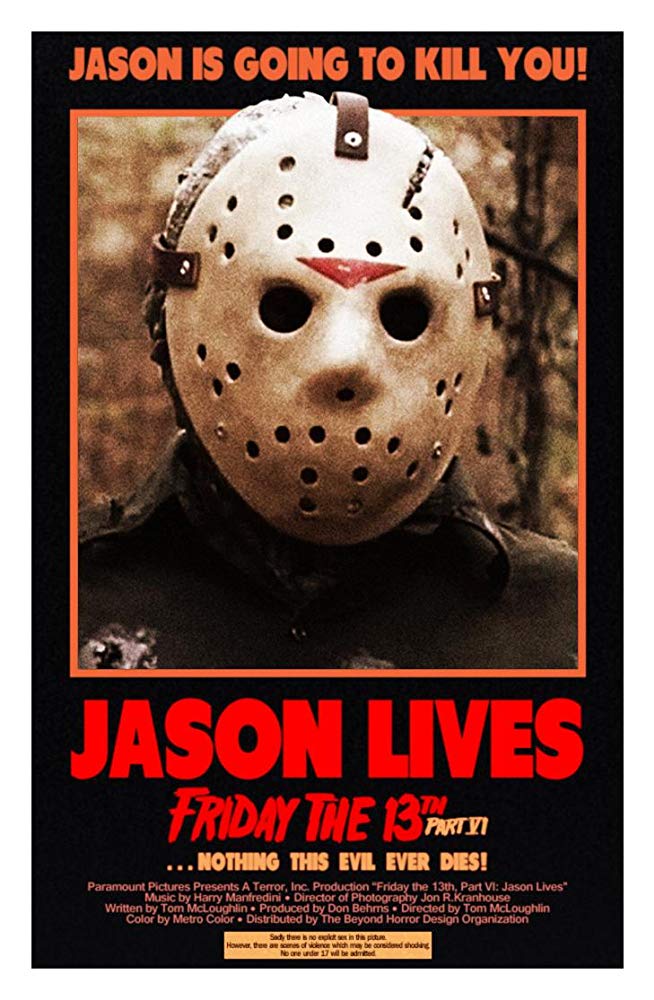
FRIDAY THE 13TH PART VI: JASON LIVES (1986) Three stars

I find the FRIDAY THE 13TH movies that I like the most are the ones with the best sense of humor.

That’s why I’ll call PART VI: JASON LIVES the best film in the entire series, beating out PART III and THE FINAL CHAPTER. JASON LIVES includes several intentionally funny scenes and that helps its 86 minutes go down smoothly.

Director and writer Tom McLoughlin wanted to satirize a slasher movie all while making one, turn Jason into a supernatural zombie, and not simply churn out a carbon copy of the five previous movies in the series. There are moments intended to recall classic horror movies, like the beginning scene in the cemetery echoes the grave robbers at the beginning of FRANKENSTEIN MEETS THE WOLF MAN. Jason’s revival from the dead courtesy lightning also recalls Frankenstein’s Monster.

“I set up a lot of visual gags,” McLoughlin said in the book “A Strange Idea of Entertainment — Conversations with Tom McLoughlin.” “Like when my wife Nancy is killed by Jason. She tries to bribe him, offering him her wallet to keep him from killing her. She’s got money and a credit card in her wallet, and when Jason kills her in this giant mud puddle, the money sinks and the American Express card floats. I held on that shot for a few extra beats because I knew there would always be some joker in the theater that would yell, ‘Don’t leave home without it!’ And someone always did.”

McLoughlin’s background proved to have a strange influence on Jason Voorhees.

“I was recently interviewed about it, and someone said, ‘Your Jason seemed to be much more communicative,’” McLoughlin said. “I said, ‘That’s because I was dealing with a mime character.’ When he sees the motor home bouncing up and down because a couple are having sex in there, Jason just stands there and stares, with his head tilting back and forth — like a dog trying to figure out what’s going on. It got a big laugh. I wasn’t making fun of Jason … I just figured he would be processing what was going on in that motor home. Whenever I find a way to put my mime training to use in storytelling, I do it.”

Marcel Marceau influenced Jason Voorhees. Makes perfect sense to me.

McLoughlin sang in a rock band before he went to Paris to study mime under Marceau. Back in the States, several years later, McLoughlin had a part as the mutant bear monster in the 1979 horror film PROPHECY directed by John (MANCHURIAN CANDIDATE) Frankenheimer. All these experiences seemingly fed McLoughlin more insight into Jason than any other director.

Alice Cooper provided three songs for JASON LIVES:  “Teenage Frankenstein,” “Hard Rock Summer,” and “He’s Back (The Man Behind the Mask).” Unfortunately, they are not classic Alice Cooper songs, a la the four-album period from “I Love It to Death” through “Billion Dollar Babies” when the band cranked out some of the greatest hard rock ever made, but I still enjoy “He’s Back.” SCREAM later made great use of the Alice classic “School’s Out.”

Speaking of SCREAM, apparently screenwriter Kevin Williamson wanted McLoughlin to direct his hot commodity screenplay, before the project ended up with Wes Craven. Williamson told McLoughlin that JASON LIVES and its humor made a huge impact on Williamson during his youth, so much so that it served as one of the inspirational springboards for SCREAM.

There’s a James Bond gun barrel sequence parody, dialogue that breaks the proverbial fourth wall, a camper reading Jean-Paul Sartre’s existentialist play “No Exit,” a camper praying to God for the first (and only) time in the series, and even Jason surprised at his own astonishing strength. Also, for the first and only time in the series, young campers are in attendance at Camp Forest Green, er, Camp Crystal Lake.

“I’ve seen enough horror movies to know any weirdo wearing a mask is never friendly” and “Some folks sure got a strange idea of entertainment” are lines that display how JASON LIVES influenced SCREAM.

The young children, who Jason does not harm, have their moments, as well, especially when one boy asks his little friend, “So, what were you gonna be when you grew up?”

All these words so far and I have not even mentioned protagonist Tommy Jarvis, who figured in THE FINAL CHAPTER, A NEW BEGINNING, and JASON LIVES. He’s responsible for reviving Jason in the opening sequence and Tommy even makes sure to bring that infamous hockey mask with him. Originally, it had been planned for Tommy to become the antagonist, but it was the extremely negative reaction to A NEW BEGINNING and its non-Jason killer which truly brought Jason back from the dead. Tommy never panned out like he should have and part of the problem is that he’s played by three different actors, Corey Feldman (THE FINAL CHAPTER), John Shepherd (A NEW BEGINNING), and Thom Mathews (JASON LIVES).

Anyway, definitely by this point in the series, Jason became the focus of attention and the antihero extraordinaire of the late ‘80s. Dan Bradley played Jason in the paintball massacre sequence, but former soldier C.J. Graham handled the rest of the duties. He’s a lot more interesting than Tommy Jarvis. That’s why the series moved forward with Jason (Kane Hodder the man behind the mask for four more sequels) and without Tommy Jarvis.

Night of the Lepus (1972)

NIGHT OF THE LEPUS (1972) Three stars

Janet Leigh (1927-2004) famously said that she never took another shower after her iconic scene in PSYCHO.

Wonder what she said after her performance in William F. Claxton’s NIGHT OF THE LEPUS.

Reportedly, Leigh said “I’ve forgotten as much as I could about that picture.”

Well, Claxton ain’t quite Hitchcock and NIGHT OF THE LEPUS ain’t quite PSYCHO, but this 1972 picture certainly deserves a far better reputation. Like PLAN 9 FROM OUTER SPACE, it’s simply just too darn entertaining to be anywhere near the “worst movie ever made.”

After all, it’s not every day that you see a bad movie featuring Leigh, Stuart Whitman, Rory Calhoun (1922-99), DeForest Kelley (1920-99), Paul Fix (1901-83), and a cast of all-star killer rabbits. They’re playing it straight and not condescending to the material. Give them at least that much credit.

The single biggest gripe against NIGHT OF THE LEPUS: The killer rabbits are not scary. I don’t know if there’s ever been a single review of NIGHT OF THE LEPUS that’s gone without making a major note about the premise itself and then the botched execution of that bad idea.

Claxton and crew obviously worked very hard to make the homicidal rabbits more imposing and terrifying. They constructed miniature sets for regular-sized rabbits to run wild through, filmed them from angles conducive to making the rabbits appear larger-than-life, and cooked up very convincing guttural noises for our furry friends when they’re in full-on beast mode. Basically, our title characters look like they’re running wild on the set of a Western filmed in the back lots of Arizona … and I believe that’s exactly what happened.

Maybe one day they’ll cross NIGHT OF THE LEPUS with THE TERROR OF TINY TOWN.

As far as rabbits not being scary, I do believe these complainers have not encountered that dynamite rabbit from MONTY PYTHON AND THE HOLY GRAIL and Ted “Theodore” Logan’s brush with the Easter Bunny from Hell in BILL AND TED’S BOGUS JOURNEY.

Rabbits can be scary. In theory, anything could be scary, if done right.

Honestly, I don’t know if I could handle a truly scary killer rabbit picture.

The producers did their best to obscure the nature of the killers in promoting NIGHT OF THE LEPUS, apparently booking on the fact that millions did not know the Latin word for rabbit.

They believed that people would not waste their time and money on a killer rabbit picture.

Idiom: “A fool and his money are soon parted.”

Well, here we are at least 47 years after the release of NIGHT OF THE LEPUS and I received a DVD copy of the film for an early Christmas present. It’s a gift that’s already kept on giving.

On first re-watch, I enjoyed NIGHT OF THE LEPUS all over again and I actually enjoyed it more at the age of 41 being able to see all its flaws more clearly than when I first watched the film in late prepubescence. I enjoyed all the melodramatic efforts to make the rabbits scary (especially the bloody aftermath of rabbits on the rampage scenes), all the scientific mumbo-jumbo, all the scenes of the rabbits on their attack route (Pamplona with rabbits and no people), all the blatantly obvious set-ups for blatantly obvious payoffs, the ridiculous final plan to exterminate the rabbits and restore natural order, and I especially loved watching the all-star cast diligently keep a straight face through all the silliness and earn their paychecks.

It’s still a notch below such contemporaneous classics as FROGS, GODZILLA VS. THE SMOG MONSTER, and INVASION OF THE BEE GIRLS.

The Thing with Two Heads (1972)

THE THING WITH TWO HEADS (1972) Three stars

Former NFL player Rosey Grier and 1946 Academy Award for Best Actor winner Ray Milland are the two heads. Let’s get that out of the way right from the start.

Top-billed Milland plays a brilliant scientist with terminal cancer who finds trial success with a two-headed gorilla (Rick Baker’s preparation for KING KONG). He comes up with a diabolical scheme to keep on living. Just like Spinal Tap lead singer David St. Hubbins once said, “It’s such a fine line between stupid, and clever.”

Second-billed Grier plays a convicted murderer on Death Row who has volunteered his body to medical science.

Doctors transplant Milland’s head onto Grier’s body, since both are running out of time. Maybe the wrong Grier, because just imagine Milland’s head, for example, on Pam Grier’s body. Now, that would be interesting. American International Pictures could have made it happen, at least for a sequel, but unfortunately it’s too late since Milland passed away in 1986.

You might not believe this, but Grier’s Jack Moss is an innocent man and Milland’s Maxwell Kirshner is an unapologetic racist. Try and imagine a TV show where they put Archie Bunker’s head on George Jefferson’s body.

Honestly, I don’t think THE THING WITH TWO HEADS takes off until it gets Milland and Grier out of the hospital and into the open after their transplant. That’s about the halfway point of the picture, when they kidnap black doctor Fred Williams (Don Marshall) and Moss and Kirshner both do their best negotiating to get the good doctor on their side. They both face challenges, in Moss being on Death Row and Kirshner being an unrepentant bigot. They both want the other head removed.

THE THING WITH TWO HEADS devotes several minutes to a chase scene with many police cars in hot pursuit of a “two-headed monster.” You really have not lived until you see this chase, especially after Grier and Milland commandeer a motor bike, make their way through a race course, and evade 14 crashing police cars en route to a safe haven. These policemen are incredibly incompetent: They cannot shoot, cannot drive, and cannot even close a trunk on their downtrodden squad cars. Yes, they do drive, but just look at their end results. Like a test reel for SMOKEY AND THE BANDIT and THE BLUES BROTHERS.

Milland plays basically the same character that he does in FROGS, another 1972 production from American International; FROGS came out on March 10 and THE THING WITH TWO HEADS on July 19. Milland sinks his teeth into the dialogue in both films and he gives off the feeling of an unhappy camper in both performances, but it works for his characters. Reportedly, Milland sweated so much during the production of FROGS, filmed in the Everglades, that his toupee fell off several times; additionally, he hated the production so much that he left it three days early.

Grier, meanwhile, has lived an interesting life to say the least and a starring role as one of the heads in THE THING WITH TWO HEADS barely scratches at the surface of that life, believe it or not. Grier played college football at Penn State and then professionally for the New York Giants and the Los Angeles Rams from 1955 through 1966. He served as a bodyguard for Robert Kennedy during the 1968 presidential campaign and it was Grier who subdued assassin Sirhan Sirhan. Grier hosted a TV show, enjoyed a recording career, became an ordained minister, spoke at the 1984 Republican National Convention, and entertained running for the Governor of California in 2018, lest we forget Grier’s 1973 book “Rosey Grier’s Needlepoint for Men.” He’s the last living member of the Rams’ “Fearsome Foursome,” a defensive line that included Deacon Jones (1938-2013) and Merlin Olsen (1940-2010).

Grier even gets to show off his singing ability just a little bit in the final moments of THE THING WITH TWO HEADS and let’s just say that, of course, the film ends on “Oh Happy Day.” It is just that kind of a movie.

NOTE: I would assign the film’s trailer four stars. It is 2 minutes, 21 seconds of greatness, especially with that dynamite opening line “It seemed like a good idea at the time,” which might just be exactly what many people have said after seeing THE THING WITH TWO HEADS.

House (1977)

HOUSE

HOUSE (1977) Four stars

The year 1977 produced four of the definitive WTF movies in the history of cinema: ERASERHEAD, SUSPIRIA, EXORCIST II, and HOUSE, an item from the Japanese studio (Toho) responsible for Akira Kurosawa, Godzilla, Mothra, Rodan, and the H-Man.

Toho really outdid itself with HOUSE, which even surpasses GODZILLA VS. THE SMOG MONSTER in nonstop funky weirdness. Janus Films describes HOUSE as an episode of “Scooby Doo” directed by Dario Argento.

Bottom line: HOUSE just might be even weirder than ERASERHEAD, more colorful than SUSPIRIA, and more whacked out bat shit crazy than EXORCIST II. You have been warned.

First-time director Nobuhiko Obayashi pulls out all the stops in realizing a rather simple tale on the surface: teenage girl Gorgeous (Kimiko Ikegami) and her six friends Prof (Ai Matsubara), Melody (Eriko Tanaka), Mac (Mieko Sato), Kung Fu (Miki Jinbo), Sweet (Masayo Miyako), and Fantasy (Kumiko Oba) pay Gorgeous’ aunt (Yoko Minamida) in the country a visit. It just so happens that the aunt died in this house many years ago waiting on her fiancee to return from World War II and her spirit remains and feasts on unmarried girls. This is a haunted house movie where the house is hungry, very hungry indeed.

Obayashi’s at-the-time pre-teen daughter Chigumi Obayashi contributed ideas to her father. She came up with several childhood fears, her father relayed the fears to screenwriter Chiho Katsura, and they incorporated her ideas into the finished product. You’ll be able to recognize her contributions almost instantly and they contribute to the uniqueness.

Just as a fun exercise, I looked up the plot keywords for HOUSE on IMDb: “refrigerator,” “banana,” “watermelon,” “bloody spray,” “dismemberment,” “decapitation,” “full frontal nudity,” and “severed head” are some of the more interesting 75 keywords and they only scratch at the surface of the overall bizarre nature of the entire enterprise.

More than 30 years after its original release, HOUSE seemingly came from out of nowhere to develop a cult following in the United States, playing first as a midnight movie in Nashville and then at a film festival in Austin in 2009 before heading to DVD.

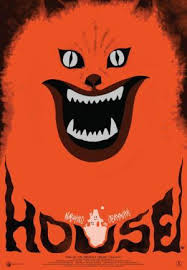
I first encountered HOUSE through its cover image for the Criterion Collection release on October 26, 2010. Maybe you remember seeing that artwork, as well. Nashville graphic designer and Ben Folds drummer Sam Smith came up with the distinctive image: “I used the first idea that came to me after watching a screener of the film — Blanche the cat’s psycho-screaming mug — and adapted it to stand alone as a symbol of the uncanny and over-the-top assault that our midnight-movie audience was in for,” Smith said. The poster first appeared for the film at the Belcourt Theatre in Smith’s hometown.

Then, I read the reviews for HOUSE and they’re nearly as over-the-top as the film itself.

Online reviewer Dennis Schwartz wrapped up his mixed review, “The director uses freeze-frames, jump-cuts, video effects to change dimensions, spiral effects, color tints, and assorted other techie tricks to play the scary pic card more for laughs than to be gruesome. It’s an experimental visual pic that becomes overwhelmed with low-brow slapstick comedy, a ridiculous killer house and garish visuals. But it’s a one-of-a-kind film that has its admirers, who just can’t resist such weird childish nonsense.”

Michael Atkinson opined in the Village Voice, “But though it plays like a retarded hybrid of ROCKY HORROR and WHISPERING CORRIDORS, it is, moment to moment, its own kind of movie hijinks. It even won a directorial-debut critics’ prize back in the day. Gigglers and cultists, pony up.”

I watched James Rolfe’s review for Monster Madness X from 2016. Rolfe started his review with a pause and a WOW! Of course, Rolfe picked HOUSE for one of the “WTF Wednesday” reviews.

I finally caught up with HOUSE in late summer 2019 and it lived up to expectations. It calls to mind a few pictures: EVIL DEAD II, THE SPIRIT OF THE BEEHIVE, THE 5,000 FINGERS OF DR. T, DAISIES, SUSPIRIA, and MY NEIGHBOR TOTORO. Like those films, though, HOUSE ultimately stands alone as an unique work because it creates its own world. I find that I respond more forcefully to fictional works that do that, rather than just rehash more of the same old already damaged goods. I want to be challenged, inspired, etc. I’ve never seen a haunted house movie quite like HOUSE.

HOUSE haunts one’s thoughts and gains in strength upon deeper reflection. At this moment of typing, I am thinking about Gorgeous’ aunt and how much time she spent waiting alone in that house for the love of her life to return from World War II. He never did, and they both died, she in that darn house and she’s cursed to haunt it for eternity because of her bitterness about the war. Then, I start thinking about the sheer enormity of the loss endured by the human race from Sept. 1, 1939 through Sept. 2, 1945: An estimated 70-85 million people died or three percent of the world’s population in 1940; 50-55 million civilians and 21-25 million soldiers no longer lived on this planet from a variety of causes, death on a mass scale that doubled World War I; the atomic bomb and the Holocaust two of humanity’s depressing advancements in death.

Obayashi was born in Hiroshima in 1938 and he lost all his childhood friends when the United States dropped an atomic bomb on Hiroshima on Aug. 6, 1945. Hiroshima and Nagasaki, as well as post-WWII nuclear testing, inform many Japanese films of the last almost 75 years.

Terror Train (1980)

TERROR TRAIN.jpg

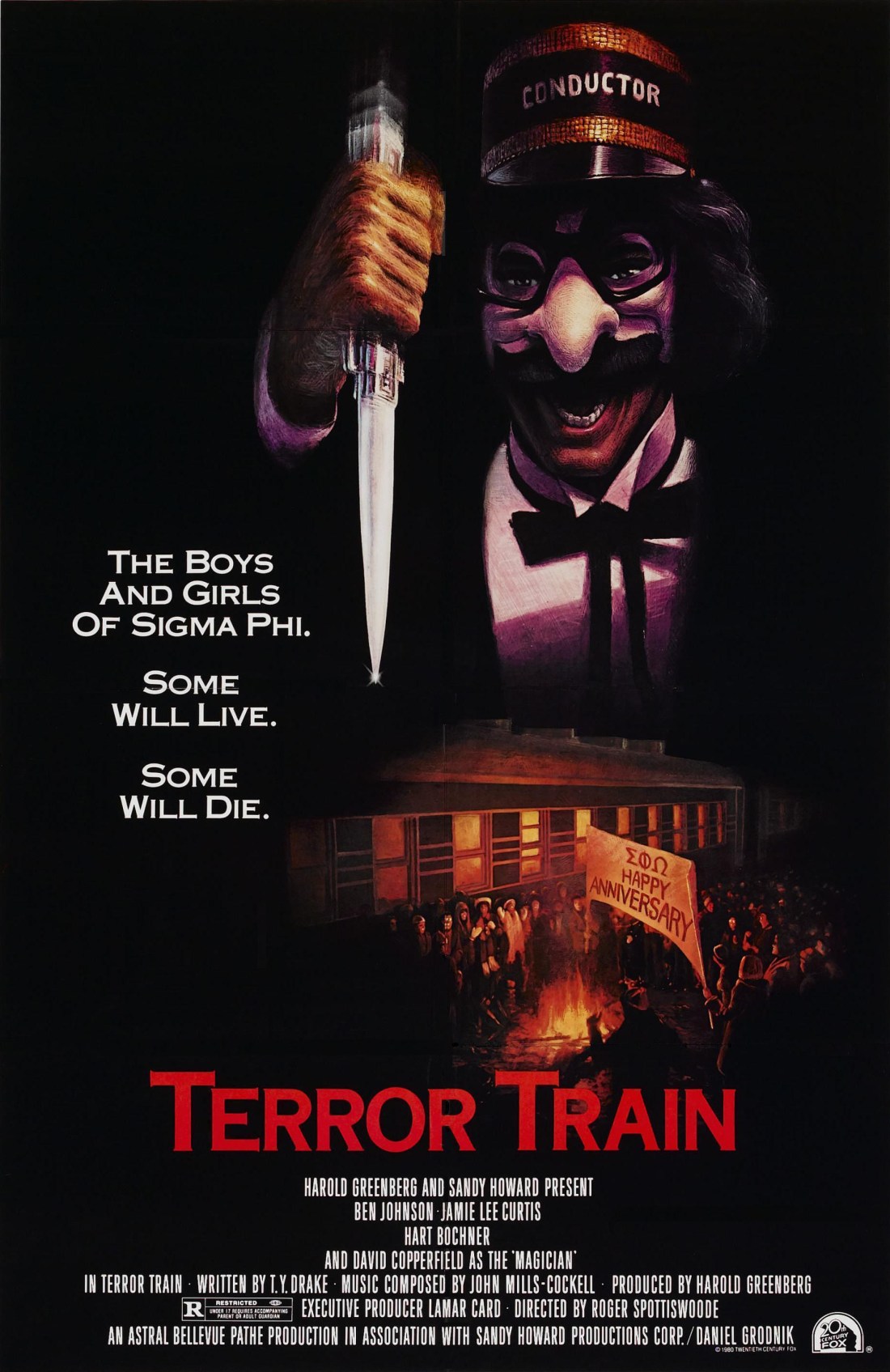
TERROR TRAIN (1980) Two stars
An above-average cast and cinematographer John Alcott’s work aboard a novel setting for a horror film distinguish TERROR TRAIN but otherwise, it’s a bumpy ride for 90-plus minutes.

TERROR TRAIN succeeds in making the sales pitch “HALLOWEEN on a train” come true.

Scream queen Jamie Lee Curtis headlined the cast and this was her fourth horror movie of a career that began with a big bang in HALLOWEEN. She appeared in three horror movies alone in the calendar year 1980: THE FOG in February followed by Canadian productions PROM NIGHT (July) and TERROR TRAIN (October). HALLOWEEN II rounded out the Curtis horror movie quintology in October 1981 and she had successfully become typecast. Curtis broke free by the end of the decade, proving herself especially adept at comedy.

HALLOWEEN was a great scary movie and Curtis’ next four ranged from the average (THE FOG, HALLOWEEN II, TERROR TRAIN) to the abysmal (PROM NIGHT). They made her Laurie Strode character in HALLOWEEN II a shell of herself from the first movie: Curtis never quite perfected her limp and it was depressing to see her in that hobbled state after being such a refreshing, resourceful character in the original. She never lost her scream, though.

Like seemingly every other slasher of the era, TERROR TRAIN starts in the past. In the original HALLOWEEN, 6-year-old Michael Myers murdered his teenage sister Judith. In FRIDAY THE 13TH, two camp counselors are murdered. In PROM NIGHT, there’s a prank gone horribly wrong. TERROR TRAIN belongs in the prank gone horribly wrong category.

Curtis plays Alana Maxwell, who reluctantly takes a central role in the sexual initiation prank against fraternity pledge Kenny (Derek MacKinnon). Kenny, of course, goes schizo almost immediately after this prank and he’s sent to a psychiatric hospital. Three years later, these same fraternity and sorority creeps host a New Year’s Eve costume party on a moving train … and they have an uninvited guest. This costume party angle affords the filmmakers another novelty: Kenny can assume the identity of every person he kills, so he can be the guy in the Groucho Marx mask or the great lizard costume and catch his next victim by complete surprise.

These fraternity and sorority characters are by and large noxious pieces of work, especially Doc (Hart Bochner) and Mo (Timothy Webber). Their inevitable deaths feel like they take forever, mainly because we have to endure more and more of their odious behavior. Then, when we get there, their deaths are letdowns compared to similar moments in other slasher films. I mean, for crying out loud, even PROM NIGHT, an otherwise awful movie, gives us a great decapitation replete with a head roll.

And now for something completely different: Slashers often found room for at least one veteran cast member. They picked Ben Johnson (1918-96) as the veteran cast member in TERROR TRAIN and he thankfully gets a more substantial role than, let’s say, Glenn Ford in HAPPY BIRTHDAY TO ME. As the conductor Carne, Johnson shows the cool of a world champion rodeo cowboy and Academy Award winning supporting actor (LAST PICTURE SHOW). In fact, he’s almost too cool in the midst of all the murder and mayhem. Overall, he’s a welcome presence.

David Copperfield (the magician, not the Charles Dickens character) makes his motion picture debut, apparently because producer Sandy Howard liked magicians. Copperfield stretches his chops by playing “The Magician,” does a routine that slows down the movie even more in the middle, and bows out none too gracefully after being an obligatory red herring.

Harry Houdini (1874-1926) made only silent movies: feature-length THE GRIM GAME, THE MAN FROM BEYOND, and HAIDANE OF THE SECRET SERVICE. Silence could have served TERROR TRAIN well.

John Alcott (1931-86) received a mention in the opening paragraph for his cinematography. His credits include the Stanley Kubrick films 2001, A CLOCKWORK ORANGE, BARRY LYNDON, and THE SHINING (released about five months before TERROR TRAIN), and I mentioned him in the review of the 1975 World War II film OVERLORD. OVERLORD seamlessly combined archival footage director Stuart Cooper found from the Imperial War Museum with contemporary footage shot by Alcott. Alcott’s challenge in TERROR TRAIN naturally centered on space and lighting, and he proved up to the challenge. You can file TERROR TRAIN in the great-looking slasher films after HALLOWEEN and MY BLOODY VALENTINE.

Ultimately, though, TERROR TRAIN succeeds at train and fails at terror.

Predator and The Most Dangerous Game


PREDATOR (1987) & THE MOST DANGEROUS GAME (1932)

It’s been duly noted over the years that PREDATOR combines elements from ALIENS and RAMBO into one blockbuster.

Until only recently, I did not realize PREDATOR also updated a 1932 horror movie named THE MOST DANGEROUS GAME for modern times and weaponry. That relatively unknown classic centers around the concept of a big game hunter (Leslie Banks) who moved on from animals to humans on his own island reserve. The big game hunter finally meets his match in another legendary hunter (Joel McCrea) shipwrecked on the island, due to the big game hunter’s dastardly design of sabotaging ships and hosting then hunting the shipwrecked survivors. The two great hunters contest their most dangerous game on the same jungle sets as KING KONG. Ernest B. Schoedsack co-directed both MOST DANGEROUS GAME and KING KONG, films released several months apart. Fay Wray and Robert Armstrong appeared in both. I say go check out THE MOST DANGEROUS GAME.

In a two-star review for THE PREDATOR, I summed up the difference between the 1987 original and the 2018 retread.

“PREDATOR ‘87 does not have perfunctory dialogue and dead weight, and it does not drag. It plays like ‘a lean, mean fighting machine’ (in the great words from STRIPES) and it’s a streamlined entertainment that moves faster than this, er, last year’s model (an Elvis Costello reference following STRIPES).

“The cast of the original PREDATOR amounted to 16 actors.

“By comparison, THE PREDATOR features approximately 50 credited and 20 uncredited cast members.

“Favorite character: ‘Sobbing veterinarian.’ Second favorite: ‘Cantina bartender.’ Show: ‘Halloween mom.’”

Let’s face it: PREDATOR star Arnold Schwarzenegger could do very little wrong at this stage in his career and he’s a presence missing from the PREDATOR movies that have followed. This is a different Schwarzenegger film in one key aspect: When his Dutch faces off against the title character in the final act, it’s an incredibly tense final showdown because, for a change, we are not sure Schwarzenegger’s character will make it out alive. Kevin Peter Hall’s Predator knocks Schwarzenegger around real good, something that we just don’t see every day. Hall stood at 7-foot-2 and he towers over everybody, including Schwarzenegger.

The film’s marketing campaign proved to be misleading, since Schwarzenegger is not the predator, he’s the prey.

The supporting cast around Schwarzenegger forms one of the most macho in history, with such luminaries as Carl Weathers, Jesse Ventura, and Bill Duke around to chew the scenery. Their machismo ultimately descends into terror as the title character begins systematically eliminating them. They sure do make great trophies for the intergalactic hunter. They’re the best of the best, at least on this planet.

PREDATOR director John McTiernan (DIE HARD) and crew made the film in the real jungles of Mexico rather than some back lot. Like PLATOON, PREDATOR turns the jungle into another character and it exerts a force seemingly every bit as potent as the title character. If that intergalactic hunter don’t kill you, then the damn jungle will for sure.

Like JAWS, behind-the-scenes difficulties benefited the finished product. Originally, Jean-Claude Van Damme signed on to play the Predator, but was fired during production for reasons that nobody has ever been able to agree on. Apparently, some of his footage survived and made the final cut. The 5-foot-10 Van Damme would have made a radically different Predator, one definitely not quite as imposing and intimidating and one more ninja-like than Hall, who played the role in the first two PREDATOR movies before his 1991 death.

The first Predator suit failed, so the filmmakers called on special effects guru Stan Winston (1946-2008) to solve the problem. Winston is another one of those behind-the-scenes figures who developed a legendary reputation and just reading some of his credits justify the legend: PREDATOR, ALIENS, THE TERMINATOR and TERMINATOR 2, STARMAN, A.I., FRIDAY THE 13TH PART III (uncredited), THE THING, and PUMPKINHEAD (Winston also made his directorial debut with this 1988 horror feature).

Like a classic horror movie, we have a gradual build-up to the full reveal of the monster in PREDATOR. Characters also build him up in our imaginations with their dialogue. Of course, we see the effects of an escalating body count and this only fuels our anticipation for seeing this predator in his true form. When we do see this intergalactic villain, it’s worth the wait. The final showdown between Schwarzenegger and Predator definitely lives up to our expectations, and it’s on par with the big fights in KING KONG VS. GODZILLA and FREDDY VS. JASON, though PREDATOR is overall a better film than both KING KONG VS. GODZILLA and FREDDY VS. JASON.

You have not lived a full cinematic life until you have seen Schwarzenegger’s Dutch tell the Predator, “You’re one ugly motherfucker,” as he takes off his mask.

PREDATOR (1987) Three-and-a-half stars; THE MOST DANGEROUS GAME (1932) Three-and-a-half stars

The Blair Witch Project (1999)


THE BLAIR WITCH PROJECT (1999) Four stars

I occasionally find myself looking back fondly on all the multiplex experiences I had during 1999 and 2000.

Please bear with me as I rattle off the titles: THE PHANTOM MENACE, SOUTH PARK BLU, SLEEPY HOLLOW, AMERICAN BEAUTY, GLADIATOR, THE PATRIOT, THE LEGEND OF DRUNKEN MASTER, and CROUCHING TIGER, HIDDEN DRAGON. Just for variety and to balance the bad with the good, there was also DRACULA 2000, THE LADIES MAN, ROMEO MUST DIE, and THE SKULLS. There’s even one more.

I shall never forget when I watched THE BLAIR WITCH PROJECT on the first night it played at the Pittsburg 8.

This was a major event for my generation (let’s say those of us born from 1965 through 1981), because the BLAIR WITCH hype was inescapable that summer and fall in 1999 and the seemingly inevitable backlash proved even stronger and more lasting. For at least a couple years, you just had to watch THE BLAIR WITCH PROJECT and form your own strong opinion. You either loved or hated THE BLAIR WITCH PROJECT with no middle ground whatsoever and everybody felt like expressing their opinion about it, something that cannot be said for the average movie. Nowadays, though, how many people give this 20-year-old movie the time of day.

Anyway, I myself walked into the late show that night stoked, not only because of the insane buzz around the film but also because of the four-star review written by Roger Ebert that I read when the film opened July 16. “At a time when digital techniques can show us almost anything, THE BLAIR WITCH PROJECT is a reminder that what really scares us is the stuff we can’t see. The noise in the dark is almost always scarier than what makes the noise in the dark. Any kid can tell you that. Not that he believes it at the time” finishes off Ebert’s review. BLAIR WITCH later rounded out Ebert’s list of the 10 most influential films of the 20th Century.

Of course, leading up to whenever we first watched it, we heard all the noise about THE BLAIR WITCH PROJECT being the “scariest movie ever made.” How many times have we heard that about the latest horror movie and then found it out to be a lie, a hype, a con?

Sitting down in the Pittsburg 8 that night, though, we knew that we were in for a treat, a transcendent experience. THE BLAIR WITCH PROJECT, whether you love it or hate it, delivered.

I have never seen a movie in a theater setting before or after create such an intense reaction. As the end credits rolled, members of the packed house cheered and booed. I remember more people cheering, but the boos were both louder and longer. Debates broke out across the theater as we slowly exited. I loved the film and defended it in the midst of some intense hostility from individuals who felt they had been cheated. They expected something different than what they got from THE BLAIR WITCH PROJECT. And hated main protagonist Heather Donahue and found her incredibly annoying. And hated hated hated that darn ending. I started thinking even more positively about the film after each hate-filled editorial I heard.

A strange thing happened in the first couple years after THE BLAIR WITCH PROJECT: I encountered several people who enjoyed the sequel BOOK OF SHADOWS more than the original. It was here that I developed a little theory: People who hated THE BLAIR WITCH PROJECT but liked or even loved BOOK OF SHADOWS wanted a more traditional horror movie or at least one more beholden to the conventions of the late 20th Century horror movie. Meanwhile, people who loved THE BLAIR WITCH PROJECT loved it partly because it broke away from the conventions of contemporary horror movies. It was not SCREAM, not I KNOW WHAT YOU DID LAST SUMMER, not URBAN LEGENDS, et cetera, populated by late 20th Century pretty boy or hip actors and lovely actresses with that nudge-nudge wink-wink we’re so contemporary and hip tone. I know I dig BLAIR WITCH mostly because it is different from the horror movies of its time and belongs to another tradition. At the time, most of us had probably never seen a found footage movie before, although everybody who believed the whole “true story” bit should have known better. I mean, come on, after THE TEXAS CHAINSAW MASSACRE and FARGO, you fell for that jive?

THE BLAIR WITCH PROJECT set itself up perfectly for a backlash of epic proportions. We already mentioned anything touted as “the scariest movie ever made” will create large numbers of viewers laughing and scoffing at such a ridiculous claim. The film made nearly $250 million on a $60,000 budget … with the help of a groundbreaking marketing plan that ultimately backfired, at least in terms of perception of the film itself.

Here’s the third paragraph of a story by MWP Digital Media, “So perhaps you’d be surprised to learn the most successful viral marketing campaign of all time took place before social media existed. Even before mainstream use of the Internet. The most successful viral marketing campaign of all time centred on a small, low-budget indie flick in 1999 called THE BLAIR WITCH PROJECT.” Just thinking about it even now, yeah, it’s crazy to conceive of a frenzied audience in small college town Pittsburg, Kansas, for a low-budget horror movie with no-name performers.

The filmmakers decided to use a website to promote their little movie, not just any website though since this one creates an entire world treating THE BLAIR WITCH PROJECT like it really happened rather than it being a fictional work. More than 20 years later, we can still check out blairwitch.com/project. We’re greeted with a familiar title card upon visiting the site, “In October of 1994, three student filmmakers disappeared in the woods near Burkittsville, Maryland while shooting a documentary. A year later their footage was found.”

There’s “Mythology,” a timeline of major events in the history of the Blair Witch: February 1785, November 1786, November 1809, 182, August 1825, March 1886, November 1940-May 1941, and several dates from October 1994-October 1997. The front page of “Mythology” ends on this note, “The found footage of their children’s last days is turned over to the families of Heather Donahue, Joshua Leonard, and Michael Williams. Angie Donahue contracts Haxan Films to examine the footage and piece together the events of October 20-28, 1994.”

We can see a picture of “Montgomery College film students Michael Williams, Joshua Leonard, and Heather Donahue less than a week before their disappearance” and several stills from their documentary.

The “Aftermath” section includes evidence, search, interviews, and news. Evidence includes crime scene photos from the Frederick County Sheriff’s Office and anthropology professor David Mercer describing how there is no scientific explanation for a certain event. Search provides a MISSING poster for Donahue, Leonard, and Williams with their photos, measurements, and features; “Last seen camping in the Black Hills Forrest area, near Burkittsville.” If you look closely, you can see the famous 555 extension listed for the Frederick County Sheriff’s Office. Interviews are clips featuring such figures as Sheriff Ron Cravens and search party members. News offers clips from coverage by Channel 11 and Channel 6.

“The Legacy” takes in discovered footage, audio, and Heather’s journal, which was found buried beneath a 100-year-old cabin in the woods. Her journal amounted to 37 pages; from Page 21, “It is freezing and we are still out here. We’re completely fucking lost now, we’ve decided basically to just keep heading south, but it doesn’t seem to be getting us anywhere fast and weird shit keeps happening which is, to be totally honest, sitting here with gloves and sweaters in a cold tent in the middle of nowhere and the guys asleep – beginning to scare me. I’m hungry. I’m cold. I want to see what we shot. We didn’t light a campfire tonight because we wanted to lay low. Not that there’s anything left to cook on it anyway. I feel like we are bound to cross a road of something soon, it’s not like Maryland has wilds that go on forever or some shit. We have got to get out of here. As much as I would like…”

Personally, I appreciate that THE BLAIR WITCH PROJECT deals in myths and legends and makes a valiant effort to create its own timeless story. It belongs most to a tradition of American storytelling that started with Washington Irving (1783-1859), namely his 1820 work “The Legend of Sleepy Hollow.” This tradition also involves more local stories, like, for example, haunted McCray Hall at Pittsburg State; “Sightings of a lady in a black dress. The Pipe organ is heard playing at night. Sudden temperature variations. Strange movements from corners of eyes” highlights the listing on “Dark Kansas.” BLAIR WITCH remembers the power of imagination.

Daniel Myrick and Eduardo Sanchez, BLAIR WITCH directors, talked about the genesis for their movie in Little White Lies, “We came up with the basic premise for what eventually became THE BLAIR WITCH PROJECT back in the early ‘90s. We were studying at the University of Central Florida at the time, and like most college students we didn’t have any money. … One day we got to talking about this show called “In Search of…,” which Leonard Nimoy hosted in the ‘70s. We started thinking about all these pseudo-documentaries like THE LEGEND OF BOGGY CREEK, IN SEARCH OF NOAH’S ARK, CHARIOTS OF THE GODS, exploratory, investigative films linked to paranormal encounters, and how they really freaked us out as kids. So we rented a bunch of those movies and we were surprised how much they still freaked us out. …

“We shot [BLAIR WITCH] in two sections: Phase One, which is everything in the woods, and then Phase Two, which ended up being used for the “Curse of the Blair Witch” TV documentary. The Phase One stuff was shot over about eight pretty intensive days. It was a continuous shoot, where the actors were the cameramen and all the dialogue was improvised.”

Lead performer Donahue took a great deal of the backlash against BLAIR WITCH, as she was the most publicly visible; she won Worst Actress from the Golden Raspberry Awards, for example, beating out Melanie Griffith in CRAZY IN ALABAMA, Milla Jovovich in THE MESSENGER: THE STORY OF JOAN OF ARC, Sharon Stone in GLORIA, and Catherine Zeta-Jones in ENTRAPMENT and THE HAUNTING. Her acting career persisted until 2008, for example she appeared in the billion times worse than BLAIR WITCH romantic comedy BOYS AND GIRLS, and she left the profession to grow medical marijuana. She then became an author and delivered the 2012 memoir “Growgirl: How My Life After the Blair Witch Project Went to Pot.”

Two movies from 1999 became parodied to what seemed like no end at the time, THE MATRIX and BLAIR WITCH. This endless parodying did not help either film. I especially got beyond exasperated at MATRIX parodies. Anybody who lived during that era knows which two scenes that we’re talking about without even mentioning them. Just say THE MATRIX and BLAIR WITCH, and we can bet they’re the first scenes that come to mind.

Myrick and Sanchez filmed apology scenes for both Donahue and Williams, and decided upon Donahue for the finished product because she had the most reason to apologize. Reactions to her apology are the most extreme in a film that creates extreme reactions. Ebert said that it reminded him of explorer Robert Scott’s notebook entries as he froze to death in the Terra Nova expedition (1910-13). Others have laughed at it like it was the funniest thing they have ever seen.

Leonard and Williams have both maintained acting careers, Leonard being far more busy. BLAIR WITCH marked the feature debuts for Donahue, Leonard, and Williams and I like them all because they have an everyman appeal not typically found in horror movies of the late 90s and early 00s.

The promotion for BLAIR WITCH proved so effective that Donahue’s mother even received sympathy cards from people who believed that her daughter was either dead or missing. Sanchez’s experience in web design proved to be a godsend. It was probably just some elective that he barely thought about at the time he took it.

The Last House on the Left (1972)

LAST HOUSE ON THE LEFT

THE LAST HOUSE ON THE LEFT (1972) Three stars
Former academic Wes Craven (1939-2015), who also did some work on pornographic films under different aliases, made a big bang with his feature debut THE LAST HOUSE ON THE LEFT, one of the great shockers of the seventies.

It’s an exploitative American modern take on Ingmar Bergman’s THE VIRGIN SPRING (1960), a film itself based on a 13th Century Swedish folk ballad. THE VIRGIN SPRING won the Academy Award for Best Foreign Language Film at the 1961 Academy Awards.

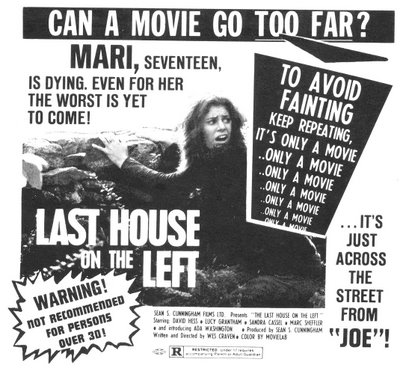
The film’s classic tagline, “To avoid fainting, keep repeating: It’s only a movie, only a movie, only a movie. …” Viewers had a variety of extreme reactions, of course which only helped to hype the film en route to $3.1 million in returns on a $87,000 budget.

Theaters and drive-ins showed LAST HOUSE in many different prints, because individual machinists took it upon themselves to make their own cuts. Normally, the most shocking bits would end up missing. Good luck finding an uncut version of the film.

It received some of the nastiest reviews imaginable, which made seeing the film again seem like more of an event, a happening. Writing for the New York Times, Howard Thompson said, “When I walked out, after 50 minutes (with 35 to go), one girl had just been dismembered with a machete. They had started in on the other with a slow switch blade. The party who wrote this sickening tripe and also directed the inept actors is Wes Craven. It’s at the Penthouse Theater, for anyone interested in paying to see repulsive people and human agony.” Roger Ebert wrote just about the only positive review at the time of the film.

I first watched it about 10 years back and I thought it was a powerful work. I wrote a very positive review somewhere and I gave it three-and-a-half stars. I found it less powerful after subsequent viewings.

Craven and crew made some appalling choices that create a split personality movie.

Watching LAST HOUSE for the first time, you might notice the buffoonish antics of the Sheriff (Marshall Anker) and the Deputy (Martin Kove). Their comedic relief never works and in fact they play like failed slapstick comedy dropped in from another movie. I noticed this element upon first viewing and it was the reason I graded THE LAST HOUSE ON THE LEFT three-and-a-half rather than four stars.

PSYCHO. Herrmann. SUSPIRIA. Goblin. HALLOWEEN. Carpenter.

Well, you’ll never find THE LAST HOUSE ON THE LEFT soundtrack filed alongside those indelible horror movie scores and their composers. That’s why I started a new paragraph.

David Hess, who plays the main villain Krug, wrote and performed four songs for the movie: “The Road Leads to Nowhere” (the best song of the bunch), “Wait for the Rain,” “Sadie and Krug (Baddies’ Theme),” and “Now You’re All Alone.”

Upon more viewings, this music stuck out like a sore thumb, one that poked me right straight in the eye. I’m not sure why I overlooked the music the first time around.

Krug the character, played by Hess the actor, would have killed Hess the singer and songwriter, just slit his throat for singing one of those ridiculous songs. Believe it or not, Hess wrote “Speedy Gonzales,” which became a big hit for Pat Boone in the year 1962.

I still deduct one-half star from LAST HOUSE for the rumbling bumbling stumbling cops and a good quarter star for them Hess songs.

Hess (1936-2011) is so good as the bad guy in LAST HOUSE that we can understand precisely why he became typecast as villain. He played one of the henchmen in Craven’s SWAMP THING.

Sandra Peabody and Lucy Grantham play Mari and Phyllis, who are kidnapped, tortured, raped, and murdered by Krug and company. They have the most difficult roles.

Filming LAST HOUSE proved to be a horrifying ordeal for Peabody, especially since Hess believed in method acting and even threatened assaulting her for real during a rape scene. Peabody dropped out from acting in 1974, after being cast in movies like VOICES OF DESIRE and MASSAGE PARLOR MURDERS! She went into screenwriting, producing children-orientated entertainment, and being an acting coach.

Fred Lincoln (1936-2013) played Weasel, one of Krug’s nasty associates, and LAST HOUSE marked Lincoln’s only non-pornographic role. Lincoln directed more than 300 films; the Internet Movie Database lists 340 directorial credits for the New York native.

Jeramie Rain, who played the vicious Sadie, was married to Richard Dreyfuss from 1983 to 1995 and their union produced three children. She once hitched a ride with real-life serial killers Charles Manson and Tex Watson. That’s fitting because LAST HOUSE seems to have been heavily influenced by the Manson Family and their murders.

Richard Towers and Eleanor Shaw, under different names, play Mari’s parents Dr. John and Estelle Collingwood, highly respectable upper middle class folk. Krug and his gang disguise themselves as traveling salesmen and they call upon the Collingwoods. Both parties eventually discover the others’ identities: The Collingwoods find out their guests killed their daughter and Krug and company discover that Dr. John and Estelle are Mari’s parents.

Dr. John and Estelle devise some elaborate booby traps and Craven displays his fondness for booby traps for the first time. Booby traps also played a role in both THE HILLS HAVE EYES and A NIGHTMARE ON ELM STREET. I believe that Craven should have directed at least the first HOME ALONE, given his predilection for booby traps.

This juxtaposition of seeing a socially respectable upper middle class couple getting down-and-dirty to exact revenge has been one of the most fascinating elements at work in LAST HOUSE. You just might find yourself asking, “What would I do if I found myself in a similar situation?”

Though it’s not a classic on the same level as both NIGHT OF THE LIVING DEAD and THE TEXAS CHAINSAW MASSACRE, LAST HOUSE is essential viewing for horror fans.