X: The Man with the X-Ray Eyes (1963)

X: THE MAN WITH THE X-RAY EYES (1963) ****

I had wondered long and hard for many years where Al Jourgensen found a certain sample for a cover version of Black Sabbath’s “Supernaut” that appeared on the Ministry greatest hits compilation “Greatest Fits.”

This incredible sample about halfway through “Supernaut” goes something like, “I’ve come to tell you what I see. There are great darknesses. Farther than time itself. And beyond the darkness … a light that glows, changes … and in the center of the universe, the eye … the eye … the eye … the eye … the eye.”

There I was minding my own fucking business on a hot Saturday night in early June 2020, watching the thrilling conclusion of a pretty damn good little science fiction horror movie called X: THE MAN WITH THE X-RAY EYES, directed by Roger Corman and starring the reliably good Ray Milland. Then, hot dog, what do I hear but “I’ve come to tell you what I see. There are great darknesses. Farther than time itself. And beyond the darkness … a light that glows, changes … and in the center of the universe, the eye that sees us all.” I said to myself, “You magnificent bastard! That’s that sample from ‘Supernaut!’”

Before that discovery, I already thought X was one groovy movie. After that discovery, though, I am convinced it’s a great movie.

I must admit upfront to having a bias in favor of Ray Milland (as well as Roger Corman, for that matter). Milland (1907-86) has never let me down so far and that includes his Academy Award-winning performance as a struggling alcoholic writer in Billy Wilder’s THE LONG WEEKEND, his battle of minds with John Williams’ Chief Inspector Hubbard in DIAL M FOR MURDER, his ultimate cantankerous old coot Jason Crockett in FROGS, his ultimate hateful old bigot Maxwell Kirshner in THE THING WITH TWO HEADS, and his better-than-average Disney live-action villain Aristotle Bolt in the better-than-average Disney live-action film ESCAPE TO WITCH MOUNTAIN. To be honest, I enjoy FROGS every bit as much as DIAL M FOR MURDER and Milland proves responsible for much of the enjoyment of both films.

He’s very good in X as Dr. James Xavier, whose name immediately puts the X-Man character Charles Xavier to mind. Are they related?

In X, Xavier develops special eye drops that give himself X-ray vision and with this great power comes terrible repercussions, of course. Xavier just cannot stop himself from pushing the limits farther and farther. He must see what no man has ever seen before. His friend and colleague Dr. Brant (Harold J. Stone) tries stopping Xavier and Xavier accidentally kills Brant. Xavier goes on the run, first to a carnival, then to a Las Vegas casino, and finally to a religious tent revival that leads to one helluva conclusion.

One of the great scenes begins when Xavier’s lovely colleague Dr. Diane Fairfax (Diana Van der Vlis) takes the X-Man to a groovy little party where everybody just loves to do the Twist. Xavier’s X-ray vision kicks in at some point and we ponder what this scene would have been like had the movie came out in 1969. Even greater.

Before closing soon, I should mention Don Rickles’ strong performance and Dick Miller’s enjoyable one as carny heckler.

X: THE MAN WITH THE X-RAY EYES should be a treat for Corman, Milland, science fiction, horror, American International, sample, Black Sabbath, Ministry, Rickles, and/or Miller connoisseurs. Speaking only from personal experience, it was for me.

Fade to Black (1980)

FADE TO BLACK

FADE TO BLACK (1980) ***

Vernon Zimmerman wrote and directed FADE TO BLACK, a horror film that shows the darkest side of an obsession with movies. Its main character, Eric Binford (Dennis Christopher), takes cinemania literally, as he kills his victims in the guise of his favorite movie characters. They include Dracula, the Mummy, and Hopalong Cassidy.

FADE TO BLACK reached theaters on October 14, 1980. Nearly two months later, disillusioned Beatles fan Mark David Chapman killed former Beatle member John Lennon outside his residence at the Dakota Apartments in New York City. Chapman shot Lennon four times in the back with a .38 special. Chapman stayed at the scene and read from J.D. Salinger’s “The Catcher in the Rye” until the police arrived to arrest him. Chapman became fixated on “Catcher” protagonist Holden Caulfield, who loved to rail against “the phonies,” and Chapman surely considered Lennon a phony.

Eric is barely hanging on at the beginning of FADE TO BLACK. His wheelchair bound Aunt Stella (Eve Brent Ashe), who we later find out is actually his mother, nags at him; for example, her first lines are “Eric! Get up! Well, lookie here. Mister Smart Mouth fell asleep with his nose buried in the screen again! Your one-eyed monster is gonna soften your eyes, much less rot your brain! You spend all your time daydreaming and watching those silly movies on the TV and your projector.” Aunt Stella even blames Eric for her accident and her subsequent paralysis many years ago.

Had she ever seen KISS OF DEATH, she might not have been so hateful to the kid. Eric, though, seems to have a special affinity for Richard Widmark’s Tommy Udo, a precursor to Heath Ledger’s Joker in THE DARK KNIGHT. Udo’s the type of guy who thinks nothing of pushing an old lady in a wheelchair down a flight of stairs to her eventual demise.

Eric is a perpetual fuck up at his job at a film distributor’s warehouse and his boss Mr. Berger (Norman Burton), well, you know, he does what a good boss does in a horror movie built around revenge. Eric discovers Mr. Berger’s weakness, a weak heart that could stop ticking any time if Mr. Berger proved unable to reach his precious medication.

Co-workers Richie (Mickey Rourke) and Bart (Hennen Chambers), especially Richie, give Eric grief every chance they get.

One day, Eric spots Australian model and Marilyn Monroe lookalike Marilyn O’Connor (Linda Kerridge, in a sensational movie debut) eating in a cafe with her friend. Eric works up the courage to strike up a conversation with Marilyn and he asks her what movie Marilyn Monroe and Tom Ewell watched in THE SEVEN YEAR INCH. (I know this one. May I please answer? THE CREATURE FROM THE BLACK LAGOON.) Eric asks Marilyn out to a movie that night and she says yes. He’s all excited, for a change, about something in the “real world.” …

Marilyn unintentionally stands up Eric, a prostitute treats him like shit, Stella smashes his film projector, and, yes, Eric loses his shit and for the rest of the picture, he seeks vengeance against those who he feels have wronged him.

Even a shady filmmaker named Gary Bially (Morgan Paull) crosses Eric by stealing his idea for a nifty low-budget film named ALABAMA AND THE FORTY THIEVES, which Eric says would be made in the early 1950s style of Samuel Fuller.

I’ve read in several places that FADE TO BLACK fails because Christopher gives a bad performance and/or Eric Binford proves to be such a detestable protagonist. Reviews mentioned that Christopher plays a character totally unlike his Dave Stoller in BREAKING AWAY, Christopher’s last big film before FADE TO BLACK.

An unhinged character like Eric Binford — especially since he loves imitating his favorite movie characters in both appearance and speech — allows the actor latitude to push a performance over-the-top and Christopher definitely pushes those limits for even somebody (like me, for example) who admires his performance in FADE TO BLACK.

I give Christopher a tremendous amount of slack after his breakout performance in BREAKING AWAY; he created one of the more lovable characters in cinematic history and I’ll always be grateful to Christopher for that.

Reviewers, though, apparently forgot Dave Stoller’s obsession with bicycling and everything Italian. Did they not remember “cutter” Dave pretending to be Italian exchange student Enrico Gimondi to impress and then date a cute Indiana University co-ed? Dave even renamed poor Jake the Cat “Fellini.”

Eric and Dave are not as different as reviewers have suggested. Eric just lived a tougher life right from the start and he was definitely not blessed with great friends and family like Dave Stoller. We could get into the whole “Nature vs. Nurture” discussion and when’s the last time a horror movie spurred on that.

What I especially liked about FADE TO BLACK is that it follows Eric’s descent into madness all the way to its inevitable conclusion — especially inevitable since Eric becomes Cody Jarrett from WHITE HEAT — and then it finishes in such a flourish atop legendary movie palace Grauman’s Chinese Theatre to make WHITE HEAT director Raoul Walsh and star Jimmy Cagney proud. “Made it Ma! Top of the world!”

Sleepaway Camp (1983)

SLEEPAWAY CAMP

SLEEPAWAY CAMP (1983) Two stars

This is one of those instances where I can remember seeing the poster long before the attached movie.

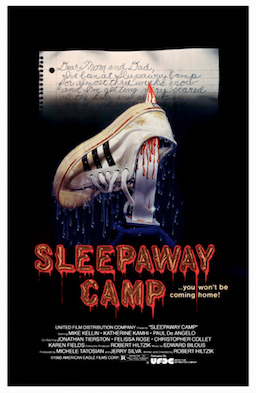
Undoubtedly like most of the jaded youth of my generation, I first saw the poster for SLEEPAWAY CAMP back in the late 1980s. It’s the one that stayed with me the most over the decades.

It has the dominant image of a dripping wet shoe being stabbed all the way through by a bloodied knife. Above, there’s a letter from a camper, “Dear Mom and Dad, I’ve been at Sleepaway Camp for almost three weeks now and I’m getting very scared. …” Right below the hand holding the knife are the title dripping blood from its bold type and the tag “You won’t be coming home!”

Now, hours after watching SLEEPAWAY CAMP for the first time, it’s just as unforgettable as the poster.

To a great degree, SLEEPAWAY CAMP chucks our traditional notions of what constitutes a “good” or a “bad” movie right out the fucking window. It’s more of an experience, an event, a rite of passage, something where you can ask friends and family if they have ever seen it. If they have or haven’t, dynamite conversation will follow either way. For sure, though, it would make a great watch party — of course, following proper social distancing protocol at this point in history.

Here’s a few notes on the experience:

— Melodrama is defined as such, “A sensational dramatic piece with exaggerated characters and exciting events intended to appeal to the emotions.” Addendum: See SLEEPAWAY CAMP. Early on, after the obligatory flashback to traumatic events of the past, Desiree Gould’s Aunt Martha establishes the basic tone for the rest of the movie: Campy with overacting possible. Yes, SLEEPAWAY CAMP goes over-the-top, gleefully, merrily, in every scene, including the end credits.

— Being bat shit crazy for 84 minutes has been SLEEPAWAY CAMP’s meal ticket to cult movie immortality. Because, let’s face it, it’s not as well-made technically as similar low-budget precursors BLACK CHRISTMAS, ALICE SWEET ALICE, and HALLOWEEN. Not even remotely close.

— SLEEPAWAY CAMP uses a musical score that also functions as bludgeoning device and melodrama amplifier. I just checked for any injuries after being whacked upside the head at regular intervals by Edward Bilous’ sledgehammer score. I survived without a single bump — amazing, I know. Anyway, I looked up this Bilous fellow. IMDb linked me to edwardbilous.com and a Bilous quote from the Wall Street Journal, “Artists today need a new set of skills to be able to tell the unique story of their generation.” He’s the founding director for the Center for Innovation in the Arts and the artistic director for Beyond the Machine, A Festival of Electro-Acoustic and Interdisciplinary Art at Juilliard. He joined the Juilliard faculty in 1984.

— “Weird Al” Yankovic’s “Nature Trail to Hell” sounds like a spin on FRIDAY THE 13TH PART III and SLEEPAWAY CAMP. “Coming this Christmas to a theater near you / The most horrifying film to hit the screen / There’s a homicidal maniac who finds a cub scout troop / And he hacks up two or three in every scene / Please don’t reveal the secret ending to your friends / Don’t spoil the big surprise / You won’t believe your eyes when you see. …” and “See severed heads that almost fall right in your lap / See that bloody hatchet coming right at you / No, you’ll never see hideous effects like these again / ‘Till we bring you ‘Nature Trail to Hell Part 2.’” File “Nature Trail to Hell” alongside such “Weird Al” epics as “The Biggest Ball of Twine in Minnesota,” “Albuquerque,” “Trapped in the Drive-Thru,” and “Jackson Park Express.”

— In his final performance, veteran actor Mike Kellin (1922-83) surpasses Gould in scenery chewing. He chews scenery to such a degree that he could chew through every picture’s scenery within an entire multiplex. Kellin plays Camp Arawak owner Mel Kostic, who keeps downplaying everything until about the 50th dead body. At least it feels that way anyway. He’s one of those characters who becomes creepier and more detestable over the course of the movie, especially when he lines up dinner with a camp counselor in her late teens and assaults one of the main characters who he mistakenly believes to be the killer. Mel loses his shit late in the picture, and it’s not pretty.

— By this point in the review, I should have already discussed the plot. Eight years after a tragic boating accident near Camp Arawak, Aunt Martha sends her niece Angela (Felissa Rose) to camp with Ricky (Jonathan Tiersten), Angela’s cousin and Martha’s son who’s a veteran camper. Mean girls Judy (Karen Fields) and Meg (Katherine Kamhi), as well as a group of their male counterparts both teenage and prepubescent, are relentlessly cruel and nasty toward Angela and Ricky, especially the initially painfully shy and quiet Angela. Ricky’s friend Paul (Christopher Collet) takes a shining to Angela and he’s able to break her silence. Over time, however, the picture develops a dread pattern: Every character who’s cruel and nasty to Angela or Ricky bites the dust in spectacular fashion. Yes, just like everything else in the picture, including the crop-tops and short-shorts, the murder set pieces are over-the-top.

— At this relative late point in the slasher film craze, a mere five years since HALLOWEEN, films in the genre needed a major selling point and SLEEPAWAY CAMP includes one of those (awesome but infuriating) endings that redefines the reality of every scene that came before, just like FRIDAY THE 13TH and HAPPY BIRTHDAY TO ME. This beyond bizarre ending is the first and foremost reason we still talk about SLEEPAWAY CAMP all these years later.

Alice, Sweet Alice (1976)

ALICE, SWEET ALICE (1976) ***

They really tried hard with ALICE, SWEET ALICE, the horror film that’s best known for being Brooke Shields’ film debut.

It appeared in November 1976 at the Chicago International Film Festival, where it competed against such films as ALLEGRO NON TROPPO, GREY GARDENS, SMALL CHANGE, THE DEVIL’S PLAYGROUND, and Best Feature winner KINGS OF THE ROAD.

It received theatrical release (and mostly negative reviews) in 1977, 1978, and 1981. Viewers might have seen it as either ALICE, SWEET ALICE or COMMUNION (the original title) or HOLY TERROR depending on when they watched it.

The promotional forces especially played on the Brooke Shields angle in ‘78 and ‘81.

One of the ‘78 ALICE, SWEET ALICE ads proclaimed at its top, “PRETTY BABY Brooke Shields, America’s New Star,” a reference to Shields being in Louis Malle’s contemporaneous PRETTY BABY.

Three years later, the film returned as HOLY TERROR with a hard sell promotional campaign again built around exploiting Shields’ notoriety from her Calvin Klein advertisements and her film projects like THE BLUE LAGOON. Shields put up a fight, though, because she had more clout and ENDLESS SUMMER coming down the pike; “Brooke was concerned that film goers could only be disappointed if led into the theater with the promise that the film was of recent vintage or that she had a central part in it,” said her attorney. See, the original HOLY TERROR ads used a photo of Shields circa ‘81 rather than one of her from the film that was made during a different administration. Those naughty ad men, they did a bad, bad thing.

Roger Ebert made the advertising campaign for HOLY TERROR his “Dog of the Week.” “The ads promise that it stars Brooke Shields,” Ebert said. “That’s where the trouble begins, because HOLY TERROR was first released five years ago under the title of COMMUNION and then it was released three years ago as ALICE, SWEET ALICE. Now, when this movie was originally shot, Brooke Shields was a little girl, only 10 years old, and as Calvin Klein can tell you, she’s not 10 years old anymore. Shields has a supporting role in the movie as an apparently demented little girl and it’s an effective thriller alright, but how many title changes is it going to go through in an attempt to cash in on Brooke Shields’ recent popularity?” Gene Siskel replied, “Maybe they ought to try GONE WITH THE WIND.”

Truth in advertising: Shields, listed 10th in the cast in the end credits, appears in the picture for about the first 10 minutes. For those of us who think she’s one of the worst mainstream actresses ever committed to celluloid, that’s a major blessing in disguise. She’s not a demented little girl, though, but the first murder victim. Attending her first communion, her character Karen gets killed real good before she can receive it, strangled to death and then incinerated by a masked figure in a costume that should make one think back to the superior thriller DON’T LOOK NOW. Only this raincoat is yellow rather than red like DON’T LOOK NOW.

Deceptive promotional campaigns are not anything new. They’ve happened before and they will happen again. It happens all the time, and not only (but especially) during election years.

For example, John Travolta made his debut (briefly) in the ridiculous 1975 thriller THE DEVIL’S RAIN, which features Ernest Borghine, Eddie Albert, Ida Lupino, Tom Skerritt, William Shatner, and Keenan Wynn in the cast, as well as the special participation of Anton LaVey, high priest of the Church of Satan. Anyway, in the original 1975 ads, not a mention of Travolta. Instead, we have mug shots of “Satan on Earth” (Borghine), “Devil Destroyer” (Albert), “Demon Sacrifice” (Lupino), “Tortured Soul” (Shatner), and “Faceless Follower” (Wynn) right above the claim “Absolutely the most incredible ending of any motion picture ever!”

Preying on Travolta’s success in SATURDAY NIGHT FEVER and GREASE, THE DEVIL’S RAIN made a comeback. Siskel named it a “Dog of the Week” the same week in 1978 his colleague Ebert picked that awful monster movie SLITHIS. “My dog this week is a four-year old film named THE DEVIL’S RAIN that’s suddenly come back to a lot of theaters advertised as starring John Travolta,” Siskel said. “Well, that’s a complete lie. THE DEVIL’S RAIN stars Ernest Borghine as a Devil’s helper trying to hang on to some lost souls. Travolta is on screen for less than a minute, this was his first film. He had only one line of dialogue in it. Most of the time, he has red and green wax melting all over his face. Looks like he fell asleep on a pizza. … Beware of films you’ve never heard of promising big stars. One reason you’ve never heard of them, they’re lousy.”

These promotional campaigns definitely backfired in the case of ALICE, SWEET ALICE, because it’s a good little thriller often compared with the works of Alfred Hitchcock and called a prototype of the slasher film. That should have been more than enough to sell the film.

ALICE, SWEET ALICE involves a series of murders in 1961 in Paterson, New Jersey, around a church and an apartment building. Our title character, a 12-year-old girl played by a 18- or 19-year-old Paula Sheppard, becomes the first suspect and she’s sent to a psychiatric institution for evaluation. She was always mean to her little sister and besides, she’s just plain “weird.” Their parents are divorced and they live with their mother Catherine (Linda Miller) and attend St. Michael’s Parish Girls’ School. We also have the girls’ father Dom (Niles McMaster) and their aunt (Jane Lowry), Father Tom (Rudolph Willrich), his housekeeper Mrs. Tredoni (Mildred Clinton), the creepy obese landlord (Alphonso DeNoble), and assorted policemen and minor characters. Dom leaves behind his new wife to more or less become a detective on behalf of his oldest daughter, and that leads to his demise in a scene that echoes Donald Sutherland’s death at the end of DON’T LOOK NOW.

ALICE, SWEET ALICE reminds one of not only DON’T LOOK NOW, but also any number of giallos or Italian thrillers because of the anti-Catholic themes, dark humor, and familial dysfunction. Lucio Fulci’s DON’T TORTURE A DUCKLING and Dario Argento’s PROFONDO ROSSO quickly come to mind. Of course, all these films have their roots in Hitchcock.

Director, producer, and co-writer Alfred Sole, who shared the screenplay with Rosemary Ritvo, reveals the real killer around the two-thirds mark and that’s a departure from the modus operandi of the thriller.

ALICE, SWEET ALICE stands up long after the promotional campaign has become a faded memory. Anyway, I’ll still call it Brooke Shields’ best movie.

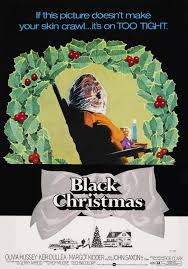
Black Christmas (1974)

BLACK CHRISTMAS

BLACK CHRISTMAS (1974) Three stars

Watching BLACK CHRISTMAS for the first time, one might be surprised just how many standards of the slasher film can be seen during this 1974 Canadian chestnut from director Bob Clark.

Let’s see, we have an opening shot later repeated by John Carpenter’s HALLOWEEN, a killer who racks up a rather impressive body count, POV shots from the killer’s perspective, obscene phone calls from the killer following every killing, plot twists (including the location of the caller), “The Final Girl,” and a shock ending, as well a holiday theme. BLACK CHRISTMAS basically synthesized elements that were already present during previous films like PSYCHO, PEEPING TOM, and Mario Bava movies BLOOD AND BLACK LACE and TWITCH OF THE DEATH NERVE into a single horror film narrative.

The plot also echoes “The Babysitter & The Man Upstairs” urban legend, so we already know the location of the caller. Still, the characters do not, so it’s a jolt hearing “The call is coming from inside the house.” Several movies, notably BLACK CHRISTMAS and WHEN A STRANGER CALLS, have relied on this angle for their chills and thrills.

A real-life case has been credited for inspiring the urban legend.

On Mar. 18, 1950, 13-year-old babysitter Janett Christman was raped and strangled to death in Columbia, Missouri, three days before her 14th birthday. Mr. and Mrs. Ed Romack found the body when they returned home, but, fortunately, their 3-year-old son Gregory was still alive, sleeping in his room. From the AP story, “Prosecuting Attorney Carl Sapp said blood was smeared through the house, indicating the girl put up a terrific struggle. … Footprints were found in a sleet-covered area near a broken window in the house. Police believe the intruder crawled through the window. The state highway patrol also is processing fingerprints found at the scene.”

More from the report, “An electric iron cord was twisted around the girl’s throat. Her scalp had been pierced several times by an instrument, apparently similar to a small lead pipe.”

Christman may have attempted to call the police around 11 p.m. the night of her death. Columbia policeman Roy McCowan took a call from a frightened girl who told him to “come quick.” “I urged her to calm down and just tell me where she was,” he said. “Then there was silence — not the sound of a receiver being hung up — just silence.” The Romacks’ phone was discovered “improperly placed on the instrument.”

Christman’s murder remains unsolved.

Just a few years earlier in Columbia, Stephens College student Marylou Jenkins, a white woman, was raped and murdered with an electric cord (reportedly from a lamp) twisted around her throat. An all-white jury convicted black man Floyd Cochran of the crime and he was executed Sept. 26, 1947 in the Missouri State Penitentiary Gas Chamber in Jefferson City. Cochran was originally arrested for murdering his wife with a shotgun and then he confessed to raping and murdering Jenkins.

For his last meal, Cochran ordered but did not partake in consuming a T-bone steak, french fries, scalloped corn, cream gravy, bread, butter, cake, and coffee. He died at the age of 36.

From 1938 through 1989, Missouri put to death 40 inmates in the gas chamber at Jefferson City, with John Brown the first on Mar. 3, 1938 and George “Tiny” Mercer the last on Jan. 6, 1989. Mercer was the first person from Missouri executed since 1965.

Just about seemingly every horror movie in existence shoots for a slambang ending, so we leave it discussing just what happened inside our heads or with all our friends and loved ones who have also seen this movie. BLACK CHRISTMAS gives us a rather unconventional ending, in that we are left unsure of the fate of protagonist Jess (Olivia Hussey) as she’s alone in the sorority house with the killer. Also, we never find out the real identity of the killer other than he’s named “Billy” and very rare indeed is the horror movie (especially a slasher) without a great big reveal in the grand finale. You just might have to be a fan or at least more forgiving of an ambiguous ending to appreciate BLACK CHRISTMAS. Either way, though, it will be discussed.

Like the later HALLOWEEN, BLACK CHRISTMAS thrives on atmosphere. That’s what they both do best and why fans appreciate them all these decades later.

Both films have rather distinguished casts for low-budget horror movies. Hussey came to fame during her teenage years for her performance as Juliet in Franco Zeffirelli’s 1968 ROMEO AND JULIET. Keir Dullea played astronaut Dave Bowman in both 2001: A SPACE ODYSSEY (1968) and later 2010 (1984); Dave uttered the famous words, “Open the pod bay doors please, HAL.” Margot Kidder (1948-2018) appeared previously in Brian De Palma’s 1973 shocker SISTERS and subsequently made her fame as Lois Lane in four Superman movies. Character actor John Saxon’s six-decade career includes ENTER THE DRAGON, TENEBRAE, A NIGHTMARE ON ELM STREET, and FROM DUSK TILL DAWN.

Director, screenwriter, and producer Clark (1939-2007) is best known for his two radically different nostalgia pieces, PORKY’S and A CHRISTMAS STORY. Yes, please wrap that magnificently designed brain around the fact that Clark directed both BLACK CHRISTMAS and A CHRISTMAS STORY. Louisiana born Clark found his greatest success up north in Canada. PORKY’S supporting actors Doug McGrath and Art Hindle both appear in BLACK CHRISTMAS.

Kidder almost steals the show in BLACK CHRISTMAS as the drunken, profane sorority girl Barb. She rips into her dialogue with extra relish. Hussey makes for a good entry point and rooting interest. Saxon knows how to maximize his screen time.

For horror movie fans who have not yet seen BLACK CHRISTMAS, I fully recommend amending it immediately.

Fiend Without a Face (1958)

FIEND WITHOUT A FACE

FIEND WITHOUT A FACE (1958) ****

The 1958 British independent horror production FIEND WITHOUT A FACE contains everything this science fiction and horror fiend wants from a film of that era: a square but likeable hero (Marshall Thompson), a shapely heroine (Kim Parker), a mad scientist (Kynaston Reeves), townspeople who blame everything on the wrong people, atomic fallout, and horrible, terrifying stop motion animation monsters (created by the special effects team of Flo Nordhoff and Karl-Ludwig Ruppel) that are loads of fun.

It also has an evocative title.

The final 20 minutes or so of FIEND WITHOUT A FACE are phenomenal and push this film into the stratosphere.

The fiends of the title are floating killer brains who started as one brain materialized from the thoughts of Professor R.E. Walgate, a man who specializes in telekinesis. The nearby airbase’s nuclear power radar experiments have dire consequences and the original fiend escapes from Walgate’s lab and wreaks murder and mayhem on the surrounding community. The fiends replicate themselves through attacks on humans (looting their brains and spinal cords) and they remain invisible until the final 20 or so minutes after they crank up the nuclear power to DANGER! They must be stopped!

These fiends are one helluva brainstorm, literally. They have antennae and tentacles, and one can see their influence on later creature features creatures. (The ALIEN films leap to mind. George Romero must have watched at least the last 20 minutes of FIEND WITHOUT A FACE before he made the first NIGHT OF THE LIVING DEAD.)

When the fiends are shot in the brain (love that concept), they naturally gush out this great-looking brain glop and I honestly wish these death scenes lasted another 20 minutes. They are so much fun, and it’s just as great when our hero breaks out an axe. The fiends (love that word) finally turn into goo after our hero blows up their great power source real good.

When the fiends are in their invisible stage, we hear slurping sounds when they strike their victims’ brains and spinal cords. Awesome, totally awesome, because it’s not happening to us, of course.

Credited director Arthur Crabtree (reports have it that star Thompson worked on the film himself after Crabtree walked off the picture because directing sci-fi proved to be too much for his fragile little mind) and his team did a fantastic job with the fiends when they’re invisible or visible. FIEND WITHOUT A FACE pulls off the nifty little trick of building up high audience expectations toward a great final act, then it delivers the goods and maybe even exceeds expectations during that final act.

Believe it or not, FIEND WITHOUT A FACE apparently caused quite a storm of controversy when it was first released in early July 1958. The British Board of Film Censors demanded cuts be made before it would be certified for release and the picture still received an ‘X.’ It’s lucky to not have met the same fate as banned-for-many-years pictures like BATTLESHIP POTEMKIN (1926-54), FREAKS (1932-63), and ISLAND OF LOST SOULS (1932-58), for example.

Legend even has it that British Parliament discussed why the censors allowed FIEND WITHOUT A FACE to be released.

Over time, I’ve come to realize that I love 1950s horror and sci-fi: THE DAY THE EARTH STOOD STILL, THE THING FROM ANOTHER WORLD, HOUSE OF WAX, GODZILLA, THEM!, CREATURE FROM THE BLACK LAGOON, INVASION OF THE BODY SNATCHERS, THE INCREDIBLE SHRINKING MAN, ATTACK OF THE CRAB MONSTERS, FIEND, THE H-MAN, THE BLOB, THE FLY, HORROR OF DRACULA, PLAN 9 FROM OUTER SPACE, BUCKET OF BLOOD, and THE KILLER SHREWS all have made personal top 10 lists for their respective years and the decade also featured at least five of Hitchcock’s best works (STRANGERS ON A TRAIN, REAR WINDOW, THE WRONG MAN, VERTIGO, NORTH BY NORTHWEST) and other films that are horrifying in their own distinct ways, like film noir KISS ME DEADLY and war film FIRES ON THE PLAIN.

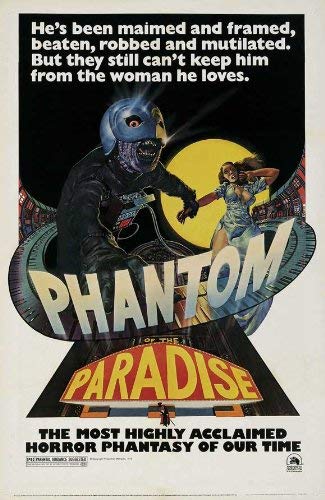
Phantom of the Paradise (1974)

PHANTOM OF THE PARADISE

PHANTOM OF THE PARADISE (1974) **

Brian De Palma’s PHANTOM OF THE PARADISE, a great big flop during its original release, is another cult film where I have to say, “I am glad you love this movie, but I don’t.” Big deal, it happens both ways on a regular basis.

It’s also one of those movies where I liked it less and less the more it was on, until I simply just wanted it to be over.

PHANTOM OF THE PARADISE gets called a “rock opera” and compared with THE ROCKY HORROR PICTURE SHOW, which came out about one year later.

Now, we’re getting to the heart of the problem. Both PHANTOM OF THE PARADISE and ROCKY HORROR are limp-wristed rock if they are in fact rock at all. Paul Williams, the songwriter and star of PHANTOM, he’s best known for writing Three Dog Night’s “An Old Fashioned Love Song,” the Carpenters’ “Rainy Days and Mondays,” Barbra Streisand’s “Evergreen” from A STAR IS BORN, and Kermit the Frog’s “Rainbow Connection” from THE MUPPET MOVIE. Not exactly the most rocking credentials.

Singer-songwriter and show tunes, with a little Sha Na Na and Meatloaf thrown in for extra measure, are not my idea of rock and that’s what PHANTOM and ROCKY HORROR offer listeners and viewers.

I already wrote a review comparing ROCKY HORROR against ROCK ‘N’ ROLL HIGH SCHOOL, a 1979 film that centers around the music of the Ramones.

This whole rock opera angle initiated my brilliantly engineered mind to recall Ken Russell’s TOMMY from 1975, another musical contemporaneous with both PHANTOM and ROCKY HORROR that’s far more deserving of being called a “rock opera.” That’s definitely true, because at one time The Who — the band responsible for the music for both the 1969 album and 1975 movie — owned the rights on “loudest rock band in the world.” They lived rock, long before they wrote a song like “Long Live Rock,” “Be it dead or alive.”

Russell, who’s every bit as good as De Palma at capturing wretched excess on celluloid, gives us non-singers Oliver Reed and Jack Nicholson, natural born entertainers Ann-Margret and Tina Turner, a Marilyn Monroe-themed cult led by “The Preacher” (Eric Clapton), and Elton John’s centerpiece “Pinball Wizard” number, taking advantage of a $5 million budget. Hell to the yes, I love me some pinball and Sir Elton’s melodramatic demise. Never mind what Ann-Margret does with champagne, beans, chocolates, and bubbles. What’s that Beach Boys line about excitation?

PHANTOM OF THE PARADISE (reportedly made for $1.3 million) takes on classic novels “Phantom of the Opera,” “The Picture of Dorian Gray,” and “Faust.” It also predates the Black Sabbath compilation album “We Sold Our Soul for Rock ‘N’ Roll.”

I prefer the 1925 silent PHANTOM OF THE OPERA because of Lon Chaney’s brilliant performance (his 1974 counterpart William Finley gives the best performance in the movie), the fact that melodrama works better in silent rather than sound films, and the fact that we do not hear the opera music. Yeah, that’s right, I do not particularly care for opera, rock or not. PHANTOM OF THE PARADISE does not rock enough.

I would have greatly preferred Robert Johnson’s music over Paul Williams’ tunes. Here I am and I can’t remember any of Williams’ songs from the film. Not a good sign.

I would not be surprised, though, to find out that Dario Argento cast Jessica Harper in SUSPIRIA (1977) because of her performance in PHANTOM OF THE PARADISE.

I’ll take SUSPIRIA.

TOMMY (1975) ***

TOMMY

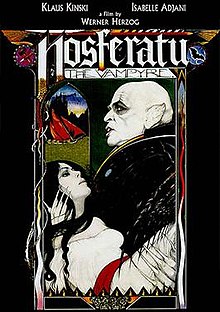
Nosferatu (1979)

NOSFERATU

NOSFERATU (1979) ***1/2

German director Werner Herzog’s NOSFERATU THE VAMPYRE has often been described as a “slow burn” horror film and every critic seems to want to sound a fire alarm that it’s not the average “creature feature” with cheap thrills every few minutes and that it will disappoint most horror movie fans.

The former is certainly true and I cannot speak for the latter except to say this horror movie fan liked it. I’ll be honest, I did not much enjoy it the first time watching it a good 20 years before my return viewing. I remember having a more neutral reaction that first time. Not sure why.

Looking up “slow burn,” I find that it means “a filmmaking style, usually in narrative productions, wherein plot, action, and scenes develop slowly, methodically toward a (usually) explosive boiling point.”

NOSFERATU definitely fits methodical and perhaps only slow to viewers raised on Attention Deficit Cinema. I’d rather say that Herzog’s remake and F.W. Murnau’s original 1922 masterpiece subtitled A SYMPHONY OF HORROR both move at their own leisurely pace. They play more like fever dreams than the average horror movie.

NOSFERATU does not fit the back end of that slow burn definition, because there’s not an explosive boiling point. Certainly not anything resembling the stereotypical big bang grand finale to a standard Hammer Dracula picture.

Herzog marches to the beat of his own drum. That’s for sure and thank God for that, just as we should be thankful for every great director. I consider his AGUIRRE, THE WRATH OF GOD to be the best film I have seen from 1972 and I would put it on a list of the greatest films ever made. LITTLE DIETER NEEDS TO FLY and GRIZZLY MAN are on my top 10 lists for 1997 and 2005, respectively. Les Blank’s documentary BURDEN OF DREAMS, which chronicles Herzog’s great adventure making FITZCARRALDO, also makes my top 10 list for 1982. Ramin Bahrani’s 18-minute PLASTIC BAG, a top 10 entry for 2010, utilizes Herzog as its narrator.

I know that NOSFERATU was my first time watching a Herzog movie and I believe I had not yet seen the Murnau original. To be sure, I was more equipped watching NOSFERATU for a second time.

More than anything else, images stand out. Brilliant images are the heart of both the 1922 and 1979 films and both Murnau’s and Herzog’s filmography.

Musophobes should not watch NOSFERATU, because rats take over the screen at crucial points late in the picture. The rats are the source of some legendary stories: Herzog said the rats were better behaved during the shoot than star Klaus Kinski and since real grey rats proved to be unavailable, white rats were given a grey makeover, for example.

The rats call to mind the monkeys from AGUIRRE.

Of course, there’s every time Dracula (Kinski) is on the screen. Since copyright was not a concern for Herzog like it had been in 1922 for the first NOSFERATU, Herzog returned names like Dracula, Jonathan Harker, and Lucy to his version. Dracula’s look echoes Max Schreck’s iconic Count Orlok and both vampires are radically different from the classic bloodsuckers played by Bela Lugosi and Christopher Lee, as well as just about every other vampire in cinematic history. Herzog and Murnau both show how it is more of a curse to be a vampire and make it far less of a power trip. Herzog’s Dracula and Count Orlok are not suave and debonair, and their striking physical appearances echo vampire folklore. We also have far more complex reactions to the vampires played by Schreck and Kinski, since we feel more empathy for them.

Around her mid-20s at the time she made NOSFERATU, French actress Isabelle Adjani already had a strong claim on the title of most beautiful woman in the world. NOSFERATU did nothing to refute that.

Thinking about the various Jonathan Harkers over time, Bruno Ganz’s performance ranks better than David Manners in the 1931 DRACULA and Keanu Reeves in the 1992 DRACULA. He certainly goes through a wider emotional range than either Manners or Reeves, who are both “mannered” in their performances.

Ultimately, NOSFERATU leaves one with feelings different from how we normally react to a vampire picture. There’s not the standard euphoria that we experience, for example, when Lee’s Dracula spectacularly bites the dust. Instead, we are more pensive and melancholic than excited and thrilled.

A New World Pictures Double Feature: Avalanche & Piranha (1978)

A NEW WORLD PICTURES DOUBLE FEATURE: AVALANCHE & PIRANHA (1978)

Two New World Pictures exploitation films entered the Great American box office sweepstakes in August 1978.

One became a surprise hit and the other dramatically flopped.

Roger Corman, a man of a million film productions, tossed his hat into the disaster movie ring with AVALANCHE, while PIRANHA riffed on the killer fish blockbuster JAWS.

PIRANHA, directed by Joe Dante and populated by experienced character actors like Bradford Dillman and Keenan Wynn and Dick Miller, recouped its budget and then some and spawned one sequel and at least two remakes.

Star actors Rock Hudson (1925-85) and Mia Farrow headline the human cast of AVALANCHE and New World invested a reported $6.5 million on the picture, a great deal more $ than PIRANHA. You know that it did not go very well for AVALANCHE when its greatest claim to fame is that it made “The Official Razzie Movie Guide” honoring the 100 most enjoyably bad movies ever made.

This bad movie enthusiast, however, did not enjoy AVALANCHE. I found it to be a long slog. I mean, I felt like the one climbing the mountain to get through its 90-odd minutes.

First and foremost, it’s a soap opera in the shape of a ski resort hosting a ski tournament and a figure skating competition. Egads! Magazine reporter Caroline (Farrow) divorced control freak and wealthy ski resort owner David (Hudson). You guessed it, David wants her back, wants her to use his last name rather than her maiden name, she keeps him at arm’s length, and she attaches herself to another man, which only infuriates Mr. Control Freak. Man oh man, that scene on the dance floor when David flips on Caroline, I wanted to bury my head in the snow.

That’s not all: We have David’s spirited mother, an elite skier who seems to be even better as lothario, competing figure skaters, competing lovers, a television reporter, and a nosy photographer. Remember, we need a body count.

That nosy photographer (Robert Forster) and David act out a scene near and dear to disaster movie connoisseurs everywhere. Nick Thorne, the nosy photographer’s name, warns David there’s an avalanche coming and that everybody’s in danger. Any of us could write the rest of the scene and, for that matter, the rest of the movie.

Disaster movies often create a dilemma in our hearts and minds: We desperately want the disaster to come and take us away from the phony baloney dialogue and situations. Yes, I’ll say it, the characters deserve to die a dramatic cinematic death sooner rather than later. … Then, when disaster strikes, disaster movies invariably give us scenes just as phony baloney as before. That’s what happens in AVALANCHE.

Director and screenwriter Corey Allen (1934-2010) blamed AVALANCHE’s disaster as a movie on budget cuts and a tight production schedule, whereas Corman said PIRANHA succeeded because it’s funny and very well directed.

I agree.

PIRANHA tips its humorous hand very early on when one of the main characters plays the classic Atari “Shark Jaws” arcade game. Then, we have classic lines like “They’re eating the guests, sir” and “People eat fish. Fish don’t eat people” and “Terror, horror, death. Film at eleven.” Those with a darker sense of humor may find a friend in PIRANHA. We can thank John Sayles for the script.

I’ve said it before and I’ll gladly say it again: Joe Dante is one of the best American directors. His credits include GREMLINS, GREMLINS 2: THE NEW BATCH, THE HOWLING, THE ‘BURBS, MATINEE, and SMALL SOLDIERS. I don’t think he’s ever let me down, and he does not let me down in PIRANHA.

PIRANHA goes cheerfully over-the-top.

For example, JAWS eliminates one kid. PIRANHA takes out virtually an entire summer camp in grisly detail. I’ve known people who hate PIRANHA because of this one sequence.

Roger Ebert began his one-star review, “I walked into PIRANHA wondering why the U.S. government would consider the piranha to be a potential secret weapon. After all, I reasoned, you can lead the enemy to water but you can’t make him wade. I was, it turns out, naive. PIRANHA is filled with people who suffer from the odd compulsion to jump into the water the very moment they discover it is infested by piranhas.”

Of course, the characters in PIRANHA have a compulsion to jump into piranha-infested waters. Honestly, that’s all part of the joke and part of the fun, especially when Kevin McCarthy works up a variant on his INVASION OF THE BODY SNATCHERS performance.

Just like it’s fun seeing Dick Miller doing his take on Murray Hamilton’s mayor in JAWS. Miller, of course, does not want to hear about top secret scientifically-engineered killer piranhas (created through Operation: Razorteeth) and he does not cancel his party for prospective home buyers. You can guess what happens to most of them home buyers. Yes, PIRANHA takes many of the elements from JAWS and pushes them to extremes.

I enjoyed PIRANHA quite a bit, for its tongue-in-cheek humor and film buff references. There’s brilliant little touches strewn throughout the film, like Phil Tippett’s stop-motion animation creation in McCarthy’s lab. He’s the scientific genius behind them super killer fish, who are released into the system by our heroes played by Dillman and Heather Menzies. Anyway, this stop-motion creation, part-fish and part-lizard, epitomizes the generosity of PIRANHA in general. The film gives us a lot to enjoy.

The credits for PIRANHA are first-rate: Dante, Sayles, Tippett, composer Pino Donaggio, editors Dante and Mark Goldblatt, and makeup effects creator Rob Bottin. They all have done some fine work during their careers, inc. PIRANHA.

Steven Spielberg, the director of JAWS, reportedly considered PIRANHA the best of the many JAWS rip-offs and his approval expressed to Universal stopped the studio from pursuing an injunction against New World for PIRANHA. Universal’s first JAWS sequel, JAWS 2, came out two months before PIRANHA.

AVALANCHE (1978) *; PIRANHA (1978) ***

Attack of the Killer Tomatoes (1978)

ATTACK OF THE KILLER TOMATOES

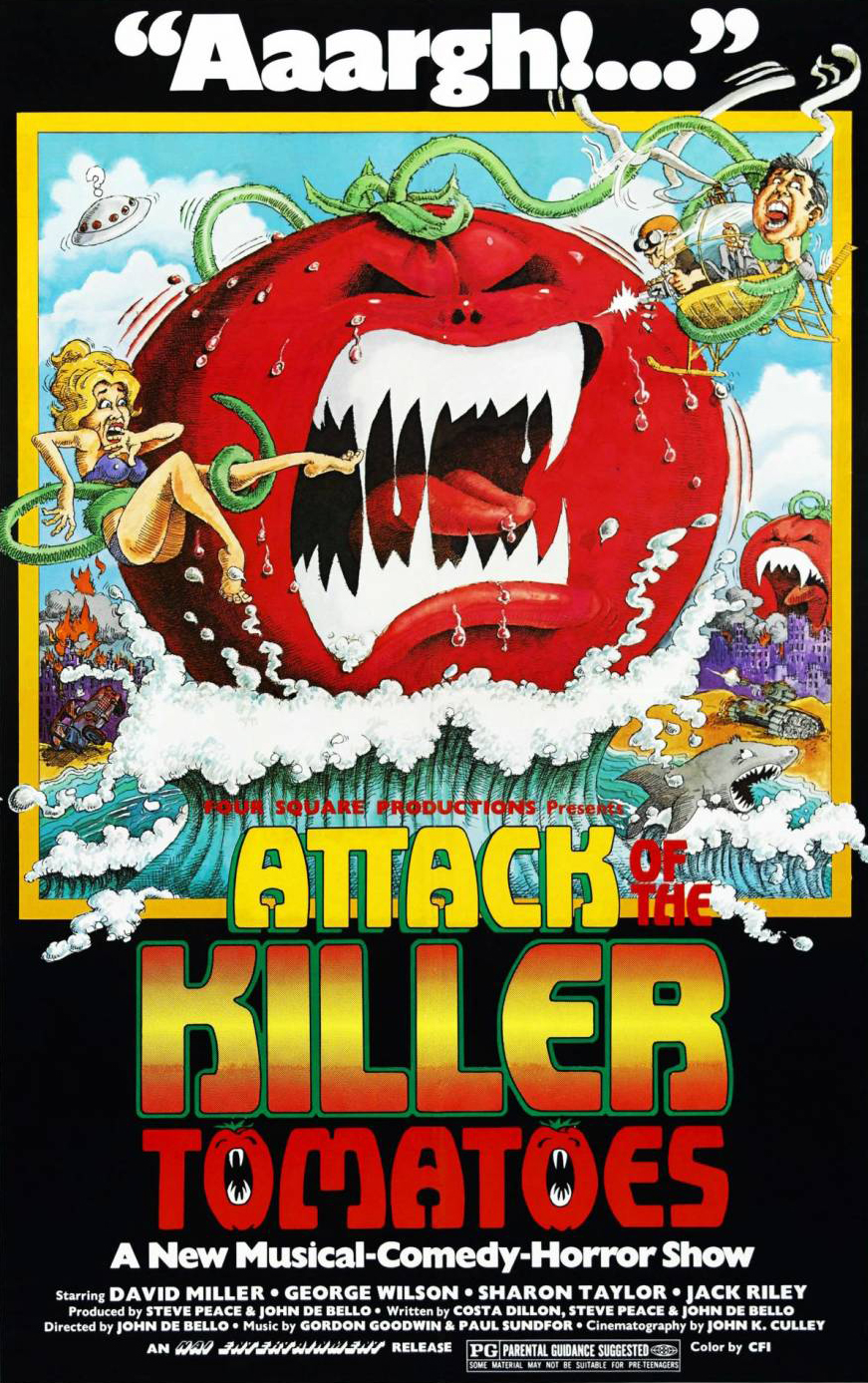
ATTACK OF THE KILLER TOMATOES (1978) Three stars

“In 1963, Alfred Hitchcock made a motion picture entitled THE BIRDS, a film which depicted a savage attack upon human beings by flocks of the winged creatures.

“People laughed.

“In the fall of 1975, 7 million black birds invaded the town of Hopkinsville, Kentucky, resisting the best efforts of mankind to dislodge them.

“No one is laughing now.”

— Introduction to ATTACK OF THE KILLER TOMATOES


Watching ATTACK OF THE KILLER TOMATOES in full for the first time in possibly 30 years, it brought to mind KING KUNG FU.

Both are extremely low-budget labor-of-love parodies and tributes to both older and contemporaneous movies. Both have their dead spots and their high points. Both try many, many, many jokes. Both are filed under cult movies and “so bad they’re good.” Both love their filming locations, Wichita in KING KUNG FU and San Diego in KILLER TOMATOES. Both show people having a darn good time making a silly little movie. Both are so endearingly goofy that I end up forgiving all their various sins and transgressions and enjoying them.

Unlike KING KUNG FU, though, KILLER TOMATOES inspired three sequels — RETURN OF THE KILLER TOMATOES! (1988), KILLER TOMATOES STRIKE BACK! (1990), and KILLER TOMATOES EAT FRANCE! (1991) — plus an animated series and two video games.

Let me highlight what I liked (or loved) about KILLER TOMATOES.

— The songs are great. We have “Theme from Attack of the Killer Tomatoes,” “Puberty Love,” “The Mindmaker Song,” “Tomato Stomp,” and “Love Theme from Attack of the Killer Tomatoes.” I am sure that millions and millions proclaim GREASE the best musical from the film year 1978. No way! I say it’s KILLER TOMATOES all the way. I mean, both the opening and closing musical numbers are fantastic. “Theme” should have been a hit a la “The Blob” by The Five Blobs in 1958. “Love Theme” gives us better opera than YES, GIORGIO, Pavarotti’s feature film debut and farewell. I should have selected it to play at my wedding. “Puberty Love” kills the tomatoes. It’s that bad. Even badder. Just the sheet music for “Puberty Love” alone kills tomatoes smack dead in their tracks. Future Soundgarden and Pearl Jam drummer Matt Cameron sang “Puberty Love” around the tender age of 15. Maybe one day Pearl Jam will cover “Puberty Love.” It couldn’t be any worse than “Last Kiss.” By the way, you can’t throw tomatoes at the performers during “Puberty Love,” because all the tomatoes will be dead.

— KING KUNG FU combined King Kong and kung fu, according to a report from man on the spot Captain Obvious. KILLER TOMATOES affectionately kids monster movies, for example. Notice how the Japanese military always struggles against Godzilla. Well, in KILLER TOMATOES, the American military cannot lick our title characters. Rather, it takes playing a horrible little song named “Puberty Love” throughout San Diego Stadium. Tim Burton must have been taking notes before he made MARS ATTACKS!

— Fans of imported monster movies should have a great time with the character Dr. Nokitofa (credited to Paul Oya). KILLER TOMATOES purposely gave Dr. Nokitofa a bad dub, you know, one of those wildly inappropriate voices that just does not fit the character. I love it and I wish they gave his character more scenes with more lines. I busted a gut at his scene. When Dr. Nokitofa corrects somebody for calling tomatoes “vegetables,” he says “Technically sir, tomatoes are fags” … then his colleague Dr. Morrison says, “He means fruits.” Yes, there’s some bad taste humor in KILLER TOMATOES. Some of it works and some of it does not. Nature of the humor, so they say.

— There’s something absolutely brilliant about a character being chased by a “killer” tomato, relentlessly down the street, up the stairs, and through the hallway.

— I must admit to feeling grateful none of my newspaper bosses ever said that I have a great ass, like the editor (Ron Shapiro) tells Lois Fairchild (Sharon Taylor) in their first scene together.

— With a reporter named Lois, of course that affords KILLER TOMATOES an opportunity to kid SUPERMAN. KILLER TOMATOES came out a good two months before SUPERMAN, one of the most wildly anticipated releases in 1978.

— KILLER TOMATOES kids JAWS much more affectionately and successfully than GIANT SPIDER INVASION, A*P*E, THE HILLS HAVE EYES, and ORCA: THE KILLER WHALE, all of which took pot shots at Steven Spielberg’s game-changing summer blockbuster.

— I cannot have much of any ill will toward a film that works in a cameo for the San Diego Chicken (Ted Giannoulas) and thanks “Every Screwball in San Diego County,” that’s including Mr. Chicken, for the great crowd scene near the end of the picture.

— In conclusion, I thank director and co-writer John DeBello and fellow writers Costa Dillon and J. Stephen Peace (all three each took on even more roles) for their efforts in making a fun little movie.